Semiexible Polymer in a Strip
JurgenF. Stilk
InstitutodeFsia
UniversidadeFederalFluminense
Av. Litor^anea,s/n,24210-340, Niteroi,RJ,Brazil
Reeivedon17June,2002
Westudythethermodynamipropertiesofasemiexiblepolymeronnedinsidestripsofwidths
L9denedonasquarelattie. Thepolymerismodeledasaself-avoidingwalkandashort-range
interationbetweenthemonomersand thewallsis inludedthroughanenergyassoiated with
eahmonomer plaed ononeofthe walls. Also, anenergyb is assoiated witheahelementary
bendof the walk. The free energy of the model is obtained exatly through a transfer matrix
formalism. Theproleofmonomerdensityandtheforeonthewallsareobtained. Wenotiethat
asbis dereased,therangeof valuesofwhihthedensityproleisneither onvexnoronave
inreases,andforsuÆientlyattratingwalls(<0)wendthatingeneraltheattrativeforeis
maximumforb<0,thatis,forsituationswherethebendsarefavored.
I Introdution
Polymersareoftenmodeledasself-andmutually
avoid-ingwalksplaedonalattie,andmuhhasbeenlearned
about their thermodynami properties through suh
models [1, 2℄. Grand-anonial models of this kind,
where the numberof monomers inorporatedinto the
hain is allowed to utuate ontrolled by an ativity
z = exp(=k
B
T), display a phase transition at some
valueoftheativity(forinnitehains, thatis, inthe
polymerlimit). Thistransition isdisontinuousinthe
one dimensional ase d = 1 [3℄, and ontinuous for
d>2. Ratherpreiseestimatesoftheritialvalueofz
were foundin twodimensionsthroughtransfermatrix
alulations [4℄ and series expansions [5℄. Also, exat
values for the ritial exponents are available in this
ase[6℄.
Morereently,propertiesofsuhmodelsonlatties
limitedbywallshaveattratedmuhinterest[7℄,
follow-ingstudiesofmagnetimodelsinthesamesituation[8℄.
The short range interation between thewalland the
polymermaybeintroduedbyassoiatingaBoltzmann
fator!=exp( =k
B
T)witheahmonomerplaedon
thewall,sothat <0orrespondsto attratingwalls
whilerepulsivewallsaredesribedby>0.The
grand-anonialpartitionfuntionforamodelofasinglehain
is
Y(x;!)= X
z N
! Nw
; (1)
where N isthenumberofmonomersin thehain,the
sumisoverallongurationsofthehainwiththe
ini-tialmonomerplaedon thewall, andN
w
N stands
forthenumberofmonomersloatedonthewall. Suha
modelshowsinterestingfeatures,andeveninthelimit
wheretheselfavoidaneonstraintisnegleted(the
so-alled ideal hains)onendsthat for suÆientlylarge
valuesof! >!
0
thesurfaepolymerizationtransition
will ourat a lowervalue of the ativity z than the
oneinthebulk[9℄. Thepoint(z
0 ;!
0
)inthephase
di-agramwhere thebulk(alsoalled ordinary)transition
line meets the surfaetransition line is alled the
ad-sorptiontransitionpoint. Intwodimensions,suh
mod-elshavebeenstudied throughtransfermatrix
alula-tions [10℄ and seriesexpansions [11℄. Additional walls
maybeadded,onningthepolymerinsideastrip,slab
orpore[7℄, and thefore applied onthe wallsin suh
situations is ofinterestevenfrom thepoint ofviewof
appliations ofpolymersasadhesives[12℄. Themodel
of idealhains onned in a slab has been studied in
the past [12, 13℄, and it was found that the fore on
thewallsisattrativeif! exeedstheadsorptionvalue
!
0
. In the ase of self-avoiding hains onned in a
striponthesquarelattie,transfermatrixalulations
showthatattrativeforesappearfor! below!
0 [13℄.
Also,theproleofthemonomerdensityinsidethestrip
wasobtained[14℄, and, unlikewhat happens for ideal
hains, for aself-avoidinghain proleswhih are
nei-theronvexnoronavearefoundforarangeofvalues
of!. Finally,similartehniqueshavealsobeenapplied
toshedlightonthesalingbehaviorofsuhmodelsfor
thewidthof thestripsbeomeslarge[15℄.
Another generalization of the original polymer
model is to introdue an energy assoiated with the
operation of bending the hain. On hyperubi
lat-ties, theelementary bends willalwaysbeatright
an-gles, and anenergy
b
maybeassoiated witheahof
them. This semiexible polymer problem (also alled
persistentorbiasedwalks),hasbeenstudiedsometime
ago[16,17,18℄. Reently,thismodelhasattrated
re-newed interest , sine it may desribe some relevant
aspetsin the proteinfolding problem [19℄. The
ther-modynami properties of the model have been
stud-ied on the Bethe lattie [20℄ and, equivalently, in the
Bethe approximation[21℄. Theend-to-end distaneof
semi-exible hains on Bethe and Husimi latties was
obtained [22℄. In this paper we study the
thermody-nami behavior of asemiexible polymer onned
in-side astrip. The partition funtion of themodel may
bewrittenas
Y(x;!)= X
z N
! Nw
! N
b
b
; (2)
whereN
b
isthenumberofelementarybendsinthe
on-guration and !
b
= exp(
b =k
B
T) is the Boltzmann
fator assoiated with eah elementary bend and the
sum is over all ongurations of the hain. We
de-ne a transfer matrix for the model and obtain the
grand-anonial partition funtion in the
thermody-namilimit,determinedbythelargesteigenvalueofthis
matrix. Inorder to beableto obtain thedistribution
of monomersin the transversesetion ofthe strip, we
deneapositiondependentativityforthemonomers.
Also, the foreapplied by thepolymeronthe wallsis
alulated, as a funtion of the width of the strip, !
and !
b
. All thermodynami properties are alulated
at the polymerization transition, that is, at the value
of theativity ofa monomerfor whih thenumberof
monomersinorporatedintothepolymerdiverges.
In setionII the model is dened in detail and its
solutionispresented. Theresultswendforthe
ther-modynamibehaviorofthemodelareshowninsetion
IIIas wellasnal onlusionsanddisussions.
II Denition of themodel andits
solution
The selfavoidinghainis onstrainedinside astripof
widthmdenedonthesquarelattieinthe(x;y)plane,
so that 0xm. Thehainrunsthroughthewhole
strip, from y ! 1 to y ! +1. We may dene a
transfermatrixfortheproblemfollowingapresription
proposedbyDerrida,inawaytotakeintoaountthe
self-avoidane onstraintexatly[4℄. Theonnetivity
propertiesofallvertialbondsofthehainarrivingata
liney
0
frombelowarespeiedthroughtheindiation
of
1. The (unique) bond onneted to the initial
monomer of the hain (plaed in y ! 1)
through a path lying entirely below the line y
0
(passingthoughsiteswithy<y
0 );
2. The pairs of bonds onneted to eah other
throughapathlyingentirelybelowtheliney
0 .
InFig. 1theveongurationsfortheasem=2are
depited, anda portion of thehain plaedinside the
stripisshownwith eahongurationindiated.
Con-gurations 1and 3, aswell as 4and 5, are related to
eah other by reetion symmetry. Wedene olumn
dependent ativitiesz
i
, i= 1;2;:::n
a
(m)aording to
this reetion symmetry, as indiated also in Fig. 1.
Thenumberofativitiesn
a
(m)isequaltom=2+1for
evenvaluesofmand(m+1)=2foroddvaluesof m.
2
z
z
1
2
z
1
2
3
5
(a)
4
y
x
2
1
4
3
5
1
(b)
Figure1.a)Theveonnetivityongurationsform=2.
b)Portionofthehain,withthenumberofeah
onnetiv-ityongurationindiated.
For a xed onnetivity onguration of a set of
m+1vertialbondsarriving attheliney
0
, the
aty
0
+1maybeobtained,aswellastheontributionto
thepartitionfuntionfromthesitesomprisedbetween
bothsets of vertial bonds. This ontributionwill be
givenby ! Nb;y 0 b na(m) Y i=1 z Ni;y 0 i whereN i;y 0
isthenumberofmonomerswithativityz
i
inliney
0 andN
b;y0
isthenumberofelementarybends
inthisline. Theseontributions,shownforapartiular
exampleinFig. 2,dene aline ofthetransfermatrix.
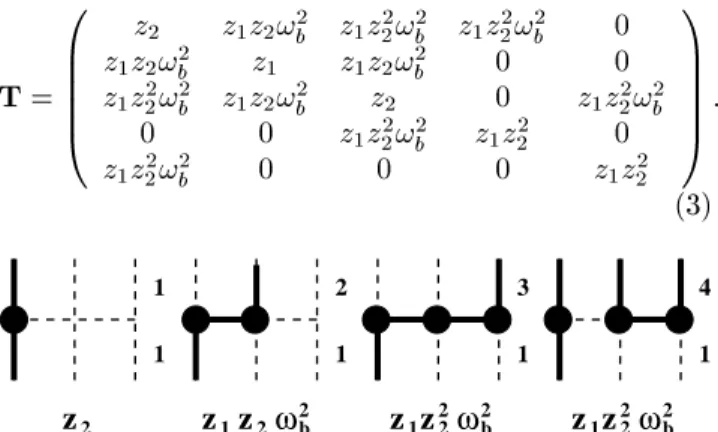
Form=2thetransfermatrixwillbegivenby
T= 0 B B B B z 2 z 1 z 2 ! 2 b z 1 z 2 2 ! 2 b z 1 z 2 2 ! 2 b 0 z 1 z 2 ! 2 b z 1 z 1 z 2 ! 2 b 0 0 z 1 z 2 2 ! 2 b z 1 z 2 ! 2 b z 2 0 z 1 z 2 2 ! 2 b
0 0 z
1 z 2 2 ! 2 b z 1 z 2 2 0 z 1 z 2 2 ! 2 b
0 0 0 z
1 z 2 2 1 C C C C A : (3)
z
1z
2
2
ω
b
2
z
1z
2
2
ω
b
2
z
1
z
2
ω
b
2
z
2
2
1
1
1
1
3
4
1
Figure2.Contributionstotherstline ofthetransfer
ma-trixfortheasem=2.Theonnetivityongurationsare
indiatedfollowingtheenumerationadoptedinFig. 1.
The grand anonial partition funtion of the
model,onsideringperiodiboundaryonditionsinthe
y diretion,willbegivenby
=(Tr)T Ny
; (4)
where N
y
is the total length of the strip in the y
di-retion, so that the total number of sites is given by
N
s =N
y
(m+1). The number of monomerswith
a-tivityz i is N i = z i z i ; (5)
andthetotalnumberofmonomersinthehainwillbe
N = na(m) X i=1 N i : (6)
Thefrationofmonomersplaedatolumn xis
(x)= N x+1 (2 Æ x;m=2 )N ; (7)
wherex=0;1;:::;n
a
(m) 1and(x)=(m x). The
Kronekerdeltainthedenominatorontributesonlyfor
evenvaluesof m.
Inthethermodynami limitN
y
!1thepartition
funtion4isdominatedbythelargesteigenvalueofthe
transfermatrix
1
, sothat Ny
1
andinthislimit
N i =N y z i 1 z : (8)
The rst order polymerization transition in the nite
strip will take plae when the thermodynami
poten-tial
= k
B
Tln() (9)
isequalto theonefortheemptylattie
0
=0. Thus,
sineinthethermodynamilimitwehave
=N
s
= k
B
T(m+1)ln(
1
) (10)
the polymerized phase will oexist with the
non-polymerized phase for
1
=1. Therefore, all
thermo-dynami quantities below will be alulated for z
i =
z;i=1;:::;n
a
(m) 1andz(n
a
(m))=!z, where the
ativity z is then xed at the oexistene value z
so
that, foragivenvalueof!
b
,wehave
1 =1.
Finally,theforeapplied onthewallsisgivenby
F = 1 a m z;!;! b ; (11)
whereaisthelattieparameterandpositivevalues
or-respondtoattrativefores. Anadimensionalforeper
monomerattheoexistenemaybethendenedas
f = Fa k B TN = m z;!;! b z z m;!;! b = 1 z z m !;!b : (12)
Sineourresultsorrespondtointegervaluesofm,the
fore f wasestimated makingthedisrete
approxima-tion
f(m+1=2;!;!
b
)
2
z
(m+1;!;!
b )+z
(m;!;!
b )
[z
(m+1;!;!
b ) z
(m;!;!
b )℄:
(13)
Asimplealulationmaybeperformedinthelimit
of rigid rods !
b
= 0, where bends are not allowed.
In this limit the transfer matrix is diagonal of size
(m+1)(m+1). For ! > 1 all monomers are on
the walls, for ! = 1 they are uniformly distributed,
whereasfor !<1anuniform distribution in thesites
awayfromthewallsisfound. Asexpeted,inthislimit
theforeonthewallsvanishes. Inthenumerialresults
belowweonsider!
III Numerial results and
on-lusion
The transfermatriesfor themodelwereobtained
ex-atly for strips of widths ranging from 3 to 9. After
usingthereetionsymmetry,thesizesofthematries
are, respetively,equalto6,16, 38,100,256,681,and
1805. We obtained the density prole at the
oexis-tene onditionforvaluesof! and!
b
mostlybetween
1and3.
1
1.5
2
2.5
3
ω
0
0.1
0.2
0.3
0.4
ρ
(a)
1
1.5
2
2.5
3
ω
0
0.1
0.2
0.3
0.4
ρ
(b)
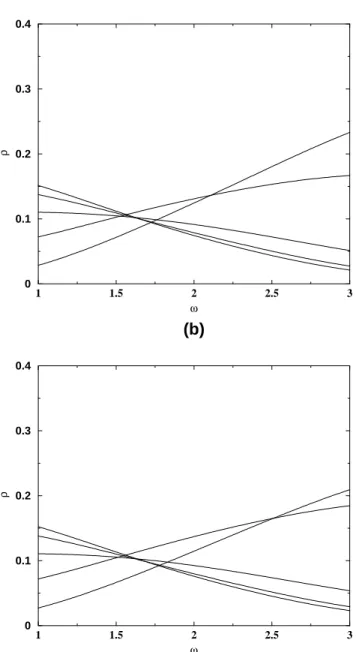
Figure3. Densityofmonomersasfuntionof!forastrip
withm=9. (a)orrespondsto !
b
=2and(b)to !
b =3.
Curvesarefordierentvaluesofxand(x)=(m x).At
!=1thehighestdensityorrespondstotheenterofthe
strip(x=4andx=5)andthedensitydereases
monoton-iallyoutwards,beinglowestatthewall(x=0andx=9).
At !=3 thedensity proleis onvexinbothases, with
themaximumdensityloatedonthewalls.
For neutralwalls(! =1) the densityprole is
al-waysonave,withahigherdensityintheenter. This
maybeunderstoodsinetheregionawayfromthewalls
isfavoredentropially. As!beomeslarger,monomers
onthewallsareenergetiallyfavored,soforsuÆiently
largevalues of ! aonvexdensity proleis expeted.
For ideal exible hains (!
b
= 1), at the adsorption
value ! = 4=3 the density prole is at for all sites
whih are not on the walls [12, 14℄. Suh a at
tran-sition prole is not observed for self-avoiding hains,
whereonvexprolesare separatedfrom onaveones
by an interval of values of !, loated well below the
adsorptiontransitionvalue,wheretheproleisneither
onvex noronave. This intervalis quite narrow for
exiblehains [14℄. InFig. 3thedensitiesareplotted
asfuntionsof!fortwovaluesof!
b
. Itislearthatas
!
b
isinreased,favoringbends,theintervalofvaluesof
!withaprolewithoutwelldened onvexitygrows.
The valuesof ! below whih thedensity prole is
onave (!
1
)and those abovewhih the proleis
on-vex (!
2
) are plotted in Fig. 4 as funtions of !
b for
twovaluesofm. As isapparenttherangewithno
de-ned onvexity grows with !
b
in a nearly linear way.
Asageneralrule,wefoundthatas!
b
isinreasedfrom
1, the rst pair of densities to ross, destroying
on-avity, is always orrespondent to the olumns whih
arerst and seond neighbors to the walls. Also, the
lastrossing,whihturnstheproleonvex,isbetween
densitiesorrespondingtotheolumnsatthewalland
theneighborolumns. Inthe limit!
b
! 1wefound
that!
2 !1.
1
1.5
2
2.5
3
ω
b
1
1.5
2
2.5
3
ω
Figure 4. Boltzmann weights below whih the density is
onave(lowerurves)andabovewhihitisonvex(upper
urves)form=6(dashedurves)andm=9(fullurves).
Finally,wealulatedtheforepermonomeronthe
As already found for exible self-avoidinghains [13℄,
attrativefores appear forsuÆiently large valuesof
!. Fig. 5 shows results for the fore as a funtion
of ! for some values of !
b
. The origin of attrative
fores in the system are portions of the hain limited
bymonomersadsorbedonoppositewalls. Thus, as
ex-peted, theurvesf ! displayamaximum, beause
the fore vanishes as ! ! 1, sine in this limit suh
\bridge"segmentsareabsent.
1
1.5
2
2.5
3
ω
−0.015
−0.010
−0.005
0.000
0.005
f
a
b
c
d
Figure5. Forepermonomeronthewallsasfuntionof!
for (a)!b =1, (b)!b = 2,()!b =3, and (d)!b !1.
Resultsshownareform=8:5.
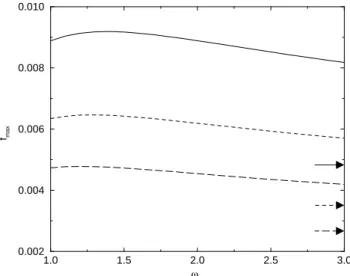
InFig. 6themaximumforepermonomer(with
re-spetto!)isplottedasafuntionof!
b
. Itisapparent
thatthemaximumoftheseurvesisloatedat!
b >1,
and thus we onlude that polymers for whih bends
aresomewhatfavoredgiverise,ingeneral,tolarger
at-trative fores than exible ones. As !
b
is inreased,
the maximum attrative fore ours at higher values
of!
Thefore per monomerasafuntion ofthe width
ofthestripm,for! aboveathreshold,showsastable
equilibriumpointatverylowseparationm
1
andan
un-stableequilibriumpointatalargerseparationm
2 [13℄.
Theforeisattrativeintheintervalm <x<m .
1.0
1.5
2.0
2.5
3.0
ω
b
0.002
0.004
0.006
0.008
0.010
f
max
Figure 6. Maximum fore per monomer on the walls for
m = 6:5 (full line), m = 7:5 (dottedline), and m = 8:5
(dashedline)asfuntionsof!
b
. Arrowsindiatethe
maxi-mumforefor!
b !1.
Thestable equilibrium point m
1 (!;!
b
) isfound in
the range 0:5 m
1
1:5, showinglittle variation as
a funtion of the Boltzmann fators, as long as ! is
largerthan thethresholdvalue. Theunstable
equilib-riumpointm
2 (!;!
b
)showsaratherstrongmonotoni
dependeneonbothvariables,beinganinreasing
fun-tionof! andadereasingfuntionof!
b .
In onlusion, we may summarize the behaviorof
semiexiblehainsonnedinsidestripsobservingthat
as the presene of elementary bends in the hains is
favored,therangeofvaluesof !for whih thedensity
prolehasnodenedonvexitygrows. Also,thelargest
attrativeforesarefoundfor!
b
>1,thatis,whenthe
bending of thehains is favored. It should benotied
that the nonmonotoni behaviorobserved forthe
ten-sion as afuntion of the width of the strip, with two
equilibriumpoints,happensinaregimewherethenite
size salingbehaviorhasnotyet beenreahed[13℄.
Aknowledgements
Partial nanial support by the brazilian agenies
CNPqandFAPERJ isgratefullyaknowledged.
Referenes
[1℄ P.J.Flory, Priniples of Polymer Chemistry, Cornell
UniversityPress,Ithaa,New York(1953).
[2℄ P.G.deGennes,SalingConepts inPolymerPhysis,
CornellUniversityPress,Ithaa,NewYork(1979).
[3℄ P.M.PfeutyandJ.C.Wheeler,Phys.Rev.A27,2178
(1983).
[4℄ B.Derrida,J.Phys.A14,L5(1981).
[5℄ A. R.Conway andA. J.Guttmann, Phys.Rev.Lett.
[6℄ B.Nienhuis,Phys.Rev.Lett.49,1062(1982);seealso
B.NienhuisinPhaseTransitionsandCritial
Phenom-ena,vol11,ed.byC.DombandJ.L.Lebowitz,
Aa-demiPress(1987).
[7℄ K.De'Bell andT.Lookman, Rev.Mod.Phys.65,87
(1993).
[8℄ K.BinderinPhase Transitions andCritial
Phenom-ena, vol.8,ed.by C.DombandJ.L. Lebowitz,
Aa-demiPress(1983).
[9℄ R.J.Rubin,J.Chem.Phys.43,2392(1965).
[10℄ I.GuimandT.Burkhardt,J.Phys.A22,1131(1989);
Phys.Rev.E49,1495(1994).
[11℄ D. Zhao, T.Lookman and K.De'Bell, Phys. Rev.A
42,4591(1990).
[12℄ E. A.DiMarzio and R.J.Rubin, J.Chem.Phys.55,
4318 (1971).
[13℄ J.F.StilkandK.D.Mahado,Eur.Phys.J.B5,899
(1998);J.F.Stilk,Braz.J.ofPhys.28,369(1998).
[14℄ J.F.Stilk,Europhys.Lett.40,19(1997);PhysiaA
257,233(1998).
[15℄ T.W.BurkhardtandI.Guim,Phys.Rev.E59,5833
(1999).
[16℄ M.F.ThorpeandW.K.Sholl,J.Chem.Phys.75,5143
(1981);W.ShollandA.B.Thorpe,J.Chem.Phys.76,
6386 (1982); J.W.Halley, H. Nakanishi, and R.
Sun-darajan,Phys.Rev.B31,293(1985);S.B.LeeandH.
Nakanishi,Phys.Rev.B33,1953(1986);M.L.Glasser,
V.Privman,andA.M. Szpilka,J.Phys.A19,L1185
(1986);V. Privmanand S.Redner,Z. Phys.B67,129
(1987);V.PrivmanandH.L.Frish,J.Chem.Phys.88,
469(1988); J.W.Halley, D.Atkatz, andH. Nakanishi,
J.Phys.A23,3297(1990).
[17℄ J. Moon and H. Nakanishi, Phys. Rev. A 44, 6427
(1991).
[18℄ C.J.Camaho, M. E. Fisher, and J. P. Straley,
Phys.Rev.A46,6300 (1992).
[19℄ S.Doniah,T.Garel,andH. Orland,J.Chem. Phys.
105,1601 (1996); U. Bastollaand P. Grassberger, J.
Stat.Phys.89,1061(1997).
[20℄ E. Botelho and J. F. Stilk, Phys. Rev. E 48, 723
(1993).
[21℄ S.Lise,A.Maritan,andA.Pelizzola,Phys.Rev.E58,
R5241(1998).
[22℄ J.F.Stilk,C.E.Cordeiro,andR.L.P.G.doAmaral,