Quim. Nova, Vol. 39, No. 8, 932-935, 2016
A
rti
g
o
http://dx.doi.org/10.5935/0100-4042.20160115
*e-mail: [email protected]
ELECTROCHEMICAL OXIDATION OF ETHYLENE AT PANI/Pt AND Ag/PANI/Pt MODIFIED ELECTRODES
Lenys Fernándeza,*, Edison Omar Martínezb and Hicher Zambranoc
aDepartamento de Química, Universidad Simón Bolívar, Apartado 89000, Caracas 1080-A, Venezuela bFacultad de Ciencias Químicas y de la Salud, Universidad Técnica de Machala,
Apartado 070151, Machala, Ecuador
cFacultad de Ingeniería, Universidad de Los Andes, Apartado 5101, Mérida, Venezuela
Recebido em 20/12/2015; aceito em 18/04/2016; publicado na web em 08/07/2016
The electrochemical behavior of ethylene on PANI/Pt and Ag/PANI/Pt modiied electrodes was investigated in different media. Morphology of the deposits of PANI were observed by SEM analysis, complemented by the EDX techniques to obtain the Ag composition that shows that Ag is deposited in the polymeric matrix which covered the whole platinum surface. The electrodic system comprising Ag/PANI/ Pt electrode exhibited a more important electrocatalytic response for ethylene oxidation in neutral solutions than the PAN/Pt and Pt electrodes at 20 oC.The results suggest that the oxidation of ethylene on Ag/PANI/Pt electrode is limited by adsorption-controlled reaction while the oxidation at PANI/Pt is mass transport-limited.
Keywords: ethylene electrooxidation; polyaniline; electrocatalysis; silver microparticles.
INTRODUCTION
The use of electrochemical reactions to produce species capable of initiating polymerization processes, has allowed obtaining prod-ucts that conventionally cannot be obtained, which can be drawn much beneit. It may solve problems, such as improving the energy conversion to electricity, its accumulation and development of new methods for production of substances without danger of contamina-tion, among others. An example of this is anodically oxidize organic compounds such as methanol, ethylene, etc., to convert the chemical energy contained in their bonds directly into electricity, by designing electrocatalysts. At present, there is considerable interest in the use of hydrocarbon oxidation reactions as a source of energy and the use of raw material for obtaining other products of great industrial importance. Traditionally in the sixties, the electrochemical oxidation of ethylene on noble metals was studied at high temperature (80 °C) and pH.1-3 Under these conditions, ethylene can only be anodically oxidized to CO2:4-6
C2H4 + 4H2O 2CO2 + 12H+ + 12e
-Electrocatalytic applications utilizing conducting polymer should offer a potential increase in operational eficiency, and this has been the subject of a great deal of investigations. Polyaniline (PANI) is particularly interesting among the conducting polymers because of its stability under atmospheric condition and its good conductivity.7-9 It has been found that PANI offers a protective matrix for Pt microparticles dispersed into the polymer ilms.10-14 To our best knowledge, there is no formal report about electro-chemical oxidation of ethylene at polymer modiied electrode. In the present report, we discuss the ethylene preliminary results of electrochemical oxidation behavior on PANI/Pt and on PANI/Pt with dispersed Ag.
EXPERIMENTAL
Reagents
Aniline (Aldrich) was used immediately after distilling under reduced pressure. Ethylene (Mathesson, 99.99% purity) was used directly, H2SO4 95-99%, HCl 37%, Na2SO4 99%, Na2ClO4 reagent grade quality were purchased from Riedel-de Haën. These and all other reagent grade chemicals were used as received.
Apparatus
Electrochemical measurements were performed in a conventional three-electrode cell. The working electrode was a modiied Pt (0.6 cm2 real surface) and a graphite carbon was used as the counter– elec-trode (1.5 cm2 real surface). All potentials in the paper are reported vs. Ag/AgCl.
The experiments were carried out using an EG&G model PAR 273A Potentiostat– Galvanostat, under direct computer control. The morphology and composition of the polymer–catalyst assem-blies were determined using a Hitachi S-2500 scanning electron microscope.
RESULTS AND DISCUSSION
Formation and characterization of the PANI and Ag-PANI films at Pt electrodes
Preparation and electrochemical response of the modiied elec-trodes polyaniline– modiied elecelec-trodes were obtained by continu-ous cycling of the electrode potential and a pulse technique. Film formation was examined in different electrolytes (H2SO4, NaClO4, Na2SO4). The redox couple response was obtained in the three sys-tems, however, in 0.60 mol L-1 H2SO4 and 0.25 mol L-1 Na2SO4, the behavior was most reproducible, and the results presented there are in this media.
Figure 1 shows the voltammograms of PANI formation by a cyclic voltammetric (CV) technique after ten cycles on a platinum electrode, obtained between -0.600 and 0.800 V in 0.60 mol L-1 H
Electrochemical oxidation of ethylene at PANI/Pt and Ag/PANI/Pt modiied electrodes 933
Vol. 39, No. 8
0.25 mol L-1 Na2SO4, 0.25 mol L-1 aniline at 20 °C. The multiple re-dox waves indicate the complexity of the electrooxidation of aniline which involves the coupled multiple heterogeneous electron transfer reactions and homogeneous chemical.15-21 The literature reports that the PANI ilms formed at slow scan rates were very different from those produced at fast scans. The difference arises from different reactions in the polymerization pathways22 that are important at dif-ferent time scales. In this work, the PANI ilms had been synthesized at slow rates (10 mV s-1). Different electrooxidation process of PANI had been proposed;22 the redox current corresponds to the formation/ removal of the radical cation (polaron) sites in the PANI polymer chain. PANI differs from the majority of organic conducting poly-mers in that the counterions needed for electroneutrality are protons chemically bonded to the polymer backbone, this might lessen the degree of localization due to an irregular coulomb potential; their electrostatic repulsion causes a Peierls’ distortion, and the distortion favors the formation of an energy gap.23 Thus, the fully oxidized state loses the conductivity.
SEM examined the ilm formed at a slow scan rate (10 mV s-1). The topography of the ilm (Figure 2a) shows that the polymer is both amor-phous and highly porous, with micro-peaks and micro-valley. In Figure 2b, the higher magniication micrograph reveals particles of uniform size with a chain microiber structure. The iber thickness was about 0.36 µm, which exhibited some branching. Gaps of approximately 90 µm were observed between branches. Similar microstructures have been previously reported for PAN ilms prepared in the presence of H2SO4 or HCl, this morphology is characteristic of the emeraldine state.24,25
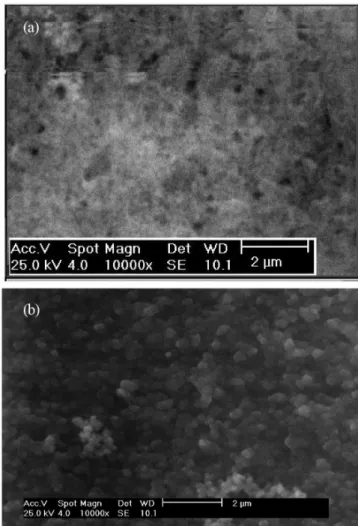
In Figure 3, the PANI ilms obtained by a pulse technique in the similar solutions to the CV case are shown. The potentiostatic synthe-sis was performed at 0.600 V. Variations of the preparation technique produce morphology changes, which has a lakes structure of low porosity, it is denser, irregular and with large lakes in comparison to that obtained with CV. This characteristic has been associated to a very fast polymer growth. This morphology type is very similar to that present when PANI is synthesized via CV at scan rates higher than 200 mV s-1. In this work, the PANI/Pt was prepared by CV at 10 mV s-1, since ethylene electrooxidation was the most reproducible.
The oxidation charge, Q, of the inal voltammetric curve was used as a relative measurement of ilm thickness and it was compared with that obtained from chronocoulometry. The total charge passing the electrode was measured and ranged from 200 to 400 µC. The ilm obtained when Q=225 µC cm-2 was chosen for the electrode modiica-tion. The ilm thickness was estimated from the ilm capacitance using the thickness data reported by Wrighton et al.26 The ilm thickness
for deposition under these conditions was 2.7µm.
Electrodeposition of silver on the polymer-coated electrode was carried out at constant potential (-0.200V vs. Ag/AgCl) from a 1 x 10⁻³ 25 mol L-1 AgNO3 solutions. After each transient, the charge for Ag deposition was 127 µC.
Scanning electron microscopy reveals a transition in the growth mode and Ag atoms inely dispersed on the polymer surface as well as embedded into the PANI ibrils (Figure 4a). At higher Ag loading (127 µC), silver clusters were irregularly covering the polymer surface (Figure 4b). The EDX shows that Ag grows on the polymer and not
Figure 1. Cyclic voltammograms of electrodeposition of PANI from
0.25 mol L-1 aniline in 0.60 mol L-1 H
2SO4 and 0.25 mol L-1 Na2SO4,
v = 10 mV s-1, T= 20 °C
Figure 3. Scanning electron micrographs of PANI film, grown on a platinum electrode under potentiostatic conditions at 0.600 V
Fernández et al.
934 Quim. Nova
on the platinum surface (Figure 4c). The PANI/Pt and Ag/PANI/Pt modiied electrodes showed a remarkable stability in neutral solutions and no visible polymer degradation was observed after more than 5 h.
Electrochemical response of modified electrodes in the presence of ethylene
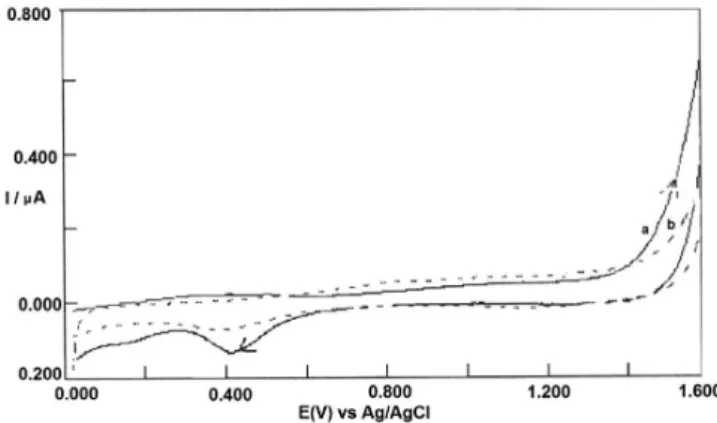
The platinum electrode has no ethylene oxidation activity in a neutral medium (0.25 mol L-1 NaClO
4) at 20 °C, Figure 5.
In neutral pH solution, the conductive properties of polyaniline
can be favored between 0 and 1.0 V, a potential range where the polyaniline is also stable. Figure 6 shows the stable ethylene oxida-tion voltammetric curves at PANI/Pt (Figure 6b), Ag/PANI/Pt (Figure 6c) and Pt (Figure 6a) modiied electrodes in 0.25 mol L-1 NaClO4, at 20 mV s-1.In this neutral solution, ethylene oxidation current at PANI/Pt begins to increase at 0.800 V and one anodic peak is detected, which is signiicantly different from the onset of ethylene oxidation on the Ag/PANI/ Pt which occurs at 0.650 V. The current in the last case was higher by a factor of two compared to that on the PANI/Pt modiied electrode. This could be a consequence of the active sites distribution and its uniformity requiring less positive potentials for ethylene oxidation, taking place on energetically more favored sites. The current density and potential data obtained at PANI/Pt and Ag/ PANI/Pt electrodes modiied in different electrolytic medias (Na2SO4 and NaClO4) show the responses most favorable for Ag/PANI/Pt electrode in NaClO4. In this case, a catalytic effect in current density (2.162 µA) and potential shifted to a less positive value (0.650 V) in relation to the oxidation of ethylene at PANI/Pt.
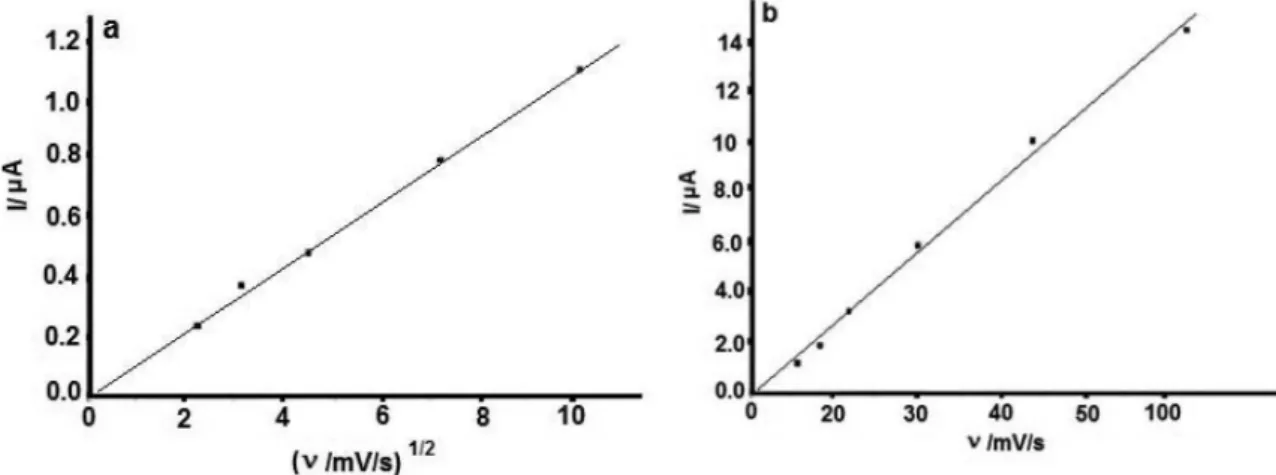
At PANI/Pt electrode the peak current (Ipc) depends linearly on ν1/2 (Figure 7a), where v is the scan rate, as expected for a diffusion--controlled reaction. In the Ag/PANI/Pt electrode case, the current peak depends linearly on ν(Figure 7b), as expected for an adsorption--controlled reaction.
Further evidence that the Ag micro-particles are mechanically stabilized in the polyaniline matrix was demonstrated by ultrasoni-cation of the Ag/PANI/Pt electrodes.
The promoting effect of Ag particles in the polymeric matrix was observed only at loading level near 127 µA. At higher Ag, loading of 127 µC, the electrode showed no activity for ethylene oxidation; in this case, scanning electron microscopy shows that silver clusters were irregularly covering the polymer surface. This promoting effect has been explained based on a preferential ethylene adsorption on
Figure 6. Cyclic voltammetric behavior of ethylene on (c) Ag/PANI/Pt, (b)
PANI/Pt and (a) Pt in 0.25 mol L-1 Na
2ClO4, ν = 10 mV s-1, T = 20 °C
Figure 5. Cyclic voltammetric behavior of ethylene at Pt electrode in 0.25
mol L-1 Na
2ClO4, ν = 10 mV s-1, T= 20 °C. In saturated solutions of: (a) Ar
and (b) ethylene
Electrochemical oxidation of ethylene at PANI/Pt and Ag/PANI/Pt modiied electrodes 935
Vol. 39, No. 8
Figure 7. Effect of sweep speed in the ethylene oxidation at: (a) PANI/Pt and (b) Ag/PANI/Pt modified electrodes
Ag sites. A probable scheme with ethylene molecules adsorbing the Ag particle, which leads to the oxidation catalyses of the strongly adsorbed ethylene, is depicted in Figure 8. The ethylene is adsorbed preferentially on the Ag particles, probably oxidized to AgO.
More studies, based on polymer ilm thickness, silver particle size variation (synthesizing silver nanoparticles) and the transient study, are clearly necessary to investigate this behavior, perform electrolysis of ethylene oxidation at modiied electrodes and subsequent analysis of possible products by chromatography.
CONCLUSION
The Ag/PANI/Pt system showed ethylene oxidation activity greater by a factor of two compared to PANI/Pt. Ethylene oxidation currents were appreciable only at Ag loadings ca. 127 µc cm-2; at higher Ag, the system losses catalytic activity. These results indicate that, at low loading, the silver particle is deposited mainly inside the polymer on its internal surface and a minimum load is required for tridimensional dispersion. Cyclic voltammetric behavior of a polymer-catalyst assembly during the ethylene oxidation shows preferential adsorption for ethylene oxidation on the Ag/PANI/Pt electrode and a diffusion process for PANI/Pt.
ACKNOWLEDGMENTS
The authors would like to thank for the contribution of the
Figure 8. Model to explain the behavior of ethylene oxidation at the Ag/ PANI/Pt electrode
Technical University of Machala through the implementation of the System Reengineering Research, driven by its Academic Vice President, and Decanato de Investigación y Desarrollo Universidad Simón Bolívar (USB), Caracas-Venezuela, for inancial support.
REFERENCES
1. Gileadi, E.; Stoner, G.; Bockris, J. M.; J. Electrochem. Soc. 1966, 113, 585.
2. Wojtowicz, J.; Marincic, N.; Conway, B. E.; J. Chem. Phys. 1968, 48, 4333.
3. Green, M.; Weber, J.; Drazic, V.; J.Electrochem. Soc. 1964, 111, 721. 4. Dahmsand, H.; Bockris, J. O. M.; J. Electrochem. Soc. 1964, 111, 728. 5. Blake, A. R.; Sunderland, J. G.; J. Chem. Soc. A 1969, 6, 3015. 6. Harley, T. N.; Price, D.; J. Electrochem. Soc. 1970, 117, 448.
7. Vivekanandan, J.; Ponnusamy, V.; Mahudeswaran, A.; Vijayanand, P. S.;
Arch. Appl. Sci. Res. 2011, 3, 147.
8. Reda, S. M.; Al-Ghannam, S. M.; Adv. Mater. Phys Chem. 2012, 2, 75. 9. Shama, I.; Lakshmi, G. B. V. S.; Siddiqui, A. M.; Husain, M.;
Zulfequar, M.; Int. J. Polym. Sci. 2013, 2013.
10. Xia, Y.; Zhu, D.; Si, S.; Li, D.; Wu, S.; J. Power Sources. 2015, 283, 125
11. Ates, M.; Topkaya, E.; Prog. Org. Coat. 2015, 82, 33.
12. Shabani-Nooshabadi, M.; Karimian-Taheri, F.; RSC Adv. 2015, 5, 96601. 13. Lattach, Y.; Deronzier, A.; Moutet, J. C.; ACS Appl. Mater. Interfaces
2015, 7, 15866.
14. Hosseini, M.; Momeni, M. M.; J. Mater. Sci. 2010, 45, 3304.
15. Bhadra, S.; Singha, N. K.; Khastgir, D.; J. Appl. Polym. Sci. 2007, 104, 1904.
16. Borole, D. D.; Kapadi, U. R.; Kumbhar, P. P.; Hundiwale, D. G.; Mater.
Lett. 2002, 56, 685.
17. Kinyanjui, J. M.; Wijeratne, N. R.; Hanks, J.; Hatchett, D. W.;
Electro-chim. Acta 2006, 51, 2825.
18. Tang, Z.; Liu, S.; Wang, Z.; Dong, S.; Wang, E.; Electrochem. Commun. 2000, 2, 32.
19. Dui , L. J.; Mandi , Z.; Kova i ek, F.; J. Polym. Sci., Part A: Polym.
Chem. 1994, 32, 105.
20. Kinyanjui, J. M.; Hanks, J.; Hatchett, D. W.; Smith, A.; Josowicz, M.; J.
Electrochem. Soc. 2004, 151, D113.
21. Hand, R. L.; Nelson, R. F.; J. Am. Chem. Soc. 1974, 96, 3. 22. Wang, E.; Liu, A.; Anal. Chim. Acta 1991, 252, 53.
23. Glarum, S. H.; Marshall, J. H.; J. Phys. Chem. 1986, 90, 6076. 24. Nunziante, P.; Pistoia, G.; Electrochim. Acta 1989, 34, 223. 25. Wu, Q.; Xu, Y.; Yao, Z.; Liu, A.; Shi, G.; ACS Nano 2010, 4, 1963 26. Paul, E. W.; Ricco, A. J.; Wrighton, M. S.; J. Phys. Chem. 1985, 89,