Article
0103 - 5053 $6.00+0.00
*e-mail: [email protected]
Theoretical Study of the Gas-Phase Reaction between Formyl Cation and Aromatics
André A. S. T. Ribeiro and Claudio J. A. Mota*
Universidade Federal do Rio de Janeiro, Instituto de Química. Av. Athos da Silveira Ramos 149 CT, Bloco A, Cidade Universitária 21941-909, Rio de Janeiro-RJ, Brazil
Cálculos teóricos da reação do cátion formila (CHO+) com tolueno, cumeno e p-cresol
mostraram que a transferência de próton é termodinamicamente preferida em relação a acilação. No caso do tolueneo, a acilação do anel aromático, para formação do complexo de Wheland, é 11,7 kcal mol-1 mais alta em energia ($H) que a protonação, em nível de cálculo MP4(SDTQ)/
6-31++G(d,p)//MP2(full)/6-31G(d,p). Esta diferença diminui com a introdução de um grupo hidroxila no anel (p-cresol) ou substituindo o grupo metila por isopropila (cumeno). A protonação do
tolueno pelo H3+ e pelo cátion isoformila é, respectivamente, 88,6 e 84,5 kcal mol-1 mais exotérmica
que a acilação em nível MP4(SDTQ)/6-31++G(d,p)//MP2(full)/6-31G(d,p). A afinidade protônica dop-cresol foi calculada como sendo 195,4 kcal mol-1.
Theoretical calculations of the reaction of formyl cation (CHO+) with toluene, cumene and p-cresol showed that proton transfer is thermodynamically preferred over acylation. For toluene,
acylation of the aromatic ring, to form the Wheland complex, is 11.7 kcal mol-1 higher in energy
($H) than protonation, at MP4(SDTQ)/6-31++G(d,p)//MP2(full)/6-31G(d,p) level of theory. This difference reduces upon introduction of a hydroxy group in the ring (p-cresol) or replacing
the methyl group by an isopropyl group (cumene). Protonation of toluene by H3+ and isoformyl
cation is 88.6 and 84.5 kcal mol-1, respectively, more exothermic than acylation, at MP4(SDTQ)/
6-31++G(d,p)//MP2(full)/6-31G(d,p). The proton affinity of p-cresol was calculated to be
195.4 kcal mol-1.
Keywords: formyl cation, Friedel-Crafts acylation, gas phase ion reaction, proton transfer
Introduction
Friedel-Crafts acylation is an important reaction in organic and industrial chemistry.1 Many important chemicals, like fragrances, pharmaceuticals and dyes are industrially produced through acylation steps. In addition, the Gatterman-Koch reaction2 is a useful procedure to produce benzaldehydes, through the reaction of carbon monoxide and an aromatic compound, catalyzed by a strong Bronsted acid, like HF.
Acylation of aromatic compounds has long been studied in the gas phase.3,4 Speranza and Sparapani showed that gas phase acetylation of alkylbenzenes does not follow the same reactivity trend found in solution,5 suggesting that solvent, counter ion and catalyst play a major role in the reactivity of the CH3CO+ cation in condensed phase. Strong electrophilic acylium ions, such as CF3CO+, are able to acylate deactivated substrates, such
as trifluorobenzene, in the gas phase.6 Cerichelli et al.7 reported that formyl cation behaves as a Bronsted acid in gas phase, exclusively transferring a proton to toluene, rather than producing formylated products. This behavior contrasts with the reactivity of C2H5+ and i-C
3H7+ cations in gas phase, both capable of acting as Lewis (alkylation) and Bronsted (protonation) acids toward toluene. In the present study we carried out theoretical calculations on the thermochemistry of acylation (formation of the Wheland complex) and protonation (formation of arenium ions) for the reaction of the formyl cation with toluene, cumene and
p-cresol, aiming to understand the thermodynamic gap
between them and the role of formyl cation as Bronsted and Lewis acid.
Computational Methods
molecular orbital program,8 with 6-31G(d,p) basis set. To provide more accurate energy values, the optimized structures were subjected to a single point calculation at MP4(SDTQ)/6-31++G(d,p) level of theory and for study
with cumene and p-cresol, at MP4(SDTQ)/6-31G(d,p)
level. Minima were characterized by the absence of imaginary vibrational frequencies. The energy values were corrected for the zero point energy (ZPE) and 298.15 K with frequencies scaled9 by 0.93 for all vibrational modes.
Results and Discussion
Geometry of the formyl cation and P-complex with toluene
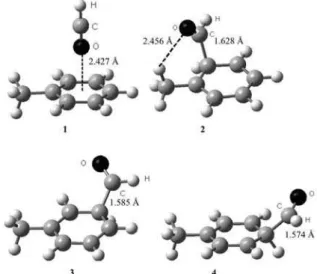
Table 1 presents some selected geometric data for the formyl cation, toluene and the P-complex (1), at MP2(full)/6-31G(d,p) level of theory. The geometry of the formyl cation is linear. The values reported in Table 1 are close to reported10-12 calculated data for the formyl cation, at similar and higher levels of calculation. Upon forming theP-complex 1, the geometry is little affected. The C-H and C-O bond lengths decrease to 1.083 Å and 1.139 Å, respectively. The angle changes by only 0.1o. The same situation occurs for the toluene molecule. The calculated geometry is little affected by the interaction with the formyl cation. The most significant changes are in the C-C bond length of the aromatic ring, which showed a slight increase, relative to the isolated toluene molecule. The structure of complex 1 has the oxygen atom of the formyl cation pointing towards the aromatic ring at a distance of 2.427 Å. This arrangement has already been observed13 for the interaction of formyl, acetyl and NO+ cations with benzene, at DFT level of calculation.
Geometry of the Wheland intermediates for toluene
We were able to find three Wheland intermediates, correspondent to the attack at ortho, meta and para positions. The optimized structures are shown in Figure 1 and Table 2 shows some selected geometry values. The C-C bond between the aromatic ring and the formyl moiety varies slightly for each intermediate. In 2, the Wheland intermediate formed upon acylation at ortho position, the C-C bond length is 1.628 Å, whereas in 3, the intermediate formed upon acylation in meta position, this distance decreases to 1.585 Å. In 4, the intermediate formed upon attack at para position, the C-C bond is 1.574 Å long. It is curious that the methyl hydrogen atom in 2 is eclipsed with respect to the aromatic carbon-formyl bond. All attempts to rotate the methyl group to place the hydrogen atom in
staggered conformation failed. Stabilization of the eclipsed conformation by electrostatic interaction with the oxygen atom of the formyl moiety, might account for this behavior. The methyl hydrogen atom delocalizes the positive charge through hyperconjugation and thus, it is reasonable to believe that electrostatic interaction with the oxygen atom will better stabilize the structure.
Table 1. Selected geometric data for the formyl cation, toluene and P-complex (1), at MP2(full)/6-31G(d,p) level
Parameter CHO+ Toluene P-complex (1)
d C-H/(Å) 1.092 1.083
d C-O/(Å) 1.154 1.139
HCO/(degree) 180.0 179.9
d C-Cipso-ortho/(Å) 1.397 1.403
d C-Cortho-meta/(Å) 1.395 1.397
d C-Cmeta-para/(Å) 1.393 1.398
d C-Cipso-metila/(Å) 1.504 1.504
d C-Hortho/(Å) 1.083 1.083
d C-Hmeta/(Å) 1.082 1.082
d C-Hpara/(Å) 1.081 1.081
Table 2. Selected geometric parameters of the Wheland intermediates, at MP2(full)/6-31G(d,p) level
Parameter 2 3 4
Cortho-Cipsoa/(Å) 1.463 1.382 1.417
Cortho-Cipsob/(Å) 1.386 1.412
-Cortho-Cmetaa/(Å) 1.463 1.457 1.369
Cortho-Cmetab/(Å) 1.398 1.406
-Cmeta-Cparaa/(Å) 1.372 1.457 1.462
Cmeta-Cparab/(Å) 1.409 1.375
-Cipso-CH3/(Å) 1.482 1.500 1.486
CHO angle/(degree) 125.3 124.7 124.1
aNear the CHO moiety; bOpposed to the CHO moiety.
Thermochemical data for acylation and protonation of toluene by formyl cation
Calculations showed that the P-complex 1 is
10.8 kcal mol-1 lower in enthalpy than the free reactants, at MP2(full)/6-31G(d,p) and 10.9 kcal mol-1 at MP4(SDTQ)/ 6-31G++(d,p) level of theory. Table 3 shows the calculated enthalpy and Gibbs free energy at 298.15 K for acylation (formation of Wheland complex) and proton transfer (formation of arenium ions). Attack at the ortho and para position, to form the Wheland intermediates 2 and 4, respectively, is preferred by 3.9 kcal mol-1 at MP2(full)/ 6-31G(d,p) and 4.3 kcal mol-1 at MP4(SDTQ)/6-31++G(d,p) level of theory, over attack at the meta position to form 3. Nevertheless, the preferred thermodynamic pathway is protonation, lying 11.7 kcal mol-1 ($H) and 22.3 kcal mol-1 ($G298.15K) lower in energy with respect to acylation, at MP4(SDTQ)/6-31G++(d,p) level. Gas phase protonation of aromatic compounds has been widely studied in the literature, at experimental14-18 and theoretical levels.19-21 Thus, we did not include any structural and energetic discussion of arenium ion isomers in this work.
Ring and alkyl chain substitutions
To check the effect of electron releasing groups in the aromatic ring and alkyl chain substitution in the energetics
of acylation, we performed calculations of formyl cation reactions with p-cresol (p-hydroxy-toluene) and cumene
(isopropylbenzene), considering protonation and acylation. The thermochemical data are presented in Table 4. One can see that the thermodynamic gap between acylation and proton transfer is reduced to 9.3 kcal mol-1 ($H) and 19.9 kcal mol-1 ($G
298.15K) in the case of p-cresol, and 11.4 kcal mol-1 ($H) and 21.9 kcal mol-1 ($G
298.15K) in the reaction with cumene, both at MP4(SDTQ)/6-31G(d,p) level of theory.
These calculations can be validated by comparison with the experimental results, using published22 proton affinity (PA) data for CO, toluene and cumene. Scheme 1 shows the gas phase reactions with the respective enthalpy variation. One can see that calculations are in good agreement with the experimental results. For toluene, the calculated $H is just 0.8 kcal mol-1 below experiment, at MP4(SDTQ)/6-31++G(d,p) level, whereas for cumene the difference between theory, computed at MP4(SDTQ)/6-31G(d,p) level, and experiment is just 0.2 kcal mol-1. These small differences may validate the general trends taken from these calculations.
We did not find the experimental proton affinity of p-cresol in the literature. Thus, we decided to run
calculations for all possible sites of protonation in the
p-cresol molecule, especially to compare protonation at
the ring and at the oxygen atom. Scheme 2 shows the
Table 4. Thermochemical data for acylation and proton transfer of formyl cation with p-cresol and cumene
System MP2/6-31G(d,p) MP4/6-31G(d,p)
$H/(kcal mol-1) $Ga/(kcal mol-1) $H/(kcal mol-1) $Ga/(kcal mol-1)
cumene + CHO+ 0 0 0 0
cumene + CHO+lbcumene-H+ + CO –41.8 –49.3 –47.5 –55.0
Wheland intermediateb –33.4 –30.4 –36.1 –33.1
p-cresol + CHO+ 0 0 0 0
p-cresol + CHO+lcp-cresol-H+ + CO –47.7 –54.3 –53.5 –60.0
Wheland intermediatec –41.5 –37,4 –44.2 –40.1
a Calculated at 298.15 K; b in the para position; cin the meta position relative to the methyl group.
Table 3. Calculated thermochemical data for the reaction between formyl cation and toluene. All the energy values are computed in relation to the isolated reactants
System MP2/6-31G(d,p) MP4/6-31++G(d,p)
$H/(kcal mol-1) $Ga/(kcal mol-1) $H/(kcal mol-1) $Ga/(kcal mol-1)
P-complex (1) –10.8 –9.8 –10.9 –9.9
Acylation
(2) –31.3 –28.5 –32.8 –30.0
(3) –27.4 –25,3 –28.6 –26.4
(4) –31.3 –29.1 –32.9 –30.7
Protonation
toluene + CHO+lbtoluene-H+ + CO –39.8 –48.2 –44.6 –53.0
thermochemical reactions between formyl cation and
p-cresol, indicating preference for protonation in meta
position relative to the methyl group. Protonation in the oxygen atom is the less favorable pathway. These results might be explained in terms of the stabilization of the ion formed. Protonation in the ring leads to delocalization of the charge in the substituent groups, whereas protonation in the oxygen atom do not permit delocalization of the charge in the P bonds. Using the experimental PA of CO (141.9 kcal mol-1) and the calculated thermochemistry for proton transfer to the meta position (relative to the methyl group), we computed the PA of p-cresol as 195.4 kcal mol-1.
Calculations showed that gas phase protonation of toluene by formyl cation is favored over acylation by 11.7 kcal mol-1 ($H) and 22.3 kcal mol-1 ($G
298.15K), at MP4(SDTQ)/6-31G++(d,p) level. This gap is reduced when the size and number of substituents in the ring are increased. Hence, protonation is preferred over acylation by 11.4 kcal mol-1 ($H) and 21.9 kcal mol-1 ($G
298.15K) in the reaction with cumene, whereas in the reaction with p-cresol
protonation prevails over acylation by 9.3 kcal mol-1 ($H) and 19.9 kcal mol-1 ($G
298.15K), both at MP4(SDTQ)/6-31G(d,p)
level. It seems unlikely that such a thermodynamic gap, in the range of 9 to 12 kcal mol-1 ($H), would solely prevent acylation to occur in the gas phase reaction between formyl cation and toluene, as reported by Cerichelli, Crestoni and Fornarini.7 In reactions of aromatic hydrocarbons with simple alkyl carbocations both, proton transfer and ring alkylation, do occur in gas phase, although the enthalpy difference in some cases7 is over 30 kcal mol-1. Protonation is usually preferred at higher temperatures and lower pressures, whereas ring alkylation prevails at lower temperatures and higher pressures.23 It has also been reported24 that formyl cation behaves as an electrophile, acylating the aromatic ring, and as a Bronsted acid, forming arenium ions, in superacid solution. The gas phase experiments of Cerichelli, Crestoni and Fornarini7 were conducted at atmospheric pressure and 37 °C using radiolytic conditions. To produce the formyl cation, they irradiated a mixture of H2 and CO with relative molar proportion of 34:1, respectively, together with typically 1.0 to 2.0 Torr of toluene. These conditions favors proton transfer, but it is surprising that no acylated product was observed, since acylation occurs in solution and for systems presenting a larger enthalpy gap, such as ethyl and propyl cations reacting with toluene.
It is well known that radiolysis of H2 generates the H3+ ion,25 which in turn, may react with CO to generate the formyl and isoformyl cations.26 Since H
2 was present in large excess compared with CO and toluene in the experiments of Cerichelli, Crestoni and Fornarini,7 we decided to check the thermodynamics of proton transfer to toluene using H3+ and isoformyl cation (COH+) as reactant. Table 5 shows that both ions behave as strong Bronsted acid in gas phase, reacting exothermically with toluene. At MP4(SDTQ)/6-31G++(d,p) level, proton transfer from H3+ to toluene is exothermic by 88.6 kcal mol-1, whereas from isoformyl cation the exothermicity is 84.5 kcal mol-1. Both reactions are far more exothermic than acylation, lying about 50 to 60 kcal mol-1 below in enthalpy. Therefore, they are exceedingly more favorable and might provide an alternative explanation for the experimental results at high H2 pressures.7 On the other hand, we cannot completely rule out that reactivity may be governed by kinetics, as suggested by the authors. Apparently, there is no reported study of the reaction of formyl cation with toluene, cumene or p-cresol at low pressure, under gas phase ion
molecule reaction conditions. Therefore, a conclusive scheme on the role of formyl cation as Bronsted (proton transfer) or Lewis acid (acylation) in the gas phase is still missing.
Conclusions
The gas phase reaction of formyl cation with toluene,
p-cresol and cumene was investigated by means of
Scheme 1. Thermochemistry of the gas phase proton transfer from the formyl cation to toluene and cumene. The $H was calculated using the experimental PA data.
Table 5. Thermochemistry of proton transfer to toluene. Gas phase reaction with H3+ and isoformyl cation
System MP2/6-31G(d,p) MP4/6-31++G(d,p)
$H/(kcal mol-1) $G/(kcal mol-1) $H/(kcal mol-1) $G/(kcal mol-1) toluene + H3+latoluene-H+ + H
2 –88.9 –89.1 –88.6 –88.9
toluene + bCOH+latoluene-H+ + CO –83.7 –87.9 –84.5 –88.8
aprotonation in the para position; bisoformyl cation.
theoretical methods. It was found that, at MP4(SDTQ)/ 6-31++G(d,p)//MP2(full)/6-31G(d,p) level of theory, protonation is preferred over acylation by 9 to 12 kcal mol-1. The energy gap reduces with introduction of a p-OH group
(p-cresol) in the ring or alkyl chain substitution (cumene).
The energy gap of 9 to 12 kcal mol-1 between proton transfer and acylation does not completely explain the experimental radiolytic gas phase results, where protonation is the only observed reaction. Alternative explanations might involve protonation by isoformyl cation or H3+, both lying 50 to 60 kcal mol-1 lower in energy than acylation. The role of the formyl cation as Bronsted and Lewis acid is still not completely understood.
Acknowledgements
Authors thank CNPq, FAPERJ and PRH-ANP for financial support.
Supplementary Information
Supplementary data are available free of charge at http://jbcs.sbq.org.br. They include three tables with absolute energies, ZPE and thermal corrections for all calculated structures.
References
1. Corma, A.; Garcia H.; Chem. Rev. 2003,103, 4307. 2. Crounse, N. N. Org. React.1949,5, 290.
3. Olah, G. A; Kunh S. J. In Friedel-Crafts and Related Reactions, G. A. Olah, ed., Wiley: New York, 1964, vol. 3, p 1153. 4. Chatfield, D. A.; Bursey, M. M.; J. Am. Chem. Soc.1975,97,
3600.
5. Speranza, M.; Sparapani, C.; J. Am. Chem. Soc.1980,102, 3120.
6. Cacace, F.; Crestoni, M. E.; Fornarini, S.; J. Phys. Chem.1994, 98, 1641.
7. Cerichelli, G.; Crestoni, M. E.; Fornarini, S.; J. Am. Chem. Soc. 1992,114, 2002.
8. Frisch, M. J.; Trucks, G. W.; Schlegel, H. B.; Scuseria, G. E.; Robb, M. A.; Cheeseman, J. R.; Zakrzewski, V. G.; Montgomery, Jr., J. A.; Stratmann, R. E.; Burant, J. C.; Dapprich, S.; Millam, J. M.; Daniels, A. D.; Kudin, K. N.; Strain, M. C.; Farkas, O.; Tomasi, J.; Barone,
V.; Cossi, M.; Cammi, R.; Mennucci, B.; Pomelli, C.; Adamo, C.; Clifford, S.; Ochterski, J.; Petersson, G. A.; Ayala, P. Y.; Cui, Q.; Morokuma, K.; Malick, D. K.; Rabuck, A. D.; Raghavachari, K.; Foresman, J. B.; Cioslowski, J.; Ortiz, J. V.; Baboul,A. G. B.; Stefanov, B.; Liu, G.; Liashenko, A.; Piskorz, P.; Komaromi, I.; Gomperts, R.; Martin, R. L.; Fox, D. J.; Keith, T.; Al-Laham, M. A.; Peng, C. Y.; Nanayakkara, A.; Gonzalez, C.; Challacombe, M.; Gill, P. M. W.; Johnson, B.; Chen, W.; Wong, M. W.; Andres, J. L.; Gonzalez, C.; Head-Gordon, M.; Replogle, E. S.; Pople, J. A.; Gaussian 98, Revision A.7, Gaussian, Inc., Pittsburgh PA, 1998. 9. Hout Jr., R. F.; Levi, B. A.; Hehre, W. J.; J. Comput. Chem.1982,
2, 234.
10. Hartz, N.; Rasul, G.; Olah, G. A.; J. Am. Chem. Soc.1993,115, 1277.
11. Yamaguchi, Y.; Richards Jr., C. A.; Schaefer III, H. F.; J. Chem. Phys.1994,101, 8945.
12. Raugei, S.; Klein, M. L.; J. Phys. Chem. B2001,105, 8212. 13. Esteves, P. M.; Carneiro, J. W.; Cardoso, S. P.; Barbosa, A G. H.;
Laali, K. H.; Rasul, G.; Prakash, G. K. S.; Olah, G. A.; J. Am. Chem. Soc.2003,125, 4836.
14. Chiavarino B.; Crestoni, M. E.; Di Rienzo, B.; Fornarini, S.; J. Am. Chem. Soc.1998,120, 10856.
15. Fornarini, S.; Crestoni, M. E.; Acc. Chem. Res.1998,31, 827. 16. Solca, N.; Dopfer, O.; Chem. Eur. J.2003,9, 3154.
17. Jones, W.; Boissel, P.; Chiavarino, B.; Crestoni, M. E.; Fornarini, S.; Lemaire, J.; Maitre, P.; Angew. Chem. Intern. Ed.2003,42, 2057.
18. Schroder, D.; Loos, J.; Schwarz, H.; Thissen, R.; Dutuit, O.; J. Phys. Chem. A 2004,108, 9931.
19. Sieber, S.; Schleyer, P. V R.; J. Am. Chem. Soc.1993,115, 6987. 20. Glukhovtsev, M. N.; Pross, A.; Nicolaides, A.; Radom, L.;
J. Chem. Soc., Chem. Commun.1995, 2347.
21. Maksic, Z. B.; Eckert-Maksic, M.; Knezevic, A.; J. Phys. Chem. A1998,102, 2981.
22. Hunter, E. P.; Lias, S. G.; J. Phys. Chem. Ref. Data1998, 27, 413.
23. Cacace, F.; Acc. Chem. Res.1988,88, 215.
24. Tanaka, M.; Fujiwara, M.; Ando, H.; J. Org. Chem;1995, 60, 3846.
25. Auloos, P.; Lias, S. G.; J. Chem. Phys.1964,40, 3599. 26. McMahon,T. B.; Kebarle, P.; J. Chem. Phys.1985,83, 3919.
Received: August 20, 2007
Supplementary Information
0103 - 5053 $6.00+0.00*e-mail: [email protected]
Theoretical Study of the Gas-Phase Reaction between Formyl Cation and Aromatics
André A. S. T. Ribeiro and Claudio J. A. Mota*
Universidade Federal do Rio de Janeiro, Instituto de Química. Av. Athos da Silveira Ramos 149 CT, Bloco A, Cidade Universitária 21941-909, Rio de Janeiro, Brazil
Table S1. Zero Point Energies (ZPE), Enthalpy Changes (H0 298 – H
0
0), and Absolute Entropies (S 0
298). Calculated using MP2(full)/6-31G**, vibrational
frequencies (scaled by 0.93)
Species ZPE /(kcal mol-1) H0
298 – H 0
0 /(kcal mol
-1) S0
298/(cal mol -1 K-1)
1 86.06134 6.72931 90.78660
2 87.80534 5.98761 84.98712
3 87.31928 6.17586 87.08520
4 87.41027 6.12503 87.04056
toluene 75.69525 4.04738 69.43659
cumene 110.17996 6.03906 84.43749
p-cresol 78.13617 5.33249 78.93375
formyl cation 8.10615 2.41086 24.43389
m-formyl-pOH-toluene+ 90.64024 6.67409 90.60804
p-formyl-cumene+ 121.91025 7.70633 99.44490
pH-toluene+ 82.17659 4.89011 75.97728
pH-cumene+ 116.69757 6.44945 88.21236
mH-pOH-toluene+ 85.44117 5.44921 79.80330
H2 6.12488 2.07389 28.90905
H3+ 12.57128 2.36944 34.63506
CO 2.82531 2.07389 43.96947
COH+ 7.56073 2.68821 37.41948
oH-pOH-toluene+ 84.48525 5.60671 80.74167
pH-pOH-toluene+ 84.67032 5.50882 80.18274
pOH2-toluene+ 91.67964 5.66946 81.3843
Table S2.Absolute Energies (-a.u.)
Species MP2(full)/6-31G**// /6-31++G**// MP2(full)/6-31G**
MP2(full)6-31G** MP2(fc) MP3(fc) MP4SDQ(fc) MP4SDTQ(fc)
1 384.02062 383.99763 384.02166 384.04331 384.10964
2 384.05511 384.027445 384.067798 384.084942 384.146419
3 384.04839 384.020385 384.061886 384.078198 384.139124
4 384.05454 384.026760 384.070074 384.086882 384.146041
toluene 270.72799 270.707750 270.746972 270.753216 270.800027
formyl cation 113.27109 113.266074 113.254276 113.287976 113.287976
pH-toluene+ 271.03720 271.009871 271.059450 271.067225 271.110328
H2 1.15766 1.157772 1.163277 1.164687 1.164687
H3+ 1.32428 1.325313 1.331356 1.332828 1.332828
CO 113.02818 113.02913 113.02470 113.03737 113.05161
Table S3.Absolute Energies (-a.u.)
Species MP2(full)/6-31G**// /6-31G**// MP2(full)/6-31G**
MP2(full)6-31G** MP2(fc) MP3(fc) MP4SDQ(fc) MP4SDTQ(fc)
cumene 349.10659 349.060164 349.119223 349.128543 349.184505
p-cresol 345.76736 345.7285593 345.766037 345.7751123 345.826045
p-formyl-cumene+ 462.43591 462.381728 462.444729 462.464384 462.532383
pH-cumene+ 349.41839 349.372012 349.440460 349.451449 349.504388
mH-pOH-toluene+ 346.08947 346.050681 346.096216 346.107612 346.156362
oH-pOH-toluene+ 346.07492 346.036130 346.080935 346.091522 346.141408
pH-pOH-toluene+ 346.05445 346.015906 346.063479 346.074217 346.122067
CO 113.02818 113.021213 113.017893 113.029870 113.043356
formyl cation 113.27109 113.26371 113.25215 113.26850 113.28526
m-formyl-pOH-toluene+ 459.110361 459.0637228 459.1024277 459.1228471 459.1875355