Shelf-Life of a 2.5% Sodium Hypochlorite Solution
as Determined by Arrhenius Equation
Maria Aparecida NICOLETTI1
Evandro Luiz SIQUEIRA2
Antonio Carlos BOMBANA2
Gabriella Guimarães de OLIVEIRA2
1Paulista University, São Paulo, SP, Brazil
2Departament of Endodontics, Dental School, University of São Paulo, São Paulo, SP, Brazil
Accelerated stability tests are indicated to assess, within a short time, the degree of chemical degradation that may affect an active substance, either alone or in a formula, under normal storage conditions. This method is based on increased stress conditions to ac-celerate the rate of chemical degradation. Based on the equation of the straight line obtained as a function of the reaction order (at 50 and 70 oC) and using Arrhenius equation, the speed of the reaction was calculated for the temperature of 20 oC (normal storage
conditions). This model of accelerated stability test makes it possible to predict the chemical stability of any active substance at any given moment, as long as the method to quantify the chemical substance is available. As an example of the applicability of Arrhenius equation in accelerated stability tests, a 2.5% sodium hypochlorite solution was analyzed due to its chemical instability. Iodometric titration was used to quantify free residual chlorine in the solutions. Based on data obtained keeping this solution at 50 and 70 oC,
us-ing Arrhenius equation and considerus-ing 2.0% of free residual chlorine as the minimum acceptable threshold, the shelf-life was equal to 166 days at 20 oC. This model, however, makes it possible to calculate shelf-life at any other given temperature.
Key Words: accelerated stability test, sodium hypochlorite solution, shelf-life, kinetics, chemical stability, irrigation solution.
INTRODUCTION
Sodium hypochlorite solutions are used all over the world due to their antimicrobial characteristics. They are also used in tissue dissolution (1) in spite of their limited use in endotoxin inactivation (2), and are indicated as disinfectant or antiseptic agents in several health care areas. Two substances may be formed when sodium hypochlorite is dissolved in water, depending on the pH of the solution: hypochlorous acid (HOCl) and hy-pochlorite ion (OCl-). Hypochlorous acid is responsible
for most of the effective antimicrobial action, although hypochlorite ion may also contribute to it. Antiseptic/ disinfectant action is due to chlorination of microbial plasma proteins/enzymatic systems.
Vianna et al. (3) and Estrela et al. (4,5) showed that sodium hypochlorite is more bactericidal than chlorhexidine gel. In terms of tissue dissolution, ef-iciency is proportional to hypochlorite concentration in the solution (6,7).
Sodium hypochlorite solutions have low cost, and are very eficient as tissue solvents (8) and in the reduction of endodontic microbiota (9) even at low concentrations. However, they are chemically unstable (10,11). Stability may be deined as the extent to which a solution is able to maintain, within speciied ranges, the same properties and characteristics it possessed at the moment it was prepared (identity, concentration, qual-ity, purity and physicochemical properties) throughout its shelf-life. Chemical instability may be evidenced, in some situations, by means of changes in physical and/ or sensory characteristics of the preparation. However, chemical degradation is frequently imperceptible in terms of these aspects, and may only be determined by quantitative analysis of the active principle and/or other components of the solution (12).
Stability tests are used to evaluate the behavior of drugs as a function of time and to use data obtained in this evaluation to determine shelf-life, mainly in relation to the concentration of the active substance in the raw
material or inal preparation.
Some authors have studied the stability of solu-tions containing sodium hypochlorite. Pécora et al. (13) analyzed free residual chloride by means of titration in 5% sodium hypochlorite solutions. Johnson and Re-meikis (11) observed that chemical stability of sodium hypochlorite is adversely affected by exposure to high temperature, light, air, and the presence of organic and inorganic contaminants. Clarkson at al. (14) analyzed the decrease in free residual chloride in different sodium hypochlorite solutions stored in conditions similar to actual clinical use.
Although no solution is stable for an indeinite pe -riod of time, the speed of chemical reactions is variable. Stability tests are able to determine if physicochemical characteristics of different formulas are preserved. Ac-celerated stability tests may be used to monitor degra-dation reactions and determine shelf-life under normal storage conditions. Different from long-term stability tests, which are carried out under normal storage and usage conditions, accelerated stability tests use stress storage conditions, such as high temperature, to increase chemical degradation and accelerate physical changes observed in substances and/or characteristics of the solution. This established procedure yields, in a short period of time, results that make it possible to calculate shelf-life of the solution. Using data collected in the stability tests, the concentration of the active substance may be determined at any moment in time by means of mathematical equations (12,15).
The order of the reaction and the rate constant may be determined based on the decrease in concentration of the active substance over time. Together with Arrhenius equation, these values may be used to calculate shelf-life for solutions submitted both to normal storage conditions and to other conditions of interest (12,15).
The purpose of the present study was to develop an accelerated stability test for a 2.5% sodium hypochlorite solution. This solution was chosen due to its chemical instability, since it may be a model for accelerated sta-bility tests and/or shelf-life determination for sodium hypochlorite as raw material and as a component of other formulas, and for other active compounds alone or as parts of different preparations.
MATERIAL AND METHODS
A hypochlorite solution with 25 mg/mL of free
residual chlorine was used. Free residual chlorine was determined by titration, and solution was placed in 1,000 mL amber glass lasks. Two incubators were stabilized at 50 and 70 oC ± 2 oC before the beginning of the study.
Samples were placed in duplicate in the 2 incubators, and lasks were only opened at the moment of analysis.
Iodometric titration of free residual chlorine was performed for 7 days at 70 oC and 23 days at 50 oC, us-ing the method described in the British Pharmacopoeia (16). Titration solution was 0.1 N sodium thiosulfate (hyposulite) previously standardized with potassium dichromate.
Time limits (shelf-life) for the use of solutions are determined by quality control speciications, such as the concentration of free residual chlorine. In this trial, the minimum threshold was considered to be equal to 20 mg/mL of free residual chlorine.
One of the parameters used to validate analytical methods is precision measurement, expressed as a varia-tion coeficient, which indicates the degree of reproduc -ibility, that is, the level of agreement between results obtained in several repetitions of the method. In the present study, the variation coeficient was determined by 20 analyses of one sample (17).
Data obtained based on the quantitative analyzes were plotted in graphs of concentration versus time for each of the temperatures analyzed. Correlation coef-icients and the reaction order were both determined.
Based on the straight lines obtained, Arrhenius equation (equation 1) was used to determine the deg-radation rate of the samples at each temperature. This procedure determined the degree of chemical degrada-tion that would occur under normal storage condidegrada-tions, or at any other given temperature.
K = A . e - D Ha / RT (Equation 1)
Where:
K = speciic reaction rate A = frequency
D Ha = activation energy R = ideal gas constant
T = absolute temperature in which the phenomenon occurs (in Kelvin)
kinetics (12,15).
RESULTS
Precision of an analytical method is usually expressed as standard deviation or relative standard deviation (coeficient of variation). In the present study, standard deviation was equal to 0.06485, variation coef -icient, 0.26% and standard error, 0.015. These values are much lower than those oficially established (17).
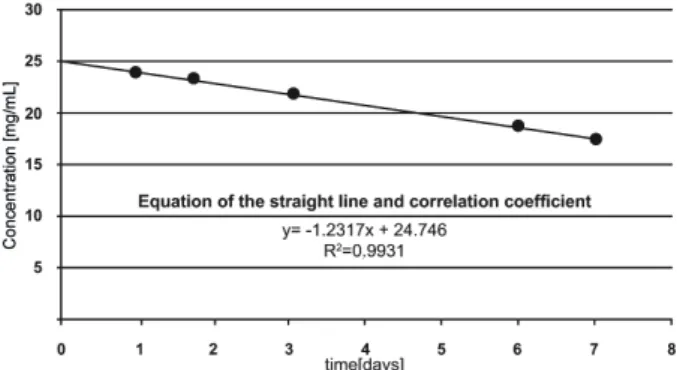
Graphs were drawn based on the degradation curve of free residual chlorine (y axis) vs. time (x axis) at each temperature; the straight line yielded determined the reaction order.
The reaction order is related to the equation of the straight line in its reduced form, that is, as represented by the expression y = ax + b (a = angular coeficient, the slope of the straight line in relation to x axis. In the study, it represents K, the reaction rate; and b = linear coeficient, the intercept of the straight line and y axis).
Degradation reactions may be of different orders, that is, the reaction order is determined by best correla-tion coeficient obtained between a given funccorrela-tion vs. time. In this study, concentration vs. time yielded the best correlation for 70 and 50 oC (respectively, 0.9931
and 0.9953); therefore, a zero order reaction. In a zero order reaction, decomposition rate is independent of reagent concentration, that is, the rate is constant (12,15). Figures 1 and 2 show the degradation curves of free residual chlorine as a function of time. The straight line equation was determined by the mean straight line in each situation using least squares itting. Based on the equation of the straight line, it is possible to calculate the concentration of the active principle at any given time. Using the speed constant obtained with samples
submitted to the 2 different conditions together with Ar-rhenius equation (equation 1), it is possible to calculate the speed constant at any temperature.
D Ha values were determined (equation 2) by means of experimental K values (K1 and K2), for
tem-peratures T1 and T2.
Log K1 / K2 = D Ha / 2.303 . R . T1. T2 / T1 – T2
(Equation 2)
if D Ha values are known, log A (equation 3) may be determined. Any experimentally determined T and K pairs may be used.
Log K = log A - D Ha / 2.303 . R . 1 / T (Equation 3)
In the present study, K70 and K50 were used to
determine the activation energy (D Ha) of the reaction, which was equal to 14.82 kcal mol-1 degree-1. Log A
was obtained using log K70, equal to 9.5309058. Based
on these results, the speed constant at 20oC was equal
to K20 = 0.030165 day-1.
Shelf-life in terms of a decrease in free residual chlorine from 25 to 20 mg/mL was determined using equation 4, based on the zero order reaction kinetics.
t = Co – C / K (equation 4)
Where: t = time (days)
Co = initial concentration (25 mg/mL) C = inal concentration (20 mg/mL)
Equation 4 estimated that it would take 166 days at 20oC for the 25 mg/mL sodium hypochlorite solution
to reach 20 mg/mL of free residual chlorine. Both studied conditions showed zero order kinetics.
DISCUSSION
Studies on the activity of sodium hypochlorite solutions as tissue solvents and bactericidal compounds are very popular nowadays (6,7). However, chlorine is highly unstable in these solutions (10,13) mainly due to factors such as presence of organic material (1,6), pH (9), temperature (18), and presence of oxygen or light (19).
The shelf-life of a given pharmaceutical presen-tation is variable and depends on the degradation of its main component. This fact underscores the importance of using sodium hypochlorite solutions showing free residual chloride content within speciied ranges, as determined by pharmacopoeia monographs, both for sodium hypochlorite as an active principle and as a component of more complex solutions.
Pécora et al. (13) evaluated the degradation of sodium hypochlorite solutions using titration to assess that chlorine content of the samples was similar to mini-mum thresholds (titration is a simple and reproducible method for the analysis of chlorine content in sodium hypochlorite solutions). However, shelf-life would be de-termined much more quickly if the method proposed here was used, provided that chlorine degradation showed a straight line with a viable correlation coeficient.
Nicoletti and Magalhães (19) evaluated the chemical stability of three different commercial bleach solutions and analyzed the inluence of oxygen in open lasks, conirming that oxygen has an important role in the degradation of this solution.
Two kinds of factors may be responsible for changes in pharmaceutical products: external (extrinsic) factors, such as time, temperature, light, oxygen, carbon dioxide, primary packaging, humidity and microbial agents; and internal (intrinsic) factors, that is, those related to the nature of the drug, such as oxidation, hydrolysis, racemization, decarboxylation, incompat-ibilities, polymerization and disammination (12).
Knowledge of the kinetics of the degradation reaction of a chemical compound either isolated or in a formula, is essential for stability studies. Kinetics of the reaction is determined by the concentration of the active substance in the formula under given conditions. Accelerated stability tests use increased reaction kinetics produced by higher temperatures, which in turn increase
the speed of the reactions affecting substances in the formula. This study model may be used when shelf-life is unknown, no matter the active principle it contains, provided there is a methodology to quantify its concen-tration. Samples subjected to high temperatures show increased rate of degradation of the active substance in the formula, making it possible to measure this degrada-tion in a short time. The importance of this study may be underscored by the fact that a preparation may have different shelf-lives depending on the environmental conditions it is submitted to, as occurs in the diversity of temperatures found in the different Brazilian regions.
RESUMO
Testes acelerados de estabilidade são indicados para avaliar, em um curto período de tempo, o grau de degradação química que poderá afetar uma substância química, isoladamente ou quando inserida em uma fórmula, sob condições normais de armazenamento. Este método está fundamentado na intensiicação das condições de estresse para acelerar a velocidade de degradação química. Baseando-se na equação da reta obtida e na ordem de reação determinada (a 50 e 70 oC) e usando a equação de Arrhenius, a
velocidade de reação foi calculada para a condição de temperatura de 20oC (condições normais de armazenamento). Este modelo
de teste acelerado de estabilidade torna possível a predição da estabilidade química de qualquer substância, em qualquer tempo, desde que o método de quantiicação da substância química esteja disponível. Como exemplo da aplicabilidade da equação de Arrhenius em teste acelerado de estabilidade, uma solução de hipoclorito de sódio a 2,5% foi analisada por ser quimicamente instável. A quantiicação do cloro residual livre foi determinada através de titulação iodométrica. A partir dos dados obtidos decor -rentes das amostras submetidas às temperaturas de 50 e 70 oC e
com o emprego da equação de Arrhenius, o tempo de prateleira obtido foi de 166 dias em temperatura de 20 oC, considerando
como limite inferior a concentração de 20 mg/mL de cloro residual livre. Este modelo, entretanto, possibilita o cálculo de tempo de prateleira em qualquer outra temperatura de interesse.
ACKNOWLEDGEMENTS
This study was supported by a grant from the Vice-Dean Ofice for Postgraduate Courses and Research of Paulista University, São Paulo, Brazil.
REFERENCES
1. Estrela C, EstrelaCRA, BarbinEL, Spanó JCE, MarchesanMA, Pécora JD. Mechanism of action of sodium hypochlorite. Braz Dent J 2002;13:53-56.
2. Silva LAB, Leonardo MR, Assed S, Tanomaru Filho M. Histo-logical study of the effect of some irrigating solutions on bacterial endotoxin in dogs. Braz Dent J 2004;15:109-114.
evalu-ation of microbial reduction after chemo-mechanical preparevalu-ation of human root canals containing necrotic pulp tissue. Int Endod J 2006;39:484-492.
4. Estrela C, Ribeiro RG, Estrela CRA, Pécora JD, Sousa-Neto MD. Antimicrobial effect of 2% sodium hypochlorite and 2% chlorhex-idine tested by different methods. Braz Dent J 2003;14:58-62. 5. Estrela CRA, Estrela C, Reis C, Bammann LL, Pécora JD. Control
of microorganisms in vitro by endodontic irrigants. Braz Dent J 2003;14:45-49.
6. Barbin EL, Spanó JCE, Santos, TC, Guimarães LFL, Pécora JD. Solvent action of sodium hypochlorite on bovine pulp and physico-chemical properties of resulting liquid. Braz Dent J 2001;12:154-157.
7. Okino LA, Siqueira EL, Santos M, Bombana AC, Figueiredo JAP. Dissolution of pulp tissue by aqueous solution of chlorehexidine digluconate and chlorhexidine gel. Int End J 2004;37:38-41. 8. Zhender M. Root canal irrigants. J Endod 2006;32:389-398. 9. Ferrari PHP, Cai S, Bombana AC. Effects of endodontic pro
-cedures on enterococci, enteric bacteria and yeasts in primary endodontic infections. Int Endod J 2005;38:372-380.
10. Bloomield SF, Sizer TJ. Eusol BCP and other hypochlorite for-mulations used in hospitals. Pharm J 1985;235:153-157. 11. Johnson BR, Remeikis NA. Effective shelf-life of prepared sodium
hypochlorite solution. J Endod 1993:19:40-43.
12. Pugh WJ. Kinetics of product stability. In: Aulton ME (Ed).
Aultons´s Pharmaceutics. The design and manufacture of the medicines. 3rd ed. London: Churchil Livingstone Elsevier 2007:99-107.
13. Pécora JD, Guerisoli DMZ, Silva RS, Vansan LP. Shelf-Life of 5% Sodium Hypochlorite Solutions. Braz Endod J 1997;2:43-45. 14. Clarkson RM, Moule AJ, Podlich HM. The shelf-life of sodium
hypochlorite irrigating solutions. Aust Dent J 2001;46:269-276. 15. Prince SJ, Ansel HC. Pharmaceutical calculations: The
Phar-macist’s Handbook. 1st ed. Baltimore: Lippincott Williams & Wilkins; 2004.
16. British Pharmacopoeia. London: Her Majesty´s Stationery Ofice. 1980.
17. Brazil. National Agency of Sanitary Surveillance. Resolution RE nº 899, on the 29th may 2003. It determines the publication of the
“Guide for validation of analytical and bioanalytical methods”. Diário Oicial da União; Executive Power, published on the 2nd
june 2003.
18. Gélinas P, Goulet J. Heat and light stability of eight sanitizers. J Food Prot 1982;45:1195-1196.
19. Nicoletti MA, Magalhães JF. Inluencia del envase y de factores ambientales en la estabilidade de la solución de hipoclorito sódico. Bol Oicina Sanit Panam 1996;121:301-309.