Cozinha da Madeira Website: The online
touchpoint for a sustainability oriented Service of
Madeira Island
Joana Gonçalves Pereira
(Licenciada em Engenharia Informática pela Universidade da Madeira)
Tese Submetida à Universidade da Madeira para a
Obtenção do Grau de Mestre em Engenharia Informática
Funchal – Portugal
Advisor:
Valentina Nisi, PhD Assistant Professor
Co-Advisor:
iv
A
BSTRACT
Over the past several years technology has been evolving in a way that it has become crucial for most businesses and companies to have interactive technology enabled touchpoints available online. Such interactive touchpoints can be developed as mobile application, webpages, or even through social networks. In the end such touchpoints will most surely represent the most easily reachable and marketable side of the business.
Today selling a product alone is no longer enough to make consumers satisfied and complete, businesses and business models are changing. Increasingly, companies are choosing to not just sell products but to combine both sale and service. These service-based approaches will provide the client with a unique and personalized experience of what the company is selling. By selling a service the company transmits values that are more complex than the simple selling of a product. A service is something immaterial, happens over time and exists in the moment of the delivery.
When conceiving and designing services, the use of the new technologies becomes a crucial step in order to craft touchpoints that facilitate the whole experience cycle of the service, from attracting, orienting, interacting and retaining the client, as well as providing later support to the consumer to advocate for the service itself.
K
EYWORDS
Service Design Sustainability Biological ingredients Sustainable Tourism Sustainable AgricultureR
ESUMO
Ao longo dos anos a tecnologia tem vindo a evoluir de uma forma que se tornou crucial a todos os negócios e empresas a terem um ponto de contato interativo disponível online. Estes pontos de contacto interativos podem ser desenvolvidos como forma de aplicação móvel, um site ou até através das redes sociais. No final, estes pontos de contactos vão certamente representar o lado mais acessível e comercial do negócio.
Hoje a venda de um produto por si só já não é o suficiente para manter os consumidores completos e satisfeitos, as empresas e modelos de negócio estão mudando. Cada vez mais as empresas optam não apenas por vender um produto, mas sim combinar a venda com um serviço. Estas abordagens baseadas em serviços irá fornecer ao cliente uma experiência única e personalizada do que a empresa está vendendo. Ao vender serviços a empresa transmite valores muito mais complexos do que a simples venda de um produto. Um serviço é algo imaterial, acontece ao longo do tempo e existe no momento da entrega.
Ao conceber e desenhar serviços, o uso de novas tecnologias torna-se um passo crucial de forma a criar pontos de contactos que facilitem todo o ciclo de experiência do serviço, desde atrair, orientar, interagir e reter o cliente, bem como providenciar apoio ao cliente para mais tarde recomendar o serviço.
descoberta de tradições e as paisagens da Ilha da Madeira. Tal ponto de contacto desenvolvido em forma de site incorpora totalmente ou parcialmente as várias fases do ciclo de experiência do serviço, desde atrair, conectar, orientar, interagir, bem como reter e proteger. Através desta tese vamos descrever o desenho e implementação do ponto de contacto desenvolvido em forma de site, como também a sua avaliação e possíveis implicações futuras.
P
ALAVRAS
C
HAVE
Desenho de Serviço
Sustentabilidade
Turismo Sustentável
Agricultura Sustentável
vii
A
CKNOWLEDGEMENTS
First of all I want to thank, Professor Valentina Nisi and Nuno Nunes for all the support and guidance through this process. Without them I couldn’t have finished this stage of my life. All feedback received was crucial to successfully complete this thesis. Also want to thank Miguel Caldeira for sharing his experience in design with me, guiding me into the best practices, and for helping me in the needed design.
A big thank you to Ruben Gouveia, José Rodrigues and Rui Alves for all the support given and patience in help every time I had some doubt, thank you so much for your availability.
To my family, especially my father and mother, to give me this opportunity to finished this stage of my academic life.
To all participants that work with me in the field study: Susana, Abilio, Stephen, Nuno, Sónia, Mauro, Ray and Susan, my thanks for your help.
To Amanda Myers and Mayur Karnik a big thanks for helping me in reviewing my English grammar.
viii
T
ABLE OF
C
ONTENTS
1. Introduction 13
1.1. Motivation ... 15
1.2. Objectives ... 17
1.3. Thesis structure ... 17
2. Literature Review 18 2.1. Sustainable tourism ... 19
2.2. Sustainable agriculture ... 20
2.3. Related Platforms ... 23
2.4. Technologies Used ... 33
3. Designing a SustainableService – Cozinha da Madeira 35 3.1. Customer Journey and Service Touchpoints... 35
3.1.1. ”Cozinha da Madeira” Customer and Food Journey... 36
3.2. Experience Cycle and Touchpoint Analysis ... 39
3.3. Service Blueprint ... 41
3.3.1. Supplier Searching stage ... 41
3.3.2. Chef Searching stage... 43
3.3.3. Participants Experience stage ... 45
4. Web-Application(Cozinha da Madeira) 47 4.1. Modeling ... 47
4.1.1. Requirements ... 47
4.1.1.1. Functional Requirements (FR) 47 4.1.1.2. Non-Functional Requirements (NFR) 48 4.1.2. Use Cases ... 49
4.1.3. Essential Use Case and Task Flows ... 51
4.1.4. Wisdom Model ... 52
4.2. Implementation Aspects ... 53
4.2.1. Model View Controller Pattern ... 53
4.2.2. Entity Relationship Diagram ... 55
4.2.2.1. Relational Model 56 4.2.3. Practical Example of MVC Pattern Using Codeigniter ... 56
4.2.3.1. Controller 56 4.2.3.2. Model 58 4.2.3.3. View 59 4.2.4. Libraries ... 60
4.2.5. Plug-ins ... 60
4.3. Web-application Design (Cozinha da Madeira) ... 61
4.3.1. Logo Concept ... 61
4.3.2. Graphic Design Decisions ... 61
4.3.2.1. Home 62 4.3.2.2. Recipes 64 4.3.2.3. Journeys 67 4.3.2.4. Ingredients 69 5. Study 71 5.1. Concerns and Goals ... 72
5.2. Participants ... 74
5.3. Method ... 75
5.4. Study 1: Usability Tests ... 77
ix
5.4.1.1. General Tasks Results 79
5.4.1.2. Chef Tasks Results 82
5.4.1.3. Supplier Tasks Results 88
5.4.1.4. Participants Tasks Results 90
5.4.2. Conclusions ... 93
5.5. Study 2 : Survey ... 93
5.5.1. Findings ... 93
6. Conclusions and future work 96 References 99 7. Appendices 105 7.1. Appendix A – Blueprint ... 105
7.1.1. Blueprint – Supplier Searching Stage ... 105
7.1.2. Blueprint – Chef Searching Stage and Participant Searching Stage ... 106
7.2. Appendix B - Use Cases Diagram ... 107
7.3. Appendix C – Essential Use Case and Task Flows ... 109
7.4. Appendix D – Wisdom Model ... 111
7.5. Appendix E – Entity Relationship diagram ... 113
7.6. Appendix F - Database - Relational Model ... 115
7.7. Appendix G–Low Fidelity Prototype ... 117
7.7.1. Home Page - Prototype ... 117
7.7.2. Recipes Page – Prototype ... 118
7.7.3. Journeys Page - Prototype ... 119
7.7.4. Ingredients Page - Prototype ... 120
7.7.5. About Us - Prototype ... 121
7.8. Appendix H – High Fidelity Prototype ... 122
7.8.1. Anonymous User - Screen Shoots ... 122
7.8.2. Role Chef - Screen Shoots ... 130
7.8.3. Role Supplier – Screen Shoots ... 134
7.8.4. Role Participant – Screen Shoot ... 136
7.8.5. Role Admin – Screen Shoots ... 138
7.9. Appendix I – Affinity Map ... 143
7.10. Appendix J – Customer Journey MaP ... 145
x
L
IST OF FIGURES
Fig. 1 - Slow food movement – Homepage [26] ... 22
Fig. 2 - WWoof Portugal– Homepage [34] ... 24
Fig. 3 - WWoof Portugal – Hosts (list view) [35] ... 25
Fig. 4 - WWoof Portugal - Hosts (map view) [35] ... 25
Fig. 5 - WWoof Portugal - Host Information ... 26
Fig. 6 - WWoof Portugal - Join Wwoofers [36] ... 26
Fig. 7 - WWoof Portugal - Join Host Farm [36] ... 27
Fig. 8 - Homepage of the website FresBio [38] ... 28
Fig. 9 - Freshbio, order form page [39] ... 29
Fig. 10 - Tukxi website [40] ... 30
Fig. 11 - Up Mountain Madeira – Lack of coherence between pages [41] ... 32
Fig. 12 - Recipe ingredients leading to customer journey ... 38
Fig. 13 - Customer Journey Map ... 39
Fig. 14 - Partial image of the blueprint - Supplier Searching Stage [1] ... 42
Fig. 15 - Image number 1 of the partial blueprint - Chef Searching Stage [1] ... 43
Fig. 16 - Image number 2 of the partial blueprint - Chef Searching Stage ... 44
Fig. 17 - Image number 2 of the partial blueprint - Participant Searching Stage ... 45
Fig. 18 - Image number 2 of the partial blueprint - Participant Searching Stage ... 46
Fig. 19 – Use cases diagram ... 50
Fig. 20 - Essential Use Case and Task Flows ... 51
Fig. 21 - Wisdom Model diagram ... 52
Fig. 22 - Web Application abstract architecture ... 54
Fig. 23 - Database : Entity Relationship Diagram ... 55
Fig. 24 - Database: Relational Model ... 56
Fig. 25 - A snippet of code of MY_controller class... 57
Fig. 26 - A snippet of code from a function within the ingredients controller ... 57
Fig. 27 - A function accessible to all controllers ... 58
Fig. 28 - A snipped of code from the ingredient model ... 59
Fig. 29 - A snipped of code of active record mechanism used in Codeigniter ... 59
Fig. 30 - Template used to manipulate the views ... 59
Fig. 31 - A snippet of code within one of the HTML files ... 60
Fig. 32 - Logotype of the CdM service ... 61
Fig. 33 - Homepage without user logged in ... 62
Fig. 34 - Homepage with a user logged in ... 63
Fig. 35 - Recipe page without login ... 64
Fig. 36 - Add recipe button ... 65
Fig. 37 - Recipe details page ... 65
Fig. 38 - Proposing a journey by choosing the recipes ... 66
Fig. 39 - Journey page ... 67
Fig. 40 - Journey details ... 68
Fig. 41 - Example of a journey with a logged user ... 69
Fig. 42 - Example of a journey with a non-register user ... 69
Fig. 43 - Ingredients page with a supplier logged in ... 70
Fig. 44 - Seasonal products page ... 71
xi
Fig. 46 - Quantitative results for the general tasks ... 79
Fig. 47 – Partial view of the interface before task #1 evaluation ... 80
Fig. 48 – Partial view of the interface after task #1 evaluation ... 80
Fig. 49 – Partial view of the interface before task #3 evaluation ... 82
Fig. 50 – Partial view of the interface after task #3 evaluation ... 82
Fig. 51 - Continuation of the quantitative analysis for the chef tasks ... 83
Fig. 52 – Web element before the task#6 evaluation ... 84
Fig. 53 – Web element after the task#6 evaluation ... 84
Fig. 54 - Web element before the task#7 evaluation ... 85
Fig. 55 - Web element after the task#7 evaluation ... 85
Fig. 56 - Web elements before the task#8 evaluation ... 85
Fig. 57 - Web elements after the task#8... 86
Fig. 58 - Partial view of the interface after task#9 evaluation ... 86
Fig. 59 - Partial view of the interface before task #10 evaluation ... 87
Fig. 60 - Partial view of the interface before task#10 evaluation ... 88
Fig. 61 - Partial view of the interface after task#10 evaluation ... 88
Fig. 62 - Continuation of the quantitative analysis for the supplier tasks ... 89
Fig. 63 - Web elements before task #5 evaluation ... 90
Fig. 64 - Web elements after task #5 evaluation ... 90
Fig. 65 - Continuation of the quantitative analysis for the participants tasks. ... 91
Fig. 66 - Web elements before task #7 evaluation ... 92
Fig. 67 - Web elements after task #7 evaluation ... 92
Fig. 68 - Brainstorming the survey answers ... 93
Fig. 69 - Affinity map to evaluate answers from the survey ... 94
L
IST OF
T
ABLES
Table 1 - Functional Requirements ... 48Table 2 - Non-Functional Requirements ... 49
Table 3 - External Libraries list used to help the development process ... 60
Table 4 - Plug-ins list used to help the development process ... 60
Table 5 - Different tasks for each type of users ... 74
Table 6 - The tasks presented for the Chef role ... 75
Table 7 - The tasks presented for the Supplier role ... 76
12
ACRONYMS
AJAX – Asynchronous JavaScript and XML CdM – Cozinha da Madeira
CSS – Cascading Style Sheet EA – Entity Association ER – Entity Relationship FTP – File Transfer Protocol
HTML – Hypertext Markup Language IDE – Integrated Development Environment JSON – JavaScript Object Notation
MVC – Model – View – Controller PHP – Hypertext Preprocessor SD – Service Design
SQL – Structured Query Language
13
1. I
NTRODUCTION
Human beings live in a world where they consume more resources than can be produced [1]. Today sustainability has become a subject that needs special attention regarding futures generations. In 1987 at a conference of the United Nations (UN) sustainable development was defined as development that “meets the needs of the present without compromising the ability of future generations to meet their own needs” [2]. Sustainability is not only about re-use and re-cycle
of materials anymore [1]. Current definitions of sustainability go beyond that, encompassing human needs and satisfactions as the main goals of this concept [2].
Accordingly to the UN, “sustainable development requires meeting the basic needs of all and extending to all the opportunity to satisfy their aspirations for a better life” [2]. Knowing exactly what people’s
needs are in present generations is difficult, trying to predict needs for future generations seems almost impossible [3]. In order to take seriously the concept of sustainable development, care must be taken in present decisions, because these can be harmful for future generations [3]. However, to understand future needs, it is important to understand the progress of sustainability [3].
There are multiple concepts behind the term sustainability, but in the end all concepts rely on increasing the quality of life for humans beings. Charles state that “sustainability are so deeply embedded in fundamentally different concepts, each of which has valid claims to validity, that a search for
a single definition seems futile”[4]. Shedroff deepened this line of thought, stating that “before
caring about humans, we need to preserve our environment” [5]. These environments not only wrap
the planet Earth but everything involved in the system: “the human systems we live in, our societies, and the forming, changing, and constantly evolving values, ethics, religion, and culture that
encompass these societies“ [5]. All of these concepts need special attention. It’s important for
humans to work together regarding the impact that our actions will take in future generations [5].
In order to tackle the problems identified in sustainability, many sustainable services have arisen in the recent past. Chun-Juei-Chou et al states that “service design has been widely adopted to improve relationships between companies and customers and it also advanced products’ life cycle for
sustainable development” [6]. Service design (SD) do not have a fixed definition. In general,
14 Stefan Holmlid define service design as “business innovations that use strategies combining process and interactive technology creating several modeling techniques for services experiences” [7]. For
example, Sue Coppard [8] designed a service that already reaches more than 50 WWOOF (World Wide Opportunities on Organic Farms) groups worldwide. Namely by WWOOF, this service aims to gather and give opportunity to support the countryside and organic behaviors [8]. People get to travel to other countries and stay on organic farms or smallholdings in exchange for food, accommodation and learning opportunities in organic farming (WWOOFers) [8]. This service allows people from everywhere to explore and help in the development of organic farms, learn sustainable techniques and contact directly with different cultures [8].
This thesis will deepen the idea of sustainable services linked to local agriculture and natural resources highlighting how tourism can be used to promote local sustainable services. In particular, the web interface “Cozinha da Madeira” was developed. This interface is a service system that combines food and travel to support sustainability while discovering Madeira’s culture and landscapes [1]. The CdM service brings food to life by combining people, products and travel through the island in search of the right ingredients for seasonal recipes. At the end of the day, a local chef will teach the guests how to cook traditional recipes from food collected by the guests at local farms. In our Thesis work we developed the web interface for such a service. The CdM web interface is an important touchpoint for attracting and connecting participants and the CdM team, organize and choose the recipes and the food producers availability. Additionally, this interface serves as an archive of photos from trips for future reference, reflection and publicity.
15
1.1. M
OTIVATION
Madeira is a major tourist destination in Portugal, as confirmed by the World Travel Award given in 2013, for being the best European island destination oriented towards tourism [9].
According to official statistics, Madeira receive a total of 4,935,666 international tourists in 2012, with an annual increase of 2% in overnights stays (from 2011 to 2012). Forecasts for future tourism are positive, comparing with 2012 [10]. The results between January 2013 and November 2013 are pointing to a total of 5,074,865 international tourists, which is an increase of 8,4% [11]. Despite the current economical crisis, these results indicate that Madeira keeps receiving a considerable number of tourists, which is a consistent part of the income of the local economy.
According to Luís Machado “tourism marketing campaigns are becoming increasingly creative” [12], and this indicates how important it is to focus on marketing to maintain growth. With all that Madeira has to offer, marketing is the key point to attract tourists from everywhere, as explained by Noémi and Vieira who stated that “all form of advertising should be used to capture the attention of even the most distracted potential tourists” [13].
The Internet is recognized as an extremely valuable tool for disseminating information about tourist destinations [13]. Tourists can schedule a trip in the comfort of their own home, using the internet. In turn, this new privileged means of communication, increase the level of requirements and expectations about the touristic destinations [13].
According to Noémi and Vieira “It’s important to transmit to the potential tourist an idea of living an unique experience in different places with singular characteristics” [13]. Thus, professionals carry an
important responsibility while communicating why tourists should choose Madeira instead of other destinations.
Manuel and Almeida point to the fact that industry actors should pay more attention to the rural sector in Madeira. They state: “This sector is in direct competition with other destinations chosen by those visitors interested in stress coping strategies, which should be capitalized on the
promotion strategies” [14]. Rural tourism enables a close proximity with nature and a direct
16 on agricultural use on Madeira, in 2012 there were 73 farmers producing organic goods, with a respective area of 169 hectares [15]. Additionally, there are more than 29 farmers exchanging 27,9 hectares for this kind of production which should increase the attraction for rural tourism [15]. Regarding the sustainable practices that have been increasing over the years in the country side, tourist are likely to be more interested in seeing biological lands instead of industrial ones.
The industry should take more advantage of rural tourism, creating more opportunities and choice in this segment, including both “tours around the island for adventurous travelers, but also culturally oriented visitors” [14]. There should be an attempt to match the expectations of those
who “wish to improve their knowledge about the local natural environment and culture” [14]. It is
important to raise the tourist’s satisfaction levels, because “maximizing tourist’s satisfaction is an important factor for the destination’s success, satisfaction is associated to the will to return, or to
recommend, the destination” [12].
17
1.2. O
BJECTIVES
This thesis aims to design and develop an online touchpoint to Cozinha da Madeira’s service. Using the internet as a means of communication will enhance interaction between stakeholders, resulting in higher visibility for our service. Tourists who wish to visit Madeira, will have an available online touchpoint, in the form of a highly interactive website, which is reachable from any location. In this website they will find meaningful information regarding what the service has to offer and how to organize themselves in order to participate. Furthermore, the website stores shared experiences and stories in the form of pictures and comments from past trips, generating something new and different from the normal tourist experience. Through the CdM service, users, will be able to enjoy the natural landscape and beauty of the island, the gastronomic traditions, and the local culture – all in one experience. The CdM website touchpoint is a communication gateway between users and the service, allowing them to subscribe to the service and enjoy the given experience. Additionally, a usability test has been conducted in order to evaluate the user experience with the web touchpoint of the service. After the usability test, we also conducted a mini-survey to gather some insights about the service concept itself. Finally, towards the end of this thesis the findings will be discussed. Conclusions will be drawn from those, and possible future improvements to the adopted solutions will be proposed if applicable.
1.3. T
HESIS STRUCTURE
This thesis is organized in six chapters:
1º Chapter – The first chapter will give the context of our theme.
18 3º Chapter – This chapter describes the service concept of Cozinha da Madeira, including the touchpoints available and the blueprint map for each type of user (Supplier/Chef/Participant), are explained with particular attention to the internet based touchpoint, namely the website.
4º Chapter –This chapter is divided in 3 main sections:
Modeling: This section will overview the modeling aspects of the website, with reference to requirements, the use cases, the essential use case and the wisdom model.
Implementation aspects: In this section, the implementation aspects of the site will be detailed, including the type of architecture chosen to develop the website and the database diagrams. This section will include the libraries and plug-ins used to help the development phase.
Web-application Design: In this section the justification of the design decisions taken into account when developing the service’s website will be given.
5º Chapter – In this section the methodology used to develop the usability tests and the mini-survey will be presented. This section will also include the findings and conclusions from the study.
6º Chapter – General conclusions about all of the processes taken to develop and execute this thesis work and some preliminary ideas for future work will be presented. This chapter will also include, procedures that have to be done to continue and improve this work.
2. L
ITERATURE
R
EVIEW
In this chapter we present some important issues about sustainable tourism and sustainable agriculture will be overviewed. Some services that have overlapping concerns in terms of tourism, food and sustainability like CdM will be addressed.
19
2.1. S
USTAINABLE TOURISM
According to the Word Tourism Organization (WTO), tourism is defined as “the activities of persons travelling to and staying in places outside their usual environment for not more than one
consecutive year for leisure, business and others purposes not related to the exercise of an activity
remunerated from within the place visited” [16]. In the 20th century, tourism stands as the most
socio-economic phenomena [16]. Back then, not everyone had the privilege to enjoy this activity, but around 1970 the concept of tourism became a mass consumption [16]. Nowadays the number of people willing to travel around the world keep growing massively, along with the dissemination of shared economic values in many countries [17]. Due the fast growth of the tourism sector, many countries encounter big changes in their natural, cultural and socio-economic environments. This results in eventual identification that the short-term benefits of tourism is married to the negative impacts of increased stress on the local environment [18]. These negative impacts involve damaging the environment and societies, which slaughters the basis on which tourism increases local prosperity [18]. Frederico Neto, emphasizes that “countries and regions where the economy is driven by the tourism industry have become increasingly concerned with the environmental, as well as the socio-cultural problems associated with unsustainable
tourism” [16]. It was acknowledged that tourism could bring more economic value to host
communities, help with poverty alleviation, and preserve natural and cultural assets along with other benefits if performed in a sustainable manner [18]. Sustainable tourism, as described by the WTO in the context of the United Nations, is defined as the act of preserving resources in a way that economic, social and aesthetic needs can be accomplished having in consideration the cultural integrity, essential ecological processes, biological diversity and life support system [16]. Host communities started adopting an awareness of the problems of unsustainable tourism [18]. This kind of awareness regarding sustainability concerns eventually, reached the national, regional and local tourism policies [18]. Sue Berry and Adele Ladkin performed research to evaluate how sustainable tourism is understood by small businesses at the local level [19]. This study was conducted in three different regions in the south coast of England [19]. The method chosen to perform this study, was using focus group, that aim to create a flow of discussion between the interviewer and the individuals being polled [19]. The researcher works as a facilitator, recording the group discussion for later analyses [19]. The people invited to the study “consisted of a selection of people who ran small business, such as bed and breakfast
20 gathered some interesting findings from the groups, that may help to promote sustainable behaviors in the tourism sector. These include, the design of new services to promote less known areas of the local regions [19]. The respondents also felt that communicating an image of locals adopting and using sustainable practices may increase the flow of tourists to the region. Tourists that appreciate environmental quality would definitely choose a destination with these types of characteristics [19]. The interview groups also suggested that “ the government and the local tourism industry should collaborate to educate people to be more respectful towards the
environment, with children being the most receptive” [19], p. 437. Local activities should also make
use of local products and this would improve the local economy [19]. The author concludes with two important key points: “there is a place for the general macro principles of sustainable tourism” and “decision making and implementation must have a strong regional and local focus in order
to these principles to become workable practice” [19], p. 439.
2.2. S
USTAINABLE AGRICULTURE
According to David Tilman et al, sustainable agriculture is seen “as a practices that meet current and future societal needs for food and fiber, for ecosystem services, and for healthy lives, and that do so by
maximizing the net benefit to society when all costs and benefits of the practices are considered” [20].
Petit et al state that “sustainable agriculture is concerned with the ability of agro ecosystems to remain productive in the long term” [21]. These concerns have to do with the use of “heavy reliance on
chemical fertilizers, pesticides and herbicides, the destruction of wildlife habitats, environmental pollution
and risk to human health” [22]. With the growth of earth’s population, by 2050 both population
size and the need for resources is estimated to double [20].
Angela Maycock states that across the United States, “green initiatives are growing into a powerful, popular phenomenon” [23]. The organic food movement is key in supporting these green
initiatives [23].
21 preserving cultural life and promoting sustainable practices around the agricultural sector, working with organic farms, and helping the local economy by promoting the local farms [25].
This movement started in Italy with a simple reaction to the invasion of fast food chains [24]. Nowadays it has reached worldwide with a membership of 100,000 people all over the world. It has outlets in 150 countries, grouped in 1,500 local divisions, named ‘convivia’ [26]. These groups are responsible to “develop activities, projects and events at a local, regional and global level”[26].
“Slow Food envisions a world in which all people can access and enjoy food that is good for them, good for
those who grow it and good for the planet” [25]. The core concept of the slow food movement is
connected with three principles: Good, clean and fair [25].
Good: A fresh seasonal diet which is part of the local culture [25] .
Clean: “Food production and consumption that does not harm the environment, animal welfare
or human health” [25].
Fair: Fairness between the price versus condition for consumer and producers [25].
These three principles represents a guideline to be used in all local initiatives around the globe related with the slow food movement [24].
Today this movement includes, “more than 5000 Slow Food initiatives each year, over 10,000 small producers involved in more than 400 Presidia projects [27], Over 1000 products at risk of extinction
promoted through the Ark of Tastcatalog [28], 1,300 food education activities [29] and 350 school
gardens in 100 countries and Terra Madre network[30] activities which involve 2,000 food
communities, 1,000 cooks, 500 academics and 1,000 young activists” [26].
Vicky Berkley demonstrate the importance of the slow food movement in his revision about the book of “the slow food story: politics and pleasure”, the author state: “reminded me of the valuable role for local foods and artisan products in preserving local knowledge and sense of place, as well as in
creating connections between food producers and consumers” [24].
22 world map, with all the ‘convivia’ events available by country. This information is useful because local communities can obtain access to the slow food movements within their countries, increasing the slow food community around the globe. The slow food movement organizes a lot of events around the theme of sustainable behaviors, and the website allows for the sharing of organizational information for these events. All of the testimonials available on the website give examples of positive words and experiences which helps to promote the movement and keep this community growing. In the end, without a worldwide website touchpoint this movement would not have the visibility they currently have.
23
2.3. R
ELATED
P
LATFORMS
This section will review some projects that are focused on the themes of tourism, food and sustainability, followed with a brief discussion about the website touchpoint used to promote the project.
WWOOF (WORLD WIDE OPPORTUNITIES ON ORGANIC FARMS)
WWOOF aims at supporting the countryside and organic behaviors [8]. People who are associated with the WWOOF project get to travel to other countries and stay in WWOOF’s organic farms or smallholding in exchange for food, accommodation and learning opportunities in organic farming (WWOOFers) [8]. This service allows people from everywhere to explore and help in the development of organic farms, as well as learn sustainable techniques and have direct contact with different cultures [8]. Portugal is part of the many countries that contribute to this project [31]. WWOOF is a non-profit organization; therefore, membership fees are requested for host finding services and maintenance of contacts for future wwoofing experiences [32]. The WWOOF group from Portugal charges 25€ annually per volunteers and 15 € for farmers [32]. After the registration, the users are the ones responsible for making contact with farmers to arrange the stay on their land .
WWOOF makes use of an internet touchpoint in the form of a website. This platform serves as a bridge of communication between WWOOF hosts from Portugal and wwoofers from around the world. With this touchpoint, people who want to be involved and participate can find all the information they need on the website. To be able to interact with each other they have to pay for a membership account [32].
“WWOOF has a very simple principle: In return for volunteer help, WWOOF hosts offer food,
accommodation and opportunities to learn about organic lifestyles” [33].
Shown in the
24 Fig. 2 - WWoof Portugal– Homepage[34]
25 Fig. 3 - WWoof Portugal – Hosts (list view) [35]
26 Fig. 5 - WWoof Portugal - Host Information
Another important feature of the wwoof web interface is the join task. Here the users can choose which role they want to practice. If they have an organic farm to receive people, they definitely will be registering a host profile (Fig. 7), or if they are just an individual traveler who wants to travel and experience other cultures and learn techniques about organic behaviors in the farms, those users will chose the wwoofers profile option (Fig. 6).
27 Fig. 7 - WWoof Portugal - Join Host Farm [36]
In conclusion, the website of the wwoof group from Portugal has all the needed information to connect hosts and potential wwoofers. The design and implementation of the website is efficient and complete, but it lacks of the local characteristics and colors of Portugal. Thus users will not have a strong impression of where the experience takes place through this website. From this web touchpoint it is clear that it is important to foster the users participation in the service by depicting the local aspects of the experience as well. This can be achieved by giving them as many indicators as possible of how would such experience will look and feel in actuality on the website.
FreshBio – Produtos biológicos
FreshBio is a distribution company and home delivery service of organic ingredients, from local organic farms in Madeira [37]. This local company delivers fresh high quality products to their customers. They choose regional products, because it’s fresh, require less fossil fuel and promotes the development of the local economy [37]. The main goal of the Freshbio is to encourage healthy eating habits, promote the sustainability of the agricultural ecosystem, develop community cooperation and promote social consciousness [37].
28 Fig. 8 - Homepage of the website FreshBio [38]
´
Besides the home page, the rest of the website, is confusing and not easy to navigate. This is particularly true of the Freshbio website ordering page as shown in Fig. 9. Since this service is based on ordering local ingredients to deliver to the client’s homes, the order page should be carefully designed, as it is the most important requirement of the website. For example in the selection of ingredients (Fig. 9), form requires the user to select the ingredients that they do not want instead of selecting the ingredients that they do want to order. This is counter-intuitive and may lead the user to make the wrong order.
29 Fig. 9 - Freshbio, order form page [39]
30 Tukxi – Eco City Tours
Tukxi is a local company that provides customers with an eco experience in the heart of Funchal, the main city in Madeira. Tukxi uses an electric car to give the tours around the city, in an ecological fashion. The car was inspired by the Italian dolce vita glamorous style and the iconic three wheeled Ape Calessino [40].
Fig. 10 - Tukxi website [40]
The website of this service (Fig. 10) has only one page, where they have all the information about the service, including the tours routes available. Some of the tours have an icon representing what is included, like making stops to take pictures, or even to a walk guided tour, it depends on the tour route. Each tour also has the price per person and the estimated time the tour will take.
31 right at the beginning of their touchpoint. The customers can get confused, and the site could benefit from organizing the information by categories. Having the information separated by categories helps the client to find what they want more quickly. For example if the website showed them routes that could be filtered by the characteristics of each route, it would decrease the time wasted trying to understand the meaning of each icon represented in each tour. On the other hand the video used to disclose the service is very clear and explicit and shows in a few minutes what they do and what can be accomplished with this experience.
To conclude, the Tukxi website is in some ways informative, but overall cluttered. A gallery to show happy moments from the tourists who previously enjoyed the service, and wanted to share with future customers would also be beneficial, since the experience seems fun and entertaining. It is important to keep the customers interested, both indicating the good service, as well as some of the particulars of the experience for example stopping to let the customers take photos, which allows the tourist to save specials moments and memories.
Up Mountain Madeira
UMM (Up Mountain Madeira) is a local and small company who cares about sustainable tourism, local art and traditional culture [41]. It is a service more directed for tourist who are interested in getting to know Madeira from a cultural and artistic perspective, without engaging with big crowds of tourists. This company organizes tours around the island in a open classic jeep, with a small group, the driver and a few tourists [41].
32 Fig. 11 - Up Mountain Madeira – Lack of coherence between pages [41]
33 touchpoints and in this case websites need to be simple to use and need to present clear information with an easy means of preliminary engaging with the service.
2.4. T
ECHNOLOGIES
U
SED
This chapter summarizes the core technologies used across the CdM web touchpoint
development process, from the modeling phase, through design and implementation.
Cacoo
“Cacoo” is a free web application used to drawn differences types of diagram from wire frame
diagrams, site maps, architecture, mind maps and much more. This software was used to
design all the diagrams used in the modeling phase. MySQL Workbench MySQL Workbench is a unified visual tool for database architecture. This software was used to design the database. With this software it was possible to export the SQL file, to thereafter be upload to the server (refer to appendix E). Xampp This tool was used to simulated a local server, working in a local host. Testing and debugging while programming is facilitated by using a local host. Adobe Illustrator & Adobe Photoshop
Adobe Illustrator and Adobe Photoshop are both image editing tools. Illustrator was used to
design the low fidelity prototype (refer to appendix F) and the Interactive map representing
Madeira. Photoshop was used to design all the visual aspects of the website, as demonstrated in
the high fidelity prototypes (refer to appendix G) and the respective poster of the Cozinha da
Madeira Service (refer to appendix H).
34 Filezilla
Filezilla is a free ftp client, used to manage the files in the server.
Netbeans is a IDE (Integrated Development Environment)
Netbeans was the platform used to program in PHP. Programming with a good IDE like
Netbeans makes the work easier for the developer, providing a lot of useful tools that will
increase the time of development.
Notepad++
Notepad++ is a very good code editor. This software was used to program the client side of the
website (HTML/CSS/JavaScript). After uploading the full website to the online server.
Notepad++ in addition to a plug‐in called NppFTP, it was possible to connect with the server
and make the possible modifications without using the local host again.
Dropbox
Dropbox was used to share the work with the stakeholders of this project.
Mendeley Desktop
35
3. D
ESIGNING A
S
USTAINABLE
S
ERVICE
–
C
OZINHA DA
M
ADEIRA
Designing sustainable solutions requires designers to present alternatives that comply both to user’s needs and, at the same time, are beneficial for the environment and for the local communities. This encourages the users to change from un-sustainable behaviors to more sustainable ones [1].
Users do not desire a given system of products or services. They look for the benefits or results of these services or products. These results can change in time but can be achieved by combining different products and services.
In this project our goal is to design a web based touchpoint to support the CdM sustainable service. Furthermore CdM aims to create a mental model in the tourists minds about the acquired experience, that perhaps might inspire them to choose more sustainable practices in their future tourism experiences.“Our approach investigates a holistic view of the Madeira culture, rituals, influence, products, and services contemporary as well as past. Traditions that have been
practiced for a long time in the island and have disappeared over time” [1].
In brief, the major goal of the CdM service is to promote sustainable habits, i.e. to think, act, reflect and consume sustainably. Thus, through our CdM touchpoint we provide an attractive entry and orientation guide on how the service works and how to engage with it. Furthermore, since we hope that the experience might motivate users to opt for similar experiences in others places, we provide a repository for sharing their experiences, storing their memories and contributing with comments and pictures to the CdM website.
3.1. C
USTOMER
J
OURNEY AND
S
ERVICE
T
OUCHPOINTS
36 all the dimension of the service experience can be explored [1, 42]. The customer journey map is valuable to identify the service touchpoints, in which customers and service meet and interact. As mentioned by Stickdorn and Schneider, touchpoints can take many forms, from personal face to face contact between individuals, to virtual interactions with a website or physical trips to a location [43]. Each touchpoint allows the interaction between the customer and the service.
The touchpoints should be presented to the customers in a positive way, with good design as each touchpoint is an important and crucial interaction that can make or break the service [1, 43]. Designers must pay particular attention to the development of touchpoints, because these points are where they can look for opportunities to innovate and improve the overall service process, thus leveraging the user experience [1].
The CdM customer journey enables a series of touchpoints in a way that promotes and helps to understand sustainable practices. These points are based on, or intensified by, social context and technological aids. Each touchpoint was designed to provide customers with a unique moment, resulting in a memorable experience for them [1]. In the next section, the CdM’s customer journey map will be detailed in order to illustrate how the web based touchpoint we designed fulfills many of the service requirements supporting several touchpoints along the customer’s journey. .
3.1.1.”Cozinha da Madeira” Customer and Food Journey
37 dismissing the need to physically appear at CdM’s headquarters. Each time a recipe is proposed by the chefs and accepted by the CdM staff a journey is ready to accept participants (Fig. 12). Once there are enough people subscribed to a journey, the food journey is ready to start. This information is managed throughout the website by the CdM staff, who contact the farmers and food providers to test the journey route. Ingredients that are unavailable will be purchased at the supermarket and stored in the kitchen facilities. The information about the number of ingredients available to be collected around the island and the ingredients that have been acquired is stored on the website to keep customers informed of what they will be doing during the journey.
The journey starts at CdM headquarters, which can be one of the service’s main touchpoints depending on the client’s choices. Clients can either use the website or go directly to the headquarters.
In the headquarters, a driver will be waiting in his van for all the participants, associated with the service, to start the journey around the island to collect the ingredient for their meal. After passing by the first and the second touchpoint, the van will be the third touchpoint, where the driver will be responsible to take them around the island and make the stops. During the journey there will be some stops, to show to the participants our island, the beauty of its landscape, endemic forest (Laurisilva [44]) and agricultural places. During each stop, the participants are allowed to take pictures, which can be uploaded to the website referencing the journey, and share comments with others participants about their experience, creating the CdM social community. It is important to create a spot where people who experienced the service can share their experiences to others that participate or want to participate in the service.
Suppliers that have ingredients related with the journey recipe agree to receive our participants in their homes. Consequently, they show them the land and share some knowledge about food and agricultural products. The suppliers home is considered the fourth touchpoint, here suppliers will share with the participants their story, and what they do on the farm. Each touchpoint will have something special to be shared with the participants. The website is both the first touchpoint and the last touchpoint, because we expect that the participants, suppliers and chef, share their experience with us, the CdM staff, with the CdM community and everyone who wants to be part of the Cozinha da Madeira service.
38 name of the localities where they will travel through. The website allows users to share information with the intent to improve client engagement towards the service (Fig. 12). Back on the farm, after collecting all the ingredients during the trip, the van returns to the starting point in CdM headquarters. The kitchen is the fifth touchpoint, and customers are free to learn with the chefs how to prepare the food in the kitchen facilities, or go home and rest, while waiting for dinner to be ready [1].
Fig. 12 - Recipe ingredients leading to customer journey
39 Fig. 13 - Customer Journey Map
3.2. E
XPERIENCE
C
YCLE AND
T
OUCHPOINT
A
NALYSIS
40 assumption that experience emerges from the activity of persons acting in a setting and is embedded in context and ongoing social practices [13]. The experience originates from context and social practices, allowing people to engage physically and emotionally with the service.
Dubberly and Evenson developed a model of the ideal “experience cycle”. The stages of that model are: ”i) connect & attract – the initial connection with the person and using that contact to make an effective and effective impression, ii) orient – the overview or preview or what’s available or
possible, matching expectations and allowing exploration and supporting the early stages of learning, iii)
interact – the completion of valuable or valued activities while delighting the senses, skilling, and establishing expectations about the overall content of encounters, iv) extend & retain –the person comes
back for more as their expectations are raised, creating loyalty and leveraging existing experiences and v)
advocate - the person actively communicates their satisfaction level to others” [46].
In the CdM service Stage i will be achieved through advertisement and marketing material as well as the CdM website [1]. The website functions as an attraction point by presenting the service using aesthetically careful design and attention to depicting the location and core competency of the service. Stage ii “in our service this is accomplished through the online touchpoint: the website” [1]. Users will be oriented to the experience via prior user testimony which will give
41
3.3. S
ERVICE
B
LUEPRINT
Service blueprint serves to specify in detail every aspect of the service [43]. This approach helps to project the service delivery process giving a visual schematic of the user, the service provider and other stakeholders that maybe be involved in the service. This artifact, creates a visual connection between the customer contact and the behind-the-scenes processes [1, 43]. The service blueprint involves the physical evidence of the service encounter in each touchpoint [1]. Our service has the reception, a physical spot responsible for interacting with the customers in order to give answers about any doubts that the customers may have, the kitchen where the Chef will cook for all participants, the food storage to keep the food fresh to serve to the customers, the van that will take all the participants through the island creating a beautiful journey, amongst others physical evidence that complement the CdM service. The line of interaction separates the touchpoint and the onstage. Touchpoint represent a point of contact between the customer and the service. Our service has the website, email, phone and a reception with a receptionist, that belongs to the onstage, in charge of responding to requests by customers. The onstage actions are defined as visible to the customer, and situated above the line of visibility [1]. Below the visible line we have the backstage actions and the supporting processes. In the backstage actions we have all the necessary actions to make the service happen, a bit like the behind the scenes in a theater. Since CdM is a complex service, a blueprint was developed to visually explain how to co-create and stage the experience [1].
The blueprint was divided in three services stages, the Supplier Searching stage, Chef Searching stage and Participants Experience stage. Further detail is provided in the following sub-sections. In the following sections we will highlight where the internet components are and further explain what it does in the blueprint.
3.3.1.Supplier Searching stage
42 (point number one). After registering on the website they can start introducing ingredients using the website touchpoint. The website has an interaction map of Madeira Island where suppliers can add ingredients. All this data will be available on the website (point number three), to be used by the Chefs to introduce new recipes. Each time a new ingredient is added, the ingredients information is updated on the website to keep the Chef aware of what is new (point number four). The Staff of CdM are responsible for contacting and checking the supplier’s location to guarantee that the data available on the website about the ingredients is reliable. When everything is confirmed, the staff can update the ingredients information on the website, if necessary.
43 3.3.2.Chef Searching stage
The process of interaction with the service works in the same way across all roles. As mentioned in the previously section, the interaction can be through email, phone or website. Customers wanting to be part of the service as a Chef just need to do the registration on the website choosing their role (point number 1). The Chef can be any person who enjoys cooking or works as a chef on a daily basis. He is responsible for introducing recipes and propose menus to create journeys. All these actions can be done on the website (point number 1). The recipe is evaluated by the CdM Staff, and if required a new page with the journey details will be exposed on the website, ready to receive participants willing to participate in the journey (point number two and three).
44 When the journey has enough participants, the staff contacts the chef to confirm the journey, and all the participants receive an email with the confirmation of the journey with all the details of the same (point number four, see Fig. 16).
Fig. 16 - Image number 2 of the partial blueprint - Chef Searching Stage [1]
45 3.3.3.Participants Experience stage
The participant co-creates the service passing over the line of visibility of a “traditional restaurant experience by engaging into many actions, that traditionally would be part of the backstage (e.g buying
ingredients from the local farmers and getting involved in cooking the recipes together with the chef)“ [1].
.
Fig. 17 - Image number 2 of the partial blueprint - Participant Searching Stage [1]
46 to be cooked in the kitchen facilities in the CdM headquarters, at the end of the dinner, as we can see in the Fig. 18 the final stage of the participants experience, they can use the website to give feedback about their experience with the service (point number three) and also the chefs at the end of the dinner can give feedback (point number four). The full blueprint of the Participant Searching stage can be seen on the appendix A.
47
4. W
EB
-A
PPLICATION
(C
OZINHA DA
M
ADEIRA
)
After gaining a deeper understanding of service design and its implications, we designed one of the touchpoints in our service: a website. It allows non-subscribers and subscribers to visualize what ingredients, recipes and journeys are available and also the feedback provided by previous participants.
4.1. M
ODELING
Modeling is an important and necessary process to design an application. It helps to, write, design, create, discuss and visualize ideas in the lower stages of the design conception, decreasing possible risks and errors in the implementation stage.
4.1.1.Requirements
A requirement is a specification of an action or condition that the system must be able to satisfy [47]. The information gathered about the project is important, giving us a detailed perception of what the system should be able to do. Requirements can be categorized as functional requirements or non-functional requirements [47]. These requirements were created based on the service concept and discussions with the supervisors.
4.1.1.1.Functional Requirements (FR)
48 The CdM functional requirements are:
Table 1 - Functional Requirements
ID Description
FR1 The Chef, suppliers and participants must be able to register on the system. FR2 All Stakeholders must be able to edit their personal data.
FR3 The suppliers must be able to add ingredients on the system. FR4 All Stakeholders must be able to visualize their profiles.
FR5 The system must allow the addition of further information about the previously added products.
FR6 The suppliers must be able to add, remove and edit ingredients. FR7 The chef must be able to add a new recipe.
FR8 The chef must be able to propose a journey.
FR9 The chef must be able to add, remove and edit recipe.
FR10 The system must allow the registered users to dislike a previously added like. FR11 The system must allow the registered users to remove a previously added
comment.
FR12 The system must be able to filter all the available ingredients through the present season.
FR13 The system must be able to notify the chef that he/she was selected for the journey.
FR14 The system must allow all the participants to sign up for the journey. FR15 The system must be able to detect that the minimum number of participants
allowed are already full.
FR16 The system must be able to inform about the journey details to all participants. FR17 The system must be able to detect which ingredients did the suppliers not
provide
FR18 The system must allow the addition of comments from the registered users FR19 The system must allow the addition of likes from the registered users
FR20 The administrator of the website should be able to insert, edit and remove any type of information.
FR21 The system must be able to show important information about the service, including the address of headquarter CDM
4.1.1.2.Non-Functional Requirements (NFR)
49 The non-functional requirements are:
Table 2 - Non-Functional Requirements ID Description
NFR1 The system shall protect the data from unauthorized access. NFR2 The system shall allow users to add any type of file to the system
NFR3 The system query shall not take more than 3 minutes to retrieve data from the server.
NFR4 The system shall be prepared to backup the data in case of a fail
NFR5 The system shall allow that the users could access to their account permanently 4.1.2.Use Cases
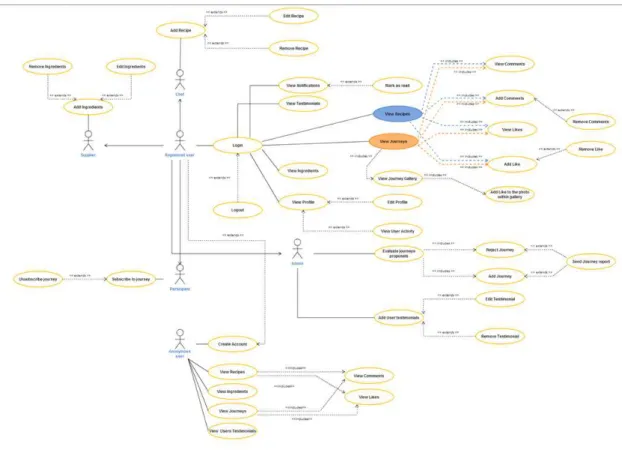
Use cases are used to help the designer to identify the roles of users that interact with the system as also the type of interaction. In this diagram two major swim lanes divide user intentions and system responsibilities. The notation is quite simple, we use sticky figures to represent actors and ellipses representing the use cases [48]. The relationships between use cases are represented by includes and extends. Include is used when you want to avoid duplication of uses cases, the base use cases incorporates the included case behaviors [47]. The extend relationship implicitly incorporates the extended use case behavior [47]. Lano and Wiley deepened the relationship includes and extends between uses cases, stating that “every execution of the including use case contains an execution of the included use case, and there exists an execution of
the extended use case that contains an execution of the extension use case” [48].
The actors represent entities that directly or indirectly interact with the system. In our project we have five actors: chef, supplier, participants, administrator and unregistered users. In detail:
Chef – Responsible for adding recipes and propose journeys.
Supplier – Responsible for adding ingredients that are included in the recipes, that were added by the Chef.
Participants – Interact more actively in the system by commenting and putting likes in the proposed recipes or journeys, keeping a level of social communication and sharing between all the stakeholders.
50 Unregister user – An unregistered user is able to visualize all the social communication between the stakeholders already subscribed, the journey, recipes and information about ingredients.
The users can interact through the system, based on their role (participant, chef, supplier or
administrator). Each actor can have equal interactions or a few specifically directed to their role.
For example the supplier is the only one that can add ingredients. Such interactions are
represented by the use cases, which represent the overall functionalities of the system. Fig. 19, is the use case diagram, in which all actors and use cases are depicted (refer to appendix B – Use cases diagram).
Fig. 19 – Use cases diagram
51 4.1.3.Essential Use Case and Task Flows
The Essential Use case model is where we choose the most important uses case, that needs a special attention, i.e. these are technology free, general descriptions of user intentions and system responsibilities. The essential use cases show us the flow between the system and the user, giving us a sequence of interaction, with abstract steps, represented by the users intentions and the system responsibilities, as aforementioned. This diagram allows us to have a variety of concrete implementations [49]. In the Fig. 20, we can see a combination of these models (refer to appendix C – Essential Use Case and Task Flows).
52 4.1.4.Wisdom Model
The Wisdom architectural model represents the logic map of the system where we have the different user interfaces of the system. This model is an improvement of the UML modeling (object oriented), and concerns with the overall organization of the user interface in an interactive system. Depicted in Fig. 21, we have the view class elements that represent the interaction space within the user interface. These elements are used to build the interaction model between the system and the users (human-actors) [50]. This model also depicts the connections between the interaction spaces (through the notions of <<includes>> and <<navigation>>). Additionally, it also describes how the physical interaction within the system
takes place. This is achieved through the notion of input element (incoming information on the interface), output element (outgoing information on the interface) and actions (actions that can be done on the interface) [50]. This model can be found in Appendix D – Wisdom Model.
53
4.2. I
MPLEMENTATION
A
SPECTS
All services encompass several touchpoints, through which participants interact with the service. In CdM, we have designed and developed a website, which is one of the touchpoints available to interact with the service. With this platform users can access all the information related to their roles in the service and the feedback given by people who have used the service, thus creating a CdM community, where people can exchange lived ideas and experiences.
This website was built, using an FTP server, a database (MySQL), to store all the needed data. In what concerns development, CdM’s website was built according to the Model View Controller (MVC) programming paradigm. Several technologies were used to implement it, namely, CSS (Cascading Style Sheet), PHP (Hypertext Preprocessor), Javascript and HTML (HyperText Markup Language). HTML was used for the interaction spaces, CSS was employed for formatting and to take care of the look and feel, PHP was employed for data handling and, last but not the least, Javascript was the scripting language used to build the client-side scripts to interact with the user.
In the next section we present all the development process to implement the website of CdM.
4.2.1. Model View Controller Pattern
To implement the web application, we used a powerful open source PHP framework named Codeigniter [51]. This framework is known for being extremely easy to use and practice with a very clear documentation, which helps the development and is based on MVC programming paradigm.
54 Fig. 22 - Web Application abstract architecture
The Codeigniter framework explores the directory into three folders, Model, View and Controller creating a coherent structure. The model, represent the application data, allowing us to manage the database through which it can fetch, modify, insert and remove data [51]. All the files within the view folder, represents the output of data to our users and visitors of our application, no programming logic, SQL (Structured Query Language) queries, or any type of script must be run here [51]. The controller is the “brain” of the MVC pattern where all the programming logic occurs. It is responsible for calling and fetching the data from the Model and further on for load the data and passing it to the Views, thus sending the results to the users. It’s a very clean way to keep your code organize and makes it easy to maintain the code repositories.
55 4.2.2.Entity Relationship Diagram
Entity Relationship diagrams (Fig. 23) are graphical specifications that represent the static relationships within the system [47]. The purpose of this diagram is to represent all the entities involved in the project along with their attributes and the relations between them.
Fig. 23 - Database : Entity Relationship Diagram
56 4.2.2.1.Relational Model
Fig. 24 represents the relational model that define the tables of the database and their relationships. This model can be found in the appendix F.
Fig. 24- Database: Relational Model
4.2.3.Practical Example of MVC Pattern Using Codeigniter
In this section we will show the internal behavior of the MVC pattern using the Codeigniter framework. We will also show some snippets of code to demonstrate how the Codeigniter deals with the communication between model, controller and view.
4.2.3.1.Controller
$this-57 >ingredients_model->get_all_ingredients()), to receive the necessary data to print to the view. Codeigniter uses the array $data to keep all the information that we want to send to the view, the index that we assign is the one used in the view to access the data. Respecting the principle of DRY (don’t repeat yourself), Codeigniter allows us to extend the core system class [52]. The way that is ensured is by creating a file called “MY_Controller” inside your local “application/core” directory and guarantee that all the available controllers extends “MY_controller” instead of “CI_controller” that represent the core controller of the Codeigniter framework [52], (Fig. 25).
Fig. 25 - A snippet of code of MY_controller class
Fig. 26 - A snippet of code from a function within the ingredients controller
58 Fig. 27 -A function accessible to all controllers
4.2.3.2.Model
Models are responsible for working with information available in database. The folder ‘Models’ contains PHP classes to each kind of data that needs to be manipulated [53]. To maintain the organization of the code, we have different classes to treat different data. Here we show an example of the “ingredients_model” that have all the necessary functions to manipulate the ingredients within the database.
To use the classes within the ‘Model’ folder, each class needs to be called within each controller (Fig. 25).
![Fig. 1 - Slow food movement – Homepage [26]](https://thumb-eu.123doks.com/thumbv2/123dok_br/15683647.626102/22.892.112.742.441.889/fig-slow-food-movement-homepage.webp)
![Fig. 6 - WWoof Portugal - Join Wwoofers [36]](https://thumb-eu.123doks.com/thumbv2/123dok_br/15683647.626102/26.892.201.654.159.501/fig-wwoof-portugal-join-wwoofers.webp)
![Fig. 10 - Tukxi website [40]](https://thumb-eu.123doks.com/thumbv2/123dok_br/15683647.626102/30.892.285.569.374.805/fig-tukxi-website.webp)

![Fig. 14- Partial image of the blueprint - Supplier Searching Stage [1]](https://thumb-eu.123doks.com/thumbv2/123dok_br/15683647.626102/42.892.181.673.431.1034/fig-partial-image-blueprint-supplier-searching-stage.webp)
![Fig. 15 - Image number 1 of the partial blueprint - Chef Searching Stage [1]](https://thumb-eu.123doks.com/thumbv2/123dok_br/15683647.626102/43.892.149.791.481.1030/fig-image-number-partial-blueprint-chef-searching-stage.webp)
![Fig. 16 - Image number 2 of the partial blueprint - Chef Searching Stage [1]](https://thumb-eu.123doks.com/thumbv2/123dok_br/15683647.626102/44.892.104.747.253.818/fig-image-number-partial-blueprint-chef-searching-stage.webp)
![Fig. 17 - Image number 2 of the partial blueprint - Participant Searching Stage [1]](https://thumb-eu.123doks.com/thumbv2/123dok_br/15683647.626102/45.892.147.791.329.892/fig-image-number-partial-blueprint-participant-searching-stage.webp)
![Fig. 18 - Image number 2 of the partial blueprint - Participant Searching Stage [1]](https://thumb-eu.123doks.com/thumbv2/123dok_br/15683647.626102/46.892.155.540.355.928/fig-image-number-partial-blueprint-participant-searching-stage.webp)