Thermal and Mechanical Properties of Vinyltrimethoxysilane (VTMOS) Crosslinked High
Molecular Weight Polyethylene (HMWPE)
Marisa Cristina Guimarães Rochaa*, Lorena Rodrigues da Costa Moraesa, Norberto Cellaa
Received: July 21, 2016; Revised: June 06, 2017; Accepted: July 03, 2017
The use of polyethylene in sliding systems for automotive industry requires adequate mechanical properties, such as high wear resistance, besides good processing properties in conventional extrusion
processes. Aiming to fulill these requirements, crosslinks were introduced in a high molecular
weight polyethylene (HMWPE) grade through a process involving grafting of vinyltrimethoxysilane (VTMOS) onto the polymer chain, promoted by dicumyl peroxide (DCP). The results obtained showed
that the introduction of crosslinks improved the wear resistance of HMWPE. However, the HMWPE crosslinking led to a signiicant decrease in the Young’s Modulus, as a result of the reduction in crystallinity or the heterogeneous structure of the crosslinked samples. The tensile strength and the thermal properties were not afected.
Keywords: high molecular weight polyethylene, mechanical properties, thermal properties, wear resistance
* e-mail: [email protected]
1. Introduction
Poly(tetraluorethylene) (PTFE) and ultra high molecular weight polyethylene (UHMWPE) are the irst choice materials, when low friction coeicient is the main performance parameter. However, the major diference between these two polymers is that the PTFE does not have a good wear resistance, unlike UHMWPE, which is the polymeric material
that presents the best resistance to abrasion index, among other thermoplastic materials. Because of that, UHMWPE has been widely used in high tech applications, where the wear and debris must be avoided1-4.
It is worth mentioning that although UHMWPE has a good wear resistance, for some applications such as orthopedic prosthesis, satisfactory values of resistance to abrasion are only
obtained by introducing crosslinks in the polymer chain, through
irradiation with gamma radiation5-9,. However, despite of the
desirable mechanical properties that UHMWPE presents the high viscosity does not allow its processing in the conventional machinery used in polymer processing.
The use of polyethylene in sliding systems for automotive industry requires adequate mechanical properties, such as high wear resistance, besides good processing properties. There is
an ethylene-1-hexene copolymer (HMWPE) in the market that
although presents a high molecular weight can be processed by conventional extrusion processes1,10. This polymer has a melt
low rate (MFR) of about 3.0 g/10 min, determined in accordance with the ASTM D1238 conditions (190°C and 21.6 kg), while the MFR of UHMWPE under the same experimental conditions
is close to zero10. In order to obtain a suitable set of mechanical
properties, it is desirable to introduce crosslinks in this polymer.
A process widely used to introduce crosslinking in
polyethylene involves grafting a vinyl silane in the polymer chain and its subsequent hydrolysis, generating silanol groups. This reaction is promoted by an organic peroxide, usually
dicumyl peroxide (DCP). The crosslinking occurs through
condensation reactions of these silanol groups, leading to the formation of siloxane bridges (-Si-O-Si-), which restricts the mobility of the polymeric chains. An organotin catalyst is generally employed11-26.
This crosslinking process may be performed in one single
step (Monosil process) or in two steps (Sioplas process)11.
The major diference between them is related to the procedure
used for mixing the reactants. In the Sioplas process, silane and peroxide are fed together into the extruder and processed. The heating in the extrusion process promotes the peroxide degradation resulting in the grafted polymer, which is extruded and granulated. In the second step, the grafted polyethylene is mixed with the tin catalyst and extruded
or injected. The obtained product is crosslinked after the
extrusion in hot water, steam or moist air. In the Monosil process, silane, peroxide and catalyst are all fed together into
the extruder. The length (L)/diameter (D) extruder ratio of
about 30:1 allows the reactants to be reacted (grafted) during the extrusion process. After the extrusion, the polymer is
crosslinked by exposing it to the steam or hot water. Other
more recent technology involves the copolymerization of the silane in the polymer chain during the polymerization process11,18-20,. By crosslinking, some important properties
of polyethylene such as: creep12, 27 and wear resistance8,9,11,12,
thermal11,l4,28 and dimensional stability12, elastic properties11
and impact strength11,12 can be improved.
From our knowledge, there is a lack of studies regarding crosslinking of the polyethylene grade used in this study and
the resulting mechanical properties. Besides, in most of the
studies involving silane-grafting and moisture crosslinking
of polyethylene, there is no investigation of its tribological
behavior. The aim of this work is to evaluate the thermal and mechanical properties resulting from the crosslinking
of HMWPE by the Sioplas process. Assess the possibility of applying the obtained materials in sliding systems for automotive industry is also one of the objectives of this
work. In order to accomplish this, a preliminary investigation of the tribological behavior of the crosslinked HMWPE
samples was performed.
2. Experimental Procedure
2.1 Materials
The polymer used in this work was a commercial high
molecular weight ethylene-1 hexene copolymer (HS5103)
supplied by Braskem S. A. Speciications of this resin are
presented in Table 11. The dicumyl peroxide (Perkadox
BC-FF) was donated by Akzo Nobel Chemicals. The vinyltrimethoxysilane (VTMOS) was supplied by D’Altomare
Química Ltda. The tin catalyst used in this investigation was dibutyltindilaurate (Liocat 119) furnished by
Miracema-Nuodex Indústria Química Ltda. All chemicals were used
as received.
Properties ASTM Method Values
Melt low index (MFI)
(190°C/21.6 kg) D 1238 2.2 g/10 min
Density D 1505/ D 792 0.952 g/cm3
Yield strength D 638 25 MPa
Tensile stress at break D 638 30 MPa
Flexural Modulus D 790 1200 MPa
Durometer Hardness (Shore D) D 2240 66
Table 1. Speciications of HMWPE (Braskem-HS5103)1.
2.2 Grafting procedure
Mixtures of HMWPE, DCP (0.01wt%) and VTMOS (0.5, 1.0 and 1.5 wt%) were processed in a AXPlásticos single screw extruder at 50 rpm. The extruder had a screw diameter
of 30 mm and a length/diameter ratio of 32:1. The temperature proile in the extruder from the feed to the metering zone was set to 190/220/240/260/280°C. The extruded samples were
mixed with the tin catalyst (0.05 wt%) and reprocessed in the extruder using the same experimental conditions above described. The samples were then immediately stored in a oven at 60°C to prevent atmospheric absorption of water. Dried extruded granules were then compression molded in
a hot Carver Press at 190°C for 5 min to make sheets of 2 mm thick for water crosslinking reactions1.
2.3 Water crosslinking reactions
In order to provide the crosslinking reaction in the
HMWPE, the silane-grafted sheet samples were immersed in a hot water bath at 80°C, for a period of 24 h, in a Quimis equipment, Model Q 215-21.
2.4 Characterization
The following analysis were used to characterize the materials obtained:
2.4.1 Fourier transform infrared (FTIR) spectroscopy
FTIR spectra for crosslinked HMWPE ilms were recorded
in the region of 4000-600 cm-1 using the Varian infrared
spectrometer, Excalibur Series 100, equipped with a diamond
crystal attenuated total relectance (ATR) accessory. Films of 0.2 mm thick were obtained by compression molding in
a Carver Press at 200°C for 5 min.
2.4.2 Gel content
The gel content of the HMWPE crosslinked samples was
determined according to ASTM-D2765. The samples with about 0.3 g were allowed to swell and the soluble fractions were extracted in Xylene at (120 ± 2)°C for 24 h. The samples were then dried to a constant weight at a vacuum oven at (60 ± 1)°C. The gel content was determined by calculating the percentage of the sample weight remaining related to the sample initial weight.
2.4.3 Dynamic mechanical analysis (DMA)
The Storage Moduli (E’) of the HMWPE samples were
determined in a Q 800 dynamic mechanical analyser (DMA)
(TA Instruments) by employing a tensile coniguration.
Specimens with 16 mm x 4 mm x 2.2 mm dimensions were prepared by compression molding in a Carver Press at 190°C for 5 min. Temperature was swept from 300 to 190°C at 3°C
/ min with a modulating strain of 0.2% at 1 Hz. The Storage
Modulus (E´) was reported as a function of temperature. E´ values in the rubbery plateau region were then obtained at 180°C for each sample.
2.4.4 Diferential scanning calorimetry (DSC)
The thermal properties of HMWPE and VTMOS crosslinked HMWPE samples were evaluated by DSC using a Perkin
Elmer 7 Series Thermal Analysis System. Polymer samples of 4.5-7 mg were encapsulated in standard aluminum pans. An indium standard was used to calibrate the temperature scale and enthalpy of melting. The endotherms were determined
under nitrogen atmosphere. The degree of crystallinity of the samples was calculated from the enthalpy of melting,
assuming a value of 293 J/g for a melting enthalpy of a
100% crystalline polyethylene.
2.4.5 Thermogravimetric analysis (TGA)
The thermal stability of the samples was evaluated by TGA. The analyses were performed from 25 to 700°C at
a heating rate of 10°C/min under nitrogen low. The initial
temperature of loss of weight (Tonset) and the temperature, in which the loss of weight was maximum were measured.
2.4.6 Tensile testing
Tensile properties were measured using a Shimadzu
Universal Testing Machine, Model AG-I with a 5 kN load
cell. Tests were conducted in accordance to ASTM D 638 using Type V test specimen dimensions. A crosshead speed
of 2 mm/min was employed.
2.4.7 Sliding wear testing
The sliding wear tests were performed in an equipment
developed by the Brazilian company NFP Automotive to
perform tests with conventional and new developed materials.
This equipment is composed of a cart like compartment,
which has a steel base where the sample to be tested with dimensions of 150 mm x 15 mm x 2 mm is placed. This base is disposed on linear bearings and connected to a motor that rotates at a frequency range of 50 to 60 rpm by an articulated rod. A polished carbon steel AISI 1020 pin with 10 mm diameter is positioned on the prepared sample in the cart.
This pin is kept in a vertical position by an aluminum base connected to a load cell (MK Controle, Model CSA -10 kg),
which is supported by a bearing type rod in a steel base. The aluminum base has a support, where weights may be allocated allowing the reproduction of a sliding movement between two materials subject to a stress. The pin imposes a stress on the sample and the sliding force between them is recorded by the load cell during the entire movement
and during all desired cycles. In this work, a force of 74 N
was applied to the pin and the friction forces were acquired at each 600 cycles. These experimental conditions were adopted based on tests performed on gearboxes for heavy
trucks used in NFP automotive1. In order to determine the
abrasion resistance, the specimens were weighted before and after the test.
3. Results and Discussion
In order to obtain a material with improved wear resistance
and good processability, crosslinks were introduced in a high molecular weight polyethylene grade. The crosslinking
method employed is based on the grafting of a vinyl silane onto the polymer chain and the formation of siloxane bridges,
through moisture crosslinking. The main features of the
products obtained are described below.
3.1 Evidence for grafting and crosslinking
reactions
Figure 1 shows the mechanism leading to the crosslinking
of polyethylene and the involved reactions14,18-20,29-31. The
changes in the content of structures I-III and the occurrence of oxidation products, whose absorption bands are reported in
Table 2 are often used to monitor the crosslinking process14.
Figure 1. Silane crosslinking of polyethylene.
Table 2. Absorption frequencies used to follow the crosslinking
reactions of polyethylene.
Structure Wavenumber (cm-1) References
-Si-CH 773 28
-Si-CH2 1244 25, 28
-Si-OCH3 1080,1090, 1092, 1192 17-19, 25, 26
-Si-OH free 3691 17
Hydrogen Bonded 3549 (3431) 17
-Si-O-Si- 1030, 1003 17, 27
-C=O 1720 17
In this work, FTIR technique was used to ensure that silane grafting and crosslinking reaction ocurred as a result of the Sioplas process. Figure 2 shows the FTIR spectra of HMWPE before and after crosslinking with 1.5 wt% of
VTMOS, promoted by 0.01 wt% of DCP in the presence of 0.05 wt% of a tin catalyst. Quite similar spectra were obtained
There is an absorption peak at 1096 cm-1 related to the
Si-O-C stretching vibration of the silane group. According to Ahmed et al.32, the absorption peaks at 1192 and 1092
cm-1 are characteristic of the methoxy groups Si-OCH 3 and
any siloxane crosslinks (Si-O-Si) that are formed during extrusion. There is also a peak at 1260 cm-1, related to the
Si-CH2 group and other around at 1722 cm-1 corresponding
to the absorption of carbonyl groups, C=O. The Si-O-Si
absorption peak usually appears as a shoulder on the larger
band related to the Si-O band of the Si-O-CH3 structure.
This larger peak can inluence the absorption value of the Si-O-S linkage20. The peak at 1016 cm-1 may be assigned to
the Si-O-Si asymmetric streching31. In this work, the peaks
related to silane grafting and crosslinking reactions became
more evident as the concentration of silane was increased. The absorption bands at 2916, 2848 and 719 cm-1 correspond
to polyethylene CH2 asymmetric stretching, CH2 symmetric
stretching and rocking deformation29.
3.2 Efect of the VTMOS concentration on the gel
content and on the storage moduli (E’) of the
HMWPE samples.
Table 3 shows the gel content of samples of HMWPE
crossslinked with diferent concentrations of VTMOS. Table 3 also shows the values of Storage Modulus (E’) obtained
from DMA analysis.
The gel content increases with the increase of silane concentration. These results are in agreement with those obtained by other researchers14,16,33. There are evidences
that high concentrations of silane grafted polyethylene are obtained using low concentrations of peroxide or with the increasing of peroxide concentration using low concentrations of silane. These studies indicate that, on basis of the processing conditions adopted, there is a optimum ratio between silane
and peroxide concentration that provides the better eiciency
of the graftization process11.
According to Tamboli et al.13, the main diference
between thermoplastic and crosslinked polymer is that, at the
temperature above the crystalline melting point, crosslinked
polymer behaves as a soft rubber, while thermoplastic has
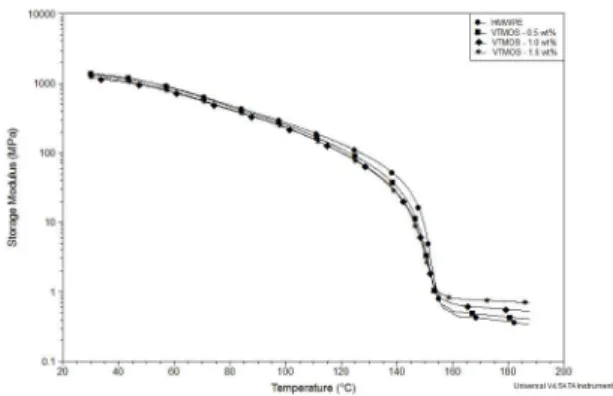
no signiicant strength above melting temperature. Figure 3 presents the DMA curves of HMWPE and VTMOS crosslinked HMWPE samples.
Figure 2. FTIR spectra of HMWPE and HMWPE crosslinked
with 1.5 wt% of VTMOS.
Table 3. Gel content and Storage Modulus (E’) of HMWPE and VTMOS crosslinked HWMPE.
VTMOS (wt%) Gel Content (%) Error E' (MPa) at 180°C
0 0.98 0.25
-0.5 8.69 1.35 0.4331
1 29.23 0.43 0.5565
1.5 57.54 3.62 0.7241
Figure 3. DMA curves of HMWPE and VTMOS crosslinked
HMWPE samples
The proile of DMA curve of HMWPE is not afected by the introductions of crosslinks as shown in Figure 3.
However, from 100°C, the samples processed with VTMOS present a slightly greater reduction of the E`values than the
E’ value presented by the HMWPE. A pronounced drop in E’ is observed around 140°C due to the melting of the
polymer. Compared to the HMWPE, the silane HMWPE
crosslinked samples present higher and constant E´ values
in high temperatures. Even, the DMA curve of HMWPE
tends to latten at higher temperatures. This inding has been attributed to the formation of unintended crosslinks caused
by moisture intrusion into the polymer both pre and pro extrusion18. An increasing of the pseudoequilibrium modulus
(E’) in the rubbery plateau region with the increasing of
VTMOS concentration is also observed (Table 3).
3.3 Thermal properties
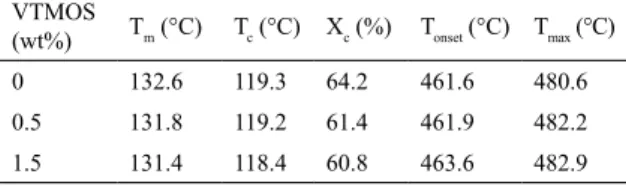
Table 4 presents the following thermal properties of the materials under study: melting temperature (Tm), crystallization temperature (Tc), degree of crystallinity (Xc), the temperature of the beginning of degradation (Tonset) and the temperature at which the rate of thermal degradation is maximum (Tmax).
The thermal properties of HMWPE are not greatly
polyethylene crosslinking occurs basically in the amorphous
regions leaving the crystalline phase unchanged or slightly
modiied. Although the energy of the Si-O-Si linkages is high, 779 kJ/mol, the introduction of crosslinks hardly afect
the polyethylene thermal stability, especially in a nitrogen atmosphere21. Similar results have been found by others
researchers12,15.
3.4 Tensile mechanical properties
Table 5 shows the tensile mechanical properties of
HMWPE and VTMOS crosslinked HMWPE samples. The results obtained shows that the HMWPE crosslinking led to a signiicant decrease in the elasticity modulus. However,
the increasing of VTMOS concentration and gel content
have not promoted any increasing in the Young´s Modulus of the crosslinked samples. This result was not expected
as the mobility of the polymeric chains is restricted by the
introduction of crosslinks25. Some researchers has attributed
the decrease of the Young`s Modulus with the increase of the crosslinking density to a decrease in HMWPE crystallinity13,34.
According to Tamboli et al13, reduction in crystallinity occurs
because crosslinking takes place in the amorphous phase. Decrease in the degree of crystallinity and crystalline thickness promotes a decrease of the Young’s Modulus. Khonakdar34
et al. in a study of high density polyethylene crosslinked with di-tert butyl cumyl peroxide (BCUP) veriied that the
glass transition temperature decreased with the increase of peroxide concentration. This result was attributed to the reduction in crystallinity and the expected increase in free
volume as a result of restriction in chain packing. These researchers veriied a decrease in the tensile modulus with
the increase of peroxide concentration.
The decrease of the elasticity modulus may also be considered a result of the heterogeneous structure of the
crosslinked samples, composed by regions in which there are highly crosslinked centers and a large fraction of efectively uncrosslinked chains15.
In this study, there was a slight decrease in the HMWPE degree of crystallinity with the increase of VTMOS concentration (Table 4). However, it is not possible to say for sure that this observed decrease in the modulus was due to this gentle decrease of HWMPE crystallinity. The
heterogeneous structure of crosslinked samples may also
be responsible by the reduction of the HMWPE elasticity
modulus with the increase of the crosslinking density.
Table 5 shows that the HMWPE yield tensile strength
was not afected by the reticulation process. This result is in
agreement with those obtained by other researchers11. The
increase in tensile strength seems to be caused basically by
the -C-C- crosslinks, whereas the efect of siloxane bridges
on this property is considered secondary. However, other studies indicate the tensile strength increases gradually with increasing of silane concentration from zero to 1.5 phr. This
result has been attributed to the formation of a crosslinked
structure considered very stable due to the high bond energy
of the siloxane links33.
3.5 Tribological properties
The friction and wear are often hard to predict from the material properties. Therefore, it is usually necessary to perform friction and wear tests for developing a tribo
engineering system for a speciic application. During test, it
is important to simulate the conditions at which the system will be submitted because many variables, such as: contact pressure, temperature, sliding velocity, roughness of the
rubbing surfaces, relative motion, among others afect wear
and friction. The polymer molecular structure, viscoelastic behavior, surface texture and processing properties also have
inluence of the polymer tribological properties. Therefore,
it is very important to simplify tests in order to exclude
variables not signiicant for a given application35,36.
In polymer friction, the main mechanisms of wear are adhesion, abrasion and fatigue. According to Lancaster37,
abrasive wear has been deined as wear by displacement
of material from surfaces in relative motion caused by the presence of hard protuberances, or by the presence of hard particles, either between the surfaces or embedded in one of them. However, the wear of polymers is very complex and frequently none of the friction mechanisms of failure can be achieved without participation of others.
In this work, as mentioned earlier, sliding wear tests
were performed in an equipment developed by the Brazilian
company NFP Automotive1. In this company, there is a
demand to perform tests with conventional materials as well as some new proposed materials. The tribological tests are Table 4. Thermal properties of HMWPE and VTMOS crosslinked
HMWPE samples.
VTMOS
(wt%) Tm (°C) Tc (°C) Xc (%) Tonset (°C) Tmax (°C)
0 132.6 119.3 64.2 461.6 480.6
0.5 131.8 119.2 61.4 461.9 482.2
1.5 131.4 118.4 60.8 463.6 482.9
Table 5. Tensile mechanical properties of HMWPE and VTMOS
crosslinked HMWPE samples.
VTMOS (wt%)
Young's
Modulus (MPa)
Error (MPa)
Tensile Strength
(MPa)
Error (MPa)
0 1259.9 79.9 21.6 0.5
0.5 1072.5 67.2 19.7 1.7
1.0 1041.8 93.8 21.8 0.4
performed in order to evaluate if a material could be used for the development of steering columns and i-shaft systems
for transportation segments. A signiicant small wear is
desirable to ensure low friction over high number of cycles that corresponds to the life span of these automotive parts. The mass loss is usually an indication that the test material is not suitable for the desired application.
Figure 4 presents the relationship between the tribological
pairs under study and the slip cycles.
by increasing the crosslinking density seems to be basically
dependent on the decreased conformational segmental mobility of the polymeric chains. This restricted mobility
of the chains leads to a signiicant reduction in the surface
deformation and orientation, which are the primary precursors of wear particle generation40.
Figure 4 shows that a steady value of coeicient of friction is achieved by both, the HMWPE/ Carbon Steel 1020 and HMWPE crosslinked with 0.5wt% of VTMOS/ Carbon
Steel 1020 friction pairs. However, the stationary value of
the dynamic coeicient friction of this sample / Carbon Steel pair is lower than that presented by the HMWPE/ Carbon
steel friction pair. This result may be an indication that the
crosslinking of HMWPE with this low concentration of silane improves the wear resistance of this polymer. The coeicient of friction of HMWPE/ Carbon Steel pair seems to achieve a constant friction coeicient from 4800 cycles. However, this coeicient of friction begins to oscillate and appears to
increase again from 15000 cycles. These oscillations may be attributed to changes in the sample, such as degradation. Some empirical correlations established for the abrasive wear shows the wear rate is proportional to the inverse of the double strain energy in the elastic region of the tensile curve for the softer material35. Therefore, the evaluation of the
resilience of the materials under study becomes interesting.
Figure 5 shows the resilience of HMWPE and VTMOS crosslinked HMWPE samples.
Figure 4. Relationship between the coeicient of friction of the HMWPE/Carbon Steel 1020 and VTMOS crosslinked polyethylenes/
Carbon Steel 1020 friction pairs and the slip cycles.
The variation of wear rate with operating time involves three distinct stages: a running-in period, a steady-state period and a severe wear period. At the starting of the experiment, the friction force is low due to the initial contact between the two materials that constitute the tribological system. As the friction continues, the softer material becomes worn and remains in contact with the harder material. The roughening of the surface of the softer material causes the ploughing
and there is an increase of the coeicient of friction between
the two materials. After a certain period, the increase of roughness and other parameters may reach a steady value
and then, the values of the coeicient of friction remains
constant. At this time, the friction force becomes independent on the force acting on the softer material36.
In the irst part of the tribological test, an increase in temperature and the formation of a transfer ilm is often noticed. This ilm is formed by the polymer particles that lie
between the asperities at the steel pin surface. The formation
of a transfer ilm occurs for most polymers, except for the highly crosslinked and some glassy polymers. Transfer ilm has important efects on the tribological behavior of polymers.
In general, the thinner and more uniform and continuous the
transfer ilm is, the lower the coeicient of friction. During the stationary test stage, however, oscillations of the coeicient of friction may occur due to local breakdown and recovery of the transfer ilm35,36,38,39.
The mechanism of improvement in the wear resistance of the ultra high molecular weight polyethylene (UHMWPE)
Figure 5. Resilience of HMWPE and VTMOS crosslinked HMWPE
samples.
The resilience of the polyethylene crosslinked with 0.5
wt% of VTMOS is higher than that of the HMWPE. Thus,
this crosslinked sample has more capacity to sustain the
stresses caused by the contact with the asperities without
signiicant permanent deformation. This result might be a
plausible explanation for the increased resistance to wear this sample presents compared to that presented by the HMWPE.
around 0.34 and 0.33. This result perhaps may be attributed to the higher gel content and hardness of these samples.
A steady value of the coeicient of friction was not achieved during the sliding test of the crosslinked HMWPE with 1.0 and 1.5 wt% of VTMOS / steel tribological systems (Figure 4). These results may be an indication that the restricted mobility of the polyethylene chains with higher crosslinking
density (Table 3) may be hampering the formation of the
transfer ilms. In order to obtain more reliable results it is
necessary to perform a experiment with a higher number of cycles or with an increasing of the normal force.
Table 6 shows the loss of mass of HMWPE and VTMOS
crosslinked HMWPE samples during the wear sliding test. It
is possible to see that in the experimental conditions used in
this work the VTMOS crosslinked HMWPE samples/ Carbon
Steel 1020 tribosystems presented higher wear resistance
than the HMWPE/ Carbon steel 1020 tribosystem.
following institutions: Institute of Macromolecules Professora
Eloisa Mano by the access to the thermal analysis and FTIR equipments and Fundação de Amparo à Pesquisa do Estado do Rio de Janeiro (FAPERJ) for the inancial support to our
research group.
6. References
1. Moraes LRC. Processos de formação de ligações cruzadas de polietileno de alto peso molecular. [Dissertation]. Nova
Friburgo: Universidade do Estado do Rio de Janeiro; 2015. 2. Fischer LW. Selection of Engineering Materials and Adhesives.
Boca Raton: CRC Press; 2005.
3. Baena JC, Wu J, Peng Z. Wear Performance of UHMWPE and Reinforced UHMWPE Composites in Arthroplasty Applications. A Review. Lubricants. 2015;3(2):413-436.
4. Selyutin GE, Gavrilov YU, Voskresenskaya EN, Zakharov VA, Nikitin VE, Poluboyarov VA. Composite Materials Based on Ultra
High Molecular Polyethylene: Properties, Application Prospects.
Chemistry for Sustainable Development. 2010;18:301-314.
5. Medel FJ, García-Álvarez F, Gómez-Barrena E, Puértolas JA.
Microstructure changes of extruded ultra high molecular weight polyethylene after gamma irradiation and shelf-aging. Polymer
Degradation and Stability. 2005;88(3):435-443.
6. Pruitt LA. Deformation, yielding, fracture and fatigue behavior
of conventional and highly cross-linked ultra high molecular
weight polyethylene. Biomaterials. 2005;26(8):905-915.
7. Oral E, Neils AL, Rowell SL, Lozynsky AJ, Muratoglu OK.
Increasing irradiation temperature maximizes vitamin E grafting and wear resistance of ultrahigh molecular weight polyethylene.
Journal of Biomedical Materials Research. Part BApplied Biomaterials.2013;101B(3):436-440.
8. Kurtz SM, Muratoglu OK, Evans M, Edidin AA. Advances in
the processing, sterilization, and crosslinking of ultra-high
molecular weight polyethylene for total joint arthroplasty.
Biomaterials.1999;20(18):1659-1688.
9. Muratoglu OK, Bragdon CR, O’ Connor DO, Jasty M, Harris WH. A novel method of cross-linking
ultra-high-molecular-weight polyethylene to improve wear, reduce oxidation, and retain mechanical properties. Journal of Arthroplasty. 2001;16(2):149-160.
10. Globichem. High density polyethylene HS5103 [Internet]. 2016. Available from: <
http://www.globichem.com/pdf/polyethyene-pe/hdpe/HDPE%20-%20HS5103.pdf>. Access in: 2/11/2016. 11. Morshedian J, Hoseinpour PM. Polyethylene crosslinking: Silane
Method: A Review. Iranian Polymer Journal. 2009;18(2):103-128.
12. Sirisinha K, Sungmanee B. Silane Crosslinking of High
Density Polyethylene as Catalyzed by Tin and Amine Catalyst.
Journal of Chemical Engineering and Chemistry Research. 2014;1(6):365-372.
13. Tamboli SM, Mhaske ST, Kale DD. Crosslinked polyethylene.
Indian Journal of Chemical Technology. 2004;11:853-864.
14. Melo RP, Aguiar VO, Marques MFV. Silane Crosslinked Polyethylene from Diferent Commercial PE`s: Inluence
of Comonomer, Catalyst Type and Evaluation of HLPB as
Crosslinking Coagent. Materials Research. 2015;18(2):313-319.
Table 6. Loss of mass of HMWPE and VTMOS crosslinked HMWPE
samples during the wear sliding test.
VTMOS (wt%) Initial mass Final mass Loss of mass (%)
0 3.166 3.140 0.82
0.5 3.021 3.021 0
1.0 3.315 3.315 0
1.5 3.443 3.443 0
4. Concluding Remarks
The results obtained indicate the gel content and
crosslinkink density of HMWPE increase with the increasing
of VTMOS content. The thermal properties were not much
afected by the crosslinking density. The tensile modulus of HMWPE decreased with the introduction of crosslinks.
Maybe, this result may be explained by the observed tendency of reducing the degree of crystallinity of HMWPE with
increasing of the crosslink density or by the heterogeneous network formation. The yield tensile strength of HMWPE, however, was not afected. The preliminary investigation of the tribological behavior of the HMWPE/ steel 1020 pair and HMWPE crosslinked samples/ Carbon Steel 1020
pairs indicated that the functionalization of HMWPE with VTMOS improved the wear resistance of HMWPE in the
experimental conditions adopted in this work. In order to
obtain more reliable results for the tribological properties, in the next steps of this study, experiments with a higher number of cycles or with an increasing of the normal force should be performed.
5. Acknowledgments
15. Celina M, George GA. Characterization and degradation studies
of peroxide and silane crosslinked polyethylene. Polymer
Degradation and Stability. 1995;48(2):297-312.
16. Shah GB, Fuzail M, Anwar J. Aspects of the crosslinking of
polyethylene with vinyl silane. Journal of Applied Polymer
Science. 2004;92(6):3796-3803.
17. Kuan HC, Kuan JF, Ma CCM, Huang JM. Thermal and mechanical properties of silane-grafted water crosslinked polyethylene.
Journal of Applied Polymer Science. 2005;96(6):2383-2391.
18. Ghosh-Dastidar A, Sengupta S, Flory A, Cogen JM. Efect of Silane Grafting Level and Crosslinking Structure on Properties of Moisture Crosslinkable Systems. In: Proceedings of the
57th International Wire&Cable Symposium; 2008 Nov 9-12;
Providence, RI, USA. IWCS; 2008. p. 138-145.
19. Cameron R, Lien K, Lorigan P. Advances in silane crosslinkable
polyethylene. Wire Journal International. 1990;23(12):56-58.
20. Hjertberg T, Palmlöf M, Sultan BA. Chemical reactions in
crosslinking of copolymers of ethylene and vinyltrimethoxy silane.
Journal of Applied Polymer Science. 1991;42(5):1185-1192.
21. Sen AK, Mukherjee B, Bhattacharyya AS, De PP, Bhowmick AK. Kinetics of silane grafting and moisture crosslinking of
polyethylene and ethylene-propylene rubber. Journal of Applied
Polymer Science. 1992;44(2):1153-1164.
22. Wong WK, Varral DC. Role of molecular structure on the
silane crosslinking of polyethylene: the importance of resin
molecular structure change during silane grafting. Polymer. 1994;35(25):5447-5452.
23. Huang H, Lu HH, Liu NC. Inluence of grafting formulations and
extrusion conditions on properties of silane-grafted polypropylenes.
Journal of Applied Polymer Science. 2000;78(6):1233-1238.
24. Barzin J, Azizi H, Morshedian J. Preparation of Silane-Grafted
and Moisture Crosslinked Low Density Polyethylene. Part II:
Electrical, Thermal and Mechanical Properties. Polymer-Plastics
Technology and Engineering. 2007;46(3):305-310.
25. Oliveira GL, Costa MF. Optimization of process conditions, characterization and mechanical properties of silane crosslinked
high-density polyethylene. Materials Science and Engineering:
A. 2010;527(18-19):4593-4599.
26. Narkis M, Tzur A, Vaxman A, Fritz HG. Some properties of silane-grafted moisture-crosslinked polyethylene. Polymer
Engineering & Science. 1985;25(13):857-862.
27. Lachtermacher MG, Tatizawa, N, Ramos VD, inventors. Petróleo
Brasileiro AS, assignee. Polietileno de alta densidade modiicado
por reação com peróxido para a fabricação de ilmes e ibras.
Brazil Patent PI09048847. 2011 Aug 2.
28. Sun KR, Park IG, Nam YS, Song Y, inventors. LG Chem Ltd,
assignee. Crosslinked polyehtylene resin composition. Korea Patent EP 3045496 A1. 2016 Jul 20.
29. Pessanha AB, Rocha MCG, Silva AHMFT. Introdução de ligações cruzadas no LLDPE através do processo de extrusão reativa de graftização do vinil-trimetóxi-silano (VTMS) na cadeia polimérica: Efeito das condições de processamento e
do sistema reacional. Polímeros. 2011;21(1):53-58.
30. Shieh YT, Chuang HC, Liu CH. Water crosslinking reactions of silane-grafted polyolein blends. Journal of Applied Polymer
Science. 2001;81(7):1799-1807.
31. Shieh YT, Tsai TH. Silane grafting reactions of low density
polyethyelene. Journal of Applied Polymer Science. 1998;69(2):255-261.
32. Ahmed GS, Gilbert M, Mainprize S, Rogerson M. FTIR analysis
of silane grafted high density polyethylene. Plastics, Rubber and Composites. 2009;38(1):13-20.
33. Yussuf AA, Kosior E, Alban L. Silane grafting and crosslinking
of metallocene-catalysed LLDPE and LDPE. Malaysian Polymer Journal. 2007;2(2):58-71.
34. Khonakdar KA, Morshedian J, Wagenknecht U, Jafari SH. An investigation of chemical crosslinking efect on properties of
high density polyethylene. Polymer. 2003;44(15):4301-4309.
35.Gustafsson E. Investigation of friction between plastic parts. [Dissertation]. Göteborg: Chalmers University of Technology; 2013.
36. Chowdhury MA, Nuruzzaman DM, Roy BK, Samad S, Sarker R, Rezwan AHM. Experimental investigation of friction coeicient
and wear rate of composite materials sliding against smooth and rough mild steel counterfaces. Tribology in Industry. 2013;35(4):286-296.
37. Lancaster JK. Abrasive wear of polymers. Wear. 1969;14:223-239.
38. Besnea MAC, Trufasu DC, Andrei G, Bastiurea M, Rodeanu MS. Estimation of Wear Behavior of Polyphenylene Sulphide
Composites Reinforced with Glass/Carbon Fibers, Graphite and Polytetraluoroethylene by Pin-on-Disc Test. Tribology in Industry. 2015;37(1):88-96.
39. Xie T, Zhou ZH, Xu ZX, Yu JW, Jiao MH. Characteristics of the transfer ilm and tribological properties of Oxide/PTFE
composites. Advanced Materials Research.2013;631-632:172-175.
40. Muratoglu OK, O’Connor DO, Bragdon CR, Delaney J, Jasty M, Harris WH, et al. Gradient crosslinking of UHMWPE
using irradiation in molten state for total joint arthroplasty.