http://www.uem.br/acta ISSN printed: 1806-2563 ISSN on-line: 1807-8664
Doi: 10.4025/actascianimsci.v34i3.14328
Ingestive behavior of Guzerat and Sindhi heifers under the effects of
feed restriction
Ebson Pereira Cândido1*, Severino Gonzaga Neto2, Leilson Rocha Bezerra3, Edilson Paes Saraiva2, Edgard Cavalcanti Pimenta Filho2 and Gherman Garcia Leal de Araujo4
1
Programa de Pós-graduação em Zootecnia, Centro de Ciências Agrárias, Universidade Federal da Paraíba, Campus II, 58397-000, Areia, Paraíba, Brazil.
2
Departamento de Zootecnia, Centro de Ciências Agrárias, Universidade Federal da Paraíba, Areia, Paraíba, Brazil. 3
Departamento de Zootecnia, Universidade Federal do Piauí, Bom Jesus, Piauí, Brazil. 4
Empresa Brasileira de Pesquisa Agropecuária, Petrolina, Pernambuco, Brazil. *Author for correspondence. E-mail: [email protected]
ABSTRACT. This study aimed to evaluate the effect of feed restriction on the ingestive behavior of Guzerat and Sindhi heifers. A total of 36 heifers were used, 18 from each breed, randomly distributed in a completely randomized design, in a 2 x 3 factorial scheme. The treatments used were 20 and 40% restriction compared to intake by animals from the third group, which were fed ad libitum (without restriction). For the behavioral analysis, the scan sampling method was used by logging and recording times in five-minute intervals during 24 hours, thus estimating the time spent feeding, ruminating and idling. With regard to the imposed restrictions, it was observed that non-restricted animals showed greater feeding time and lower resting time (p < 0.05); the two breeds showed the same feeding efficiency. When subjected to levels up to 40% of feed restriction, both studied genotypes perform similarly with regard to ingestive behavior, feeding efficiency and cud chews. However, there was an effect of the restriction levels on the patterns of ingestive behavior and cud chews, although there were no changes to feeding efficiency or chewing time per cud.
Keywords: ethology, nutrition, zebu.
Comportamento ingestivo de novilhas Guzerá e Sindi sob efeito de restrição alimentar
RESUMO. Objetivou-se com este estudo avaliar o efeito da restrição alimentar sobre o comportamento ingestivo de novilhas da raça Guzerá e Sindi. Foram utilizadas 36 novilhas, sendo 18 de cada uma das raças, distribuídos aleatoriamente em um delineamento inteiramente casualizado, em arranjo fatorial 2 x 3. Os tratamentos utilizados foram de 20 e 40% de restrição em relação ao consumido pelos animais do terceiro grupo que se alimentavam à vontade (sem restrição). Para a análise comportamental utilizou-se o método de amostragem scan com registro temporal em intervalos de cinco minutos durante 24 horas contínuas, estimando-se assim o tempo despendido em alimentação, ruminação e ócio. Em relação às restrições impostas, notou-se que animais que não passaram por restrição alimentar apresentaram maior tempo de alimentação e menor tempo em ócio (p < 0,05), observando-se a mesma eficiência alimentar para novilhas das duas raças em confinamento. Os genótipos estudados quando submetidos até um nível de 40% de restrição alimentar se comportam de maneira igual quanto ao comportamento ingestivo, eficiência alimentar e mastigação merícica. Contudo houve efeito dos níveis de restrição que são alterações nos padrões de comportamento ingestivo, mastigação merícica, apesar de não ter ocorrido alterações na eficiência de alimentação e no tempo de mastigação por bolo.
Palavras-chave: etologia, alimentação, zebuínos.
Introduction
In order to efficiently explore dairy production, feed use must be perfected to ensure greater competitiveness, as feeding is among the factors with the greatest impact on production costs. This requires studies applying feeding restrictions to determine a point of equilibrium between feeding losses from leftover and profit. One way to evaluate these practices would be by observing ingestive behavior.
In quantitative feeding restriction for heifers, the amount offered should reach the best adjustment in ingested amount and provide the
best weight gain around 700 g day-1, without
causing reproductive damages, while reducing feeding costs.
Acta Scientiarum. Animal Sciences Maringá, v. 34, n. 3, p. 297-303, July-Sept., 2012 to animal feeding management to obtain the best
possible productivity results.
Neumann et al. (2007) affirm that the biology of voluntary intake and animal performance response are complex, and their effects depend on the interaction of factors regarding the animal, diet and environment; these factors are associated not only to the volume of roughage, but also to the rate of roughage in the diet and/or level of concentrate. To fully understand daily feed intake, it is necessary to study components individually, which can be described by the number of feedings per day, mean duration of these feedings, and eating rate of each feeding (PEREIRA et al., 2004).
Genotypes Guzerat and Sindhi are quite common in the State of Paraíba, Brazil, showing high potential for that region. As such, it is quite important to study the ingestive behavior of these breeds in order to better understand the relationships that define animal performance under restricted feeding conditions. Such studies could determine how these different-sized Zebu breeds behave under those conditions, and infer which breed should be chosen depending on the behavioral parameters that best adapt to the impact of soil and climate conditions during the drought period, with regard to qualitative and quantitative restrictions of forage in the semi-arid region of Paraíba.
The need to understand the ingestive behavior of ruminants leads to studies that provide researchers and producers with data to adequately manage animal nutrition (SILVA et al., 2008).
Therefore, the objective of this study was to evaluate the effect of feeding restrictions on the ingestive behavior of Guzerat and Sindhi heifers.
Material and methods
The experiment was carried out between June 18 and August 27, 2008 at the Cattle Breeding Sector of the EMEPA Experiment Station in Alagoinha, Paraíba State, Brazil, located Agreste mesoregion of Paraíba, Guarabira microregion, municipality of Alagoinha, Paraíba State, Brazil. The station is located at 6º57'00''S, 35º32'42''W. Gr., elevation 135 m.
The experiment lasted 77 days: 15 days for animal acclimation to the diet and facilities, plus four observations of ingestive behavior every 15 days.
A total of 36 heifers were used (18 from each breed), with initial age of 21 months and average body weight of 268.17 kg for Guzerat and 211.7 kg for Sindhi. The animals were distributed into three groups containing 12 plots, with six from each
genetic group. They were dewormed, allotted randomly according to breed and restriction level, and housed in a barn containing 36 individual stalls, 7.5 m2 each, with feeders and drinkers.
The experimental diets were formulated to meet the nutritional requirements of growing heifers for an average gain of 700 g day-1, from initial to adult
weight (NRC, 2001), by using the “Viçosa feed formulation system” (LANA, 2007) for adjustments. Two diets were used, one for each breed – treatment
1: 0% restriction (diet for 700 g day-1 gain);
treatment 2: 20% restriction; and treatment 3: 40% restriction compared to the control group.
The ingredients used in the diets (elephant grass at 70 days of regrowth, cassava root, corn meal, soybean meal, urea and mineral mix) were processed and provided as a complete ration.
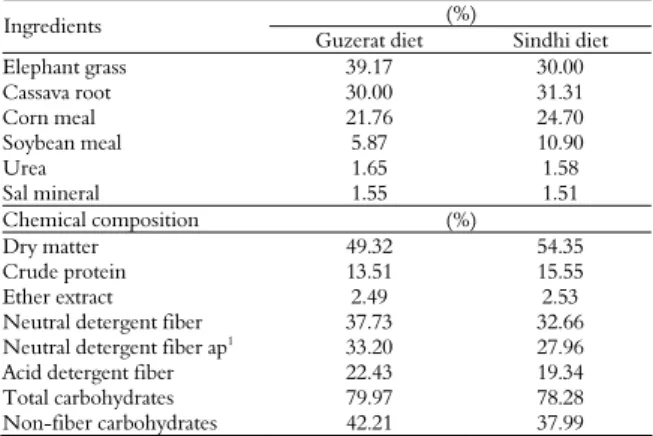
The chemical composition of the ingredients is shown in Table 1, and the percentage of each ingredient and the chemical composition of the experimental diet are found in Table 2.
Table 1. Chemical composition of the ingredients of the experimental diet on a dry-matter basis.
Nutrients Elephant grass
Cassava root
Corn meal
Soybean meal
Dry matter (DM) 26.00 38.30 88.90 87.55
Crude protein (CP) 6.15 3.83 12.19 47.49
Ether extract (EE) 2.17 1.27 5.47 1.19
Neutral detergent fiber (NDF) 71.23 17.98 16.36 14.84
Neutral detergent fiber ap1 67.39 11.72 12.98 8.13
Acid detergent fiber (ADF) 42.55 11.74 8.07 8.29
Total carbohydrates (TC) 82.15 92.00 80.64 45.02
Non-fiber carbohydrates (NFC) 14.76 80.48 71.66 36.00
1
Corrected for ash and protein.
Table 2. Percentage of each ingredient and chemical composition of the experimental diet on a dry-matter basis.
(%) Ingredients
Guzerat diet Sindhi diet
Elephant grass 39.17 30.00
Cassava root 30.00 31.31
Corn meal 21.76 24.70
Soybean meal 5.87 10.90
Urea 1.65 1.58
Sal mineral 1.55 1.51
Chemical composition (%)
Dry matter 49.32 54.35
Crude protein 13.51 15.55
Ether extract 2.49 2.53
Neutral detergent fiber 37.73 32.66
Neutral detergent fiber ap1
33.20 27.96
Acid detergent fiber 22.43 19.34
Total carbohydrates 79.97 78.28
Non-fiber carbohydrates 42.21 37.99
1Corrected for ash and protein.
allowing voluntary intake. Feed-restricted animals were offered 20% less (20% restriction group) or 40% less (40% restriction group) compared to the voluntary intake of the non-restricted group.
Bromatological analysis was conducted at the CCA/UFPB Animal Nutrition Laboratory. Materials were pre-dried in a forced-air oven at 55°C for 72 hours. The samples were then processed in a Wiley-type knife mill, and later analyzed to obtain levels of dry matter (DM), mineral matter (MM), crude protein (CP) and ether extract (EE), as per AOAC (2005). The methodology proposed by ANKON (Ankon Technology Corporation) was used to assess neutral detergent fiber (NDF) using amylase and acid detergent fiber (ADF); CP and ash levels in NDF were quantified according to Mertens (2002) and Licitra et al. (1996), in order to obtained corrected NDF (NDFap) values with changes to the bags, as non-woven fabric bags were used, 100 mm weight, manufactured at the Animal Nutrition Laboratory. The percentage of total carbohydrates (TC) was obtained through the equation: 100 – (%CP + %EE +%ash), and the percentage of NFC was calculated as 100 - (%NDFap + %CP + %EE + %ash) according to Sniffen et al. (1992).
The scan sampling method was used to record the time spent on eating, rumination and idling. This was done in five-minute intervals starting at 7 a.m. during 24 straight hours, for a total of four observations at 15-day intervals throughout the course of the experiment; this resulted in 24 replications per treatment, totaling 288 records per animal. Artificial lighting was used during nighttime observations.
Ingestive behaviors were considered to be mutually exclusive – that is, for each record, each animal was classified into one activity only (PARDO et al., 2003). From these data, the mean times spent eating, ruminating and idling were analyzed.
To obtain rumination time, the times spent on regurgitation, remastication, resalivation and redeglutition of the cud were added. The eating and feeding time included biting, chewing and swallowing of the bolus. Idling consisted of the time spent not feeding, ócio representou o tempo de não apreensão e ingestão e o de não ruminação (GOULARTE et al., 2011).
Eight animals were used to evaluate cud chew, alternating the animals in each observation. Two rumination periods were evaluated – 10 p.m. to midnight and 4 to 6 a.m., assessing the number of cud chews and the time spent ruminating each bolus (seconds/bolus), using a stopwatch. Chewing was
calculated by three times of 15 seconds each, with the average multiplied by four to obtain chewing time/minute.
The results for ingestive behavior factors were obtained from the ratios: FE = DMI/FT; RUE = DMI/TRU; RUE = NDFI/TRU; TCT =
FT+TRU; NRC = TRU/CUDtc; CUDnd = NRC
x CUDnc; GDMcud = DMI/NRC; GNDFbolus =
NDFI/NRC; DFN = number of daily feedings;
MDFtf = mean duration of each feeding, in that: FE
(g DM h-1) = feeding efficiency, DMI (g DM day-1)
= dry matter intake, FT (h day-1) = feeding time,
RUE (g DM h-1) = rumination efficiency, TRU
(h day-1) = rumination time, TCT (h day-1) = total
chewing time, NRB (no. day-1) = number of cuds
in rumen, TRU (s day-1) = rumination time, CUD
tc
(s cud-1) = duration of cud chews per ruminal
bolus; NCCnd (no. day-1) = number of cud chews;
and NCCnc (no. bolus-1) = number of cud chews
per bolus; GDMbolus = grams of DM per bolus,
GNDFbolus = grams of NDF per bolus, DFN =
daily number of feedings, MDFtf = mean duration of each feeding (CARVALHO et al., 2004).
When calculating DFN and MDFtf, only feedings
equal to or greater than 15 minutes long were considered, so as to minimize errors of observation or in the psychogenic characteristics of the animals – such as smelling or playing with the ration, but not actually eating.
The experimental design was entirely randomized in a 2 x 3 factorial scheme (two breeds and three restriction levels), totaling 36 experimental units. The data were evaluated using analysis of variance. Whenever significant, the means were compared using Tukey’s test at 5% probability. All statistical analyses were carried out using the Statistical Analysis System software suite (SAS, 2005).
Results and discussion
There was no interaction between breed and restriction levels (p > 0.05) on the behavioral variables analyzed. No differences were observed (p > 0.05), either, in the times spent feeding, ruminating and idling, between Guzerat and Sindhi heifers (Table 3). These results are likely due to the fact that all experimental diets were made from the
same ingredients in order to meet the 700 g day-1
Acta Scientiarum. Animal Sciences Maringá, v. 34, n. 3, p. 297-303, July-Sept., 2012 There was a significant effect for the time
spent on feeding as a function of restriction levels (p < 0.05) (Table 4). This can be explained by the growing restriction levels of offered diet (20 and 40%) compared to the intake by animals without restriction. Thus, non-restricted animals showed the highest (p < 0.05) time spent feeding (3h and 34 min.), as the offered feed was much greater and they therefore had 24-hour feed availability. Even though not evaluated, it is believed there was a visual stimulus for greater DMI, which probably led to this result; conversely, the animals subjected to 20 or 40% restriction spent less time feeding (2h and 43 min., and 2h and 3 min., respectively), as the offered amount was lower (Table 4).
Table 3. Means and coefficients of variation (CV %) of the time (in hours) spend feeding, ruminating and idling by Guzerat and Sindhi heifers.
Guzerat Sindhi CV %
Feeding 2.92 2.65 16.11
Ruminating 6.29 6.10 12.39
Idling 14.78 15.24 5.40
According to Fontenele et al. (2011), in order to understand daily feed intake it is necessary to study the components individually, which can be described by the amount of feed provided and ingested daily, by the mean time duration to ingest it, and by the eating rate of all feeding items provided. Each one of these processes is the result of the interaction between animal metabolism and the physical-chemical properties of the diet, stimulating satiety receptors.
Table 4. Mean time (in hours) spent feeding, ruminating and idling by Guzerat and Sindhi heifers as a function of the restriction levels.
Treatments Variables
0% 20% 40%
Feeding 3.57a 2.72b 2.05c
Ruminating 7.15a 6.49a 4.95b
Idling 13.27c 14.78b 16.99a
Means followed by different letters, in the same row, differ according to Tukey’s test at 5% probability.
With regard to the time spent ruminating, there was no difference (p > 0.05) between non-restricted and 20% restriction animals; 40% restriction animals had lower (p < 0.05) results than the other treatments. However, there was a difference (p < 0.05) among the treatments for time spent idling, inversely proportional to time spent feeding.
It can be observed that the highest mean DMIs were found for Guzerat compared to Sindhi, as shown in Table 5; this is likely due to the larger size
of Guzerat, meaning they have larger GI tracts that enable higher feed intake, as confirmed by the similar data for NDF intake for both breeds.
Table 5. Daily intake of dry matter (DMI), of neutral detergent fiber (NDFI), dry matter feeding efficiency (FE), ruminating efficiency of dry matter (RUEDM) and of neutral detergent fiber
(RUENDF), and ruminating efficiency in grams of DM per bolus
(GDMbolus) and in grams of NDF per ruminated bolus
(GNDFbolus) observed in Guzerat and Sindhi heifers under
different feeding restriction levels.
Breed Variables
Guzerat Sindhi CV %
DMI (g day-1) 7565.22a 6439.55b 11.84
NDFI (g day-1) 3941.93a 3231.93b 11.82
FE (g de DM h-1
) 2634.14 2476.54 17.36
RUEDM (g of DM h
-1) 1198.78a 1057.91b 16.74
RUENDF (g of NDF h-1) 625.49a 531.67b 16.67
GDMCud (g cud -1
) 20.99 21.29 27.22
GNDFCud (g cud
-1) 10.96 10.69 27.47
Means followed by different letters, in the same row, differ according to Tukey’s test at 5% probability; CV = coefficient of variation.
According to Pereira et al. (2003), feed intake by ruminants can be regulated by several mechanisms. Accordingly, the size, body condition, rumen distension ability, breed and physiological status are characteristics that influence intake, by altering animal requirements.
Results obtained by Marcondes et al. (2011) highlighted an increase in energy demand as the body weight of cattle from different genetic groups increases. This is the result of the increased maturity of animals, in which protein deposition begins to decrease and metabolism transfers the flow of energy to body reserves.
Feeding efficiency (FE), expressed as g of
DM h-1, did not differ (p > 0.05) between the
genotypes, demonstrating a similar behavior for Guzerat and Sindhi heifers for that variable.
For rumination efficiency (RUE), expressed
both as g of DM h-1 and g of NDF h-1, a genotype
effect (p < 0.05) was observed, with Guzerat heifers being more efficient in ruminating, which may be justified by the higher intake of dry matter (DMI) and neutral detergent fiber (NDFI).
Although the DMI of each breed was different, the variables grams of DM per ruminated bolus (GDMbolus) and grams of NDF per ruminated bolus
(GNDFbolus) did not differ (p > 0.05) between the
studied genotypes, indicating that these variables are not influenced by DMI and rumination efficiency, which were different in the two breeds.
No effect (p > 0.05) of the restriction levels was observed with regard to feeding efficiency
(g of DM h-1). These results are in accordance with
those obtained by Fischer et al. (2002), who studied certain behavioral variables in Holstein cows and observed that the time spent ingesting varied more, over a 24-hour period, than the time spent ruminating.
Table 6. Daily intake of dry matter (DMI), of neutral detergent fiber (NDFI), dry matter feeding efficiency (FE), ruminating efficiency of dry matter (RUEDM) and of neutral detergent fiber
(RUENDF), grams of DM per bolus (GDMbolus) and grams of
NDF per cud (GNDFbolus) for Guzerat and Sindhi heifers as a
function of the restriction levels.
Treatments Variables
0% 20% 40%
DMI (g day-1) 9305.64a 6692.06b 5009.45c
NDFI (g day-1
) 4703.19a 3464.24b 2593.37c
FE (g de DM h-1) 2605.06 2479.83 2581.12
RUEDM (g of DM h-1) 1313.05a 1044.71b 1027.29b
RUENDF (g of NDF h
-1
) 663.36a 540.33b 532.05b GDMbolus (g bolus
-1) 25.94a 20.49ab 16.99b
GNDFbolus (g bolus -1
) 13.09a 10.60ab 8.78b
Means followed by different letters, in the same row, differ according to Tukey’s test at 5% probability.
For rumination efficiency, expressed both as g of
DM h-1 and g of NDF h-1, an influence of the
restriction levels was observed (p < 0.05), in that non-restricted animals showed higher rumination efficiency when compared to the animals subjected to the restriction levels of 20 and 40%.
It was observed that the variables grams of DM
per ruminated bolus (GDMBolus) and grams of NDF
per ruminated bolus (GNDFbolus) differed
(p < 0.05) with the increase in restriction levels, in that non-restricted animals ruminated more grams
of DM bolus-1 and more grams of NDF bolus-1 than
animals under 40% restriction; heifers under 20% de restriction did not differ from the other restriction levels.
There was no difference (p > 0.05) between
genotypes in total chewing time expressed as h day-1
(Table 7). As this variable is the sum of FT + TRU, it was to be expected that there would be no difference, because there was no difference in these two parameters of ingestive behavior between the studied breeds.
The number of rumen bolus (no. day-1),
number of cud chews (no. day-1 and no. cud-1)
and the duration of chews per cud (s cud-1) were
similar (p > 0.05) between the two studied genotypes. There was a difference (p < 0.05) between the two genotypes for the daily number and mean duration of feedings; Sindhi heifers showed higher DFN compared to Guzerat, while the mean duration of each feeding was the
opposite of MDFtf (p < 0.05) for both breeds,
resulting in a roughly similar total feeding time
(DFN x MDFtf) between them, as shown in
Table 4.
Table 7. Total chewing time (TCT), number of rumen bolus (NRB), daily number of cud chews (CUDnd), chews per cud
(CUDnc), duration of chews per cud (CUDtc), number of daily
feedings (DFN) and mean duration of each feeding (MDFtf) for
Guzerat and Sindhi heifers under different restriction levels.
Raça Variables
Guzerat Sindhi CV %
TCT (h day-1
) 9.21 8.75 9.03
NRB (no. day-1) 352.54 320.29 23.37
CUDnd (no. day-1) 21,923.67 20,020.44 18.85
CUDnc (no. cud
-1) 63.45 63.37 18.70
CUDtc (s cud
-1) 65.78 71.16 18.09
DFN (no. day-1
) 2.72b 3.62a 23.28
MDFtf (min.) 46.78a 37.33b 14.73
Means followed by different letters, in the same row, differ according to Tukey’s test at 5% probability; CV = coefficient of variation.
According to Oliveira et al. (2011), animals ingest during given periods of time, each period representing a feeding, and this number of daily feedings varies according to feed availability and is distributed unevenly over a 24-hour period. Nevertheless, ruminants can have a series of small feedings depending on the room available for digestion and digesta passage (MAGGIONI et al., 2009).
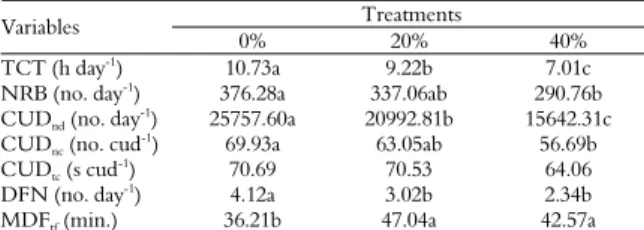
Total chewing time showed a significant difference (p < 0.05) between the restriction levels, as seen in Table 8. This behavior was inversely proportional to the application of restriction levels – that is, as the restriction level increased, TCT decreased. This can be explained by the reduction in DMI and FT according to the increasing levels of restriction.
Table 8. Total chewing time (TCT), number of rumen bolus (NRB), daily number of cud chews (CUDnd), chews per cud
(CUDnc), duration of chews per cud (CUDtc), number of daily
feedings (DFN) and mean duration of each feeding (MDFtf) de
Guzerat and Sindhi heifers as a function of different restriction levels.
Treatments Variables
0% 20% 40%
TCT (h day-1) 10.73a 9.22b 7.01c
NRB (no. day-1
) 376.28a 337.06ab 290.76b CUDnd (no. day
-1) 25757.60a 20992.81b 15642.31c
CUDnc (no. cud-1) 69.93a 63.05ab 56.69b
CUDtc (s cud
-1) 70.69 70.53 64.06
DFN (no. day-1) 4.12a 3.02b 2.34b
MDFtf (min.) 36.21b 47.04a 42.57a
Means followed by different letters, in the same row, differ according to Tukey’s test at 5% probability.
Variables NRB and CUDnc showed similar
Acta Scientiarum. Animal Sciences Maringá, v. 34, n. 3, p. 297-303, July-Sept., 2012
restriction. With regard to CUDnd, there was an
effect of the restriction levels (p < 0.05), decreasing as restriction levels increased. These results may have occurred due their relationship with NDFI, which behaved similarly. Indeed, there is a close link between NDF diet levels/intake and rumination; in this experiment, the differences in NDFI among the treatments were expressive and may have significantly influenced those results.
Rumination time is highly correlated with NDF intake. Finely milled or pelletized concentrates and hays reduce rumination time, whereas roughages with high cell wall levels tend to increase it. Higher intake tends to shorten rumination time per gram of feed, which was likely responsible for the larger size of fecal particles in cases of greater intake.
Nevertheless, CUDtc was not influenced by the
treatments.
Pereira et al. (2004), working with confined ruminants fed twice a day, observed two main feedings after feed was provided, lasting one to three hours, as well as a varying number of smaller feedings between them. In the present work, the number of daily feedings (DFN) was higher for non-restricted animals compared to heifers under 20 and 40% restriction. However, the opposite occurred for mean duration of each feeding
(MDFtf). These results are likely due to the fact
that non-restricted animals had feed in their troughs for more time and necessarily spent less time at the trough, with shorter feeding time. Conversely, animals under 20 and 40% restriction had less available feed, which influenced the number of trips to the trough; because those animals were not full, the mean duration of each feeding was higher than that of non-restricted animals.
Overall, the number and duration of feedings are more variable than ruminating periods (DULPHY; FAVERDIN, 1987). By modifying the number of daily feedings and their size (duration x intake rate), the intake of dairy cows can be adjusted in short period of time (GRANT; ALBRIGHT, 1995).
Conclusion
When subjected to levels up to 40% of feeding restriction, the studied genotypes behave similarly with regard to ingestive behavior, feeding efficiency and cud chews. However, there was an effect of the restriction levels on the patterns of ingestive behavior and cud chews, although there were no changes to feeding efficiency or chewing time per cud.
References
AOAC-Association of Official Analytical Chemists.
Official methods of analysis of the association analytical chemists. 18th ed. Maryland: AOAC, 2005. CARDOSO, A. R.; CARVALHO, S.; GALVANI, D. B.; PIRES, C. C.; GASPERIN, B. G.; GARCIA, R. P. A. Comportamento ingestivo de cordeiros alimentados com dietas contendo diferentes níveis de fibra em detergente
neutro. Ciência Rural, v. 36, n. 2, p. 604-609, 2006.
CARVALHO, G. G. P.; PIRES, A. J. V.; SILVA, F. F.; VELOSO, C. M.; SILVA, R. R.; SILVA, H. G. O.; BONOMO, P.; MENDONÇA, S. S. Comportamento ingestivo de cabras leiteiras alimentadas com farelo de
cacau ou torta de dendê. Pesquisa Agropecuária
Brasileira, v. 39, n. 9, p. 919-925, 2004.
DULPHY, J.; FAVERDIN, P. L’ingestion alimentaire chez les ruminats: modalités et phénomènes associés.
Reproduction, Nutrition and Dévelopment, v. 27, n. 2, p. 129-155, 1987.
FISCHER, V.; DESWYSEN, A. G.; DUTILLEUL, P.; BOEVER, J. Padrões da distribuição nictemeral do comportamento ingestivo de vacas leiteiras, alimentadas com dieta à base silagem de milho, ao início e final da
lactação. Revista Brasileira de Zootecnia, v. 31, n. 5, p.
2129-2138, 2002.
FONTENELE, R. M.; PEREIRA, E. S.; CARNEIRO, M. S. S.; PIMENTEL, P. G.; CÂNDIDO, M. J. D.; REGADAS FILHO, J. G. L. Consumo de nutrientes e comportamento ingestivo de cordeiros da raça Santa Inês alimentados com rações com diferentes níveis de energia
metabolizável. Revista Brasileira de Zootecnia, v. 40,
n. 6, p. 1280-1286, 2011.
GOULARTE, S. R.; ÍTAVO, L. C. V.; ÍTAVO, C. C. B. F.; DIAS, A. M.; MORAIS, M. G.; SANTOS, G. T.; OLIVEIRA, L. C. S. Comportamento ingestivo e digestibilidade de nutrientes em vacas submetidas a diferentes
níveis de concentrado. Arquivo Brasileiro de Medicina
Veterinária e Zootecnia, v. 63, n. 2, p. 414-422, 2011. GRANT, R. J.; ALBRIGHT, J. L. Feeding behavior and management factors during the transition period in
dairy cattle. Journal of Animal Science, v. 73, n. 12,
p. 2791- 2803, 1995.
LANA, R. P. Sistema Viçosa de formulação de rações.
Viçosa: Universidade Federal de Viçosa, 2007.
LICITRA, G.; HERNANDEZ, T. M.; VAN SOEST, P. J. Standartization of procedures for nitrogen fractionation of
ruminant feeds. Animal Feed Science and
Technology, v. 57, n. 4, p. 347-358, 1996.
MAGGIONI, D.; MARQUES, J. A.; ROTTA, P. P.; ZAWADZKI, F.; ITO, R. H.; PRADO, I. N. Ingestão de
alimentos. Semina: Ciências Agrárias, v. 30, n. 4,
p. 963-974, 2009.
MARCONDES, M. I.; VALADARES FILHO, S. C.; OLIVEIRA, I. M.; PAULINO, M. F.; PAULINO, P. V. R.; DETMANN, E.; COSTA E SILVA, L. F. Exigências de energia de animais Nelore puros e mestiços com as
raças Angus e Simental. Revista Brasileira de
MERTENS, D. R. Gravimetric determination of amylase-treated neutral detergent fiber in feeds with refluxing in
beaker or crucibles: collaborative study. Journal of
AOAC International, v. 85, n. 6, p. 1217-1240, 2002. NEUMANN, M.; SANDINI, I. E.; OST, P. R.; FALBO, M. K.; LUSTOSA, S. B. C.; PELLEGRINI, L. G. Desempenho de novilhos confinados alimentados com silagens de milho ou sorgo, associadas a três níveis de
concentrado. Revista Brasileira de Milho e Sorgo, v. 6,
n. 3, p. 365-378, 2007.
NRC-National Research Council. Nutrient
requirements of the dairy cattle. 7th ed. Washington, D.C.: The National Academies Press, 2001.
OLIVEIRA, P. A.; MARQUES, J. A.; BARBOSA, L. P.; OLIVEIRA, G. J. C.; PEDREIRA, T. M.; SILVA, L. L. Aspectos metodológicos do comportamento ingestivo de
vacas lactantes em pastejo de Brachiaria decumbens.Revista
Brasileira de Saúde e Produção Animal, v. 12, n. 1, p. 166-175, 2011.
PARDO, R. M. P.; FISCHER, V.; BALBINOTTI. M.; MORENO, C. B.; FERREIRA, E. X.; VINHAS, R. I.; MONKS, P. L. Comportamento ingestivo diurno de novilhos em pastejo a níveis crescentes de suplementação
energética. Revista Brasileira de Zootecnia, v. 32, n. 6,
p. 1408-1418, 2003.
PEREIRA, E. S.; ARRUDA, A. M. V.; MIZUBUTI, I. Y.; SILVA, L. D. F. Consumo voluntário em ruminantes.
Semina: Ciências Agrárias, v. 24, n. 1, p. 191-196, 2003. PEREIRA, E. S.; ARRUDA, A. M. V.; MIZUBUTI, I. Y. Comportamento ingestivo de vacas em lactação
alimentadas com diferentes fontes de volumosos
conservados. Semina: Ciências Agrárias, v. 25, n. 2,
p. 159-166, 2004.
SILVA, R. R.; PRADO, I. N.; CARVALHO, G. G. P.; SANTANA JUNIOR, H. A.; SILVA, F. F.; DIAS, D. L. S. Efeito da utilização de três intervalos de observações sobre a precisão dos resultados obtidos no estudo do comportamento ingestivo de vacas leiteiras em pastejo.
Ciência Animal Brasileira, v. 9, n. 2, p. 319-326, 2008. SILVA, V. B.; FONSECA, C. E. M.; ALMEIDA, M. I. V.; BRASILEIRO, L. S. G.; GODOI, F. N.; MENDONÇA, M. S. Comportamento alimentar de cabras alimentadas com diferentes teores de fibra em detergente neutro.
Arquivo Brasileiro de Medicina Veterinária e Zootecnia, v. 63, n. 1, p. 165-170, 2011.
SNIFFEN, C. J.; O’CONNOR, J. D.; VAN SOEST, P. J.; FOX, D. G.; RUSSELL, J. B. A net carbohydrate and protein system for evaluating cattle diets: II. Carbohydrate
and protein availability. Journal of Animal Science,
v. 70, n. 11, p. 3562-3577, 1992.
SAS-Statistical Analysis System. User’s guide. Version
9.0. Cary: SAS Institute, 2005. (CD-ROM).
Received on August 1, 2011. Accepted on September 23, 2011.