KNOWING THE VISION OF NURSING STAFF ON THE PALLIATIVE CARE TO
ONCOLOGICAL PATIENTS
Conhecendo a visão da equipe de enfermagem diante os cuidados paliativos ao paciente
oncológico
Renê Ferreira Da Silva Junior1
Clarissa Andrade Guimarães2 Graciele Aparecida Santos Rodrigues2 Claudiana Donato Bauman1 Sabrina Gonçalves Silva Pereira2 Daniela Alves Flecha3 Henrique Andrade Barbosa1
Abstract: Objective: to understand the vision of nursing staff on palliative care provided to cancer patients.
Methodology: this study is an integral part of the umbrella project titled (Con) living with cancer, of
qualitative approach, using the principles of the theory of symbolic interactionism as conceptual, technical
support with the technique of applying a semi-structured interview in Hospital Foundation Isiaka Godinho
de Tables located in the municipality of Montes Claros, Minas Gerais developed with professionals of the
Oncology team institution the design of this study has been approved by the Research Ethics Committee
of the SOEBRAS, with opinion approving paragraph embodied. 633,361 of 24/04/2014. Results and
discussion: three central categories were elaborated that deal around the study phenomenon, the meaning,
the experiences and relationships, represent the interaction of nursing staff with the symbolism brought by
palliative care. Final thoughts: for the team of nursing palliative care represent a process of life, which
requires these professionals care, zeal and empathy.
Keywords: Palliative care; Cancer. Nursing staff.
________________
Corresponding author: Renê Ferreira Da Silva Junior. E-mail: [email protected]
1 Universidade Estadual de Montes Claros. 2 Faculdades Unidas do Norte de Minas Gerais. 3 Fundação Oswaldo Cruz.
Resumo: Objetivo: compreender a visão da equipe de enfermagem diante dos cuidados paliativos prestados
aos pacientes oncológicos. Metodologia: este estudo é parte integrante do projeto guarda-chuva intitulado
(Con)vivendo com o câncer, de abordagem qualitativa, utilizando dos preceitos da teoria do Interacionismo
Simbólico como suporte técnico conceitual, com a técnica de aplicação de uma entrevista semiestruturada
na Fundação Hospitalar Dilson Godinho de Quadros localizado no município de Montes Claros, Minas
Gerais desenvolvido com profissionais da equipe de oncologia da instituição, o projeto deste estudo foi
aprovado pelo Comitê de Ética em Pesquisa da SOEBRAS, com parecer consubstanciado de aprovação
nº. 633.361 de 24/04/2014. Resultados e discussão: foram elaboradas três categorias centrais que versam
ao redor do fenômeno estudo, o significado, as experiências e as relações interpessoais, representam a
interação da equipe de enfermagem com o simbolismo trazido pelos cuidados paliativos. Considerações
finais: para a equipe de enfermagem os cuidados paliativos representam um processo da vida, o que exige
desses profissionais cuidado, zelo e empatia.
REVISTA UNIMONTES CIENTÍFICA
INTRODUCTION
The World Health Organization has
established palliative care as being intense and total
care and total number of patients whose disease does
not respond to treatment. Its primacy is the relief of
pain and other symptoms, as well as psychosocial
and spiritual problems . The purpose of palliative
cares is, therefore, better quality of life and offer
better quality of life and more comfortable to the
patient’s life until his passing (death).
1For Nursing, palliative cares are part of
everyday practice, and since the beginning of the
profession, Florence Nightingale stated that the
care is related to the nursing performing. Adding
the science and art for the provision of assistance
and care to give comfort, support and aid are
arguments in nursing until the present days. From
birth to diagnosis an advanced oncological disease,
the human being needs planned conducts in
different moments of life, especially in front of its
terminality.
2The nursing professionals have a role of
great importance in palliative care, with particular
responsibility with respect to information,
counseling, and education of patients. Through
connecting with the same nurses are more suitable
for monitoring and evaluating the pain and other
symptoms. It is well known that in patients with
advanced oncological disease the predominance
of pain reaches 90%; the pain is therefore an
expression extremely prevalent in terminal patients.
The treatment should be a priority and it should
be remembered that customers in the palliative
care requires attention and special care since they
present neurological disorders, or are elderly and
other times they do not know how to mention
the correct way of the disease symptoms. It is
essential that the health professionals involved in
the care of oncological disease constitute a genuine
multidisciplinary team and that have conditions
to assess the ability of the patient to decide on
all matters involving their disease, treatment and
prognosis.
3Providing palliative care in nursing is
to experience and share moments of love and
compassion, discovering with patients and family
members that you can die with dignity. As such it
is a right, favoring the certainty that they are not
alone at the time of death; offer comprehensive
care and humanized care, associated with control
of events and pain; especially elucidate the society
that it is possible to die without fear or pain.
2Thus,
this study aims to understand the vision of the
nursing team in the face of palliative care provided
to cancer patients.
METHODOLOGY
This study is part of the project umbrella
titled (con)living with cancer, a qualitative
approach, using the precepts of the theory of
Symbolic Interactionism as conceptual technical
support, with the technique of application of a
structured interview in the context of the Hospital
Foundation Dilson Godinho de Quadros located
in the municipality of Montes Claros, Minas
Gerais. In general, it can be said that the Symbolic
Interactionism as a theoretical perspective that
promotes the understanding of how individuals
interpret the objects and the other people with
whom they get involved and how this process of
interpretation involves the individual behavior in
specific occasions.
4Interviews were performed with the
professional nursing team, the exclusion criterion
was for professionals who were not present on the day
of the interview. The researchers came into contact
with the supervision of the Hospital Foundation
Dilson Godinho de Quadros for confirmation of
the authorisation of research. It was used, as an
instrumet of data collection a semistructure script
with three questions: 1) What does it mean palliative
cares of nursing team? 2) What is your experience,
as nursing professional, in taking care of a person
with terminal disease as cancer? 3) What is your
relationship, as a nursing team, with the oncologic
patient?
The professionals were approached in
their working environment, where the goals were
explained the research objectives and the request
for signing the Informed Consent Form.
The design
of this study was approved by the Research Ethics
Committee of SOEBRAS, with opinion embodied
of approval no. 633.361 de 24/04/2014.
The professionals were identified by the
letter E, and properly numbered in accordance with
the order of interviews, to ensure the anonymity of
the participants. After data collection, the statements
were transcribed in full and then cutouts were
made that responded to the objectives proposed by
the study, determining the formation of thematic
categories, from the thematic content analysis
based on the assumptions of the organization,
coding, categorization. The review recommends the
following steps, namely. Pre-analysis: transcribing
of the interviews, in full, detailed reading and in
depth, aiming at aprehension of how the family
lives this experience; Systematization of data:
subsequent readings are made in order to explore
the material through the processes of disintegration
and family reunification.. As a result, the data,
which were already initially separated by the
themes, receive a new reading, whose process of
reflection and analysis of the results produces the
interpretation of the same. The methodological
framework is the Thematic Content Analysis based
on the assumptions of organization, codification,
categorization and inference.
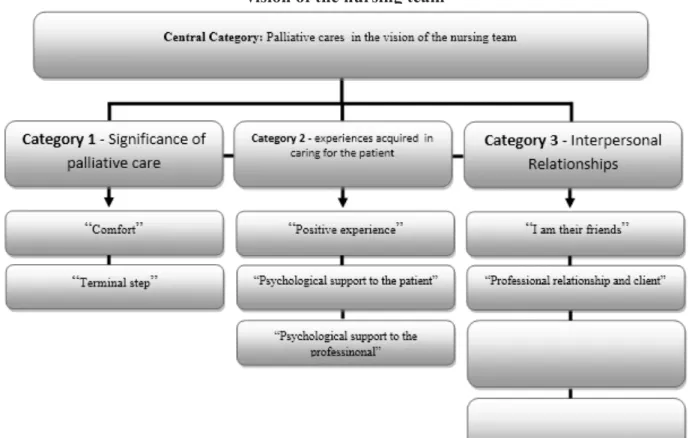
5Figure 1 - Conceptual categories and subcategories of meaning of palliative care in the
vision of the nursing team
REVISTA UNIMONTES CIENTÍFICA
RESULTS AND DISCUSSION
11 professionals were interviwed from the
nursing team with ages between 21 and 44 years
of age, the majority of brown color, marital status
Single, nursing technicians, with an income of
a minimum wage and Catholic. Regarding the
procedence, all of them reside in the northern
region of Minas. As to the time of work in the area,
it ranges from two months to five years.
CATEGORY 1 - Meaning of Palliative Cares
Subcategory A - “Comfort”.
In palliative care, it is sought to provide
a humanized support that is capable of providing
physical comfort, psycho-affective and social and
even spiritual support with the sick person
3E1 “For me are cares that will give greater comfort for the patient.”
E10 “(...) a kind of care provided in order to
give dignity and a better comfort”.
This understanding will meet the philosophy
of palliative care that proposes to offer the comfort
and relief needed to minimize the suffering and
pain of the patient, giving, therefore, quality of
life essential component to maintain the dignity in
human finitude.
E3 “(...) These are cares which will make
him to feel comfortable.”
E11“(...) it provides better quality for the
patient in a pain moment and comfort, not only coming from the nursing team but also the personal side.”
The purpose of palliative cares is, therefore,
better quality of life and offer better quality of
life and more comfort to the patient’s life until his
passing (death).
1Subcatebory B - “Terminal stage”.
In the terminal phase, in which the patient
has little time of life, palliative care is imposed,
through its procedures, ensuring quality of life,
being offered to patients beyond the therapeutic
possibilities.
E2 “(...) just to patients who do
not have more resolution of cancer.”
E4 “It is the care with the patient already in the terminal stage and there is nothing else to do, has already undergone chemotherapy, radiotherapy.”
The importance of palliative care directed
to the patient in the completion of life, especially
the oncologic one because these cares provide
a differentiated approach to pharmacological
treatment or non- pharmacological treatment that
has as main objective the promotion of humanized
care.
6E7 “(...) when the patient is admitted to
hospital, he or she goes there to have a clinical support and take medications for pain.”
E9 “(...) it is that care that you have with the patient to pain, to give medication.”
In this sense, the nurse is the health
professional who stays more time next to the patient;
thus, has responsibilities in the management of
pain, providing relief of suffering and improving
quality of life.
7Category 2 - Experiences acquired when taking
care of oncologic patients
Subcategory A- “Positive experience”
The nursing care is effective, efficient
and satisfactory at the moment that relieves pain,
E3 “(...) many times they need more psychological support than even the menial support.”
E11 “(...) they are patients who depend on
us regarding the psychological side and not only on the professional side”.
Worrying about the emotional side is, above
all, to act in the interests of improving the quality
of life of terminal patients and their families,
enabling him or her to monitor and support the pain
and anguish and redeem the lives in a context of
eminent death.
E2 “(...) you work the psychological three times, yours, the patient’s and the family’s”.
Subcategory 2C- “Psychological support to the
professional”
The nursing professionals need to have a
suitable psychological preparation for dealing with
these situations, especially those who work directly
with the patient.
E4 “(...) it is necessary to have a psychological support.” E5 “(...) we need to to have a psychological support, because it affects our psychological.”
There are people trained for such assistance,
even though there is identification with the type of
client, the nurse acquires psychological mechanisms
of defense before the patient at the end of his or her
life.
10E4 “(...)We prepare psychologically because we know that it is a patient who is going to die there.”
Category 3 - Interpersonal Relationships
Subcategory A- “I am their friends”
Oncology patients lack of affection and the
diligent contact with the nursing team provides
sharing of feelings and emotions, which can result
comforts the patient and family, when he she helps
the sick person. In the daily routine of nursing work
with oncologic patients there are rewarding and
positive factors as you see the patient is recovering,
having contact with him or her, help him or her
understand the disease and guide him or her .
8E1 “(...) it is a good experience, we learn
a lot.”
E3 “(...) Very positive experience, because
all patients that come here we know how to deal with them.”
E10 “Very positive, we learn a lot with
the oncologic patient, it a good, very good experience.
The team feels professionally fulfilled
in being able to help the patient overcome a step
considered difficult and complex. The feeling of
satisfaction in promoting the relief of suffering of
another can mean refitting of energies, seeking the
point of balance, well-being, healing of the wounds
caused by suffering, allowing new confrontations
and better performance in their work.
E2 “(...) for me it is a positive experience because I think it gives me more security of what I am going to face.”
E9 “(...) it is a very positive experience. It
does not creat fear, but trust.”
Subcategory 2B- “Psychological support to the
patient”
The conducts of care included in the
humanistic aspect and in palliative therapy go ahead
of the performance of certain technical procedures.
Certain acts performed in the act of caring, such
as a simple listening, touch, affection, makes the
patient contemplate small actions and moments
Therefore, offering him psychological support and
greater quality of time that he or she has left of
life.
9REVISTA UNIMONTES CIENTÍFICA
with patients being treated for a long period, but
professionals’ attitudes involving affection, respect
and receptivity occur regardless of the treatment
time. The nursing staff when engaging emotionally
with the patient, establishes a real, vital relationship
in therapeutics, suplyin his or her needs.
11E1 “(...) we always make friends in here and whenever I have the opportunity I’ll see them out there.”
E5 “(...) We are friends out of hospital.
E9 “(...) there are moments when we need to be friends, we need to be companion and give advice”.
We realized that the relationship established
between the nurses and the patient is important for
both and is highlighted in this study, as a relationship
of friendship, affection and understanding, which
facilitates the treatment. In this relationship, the
patient feels important, loved and not abandoned.
Therefore, this study shows that the relationship
nursing/patient goes far beyond the technical care
and treats more than the physical condition of the
patient.
E6 “the best possible, whatever I can do to help by supporting and getting on his or her side, this is my role.”
E8 “(...) we try to calm the person as most
as we can and leave the person as happy as possible”.
Subcategoria B- “Relationship
professional-client”
It is a fact beyond question that any
professional action must be based on care and
respect to the bioethical principles of beneficence,
non-maleficence, patient autonomy and justice; and
be consistent in the use of resources in the definition
of health care.
12E2 “I try to have just the relationship professional -client”.
It is a relationship marked by the oscillation between the involvement - you give yourself to people and give your hand - and the being away - the more distant you stay, the less he/ she will suffer.
E7 “I try not to have emotional bonds with the patients, but unfortunately there are times that it is not possible. We create
bonds and we walk with their shoes and then we suffer”.