A private investment facility for nature-based coastal climate resilience
Part I: Project Information GEF ID
10974 Project Type MSP
Type of Trust Fund LDCF
CBIT/NGI CBIT No NGI No Project Title
A private investment facility for nature-based coastal climate resilience
Countries Global Agency(ies) UNIDO
Other Executing Partner(s) Executing Partner Type
Earth Security Private Sector
GEF Focal Area Climate Change Taxonomy
Focal Areas, Biodiversity, Biomes, Mangroves, International Waters, Mangrove, Coastal, Climate Change Adaptation, Climate Change, Least Developed Countries, Mainstreaming adaptation, Climate finance, Livelihoods, Ecosystem-based Adaptation, Climate resilience, Private sector, Sea-level rise, Influencing models, Deploy innovative financial instruments, Stakeholders, Private Sector, Capital providers, Gender Equality, Gender Mainstreaming, Sex-disaggregated indicators, Gender-sensitive indicators, Capacity, Knowledge and Research, Innovation, Targeted Research
Sector
Mixed & Others Rio Markers
Climate Change Mitigation Climate Change Mitigation 0 Climate Change Adaptation Climate Change Adaptation 2
Duration 30 In Months Agency Fee($) 90,627.00 Submission Date 4/12/2022
A. Indicative Focal/Non-Focal Area Elements
Programming Directions Trust Fund GEF Amount($) Co-Fin Amount($)
CCA-2 LDCF 953,966.00 31,703,000.00
Total Project Cost ($) 953,966.00 31,703,000.00
B. Indicative Project description summary
Project Objective
Develop and launch a global facility to mobilise private sector investments to fund nature-based solutions to enhance climate resilience of coastal communities in LDCs
Project Componen t
Financin
g Type Project
Outcomes Project
Outputs Trus t Fund
GEF Amount($
)
Co-Fin Amount($)
Project Componen t
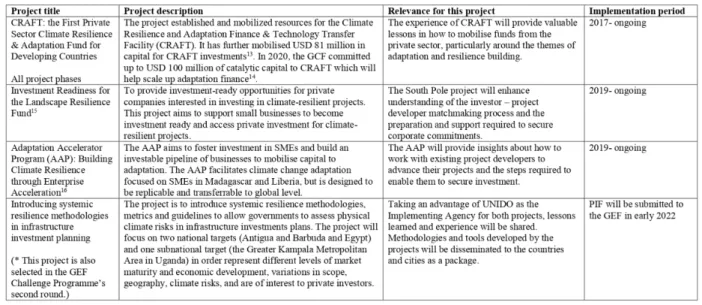
Financin g Type
Project Outcomes
Project Outputs
Trus t Fund
GEF Amount($
)
Co-Fin Amount($)
1. Identify existing nature-based coastal climate adaptation projects in LDCs and increase their investment readiness to leverage private sector investment.
Technical Assistance
?1.1
Methodology and framework developed for identifying nature-based coastal climate adaptation projects in LDCs, and assessment of their capacity needs to leverage private sector
investment.
1.2 Increased technical capacity of project developers to secure private investment for their projects.
1.3 Creation and active marketing and promotion of a global pipeline (initially consisting of at least 10 projects) of investment- ready nature- based
coastal climate adaptation projects in LDCs targeted at private sector companies to secure investment commitments.
1.1.1 Identific ation of existing nature-based coastal climat e adaptation projects, including social and economic activities that deliver value to local communities and
ecosystems.
1.1.2 Method ology and framework developed for assessing the investment readiness, type of investment required and technical capacity needs that enable a route to market for the projects, including scientific methods used in
conservation and
restoration that ensures sound environmenta l approach.
1.1.3 List of 10 projects selected as the initial basis of the global pipeline. The pipeline will be selected according to impact potential (hectares &
beneficiaries, social/gender dimensions) and
investment readiness to attract private sector investment.
1.2.1 Engage ment with project developers of 10 selected projects to define technical assistance needs including project promotion and pitch preparation required to secure private sector investments.
1.2.2 Definiti on of best practices and lessons learned by other nature- based climate adaptation financing facilities in structuring technical assistance funding as part of private sector investments.
1.2.3 Structuri ng of
technical assistance proposals for each project based on capacity needs identified to be provided as part of the private sector investments.
1.3.1 Develop ment of a global project pipeline of investment- ready projects across LDCs, with this initial selection covering up to 320,000 hectares and 240,000 beneficiaries as proof of concept.
1.3.2 Develop ment of a prospectus that can be used to support private sector engagement, defining and marketing projects and benefits for a private investment audience.
LDC F
316,751.0
0 216,409.00
Project Componen t
Financin g Type
Project Outcomes
Project Outputs
Trus t Fund
GEF Amount($
)
Co-Fin Amount($)
2. Design and launch a private finance facility for nature-based coastal climate adaptation in LDCs.
Investment 2.1 Investment commitments made by at least 3 global companies for a total of up to
$30m to illustrate the role that private sector
investments can play in
supporting nature-based coastal climate adaptation in LDCs.
2.2 Design and launch a private investment facility for nature-based coastal climate adaptati on projects in LDCs as a global mechanism to match corporate investments with projects with full consideration of gender equality and women?s empowerment.
2.1.1 Engagement with a core group of 10 corporates across relevant sectors providing a business rationale for investing in the nature- based coastal climate adaptation project pipeline identified in LDCs tailoring the opportunities to relevant corporate interests.
2.1.2 Matchm aking meetings and partnership facilitation between corporate actors and 10 climate adapt ation project developers via global virtual meetings that bring potential investors and projects together.
2.2.1 Drawing on lessons learned from other climate adapt ation financing facilities and based on the type of private sector investments targeted, an operating mechanism is designed to facilitate private investments in nature- based coastal adaptation projects.
2.2.2 Engage ment and collaboration with each of the private sector investors to formulate, refine and structure their investment commitments for climate adaptation projects.
2.2.3 Launch of the facility with private sector commitments into selected nature-based coastal climate adaptation projects.
LDC F
414,923.0
0 30,879,250.0 0
Project Componen t
Financin g Type
Project Outcomes
Project Outputs
Trus t Fund
GEF Amount($
)
Co-Fin Amount($)
3.
Disseminate knowledge and scale private sector participation through the established self-standing investment facility.
Technical Assistance
3.1
Systematised learning, dissemination and
communication s enable an increased engagement and education of the private sector to participate in nature-based coastal climate adaptati on projects.
3.1.1 Develop a typology
?playbook?
systematizing the areas of business value with illustrated case studies of private sector commitments, and the role of the facility in scaling future investments for climate adaptation.
3.1.2 Two online workshops delivered a) share lessons learned from successful projects with prospective NGOs and project developers in LDCs, and b) to share lessons learned from private companies for global private sector participants interested in investing in nature-based coastal climat e adaptation projects.
3.1.3 Ongoing monitoring and
evaluation of project results with final lessons learned developed from questionnaire s prepared by 10 project developers and 10 companies and
incorporated into the strategy to scale up the facility.
LDC F
105,552.0
0 77,618.00
Project Componen t
Financin g Type
Project Outcomes
Project Outputs
Trus t Fund
GEF Amount($
)
Co-Fin Amount($)
4.
Monitoring and evaluation
Technical Assistance
4.1 Impact of project tracked and reported
4.1.1 The project monitoring plan is designed and regular project monitoring is conducted including monitoring of the gender mainstreamin g strategy and action plan.
4.1.2 Indepen dent terminal evaluation conducted.
LDC F
30,016.00 29,723.00
Sub Total ($) 867,242.0
0 31,203,000.0 0 Project Management Cost (PMC)
LDCF 86,724.00 500,000.00
Sub Total($) 86,724.00 500,000.00
Total Project Cost($) 953,966.00 31,703,000.00
Please provide justification
C. Indicative sources of Co-financing for the Project by name and by type Sources of
Co- financing
Name of Co-financier Type of Co- financing
Investment
Mobilized Amount($)
GEF Agency UNIDO Grant Investment
mobilized
53,000.00
GEF Agency UNIDO In-kind Recurrent
expenditures 100,000.00 Private
Sector Earth Security In-kind Recurrent
expenditures 450,000.00 Private
Sector
Private Sector (potential sources to include UBS and HSBC)
Grant Investment
mobilized
31,100,000.00
Total Project Cost($) 31,703,000.00 Describe how any "Investment Mobilized" was identified
Co-financing was identified through project assessments, initial discussions with implementing partners and Earth Security?s partnerships with UBS and HSBC to develop innovative financing mechanisms for mangroves, who will be invited to get involved with this project. However, investments will be further defined, mobilized and confirmed during the PPG phase.
D. Indicative Trust Fund Resources Requested by Agency(ies), Country(ies), Focal Area and the Programming of Funds
Agenc
y Trus
t Fund
Countr
y Focal
Area Programmin
g of Funds Amount($
) Fee($) Total($)
UNIDO LDC
F Global Climat
e Change
NA 953,966 90,627 1,044,593.0
0
Total GEF Resources($) 953,966.0
0 90,627.0
0 1,044,593.0 0
E. Project Preparation Grant (PPG) PPG Required true
PPG Amount ($) 50,000
PPG Agency Fee ($) 4,750
Agenc
y Trust
Fund Country Focal
Area Programmin
g of Funds Amount($) Fee($) Total($)
UNIDO LDC
F Global Climat
e Change
NA 50,000 4,750 54,750.00
Total Project Costs($) 50,000.00 4,750.00 54,750.00
Meta Information - LDCF
LDCF true
SCCF-B (Window B) on technology transfer false
SCCF-A (Window-A) on climate Change adaptation false
Is this project LDCF SCCF challenge program?
true
This Project involves at least one small island developing State(SIDS). true
This Project involves at least one fragile and conflict affected state. true
This Project will provide direct adaptation benefits to the private sector. true
This Project is explicitly related to the formulation and/or implementation of national adaptation plans (NAPs). false
This Project has an urban focus. false
This Project covers the following sector(s)[the total should be 100%]:
*
Agriculture 0.00%
Natural resources management 60.00%
Climate information Services 0.00%
Costal zone management 30.00%
Water resources Management 0.00%
Disaster risk Management 10.00%
Other infrastructure 0.00%
Health 0.00%
Other (Please specify:) 0.00%
Total 100%
This Project targets the following Climate change Exacerbated/introduced challenges:
*
Sea level rise true
Change in mean temperature false Increased Climatic Variability false Natural hazards true
Land degradation false
Costal and/or Coral reef degradation true GroundWater quality/quantity false
Core Indicators - LDCF
CORE INDICATOR 1 Total Male Female % for Women Total number of direct
beneficiaries 240,000 120,000 120,000 50.00%
CORE INDICATOR 2 Area of land managed for climate resilience (ha)
320,000.0 0
CORE INDICATOR 3 Total no. of policies/plans that will mainstream climate resilience
1
CORE INDICATOR 4 Male Female % for Women Total number of people
trained 250 125 125 50.00%
Part II. Project Justification
1a. Project Description
a. The global environmental and/or adaptation problems, root causes and barriers that need to be addressed;
1. The IPCC 6th Assessment Report, released in August 2021 was unequivocal in its finding that this decade represents our last chance to implement climate policies and strategies that will limit the most disastrous impacts of climate change. Many of those impacts are now evident, with 2021 witnessing a series of unprecedented natural disasters, including wildfires, flooding, heat domes and typhoons. Least Developed Countries (LDCs) are the most vulnerable and the most constrained in availability of financial resources to invest in coastal adaptation, and therefore primed to be among the most affected.
2. This project addresses the critical need for climate adaptation financing around coastal locations in LDCs, where growing populations, rapid urbanisation, environmental degradation and climate vulnerability are converging. Rising sea levels, flooding, extreme weather events and coastal erosion, and saltwater intrusion into surface and groundwater are already affecting coastal locations around the world. By 2030, economic damages due to coastal storm surges and sea level rise is set to increase by a factor of 10[1]1.
3. LDCs are most vulnerable to climate change because of their economic and geographical characteristics. Geographically, LDCs are disproportionately affected by adverse impacts of climate change including temperature increase, change in precipitation and climate induced disasters. In terms of coastal communities in LDCs in particular, they are highly vulnerable to sea level rise, coastal erosion, coastal storm surge, flooding and saltwater intrusion.
4. The rapid decline of coastal ecosystems is reducing the resilience of these communities and amplifying climate risks, according to a recent report by UNEP[2]. Nature-based solutions offer these coastal regions a cost-effective tool for building resilience to the impacts of climate change. Mangroves offer a case in point: they can reduce the intensity of tidal wave energy by almost 70%, contain the flooding depth of a tsunami by 30%[3]2 and save an estimated USD 65 billion a year in coastal damages from extreme weather, with 15 million more people at risk of floods each year without them[4]3. In the Philippines, over a 15-year investment period, conserving mangroves was found to be 50-times cheaper solution for coastal protection than building a cement seawall[5]4. In addition to this cost-effectiveness, the co-benefits that mangroves provide to local populations and their livelihoods,
such as income and food security from fishing and aquaculture, and the protection of coastal fields against saline water intrusion, are well documented[6]5, as well as the co-benefits in terms of marine biodiversity and carbon sequestration. However, LDCs face significant constraints and barriers to access finance to implement ecosystem conservation and restoration projects.
5. 13 coastal LDCs (Bangladesh, Cambodia, DRC, Gambia, Guinea, Guinea Bissau, Haiti, Madagascar, Mozambique, Myanmar, Senegal, Solomon Islands and Tanzania) that are among the top 25 countries holding the majority of mangrove resources in the world[7].
6. According to the World Bank Climate Change Knowledge Portal, these LDCs are experiencing an increase in temperature, although the degree of these increases varies among countries. The annual temperatures of some countries have increased by 0.9-1.0 ? since 1960s (e.g. Gambia and Mozambique), whereas mean temperatures in Haiti have increased by 0.45 ? since 1960s. An average increase of 0.14-0.18 ? per decade since 1960 is observed in the countries such as Guinea, Cambodia and Solomon Islands. The temperatures in all 13 LDCs are projected to increase, for example, Senegal is projected to increase by 0.54-0.91 ? by the 2060s for a modest scenario, whereas the most negative scenario shows that the projected temperature increase is 1.77-2.38 ?[8]. The projected temperature increase for some countries is slightly lower, for example, Haiti is expected to increase by 0.54-0.85?
by 2060s for a modest scenario, and 1.55-1.95 ? for the most negative scenario[9].
7. Floods, droughts, storms and cyclones are all major climate-related natural hazards across LDCs.
Because of their limited capacities to respond and less means to prepare and mitigate against climate related natural hazards, LDCs are likely to suffer disproportionally from loss and damage caused by climate-related disasters. Climate hazards affect vital economic sectors on which livelihoods depend.
The majority of these LDCs are highly dependent on climate-sensitive sectors such as agriculture, fisheries and forestry which form the critical foundation of economic growth as well as providing main source of income for the countries? population.
8. Sea level rise is also causing increased salinization, coastal erosion and flooding in the coastal communities in coastal LDCs, which impacts on agriculture, shortages of drinking water and destruction of coastal ecosystems. Coastal ecosystems in LDCs are rapidly declining, reducing the resilience of these communities and amplifying climate risks. For example, mangrove ecosystems are degraded or lost because of salt intrusion and flooding. All 13 LDCs have experienced a net loss of mangrove ecosystems between 1996 and 2016. The largest net loss between 1996 and 2016 is almost 20,000 ha in Mozambique[10]. Mangrove loss will continue unless new economic or financial models are developed that provide alternative opportunities to existing practices and ensure that the physical and socioeconomic benefits of mangroves and coastal ecosystems are recognized and valued.
9. The experience of these countries highlights the twin challenge and opportunity to address climate adaptation through nature conservation, which is why nature-based conservation projects are already increasingly being implemented across LDCs. However, these projects are facing difficulties to find and sustain sources of funding, becoming highly dependent on public and philanthropic sources. A review of coastal nature-based adaptation projects in LDCs found no evidence of private sector
involvement. This underscores the need to make such nature-based coastal adaptation projects in LDCs relevant to the additional investment from the private sector. The root cause for the absence of investment towards nature-based adaptation is namely that ?nature-based solutions? for coastal adaptation are not yet well understood or recognized as an attractive investment alternative to man- made grey infrastructure investments such as cement seawalls. The barriers for promoting these type of adaptation approaches are therefore two-fold: Firstly, the need to overcome mainstream thinking on coastal resilience and engineering in order to position nature-based solutions as a viable approach to increasing coastal climate adaptation; secondly, to demonstrate in LDC contexts where adaptation funding is generally lacking, how the private sector can contribute to invest in these approaches in order to increase the mobilization of resources available to build the adaptive capacity of LDCs.
10. This project addresses the critical need to secure private-sector funding for nature-based adaptation projects in LDCs. It focuses on identifying existing projects in LDCs in order to build their capacity to attract private sector funding, while on the other engaging and mobilising a series of global private sector companies to develop commitments to invest in these projects, in ways that are closely aligned with their business interests.
Scope of project intervention
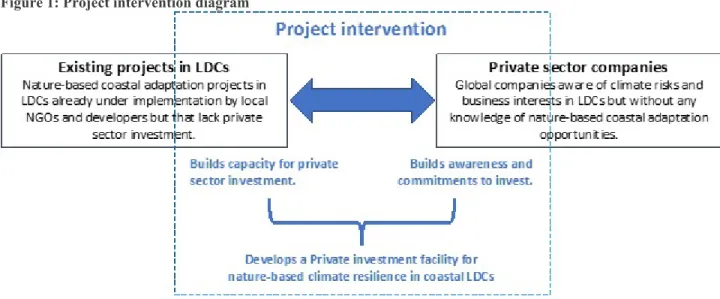
11. The project?s scope of intervention is on one hand with existing local projects in LDCs that are under implementation to build their capacity to attract private sector investment, and on the other with global private sector companies to increase their awareness of the business benefits from supporting nature-based coastal adaptation projects and facilitate commitments. The process leads the design and launch of a private sector financing facility that can continue to take this matchmaking process to scale.
Figure 1: Project intervention diagram
12. A typology of business benefits will be developed by the project (referred to as a ?playbook?
for wide dissemination) with inputs from private sector companies. Early conversations with companies in the proposal development stage, have highlighted interests such as increasing the resilience of their supply chains in LDCs through nature-based solutions and contributing to create
nature-based carbon offsets that can create measurable local impacts in terms of climate adaptation and livelihoods. The private sector financing facility resulting from this project will focus on a ?match- making? exercise between private sector entities and a global pipeline of projects that have a well- articulated business proposition.
13. Barriers that need to be addressed to unlock private sector investment in existing nature-based projects providing coastal climate resilience in LDCs:
1.a: Lack of technical capacity to make the business case
14. Projects are often not ?investment-ready?, meaning that project developers lack the technical knowledge and resources to secure private capital and to articulate a business proposition that makes them attractive to the private sector. Project developers, especially in LDCs lack the understanding of private sector interests and factors that make projects attractive, and the resources to focus on increasing assurance of impacts, such as baselines, audits and certifications. Finally, stakeholders in these countries often lack the connections to companies, meaning that the match-making that needs to happen to connect companies with a pipeline of projects remains unrealised. The investment case would be also strengthened by an increased appreciation or knowledge of what the direct and indirect damage local communities in coastal areas are facing.
1.b: Limited understanding within the global private sector on how to invest in nature-based solutions
15. Despite the growing interest from the global private sector to invest in nature-based solutions, and the growing pressures to consider climate risks to their operations and supply chains as mandated by the Task Force on Climate-Related Financial Disclosures (TCFD), there is little understanding (but great appetite to understand) the opportunities to support local efforts to increase climate resilience through nature based solutions that can also create positive impact for local communities. In addition, companies are increasingly focused on nature-based carbon offsets to meet their net-zero commitments, and while this is a climate mitigation issue, there is interest to understand how higher-impact nature- based carbon credits could help direct the necessary funding flows for nature-based climate adaptation in local contexts.
1.c: Absence of a global project pipeline and the global match-making connectivity
16. Community based restoration projects are often too small to attract private sector investment.
The aggregation of projects into larger investment pools is currently lacking and requires coordination and a global approach to pipeline development that goes beyond the individual projects. There is also a lack of clearly defined business propositions and impact metrics to encourage the engagement of international private sector companies in supporting projects with a global investment outlook. From a private sector perspective, there is an absence of facilitation opportunities that focus on creating nature- based adaptation value in coastal areas in LDCs, which have a clear business rationale, and enable stakeholders to engage with each other and define common approaches to unlocking investment.
1.d: Lack of awareness of companies, and methodological frameworks to assess business value
17. Private sector companies have no way to assess the value to their business from investing in coastal ecosystem conservation and restoration in LDCs. Hence the opportunities are largely absent from the awareness of companies. This includes understanding precisely what varying levels of investment can achieve in terms of resilience impacts (both to local communities and to their business operations), and what aspects to consider in a prospective project pipeline that build their trust and confidence on these projects being good impact and investable opportunities. The project addresses this by creating a framework that both evaluates and selects a global pipeline of projects for confidence- building and impact metrics, and also provides companies with a range of options on how to link these investments to business value.
b. The baseline scenario and any associated baseline projects;
18. Coastal ecosystems in LDCs are continuing to be lost and degraded due to both human and natural causes. Between 1996 and 2016 most LDCs have seen a significant decrease in mangrove area with losses recorded in Haiti at 11%, and 8% in Myanmar and Cambodia. The Atlas of Ocean Wealth estimates that LDCs are home to a total of 125,570 ha of restorable mangrove ecosystems ? that is, 15% of the total restorable area for mangroves worldwide is in LDCs. However, these estimates are likely to be conservative as they use a 1996 baseline without recognising the significant mangrove clearance that occurred before this year, especially within Asia. Therefore, much larger areas could be suitable for restoration with different organisations providing estimates just for Myanmar and Cambodia in excess of 450,000 ha[11].
19. As part of the baseline assessment for this proposal, Earth Security - an organisation that is developing new ways to engage the private sector to promote nature-based adaptation worldwide, mapped 34 existing mangrove restoration projects in LDCs which are either under implementation, have been implemented in the past, or have been recently announced. It found that that private sector was engaged in less than a third of these, indirectly through the purchase of carbon offset certificates via carbon offset intermediaries, without any reference to the coastal adaptation benefits that these investments were enabling. Only three of these projects featured direct investment and engagement from private sector investors for carbon sequestration purposes. The majority of funding is being provided by multilateral agencies and foundations, NGOs and governments. The selected focus of this proposal is therefore to identify the match-making potential for the private sector to invest resources in existing nature-based adaptation projects, demonstrating (a) that nature-based solutions should be seen by the private sector as a viable option for coastal adaptation in LDCs and (b) that the private sector can generate multiple levels of business value, such as improving the resilience of their supply chains, by directly supporting local nature-based adaptation projects that increase the adaptive capacity of LDCs to climate change.
20. This aligns with the findings of the 2020 OECD Report ?A Comprehensive Overview of Global Biodiversity Finance? which estimated that of the USD 90 billion total annual financial flows for biodiversity, just 12% was generated by the private sector and of this 68% was in the form of biodiversity offset mechanisms[12]. Private sector finance leveraged by the bilateral and multilateral donor accounted for just 0.7% of the total financial flows. Given the rate and scale of the losses of
coastal ecosystems the share of these flows contributed by the private sector has to grow significantly as public finance will be unable to meet the growing need.
21. Based on Earth Security?s interaction and regular engagement with financial and corporate actors, five key areas of business interest have been identified for the approach proposed by this project:
1. Supply chain resilience and business continuity risk: Using long-term nature-based solutions to directly protect physical assets and reduce disruption to ongoing business activities including supply chains (relevant for TCFD requirements to disclose climate risks).
2. People and corporate stewardship: Supporting workers, employees and their families located in local communities in LDCs to increase their climate resilience and improve community livelihoods.
3. Biodiversity impacts and regenerative business: Improving marine biodiversity, especially relevant to marine industries such as fisheries regarding healthy fish stocks, but also marine logistics and others.
4. Corporate net-zero commitments: Providing a source of high-quality carbon credits that deliver measurable and long-term climate adaptation co-benefits for coastal communities and biodiversity conservation.
5. Industry leadership on nature-based solutions: Creating market advantage by pioneering new areas for corporate impact with nature-based solutions, which create value to countries of operation.
22. The benefits for individual private sector organisations may cover more than one area above.
These will be systematised by the project in a way that can enable a much wider engagement and awareness raising of the companies around the opportunities.
23. Increasing the adaptive capacities of LDCs especially with regards to mobilising resources for coastal adaptation is paramount. Mobilising the private sector in new ways, by demonstrating the commercial value to companies, is a way to create ?win-win-win? between the adaptive capacity of local communities, the resilience of global value chains, and the conservation and restoration of natural ecosystems. Despite the clear incentives, companies often struggle to find viable projects in which to invest in at the required scale, because the existing project models are not designed to engage them proactively as a stakeholder. This project to facilitate a global pipeline of investable projects and the corporate commitments of global companies to invest in this pipeline is intended to provide the framing and match-making process to unlocking private sector investment on a global scale to align the conservation and restoration of vital ecosystems in LDCs with the interest of global private sector development.
Network of Potential Investors
24. Earth Security has been driving an engagement process with the global private sector on nature- based coastal adaptation for the past two years, in partnership with two global private banks (HSBC
and UBS). In addition to the formal partnerships with HSBC and UBS, Earth Security has regular contact and engagement with other banks such as BNP Paribas, Citibank, Credit Suisse and other institutions leading the nature financing agenda.
25. Through these and other related projects, Earth Security has built a wide network of global companies across relevant industry sectors, including manufacturing, agriculture, natural resources and infrastructure, which are keen to explore nature-based opportunities. This has also included a focus on engagement with the main global players in the global insurance and re-insurance sector, which are not only relevant to this project from their risk-mitigation perspective, but also as sustainable investors with a growing interest to allocate capital to sustainable projects and nature-based solutions.
26. The focus of Earth Security?s partnerships with HSBC and UBS is on middle and high-income countries where market conditions are more conducive to an investment environment. Currently ongoing projects to facilitate private sector investments in coastal nature-based adaptation are focused in the Philippines and Australia. The GEF Funding opens a strategic opportunity that would not otherwise happen to pursue the specific opportunity of creating an LDC focus on global pipeline generation and corporate match-making.
27. Earth Security is also a member of the Coalition for Private Investment in Conservation (CPIC), a global multi-stakeholder initiative focused on enabling conditions that support a material increase in private investment in conservation. This network provides the project with a platform to broaden engagement with a range of private sector actors already operating in this space.
28. DFIs and foundations are also playing an important role through de-risking capital and technical assistance to increase the investability of projects. Earth Security is a leading convenor in this space and its report ?The Blended Finance Playbook for Nature-Based Solutions? which draws on its engagement with public entities providing concessional and catalytic capital to attract the private sector investments is widely recognised. This work has involved insights from the likes of the US Development Finance Corporation (DFC), the Rockefeller Foundation and GEF?s Non-Grant Instruments, to name a few entities that have actively participated in the research and convening activities of Earth Security.
Project Synergies
29. This proposed project will benefit from the achievements and research outcomes of other GEF projects, leveraging good practice and lessons learned for engaging with the private sector in climate adaptation.
30. Earth Security has already engaged with South Pole and World Wildlife Fund ? US Chapter regarding their joint project ?Investment Readiness for the Landscape Resilience Fund? to learn from their experience to date and will maintain an ongoing relationship and regular dialogue throughout the project to share learning. In addition, conversations will be held with other relevant GEF projects during the project preparation phase and as part of the annual review on progress.
31. Relevant GEF projects are outlined in Table 1 below:
Table 1: Overview of associated projects
c. The proposed alternative scenario with a brief description of expected outcomes and components of the project;
32. The objective of the proposed project is to develop a private sector investment facility that enables a global match-making process to support existing projects that promote the nature-based climate resilience of coastal communities in LDCs to attract private sector investment, while on the other hand works with global companies to develop corporate investment commitments into this global pipeline in a way that moves beyond philanthropy and creates business value.
33. A preliminary analysis of 34 existing projects in LDCs suggests that these projects rely almost exclusively on philanthropic and public development funding, which by definition is limited and does not extend over long-term periods. The current state of private sector funding is indirect via carbon offset intermediaries and generally amounts to low levels of overall funding. The private sector has no awareness of the benefits to invest in these projects from a climate adaptation perspective. Therefore, the alternative ?no project? scenario is on the one hand maintaining the current gap in adaptation finance, where local projects especially in LDCs, continue to struggle to find resources, which undermines their long-term viability. Secondly, the ?no project? scenario is one where the private sector is not onboard as a stakeholders in supporting coastal adaptation in LDCs. This significantly affects the development of this agenda, as a niche that is not perceived to be relevant to the private sector.
34. The project aims to bridge existing financing gaps of these projects by creating a step-change in how the global private sector community considers investments into nature-based adaptation in LDCs as central to their business by developing and promoting a framework of business value that includes aspects such as supply chain resilience. The private sector financing facility is a global facilitation
mechanism that will measure its impact in terms of indicators on climate adaptation (people) and environmental protection (hectares).
35. In sum, without GEF funding to help establish a self-standing financing mechanism, build the awareness and capacity of projects in LDCs combating the rapid decline of coastal ecosystems to develop attractive proposition to attract the private sector, and building the awareness of the global private sector of why it is important to invest in nature-based coastal adaptation in LDCs, projects will continue to be underfunded by the private sector, which makes it difficult to reduce the existing vulnerabilities of LDCs to the impacts of climate change at the scale required.
36. The table 2 below shows an overview of the alternative scenario along the different project components, as compared to the baseline.
Table 2: Alternative scenario compared to baseline
Theory of Change
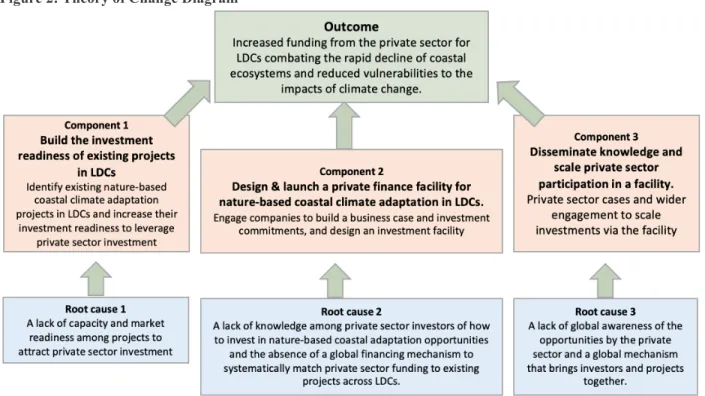
37. The overarching goal of the project is to increase the adaptive capacities of LDCs to the current and expected future impacts of climate change by bridging the financing gap between coastal nature- based resilience projects and private sector investments on a global level. Thereby, the project targets the root causes that underpin the lack of funding for projects combating the rapid decline of coastal ecosystems in LDCs, which exacerbates the existing vulnerabilities of LDCs to the impacts of climate change. In particular, it focuses on the absence of private sector funding for addressing the adaptation funding gap.
38. The project outputs are structured to target one or more of the root causes. However, it is possible to draw a direct link between the actions envisaged under each component and a root cause. In this sense, Component 1 is about tackling the lack of capacity and market readiness to attract private sector investment among projects; Component 2 is about tackling the lack of knowledge among private sector investors of how to invest in nature-based coastal adaptation opportunities and the absence of a global financing mechanism to systematically match private sector funding to existing projects across LDCs. Component 3 is tackling a lack of global awareness of opportunities by the private sector in order to scale investments through a global mechanism that brings investors and projects together.
39. Social impacts and the co-benefits provided by nature-based solutions to local livelihoods, including gender lens, are considered cross-cutting and not shown in the ToC. The ToC shows that if the outputs/components are conducted successfully then the project will contribute to address the funding gap for LDCs interested in implementing projects related to coastal ecosystems as a way to reduce the impacts of climate change.
Figure 2: Theory of Change Diagram
a) Component 1: Identify existing nature-based coastal climate adaptation projects in LDCs and increase their investment readiness to leverage private sector investment.
40. An assessment methodology to identify and analyse existing projects for nature-based coastal adaptation, which conducts a cost-benefit analysis, quantifying the environmental, social and economic impacts as well as the way to position them as investable opportunities in relation to developing key
business value categories, will create visibility and aggregation for projects with distinct assessment of different scales, levels of maturity, levels of impact and investment readiness ? developing the data needed for these to be considered by the private sector.
b) Component 2: Design and launch a private finance facility for nature-based coastal climate adaptation in LDCs.
41. An engagement of private sector companies to build their awareness of the business benefits of investing in nature-based coastal adaptation projects in LDCs, using the analysis of a pipeline of existing projects to showcase business value and development investment commitments (e.g.
regulation, coastal asset protection, supply chain resilience, carbon sequestration, community engagement, etc.). Based on these commitments, design and develop a financing facility that is fit for purpose to match project and private sector companies.
c) Component 3: Disseminate knowledge and scale private sector participation through the established self-standing investment facility.
42. Successful examples of private sector companies investing in nature-based coastal resilience projects in LDCs, based on specific areas of core business, creates a demonstration effect that enables the project to increase the scope and scale of outreach to the private sector community. This enables higher volumes of investment and the development of a self-sustaining investment facility model that is based on fees.
Project Components
COMPONENT 1: Identify existing nature-based coastal climate adaptation projects in LDCs and increase their investment readiness to leverage private sector investment.
43. This component will address the need for there to be standardized analysis of nature-based coastal resilience projects in terms of impact (social (livelihoods, gender), economic (adaptation benefits) and environmental (conservation/ha and biodiversity) and a framework for assessing the investment readiness of these projects. The latter evaluates key capability requirements of projects to create an investable proposition for the private sector and analyses key gaps in the capacity building and investment requirements needed to deliver effective adaptation outcomes. A clear, evidence-based and comparable framework is developed through the engagement of project developers primarily. The development of a methodology and framework to create consistent approach for identifying viable conservation and restoration projects will help introduce and broaden understanding of the key requirements for projects to be viewed as investment-ready by the private finance community. At the same time, the application of such an assessment framework enables the identification of projects across LDCs and a uniform analytical approach with which to assess these projects from a private sector perspective.
Outcome 1.1 Methodology and framework developed for identifying nature-based coastal climate adaptation projects in LDCs, and assessment of their capacity needs to leverage private sector investment.
Output 1.1.1 Identification of existing nature-based coastal climate adaptation projects, including social and economic activities that deliver value to local communities and ecosystems.
44. A comprehensive assessment of existing nature-based coastal climate resilience projects in LDCs and assessment of the types of impacts that these projects provide, is developed through consultations with key global NGOs and practitioners working across multiple LDCs, gathering initial feedback on existing methodologies for assessing the impact of these projects, as well as the types of value to the private sector that these impacts provide.
Output 1.1.2. Methodology and framework developed for assessing the investment readiness, type of investment required and technical capacity needs that enable a route to market for the projects, including scientific methods used in conservation and restoration that ensures sound environmental approach.
45. The framework will draw on the insights of global experts and NGOs working across multiple locations, as well as review of relevant project assessment frameworks in the field of nature-based climate adaptation and blue economy. The resulting framework will seek to assess projects for:
Key modalities in which project increases coastal adaptation (a typology will be developed).
Adaptation benefits and opportunities for building coastal resilience of local communities (measures in value of property, physical assets, and households).
Scale of natural ecosystems to be protected and/or restored, measured in hectares.
Number of people benefitting from the project in local communities, with particular emphasis on adaptation/protection benefits, types of livelihoods created, and gender positive outcomes.
Capacity building requirements by project developer (a typology will be developed).
Types of funding required (a typology will be developed).
Likelihood of accessing private investment (a typology for investment case to be developed).
Consideration of gender mainstreaming aspects.
Environmental and Social (E&S) impacts (including climate risks arising from the project; the risk of maladaptation; and the sustainability of project benefits) in the form of an E&S Scorecard, as outlined in the Environmental and Social Framework (ESMF).
Output 1.1.3 List of 10 projects selected as the initial basis of the global pipeline. The pipeline will be selected according to impact potential (hectares & beneficiaries, social/gender dimensions) and investment readiness to attract private sector investment.
46. A review of existing projects identified will lead to the selection 10 projects, which demonstrate a high impact potential across the range of criteria developed. These projects will be used to illustrate a global project pipeline and as a focus of investment facilitation with the global private sector.
Outcome 1.2 Increased technical capacity of project developers to secure private investment for their projects
Output 1.2.1 Engagement with project developers of 10 selected projects to define technical assistance needs including project promotion and pitch preparation required to secure private sector investments.
47. To increase the likelihood of the 10 shortlisted projects securing investment, the project will identify capacity building needs, technical skills and other factors required for these projects to succeed. A questionnaire will be developed that focuses on specific aspects of nature-based coastal resilience projects and information that helps to complete the Environmental and Social Scorecard for each project, as elaborated in the ESMF. Project developers in charge of these projects will be interviewed using this questionnaire to ascertain their assessment of needs and barriers to investability.
Output 1.2.2 Definition of best practices and lessons learned by other nature-based climate adaptation financing facilities in structuring technical assistance funding as part of private sector investments.
48. An analysis of existing project templates to assess capacity building needs in other nature-related financing facilities will be carried out to identify common themes and practices in project capacity assessment. Private sector companies will also be engaged to ascertain the capabilities they expect to see in projects they fund, so as to provide project developers with a better understanding of private sector needs, as an important resource to support the matchmaking process later in the project. Specific aspects of technical assistance will be assessed, such as how these projects build the investment case, prepare investment sheets and how they pitch to potential investors. This will also provide an opportunity for project developers to understand the expectations and requirements from a private sector perspective.
Output 1.2.3 Structuring of technical assistance proposals for each project based on capacity needs identified to be provided as part of the private sector investments.
49. Based on the analysis, the project will develop specific technical assistance proposals including Environmental and Social Impact Assessment studies or Management Plans, as needed, which will strengthen the investment case for these projects. These proposals will be budgeted so as to provide the private sector with an itemized capacity building plan that should form part of project investment proposals. The analysis of project capabilities and areas of technical support will increase the credibility of the projects with the private sector.
Outcome: 1.3 Creation and active marketing and promotion of a global pipeline (initially consisting of at least 10 projects) of investment-ready nature-based coastal climate adaptation projects in LDCs targeted at private sector companies to secure investment commitments.
Output 1.3.1 Development of a global project pipeline of investment-ready projects across LDCs, with this initial selection covering at least 320,000 hectares and 240,000 beneficiaries as proof of concept.
50. Based on the analysis, including areas for investment in technical assistance of each project, the 10 selected projects will be presented as a global pipeline of investment ready nature-based coastal resilience projects in LDCs with the expectation that on aggregate this first selection of projects will
cover at least 320,000 hectares of coastal ecosystem conservation or restoration projects and provide benefits for 240,000 beneficiaries in local communities. It is envisaged based on an initial mapping of possible such projects in LDCs, that this global pipeline will be geographically spread across a range of LDCs.
Output 1.3.2. Development of a prospectus that can be used to support private sector engagement, defining and marketing projects and benefits for a private investment audience.
51. The pipeline of existing projects and the data on impacts and quantified business benefits will be used to create a marketing prospectus and short video that showcases the business value of these projects, and is used as an engagement tool to market the approach to private sector companies to involve them in the process of considering their engagement and commitments.
COMPONENT 2: Design and launch a private finance facility for nature-based coastal climate adaptation in LDCs.
52. The aim of this component, is to develop through engagement a series of financial investment commitments from private sector companies to the pipeline of projects, as well as to the creation of an investment facility, which continues to grow the pipeline of projects. Earth Security is already working with a range of private sector partners including as HSBC and UBS who have an interest in participating in this process, and will continue to leverage these relationships to grow the networks of companies and investors engaged on these issues. The project aims to result in at least 3 companies providing commitments to funding projects with a total of up to $30 million in investments for the current and future pipeline.
Outcome 2.1 Investment commitments made by at least 3 global companies for a total of up to
$30m to illustrate the role that private sector investments can play in supporting nature-based coastal climate adaptation in LDCs.
Output 2.1.1 Engagement with a core group of 10 corporates across relevant sectors providing a business rationale for investing in the nature-based coastal climate adaptation project pipeline identified in LDCs tailoring the opportunities to relevant corporate interests.
53. The project will directly engage with at least 10 private sector companies, using the analysis and evidence developed about the project pipeline and its business benefits, to identify and broker the opportunities for companies to invest in such projects in a way that relates to areas relevant to business interests.
Output 2.1.2 Matchmaking meetings and partnership facilitation between corporate actors and 10 adaptation project developers via global virtual meetings that bring potential investors and projects together.
54. Once private sector companies have established interests and outlined potential commitments, the project will coordinate virtual matchmaking meetings and provide partnership facilitation with the shortlisted projects in the global pipeline, with a view to confirming and formalizing private sector commitments to invest in the projects.
Outcome 2.2 Design and launch a private investment facility for nature-based coastal climate adaptation projects in LDCs as a global mechanism to match corporate investments with projects with full consideration of gender equality and women?s empowerment.
Output 2.2.1 Drawing on lessons learned from other adaptation financing facilities and based on the type of private sector investments targeted, an operating mechanism is designed to facilitate private investments in nature-based coastal climate adaptation projects.
55. Global interviews will be carried out with 5-6 relevant nature-based financing facilities with whom Earth Security has collaborated in the past (e.g. the Blue Natural Capital Financing Facility) with a structured questionnaire to draw comparative lessons and best practices, in order to design a mechanism that is relevant to nature-based coastal resilience, as well as to an investment facilitation model between private sector and projects that intends to be designed based on principles of agility and efficiency and scale. The mechanism will also draw upon and promote the use of the E&S Scorecard to maximize the positive impacts and minimize any potential risks of future projects and subprojects.
Output 2.2.2. Engagement and collaboration with each of the private sector investors to formulate, refine and structure their investment commitments for coastal climate adaptation projects.
56. The project works with private sector companies engaged in the process to structure commitments for the pipeline of projects presented as well as for an expanded project pipeline to be further developed based on the template proposed by the project. This process will also elicit feedback from the private sector on the structure of the facility to ensure it can effectively facilitate and bridge commitments between companies and projects.
Output 2.2.3 Launch of the facility with private sector commitments into selected nature-based coastal climate adaptation projects.
57. An investment facility will be developed by Earth Security as an investment facilitation mechanism that is fit for purpose to the type of private sector commitments developed by the project and the LDC focus. Possible joint-venture models with existing financing facilities and/or with fund managers will be evaluated. The facility will be launched based on an initial set of commitments from the private sector. This will be accompanied by a marketing campaign to encourage a broader spectrum of private sector companies to engage. It is envisaged that the facility will play a brokering role between companies keen to invest in nature-based climate solutions and projects looking to secure investment commitments, focusing specifically on positive impacts on coastal climate adaptation. The facility will operate with a fee-based model as its sustainability strategy, the operating costs and long- term revenue model will be assessed in this phase, including a focus on lean and efficient operation and therefore also consider joint venture models with fund managers or synergies through existing financing facilities as a range of models to be considered.
COMPONENT 3. Disseminate knowledge and scale private sector participation through the established self-standing investment facility.
Outcome 3.1 Systematised learning, dissemination and communications enable an increased engagement and education of the private sector to participate in nature-based coastal climate adaptation projects.
Output 3.1.1 Develop a typology ?playbook? systematizing the areas of business value with illustrated case studies of private sector commitments, and the role of the facility in scaling future investments for climate adaptation.
58. A publication targeted to a global private sector audience will clearly articulate the types of business value that are provided by nature-based coastal climate resilience projects in LDCs (e.g.
supply chain resilience, regulation, carbon sequestration, climate risk reduction, community engagement, etc.), and contain private sector case studies of how these are played out in practice from a corporate strategy perspective. This will establish a missing body of knowledge on how global companies can approach and invest in projects in LDCs from a business perspective.
Output 3.1.2 Two online workshops delivered a) share lessons learned from successful projects with prospective NGOs and project developers in LDCs, and b) to share lessons learned from private companies for global private sector participants interested in investing in nature-based coastal climate adaptation projects.
59. The project will organize two online workshops for a global audience, to be disseminated through multiple networks and channels including the GEF, to build the capacity of NGOs and project developers on what the private sector expects to see in projects. A second global online workshop will be developed for a global private sector audience, disseminated to a database of over 5,000 people in Earth Security?s network, to share their experience and rationale of companies committing to invest in this pipeline in LDCs and aim to accelerate the understanding and interest of the global private sector in this field.
Output 3.1.3 Ongoing monitoring and evaluation of project results with final lessons learned developed from questionnaires prepared by 10 project developers and 10 companies and incorporated into the strategy to scale up the facility.
60. A targeted assessment of, and feedback by, participating companies and the global pipeline will provide insights and opportunities that will be used in the forward design of the scaling up strategy of the facility.
COMPONENT 4. Monitoring and evaluation
61. The project will conduct regular project monitoring activities including annual evaluation report to benchmark project progress. The targeted evaluations and interviews with companies, project developers and input of other key stakeholders such as global NGOs, and other GEF-funded projects, will provide further input to the evaluation activities, and input to the sustainability and scalability strategies.
Outcome 4.1 Impact of project tracked and reported
Output 4.1.1 The project monitoring plan is designed and regular project monitoring is conducted including monitoring of the gender mainstreaming strategy and action plan.
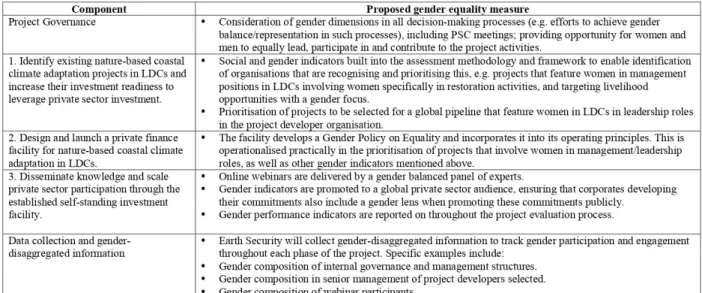
62. The project implementation will be monitored through the Project Steering Committee (PSC) meetings as well as through preparation of progress and final reports. All monitoring and evaluation tools and documents, such as the monitoring plan, progress reports and final evaluation report, will include gender dimensions, and report with respect to an established baseline for gender related targets.
When data collection or assessments are conducted, gender dimensions will be considered. This will
include in particular collection of sex-disaggregated data. The detailed monitoring plan of the project will be prepared during the PPG phase.
Output 4.1.2 Independent terminal evaluation conducted.
63. At the end of the project, UNIDO will facilitate a final evaluation by an independent evaluator within 6 months of project closure to verify achievements to date, make any final suggestions for the closing period of the project, and identify lessons learned.
Table 3: Summary Table of Project Components
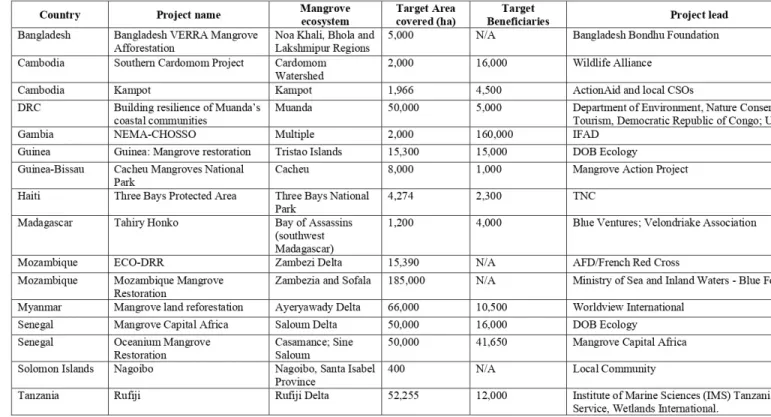
64. Preliminary sample of 16 local nature-based coastal climate adaptation projects, in each of the LDC countries that have mangrove ecosystems, as examples of the type of projects that would be analysed and considered throughout the programme, informing the development and matching of corporate commitments.
Table 4: Illustrative pipeline: Mangrove and Coastal Resilience Projects in LDCs
Project Selection
65. The full eligibility criteria for existing local nature-based coastal adaptation projects to be included in a global pipeline to be considered for private sector funding will be defined during the project preparation phase of the project, but are likely to include aspects of the following:
Hectarage of coastal ecosystem area available to be conserved or restored;
Number of potential project beneficiaries;
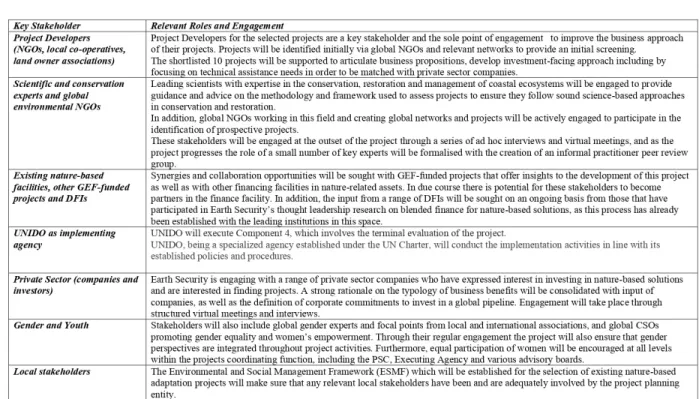
Capacity for transformative positive environmental, economic and social impacts (including gender equality and women?s empowerment;
Business value proposition, including coastal protection of physical infrastructure;
Volume of CO2 emissions capable of being sequestered by blue carbon stocks;
Investment-readiness and safeguards;
Scalability or replicability of project model and outcomes;
Evidence that government agencies and communities have been consulted by the project;
Alignment with national adaptation priorities; and
Environmental and social risks (including maladaptation, and climate change risks) and sustainability of positive impacts and co-benefits identified in the E&S Scorecard.
d. Alignment with GEF Focal Area and / or impact programme strategies;
66. This proposed project on creating a private investment facility for nature-based climate resilience is well aligned with GEF Focal Area: CCA-2 Mainstream climate change adaptation and resilience for systemic impact
67. The project will deliver impact in the priority GEF Focal area by identifying, supporting and increasing the capacity of coastal ecosystem conservation and regeneration projects in LDCs to attract private sector investment. By creating a global and scalable pipeline of projects for investors, this initiative will serve to build adaptive capacity, thereby reducing the vulnerability of people, livelihoods and natural systems.
68. It will also unlock international private finance for this nature-based solutions approach, benefitting local communities through increased economic opportunities and build resilience to the challenges presented by climate change. The outputs developed by the project will directly or indirectly mobilize private investments in climate resilience through innovative ways, which is a key goal of the Adaptation Challenge Program.
e. Incremental / additional cost reasoning and expected contributions from the baseline, the GEFTF, LDCF, SCCF and co-financing;
69. Despite underfunded efforts to combat the rapid decline of coastal ecosystems and vulnerability to climate impacts, there is no organized funding mechanism to mobilise private sector resources to support local projects for coastal ecosystem conservation and restoration. There is limited understanding by the private sector of the business value of investing into such projects that would increase local capacities for ecosystem-based adaptation. While local project developers and NGOs can often cover the costs of initial project development, they lack the knowledge to articulate a business proposition that enables the match-making process and to attract private sector funding.
70. The funding provided by GEF aims to address this gap, and develop the rationale and a mechanism that leverages private sector funding to help address the funding of projects in LDCs combating the rapid decline of coastal ecosystems and building capacities to address the impacts of climate change. It will develop the research and analysis and technical capacities necessary to build a global pipeline of projects that have clear business propositions, and facilitates corporate commitments that are mobilised according to the matching of business value areas. Developing this global opportunity further sets the scene for scaling up the approach by growing both the global pipeline and private sector participation beyond the project. The scaling up approach will rely on successful case studies of local projects across LDCs being funded by companies to demonstrate the value to companies, while at the same time build the understanding of local project developers in LDCs on how to tap into private sector funding for their projects and finally result in the establishment of a self- standing investment platform.
71. Co-financing will be sought from private sector philanthropy sources. UBS Optimus Foundation (the philanthropy arm of the global bank) will participate in the development of the financing facility and identification of a global pipeline of existing projects and provide co-financing for this project at