Neeraj K. Chasta
Dhirubhai Ambani Institute of Iinformation & Communication Technology, Gandhinagar, Gujarat
ABSTRACT
This paper, presents a novel idea for analog current comparison which compares input signal current and reference currents with high speed, low power and well controlled hysteresis. Proposed circuit is based on current mirror and voltage latching techniques which produces rail to rail output voltage as a result of current comparison. The same design can be extended to a simple current comparator without hysteresis (or very less hysteresis), where comparator gives high accuracy (less than 50nA) and speed at the cost of moderate power consumption. The comparators are designed optimally and studied at 180nm CMOS process technology for a supply voltage of 3V.
KEYWORDS
Current Mode, Current Comparator, Hysteresis.
1.
I
NTRODUCTIONNodal voltages and branch currents represents the information carried by any electric network. The former referred to “voltage domain circuits” whereas the latter are known as “current domain circuits”. In recent years; as supply voltage and device threshold voltage reduction greatly affected the performance of voltage domain circuits, current mode circuits are becoming designer’s interest. Current domain circuits show many unique and attractive properties over their voltage mode complements including higher speed, higher bandwidth, reduced distortion, low supply voltage requirements and lesser sensitivity to switching noise.
Several current mode comparison approaches are proposed [5]-[14]. The first CMOS continuous time current comparator was proposed in [5]. It consists of two cascode current mirrors but can’t operate at high speeds and frequencies due to high output impedance. To overcome this problem a new circuit has been proposed [7] which uses inverter stage in feedback with source-follower stage. But the circuit shows dead band region for low values of currents, where input impedance is quite high and thus limits speed of operation.
Fig. 1: Existing Current Comparators (A) H. Traff’s[7] (B) R. Del’s[10] (C) L. Chen’s[14] (D) V. Kasemsuwan’s[15]
2.
C
OMPARATORS WITHH
YSTERESISZ. Wang proposes current comparator with hysteresis [6] shown in fig 2. It uses three current sources namely “I1”, “I2” and “Ihy”. I1 and I2 are input currents to be compared whereas amount of hysteresis generated decided by current Ihy.
This circuit suffers from some major operational problems such as; functionality depends on the digital levels generated at node “A” and node “B”, and does not provide any assistance at the times of transitions as both of transistors M1 and M2 will be in “on” state. Speed performance is low; also design needs modification for zero and negative values of currents.
3.
C
IRCUITD
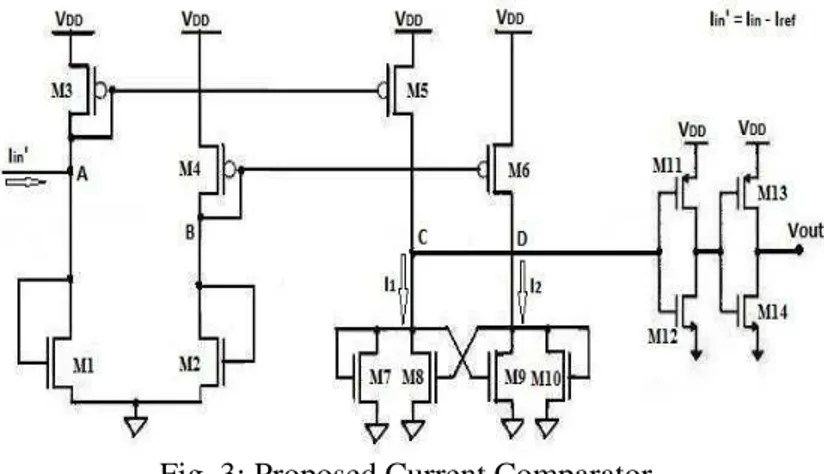
ESCRIPTIONHere a new comparison scheme is proposed which consists of three stages: the input preamplifier, a positive feedback latch stage and an output inverter. The preamplifier stage allow the input currents to flow through it and develop corresponding voltage at input nodes which results in terms of current output by current mirroring concept. It also isolates the input of comparator from switching noise (“kickback” noise) coming from positive feedback stage.
The latch stage determines which of the input signal is larger by positive feedback action. It is also called as “decision making stage”. The inverter stage amplifies the information provided by decision stage and outputs a CMOS compatible voltage signal (0 or VDD).
Fig. 3: Proposed Current Comparator
Working: Consider the case when Iref is constant and Iin change from “low” to “high”. A constant Iref will keep node B at constant voltage and allow M6 to supply a constant drain current (I2) to latch circuit. On the other hand change in Iin will make node “A” voltage varying and so the gate voltage of M5.
As Iin increases, VA increases and thus reduces the drain current (I1). This decrease in I1 will reduce current through M7 and so the voltage at node “C” (VC). This change will affect the current through M9 and as I2 is constant, current through M10 will increase. As drain current of M10 is increasing, (Vgs) of M10 will increase and so voltage at node “D” (VD), positive feedback action gives produce more reduction in drain current of M7 and hence in VC. Variations at node “C” are applied to inverter circuitry which results in CMOS compatible rail to rail output voltage.
Fig. 4: Positive Feedback Latch Circuit [2]
The expressions for node voltage “A” and “B” are as (where gm7 = gm10 & gm8 = gm9):
− − = 2 7 9 1 2 9 2 7 7 I g g I g g g V m m m m m A And, − − − = 2 9 7 1 2 9 2 7 9 I g g I g g g V m m m m m B
Both the equation shows that circuits will lead to hysteresis property (if gm’s of transistors M7 and M9 are not equal). The large signal (DC) analysis expressions for node voltage at “A” and “B” would be as:
− − + = 2 7 9 1 2 9 2 7 7 I K K I K K K V V n n n n n tn A And, − − +
= 2 1
9 7 2 9 2 7 9 I I K K K K K V V n n n n n tn B
Here we have expressions for VA and VB in large and small signal analysis, and can see that in positive feedback configuration (gm7 < gm9) circuit will show hysteresis. From the discussion above we can see that for proposed design:
(
)
(
−)
− + −− =
− 2 1
7 9 2 9 2 7 3 5 7 2 D D n n ref in n n p p n th
C I I
K K I I K K K K K V V ..(A) And,
(
)
(
−)
− + − =− 2 1
9 7 2 9 2 7 3 5 9 2 D D n n ref in n n p p n th
D I I
K K I I K K K K K V V ..(B)
4.
C
ALCULATION OFH
YSTERESISAs we are using positive feedback latch circuit, at the time transitions one of the cross coupled transistor will go in triode region and so the amount of hysteresis introduced will also depend on the drain voltages of M8 and M9 (VC and VD respectively).
When current changes from “low” to “high” values at the time of switching transistor “M8” will be in triode keeping all other transistors in saturation. So the ratio of drain currents of M5 and M6 can be given by:
( ) ( ) ( ) ( ) P V V K K V V V V V V K K V V I I tn C tn D C C tn D tn C D D = − + − − − + − = 2 7 9 2 7 9 2 6 5 2 2
As “ID5”and “ID6”are mirrored by M3 and M4 respectively, so
P I I I I D D D D = = 4 3 6 5
Appling KCL at input nodes A and B, we can easily see that
2
1 D
D ref
in I I PI
I = + −
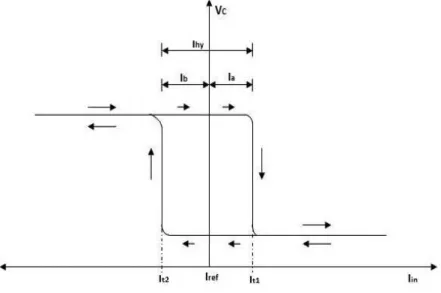
Input current in equation (3.36), give the value of current at the time of transition and it can be referred as transition current (It1).
Same can be done for reversed case; when current changes from “high” to “low” values, this time transistor “M9” will go in triode region and input signal current at the time of switching can be given by (It2):
2 '
1 D
D ref
in I I PI
I = + −
Where “ '
P” can be given by,
( ) ( )
( D tn) ( C tn D) D
tn D tn C V V V V K K V V V V K K V V P − − + − − + − = 2 2 7 9 2 2 7 9 2 '
So we have transition currents expressions as,
a ref D D ref
t I I PI I I
I1= + 1− 2 = +
(
D D)
ref bref
t I PI I I I
I = − 2− 1 = −
' 2
Fig. 5: Hysteresis Curve (VC v/s Iin)
Then hysteresis current can be given by
2
1 t
t hy I I
I = −
2 2 '
D D
hy PI PI
I = −
Equation shows the expression of hysteresis produced by circuit; where we see that it is well controlled as drain current of M2 (ID2) is always constant (see fig.3 M2 and M4 are diode connected and no current changing element is available).
Keeping equations (A) and (B) in mind; we see that when all the transistors are in saturation, amount of hysteresis produced depends on the Ration of “Kn’s”. If we set this ratio near to 1; so that
2 7 9
D n
n I
K
K term approximately get cancelled with “ID1”, and thus amount of hysteresis
introduced can nearly be set to zero. This we can understand in other way around that if we design this circuit in such a way that gm’s of all the latch transistors be nearly equal (
9
7 m
m g
g ≅ or
9
7 n
n K
K ≅ ) hysteresis produced can be reduced to “zero”. As we have already discussed that
hysteresis introduced directly relates with depth of positive feedback (difference of gm’s), then this will be the condition when circuit will have a slight positive feedback and so very less hysteresis. Under such stipulations circuit can also be used as a simple current comparator.
5.
S
IMULATIONR
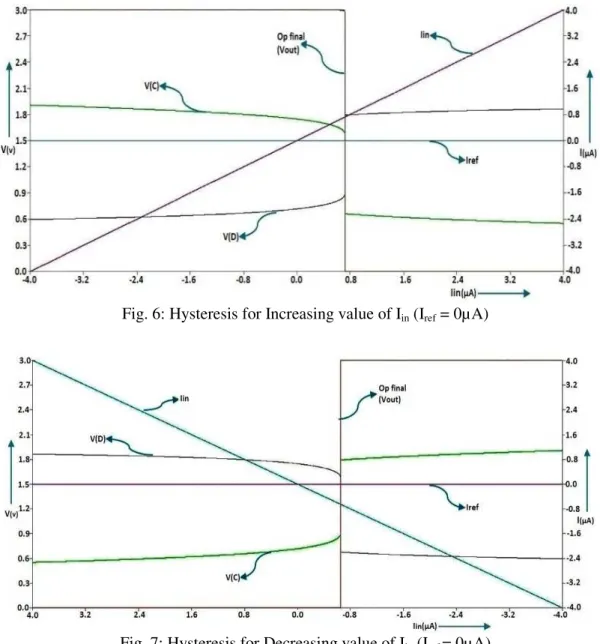
ESULTSComparator with hysteresis: The design proposed produces hysteresis in output voltage with respect to the change in direction of input current. DC transfer characteristics observed with increasing and decreasing values of input currents are shown in Fig. 6 & 7 respectively.
Fig. 6: Hysteresis for Increasing value of Iin (Iref = 0µA)
Fig. 7: Hysteresis for Decreasing value of Iin (Iref = 0µA)
Here in figures, we see that switching of output occurs at 0.72µA (Fig. 6) and -0.65µA (Fig. 7) depending on the direction of change in current. So total amount of hysteresis produced:
A A
A
Ihy=−0.7µ +0.7µ =1.4µ
Table 1: Design Parameters: Comparator with Hysteresis W
(Width)
L (Length)
M1, M2 0.18µm 0.72µm
M3, M4 0.54µm 0.72µm
M5, M6 1.08µm 0.18µm
M8, M9 0.36µm 0.18µm
M7, M10 0.27µm 0.18µm
Inverter: PMOS
0.54µm 0.18µm
Inverter: NMOS
0.18µm 0.18µm
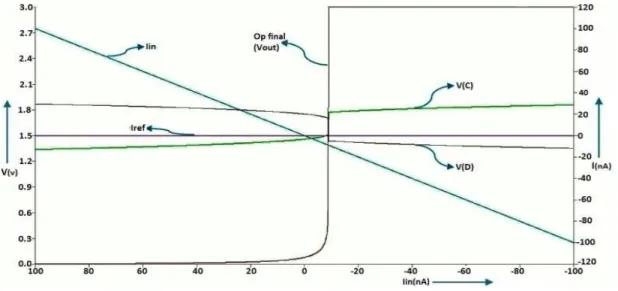
Comparator without hysteresis: The same design could be extended to comparator without (or very less) hysteresis in output voltage with the change in direction of input current. DC transfer characteristics obtained for extended concept with increasing and decreasing values of input currents are shown in Fig. 8 & 9 respectively.
Fig. 9: Hysteresis for Decreasing value of Iin (Iref = 0nA)
Here, we see that for this design switching of output doesn’t much affected by the direction of change in current as the transition points are at 9nA (Fig. 8) and -9nA (Fig. 9) with rising and falling values of input current, respectively. This is just because of very less positive feedback. Total amount of hysteresis produced:
nA nA nA
Ihy=−9 +9 =18
Circuit produces average propagation delay of 0.2ns and 1.6ns for +/- 100µA and +/- 1µA input square-wave current pulses respectively, at the DC power consumption of 2.3mW. Transistor dimensions used are as:
Table 2: Design Parameters: Comparator without Hysteresis W
(Width)
L (Length)
M1, M2 0.18µm 0.72µm
M3, M4 0.18µm 0.72µm
M5, M6 1.19µm 0.18µm
M8, M9 0.34µm 0.18µm
M7, M10 0.21µm 0.18µm
Inverter: PMOS
0.54µm 0.18µm
Inverter: NMOS
0.18µm 0.18µm
Fig. 10: Average Delay (ns): Response to +/- 1µA Current Step
Fig. 11: Average Delay (ns): Response to +/- 100µA Current Step
6.
C
ONCLUSIONA new current mode comparator with hysteresis is presented. Design have novel structure and able to achieve crucial parameter of hysteresis control. It is having analogous functionality and far better performance over the existing one in terms of speed and hysteresis control.
A
CKNOWLEDGEMENTI sincerely thank Prof. Chetan Parikh for his valuable guidance in the study of Comparators.
R
EFERENCES[1] D. A. Freitas and K. W. Current, “CMOS current comparator circuit,” Electron. Lett., vol. 19, no. 17, pp. 695-697, August 1983.
[2] Z. Wang and W. Guggenbuhl, “CMOS current Schmitt trigger with fully adjustable hysteresis,” Electron. Lett., vol. 25, no. 6, pp. 397-398, March 1989.
[3] H. Traff, “Novel approach to high speed CMOS current comparators,” Electron. Lett., vol. 28, no. 3, pp. 310-312, January 1992.
[4] A.T.K. Tang and C. Toumazou, “High Performance CMOS current comparator,” Electron. Lett., vol. 30, no. 1, pp. 5-6, January 1994.
[5] M. Bracey and W.R. White, “Design considerations for current domain regenerative comparators,” IEEE International Conference on Advanced A-D and D-A Conversion Techniques and their Applications, July 6-8, 1994.
[6] R. Fernandez, G. Cembrano, R. Castro and A. Vazquez, “A Mismatch-Insensitive High-Accuracy High-speed Continuous-Time Current Comparator in Low Voltage CMOS,” IEEE Proc. Analog and Mixed Signal IC Design, pp. 303-306, September 1997.
[7] L. Ravezzi, D. Stoppa and G.-F. Dalla Betta,"Simple high-speed CMOS current comparator," Electronics Letters, vol.33, no.22, pp.1829-1830, 23 Oct 1997.
[8] B.M. Min and S.W. KIM, “High performance CMOS current comparator using resistive feedback network,” Electronics Letters, Vo1.34, N0.22, pp.2074-2076, 1998.
[9] L. Luh, J. Choma Jr. and J. Draper, “A High-speed High-Resolution CMOS Current Comparator,” IEEE Proc. Electronics, Circuits and Systems, vol. 1,pp. 111-116, August 1999.
[10] L. Chen, B. Shi and C. Lu, “A High Speed/Power ratio continuous time CMOS current Comparator,” IEEE Proc. Electronics, Circuits and Systems, vol. 2,pp. 883-886, December 2000.
[11] V. Kasemsuwan and S. Khucharoensin, “High Speed Low Input Impedance CMOS Current Comparator,” IEEE Trans. Fundamentals, vol. E88-A, no. 6,pp. 1549-1553, June 2005.
Authors
![Fig. 1: Existing Current Comparators (A) H. Traff’s[7] (B) R. Del’s[10] (C) L. Chen’s[14] (D) V](https://thumb-eu.123doks.com/thumbv2/123dok_br/16347100.189296/2.918.136.779.159.587/fig-existing-current-comparators-traff-del-l-chen.webp)
![Fig. 4: Positive Feedback Latch Circuit [2]](https://thumb-eu.123doks.com/thumbv2/123dok_br/16347100.189296/4.918.327.589.130.286/fig-positive-feedback-latch-circuit.webp)