ISSN 1330-7142
UDK = 631.526.1:634.11
TREE CANOPY PRUNING DOES NOT REGULATE BIENNIAL BEARING IN
”ELSTAR” APPLE (Malus domestica Borkh.)
N. Pavičić, T. Jemrić, M. Skendrović,
T. Ćosić
Original scientific paper Izvorni znanstveni članak
SUMMARY
Four alternative pruning strategies (A– 25 generative buds, B– 50 generative buds, C– 75 generative buds and D–100 generative buds per tree) for Elstar apple cultivar and their possible impact on improvement in productivity were examined in 1999 and 2000. Year was significant factor for all traits, except yield. The pruning strategy is significant for number of fruits per flower cluster and fruit mass. Interaction year and pruning strategy is significant only for number of fruits per flower cluster. Fruit mass was larger for pruning strategy A compared to the pruning strategies C and D. Yield efficiency and biennial bearing index were not affected by pruning strategies. The biennial bearing index variance was the lowest for the pruning strategy B. Trunk cross sectional area (TCSA) had negative impact on fruit mass in pruning strategy C. Correlation between the flower and crop density was positive in pruning strategy A. Flower density was in positive correlation with yield in pruning strategy C. The research shows that tree pruning alone will not result in adequate yield regulation in ‘Elstar’ apple.
Key words: apple (Malus domestica Borkh), pruning strategy, biennial bearing, tree productivity
INTRODUCTION
Modern apple growing concept strives towards a production system that would yield a maximum share of the first class fruit (Krebs and Widmer, 1992). Pruning strategy plays an important role in such a fruit growing system. Pruning is primarily aimed at maintaining good light exposure of all the canopy parts during the vegetation period (Lakso and Corelli-Grappadelli, 1992). Wunsche (1991) reports that minimum 1m2 of illuminated leaf area is required for production of 5 kg of fruit. Also, care should be taken of maintaining the balance in growth of the above ground and underground tree parts (Zucconi, 1992). These requirements can only be met by an adequate pruning strategy. Inadequate pruning causes disturbance in growth and bearing balance. Pruning with leaving small number of flower buds stimulates more intensive vegetative activity (Elfving and Forshey, 1976; Mika, 1986). In the continental part of Croatia, ‘Elstar’ apple reaches excellent quality and the demand for this cultivar is on constant increase. Although the literature reports on its pruning (Soosten, 1990), no comprehensive solution has yet been found for its tendency of biennial bearing confirmed in practice. Chemical thinning helps to stabilize yield in cultivars that have lower genetic tendency towards biennial bearing (Pavičić, 1993; Pavičić and Paulić, 1989). A very week reaction of ‘Elstar’ to chemical fruit thinning has been confirmed in practice, so an optimum number of generative buds should be determined in order to decrease excessive vegetative activity and to stabilize bearing. Thus, the objective of this study was to determine the effect of different pruning intensities on growing and bearing of ‘Elstar’ apple cultivar during a three-year research period.
MATERIAL AND METHODS
The research has been carried under the ecological conditions in Kozarevac (Gornja Podravina) and it lasted for full three years (1998-2000). The first year was not taken into consideration due to possible
_________________
masking effect of tree reaction to pruning carried out before the trial was set up. ‘Elstar’ trees were grafted on M9 rootstock planted in 1995 at 3 x 0.7 planting distance.
The trial was set up with four alternatives of generative bud number left after pruning, i.e.: A = 25 generative buds per tree
B = 50 generative buds per tree C = 75 generative buds per tree D = 100 generative buds per tree
All the trial trees were pruned by the same person, according to the trial plan and using the photographs to avoid variations in pruning approach different persons might have. Five replications were established in a randomized block design (RBD). Each replication included ten trees. The same trees got the same treatments each year. The pruning was performed in January, before the vegetation starts. Generative buds were selected on the basis of their morphological characteristics.
The generative buds were counted with a manual counter. Vegetative growth was determined by measuring the trunk cross-section at 15cm above the graft and expressed as the trunk cross-section area (TCSA) in cm2. Flower density was determined in full bloom, and crop density, number of fruits/flower cluster, yield (kg·tree-1), fruit mass in grams yield efficiency and cumulative yield efficiency (kg·cm-2
All the data were statistically processed with the SAS program, version 6.12 (SAS Institute, Cary, NC, USA) using GLM procedure and Ducan test (significance level P<0.05). TCSA and flower density were subject to logarithmic and crop density, yield and yield efficiency to square roots transformation to meet the variance analysis requirements.
) were calculated (Lombard et al., 1988) in harvest. The biennial bearing index was calculated after Hoblyn et al. (1936).
RESULTS AND DISCUSSION
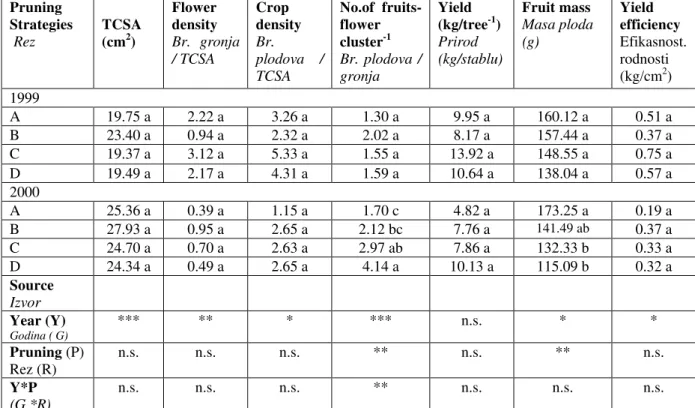
Results for the period 1999-2000 (Tab. 1) show that year significantly affects all the researched traits but for the yield per tree. The TCSA increase during the second research year was a result of normal vegetative growth. Smaller flower density in 2000 points to biennial bearing occurrence regardless of the pruning strategy. The pruning strategy effect is significant only for number of fruits per flower cluster and fruit mass. Year*pruning strategy interaction is significant only for the number of fruits/flower cluster, which shows that the pruning strategy has variable effects within a specific year, with the exception of the pruning strategy B that was stable in both research years.
Annual analyses indicate that there is no significant difference between treatments in 1999. In 2000, the difference was noticed in number of fruits/flower cluster between the pruning strategies A and D. Higher fruit number per flower cluster in alternative D is a consequence of poor differentiation of generative buds, so the fruit tree ensured sufficient assimilate for the fruit nutrition. Fruit mass in pruning strategy A is larger than in C and D, as the result of lower number of fruit buds in alternative A on one hand and less intensive fruit setting on the other.
Table 1. Indicators of vegetative and generative development of Elstar apple affected by four Pruning Strategies in 1999 and 2000
Tablica 1. Pokazatelji vegetativne i generativne razvijenosti jabuke sorte Elstar pod utjecajem četiri načina reza u 1999. i 2000. godini
Pruning Strategies Rez TCSA (cm2 Flower density ) Br. gronja
/ TCSA
Crop density
Br.
plodova / TCSA
No.of fruits-flower cluster-1 Br. plodova / gronja
Yield
(kg/tree-1) Fruit mass Prirod (kg/stablu) Masa ploda (g) Yield efficiency Efikasnost. rodnosti (kg/cm2) 1999
A 19.75 a 2.22 a 3.26 a 1.30 a 9.95 a 160.12 a 0.51 a
B 23.40 a 0.94 a 2.32 a 2.02 a 8.17 a 157.44 a 0.37 a
C 19.37 a 3.12 a 5.33 a 1.55 a 13.92 a 148.55 a 0.75 a
D 19.49 a 2.17 a 4.31 a 1.59 a 10.64 a 138.04 a 0.57 a
2000
A 25.36 a 0.39 a 1.15 a 1.70 c 4.82 a 173.25 a 0.19 a
B 27.93 a 0.95 a 2.65 a 2.12 bc 7.76 a 141.49 ab 0.37 a
C 24.70 a 0.70 a 2.63 a 2.97 ab 7.86 a 132.33 b 0.33 a
D 24.34 a 0.49 a 2.65 a 4.14 a 10.13 a 115.09 b 0.32 a
Source
Izvor
Year (Y) Godina ( G)
*** ** * *** n.s. * *
Pruning (P) Rez (R)
n.s. n.s. n.s. ** n.s. ** n.s.
Y*P
(G *R)
n.s. n.s. n.s. ** n.s. n.s. n.s.
*Note: values designated with the same character within one year are not statistically different according to the Duncan multiple range test at P≤0.05; n.s., *, *** -not significant, significant at P≤0.05 and 0.001, respectively
*Napomena: vrijednosti označene istim slovom unutar jedne godine nisu statistički različite prema Duncan-ovom testu uz P≤0,05; n.s., *, *** -nije signifikantno, signifikantno uz P≤0,05 i 0,001, respektivno
Table 2. Indicators of vegetative and generative development of Elstar apple affected by four Pruning Strategies (cumulative data for 1999- 2000)
Tablica 2. Pokazatelji vegetativne i generativne razvijenosti jabuke sorte Elstar pod utjecajem četiri načina reza (kumulativne vrijednosti 1999.- 2000.)
Pruning Strategy
Rez
TCSA
(cm2) Flower density Br. gronja /TCSA Crop density Br plodova / TCSA Yield (kg·tree-1 Prirod (kg/st) ) Fruit mass (g) Masa ploda (g) Yield efficiency (kg·cm-2 Efikasnost rodnosti (kg/cm ) 2 Biennial bearing index ) Indeks alternativno sti Variance Varijanca indeksa alternativn osti
A 2.90 a 3.81 b 1.35 b 15.39 b 159.78 a 0.61 a 0.75 a 0.05 B 2.75 a 5.28 a 1.96 a 20.73 a 143.00 b 0.74 a 0.64 a 0.03 C 3.22 a 6.23a 1.78 a 20.37 a 137.51bc 0.84 a 0.80 a 0.05 D 3.17 a 6.15a 2.07 a 19.12 a 128.06 c 0.78 a 0.75 a 0.06 * Note: values designated with the same character are not statistically different according to the Duncan multiple range test at P≤0.05
*Napomena: vrijednosti označene istim slovom nisu statistički različite prema Duncan-ovom testu uz P≤0,05
pruning strategy A (Tab. 1). It could not have compensated for the yield decrease trend noticed in 2000, caused by strong competition between the one-year shoots (Helsen and Deckers, 1984). In alternative C, there was an strong potential for intensified fruit set because of a strong positive correlation between the flower density and yield. However, this pruning strategy does not differ from the alternatives A and D when it comes to tendency towards biennial bearing.
The biennial bearing index was not significant, but its variance was the lowest in the pruning strategy B. The biennial bearing index variance is better indicator when measurements were conducted on a relatively small number of trees (Huff, 2001). In alternative B it was the lowest, which points to optimum number of 50 buds per tree, particularly considering flower density which was similar for both years. All this leads to the conclusion that pruning of the aboveground part of the tree alone is not sufficient for regulation of biennial bearing. No correlation was established between TCSA and biennial bearing index either cumulatively or in individual pruning strategies.
CONCLUSION
This research shows that pruning of canopy only does not enable adequate regulation of bearing, so further research is necessary into the root pruning and/or trunk girdling in order to decrease excessive vegetative activity and stabilize bearing. The researches focusing on these targets are currently underway.
ACKNOWLEDGEMENTS
Our sincere gratitude goes to the Agricultural Research Council of the Ministry of Agriculture and Forestry of the Republic of Croatia who supported this research (Project ARS AZ-40-98).
REFERENCES
1. Barrit, B.H., Konishi, B.S., Dilley, M.A. 1997: Tree size, yield and biennial bearing relations with 40 apple rootstocks and three scion cultivars. Acta Horticulturae 451, 105-112.
2. Elfving, D.C., Forshey, C. G. 1976: Growth and fruiting responses of vigorous apple branches to pruning and branch orientation treatments. Journal of the American Society for Horticultural Science 101, 290-296.
3. Helsen, J., Deckers, J.C. 1984: Fruit set and growth reactions of pear trees, cv. Doyenne du Commice on Quince A, pruned at different ratios of vegetative on generative buds. Acta Horticulturae 149, 145-152.
4. Hoad, G.V. 1984: Hormonal regulation of fruit-bud formation in fruit trees. Acta Horticulturae 149, 13-24.
5. Hoblyn, T.J., Grubb, N.J., Ranter, A.C., Water, B.L. 1936: Studies in biennial bearing. Journal of the Pomology Horticulturae Science 14, 39-76.
6. Huff, A. 2001: A significance test for biennial bearing using data resampling. The Journal of Horticultural Science and Biotechnology 76, 534-535.
7. Krebs C., Widmer, A. 1992. Mikado- und Drilling- System – zwei neue Baumformen in Prüfung. Schweiz. Z. Obst-und Weinbau 128, 297 – 301.
8. Lakso, A., Corelli-Grappadelli, L. 1992: Le techniche di potatura e allevamento influenzano la ripartizione dei carboidrati e lo sviluppo dei frutti di melo. Frutticoltura 54, 15-20.
9. Lombard, P.B., Callan, N. W., Dennis, F. G., Jr., Looney, N. E., Renquist, A. R., Mielke, A. 1988. Towards a standardized nomenclature, procedures, values, and units in determining fruit and nut tree yield performance. HortScience 23, 813-817.
10. Mika, A. 1986. Physiological responses of fruit trees to pruning. Horticultural Reviews 8, 249-265.
12. Pavičić, N., Paulić. N., 1989. Utjecaj kemijskog prorjedivanja plodova jabuke sorte ‘Goldspur’ (‘Auvil spur’) na prirod, promjer, rdu i dozrijevanje ploda. (In Croatian with no english abstract). Agronomski glasnik 51, 3-11.
13. Soosten, R. 1990. Der winterschnitt der sorte 'Elstar'. (In German with no english abstract). Obst & Garten 109, 59-60.
14. Wünsche, J. N., 1991., Welche Rolle spielt das Licht in modernen Apfelpflanzungen. (In German with english abstract). Ewerbsobstbau 33, 224 – 227.
15. Zucconi, F., 1992., Controllo dello sviluppo nelle piante arboree, introduzione alla fisiologia della potatura. (In Italian with english abstract) Frutticoltura 54, 7 – 12.
REZIDBA KROŠNJE NE SMANJUJE ALTERNATIVNU RODNOST JABUKE
SORTE “ELSTAR”
SAŽETAK
Istraživane su četiri različite varijante reza jabuke sorte Elstar u 1999. i 2000. godini te njihov mogući utjecaj
na poboljšanje produktivnosti te sorte (rez A– opterećenje od 25 generativnih pupova /stablu, B– 50 generativnih pupova /stablu, C– 75 generativnih pupova /stablu i D–100 generativnih pupova /stablu). Godina je imala signifikantan utjecaj na sve tretmane, osim priroda. Načini rezidbe bili su signifikantni za
broj plodova po gronji i za masu plodova. Interakcija godina*rez je signifikantna samo za broj plodova po
gronji. Rez A dao je veću masu plodova u odnosu na rezove C i D. Efikasnost rodnosti i indeks alternacije
nisu pokazali opravdane razlike između načina reza. Varijanca indeksa alternativnosti bila je najniža za rez B. Poprečna površina presjeka debla (TCSA) imala je negativan utjecaj na masu plodova kod reza C. Korelacija između broja gronja/TCSA i broja plodova /TCSA bila je pozitivna u rezu A. Broj gronja/TCSA u
pozitivnoj je korelaciji s prirodom u rezu C. Zaključeno je da rezidba nadzemnog dijela ne može dati odgovarajuću regulaciju rodnosti jabuke sorte Elstar.
Ključne riječi: Malus domestica Borkh., rezidba, alternacija, rodnost
(Received on 15 October 2004; accepted on 9 November 2004 - Primljeno 15. listopada 2004.;