Examining Perceptions about Mandatory
Influenza Vaccination of Healthcare Workers
through Online Comments on News Stories
Yang Lei1,2, Jennifer A. Pereira1, Susan Quach1, Julie A. Bettinger3,4,5, Jeffrey C. Kwong1,6,7,8,9, Kimberly Corace10,11,12, Gary Garber1,2,10,11, Yael Feinberg1,2, Maryse Guay13,14,15,16*, Public Health Agency of Canada/Canadian Institutes of Health Research Influenza Research Network (PCIRN) Program Delivery and Evaluation Group
1Public Health Ontario, Toronto, ON, Canada,2University of Toronto Faculty of Medicine, Toronto, ON, Canada,3Vaccine Evaluation Center, Vancouver, BC, Canada,4BC Children’s Hospital, Vancouver, BC, Canada,5University of British Columbia, Vancouver, BC, Canada,6Dalla Lana School of Public Health, University of Toronto, Toronto, ON, Canada,7Institute for Clinical Evaluative Sciences, Toronto, ON, Canada,8Department of Family and Community Medicine, University of Toronto, Toronto, ON, Canada,
9University Health Network, Toronto, ON, Canada,10The Ottawa Hospital, Ottawa, ON, Canada,
11University of Ottawa, Ottawa, ON, Canada,12University of Ottawa Institute of Mental Health Research, Ottawa, ON, Canada,13Département des sciences de la santé communautaire, Université de Sherbrooke, Longueuil, QC, Canada,14Institut national de santé publique du Québec, Longueuil, QC, Canada,
15Centre de recherche de l’Hôpital Charles LeMoyne, Longueuil, QC, Canada,16 Agence de la santé et des services sociaux de la Montérégie, Longueuil, QC, Canada
Abstract
Background
The aim of this study was to understand online public perceptions of the debate surrounding the choice of annual influenza vaccinations or wearing masks as a condition of employment for healthcare workers, such as the one enacted in British Columbia in August 2012.
Methods
Four national and 82 local (British Columbia) Canadian online news sites were searched for articles posted between August 2012 and May 2013 containing the words“healthcare work-ers”and“mandatory influenza vaccinations/immunizations”or“mandatory flu shots and healthcare workers.”We included articles from sources that predominantly concerned our topic of interest and that generated reader comments. Two researchers coded the unedited comments using thematic analysis, categorizing codes to allow themes to emerge. In addi-tion to themes, the comments were categorized by: 1) sentiment towards influenza vac-cines; 2) support for mandatory vaccination policies; 3) citing of reference materials or statistics; 4) self-identified health-care worker status; and 5) sharing of a personal story.
Results
1163 comments made by 648 commenters responding to 36 articles were analyzed. Popu-lar themes included concerns about freedom of choice, vaccine effectiveness, patient
a11111
OPEN ACCESS
Citation:Lei Y, Pereira JA, Quach S, Bettinger JA, Kwong JC, Corace K, et al. (2015) Examining Perceptions about Mandatory Influenza Vaccination of Healthcare Workers through Online Comments on News Stories. PLoS ONE 10(6): e0129993. doi:10.1371/journal.pone.0129993
Academic Editor:Chris T. Bauch, University of Waterloo, CANADA
Received:February 27, 2015
Accepted:May 16, 2015
Published:June 18, 2015
Copyright:© 2015 Lei et al. This is an open access article distributed under the terms of theCreative Commons Attribution License, which permits unrestricted use, distribution, and reproduction in any medium, provided the original author and source are credited.
Data Availability Statement:All relevant data are within the paper and its Supporting Information files.
Funding:The authors received no specific funding for this work.
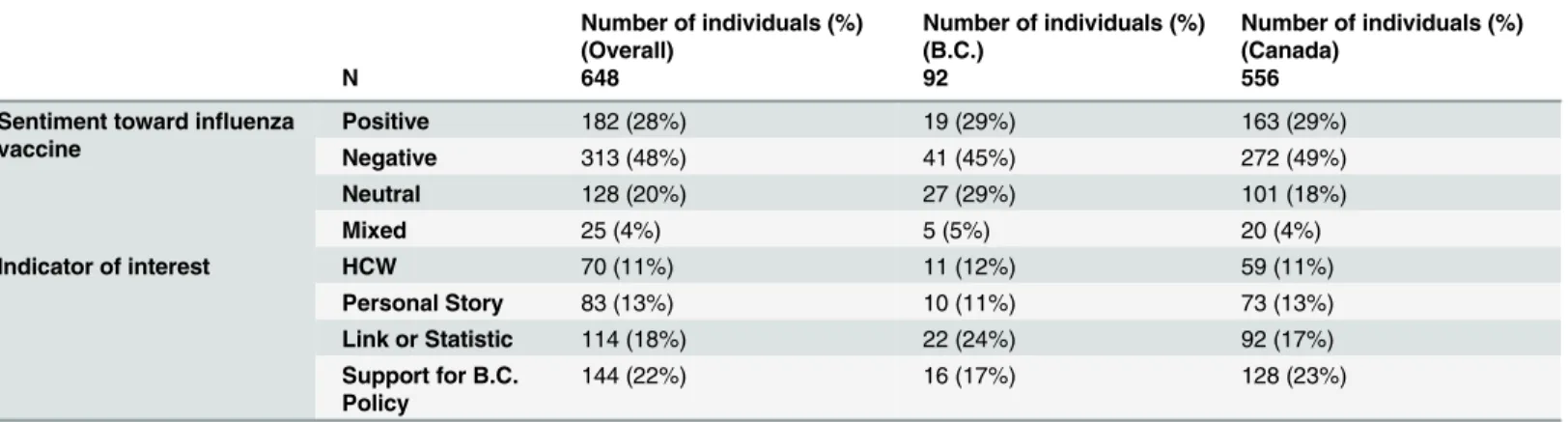
safety, and distrust in government, public health, and the pharmaceutical industry. Almost half (48%) of commenters expressed a negative sentiment toward the influenza vaccine, 28% were positive, 20% were neutral, and 4% expressed mixed sentiment. Of those who commented on the policy, 75% did not support the condition to work policy, while 25% were in favour. Of the commenters, 11% self-identified as healthcare workers, 13% shared per-sonal stories, and 18% cited a reference or statistic.
Interpretation
The perception of the influenza vaccine in the comment sections of online news sites is fair-ly poor. Public health agencies should consider including online forums, comment sections, and social media sites as part of their communication channels to correct misinformation re-garding the benefits of HCW influenza immunization and the effectiveness of the vaccine.
Background
Seasonal influenza carries a high burden of disease, especially in persons aged65 years or<2
years [1–3]. Vaccinating health care workers (HCWs) against influenza is an effective strategy
to prevent transmission in healthcare settings [4]. Yet despite the widespread availability of the vaccine and strong recommendations for HCW influenza immunization, coverage in many
Canadian healthcare organizations is low (40–60%) [5–7].
Some healthcare institutions in the United States have introduced policies making influenza vaccination a condition of work for HCWs, leading to vaccine coverage levels exceeding 90% [8–12]. In 2000, the Ontario Ministry of Health and Long-Term Care attempted to legislate mandatory influenza vaccination for paramedics, a policy that was repealed after HCWs chal-lenged it for violating personal autonomy. No other Canadian province tried to implement mandatory vaccination until 2012, when the British Columbia (BC) Ministry of Health an-nounced a policy of either influenza vaccination or wearing a mask during influenza season as a condition of service for HCWs [13]. Elsewhere in Canada, Horizon Health Network, one of the two health authorities in New Brunswick, implemented a similar policy in 2012, as did 13 Ontario hospitals in 2013 and 12 Toronto-area academic hospitals in 2014 [14], and the prov-ince of Saskatchewan in September 2014[15]. The policies in Ontario, New Brunswick, and Saskatchewan have not been legally challenged and are still in place. However, the province-wide BC condition of service policy was controversial among HCWs and resulted in a legal challenge by the nursing union. The policy was upheld in arbitration in October 2013[16].
Given the media attention around the BC policy (S1 Table), it is important to understand the perceptions of the general public towards influenza vaccination as a condition of service for HCWs. This is because online comments may influence the opinions of other content
consum-ers—including HCWs—through the effects of exemplification [17–20], and may subsequently
The disadvantages include the fact that the population of online commenter do not necessarily reflect the general population, or HCWs, and that more negative voices tend to be more vocal
online [23]. To understand Canadians’perceptions of the seasonal influenza vaccination as a
condition of service for HCWs, we evaluated readers’responses to online newspaper articles
after the BC policy was announced but before it was upheld in arbitration [16].
Methods
Data sources
We searched four national and 82 local (BC) Canadian online English language news sites for news articles about mandatory influenza vaccination policies for HCWs (Fig 1). We focused on
BC, given that the condition of service policy was introduced province-wide for the 2012–13
Fig 1. Search strategy and inclusion criteria.An initial search returned 143 articles from which we filtered down to 36 articles containing 1163 comments.
influenza season, and therefore the majority of press coverage would be from that province. We used an online newspaper database to identify BC news sites [24].
We considered English news articles posted between when the policy was announced by the Provincial Health Officer, on August 23, 2012, and the last day before our analysis began, on May 31, 2013, inclusive. We only considered English language articles since the Francophone community in BC is very small and the topic was not covered by newspapers in Quebec.
Arti-cles were included if they contained the words“healthcare worker”and“mandatory influenza
vaccinations/immunizations”or“mandatory flu shots and healthcare workers.”Each article was reviewed to ensure that they predominantly pertained to the topic of mandatory influenza vac-cinations for HCWs and had at least one comment.
Analysis
Descriptive analysis. We summarized descriptive statistics for sentiment toward both sea-sonal influenza vaccines and the BC condition of work policy, and number of comments per individual. Individuals were defined as having a unique profile name associated with their
com-ment. Some news sites allowed readers to enter comments under a“Guest”profile. For these
comments, we counted each“Guest”as a unique individual. For each comment, we recorded
whether it included an influenza vaccine-related statistic or a link to a website, whether it con-tained a personal story, and whether the individual self-identified as a HCW. We combined multiple comments from the same username on the same article as one user. In reading the first 50 comments, we identified three main patterns, and began to categorize each user into three groups: 1) those who do not believe in the effectiveness of seasonal influenza vaccines, and do not support vaccination as a condition of service for HCWs; 2) those who do believe in the effectiveness of seasonal influenza vaccines, and do support vaccination as a condition of service for HCWs; and 3) those who do believe in the effectiveness of seasonal influenza vac-cines, but do not support vaccination as a condition of service for HCWs.
Qualitative analysis. Using the process of thematic analysis [25], two researchers (S.Q. and Y.L.) co-coded 20% of the unedited comments independently, generating a coding dictio-nary that was based on the first 50 comments, and adding codes as required. After conferring and reaching consensus on the finalized coding list, S.Q. coded 30% and Y.L. coded 70% of the remaining comments. Next, the codes were organized into themes and the research team re-viewed the results together to ensure that both clinical and methodological perspectives were brought to the analysis. Each comment could contain multiple themes. The length of the com-ment was not considered. All analyses were conducted using QSR NVivo 10.
Results
Our online searches of media sites identified 36 articles that met our inclusion criteria, with 21 national articles, and 15 articles from BC newspapers (Fig 1). The majority of the articles were news articles (n = 32), with the remaining four being opinion pieces. Of these four, two sup-ported the vaccination policy, one was against, and one was neutral.
Eighty-three individuals (13%) cited personal stories in their comments, 70 (11%) self-iden-tified as healthcare workers, 144 (22%) supported a condition of service influenza vaccine poli-cy like the one proposed in BC, 69 (11%) were neutral to such a polipoli-cy, and 435 (67%) were against such a policy (Table 1). A total of 163 (25%) users provided links to information
sources or statistics in their comments. The most commonly cited sources are noted in theS1
Fig. The proportion of comments and individuals expressing the different sentiments were not substantially different between the entire dataset and the subgroups examined, with the excep-tion of users who provided a link or statistic in their comment. These users had a higher rate of negative sentiment toward the influenza vaccine than the other groups (68% vs 45%-51%) (S2 Table). Of the newspapers analyzed, only the Globe and Mail and National Post publish their online readership demographic data. Analysis of the themes by individual newspapers (Globe and Mail, National Post, CBC, CTV, BC local papers) did not show them to be substantially different from the themes that emerged from the data as a whole (Table 1).
Perceptions of Influenza Vaccine and Condition of Service for HCW
Most individuals fell into the following three categories: 1) those who did not believe in the ef-fectiveness of seasonal influenza vaccines and did not support vaccination as a condition of ser-vice for HCWs (48%); 2) those who did believe in the effectiveness of seasonal influenza vaccines and did support vaccination as a condition of service for HCWs (22%); and 3) those who did believe in the effectiveness of seasonal influenza vaccines, but did not support vaccina-tion as a condivaccina-tion of service for HCWs (6%). The remaining 24% of commenters did not ex-press an opinion on the effectiveness of the seasonal influenza vaccine.
The distribution of commenter sentiment of the most frequent themes is shown inFig 2.
Freedom of choice. The most common theme (286 comments) wasfreedom of choice. Many commenters incorrectly perceived the BC policy as making influenza vaccination man-datory for HCWs, viewing it as a state intrusion into private lives and an erosion of civil liber-ties. Others agreed with the intent of the policy but thought the (incorrectly perceived) lack of choice would be seen as excessive, while some felt it was justified on the grounds of patient safe-ty. Of commenters who understood that the policy allowed for mask-wearing as an alternative to the vaccine, some felt this to be fair, while others argued that the option of wearing a mask during influenza season was designed to identify and intimidate HCWs who did not receive the vaccine. Commenters also questioned the effectiveness of masks at preventing influenza
Table 1. Comparison of sentiment towards influenza vaccine and indicators of interest between commenters to articles in B.C. papers and nation-al papers.
Number of individuals (%) (Overall)
Number of individuals (%) (B.C.)
Number of individuals (%) (Canada)
N 648 92 556
Sentiment toward influenza vaccine
Positive 182 (28%) 19 (29%) 163 (29%)
Negative 313 (48%) 41 (45%) 272 (49%)
Neutral 128 (20%) 27 (29%) 101 (18%)
Mixed 25 (4%) 5 (5%) 20 (4%)
Indicator of interest HCW 70 (11%) 11 (12%) 59 (11%)
Personal Story 83 (13%) 10 (11%) 73 (13%)
Link or Statistic 114 (18%) 22 (24%) 92 (17%)
Support for B.C. Policy
144 (22%) 16 (17%) 128 (23%)
transmission as well as the ability of HCWs to tolerate wearing masks for the duration of their shifts.
“I agree it is a good idea for healthcare workers to get vaccinated. However people have
fought a long time for the right to decide what happens to their own body, this is not your
[em-ployer’s] choice. Where does it stop if we give our employer these [rights] to our bodies?
Women must have tubes tied after 1 child otherwise they are away from work too long if they have more children? Or maybe hospital workers must have [tattoos] to explain their entire
medical history to comfort patients. Same argument. Your body your choice.” “Dr. Grand”, in
response to
http://www.cbc.ca/news/canada/thunder-bay/story/2013/01/30/tby-hospital-flu-shot-debate-thunderbay.html.
Vaccine effectiveness. The second most common theme (221 comments) wasvaccine ef-fectiveness,with many commenters questioning the effectiveness of influenza vaccines. Some commenters rejected the concept of immunization in general, while many supported vaccines for other infectious diseases such as polio, measles, mumps, rubella, and smallpox. Those who discussed vaccine effectiveness frequently referred to sources such as the Cochrane Collabora-tion and the University of Minnesota Centre for Infectious Disease Research and Policy (CIDRAP). A smaller group of commenters believed that seasonal influenza vaccines are effec-tive in preventing influenza and its spread. Commenters questioned the credibility of sources that others on the online boards had used to support their claims. Allegations of bias in sources were frequent, and some commenters stated that more information and research on influenza vaccines was needed.
Fig 2. Seven most frequent themes and their distribution of sentiment.Freedom of choice, vaccine effectiveness, patient safety, distrust of the pharmaceutical industry, distrust of the government or public health, alternatives to vaccine, and concerns about side effects are the seven most frequently-appearing themes in our analysis.
“Get the shot, wear a mask, or go home. You are working with sick people, many with com-promised immune systems. The shot takes only a moment, and you're done. If you have a problem with needles, perhaps you shouldn't be in mainstream public healthcare. It's not
dra-conian, only a responsible reaction on the part of the hospital administration.” “Dendrast”, in
response to
http://www.cbc.ca/news/canada/thunder-bay/story/2013/01/30/tby-hospital-flu-shot-debate-thunderbay.html.
“As an RN I am offended by comments that suggest refusing the shot translates to a crappy
nurse. Until peer reviewed research confirms I am a risk to patients, I will NOT get the shot and I am happy to stay home without pay. What other profession demands the worker to knowingly chemically alter their body with potentially insidious risks? Anyone care to know how the "shot" is made? Based on predictions they throw a cocktail together. EVERY year they have missed the mark, yet they still bully workers into having it. For you know-it-all, believe ev-erything you hear people, I remind you of one of thousands of medical blunders. the
thalido-mide tragedy—a "wonder drug" endorsed by physicians, encouraged by health authorities and
permitted to kill and deform babies for 10 years before discontinued. The drug was developed
and used in Nazi prison camps and fed to Canadians post war. Minus the prison camp—is
there a difference in the mandatory imposition of these two drugs?” “RNnotPOW”, in response
to http://news.nationalpost.com/2013/01/24/nurses-aide-sent-home-for-refusing-flu-shot-the-latest-healthcare-worker-suspended-in-push-to-make-immunization-mandatory/.
Patient safety and social responsibility. Many commenters (173 comments) advocated
for mandatory influenza vaccination on the basis ofpatient safety and social responsibility.
They argued that regardless of the benefit to the person receiving the vaccine, strengthening herd immunity against the influenza in hospitals and long-term care facilities indirectly pro-tects patients with less robust immune systems. These commenters felt that there was a duty to reduce risk to vulnerable patients. Critics replied that HCWs were only a subset of those inside a hospital at any given time, and that herd immunity is impossible given the presence of new patients or visitors with influenza.
Distrust of authorities. Many commenters (270 comments) expressed adistrust of au-thorities, including government, public health, and pharmaceutical companies. Some commen-ters speculated on whether the government would receive kickbacks from the pharmaceutical companies, since the vaccine is required annually and enacting a mandatory policy would guar-antee a certain number of orders each year. Others suspected the policy was put in place not to reduce risk to patients but to reduce sick time for HCWs, thereby saving money. Several com-menters saw HCWs as role models and questioned their low rates of influenza vaccination. Fi-nally, a small number of commenters distrusted the quality of watchdog activities and
inspections undertaken by Health Canada to ensure vaccine safety and effectiveness.
Commen-ters about the pharmaceutical companies’role in the issue were universally negative, with
senti-ments ranging from resignation to outright accusations of deliberately endangering the public
for profit. Some commenters believed that pharmaceutical companies’refusal to offer
compen-sation for adverse drug reactions in Canada was suspicious, given that compencompen-sation was of-fered in several other countries.
Alternatives to vaccination. Many commenters (104 comments) advocated non-vaccine
related methods of reducing risk of influenza. Thesealternatives to vaccinationincluded
Vaccine safety. Several commenters (89 comments) had concerns about thesafety of vac-cines. Some felt all vaccines were unsafe, fearing the effects of vaccine ingredients such as thi-merosal and formaldehyde. Many expressed concerns about immune reactions, from rashes and allergies to GuillaBarré Syndrome, and some believed, or told personal stories of the in-fluenza vaccine itself transmitting inin-fluenza. Several commenters cited an article by a BC
re-searcher (Skowronski et al.) that suggested that receipt of the 2008–09 seasonal influenza
vaccine made patients more vulnerable to the 2009 H1N1 pandemic influenza virus [26].
Influenza is a minor illness. A small number of commenters (<30 comments) believed
thatinfluenza was a minor illness, and vaccination as a condition of service would result in over-vaccination and a dependence on drugs and vaccines. Most of these individuals agreed that the vaccine was necessary for specific vulnerable populations, such as patients with com-promised immune systems.
Some commenters questioned the effectiveness of mandatory vaccination for just a segment of the population, given community transmission of influenza. They debated the value of vacci-nation as a condition of service for HCWs only given that HCWs are exposed to influenza in other non-healthcare settings.
Discussion
The“influenza vaccine or mask”condition of service policy for HCWs implemented by the BC
Ministry of Health in August 2012 generated reader comments to many Canadian online news articles. The main themes of these reader comments included: (i) freedom of choice, (ii) vac-cine effectiveness, (iii) patient safety and social responsibility, (iv) distrust of government, pub-lic health, and pharmaceutical companies, (v) alternatives to vaccines, (vi) and concerns about vaccine safety. The majority of the commenters did not support the BC condition of service policy, and a plurality of commenters harboured a negative view of influenza vaccines.
In this study, approximately 48% of individuals did not believe in the effectiveness of influ-enza vaccination and did not support the condition of service policy, while only 22% of individ-uals both believed in the effectiveness of the vaccine and supported the condition of service policy. This suggests that the overall perception of the influenza vaccine and support for man-datory influenza immunization was poor among those readers who provided comments. This is not surprising given that many studies have also documented negative attitudes towards
in-fluenza vaccines among HCWs and the general population [27–29]. Commonly cited reasons
for refusal of the vaccine include misconceptions regarding the effectiveness and safety of the vaccine, as well as a belief that the vaccine is unnecessary because influenza is not a serious
ill-ness [30–33].
While we anticipated that there would be strong negative sentiment against both influenza vaccines and the BC policy, we were surprised by just how vocal this group was. We were also surprised by the subset of commenters who had positive sentiment toward the influenza vac-cine but did not support the BC policy. We did not see much discussion about influenza being a minor illness. This may be because the BC policy aroused stronger emotions about labour re-lations and thus shifted the discussion in that direction and away from influenza itself. Many of the negative comments we found appear to be rooted in misunderstanding the influenza vac-cine and the condition of service policy. This is particularly important because comments have
been shown to influence other readers’perception of the issue, such that a glut of negative
com-ments on an article may sway a previously neutral reader’s opinions [17–19]. Commonly
sourced journal articles are often split in their recommendations about whether future efforts of public health should be focused on increasing influenza vaccine coverage or developing a
evidence that the influenza vaccine is not effective. Some research has also suggested that on-line forums are a popular outlet for negative sentiments to proliferate and that these stories are more frequently shared than positive ones in social media [37]. Real-time responses to negative comments could have a role in slowing the propagation of erroneous ideas about future public health announcements.
For many commenters, the belief that influenza vaccines are ineffective is linked to a distrust of the government, public health, and pharmaceutical companies. Many users believe, even if they have positive sentiments towards influenza vaccines and support the BC policy, that the government or public health officials have inappropriate ties with the pharmaceutical industry. A previous study that examined public perceptions of measles using a similar methodology also found a strong distrust with these bodies [38], suggesting that this is not solely an issue of influenza vaccines but a broader topic about vaccines and government-industry relations in general. Therefore, in the initial public health messaging of similar future policies, healthcare organizations should be clear about the relationship between government and the pharmaceu-tical industry to counter public mistrust. Studies of attitudes of both HCWs who worked at or-ganizations with mandatory vaccination or alternative programs (such as mandatory vaccine or mask policies) and those who worked at organizations with voluntary programs reflect
simi-lar themes [39–41].
Limitations
The major limitation of this study is that the online commenting population does not necessar-ily reflect the readership of each news source, nor of the general population. Individuals who are most likely to comment are those with particularly strong (and often negative) opinions [23]. Further, although we treated each unique username as a unique person, it was possible that the same person may have used different usernames on different news sites, or even that persons were creating, and posting under, multiple accounts on the same news site to bolster the perceived support of a particular viewpoint. Finally, although we attempted to be compre-hensive in our search, because we only included sites that allowed comments we missed some media sources, particularly smaller local news sites without reader comments. However, these types of sites would most likely have generated a small volume of comments based on the read-ership size. This biases the results towards articles on larger media sources that allow
com-menting. We used online newspaper articles’comments as our sole source of public perception
data. Future studies could consider other social media such as Facebook, Twitter, and blogs to confirm findings. Finally, our study was conducted in 2013, reflecting opinions prior to the pol-icy being upheld in court, and therefore may not reflect current opinions. We only searched
English-language articles, and given BC’s large East Asian and South Asian populations, this is
a limitation on the generalizability of these results. This topic has not been addressed by the French-language media in Quebec and BC does not have a large Francophone population.
Conclusion
strategies. They also suggest the potential need for efforts at counter-messaging on online com-ment boards or on social media. Such communication efforts by health or governcom-ment officials should emphasize the following: 1) the choice given in such policies; 2) the science behind the decision, such as the effectiveness and safety of influenza vaccines, particularly in the health-care setting; 3) benefits of the policy such as improved patient and worker safety; and 4) the limits on public health interactions with the pharmaceutical industry and how this is enforced. A future study looking at comments on articles about the BC policy post-implementation may reveal if attitudes among commenters have shifted.
Supporting Information
S1 Fig. Number of times a source is cited (if n>1), divided by sentiment.Cochrane
Collabo-ration reports and a Center for Infectious Disease Research and Policy report were the two most cited sources of information in the comments.
(PDF)
S1 Table. Eligible Canadian news articles.
(PDF)
S2 Table. Source Comments. Raw data of the 1163 comments and 648 users with prelimi-nary stats.
(XLSX)
Acknowledgments
PCIRN Program Delivery and Evaluation Group members are: Julie Bettinger, David Bucker-idge, Natasha Crowcroft, Shelley Deeks, Michael Finkelstein, Maryse Guay, Jemila Hamid, Jeff Kwong, Allison McGeer, Jennifer Pereira, Susan Quach, Sherman Quan, and Margaret Russell.
Author Contributions
Conceived and designed the experiments: JCK JAP SQ. Performed the experiments: YL JAP SQ. Analyzed the data: YL JAP SQ. Wrote the paper: YL JAP SQ JAB JCK KC GG YF MG.
References
1. Centers for Disease Control and Prevention (CDC). Prevention and control of seasonal influenza with vaccines. Recommendations of the Advisory Committee on Immunization Practices—United States, 2013–2014. MMWR Recomm Rep. 2013; 62(RR-07): 1–43. PMID:24048214
2. Thompson WW, Comanor L, Shay DK. Epidemiology of seasonal influenza: use of surveillance data and statistical models to estimate the burden of disease. J Infect Dis. 2006 Nov 1; 194 Suppl: S82–S91. PMID:17163394
3. Kwong JC, Ratnasingham S, Campitelli MA, Daneman N, Deeks SL, Manual DG, et al. The impact of infection on population health: Results of the Ontario burden of infectious diseases study. PLoS One. 2012; 7(9): e44103. doi:10.1371/journal.pone.0044103PMID:22962601
4. Advisory Committee on Immunization Practices; Centers for Disease Control and Prevention (CDC). Immunization of health-care personnel recommendations of the Advisory Committee MMWR Recomm Rep. 2011 Nov 25; 60(RR-7): 1–45. PMID:22108587
5. National Advisory Committee on Immunization. Recommendations on the use of live, attenuated influ-enza vaccine (FluMist1
): Supplemental statement on seasonal influenza vaccine 2011–2012. Can Commun Dis Rep. 2011; 37. Available: http://www.phac-aspc.gc.ca/publicat/ccdr-rmtc/11vol37/acs-dcc-7/assets/pdf/acs-dcc-7-eng.pdf.
7. Wellington-Dufferin-Guelph Public Health. Influenza immunization rates for healthcare workers in long-term care homes, retirement homes, and hospitals, in Wellington-Dufferin-Guelph for the 2010–2011. 2011 March 9. Available:http://www.wdgpublichealth.ca/sites/default/files/wdgphfiles/BH_01_03_02_ 0311influenza immunization rates(2).pdf.
8. Rakita RM, Hagar BA, Crome P, Lammert JK. Mandatory influenza vaccination of healthcare workers: a 5-year study. Infect Control Hosp Epidemiol. 2010; 31: 881–888. doi:10.1086/656210PMID: 20653445
9. Poland GA, Tosh P, Jacobson RM. Requiring influenza vaccination for health care workers: Seven truths we must accept. Vaccine. 2005; 23: 2251–2255. PMID:15755605
10. Huynh S, Poduska P, Mallozzi T, Culler F. Mandatory influenza vaccination of health care workers: A first-year success implementation by a community health care system. Am J Infect Control. 2012; 40: 771–773. doi:10.1016/j.ajic.2011.10.011PMID:22325484
11. Miller BL, Ahmed F, Lindley MC, Wortley PM. Increases in vaccination coverage of healthcare person-nel following institutional requirements for influenza vaccination: A national survey of US hospitals. Vac-cine. 2011; 29: 9398–9403. doi:10.1016/j.vaccine.2011.09.047PMID:21945495
12. Babcock HM, Gemeinhart N, Jones M, Dunagan WC, Woeltje KF. Mandatory influenza vaccination of health care workers: translating policy to practice. Clin Infect Dis. 2010; 50: 459–464. doi:10.1086/ 650752PMID:20064039
13. Immunize BC. Influenza Control Program Q&A. 2014 Oct 14 Updated. Available:http://www. immunizebc.ca/sites/default/files/graphics/influenzamaskfaq.pdf.
14. Gruben V, Siemieniuk RA, McGeer A. Health care workers, mandatory influenza vaccination policies and the law. CMAJ. 2014 Oct 7; 186: 1076–1081. doi:10.1503/cmaj.140035PMID:24863919
15. Shawn Knox. Sask. implements flu shot or mask policy for health-care workers. Global News. 9 July 2014. Available: http://globalnews.ca/news/1441291/saskatchewan-implements-flu-shot-or-mask-policy-for-health-care-workers/. Accessed 12 May 2015.
16. Diebolt R. In re the matter of an arbitration under the B.C. Labour Relations Code between Health Em-ployers Association of British Columbia (HEABC) representing emEm-ployers bound by the collective agreement between HEABC and Health Sciences Association (HAS) on behalf of Health Science Pro-fessionals Bargaining Association of British Columbia (HSPBA). Influenza Control Program Policy Grievance Arbitration Ruling. Vancouver. 23 October 2013.
17. Peter C, Rossmann C, Keyling T. Exemplification 2.0: Roles of direct and indirect social information in conveying health messages through social network sites. J Media Psychol. 2014; 26: 19–28.
18. Walther JB, DeAndrea D, Kim J, Anthony JC. The influence of online comments on perceptions of anti-marijuana public service announcements on YouTube. Hum Commun Res. 2010; 36: 469–492.
19. Betsch C, Ulshöfer C, Renkewitz F, Betsch T. The Influence of narrative v. statistical information on per-ceiving vaccination risks. Med Decis Making. 2011; 31: 742–753. doi:10.1177/0272989X11400419 PMID:21447730
20. Prematunge C, Corace K, McCarthy A, Nair RC, Pugsley R, Garber G. Factors influencing pandemic in-fluenza vaccination of healthcare workers-A systematic review. Vaccine. 2012; 30: 4733–4743. doi:10. 1016/j.vaccine.2012.05.018PMID:22643216
21. Newspaper Audience Databank Inc. NADbank 2013 Study. Toronto. Available:http://nadbank.com/ en/studies/2013/overview-results
22. Rowe G, Hawkes G, Houghton J. Initial UK public reaction to avian influenza: Analysis of opinions posted on the BBC website. Health Risk Soc. 2008; 10: 361–384.
23. Coe K, Kenski K, Rains SA. Online and uncivil? Patterns and determinants of incivility in newspaper website comments. J Commun. 2014; 64: 658–679. doi:10.1016/j.annemergmed.2014.06.004PMID: 24954579
24. Web Wombat Pty Ltd (2013) onlinenewspapers.com. Available:http://www.onlinenewspapers.com/.
25. Guest G, MacQueen KM, Namey EE. Applied thematic analysis. Thousand Oaks, California: Sage Publications. 2012.
26. Skowronski DM, De Serres G, Crowcroft NS, Janjua NZ, Boulianne N, Hottes TS, et al. Association be-tween the 2008–09 seasonal influenza vaccine and pandemic H1N1 illness during spring-summer 2009: Four observational studies from Canada. PLoS Med. 2010; 7: e1000258. doi:10.1371/journal. pmed.1000258PMID:20386731
28. Larson HJ, Jarrett C, Eckersberger E, Smith DMD, Paterson P. Understanding vaccine hesitancy around vaccines and vaccination from a global perspective: A systematic review of published literature, 2007–2012. Vaccine. 2014; 32: 2150–2159. doi:10.1016/j.vaccine.2014.01.081PMID:24598724
29. Yaqub O, Castle-Clarke S, Sevdalis N, Chataway J. Attitudes to vaccination: A critical review. Soc Sci Med. 2014; 112: 1–11. doi:10.1016/j.socscimed.2014.04.018PMID:24788111
30. Wheelock A, Parand A, Rigole B, Thomson A, Miraldo M, Vincent C. Socio-psychological factors driving adult vaccination: A qualitative study. PLoS One. 2014; 9: e113503. doi:10.1371/journal.pone. 0113503PMID:25490542
31. Lehmann BA, Ruiter RA, Wicker S, van Dam D, Kok G.“I don’t see an added value for myself”: a quali-tative study exploring the social cognitive variables associated with influenza vaccination of Belgian, Dutch and German healthcare personnel. BMC Public Health. 2014; 14: 407. doi: 10.1186/1471-2458-14-407PMID:24775096
32. Corace K, Prematunge C, McCarthy A, Nair RC, Roth V, Hayes T, et al. Predicting influenza vaccina-tion uptake among health care workers: What are the key motivators? Am J Infect Control. 2013; 41: 679–684. doi:10.1016/j.ajic.2013.01.014PMID:23523520
33. Prematunge C, Corace K, Mccarthy A, Nair RC. Qualitative motivators and barriers to pandemic vs. seasonal influenza vaccination among healthcare workers: A content analysis. Vaccine. 2014; 32: 7128–7134. doi:10.1016/j.vaccine.2014.10.023PMID:25454876
34. Gardam M, Lemieux C. Mandatory influenza vaccination? First we need a better vaccine. CMAJ. 2013; 185: 639–640. doi:10.1503/cmaj.122074PMID:23529962
35. Flegel K. Health care workers must protect patients from influenza by taking the annual vaccine. CMAJ. 2012; 184: 1873. doi:10.1503/cmaj.121679PMID:23109612
36. Osterholm MT, Kelley NS, Sommer A, Belongia EA. Efficacy and effectiveness of influenza vaccines: A systematic review and meta-analysis. Lancet Infect Dis. 2012; 12: 36–44. doi:10.1016/S1473-3099 (11)70295-XPMID:22032844
37. Larson HJ, Smith DMD, Paterson P, Cumming M, Eckersberger E, Freifeld CC, et al. Measuring vac-cine confidence: Analysis of data obtained by a media surveillance system used to analyse public con-cerns about vaccines. Lancet Infect Dis. 2013; 13: 606–613. doi:10.1016/S1473-3099(13)70108-7 PMID:23676442
38. Pereira JA, Quach S, Dao HH, Kwong JC, Deeks SL, Crowcroft NS, et al. Contagious comments: What was the online buzz about the 2011 Quebec measles outbreak? PLoS One. 2013; 8: e64072. doi:10. 1371/journal.pone.0064072PMID:23691152
39. Quach S, Pereira JA, Kwong JC, Quan S, Crowe L, Guay M, et al. Immunizing health care workers against influenza: A glimpse into the challenges with voluntary programs and considerations for manda-tory policies. Am J Infect Control. 2013; 41: 1017–1023. doi:10.1016/j.ajic.2013.05.016PMID: 23973425
40. Awali RA, Samuel PS, Marwaha B, Ahmad N, Gupta P, Kumar V, et al. Understanding health care per-sonnel’s attitudes toward mandatory influenza vaccination. Am J Infect Control. 2014; 42: 649–652. doi:10.1016/j.ajic.2014.02.025PMID:24837116