www.atmos-chem-phys.net/10/431/2010/ © Author(s) 2010. This work is distributed under the Creative Commons Attribution 3.0 License.
Chemistry
and Physics
Correlations of mesospheric winds with subtle motion of the Arctic
polar vortex
Y. Bhattacharya and A. J. Gerrard
Center for Solar-Terrestrial Research, New Jersey Institute of Technology, 323 Martin Luther King Jr. Boulevard, 101 Tiernan Hall, Newark, NJ 07102-1982, USA
Received: 24 July 2009 – Published in Atmos. Chem. Phys. Discuss.: 6 August 2009 Revised: 16 December 2009 – Accepted: 27 December 2009 – Published: 19 January 2010
Abstract. This paper investigates the relationship between high latitude upper mesospheric winds and the state of the stratospheric polar vortex in the absence of major sudden stratospheric warmings. A ground based Michelson Inter-ferometer stationed at Resolute Bay (74◦43′N, 94◦58′W) in the Canadian High Arctic is used to measure mesopause re-gion neutral winds using the hydroxyl (OH) Meinel-band air-glow emission (central altitude of∼85 km). These observed winds are compared to analysis winds in the upper strato-sphere during November and December of 1995 and 1996; years characterized as cold, stable polar vortex periods. Cor-relation of mesopause wind speeds with those from the up-per stratosphere is found to be significant for the 1996 season when the polar vortex is subtly displaced off its initial loca-tion by a strong Aleutian High. These mesopause winds are observed to lead stratospheric winds by approximately two days with increasing (decreasing) mesospheric winds predic-tive of decreasing (increasing) stratospheric winds. No statis-tically significant correlations are found for the 1995 season when there is no such displacement of the polar vortex.
1 Introduction
Vertical downward lower and middle atmospheric coupling – how the troposphere reacts to reasonable changes in the state of the upper and middle atmosphere – is still a sub-ject of active investigation. Dynamical signatures in the mid-stratosphere (∼30 km) have been seen to “propagate downwards” (Baldwin and Dunkerton, 1999, 2001; Baldwin, 2000) ahead of imminent large scale changes in the strength of the stratospheric polar vortex caused mainly by planetary-Rossby waves of tropospheric origin (Andrews et al., 1987)
Correspondence to:Y. Bhattacharya
and by the interaction with the Aleutian High (Harvey and Hitchman, 1996). A detailed, ongoing observation and anal-ysis of similar events is necessary to better identify the mech-anisms of how the upper atmosphere can affect day-to-day weather in the troposphere. For instance, an objective of the International Polar Year 2007–2008 is to study the “Structure and Evolution of the Polar Stratosphere and Mesosphere and Links to the Troposphere during IPY” (www.ipy.org, Activ-ity ID No: 217).
The formation of polar vortex, its gradual strengthening in winter and its breakdown in late spring superimposes a highly interactive seasonal system that is difficult to forecast with acceptable accuracy. Although the broad mechanism of transfer of dynamical information by upward propagating waves (i.e. planetary scale Rossby waves and synoptic grav-ity waves) and interaction of such waves with a critical layer is generally known (Andrews et al., 1987), other mechanisms such as the self-modulation of the amount of wave activity entering the stratosphere (e.g. Scott and Polvani, 2004) and wave reflection (e.g. Harnik et al., 2005) are somewhat less understood. In principle, the study of downward propagating dynamical signatures should extend from the mesosphere-thermospheric regions and higher down to the surface, given sufficient upper level forcing. However, continuous obser-vations spanning weeks or months of the MLT (mesosphere, lower thermosphere) region are sparse, especially at high lat-itudes in the vicinity of the winter polar cap. MLT dynamics here show strong temporal and spatial variability attributed to the interacting dynamical systems – tidal, planetary and gravity waves and the polar vortex system. Detailed analy-sis of such observations in turn prompt advances in the un-derstanding and predictive ability of global circulation and forecast models.
432 Y. Bhattacharya and A. J. Gerrard: Mesospheric winds and polar vortex motion based (i.e. localized, frequently sampled in time)
observa-tions are necessary for detailed investigation of the dynam-ics of signal progression between the MLT and lower atmo-spheric regions. Such time series analysis of wind veloc-ities and temperatures in Arctic MLT have been recorded, amongst others, by Sivjee et al. (2003), Ozonovich et al. (1997) at Eureka, Mitchell et al. (2002) from Esrange me-teor radar, Won et al. (1999) from Thule Air Base, Fisher et al. (2002), Bhattacharya et al. (2004) and Wu et al. (2005) at Resolute Bay. Walterscheid et al. (2000) have studied temperature changes using rotational temperatures from the OH airglow and NCEP (National Center for Environmental
Prediction) assimilated data in the MLT over Eureka (80◦N)
over a period of∼35 days during a 1993 stratospheric warm-ing event, and compared it to the predictions of the TIME-GCM model. Rotational temperatures from OH airglow have also been used at the South Pole by Azeem et al. (2005), who observed signatures of the 4-day planetary wave and ev-idence of mesospheric cooling∼15 days preceding the in-crease in stratospheric temperatures.
In this paper we investigate the correlation between ob-served wind structure in the MLT region with assimilated daily wind speeds in the stratosphere (3.16 hPa, ∼40 km) during periods that are associated with both subtle polar vor-tex movement and the absence of stratospheric warmings. A crucial aspect of this paper is that unique data – neutral winds over from the Arctic mesopause measured almost daily over approximately 45 days, over two winters, is being analyzed at a unique time – when the polar vortex is cold and stable, without stratospheric warming events. Stable polar vortices have not been available since the mid 1990s, and the differ-ence in the degree of distortion of the polar vortex between the two seasons has provided a valuable and rare opportunity for such analysis. Section 2 briefly describes the instrument and observations. In Sect. 3, we analyze the observations, comparing them to assimilated data from the middle atmo-sphere at a synoptic scale. Section 4 presents a discussion in the context of differences in the strengths of polar vortex over the two observation seasons.
2 Data
Wind velocities were observed using a ground-based Michel-son interferometer called ERWIN (E-Region Wind Interfer-ometer) located at Resolute Bay (74◦43′N, 94◦58′W). ER-WIN is a wide-angle interferometer, in which an ordinary Michelson is made to be independent of the angle of incident rays by inserting a glass plate in one of the arms, described in detail by Gault et al. (1996). This configuration enables scan-ning a single fringe by making the off-axis angle as large as possible, suitable for studying faint airglow emission. The instrument measures wind velocities in the MLT region by observing the Doppler shift of the wavelength of the line-center of three airglow emissions. This paper presents
obser-vations of the Meinel OH(6,2) P1(3) airglow emission line-center at 843.0 nm, at a nominal altitude of∼85±5 km. Mea-sured wind velocities should be considered to be an average over this altitude range.
Observations from the ERWIN Michelson Interferometer are of high quality. Accuracy of measurements is typically 1 m/s for a single observation, with an integration time of 1–2 s. A full set of measurements- zonal and meridional winds – takes about 20 min in the instrument configuration used for this paper. An excellent correlation was found in simultaneously measured wind velocities (corresponding to the∼97 km green-line airglow emission) from ERWIN and a ground-based Fabry-Perot instrument (CLIO), also located at Resolute Bay (Fisher et al., 2000). Uninterrupted mea-surements are possible during darkness (polar winter) with-out significant cloud cover or bright moonlight within the in-strument field-of-view.
For comparison and correlation with stratospheric winds, daily mean winds over Resolute Bay from UKMO Strato-spheric Assimilated Data have been used. The assimilation procedure and the data are described in detail by Swinbank and O’Neil (1994). Assimilation uses the UKMO general circulation model with input data (mainly temperatures) from radiosondes and satellites. Model output for an initial 1-day run is used for the next round of input. Results are interpo-lated to a UARS (Upper Atmospheric Research Satellite) ver-tical grid, separated by a factor of 1016 in pressure levels, with
a horizontal grid size of 3.75◦ lon, 2.5◦ lat. For this paper, the 3.16 hPa (∼40 km) pressure level has been used, which we feel represents the most reliable data closest to the alti-tude of the ERWIN wind measurements. Lower altialti-tude wind analyses could also have been used for this study, but the as-sociations in stratosphere-troposphere coupling have already been addressed in references cited in this paper.
Fig. 1.Mesospheric winds as measured by ERWIN and assimilated stratospheric winds (15 November to 30 December, upper – 1995, lower – 1996). Stratospheric winds are in green. Mesospheric winds, averaged for each day are in red. Crosses represent raw (unaveraged) ERWIN data taken in 20 min periods.
also not possible to subtract tidal amplitudes from the mea-sured wind fields due to periodic, daily data gaps (∼12 h), and other, weather related, discontinuities in the data. Be-cause the wind vectors are not correlated to observational windows, we assume that any tidal bias can be treated as random geophysical noise in the ERWIN data series.
3 Analysis
The Arctic winters of 1994/1995, 1995/1996 and 1996/1997 were characterized by relatively cold and persistent polar vortices that were not interrupted by major stratospheric warmings or vortex breakup (Pawson and Naujokat, 1999). These are ideal periods for synoptic scale case study of the stratospheric polar vortex combined with site-specific observations such as those presented herein. This is be-cause the time series (in our case, winds) representative of stratospheric conditions can be considered “stationary” in the sense that the overall structure of the volume in and around the vortex does not significantly change over the period of observations. Gerrard et al. (2002) have shown that for syn-optic studies of this nature, position and movement of the vortex must be considered when interpreting site specific ob-servations – whether ground-based instruments, or in-situ and space-based instruments which sample the specific at-mospheric region being studied infrequently temporally and spatially.
Figure 2 shows the geopotential heights (UKMO assimi-lated data) at five day intervals at 3.16 hPa over the duration of observations for November–December 1995 and 1996. If the sequence of geopotential contours is taken to be a rea-sonable proxy for the upper stratosphere, the 1995 season is characterized by a polar vortex roughly circular in shape which extends over Resolute Bay for the entire measurement period. During the 1996 winter, the presence of a strong Aleutian high can be indirectly observed in the polar plot sequence. In the upper stratosphere, the polar vortex is pro-gressively distorted from its circular shape and spatially dis-placed off of Resolute (i.e. no longer below the geographic point where the mesopause is sampled). Time series corre-sponding to these two different local conditions (1995, 1996) thus complement each other nicely in this correlation study, aided by the fact that for both the seasons, the vortex shape and relative location return to (roughly) their initial condi-tions.
434 Y. Bhattacharya and A. J. Gerrard: Mesospheric winds and polar vortex motion 15-Nov-95 0 90 180 270 + 20-Nov-95 0 90 180 270 + 25-Nov-95 0 90 180 270 + 30-Nov-95 0 90 180 270 + 05-Dec-95 0 90 180 270 + 10-Dec-95 0 90 180 270 + 15-Dec-95 0 90 180 270 + 20-Dec-95 0 90 180 270 + 25-Dec-95 0 90 180 270 + 30-Dec-95 0 90 180 270 + 15-Nov-96 0 90 180 270 + 20-Nov-96 0 90 180 270 + 25-Nov-96 0 90 180 270 + 30-Nov-96 0 90 180 270 + 05-Dec-96 0 90 180 270 + 10-Dec-96 0 90 180 270 + 15-Dec-96 0 90 180 270 + 20-Dec-96 0 90 180 270 + 25-Dec-96 0 90 180 270 + 30-Dec-96 0 90 180 270 +
33.0 35.0 36.0 38.0 40.0 Geopotential Height (km) 34.0 35.5 37.0 39.0
Fig. 2.Geopotential height fields for the period 15 November to 30 December, for 1995 (top two rows) and 1996 (bottom two rows) from UKMO analyses. The black cross represents the location of the ERWIN instrument at Resolute Bay.
-8 -6 -4 -2 0 2 4 6 8 -0.6 -0.5 -0.4 -0.3 -0.2 -0.1 0 0.1 0.2 0.3 0.4 lag (days) cross-correlation
Cross-correlation of mesospheric (~85 km) with stratospheric (~55 km) winds
1995 1996
symbols in red show a significance > 90%
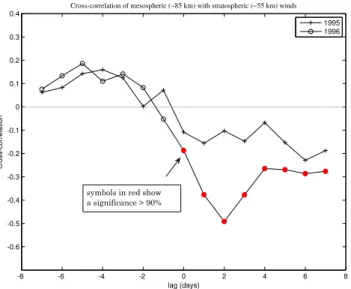
Fig. 3. Cross-correlation of upper-mesospheric (∼85 km) and stratospheric winds (assimilated data, 3.16 hPa) for 1995 and 1996.
The correlations between the mesopause winds and upper stratospheric winds for all lags in 1995 are not statistically significant and close to zero, indicating no apparent connec-tion between the mesopause and upper stratosphere. This is expected due to the undisturbed nature of the polar vortex in 1995 and thus this “quiet polar vortex” time period acts as a control case. In contrast, for the 1996 season, a statistically significant (i.e. significance >90%) negative correlation of
∼−0.5 is found at a +2 day lag. There are also weak negative correlations for other positive lag values that are statistically significant and these correlations taper toward zero for pro-gressively higher lag values. For completeness, in both 1995 and 1996 there is a very weak and not statistically signifi-cant positive correlation for negative lags and in 1995 a very weak and not statistically significant negative correlation for positive lags.
4 Discussion
stratospheric winds, observed with a lag of +2 days, suggests that mesospheric winds are “leading” the stratospheric wind fields. That is, an increasing (decreasing) mesospheric wind leads a decreasing (increasing) stratospheric winds by ap-proximately 2 days. This anti-correlation can be seen, for ex-ample, in Fig. 1 where on 7 December 1996 the mesospheric winds start to decrease and 2-days later (9 December 1996) the stratospheric winds start to increase. The opposite trend can be seen just after this period on 10 December 1996 as mesospheric winds start to increase and stratospheric winds start to decrease on 12 December 1996. This anti-correlation is only observed in the 1996 winter when the entire polar vortex is seen to be continuously subtly displaced from its nominal position away from Resolute Bay (the location of mesospheric measurements), presumably due to an interac-tion with the Aleutian High – as can be inferred from Fig. 2. We suspect that the change in mesospheric winds is caused due to a top level displacement of the polar vortex by the interaction of the Aleutian High or possibly some plane-tary wave system. This top level displacement is transmitted downward in altitude to the upper stratosphere and observed in Fig. 2. The physical nature of this transmission mecha-nism is unclear and could be due to 1) phase/amplitude de-lay of upward propagating planetary waves or 2) via creation of a new critical layer that lowers the breaking altitude of subsequent planetary waves (Baldwin and Dunkerton, 1999, 2001; Baldwin, 2000). In any case, we suspect that the dy-namical result is a displacement of the polar vortex struc-ture in the upper stratosphere. These observations are unique from earlier papers (e.g. Walterscheid et al., 2000; Azeem et al., 2005) which also reported on high latitude, wintertime, mesospheric-stratospheric relationships in that 1) neither of the two seasons analyzed here resulted in even a minor strato-spheric warming, let alone a major warming and 2) direct MLT wind measurements have been used here whereas pre-vious studies have measured, and deduced coupling correla-tions from, temperature fields.
5 Conclusions
Our analysis suggests a possible (but not proven) downward propagating, synoptic, dynamical signatures in wind fields traced from the MLT region in the Arctic polar cap to the upper stratosphere. This should be interpreted as a possi-ble indication of only downward signal propagation, since causal effect cannot be determined. To determine a causal effect would require further, detailed investigation of obser-vations from similar situations – simultaneous measurements and underlying cause of mesospheric wind behaviour as well as causal relations between relative movements of a relatively undisrupted stratospheric polar vortex off the pole and move-ment back to “normal” – centered at the pole. Before a causal relationship can be deduced, the forcing(s) experienced by the polar vortex would have to be separated into those that
can be traced in the troposphere – and the residual move-ments that could be attributed to alternative forcing mech-anisms. The observed change in the mesospheric winds, correlated with planetary wave activity associated with the Aleutian High, appears to sequentially progress towards a displacement of the polar vortex which is later identified in stratospheric analyses.
Specifically, our observations show that, for 1996, when the cold, stable winter Arctic polar vortex is displaced hor-izontally away from the sampled mesopause volume due to a strong Aleutian High, decreasing (increasing) stratospheric winds lag increasing (decreasing) mesospheric winds by ap-proximately two days. Such a correlation is absent in the wind-speed time-series during 1995 when the observed vol-ume of the mesopause falls within the stratospheric polar vor-tex; typical of a very stable vortex. If confirmed by additional observations, such analyses could improve forecasting of the state of the upper stratosphere and should enable a small suite of similar observations to synoptically predict a change in stratospheric circulation on the order of days in advance.
Acknowledgements. The authors of this paper would like to thank the National Science Foundation for support through NSF-ATM-0457277 and NSF-ATM-0735452. Data presented in this paper is based on ERWIN observations used in the first author’s (YB) Ph. D. thesis. We would also like to thank G. G. Shepherd, W. A. Gault and S. Brown of York University, Canada for the design and maintenance of ERWIN and use of its data. Operation and accommodation of the ERWIN instrument were supported by the Natural Sciences and Engineering Research Council of Canada and the National Science Foundation respectively.
Edited by: Franz-Josef L¨ubken
References
Andrews, D. G., Holton, J. R., and Leovy, C. B.: Middle Atmo-sphere Dynamics, Academic Press, 253–258, 1987.
Azeem, S. M. I., Talaat, E. R., Sivjee, G. G., Liu, H.-L., and Roble, R. G.: Observational study of the 4-day wave in the mesosphere preceding the sudden stratospheric warming events during 1995 and 2002, Geophys. Res. Lett., 32, L15804, doi:10.1029/2005GL023393, 2005.
Baldwin, M. P. and Dunkerton, T. J.: Downward propagation of the Arctic Oscillation from the stratosphere to the troposphere, J. Geophys. Res., 104, 30937–30946, 1999.
Baldwin, M. P.: The Arctic Oscillation and its role in stratosphere-troposphere coupling, SPARC Newsletter, 14, 2000.
Baldwin, M. P. and Dunkerton, T. J.: Stratospheric harbingers of anomalous weather regimes, Science, 294, 5542, doi:10.1126/science.1063315, 2001.
Bhattacharya, Y., Shepherd, G. G., and Brown, S.: Variability of atmospheric winds and waves in the Arctic polar mesosphere during a stratospheric sudden warming, Geophys. Res. Lett., 31, 2301, doi:10.1029/2004GL020389, 2004.
436 Y. Bhattacharya and A. J. Gerrard: Mesospheric winds and polar vortex motion
Mesosphere Wind Observations: Comparisons of Simultaneous Measurements with a Fabry-Perot Interferometer and a Field-Widened Michelson Interferometer, Appl. Optics, 39, 4284– 4291, 2000.
Fisher, G. M., Niciejewski, R. J., Killen, T. L., Gault, W. A., Shep-herd, G. G., Brown, S., and Wu, Q.: Twelve-hour tides in the winter northen polar mesosphere and lower thermosphere, J. Geophys. Res., 107(A8), 1211, doi:107:SIA24-1-24-16, 2002. Gault, W. A., Brown, S., Moise, A., Liang, D., Sellar, G., Shepherd,
G. G., and Wimperis, J.: ERWIN: an E-region wind interferom-eter, Appl. Optics, 35, 2913–2922, 1996.
Gerrard, A. J., Kane, T. J., Thayer, J. P., Duck, T. J., Whiteway, J. A., and Fiedler, J.: Synoptic-scale study of the Arctic polar vortex’s influence on the middle atmosphere: 1. Observations, J. Geophys. Res., 107(D16), 4276, doi:10.1029/2001JD000681, 2002.
Harnik, N., Scott, R. K., and Perlwitz, J.: Wave reflection and focus-ing prior to the major stratospheric warmfocus-ing of September 2002, J. Atmos. Sci., 62, 640–650, 2005.
Harvey, V. L. and Hitchman, M. H.: A Climatology of the Aleutian High, J. Atmos. Sci., 53, 2088–2102, 1996.
Manson, A. H., Meek, C., Chshyolkova, T., McLandress, C., Avery, S. K., Fritts, D. C., Hall, C. M., Hocking, W. K., Igarashi, K., MacDougall, J. W., Murayama, Y., Riggin, D. C., Thorsen, D., and Vincent, R. A.: Winter warmings, tides and planetary waves: comparisions between CMAM (with interactive chemistry) and MFR-MetO observations and data, Ann. Geophys., 24, 2493– 2518, 2006, http://www.ann-geophys.net/24/2493/2006/. Mitchell, N. J., Pancheva, D., Middleton, H. R., and Hagan,
M. E.: Mean winds and tides in the Arctic mesosphere and lower thermosphere, J. Geophys. Res., 107(A1), 1004, doi:10.1029/2001JA900127, 2002.
Ozonovich, I., McEwen, D. J., Sivjee, G. G., and Walterscheid, R.-L.: Tidal oscillations of the Arctic upper mesosphere and lower thermosphere in winter, J. Geophys. Res., 102(A3), 4511–4520, 1997.
Pawson, S. and Naujokat, B.: The cold winters of the middle 1990s in the northern lower stratosphere, J. Geophys. Res., 104, 14209– 14222, 1999.
Scott, R. and Polvani, L.: Stratospheric control of upward wave flux near the tropopause, Geophys. Res. Lett., 31, L02115, doi:10.1029/2003GL017965, 2004.
Sivjee, G., McEwen, D., and Walterscheid, R.: Polar Cap Distur-bances: Mesosphere and Thermosphere±Ionosphere Response to Solar-Terrestrial Interactions, Sodankyla¨Geophysical Obser-vatory Publications, 122, 686–702, 2003.
Swinbank, R. S. and O’Neill, A.: A stratosphere-troposphere data assimilation system, Mon. Weather Rev., 122, 686–702, 1994. Walterscheid, R. L., Sivjee, G. G., and Roble, R. G.:
Meso-spheric and Lower ThermoMeso-spheric Manifestations of a Strato-spheric Warming Event over Eureka, Canada (80 N), Geophys. Res. Lett., 27, 2897–2900, 2000.
Whiteway, J. A., Duck, T. J., Donevan, D. P., Bird, J. C., Pal, S. R., and Carswell, A. I.: Measurements of gravity wave activity within and around the Arctic stratospheric vortex, Geophys. Res. Lett., 24, 1387–1390, 1997.
Won, Y.-I., Niciejewski, R. J., Killeen, T. L., Johnson, R. M., and Lee, B. Y.: Observations of high-latitude lower thermospheric winds from Thule Air Base and Sondre Stromfjord, Greenland, J. Geophys. Res., 104, 25–32, 1999.