OBSERVATIONS REGARDING EXISTING INVERTEBRATES FROM
PLUM ORCHARDS
Mihai Tălmaciu*, Gianina Butnariu*, Nela Tălmaciu*, Monica Herea*
University of Applied Life Science and Environment „Ion Ionescu de la Brad” from Iasi
E-mail: [email protected]
Abstract
The observations were made during the two years, 2013 and 2014 in a plantation belonging plum fruit growing from Teaching Station Vasile Adamachi of USAMV Iasi, Iasi County Rivers Early variety.Collecting the material was done with traps type Barber from May until August at intervals between 10 and 20 days. Collection of 2013 was made on the following dates: 20.05, 30.05, 15.06, 5.07, 25.07, 10.08 and 23.08.In total 2013 were collected 265 samples belonging to 22 species (taxa). Species (taxa) with the largest number of samples collected were Dermestes laniarius L. 42 samples Heteroptera. (bedbugs) with 38 samples, and Polydrosus sericeus Schall. 26 samples. In 2014 collection of the biological material was made on the following dates: 07.05, 21.05, 19.06, 08.07, 27.07, 15.08, 04.09. In total in 2014 were collected 744 samples belonging to 41 species (taxa) with the highest number of samples were colected: Hymenoptera (bees) with 92 saples, Orthoptera (locusts) with 87 samples, Lepidoptera (larvae) with 37samplres, and Homoptera (cycads) with 31samples.
Keywords: entomofauna, Rivers Early, traps type Barber
1. INTRODUCTION
Trees fruit growing and shrubs are particularly important in economic terms. Fruit trees and shrubs is one of the most popular foods were indispensable in making an adequate food rations.
Although measures are undertaken in our plum orchards with very damaging several species,
including species: Sciaphobus squalidus, Melolontha melolontha, Agriotes spp
There are also predatory beetle species that may inhabit ecosystems fruit with genus species such as: Carabus, Calosoma, Pterostichus, Brachynus, etc..
Ideally, some species (predators and harmful) to be in balance so that species do not produce harmful damage.
In the present study is a comparative study of beetles found in plum orchards.
2. MATERIALS AND METHODS
In 2013 and 2014 there were collected the fauna of invertebrates existing in plum orchards. To establish biodiversity, ecological dynamics and calculation of indices such as (Talmaciu, 2005) abundance (A), constancy (C), dominance (D), the index of ecological significance (W) etc. They were placed in a plum plantation the soil traps type Barber. There were a number of 6 traps installed in a plum plantation belonging stationary Vasile Adamachi (Butnariu, 2014) at Teaching Station of
formalin in a concentration of 4-5%. The traps were installed in April May and worked until August to September, over two years.
The variety of plum where observations were made it was Rivers timpuriu a very popular variety in our country and and occupying large areas. The material collected were removed from plant debris, soil particles and other material, whichever is only invertebrate fauna.
To follow the dynamics of species of invertebrates collected, there have been periodic harvests of traps, samples each time tagging, labeling specifying the number and date of collection trap (Ritter, 1908) (Rogojanu and Perju, 1979).
In both years of observations have been made by 7 harvests of the collected material, covering in this way almost the entire growing season of trees.
3. RESULTS AND DISCUSSIONS
In 2013 in total, 1-6 traps were collected 265 specimens belonging to more groups of species (taxa). Most specimens were collected from the harvest VII, 76, followed by harvesting the fifth, sixth 51 specimens and 46 specimens of the harvest. The few specimens were collected from harvesting II-IV, between 17and 26 samples.
In the 6 traps at 7 harvests there were collected the specimens belonging to a number of 22 species,
the species with the highest number of specimens collected are: Dermestes laniarius 42 specimens,
Heteroptera (bedbugs), with 38 specimens, Cyaniris cinerea with 34 specimens and 26 specimens Polydrosus sericeus. The lowest number of specimens, they had two species: Anisodactylus binotatus F., Balanitis glandium L., other species (taxa) that Podonta nigra F.and Silpha obscura had between 3 and 14 specimens (see tab. 1)
Table 1. The species (taxons) and the number of specimens collected in 2013, from V. Adamachi stationary, at the Rivers timpuriu variety
No. Name of species (taxa) 28.05. 30.05 15.06 12.07 26.07. 10.08. 23.08. Total
1. Dermestes laniarius - - - 3 6 3 12+18 42
2. Anisodactylus binotatus - - - 2 - - - 2
3. Polydrosus sericeus 9+3+9 - 4 - - - 1 26
4. Coccinella septempunctata 5 - 7 4+3 - 2 - 14
5. Polydrosus amoenus - - - - 9 - - 9
6. Tomoxia biguttata - 2 - - 3 - 3 8
7. Cermatobius longitarsis - - - - 2 - 5 7
8. Heteroptera bedbugs) 2 - 3+5 - 3+2+4 12+3+3 1 38
9. Balanitis glandium - 2 - - - 2
10. Amara aenea - 4 - - 3 - - 7
11. Necrophorus vespillo - - - 3 - 3
12. Cyaninis cyanea - - - 15 19 34
13. Homoptera(cycads) - - - - 6 - 3+3 12
14. Silpha obscura - - - 2 2
15. Hymenoptera(wasp) - 3 - - - - 2 5
16. Cymindis vaporariorum - - - 4 2 6
17. Harpalus calceatus - - 3 - - - - 3
18. Podonta nigrita - - 2 - - - - 2
19. Galeruca pomonae - - 2 - - - - 2
20. Armadillidium vulgare - 3 - - - 3
21. Harpalus distinguendus - 12 - - - 12
22. Ophonus azureus - - - - 5 - - 5
Referring to the number of traps that each species was collected in 2013 from the Vasile Adamachi farm at Rivers timpuriu variety (see tab. 1) (Butnariu, 2014) shows the following:
- The most frequently collected species were Heteroptera in 10 traps, followed by
species Dermestes laniarius L. Polydrosus sericeus, collected by 5 traps, Coccinella
septempunctata into 4 traps species of Homoptera (cycads) and Tomoxia biguttata in by 3 pitfalls. The other species were collected in one or two traps;
For a deeper analysis of how the results were calculated a number of leading ecological indexes such as abundance (A), consistency (C) dominance (D) and the ecological significance index (W). These indicators in early 2013 Rivers timpuriu variety of V.Adamachi farm is as follows (see tab. 2):
- The Abundance largest had a species: (42 specimens), species Heteroptera (38
specimens), Cyanis cinerea (34 specimens), Polydrosus sericeus Schall (26 specimens), Coccinella
septempunctata L (14 specimens), Homoptera (cycads) and Harpalus distinguendus Duft (12 specimens). The other species had between 2 and 9 specimens;
- Constancy of collected species ranged between 3.57 and 35.71. The species with the
highest values of constancy were Heteroptera (35.71) Polydrosus sericeus Schall and Dermestes
laniarius L. (17.85), Coccinella septempunctata (14.28), Homopterta (cycads) and Tomoxia biguttata (10.71). The lowest values of constancy (3.57) have had a total of 10 species, namely: Polydrosus amoenus Schall., Ophonus azureus F., Necrophorus vespillo L, Harpalus calceatus
Duft, Armadillidium vulgare L., F. Anisodactylus binotatus , Balaninus glandium L., Podonta nigra
F.and Galeruca pomonae
Table 2. Valuesof ecological indices of species (taxons) in 2013, from V. Adamachi stationary, at the Rivers timpuriu variety
ECOLOGICAL INDEX No. Name of species (taxa)
A C D W
1. Dermestes laniarius 42 17.85 17.23 3.07
2. Heteroptera (bedbugs) 38 35.71 15.57 5.56
3. Cyaninis cyanea F. 34 7.14 13.93 0.99
4. Polydrosus sericeus Schall 26 17,85 10.65 1.90
5. Coccinella septempunctata 14 14.28 5.73 0.81
6. Homoptera (cycade) 12 10.71 4.91 0.52
7. Polydrosus amoenus Schall 9 3.57 3.68 0.13
8. Tomoxia biguttata 8 10.71 3.28 0.35
9. Chilopoda longitarsis 7 7.14 2.86 0.20
10. Amara aenea 7 7.14 2.86 0.20
11. Harpalus distinguendus 12 3.57 4.92 0.18
12. Cymindis vaporariorum L. 6 7.14 2.46 0.18
13. Hymenoptera(wasp) 5 7.14 2.05 0.15
14. Ophonus azureus 5 3.57 2.04 0.07
15. Necrophorus vespillo L. 3 3.57 1.23 0.04
16. Harpalus calceatus Duft 3 3.57 1.23 0.04
17. Armadillidium vulgare 3 3.57 1.23 0.04
18. Anisodactylus binotatus F. 2 3.57 0.82 0.03
19. Balaninus glandium L. 2 3.57 0.82 0.03
20. Harpalus distinguendus 3 3.57 1.23 0.04
21. Podonta nigrita F. 2 3.57 0.82 0.03
22. Galeruca pomonae 2 3.57 0.82 0.03
- Dominance (D) had the highest values species: Dermestes laniarius (17.23), Heteroptera
(15.57), Cyaniris cyan (13.93), Polydrosus sericeus (10.65) and Coccinella septempunctata (5.73).
The other species had values less than 5.00 dominance;
- Ecological significance of the index (W) had values greater than 1.00 at a number of 3
species. These were: Heteroptera - bedbugs (5.56) Dermestes laniarius L. (3.07) and Polydrosus
sericeus (1.90).
The large groups of taxa species collected the situation is as follows (see tab. 3):
- The Beetles are the most numerous, accounting for 76.25% of the total followed by heteroptera with 15.51% of the total;
- The lowest share, 5% have had Homoptera (4.03%), Hymenoptera (2.96%) and
Isopoda (1.25%).
Table 3. The structure of the collected invertebrates of plum plantations,in the V.Adamachi farm at the Rivers timpuriu variety in 2013, groups of taxons
No. Taxa No. of specimens % total (265)
1. Coleoptera 186 76.25
2. Heteroptera 38 15.51
3. Homoptera 12 4.03
4. Himenoptera 5 2.96
5. Izopoda 3 1.25
TOTAL 5 taxa 265 100
In 2014 in total, of 6 traps were collected 744 specimens belonging to several groups of species (taxa). The most specimens were collected from the harvest III, 208, followed by harvesting fourth, 99 specimens and VII of the harvest to 97 specimens. The few specimens were collected from 70 specimens fifth harvesting.
Table 4. The species (taxons) and the number of samples collected in 2014, from V. Adamachi stationary, at the Rivers timpuriu variety
No Name of species (taxa) 07.05. 21.05 07.07. 04.08. 04.09. 12.09 27.09. Total
1. Pterostichus niger 3 - - - 3
2. Araneida 2+8 - 3+5+2+2 3 - 3+2 3 33
3. Diptera (adults) 1+6+1 2+2 5 3 - - 3 23
4. Opatrum sabulosum 8+6 - - - 6+6 26
5. Hymenoptera (wasp) 6+2 1 6+3+6 3 - 3 30
6. Harpalus distinguendus 8 - - - 8
7. Gastropoda - 2 - - 6 - 5 13
8. Tomoxia biguttata - 6 6 - - - - 12
9. Hister purpurascens - - 5 - 5 - - 10
10. Hymenoptera (bees) 2 5 20+10+21+8+9 - 6+3+10 - - 92
11. Galeruca tanaceti 3 - 4 6 3 3+3 6 25
12. Harpalus calceatus - - 6+6 - - - - 12
13. Lepidoptera (larva) 1+5 4+8+3 5 1+3+2+2 - - 3 37
14. Dermestes laniarius - - - 3 6 - 9 18
15. Hymenoptera (ants) - 20 8 5 - - - 33
16. Armadillidium vulgare - - - 3 - - - 3
17. Orthoptera (locust) - 9+6 2+2 - 3+3+12 9+26 6+6+3 87
18. Harpalus distinguendus - - - - 5 - - 5
20. Ceutorhynchus crucifer 2 4 6+5 - - - - 17
21. Blaps lethifera - - 3 - - - - 3
22. Orthoptera (Gryllus) 3 - - - 3 - - 6
23. Onthophagus taurus - - - 15+2 - 17
24. Cantharis fusca. 3 - - - 3
25. Polydrosus sericeus 3 - - 9 - 4 - 16
26. Homoptera (cycads) - 6 13 - - 12 - 31
27. Carabus scabriusculus - 5 - - - 5
28. Leipidoptere (adults) - - 3+3 - - 3 - 9
29. Amara aenea - 2 9 - - - - 11
30. Pseudophonus griseus - - 8 - - - - 8
31. Coccinella conglobata - - - 12+9 - - - 21
32. Anisodactylus binotatus - - - - 3 - 4 4
33. Calathus fuscipes 4 - - - 4
34. Hymenoptera (ants) - 20 - - - 20
35. Polydrosus amoeus - - - 6+6 - - - 12
36. Carabus coriaceus - - - 3+3 - 6
37. Onthophagus ovatus - - 5 - - - 6+9 20
38. Homoptera (aphids) 8 - - - 8
39. Collembole 2 - - - 2
40. Adalia bipunctata - - - 3 - - - 3
41. Heteroptera (bedbug) - - 10 - - - - 10
Total 41 species 90 90 208 99 70 90 97 744
At the 6 traps at 7 harvests were collected specimens belonging to a number of 41 species, the species with the highest number of specimens collected are: Hymenoptera 92 specimens, Orthoptera (grasshoppers) with 87 specimens, Lepidoptera (larvae) 37 specimens , Araneide, Hymenoptera (ants) with 33 specimens, Homoptera (cycads) 31 specimens, Hymenoptera (wasps)
with 30 specimens Diptera (larvae) with 29 specimens, Galeruca tanaceti 25 specimens, Opatrum
sabulosum 24 specimens, Diptera (adults ) with 23 specimens, Coccinella conglobata 21 specimens Ontophagus ovatus and Hymenoptera (ants) with 20 specimens, Dermestes laniarius 18 specimens Ceutorhinchus crucifer and Ontophagus taurus 17 specimens, Polydrosus sericeus 16 specimens Gastropoda 13 specimens Tomoxia bigutatta , Polydrosus amoeus and Harpalus calceatus 12
specimens and 11 specimens Amara aenea (see tab. 4)
Other species recorded a number equal to or less than 10 specimens.
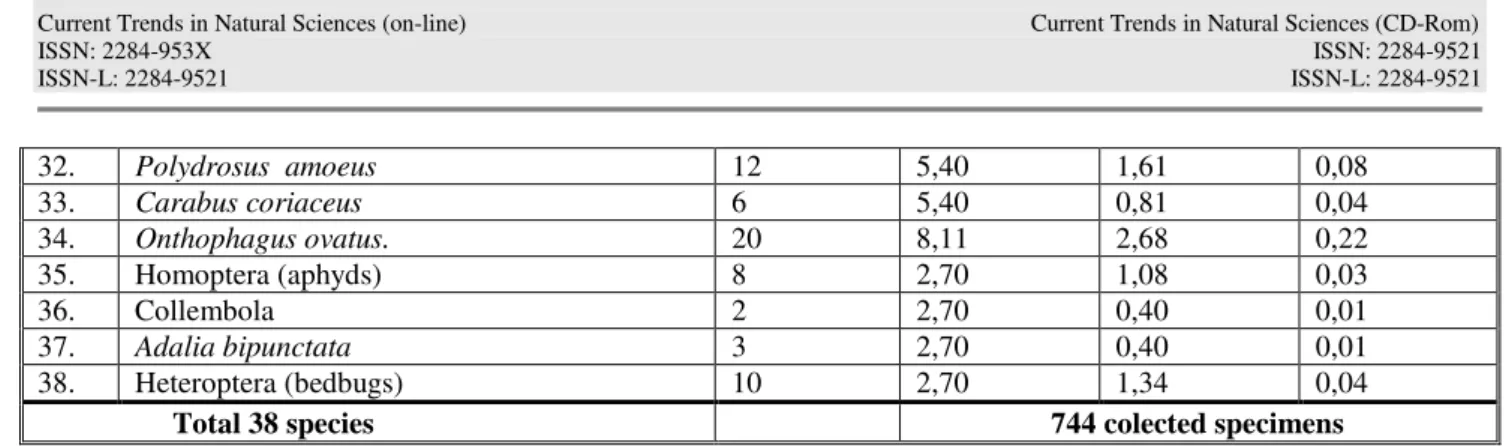
For a deeper analysis of how the results were calculated a number of leading ecological indexes such as abundance (A), consistency (C) dominance (D) and ecological significance index (W). These indicators in 2014 at Rivers early variety of farm Adamachi is as follows (see tab. 5)
The Abundance most had a species: Hymenoptera (bees) (92 specimens), Orthoptera (locusts) (87
specimens), Lepidoptera (larvae) (37 specimens), Hymenoptera (wasps) (36 specimens), Araneide,
Hymenoptera (ants) (33 specimens), Homoptera (cycads) (31 specimens), Opatrum sabulosum (26
specimens), Galeruca tanaceti (25 specimens), Coccinella conglobata (21 specimens), Ontophagus
specimens), Amara aenea (11 specimens) Hister purpurascens and Heteroptera (bugs) (1 specimens). The other species had between 2 and 9 specimens;
- The Constance collected species ranged between 2,70 and 37,83. The species with the
highest values of constancy were Orthoptera (grasshoppers (37,83), Lepidoptera (larvae) (29,73),
Hymenoptera (wasps) and Araneide (27,02), Hymenoptera (bees) (24,32 ), adults Diptera (21,62), Galeruca tanaceti (16,22), Opatrum sabulosum and Hymenoptera (ants) (10,81). the lowest values
of constancy under (8,12) have had a number of 7 species of which: Harpalus distinguendus Duft.,
Gastropoda, Dermestes laniarius, Diptera (larvae) and Homoptera (cycads).
- Dominance (D) had the highest values species: Hymenoptera (bees) (12,36), Orthoptera
(11,39), Lepidoptera (adults) (11,21), and other species showed values between 0-14 and 4,43.
- Index of ecological significance (W) had higher values of 1.00 to a total of five species.
These were: Orthoptera (locusts) (4,42), Hymenoptera (bees) (3), Lepidoptera (larvae) (1,48)
Araneide (1,19), Hymenoptera (wasps) (1,08)
Table 5. The values ecological indices of species (taxons) in 2014, from V.Adamachi stationary, at the Rivers early variety
ECOLOGICAL INDICES
NO. Name of species (taxa)
A C D W
1. Pterostichus niger 3 2,70 0,40 0,01
2. Araneida 33 27,02 4,43 1,19
3. Diptera (adults) 23 21,62 3,09 0,67
4. Opatrum sabulosum 26 10,81 3,49 0,38
5. Hymenoptera (wasp) 36 27,02 4,03 1,08
6. Harpalus distinguendus 13 8,11 1,75 0,14
7. Gastropoda 13 8,11 1,75 0,14
8. Tomoxia biguttata 12 5,41 1,61 0,09 9. Hister purpurascens 10 5,41 1,34 0,07
10. Hymenoptera ( beens) 92 24,32 12,36 3,00
11. Galeruca tanaceti 25 16,22 3,36 0,54 12. Harpalus calceatus 12 5,41 1,61 0,09
13. Lepidoptera (larva) 37 29,73 4,97 1,48
14. Dermestes laniarius 18 8,11 2,41 0,20
15. Hymenoptera (ants) 33 10,81 4,43 0,48
16. Armadillidium vulgare 3 2,70 0,40 0,01
17. Orthoptera (locust) 87 37,83 11,69 4,42
18. Diptera (larva) 17 8,11 2,28 0,18
19. Ceutorhynchus crucifer 3 2,70 0,40 0,01
20. Blaps lethifera 6 5,40 0,80 0,04
21. Orthoptera (Gryllus) 3 2,70 0,40 0,01
22. Onthophagus taurus 17 5,40 2,28 0,121 23. Polydrosus sericeus 16 8,11 2,15 0,17
24. Homoptera (cycads) 31 8,11 4,17 0,34
25. Carabus scabriusculus 5 2,70 0,67 0,02
26. Leipidoptere (adults) 9 8,1 11,21 0,09
27. Amara aenea 11 5,40 1,48 0,08
32. Polydrosus amoeus 12 5,40 1,61 0,08 33. Carabus coriaceus 6 5,40 0,81 0,04 34. Onthophagus ovatus. 20 8,11 2,68 0,22
35. Homoptera (aphyds) 8 2,70 1,08 0,03
36. Collembola 2 2,70 0,40 0,01
37. Adalia bipunctata 3 2,70 0,40 0,01
38. Heteroptera (bedbugs) 10 2,70 1,34 0,04
Total 38 species 744 colected specimens
The large groups of taxa species collected the situation is as follows (tab. 6, fig. 1):
- Beetles are the most numerous, accounting for 38,70% of the total followed by
Hymenoptera with 23,52% of the total;
- The lowest share, 5% have had Araneide (4,43%), Gastropoda (1,74%) and
Collembola (0,27%).
Table 6. The structure entomofauna collected of plum plantations, farm V.Adamachi the variety Rivers early în 2014, groups of taxons
No.. Name of species (taxa) No. of specimens % total (744)
1. Araneida 33 4,43
2. Diptera 52 6.98
3. Hymenoptera 175 23.52
4. Lepidoptera 46 6.18
5. Izopoda 3 0.40
6. Gastropoda 13 1.74
7. Orthoptera 93 12.50
8. Homoptera 39 5.24
9. Collembola 2 0.27
10. Coleoptera 288 38.70
Araneida
Diptera
Hymenoptera Lepidoptera
Izopoda
Gastropoda
Orthoptera Homoptera
Collembola
Coleoptera
Figure 1. The structure of collected taxons from plum plantations in 2014 the Rivers early variety, in. Adamachi farm
4. CONCLUSIONS
- Beetles (Coleoptera), 186 specimens representing 76.25% of the total (265 copies); - Heteroptera, 38 specimens representing 15,51% of the total;
- Homoptera 12 specimens reprezentâmnd 4.03% of the total; - Hymenoptera 5specimens, representing 2.96% of the total; - Isopoda, 3 specimens, representing 1.25% of the total.
2. In 2014, were collected from orchards of plum copies of taxa belonging to the following groups:
- Beetles (Coleoptera), representing 38 288 specimens, 70% of the total (744 specimens); - Hymenoptera 175 specimens, representing 23.52% of the total;
- Orthoptera, 93 specimens representing 12,50% of the total - Diptera, 52 specimens representing 6.98% of the total; - Lepidoptera, 46 specimens representing 6.18% of the total; - Homoptera, 39specimens reprezentâmnd 5.24% of the total; - Araneide, 33 specimens representing 4.43% of the total; - Gastropoda, 13 specimens representing 1.74% of the total; - Isopoda, 3 specimens, representing 0.40% of the total. - Collembola, 2 specimens, representing 0.27% of the total.
5. REFERENCES
Butnariu G., Hamburdă S.B., Tălmaciu M. (2014). Preliminary studies on the main pest control methods of plum plantations. Lucrări ştiinţifice, seria Agronomie, 57, 2, 163-166.
Reitter E. (1908). Fauna Germanica. Die Käfer des Deutschen Reiches Band I, Stuttgart.
Rogojanu V., Perju T. (1979). Determinator pentru recunoaşterea dăunătorilor plantelor agricole. Editura Ceres, Bucureşti.