Submitted 27 March 2015
Accepted 8 October 2015
Published27 October 2015
Corresponding author
Roberto Maffei,
Academic editor
Beth Jefferies
Additional Information and Declarations can be found on page 28
DOI10.7717/peerj.1361
Copyright
2015 Maffei et al.
Distributed under
Creative Commons CC-BY 4.0
OPEN ACCESS
Contributions to a neurophysiology of
meaning: the interpretation of written
messages could be an automatic
stimulus-reaction mechanism before
becoming conscious processing of
information
Roberto Maffei, Livia S. Convertini, Sabrina Quatraro, Stefania Ressa and Annalisa Velasco
A.L.B.E.R.T. Research group, ARPA-Firenze—Cultural association, Firenze, Italy
ABSTRACT
Background.Even though the interpretation of natural language messages is generally conceived as the result of a conscious processing of the message content, the influence of unconscious factors is also well known. What is still insufficiently known is the way such factors work. We have tackled interpretation assuming it is a process, whose basic features are the same for the whole humankind, and employing a naturalistic approach (careful observation of phenomena in conditions the closest to “natural” ones, and precise description before and independently of data statistical analysis).
Methodology.Our field research involved a random sample of 102 adults. We presented them with a complete real world-like case of written communication using unabridged message texts. We collected data (participants’ written reports on their interpretations) in controlled conditions through a specially designed questionnaire (closed and opened answers); then, we treated it through qualitative and quantitative methods.
Principal Findings.We gathered some evidence that, in written message interpre-tation, between reading and the attribution of conscious meaning, an intermediate step could exist (we named it “disassembling”) which looks like an automatic reac-tion to the text words/expressions. Thus, the process of interpretareac-tion would be a discontinuous sequence of three steps having different natures: the initial “decoding” step (i.e., reading, which requires technical abilities), disassembling (the automatic reaction, an unconscious passage) and the final conscious attribution of meaning. If this is true, words and expressions would firstly function like physical stimuli, before being taken into account as symbols. Such hypothesis, once confirmed, could help explaining some links between the cultural (human communication) and the biological (stimulus-reaction mechanisms as the basis for meanings) dimension of humankind.
Subjects Neuroscience, Psychiatry and Psychology, Science and Medical Education
Keywords Human behaviour, Meaning, Interpretation process, Human communication, Perception and natural language, Cognition, Embodied cognition,
Natural language interpretation
INTRODUCTION
Human–environment interactions entail conscious knowledge, i.e., the attribution of meanings (semantic aspect) to the incoming signals and stimuli. Interpretation, namely the operation through which the meaning is attributed, is still widely unknown. A specific difficulty is represented by natural language, although it has been studied almost since the dawn of humankind, with researches ranging from the ancient rhetoric (for example,Geymonat, 1970;Barthes, 2000;Perelman, 1981) to the most recent approaches complementing linguistics with biology and neuroscience (for example,Zuberb¨uhler, 2005;
Locke, 2009;Stekelenburg & Vroomen, 2012). Messages are (or, at least, they appear) made up just of words; however, understanding a message always goes far beyond its words.1The 1Material regarding the attempts to
explain human communication and the questions of meaning and interpretation is really countless. Specific works will be indicated within the manuscript. Taking linguistics apart, we make reference to Pettigiani & Sica (2003)for a review (in Italian) of psychological main approaches;Krauss & Fussell (1996) for a wide survey from the perspective of social psychology.
available data does not give definite answers to the researchers’ questions; our field research intends to bring some contributions to such endeavour.
Research lines and ideas: a synthetic overview
The available scientific literature is so wide to prevent, inside the boundaries of our work, an exhaustive analysis. However, a rapid survey is sufficient to reveal some trends, the first of which is the accelerating extension of these studies towards the field of science. Another trend, thanks to the extraordinary development of technology and informatics, is the enhancement of the studies that explore interpretation inside the brain and its neural processes.
All this considered, we can roughly outline a picture with two main scientific research lines, the first of which can be namedMind-centred approachesand can be synthesized as follows. Understanding/interpretation is based on abstract (conceptual) knowledge. Incoming information is provided through the body (perception) but the “mind”2 2We will not enter the disputed question
of mind, its existence, its nature and its relationships with the body in general and the brain in particular. For a first level of delving further into this subject: on the one hand, the early survey of Sperry (1952); on the other hand, the more recent works ofMarcus (2004), Rose (2005)andZeki (2010). In the context of our Introduction, the “mind” is simply intended as a factor which, by following some theoretical positions, totally controls body through functions that differ from biological processes.
processes inputs at symbolic level, turning them into propositional representations in the brain and understanding them in terms of concepts. The answer to the inputs (reaction) is based on such comprehension and is shaped as a command to some effectors (typically the motor system). Knowledge is the result of a sort of computation; the mind is separated from the body and rules it. The role of the motor system is totally passive.
The second research line can be namedBody-centred approachesand can be synthe-sized as follows. Understanding/interpretation is attained through a motor reaction of the body that instantiates understanding or, at least, co-exists with conceptual knowledge. When an external stimulus/signal is perceived, it is firstly “understood” through a motor reaction which is automatic, involuntary and based on “mental maps” that are motorial, not (or not only) propositional. Understanding is a sort of motor experience that goes along with conscious (rational) information processing; the body is not detachable from the mind and can drive it. The role of the motor system is active and decisive for understanding.
The main features of the first group theories are synthesized in some recent works, for example,Zipoli Caiani, 2013(Chapters 1 and 2);Ferrari & Rizzolatti, 2014(specially Pag. 2);Gallese, 2014(specially Pag. 2, with the concept of ontological reductionism); Pul-verm¨uller et al., 2014(specially Introduction and Fig. 1).3The range of these theories goes 3The last three works (Ferrari &
from the merely mechanical (and na¨ıve) hypotheses of psychoneural isomorphism (Sperry, 1952, pp. 293–294), and those inspired by the first electronic computers (Newell, Shaw & Simon, 1958), to the various I.P. (information processing) models (Massaro & Cowan, 1993) and current cognitive science positions (Negri et al., 2007;Mahon & Caramazza, 2008;Mahon & Caramazza, 2009). The shared concept is that information is essentially processed in a linear and unidirectional sequence, based upon a functional (besides the anatomical) separation among sensory, associative and motor areas of the brain cortex (for a general presentation and discussion, see alsoRizzolatti & Sinigaglia, 2006, Chapter 1, spe-cially pages 20–22; for a synthesis of the cognitivist paradigm, seeGallese, 2000, page 27).
The second group of theories (the body-centred ones) can be traced back, at least, to XIXth Century, up to the works ofLotze (1852)(cited inRizzolatti & Sinigaglia, 2006) andJames (1890), which present reflections on the relationships between perception and action. Other philosophers came after,4up until a new series of neurophysiological studies
4Some special mentions about the
philosophers: (Mach, 1897), in particular pages 1–8 (on the relationship between scientific knowledge and perceptual experience of physic world), pages 15–17 (a famous example on subjectivity of perspective) and pages 93–95 (sense organs as active elements of perception, fine-tuned through experience, rather than as passive receptors); (Poincar´e, 1902), especially Chapter 4 (on the relations between geometrical space and “representative,” i.e., perceptual, space); (Poincar´e, 1908), Part I, specially pages 52–63 (phenomenology of a mathematical discovery and the role of sensitivity and aesthetic feeling); (Merleau-Ponty, 1965), particularly Part II (with special regards to introduction chapter, on the impossibility to have a knowledge of the environment that is independent of the body experience).
appeared in the second part of XXth Century.5Such researches gathered evidence that the
5Some special mentions: (Sperry,
1952), especially pages 299–300 on the relationships among perceptions and ideas; (Jeannerod et al., 1995;Liberman & Whalen, 2000;Fowler, Galantucci & Saltzman, 2003).
sequential processing theory and the supposed motor system passive role are untenable. A leap ahead has probably been accomplished with the discovery of mirror neurons (Di Pellegrino et al., 1992) and the related following studies (for example,Gallese, 2000;
Rizzolatti & Craighero, 2004;Iacoboni et al., 2005;Rizzolatti & Sinigaglia, 2006). According to this theory, understanding would be firstly attained through a motor reaction of the body, “immediately and automatically”.6Cognition would be “embodied”.
6We are intentionally employing the
words “immediately and automatically”: they are typically used in describing the mirror-system working.
Embodiment of cognition, and its consequences on knowledge and interpretation process, are the object of a lively scientific debate well exemplified inHickok (2009)(direct reference toRizzolatti, Fogassi & Gallese, 2001). Imagine someone pouring a liquid from a bottle into a glass: by following the embodied cognition hypothesis, an observer can “embodily” understand such action since, thanks to his mirror neurons, he undergoes a motor reaction “as if ” himself was actually pouring (by the way, such reaction does not turn into any actual movement, it remains virtual). However, that pouring “could be understood aspouring,filling,emptying,tipping,rotating,inverting,spilling(if the liquid missed its mark) ordefying/ignoring/rebelling(if the pourer was instructed not to pour) . . . ” (seeHickok, 2009, page 1240, italics by the author). Such examples, in our opinion, well represents the crucial point: the scientifically evident automatic reaction that instantiates embodied cognition does not explain the whole process of interpretation, and the attribution of a conceptual meaning seems to have a different nature. Thus, we have either scientific evidence of embodied cognition or daily-life experience of scattered conceptual interpretations; can these two visions be conciliated or are they alternative? And which one can actually account for the field observations?
In the few last years, the hypotheses based on the mirror neurons discovery have been refined, for example through the concepts of Mirroring mechanisms (MM) and Embodied simulation (ES) (Gallese, 2005;Gallese, 2006;Gallese, 2007;Gallese, 2008;Gallese, 2009a;
Gallese et al., 2009;Gallese & Sinigaglia, 2011a;Ferri et al., 2011;Marino et al., 2011;Gallese & Sinigaglia, 2012;Ferrari & Rizzolatti, 2014;Gallese, 2014). About the ongoing dispute, a summary and a state-of-the-art outline can be found inZipoli Caiani (2013)and one of the
most interesting documents is a forum (Gallese et al., 2011) inside which the most delicate and controversial questions are widely debated.
Experimental research involving language
Theoretically, the divergence between cognitivist and embodied cognition approaches can be synthesized as follows (for further reference see, for example,Bedny et al., 2008;
Rizzolatti & Fabbri-Destro, 2008;Goldman & De Vignemont, 2009;Gallese, 2011;Gallese & Sinigaglia, 2011b;Bedny et al., 2012): cognitivism upholds the sequential processing idea, i.e., cognition would be the result of perception (the sound of a spoken message as well as the sight of written words) followed by the symbolic processing of what perceived (turning the spoken or written words into their meanings) followed by a reaction (typically, but not exclusively, a motor one). Oppositely, the embodiment theories uphold the concept of direct connections among cortical sensorial and motor areas (“sensorimotor grounding” of cognition,Guan et al., 2013). Namely, the perceived spoken or written words would trigger a motor reaction and would be mentally represented also in a motor, rather than a purely conceptual, way. In this sense, cognition would be embodied.7
7Such embodiment, inside the same
embodied cognition field, can be conceived in different ways: it can stand alone,per seresolving the problem of knowledge (“sensorimotor processing underlies and constitutes cognition”, Guan et al., 2013), or can be a “motor representation” that accompanies conscious knowledge processes (the two kinds of knowledge proposed by Gallese, for example inGallese et al., 2011; see alsoGallese, 2014).
From a technical slant, the two research lines tend to privilege different laboratory ap-proaches: cognitivist field frequently engages the noun-verbs dissociation problem, study-ing it through researches on cortically damaged, selectively impaired patients (for example,
Crepaldi et al., 2006;Ar´evalo et al., 2007;Moseley & Pulverm¨uller, 2014;Gallese, 2014). Con-versely, the embodied cognition theorists mainly go searching for the connections between language and its motor correlates, one well-known of which is the ACE (Action-sentence Compatibility Effect; for example,Vitevitch et al., 2013;Horchak et al., 2014). Such studies are frequently carried out through neuroimaging works (for example,Tettamanti et al., 2005;Aziz-Zadeh et al., 2006;Speer et al., 2008;Aziz-Zadeh & Damasio, 2008).
It is interesting to note that, beyond their important differences, both cognitivism and embodiment research use, in laboratory experiments, words and short phrases isolated from every contexts (see, for example,Bedny et al., 2008;Bedny et al., 2012, especially the Method sections; for some critical reflections about the question,Pulverm¨uller et al., 2014, specifically Pag. 80, Chapter 7). Such approach entails that meaning is an intrinsic feature of words, something embedded inside them, and that interpretation consists in extracting it (actually, the verb “to extract” is overtly used in scientific publications, for instance
Mahon & Caramazza, 2011). About some recent trends
In the end, it is worth mentioning a recent specialised research field inside psychophysics, in which researchers investigate cognition and semiosis through probabilistic models (Chater, Tenenbaum & Yuille, 2006;Ingram et al., 2008;Tenenbaum et al., 2011), applying the Bayesian inference to reproduce mental processes and to describe them through algorithms (Arecchi, 2008;Griffiths, Kemp & Tenenbaum, 2008;Bobrowski, Meir & Eldar, 2009;Arecchi, 2010c;Perfors et al., 2011;Fox & Stafford, 2012). Such concepts are currently in use also in the Artificial Intelligence (AI) field8; in addition, some studies make reference 8The origins of Artificial Intelligence
(AI) studies can be traced back to the Thirties and the works of Alan Turing on a possible “intelligent machine”. About the origins, seeLeavitt, 2007, chapters 6 and 7, andTuring, 1950 (the original work of Alan Turing). About the “Turing test” (testing the ability of distinguishing humans from computers through exchanging written messages) see a journalist’s account inChristian (2012). Some materials about recent research lines, closer to our article’s topics (like machine learning and natural language or image interpretation), can be found inMitchell (1997),Menchetti et al. (2005),Mitchell (2009),Khosravi & Bina (2010)and Verbeke et al. (2012).
incompleteness theorem as a limit to the possibility of understanding cognition “from inside” (given that, while studying cognition, we become a system that investigates itself).9
9SeeGoldstein (2006)for a
popular-scientific coverage about G¨odel and his theorem;Leavitt, 2007, chapters 2 and 3, for a particularly clear synthesis of the theorem and its genesis (in connection with theEntscheidungsproblem, i.e., the “decision problem”).
Methodological aspects and our approach
There are two main reasons why the question of interpretation and meaning has not yet been scientifically solved, the first of which is that there are still structural obstacles of technical and ethical nature.10The second main reason is the complexity of natural
10About the technical difficulties of data collecting: experimental techniques used on macaque monkeys (electrode direct insertions inside single neurons) return very accurate measurements, but on small brain cortex surfaces. About the ethic difficulties: those techniques are almost impossible to be used on humans, and only indirect techniques as fMRI (functional Magnetic Resonance Imaging), MEG (Magnetoencephalog-raphy), PET (Positron Emission Tomography) or TMS (Transcranial Magnetic Stimulation) are systematically employed. They cover wider brain cortex surfaces but with inferior accuracy; moreover, they present difficulties with regards to instrument positioning and image interpreting. For a survey of these difficulties see (Rizzolatti & Sinigaglia, 2006), chapters 2, 6, 7, and (Rizzolatti & Vozza, 2008),passim. A recent line of research is investigating the connections among single neurons activity and the total effects detectable through indirect techniques (seeIacoboni, 2008, chapter 7). In addition to all this, data interpretation and comparing are intrinsically difficult, given the differences in macaque and human brain cortex and the associated problem of identifying reliable correspondences.
language (its “equivocal” nature, seeDe Mauro, 200311), which is usually overcome
11De Mauro (2003)states that natural
language is “equivocal” in etymological sense: from Latinaeque vocare(to name (different things) in the same way). That means: a same word can be used to refer to different meanings and different words can be used to indicate the same meaning.
through studying interpretation isolated from the interpreting organism and employing simple stimuli (for instanceBedny & Caramazza, 2011).
In field experiments, researchers who capitalise on the existence of mirror neurons intentionally favour a naturalistic-like approach, letting the observed macaque monkeys freely interact with available objects, rather than stimulate them with selected artificial stimuli only (Rizzolatti & Sinigaglia, 2006, p. 3; in addition, about the reductionism question and the distinction between methodological and ontological reductionism, see
Gallese, 2000, p. 26, andGallese, 2009b;Gallese, 2010). However, their approach has been also criticized (Pascolo & Budai, 2013). About the naturalistic-like approach, we had in our background two works about interactions inside online collaborative groups (Maffei, 2006;Maffei, Cavari & Ranieri, 2007) which let us appreciate the potential of scientific observation in real world-like conditions.
On these bases we set up our approach. We set two objectives for our research: (i) to understand the process of interpretation (i.e., how messages in natural language are turned into meanings by receivers) as it works in real conditions, and design a structural model in order to adequately represent it; (ii) to produce a first check of the formulated hypothesis. We tried a naturalistic approach; this means, first, that a phenomenon must be carefully observed and precisely described in conditions the closest to “natural” ones (natural conditions=the way and the contexts in which the phenomenon usually manifests).
Second, it means that observation and description must precede analysis, being carried out independently of it. In such approach, the role of the observers is critical, either if they are involved in or external to the phenomenon. In our research, we have employed 102 observers of the first kind (the sample) and 5 (the authors) of the second one; this way, we have collected 102 self-reports (participants’ answers to a specially designed questionnaire) and worked out one analytical report (our research) about interpretation.
METHOD
This was not a clinical trial and no experiments were conducted on the participants. In addition, no personal data was collected or in any way used in the survey, and verbal informed consent was obtained. The Ethics Committee for Scientific Research of the Association ARPA-Firenze gave its approval either to the research design or to the informed consent procedure. Further details related to method, sampling and ethical aspects can be found in theSupplemental Information(SI, from now on), Sections 0, 1 and 3.
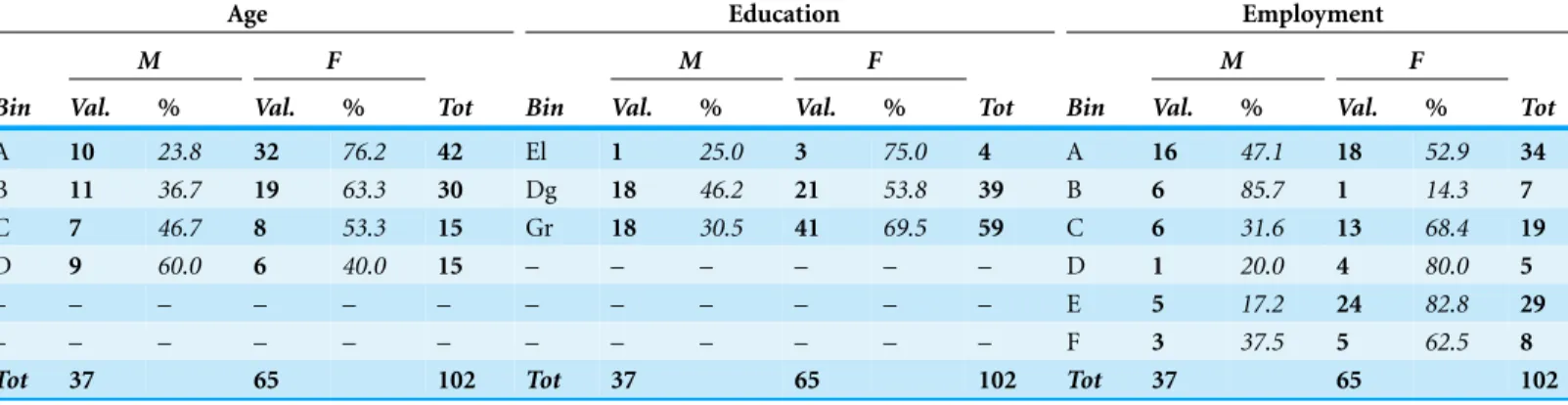
Table 1 Main features of the sample (total sample).The table provides a quantitative description of the total sample with regards to age (left columns), education level (central columns) and employment (right columns) of the participants; see Legends for the used symbols. Data is shown either as values or in percentage and split down by gender (M, males; F, Females).
Age Education Employment
M F M F M F
Bin Val. % Val. % Tot Bin Val. % Val. % Tot Bin Val. % Val. % Tot
A 10 23.8 32 76.2 42 El 1 25.0 3 75.0 4 A 16 47.1 18 52.9 34
B 11 36.7 19 63.3 30 Dg 18 46.2 21 53.8 39 B 6 85.7 1 14.3 7
C 7 46.7 8 53.3 15 Gr 18 30.5 41 69.5 59 C 6 31.6 13 68.4 19
D 9 60.0 6 40.0 15 – – – – – – D 1 20.0 4 80.0 5
– – – – – – – – – – – – E 5 17.2 24 82.8 29
– – – – – – – – – – – – F 3 37.5 5 62.5 8
Tot 37 65 102 Tot 37 65 102 Tot 37 65 102
Notes.
Legend (age):A, 18–29 yy; B, 30–39 yy; C, 40–49 yy; D, 50 yy and over.
Legend (education):El, Elementary level; Dg, High school degree; Gr, Graduates/post-graduates.
Legend (employment):A, Line workers; B, Managers; C, Graduated technicians/professionals; D, Artisans/Entrepreneurs; E, Students; F, Unemployed/others.
Materials and procedure/1: the sample
Our research plan has been based on two main assumptions: first, interpretation is a process, rather than a single operation; second, the process has the same basic (structural) universal characteristics. The rationale of our sampling was based on such assumptions: according to our objectives, we focused on the reconstruction and understanding of the process, rather than on sample features. Thus, the sample representativeness (for example, with respect to Italian people), as well as its social feature balance, were less critical; from an extreme point of view, it could be sufficient that the sample members would belong to human species. Operatively, we gathered our random sample through selecting only Italian language native speakers, all adult; we strived to reach a reasonable balance about gender and student/worker conditions. Further details (the procedure we used to randomize the sample included) can be found inSI, Section 6; the results are presented inTables 1–3.
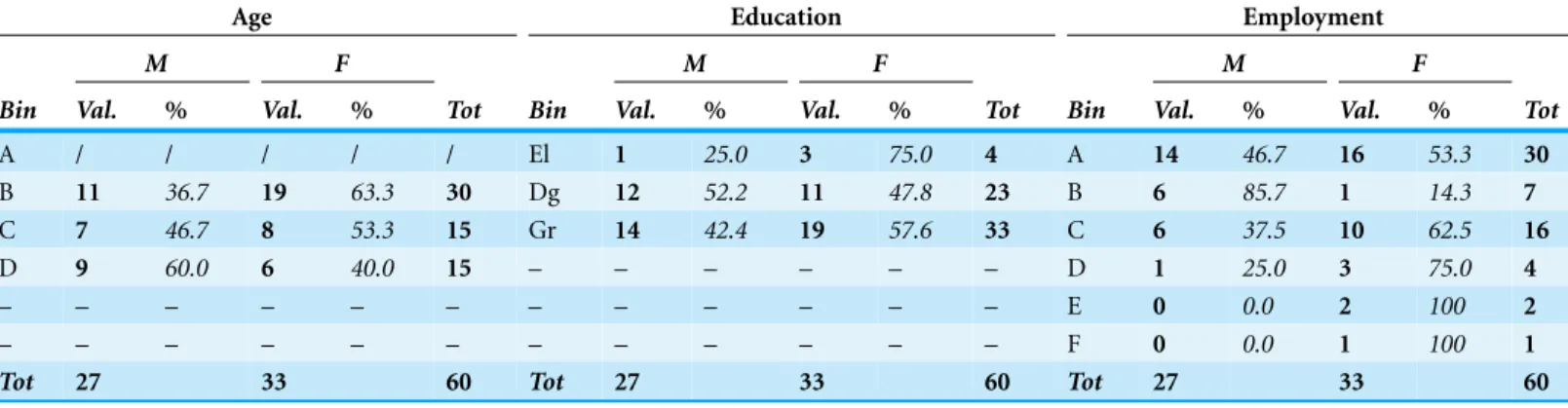
The total sample (Table 1) results slightly imbalanced with regards to gender (women exceed men), education (Graduates/Post-graduates exceed High-school degree granted members) and employment (students/unemployed exceed employed members). For these reasons, even though social features balance is less relevant in our work, we have selected more homogeneous sub-samples from the total sample, in order to verify our analyses every time it turned out necessary. The first sub-sample (“AGE,”Table 2) is exclusively composed by people over 29 years-old (60 members); the second one (“EMPLOYMENT”,
Table 3) is exclusively composed by employed people (65 members).
Materials and procedure/2: the case
Table 2 Main features of the sample (sub-sample “Age,”>29yy).The table provides a quantitative description of the sub-sample “Age” (only
participants 30 years, and over, old) with regards to age (left columns), education level (central columns) and employment (right columns) of the participants; see Legends for the used symbols. Data is shown either as values or in percentage and split down by gender (M, males; F, Females).
Age Education Employment
M F M F M F
Bin Val. % Val. % Tot Bin Val. % Val. % Tot Bin Val. % Val. % Tot
A / / / / / El 1 25.0 3 75.0 4 A 14 46.7 16 53.3 30
B 11 36.7 19 63.3 30 Dg 12 52.2 11 47.8 23 B 6 85.7 1 14.3 7
C 7 46.7 8 53.3 15 Gr 14 42.4 19 57.6 33 C 6 37.5 10 62.5 16
D 9 60.0 6 40.0 15 – – – – – – D 1 25.0 3 75.0 4
– – – – – – – – – – – – E 0 0.0 2 100 2
– – – – – – – – – – – – F 0 0.0 1 100 1
Tot 27 33 60 Tot 27 33 60 Tot 27 33 60
Notes.
Legend (age):A, 18–29 yy; B, 30–39 yy; C, 40–49 yy; D, 50 yy and over.
Legend (education):El, Elementary level; Dg, High school degree; Gr, Graduates/post-graduates.
Legend (employment):A, Line workers; B, Managers; C, Graduated technicians/professionals; D, Artisans/Entrepreneurs; E, Students; F, Unemployed/others.
Table 3 Main features of the sample (sub-sample “Employment”, job owners).The table provides a quantitative description of the sub-sample “Employment” (participants with a regular employment only) with regards to age (left columns), education level (central columns) and employment (right columns) of the participants; see Legends for the used symbols. Data is shown either as values or in percentage and split down by gender (M, males. F, Females).
Age Education Employment
M F M F M F
Bin Val. % Val. % Tot Bin Val. % Val. % Tot Bin Val. % Val. % Tot
A 2 25.0 6 75.0 8 El 1 25.0 3 75.0 4 A 16 47.1 18 52.9 34
B 11 40.7 16 59.3 27 Dg 13 52.0 12 48.0 25 B 6 85.7 1 14.3 7
C 7 46.7 8 53.3 15 Gr 15 41.7 21 58.3 36 C 6 31.6 13 68.4 19
D 9 60.0 6 40.0 15 – – – – – – D 1 20.0 4 80.0 5
– – – – – – – – – – – – E / / / / /
– – – – – – – – – – – – F / / / / /
Tot 29 36 65 Tot 29 36 65 Tot 29 36 65
Notes.
Legend (age):A, 18–29 yy; B, 30–39 yy; C, 40–49 yy; D, 50 yy and over.
Legend (education):El, Elementary level; Dg, High school degree; Gr, Graduates/post-graduates.
Legend (employment):A, Line workers; B, Managers; C, Graduated technicians/professionals; D, Artisans/Entrepreneurs; E, Students; F, Unemployed/others.
participants’ interpretations. The case we submitted to the sample (it is fully detailed and documented inSI, Sections 2, 4 and 5) is a fictional piece very close to some real cases the authors had professionally dealt with (the messages are drawn from actual messages and the outlined relationship between the characters has been actually observed). Exactly, this case is an online (via e-mail) interaction between two colleagues (no previous relations between them) having different roles and ranks in the same organization; the two characters are a female employee (XX) and a male professional (the “architect” YY, Project Account for the installation of a heating plant in XX’s office). Their interaction
consists (from its start to its end) in exchanging 5 e-mails, 3 of which (Messages #1, #3 and #5) are sent by XX, which starts and ends the interaction, and 2 (Messages #2 and #4) by YY. Such exchange (whose subject is the work-in-progress of the heating plant) can be divided into two phases, during the first of which (Messages #1, #2 and #3) a conflict emerges that will be solved through a special version of the fourth message (sent by YY); the solution of the conflict is confirmed by the last (fifth) message, in which XX declares her satisfaction. A synthesis of the first three messages is the following (further details and a full documentation can be found inSI, Section 4).
Msg #1 (XX to YY)
A 67 word e-mail to the Project Account about the installation of the heating plant in her office. She requires an inspection, claiming about “flaws” in the present state of works. Flaws are no better detailed. She also declares she is speaking on behalf of some colleagues and uses the expression: “we would be pleased if, at least once, someone of our Corporation could come here and control. . . ”
Msg #2 (YY to XX)
A brief (48 words) answer of the Project Account in which the regularity of the Project progress is declared. The message ends with the phrase: “at the moment, the progress sub-stantially complies with the chronogram.”
Msg #3 (XX to YY)
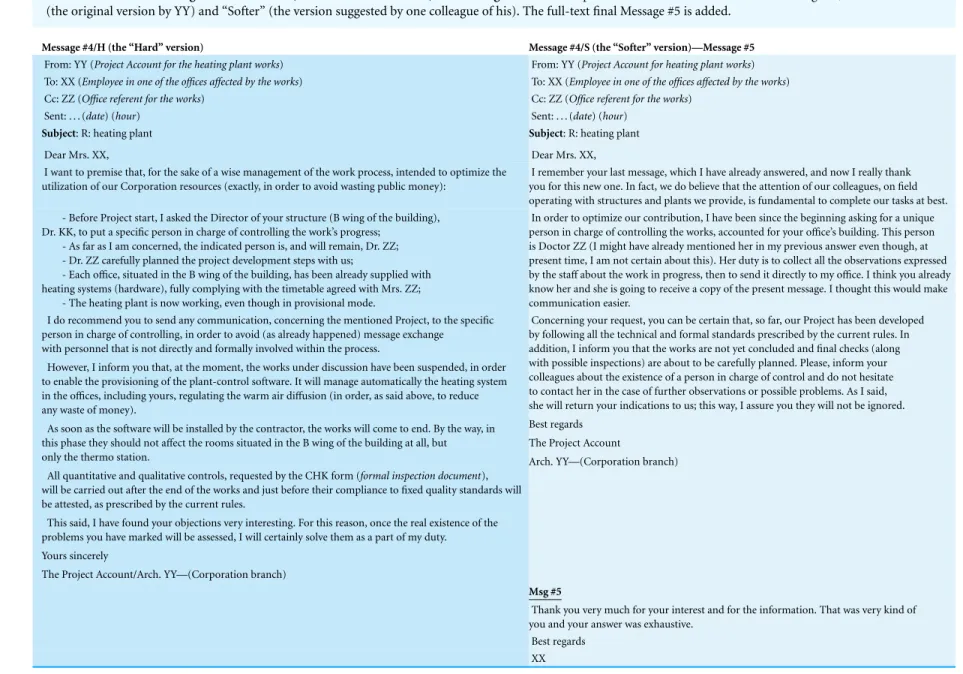
A 136 words reply in which XX declares herself totally unsatisfied. Her message presents two main features: (i) some minor flaws are listed; (ii) she expresses what resembles an actual threat against YY, in the case he would not take measures (she specifically refers to a hypo-thetical “waste of public money”, given that the Project funding involved public resources). Now the conflict is on and the second phase starts: YY prepares a reply to XX’s Msg #3 (namely, he prepares the first version, the “H” one, of Msg #4). The label “H” has been used because such version is a “hard” reply; a YY’s colleague suggests him a softer version (the “S” one) in order to avoid exacerbating the conflict. YY accepts the advice, he sends the Softer Msg #4(S) to XX and the case ends with the conflict resolution (XX’s satisfaction declared in Msg #5). Full-text versions of the Hard Message #4(H), the Softer #4(S) and of Msg #5 are displayed inTable 4; see alsoSI, Section 5 andTables S1andS2, for details about the rationale of the two alternative messages.
Materials and procedure/3: the questionnaire and the survey
Table 4 Full-text of message #4 two versions (H/“Hard and S/“Softer”) and Message #5.This table presents the full-text two versions of Message #4, labelled as “Hard” (the original version by YY) and “Softer” (the version suggested by one colleague of his). The full-text final Message #5 is added.
Message #4/H (the “Hard” version) Message #4/S (the “Softer” version)—Message #5
From: YY (Project Account for the heating plant works) From: YY (Project Account for heating plant works) To: XX (Employee in one of the offices affected by the works) To: XX (Employee in one of the offices affected by the works) Cc: ZZ (Office referent for the works) Cc: ZZ (Office referent for the works)
Sent: . . . (date) (hour) Sent: . . . (date) (hour)
Subject: R: heating plant Subject: R: heating plant
Dear Mrs. XX, Dear Mrs. XX,
I want to premise that, for the sake of a wise management of the work process, intended to optimize the utilization of our Corporation resources (exactly, in order to avoid wasting public money):
I remember your last message, which I have already answered, and now I really thank you for this new one. In fact, we do believe that the attention of our colleagues, on field operating with structures and plants we provide, is fundamental to complete our tasks at best. - Before Project start, I asked the Director of your structure (B wing of the building),
Dr. KK, to put a specific person in charge of controlling the work’s progress; - As far as I am concerned, the indicated person is, and will remain, Dr. ZZ; - Dr. ZZ carefully planned the project development steps with us;
- Each office, situated in the B wing of the building, has been already supplied with heating systems (hardware), fully complying with the timetable agreed with Mrs. ZZ;
- The heating plant is now working, even though in provisional mode.
In order to optimize our contribution, I have been since the beginning asking for a unique person in charge of controlling the works, accounted for your office’s building. This person is Doctor ZZ (I might have already mentioned her in my previous answer even though, at present time, I am not certain about this). Her duty is to collect all the observations expressed by the staffabout the work in progress, then to send it directly to my office. I think you already know her and she is going to receive a copy of the present message. I thought this would make communication easier.
I do recommend you to send any communication, concerning the mentioned Project, to the specific person in charge of controlling, in order to avoid (as already happened) message exchange with personnel that is not directly and formally involved within the process.
However, I inform you that, at the moment, the works under discussion have been suspended, in order to enable the provisioning of the plant-control software. It will manage automatically the heating system in the offices, including yours, regulating the warm air diffusion (in order, as said above, to reduce any waste of money).
As soon as the software will be installed by the contractor, the works will come to end. By the way, in this phase they should not affect the rooms situated in the B wing of the building at all, but only the thermo station.
All quantitative and qualitative controls, requested by the CHK form (formal inspection document), will be carried out after the end of the works and just before their compliance to fixed quality standards will be attested, as prescribed by the current rules.
This said, I have found your objections very interesting. For this reason, once the real existence of the problems you have marked will be assessed, I will certainly solve them as a part of my duty.
Yours sincerely
The Project Account/Arch. YY—(Corporation branch)
Concerning your request, you can be certain that, so far, our Project has been developed by following all the technical and formal standards prescribed by the current rules. In addition, I inform you that the works are not yet concluded and final checks (along with possible inspections) are about to be carefully planned. Please, inform your colleagues about the existence of a person in charge of control and do not hesitate to contact her in the case of further observations or possible problems. As I said, she will return your indications to us; this way, I assure you they will not be ignored. Best regards
The Project Account
Arch. YY—(Corporation branch)
Msg #5
Thank you very much for your interest and for the information. That was very kind of you and your answer was exhaustive.
interpretations. Finally, after submitting Msg #5 (that ends the interaction), we asked them (Final Question) to indicate which of the two versions (the original “Hard” or the colleague suggested “Softer” one), in their opinion, had been actually sent in order to elicit the final answer.
The data collection rationale
Our peculiar management of the survey and, specifically, of the participants/survey conductors relationship (SI, Section 0, for details) allow us to exclude that participants’ answers are intentionally distorted or insincere. Given this, what data did we exactly collect in our survey? In the first phase (Questions #1 and #2) we collected the participants’ conscious reports on their interpretations. Naturally, the reports we gathered cannot be considered as reliable descriptions of the “true” interpretation process; rather, they are descriptions of the participants’ subjective (conscious) experiences about interpretation. We thought that, even though the link among these conscious accounts and the true process is unknown, the answers could allow us to observe, in a naturalistic-like way, the behaviours associated to the interpretation process. On this basis, we could probably detect enough clues in order to formulate a hypothesis on the deeper “true” process of message interpreting. In other words: we tried an indirect approach given that the interpretation process cannot be directly observed.
In the second phase (Questions #3, #4 and Final Question), we investigated the relationship between the interpretation of a situation and a consequent decision to be made; such decision was the selection, between the original and the colleague suggested versions of Msg #4 (“Hard” and “Softer” versions), of the one capable to solve the case (i.e., to elicit the final Message #5). Our thought was that the consistency between interpretation and the following decision could give us either further clues for a deeper understanding of the interpretation process or elements for checking our hypothesis.
RESULTS/1: INTERPRETATION AS A MULTI-STEP
DISCONTINUOUS PROCESS
The results presented in this Section are based on data regarding the first phase of the XX–YY interaction (Messages #1–3), investigated through the first part of the questionnaire (Questions #1–2). We recall that each question submitted to the sample sent two inputs: at first, participants were requested to freely interpret some aspects of the messages; then, to account for their own interpretations indicating the “concrete elements” on which these were founded. Given that the two kinds of inputs elicit different kinds of data, we will present separate analyses.
Answers to the first input of the questions: the interpretation scatter
Table 5 An example of interpretation scatter from our research.Sixty-one individuals (60% of the sample), after having compared XX’s Messages #1 and #3, answered “YES” to Question #2 and provided 83 specifications for the changes they had detected in XX’s position toward YY. The table classifies the specifications into 4 main categories and provides some examples for each one of them.
Category Sub-category Examples of participants’ interpretations
Behaviours – XX requests for an intervention
(7 answers) She reports flaws
She is just sending a duty communication
Emotions XX is: Angry, disturbed, worried, aggressive, discouraged
(16 answers) Brave, impatient, afraid
Relations XX–YY XX expresses: Assertiveness, aggressiveness, superiority, subordination
(41 answers) XX takes a position: Tough, technical, neutral
XX: Demands a solution
Recalls YY to his duty Thwarts YY’s plans
Message form Msg #3 is more: Concrete, correct, detailed
(19 answers) Direct, effective
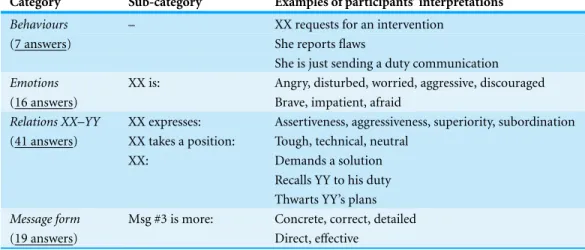
Message #3 with Message #1, they found the attitude of XX (the sender) towards YY (the receiver) being changed (‘Method’ andSI, Section 4 for the message texts;SI, Section 4 for the question full-texts). Then, to the 61 who answered “YES” (60% of the sample), we requested to specify how they would define the new XX’s attitude. They provided 83 specifications: 64 stated XX’s position as strengthened, 12 as weakened and 7 unchanged (although these seven, too, had answered “YES” to the first part of Question #2). In addition, we can find completely opposing statements in these specifications and we can see that scattering covers very different aspects of the XX–YY interaction (behaviours, emotions and so on,Table 5).
The observed scatter of interpretations can be represented through a “megaphone-shape” picture (Fig. 1): receivers take into account the same information but their final interpretations diverge. Such phenomenon is well known, there is plenty of literature about it.12The question is that, even though these observations are common and undisputed, the
12About interpretation scatter, we have
quoted an example (taken fromHickok, 2009) in our Introduction. In addition, some descriptions, referred to special cases and entailing divergence of interpretations, can be found inBara & Tirassa, 1999(pp. 4–6, communicative meanings as joined constructions); Sclavi, 2003(pp. 93–98, the “cumulex” play);Campos, 2007(analysis of a historical communication case).
reasons why this happens remain to be explained.
Answers to the second input of the questions: the importance of the not-semantic components
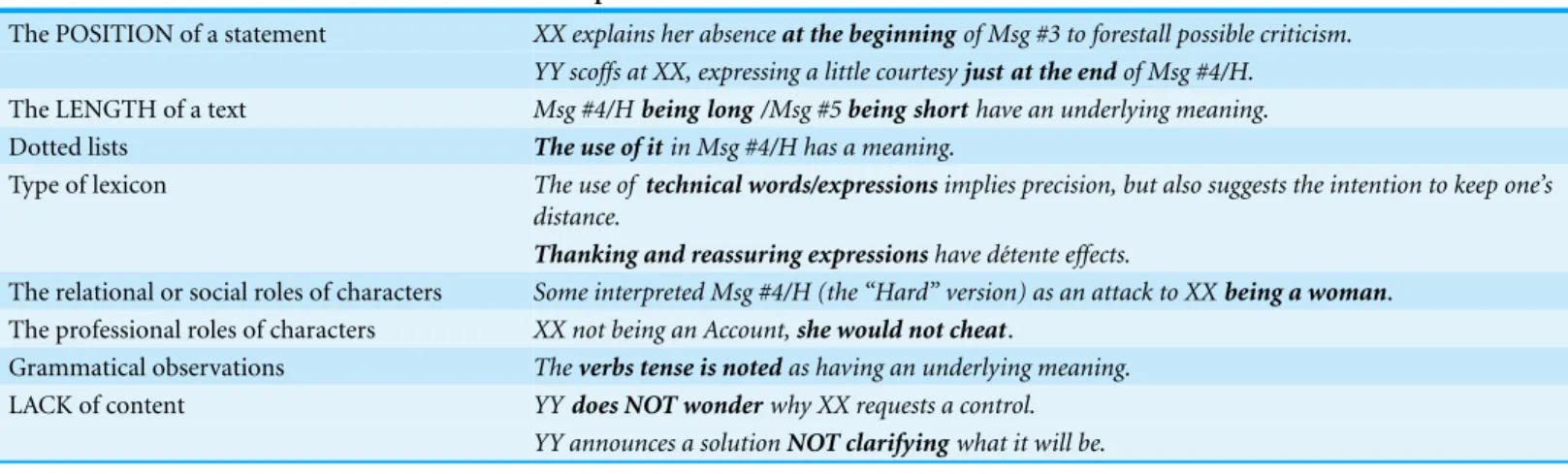
We approached these answers by carefully and sequentially reading them (more than once), and distributing them into homogeneous categories. Such an operation was performed by one of the authors, then discussed and shared with the others; its result consisted in the macro-categories presented inTable 6. We observed that many of them seemed independent of the message content and of its semantic aspects; in particular, the “Other elements” category contains items totally unrelated to the text semantics and content (a tight selection is presented inTable 7). One of the most interesting indications
Figure 1 The “megaphone-shape” model.If the interpretation of a message should be linked only to the conscious processing of its information content, then we would expect a uniform interpretation, given that the source information is absolutely identical for all the participants. On the contrary, a wide scatter is always observed and its process can be represented with a “megaphone-shape” metaphor: information would be homogeneously processed but differently interpreted.
is thelack of contentas a “concrete element” (Table 7, final row): how can an information content express a meaning through its absence?
In order to delve further into such matter, we named “components” the categories/sub-categories of the indicated concrete elements and we tried a quantitative analysis. Given that our focus remained on the process, rather than on the sample features, our goal was to provide a rough estimate. Such an estimate was important mainly in relative terms: in case of relative small non-content (non-information) component amounts, we would have to abandon this part of our research. But those amounts were not small. Our analysis of the 1,319 detected components is displayed inTable 8; the indications that clearly focus on the information content constitute only a small minority (around 12%, seeTable 8, “%” row, “Cont.” column) while references to different text components reach, on the whole, about 65% (Table 8, “%” row, sum of the first five column values). The indications referred to some overall effects of the message represent about 15% of the total. About the meaningless components (void of contentper se, mere “form” components), their relative amount can be estimated in at least 35% (holding together symbols, incidental passages, other components and grammatical notations).
Table 6 Macro-categories of the “concrete elements” respondents have indicated as the basis of their interpretations.The analysis of the answers to the second input of the submitted questions (respondents requested to indicate the “concrete elements” on which the interpretations they provided were based) returned the results displayed in this table. Following the accounts of the participants, their interpretations were based on aspects largely independent of the message information content.
Category Sub-categories Description
Information content Information content Summaries of the message texts and syntheses of their information content, presented through respondent’s own words.
Meaningful elements * Words * Phrases/periods
Quotations between double quotes, referred to selected words, full phrases (or parts of them) or periods. Such kind of indications have been provided also through pointing the beginning and the ending word of the quoted strings (“from . . . to . . . ”). The string length could cover up to a whole paragraph of the message (from a keyboard “Enter” to the following).
Incidental passages Incidental passages Incidental strings, meaninglessper se. Such strings were extracted from original full phrases and quoted isolated from the rest.
Accessory elements * Symbols * Titles/salutes * Grammar notations
Complement/accessory parts of the text: punctuation marks(∗), personal or professional titles used in the opening, the salutes used in the closing etc..
(∗)In one of the two pilot-sessions of the survey, one message contained an exclamation
mark; it was specifically identified, and noted as a meaningful component per se, by one of the participants. For this reason, it was removed in order to limit influencing respondents. In fact, other respondents successively picked up, from questionnaires now bereft of that exclamation mark, quotation marks (used in certain passages of the submitted messages) as a meaningful
componentper se.
Other elements Other elements Items unrelated to the text semantics or to the message content; a tight selection is presented inTable 7. The list is indefinite, given that each item generally appears at low frequency while the range of possible items is extremely widespread. Items of this kind are actually unpredictable; even thelack of some contentcan be focused and reported as a source of meaning (Table 7, final row).
Whole message Whole message References to some overall effects produced by the message on the participant (seeSI Section 8.a, final part, for details). In fact, in this kind of answers, participants state they cannot indicate any “concrete element”; the meaning they have attributed derives from a “general impression” received from the message, from the message’s “general tone.”
recordable by the other half). However, only 7 respondents provide a balanced or prevalent amount of indications (50%, or more, of the individual total) about information content. Among them, only one reaches 100%. Such further observation confirms that references to semantic aspects and information content are a definite minority in participants’ indications. We added an ultimate control through checking some statistical distributions related to the components, searching for possible imbalances that could contradict our findings. Nothing emerged (for details seeSI, Section 10 andFigs. S4–S7).
Following our observations, it seemed that every aspect of even a written message (and even immaterial like an e-mail), regardless of its nature and its intrinsic semantic value, could be treated as a meaningful element of the message, with an extreme degree of scatter among the participants. This was especially surprising because we had used written messages only, bereft of added signals like non-verbal language and context stimuli that usually affect verbal communication (see, for example,Horchak et al., 2014, specially the concept of “situated cognition,” andGibson, Bergen & Piantadosi, 2013).
Table 7 A selection of “other elements” that readers may focus on inside the messages.The table displays a tight selection of the “other elements” (seeTable 6, fifth row) focused on by respondents inside the messages. These elements are independent of the information content and, in most cases, of the message text. They are extremely various, indeed unpredictable, and return the impression that the receivers’ preferences could be totally rule less.
Elements Examples
The POSITION of a statement XX explains her absenceat the beginningof Msg #3 to forestall possible criticism.
YY scoffs at XX, expressing a little courtesyjust at the endof Msg #4/H.
The LENGTH of a text Msg #4/Hbeing long/Msg #5being shorthave an underlying meaning.
Dotted lists The use of itin Msg #4/H has a meaning.
Type of lexicon The use of technical words/expressionsimplies precision, but also suggests the intention to keep one’s distance.
Thanking and reassuring expressionshave d´etente effects.
The relational or social roles of characters Some interpreted Msg #4/H (the “Hard” version) as an attack to XXbeing a woman. The professional roles of characters XX not being an Account,she would not cheat.
Grammatical observations Theverbs tense is notedas having an underlying meaning.
LACK of content YYdoes NOT wonderwhy XX requests a control.
YY announces a solutionNOT clarifyingwhat it will be.
Table 8 Statistics on indicated components. The table displays a descriptive statistical analysis of what the respondents focus on inside the messages. The information content is expressly focused by 12.1% of respondents only (“Cont.” column, “%” row). Even if we suppose that reference to complete phrases/periods could actually mean reference to their content, the sum of “Cont.” and “Phras.” column % totals would amount just to 33% of respondents, again a clear minority.
Quest. Sym. Titl. Words Incid. Phras. Whole Cont. Other Gram. TOT %
1-a 1 7 46 55 53 16 29 14 4 225 17.1%
1-b 1 7 26 53 27 18 20 12 3 167 12.7%
1-c 0 6 22 58 34 13 11 12 2 158 12.0%
2 4 5 22 52 32 17 34 7 2 175 13.3%
3-4/H 0 1 13 49 54 35 31 24 2 209 15.9%
3-4/S 0 22 14 52 48 45 29 5 1 216 16.4%
Final 2 14 17 30 28 50 6 22 0 169 12.8%
TOT 8 62 160 349 276 194 160 96 14 1,319 100%
% 0.6% 4.7% 12.1% 26.4% 20.9% 14.7% 12.1% 7.3% 1.1% 100%
Notes.
Sym., Symbols (punctuation marks);Titl., Titles – Salutes (starting/closing expressions);Words, Meaningful isolated words/expressions;Incid., Incidental passages, meaninglessper se;Phras., Complete phrases/periods;Whole, General tone of the message;Cont., Information content of the message;Other, Other components of the message;Gram., Grammar notations, like verbs tense and similar;TOT, Totals;%, Percentage on totals.
Table 9 Sample distribution with regards to components referred to information content.While answering to the second input of the questions (requesting to indicate the “concrete elements” on which the interpretation was based), just the exact half of the sample indicated, at least once, information content components. In this table, the sample is distributed in bins defined through the percentage that the components referred to information content represent on the personal total of provided indications. Just for 7 people out of 102 the indications pointing at information content balance the others or prevail (50% or more); just 1 person among them indicates information content components only.
Bins (% on personal total) N. of respondents %
0% 51 50.0%
1%–24% 31 30.4%
25%–49% 13 12.7%
50%–99% 6 5.9%
100% 1 1.0%
TOTAL 102 100.0%
Figure 2 The “funnel-shape” model.If the systematically observed scattering of message interpretations would be based on the scattering at “disassembling” step, we could expect that focusing on one same component would be followed by a convergent interpretation of it, as shown in this figure through the metaphor of the “funnels.” This is the opposite of the “megaphone-shape” metaphor shown inFig. 1.
A disassembling example in detail and a three-step model of the process
Question #1 requested evaluations related to sender-receiver positions and to the relationship between them, on the basis of Messages #1 and #2 (see ‘Method’ andSI, Section 4, for the message texts). We found out that 53 people (52% of the sample) had quoted an expression the sender (the employee “XX”, see ‘Method’ andSI, Section 2, 4) used in Message #113: she premised her request of a technician inspection with the 13The 53 people have reported their
interpretations answering Question #1-a (23), #1-b (15) or both the questions (15).
words “we would be pleased if at least once. . . ” This simple expression, apparently trivial, short (8 words in a 67 word message) and in no way highlighted in comparison with the
Table 10 Interpretation scatter referred to one component (the incidental passage of Message #1).The table displays the result of classifying the interpretations given by a subset of 53 individuals (52% of the sample) to one component of Message #1. These respondents, even though focusing on that same component (the incidental passage “. . . we would be pleased if at least once . . . ”), have nonetheless dispersed their interpretations. This means that not even the “funnel-shape” model (Fig. 2) could result acceptable.
Category Examples of participants’ interpretations
“. . . we’d be pleased. . . ” Aggressiveness; office duty expression; informality; irony (32 quotations) Just a request; sarcasm; highlighting XX’s subordinate role
Expression of alternative visions
“. . . if at least once. . . ” Conflict; doubt on YY’s reliability; expression of courtesy (17 quotations) Taunting; request for attention; request for information
A reminder; stimulus to organization top management “. . . we’d be pleased. . . Expression of XX’s fear, because she doesn’t feel safe . . . if at least once. . . ” Insignificant (just a normal office communication)
(19 quotations) Complaint/claim
Reprimand/reproach, by XX to YY XX’s clarification request
Information exchange
rest of the text, has collected 68 quotations (15 people expressed two, see Footnote 13). Then, respondents have interpreted such specific passage in at least 22 different ways, summarized inTable 10.
It seems that focusing on the same component does NOT entail convergent interpreta-tions, that there are TWO levels of scatter instead of one; this could have some important consequences. In terms of metaphors, the previously proposed “funnels” (Fig. 2) were no more suitable; our observations could be much better represented by “hourglasses” (Fig. 3). In terms of process, our observations indicated that the route from the taking into account of a written message (reading it) to the attribution of a conscious meaning to it, could be a sequence of different steps, rather than a unique, homogeneous Input/Output operation (message IN/meaning OUT with the brain cortex as “black-box”processor) like it is tacitly assumed in several current approaches.
Actually, the two actions of focusing on components and interpreting them seem to have different natures. In order to clear this point, we recall an observation reported in the previous sub-section: on the one hand, respondents explain the conscious meanings they attributed through the outcomes of their individual selective focusing (in their answers, they seem to be literally building-up their meanings on the foundations of the picked-up components). On the other hand, they never explain the reasons why they exactly focused on those components: such focusing manifests “immediately and automatically,” priming the attribution of a conscious meaning. In addition, if we would assume that focusing and consciously interpreting have the same nature, our reasoning would fall into an infinite regress.14So, we can hypothesize the process of message interpretation like a sequence of 14If the selective focusing on components
represents the conscious basis of the attribution of meaning, which could that focusing conscious basis be? And which could be the conscious basis of the conscious basis of that focusing? And so on. A starting point of different nature is anyhow needed.
Figure 3 The “hourglass-shape” model. This figure displays a metaphor representing the on-field observed process of message interpretation. Two kinds of scatter co-exist, manifesting themselves in sequence: the first one regards dispersion during the focusing on the components (“disassembling”); the second one regards the interpretation of the focused components (conscious information processing).
with the reading of the message; this is just a technical step (learned reading abilities in the used language are required) which turns written signs into words.15 We named it
15In our opinion, the process should
be the same even in case of oral communication (reading and turning written signs into words should just be replaced by listening to and turning spoken sounds into words).
“decoding” and assumed that its outcomes feed the following step (the selective focusing) whose outcomes, in turn, feed the final one (conscious attribution of meaning, based on rational/logical abilities).
In the end, we outlined the model ofFig. 4. The crucial aspect of our hypothesis is the nature of the second step, “disassembling”; on the basis of the presented observations and reflections, we conceive such step as perceptual, not conceptual-logic. The components would act like “physical” stimuli, triggering automatic reactions off(“body” level) in the receivers. We mean: receivers would not consciously recognize the meaning of one component before focusing on it; simply, they would focus on those components suitable to trigger their automatic reactions off.
One last question remains: if a reader reacts to a given component, even though it appears to be meaningless/contentless, we need to identify what, exactly, that reader perceives. We think we can identify it asthe fact thatone of these components is present in the message; it can be considered some meta-information to which readers can automatically react (Table 11). This can clarify the aspect of the incidental passage (“...we would be pleased if at least once. . . ”) which triggered the participants’ reaction off:the fact thatXX had (redundantly) placed it at a certain point of her message.16
16It is particularly interesting to note
that the expression “the fact that. . . ” is spontaneously used by several respon-dents in their answers. For example, in the collected questionnaires we can find expressions like the following: “the fact that the arguments are presented through a dotted list”; “the fact that XX is referring to public money.”
RESULTS/2: UNCONSCIOUS PROCESSES IN
INTERPRETATION–ACTION RELATIONSHIP
The results presented in this Section are based on data regarding the second phase of the XX–YY interaction (Message #4 two versions and Message #5, seeTable 4), investigated
Figure 4 Scheme of the process of written message interpretation. S, Sender; R, Receiver; 1-2-3, Progressive steps of the process. This figure presents our hypothesis about how a written message is understood by the receiver. Message production (performed by the sender) is not detailed. The process of interpretation is made up by three sub-processes, in a cascade. The automatic reaction on perceptual basis (step #2) is followed by the conscious information processing (step #3). The step #1 is decoding, given that the words must be, at first, recognized in order to be interpreted.
Table 11 Examples of possible meta-information stimulus-factors.The table displays examples, drawn from the filled questionnaires, of a special stimulus-factor inside the messages. The capability of these factors to work as stimuli is not linked to the information they might contain, but to “the fact that” they are present within the message, in a certain form and/or at a certain point (in such sense they represent meta-information to which readers can automatically react).
Factors Examples
Form of address Using or not titles indicates formality level Use of idiomatic expressions Sign of familiarity, informality
Regards/greetings form Length and presence/absence of thanks are taken into account and interpreted as sign of attention, careless-ness, respect, defiance. . .
Reply quickness Courtesy/promptness sign
Use of technical terms Sign of intention to keep a distant role Amount/level of details provided Sign of major/minor accuracy or interest Quantifying information Sign of quibbling, coldness
Referring to rules/laws Taken as sign of escalation in formality
Table 12 Statistical distribution of the answers to the Final question (choice between the “Hard”/H or “Softer”/S version of Message #4).The table displays (for the total sample and the two control sub-samples) the frequencies of the answers to the Final question, i.e., the choice between the “Hard” (H) version of Message #4 and the “Softer” (S) one as the solution of the case. A strong imbalance is shown, as indications of Message #4/S overwhelm the Message #4/H ones in all cases.
Total Sample Sub-sample AGE Sub-sample
EMPLOYMENT
Variable Answers % Answers % Answers %
“H” choice 26 25.7% 16 27.6% 19 30.2%
“S” choice 75 74.3% 42 72.4% 44 69.8%
Total 101 100% 58 100% 63 100%
their opinion, to elicit the final XX’s answer (Message #5, that seals the positive ending of the case). Our rationale was the following: the participant’s choice could come as a result of the text information conscious processing (cognitivism stance) or as an automatic reaction independent of every conscious processing (embodied cognition stance). In the first case (our “Hypothesis 0”), the final choices should be outcomes of the interpretations given to the messages; thus, they should result somehow correlated with them. In the second case, no correlation, or a different kind of correlation, should be found (our “Hypothesis 1”). The problem was how to assess such correlation.
The coherence between interpretation and choice
Firstly, we displayed (Table 12) the choices indicated by the sample members and found out a strong imbalance between the “Hard” and the “Softer” version of Message #4. Secondly, we compared the interpretations of Message #4/H (the “Hard” one) with those of Message #4/S (the “Softer” one;Table 4for full-text messages). Source data (opened answers) was purely qualitative. However, answers were easily classifiable into two main categories: predictions for the message inducing a solution of the case (easing or overcoming, anyhow solving the emerging conflict between the interlocutors); predictions for the message inducing a surge, or escalation, in the conflict. We created the dummy variable “Expected effects” and assigned two values to it: “+” in the first condition; “−” in the second one.
Finally, we labelled each questionnaire with two new symbols: one referred to the “Hard” Message #4 (H+or H−) and one to the “Softer” one (S+or S−). Methodologically, the
labelling has been carried out by one of the authors and, independently, by two external persons. The inter-rater reliability has been checked through Fleiss’ kappa and resulted 0,95 (excellent rate of agreement).
The combination of the two symbols reports the combined predictions each participant expressed about the effects of the two versions on XX: H+/S+(both the versions
solving the conflict), H+/S−(the “Hard” Message #4 easing the conflict while the
“Softer” Message #4 escalating it), H−/S+(the opposite), H−/S−(both escalating).
Dichotomously displaying “H” against “S” predictions (SI, Section 11a andTable S5) returns a clear convergence on combined prediction “H−/S+”; statistical tests
(significance level 5%) confirm that some correlations between the interpretations of the “Hard” and the “Softer” version could exist, even though not all cases result significant (Chi-squared test:p=0.029, total sample;p=0.166, sub-sample “AGE”;p=0.038,
sub-sample “EMPLOYMENT”; Fischer’s Exact test:p=0.043, total sample;p=0.219,
sub-sample “AGE”;p=0.064, sub-sample “EMPLOYMENT”). By cross-checking the
combined predictions with the final choice (SI, Section 11a andTable S6) we obtained that the most frequent combined prediction (H−/S+) appears to be strongly associated to the
“Softer” message choice; indeed, the significance tests show that some further, stronger relations between combined predictions and choice do exist (Chi-squared test:p=0.001,
total sample;p=0.035, sub-sample “AGE”;p=0.009, sub-sample “EMPLOYMENT”;
Fischer’s Exact test:p=0.002, total sample;p=0.027, sub-sample “AGE”;p=0.008, sub-sample “EMPLOYMENT”). Such results led us facing the core-question related to our hypothesis: given the existence of some correlations between choice and combined predictions, which is its direction? We mean: do the interpretations (the predictions) drive the choice (cognitivism stance) or, oppositely, does the choice precede and somehow drive, or overcome, the interpretations (embodied cognition stance)?
To delve further into such subject, we created a “coherence indicator” starting from the following premises: (i) The final Message #5 clearly indicates XX’s satisfaction; therefore, the conflict has come to its end. (ii) Now, let us figure a respondent whose answers to Questions #3 and #4 return a combined prediction H+/S−(the “Hard” Message #4 solving
the conflict, the “Softer” one escalating it). Then, we expect that this respondent indicates the “Hard” Message #4 in his final choice. Such combination (H+/S−& “Hard” Msg
#4 choice) would represent the maximum coherence level. (iii) If another respondent provides the same combined prediction but chooses the “Softer” Message #4 (combination H+/S−& “Softer” Msg #4 choice), this would represent the minimum coherence level.
(iv) Given the natural variability always recorded in human samples, we expected to find also intermediate coherence levels, based on the other possible combinations (H+/S+and
H−/S−). These could also be due to the predictable scattering of interpretations about the
final Message #5: someone could interpret it as something different from the sign of the conflict ending (what happened in a fistful of cases).
We defined four coherence levels, increasing from L (low) to LM (low-medium), MG (medium-great) and G (great); the scale is fully represented inSI, Section 11a andTable S7. This way, it has been possible to study the sample distribution with respect to coherence levels (Table 13). The histogram for the whole sample (Fig. 5, data fromTable 13) shows the expected shape except for the frequency of the low coherence bin, over-represented. Actually, we expected L frequency to be null or very close to null; anyway, it should result the lowest of all. On the contrary, we found L values higher than the LM ones, representing 12.2% of the sample. The two control sub-samples (right columns ofTable 13) show fully comparable features.