Research Articles
On the risk of severe dengue during secondary infection: A systematic
review coupled with mathematical modeling
Kenji Mizumoto
1, 2, Keisuke Ejima
2, Taro Yamamoto
3& Hiroshi Nishiura
21Graduate School of Arts and Sciences; 2Graduate School of Medicine, The University of Tokyo, Tokyo; 3Department of International Health,
Nagasaki University Institute of Tropical Medicine and GCOE, Sakamoto, Nagasaki, Japan
ABSTRACT
Background & objectives: The present study aimed to systematically quantify the well known risk of severe dengue during secondary infection in literature and to understand how epidemiological mechanisms of enhancement during the secondary infection influence the empirically estimated risk of severe dengue by means of mathematical modeling.
Methods: Two conditional risks of severe dengue, i.e. symptomatic illness and dengue hemorrhagic fever (DHF) or dengue shock syndrome (DSS), given secondary infection were explored based on systematically searched prospective studies. A two-strain epidemiological model was employed to simulate the transmission dynamics of dengue and to identify the relevant data gaps in empirical observations.
Results: Using the variance-based weighting, the pooled relative risk (RR) of symptomatic illness during secondary infection was estimated at 9.4 [95% confidence interval (CI): 6.1–14.4], and similarly, RR of DHF/DSS was estimated to be 23.7 (95% CI: 15.3–36.9). A variation in the RR of DHF/DSS was observed among prospective studies. Using the mathematical modeling technique, we identified the duration of cross-protective immunity as an important modulator of the time-dependent behaviour of the RR of severe dengue. Different epidemiological mechanisms of enhancement during secondary infection yielded different RR of severe dengue.
Interpretation & conclusion: Optimal design of prospective cohort study for dengue should be considered, accounting for the time-dependence in the RR during the course of dengue epidemic. It is critical to statistically infer the duration of cross-protective immunity and clarify how the enhancement influences the epidemiological dynamics during secondary infection.
Key words Dengue; dengue hemorrhagic fever; enhancement; epidemiology; Flaviviridae; interference; mathematical model; susceptibility
INTRODUCTION
Dengue fever (DF), dengue hemorrhagic fever (DHF) and dengue shock syndrome (DSS) are caused by dengue virus (DENV) that belongs to the family of Flaviviridae, consisting of four closely related serotypes1. The virus is
transmitted by mosquito vector Aedes spp including Aedes aegypti and Ae. albopictus (Diptera: Culicidae), contrib-uting to high disease burden in tropical and sub-tropical areas where the vectors are abundant2. Over the decades,
the geographic area with ongoing DENV transmission has been magnified3. Although the pathogenesis of “severe
dengue”, namely, the symptomatic infection, DF, DHF and DSS (especially the last two) has yet to be fully clari-fied, a number of apparent risk factors for DHF and DSS including secondary infection with heterologous strain4–5 and different virulence and susceptibility6–8 has
been reported in literature.
The elevated risk of severe dengue during secondary infection (as compared to primary infection) has been originally identified from epidemiological observations9.
During the secondary infection, the so-called antibody dependent enhancement (ADE) is known to be observed and is considered responsible for the pathophysiological development of DHF or the vascular permeability syn-drome4. While a number of prospective studies have been
conducted to observe the elevated risk of severe dengue during secondary (and tertiary) infection, and also a re-view study has taken place elsewhere10, we have yet to
den-gue caused by: (i) simply increasing the conditional prob-ability of severe clinical manifestations (given infection); (ii) increasing susceptibility of host who was previously exposed to other serotype(s); or (iii) delaying recovery from infection during secondary infection and extending infectious period?11 To appropriately describe and
inter-pret the epidemiology of severe dengue, epidemiological studies should be designed based on a firm understand-ing of the transmission dynamics.
Whereas, the causal relationship between DHF/DSS and secondary infection has been well demonstrated in literature, it is fruitful to understand how the secondary infection leads to an increase in severe dengue in an epi-demiological manner. The purposes of the present study are two-folds. First, we aimed to quantitatively analyze the known “risks” of severe dengue during secondary in-fection by systematically reviewing prospective obser-vational studies at a population level, thereby character-izing the elevated risks of severe dengue in literature. Second, we exploited a simple mathematical model with two interacting serotypes (and enhancement), simulating epidemics caused by two serotypes and measuring differential impact of enhancement on the rela-tive risk estimates of severe dengue during secondary in-fection.
MATERIAL & METHODS
The present study consists of two major steps, (i) a systematic review and meta-analysis of published litera-ture on severe dengue; and (ii) mathematical modeling and scenario analysis that intend to clarify the data gaps and help consider appropriate study design in the future. As for the former, this systematic review and meta-analy-sis was conducted in accordance with the Preferred Re-porting Items for Systematic Reviews and Meta-Analy-ses (PRISMA) statement12.
Search strategy
Prospective studies containing data on enhancement were retrieved from the Medline (PubMed) and Web of Science electronic databases on 1 March 2013. We used the following free text search terms in ‘All fields’: ‘den-gue’, ‘enhancement’ OR ‘secondary infection’, ‘cohort’ OR ‘prospective study’ and their combinations.
The search was limited to studies published after 1984, i.e. subsequent to the first long-term dengue prospective cohort study in Thailand5. Additional relevant studies
identified by authors were manually retrieved from other databases.
Study selection
To select studies, all titles, identified by the search strategy, were screened by two authors independently (K.M. and H.N.). Subsequently, abstracts of only relevant titles were further screened for review of eligibility, and articles were selected for closer examination of full-text if it turns out to be a prospective (cohort) study of den-gue. For clarity, retrospective and clinical studies (includ-ing prospective ones with recruitment only at medical facilities) were excluded. Eligible articles must explicitly define secondary infection (e.g. having been confirmed as immune to a single serotype before an epidemic of the other serotype) as well as primary infection (e.g.
having been confirmed as fully susceptible before an epidemic). Multiple reports of the same dataset (i.e. the same geographic area at the same time) were jointly assessed.
Ascertainment of primary infection and secondary infection
During the systematic review, we focused on two risks of severe dengue during secondary infection, including the conditional risk of symptomatic illness and the con-ditional risk of DHF (inclusive of DSS), both given DENV infection. Relative risk (RR) was calculated as the pro-portion of severe dengue during secondary infection di-vided by the same proportion during primary infection. DENV infection was identified by virologic testing or serologic evidence of infection. Primary and secondary infections have been defined as infections among those with previous sero-negative and sero-positive states prior to the infection event, respectively. For simplicity, we discarded the serotype information and the sequence of infections with different serotypes.
Data extraction
We extracted the information regarding primary/sec-ondary infection, asymptomatic/symptomatic infection and DHF/DSS. If reported, we also analyzed additional results from the serological survey (including the timing of the survey relative to the epidemic time), absenteeism survey, and attendance to fever clinic. All the datasets were summarized in a standardized form.
Meta-analysis
also computed the pooled effect size by employing the random effects model. Statistical heterogeneity was as-sessed by Q statistic as well as I2 statistic (representing
the extent of the degree of variation). All statistical data were analyzed using a statistical software JMP version 9.0.0 (SAS Institute Inc., Cary, NC, USA).
Modeling method
As a second part of the present study, we employed a deterministic epidemiological model that describes the time-dependent transmission dynamics of dengue with two distinct serotypes. Specifically, we tackled two ques-tions: (i) how the timing of observation influences the estimate of effect size (i.e. RR of severe dengue during secondary infection) during the course of epidemics, and (ii) how different epidemiological scenarios with differ-ent mechanisms of enhancemdiffer-ent influence the RR esti-mate. As for the former, we computed the RR of severe
dengue during secondary infection by varying the mean duration of cross-protective immunity and the time-lag between the invasion of one serotype and that of the other serotype. For the latter question, we compared the dy-namics under three hypothetical scenarios, i.e. the sce-nario in which: (a) the conditional risk of severe dengue is elevated given secondary infection, (b) susceptibility during secondary infection is increased, and (c) the dura-tion of infectious period during secondary infecdura-tion is extended.
Figure 1 shows the compartment that we used to com-pute the epidemiological dynamics of dengue. Each state of infection is represented by single compartment in Fig. 1 with arrows indicating the direction and rate of transition. Since, we considered epidemics in a short-time scale, the background demography of human host, like birth and death, was ignored. First and second letters for each compartment stand for the state of infection with
Fig. 1:Transmission dynamics of dengue with two serotypes. A compartmental model is employed. First and second letters for each compartment stand for the state of infection with respect to serotype 1 and serotype 2, respectively. S stands for susceptible, I stands for infectious, R
serotype 1 and serotype 2, respectively. Although, there are four distinct serotypes of dengue virus in reality, we considered only two theoretical serotypes in modeling exercise, because our outcome (i.e. RR of severe dengue during secondary infection) for a two-serotype setting mirrors that of a realistic four-serotype setting. S
stands for susceptible, I stands for infectious, R repre-sents recovered and immune state, and W represents a protected state due to a short-lasting cross-protective immunity (i.e. when a host experiences infection with a single serotype, it is assumed that the infected host is protected from infection with other serotypes for a short period of time13–14). Thus, for example, RI represents the
host who recovered from infection with serotype 1 while being infectious with serotype 2. It should be noted that we ignored the dynamics of mosquito vector in the fol-lowing model (while incorporating the delay in second-ary transmission due to the extrinsic incubation period into the model by extending the generation time), because the detailed population dynamics of mosquitoes is out of the scope of the present study and we focus on the natural history of dengue in the human host.
Let 1/γ be the mean duration of infectious period and 1/δ be the mean duration of cross-protective immunity. It should be noted that for simplicity, we assumed that all parameters are identical between serotypes (i.e. the dy-namics is symmetric). The transmission dydy-namics is de-scribed by the system of ordinary differential equations:
1/α2 reflect the enhancement in epidemiological dynam-ics, each interpreted as follows: α1, the relative suscepti-bility during secondary infection compared to primary infection, and 1/α2, the relative infectious period during secondary infection compared to that during primary in-fection. Let η be the conditional hazard of severe dengue given infection. Cumulative numbers of severe dengue during primary and secondary infections are calculated as:
... (3)
where, κ is the conditional relative hazard of severe den-gue given secondary infection. Let Y(t) represent the num-ber of hosts who have experienced only primary infec-tion, i.e.
Y (t) = N – SS(t)–RI(t) – IR(t) – RR(t), ... (4) where, N represents the total population size which is as-sumed to be a constant. Considering that an epidemio-logical study samples the data from the population at the most recent time T, the relative risk estimate that we ob-tain is calculated as:
... (5)
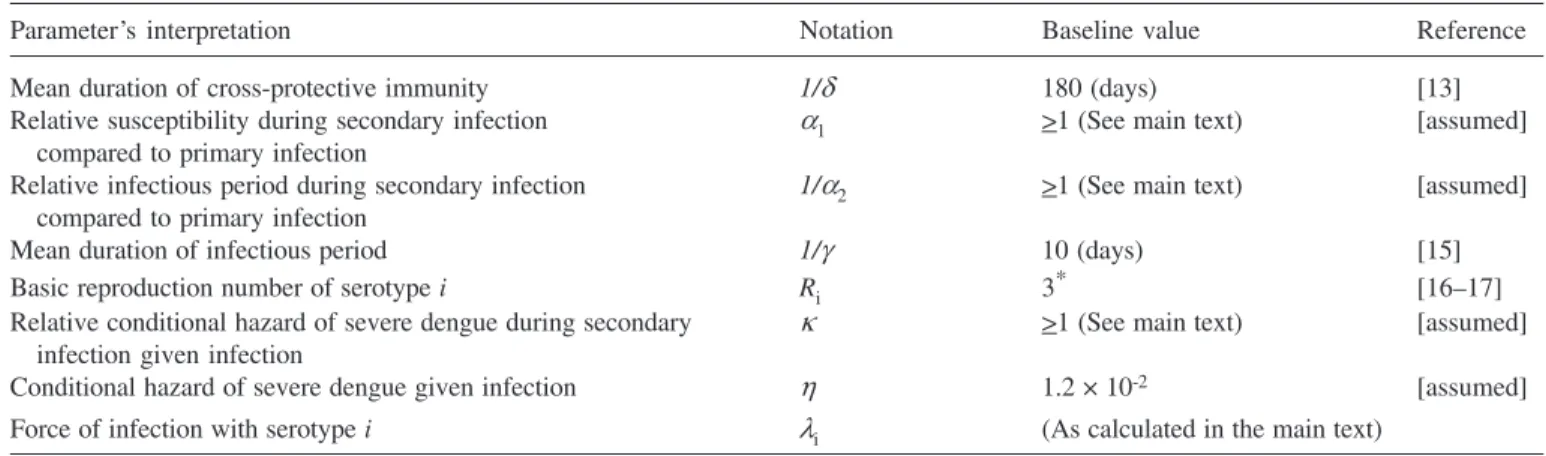
The parameter values that we used for numerical so-lutions are shown in Table 113,15–17.
We examined the sensitivity of RR in (5) to model parameters and initial conditions for two different sce-narios. In both scenarios, we consider an epidemic in the population of N = 1,000,000 individuals in which N-1 are initially fully susceptible and 1 is newly infected with serotype 1 at time t = 0. In the first scenario, it is assumed that secondary infection induces only the elevated risk of severe clinical manifestations at 10 times as compared with that during primary infection, and the mean dura-tion of cross-protective immunity is allowed to vary from 0 to 360 days. During the course of the epidemic, an in-fected individual with serotype 2 is introduced to the com-munity at variable timings; before the epidemic peak (at Day 50), nearby the epidemic peak (Day 72) and during the declining phase of the epidemic (Day 100). We can then measure how r(t) varies as a function of epidemic time. In the second scenario, the epidemiological mecha-nism of enhancement is varied, while the time to intro-duce a single infected individual with serotype 2 is fixed at Day 72. We can measure r(t) as a function of time for ... (1)
where, λi represents the force of infection with serotype
i(for i = 1 or 2) (or the rate at which susceptible individu-als acquire infection with serotype i) calculated as:
... (2)
three possible types of enhancement, i.e. (a) κ = 10, (b)
α1 = 10, or (c) 1/α2 = 10. We also examined the same types of enhancement with different level— (a) κ = 5, (b)
α1 = 5, or (c) 1/α2 = 5. Subsequently, we investigated how r(t) is scaled by κ, α1 and 1/α2 at the end of the epi-demics of both serotypes. A differential equation solver, Berkeley Madonna version 8.0.1 (Robert Macey and George Oster, CA, USA) was used to numerically simu-late the epidemics.
RESULTS
Reviewed literature
Of the 46 titles that were initially identified, 37 ab-stracts were assessed for eligibility, of which 22 were ex-cluded. In total, 15 full length articles were assessed for eligibility (Fig. 2). Of these, eight studies were determined to be eligible and included in this systematic review (Table 2)5, 18–25. One of the eight studies was
split into two original research articles in a single volume of a periodical21–22, and thus, hereafter we combined two
articles into a single study. Of the excluded 22 abstracts, 20 articles were clinical studies (e.g. conducted at healthcare facilities), one article was retrospective study, and one article was a mathematical modeling study. Of the excluded seven full length reports, six articles were clinical studies enrolling participants at hospital settings only26–31 and one article was a
retrospec-tive study32.
Secondary infection and severe dengue in literature
Of the included eight cohort studies, five studies re-ported RR of symptomatic illness and DHF/DSS during secondary infection compared to primary infection. The reported estimates are summarized in Fig. 3 with the RR of symptomatic illness and DHF/DSS ranging from 1.9
to 14.3 and from 1.4 to 58.1, respectively. There have been multiple reports that measured the association be-tween secondary infection and DSS, but DSS during pri-mary infection was too scarce and did not permit precise calculation of RR. For this reason, we grouped DHF and DSS into a single category in all of the following results. Using the variance-based method, the pooled estimate of RR of symptomatic illness during secondary infection was 9.4 [95% confidence interval (CI): 6.1–14.4], and simi-larly, RR of DHF/DSS was 23.7 (95% CI: 15.3–36.9). The pooled estimates using the random effects model were not significantly different: RR of symptomatic illness and DHF/DSS were 5.9 (95% CI: 0.99–35.7) and 15.2 (95% CI: 1.7–137.1), respectively, although the lower bound for symptomatic illness was slightly below unity. A very little heterogeneity was identified for the symptomatic
Fig. 2: Flow diagram of study selection. Table 1. Parameter values for an epidemiological model of dengue
Parameter’s interpretation Notation Baseline value Reference
Mean duration of cross-protective immunity 1/δ 180 (days) [13]
Relative susceptibility during secondary infection α1 >1 (See main text) [assumed]
compared to primary infection
Relative infectious period during secondary infection 1/α2 >1 (See main text) [assumed] compared to primary infection
Mean duration of infectious period 1/γ 10 (days) [15]
Basic reproduction number of serotype i Ri 3* [16–17]
Relative conditional hazard of severe dengue during secondary κ >1 (See main text) [assumed] infection given infection
Conditional hazard of severe dengue given infection η 1.2 × 10⁻² [assumed]
Force of infection with serotype i λi (As calculated in the main text)
illness (Fig. 3a) with Q = 3.8 and I2 = 0%, while a
varia-tion in the RR of DHF/DSS was seen (Fig. 3b) with
Q = 13.1 and I2 = 69.4%.
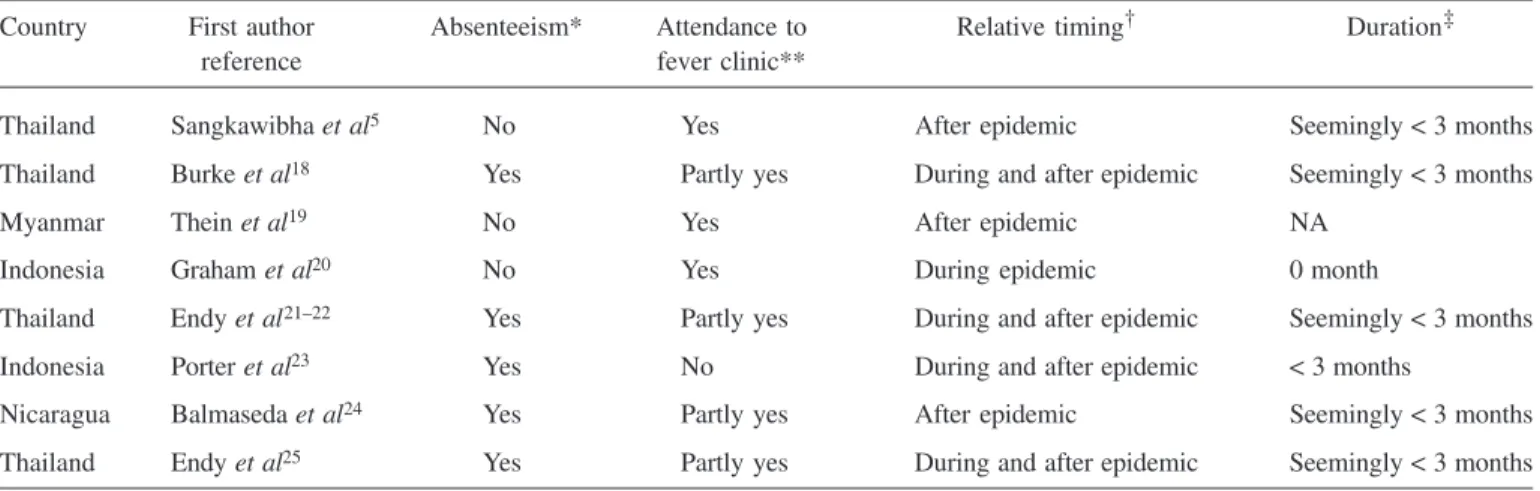
Table 2 shows additional information of our interest during secondary infection in eight cohort studies. Of the eight studies, routine surveillance of absenteeism was con-ducted in five studies (62.5%), while the attendance to fever clinic was observed in seven studies (87.5%). As for the timing of serological survey relative to the epi-demic, four studies (37.5%) obtained samples “during and after epidemic” and three studies (37.5%) did so “after epidemic” only. The time lag from the epidemic to sero-logical survey was most commonly <3 months in five studies (62.5%).
Simulated epidemics with two serotypes
Figure 4 shows the relative risk estimates (of severe dengue which can be interpreted as symptomatic illness, DHF/DSS or other form of severe manifestation) by vary-ing the time to introduce serotype 2 durvary-ing the course of the serotype 1 epidemic and also by varying the mean duration of cross-protective immunity. It is remarkable that the RR varies as a function of time, and it reaches to the stable state only after the end of epidemics of both serotype 1 and 2. Figures 4 (a), (c) and (e) indicate that the timing to introduce serotype 2 has only limited impact on the time-dependency of the RR. However, Figs. 4 (b), (d) and (f) clearly demonstrate that the time-dependent behaviour of RR, r(T) is sensitive to the dura-tion of cross-protective immunity.
In Fig. 5, we examined r(T) for three possible types of enhancement, i.e. when (a) the conditional risk of
se-vere illness was elevated, (b) susceptibility to secondary infection was elevated, and (c) the infectious period dur-ing secondary infection is extended. Three different as-pects are notable. First, as can be expected from Fig. 4, the time-dependent behaviour of r(T) is sensitive to the duration of cross-protective immunity. Second, although the enhancement types (a) and (c) lead to similar equilib-rium at the end of the epidemic of both serotypes, it is remarkable that the enhancement in susceptibility finds a rather different equilibrium value. That is, although the increase in susceptibility has been a common assumption (or interpretation) for describing the epidemiological mechanism of enhancement in various published stud-ies11, 33, the elevated susceptibility does not lead to an
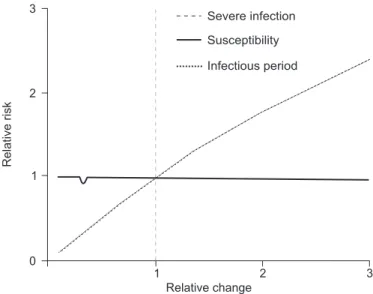
increase in r(T) and even leads to the relative risk below unity. Third, for all three types of enhancement, the equi-librium value of the relative risk is different from the scale of the enhancement in the corresponding parameter. For instance, Figs. 5 (a), (c) and (e) magnified one of param-eters by 10 times, but the equilibrium r(T) value takes approximately 5 for (a) and (c), and 1 for (b), respec-tively. Figures 5 (b), (d) and (f) multiply 5 to one of the parameters, but r(T) is stable approximately at 3.5 for (a) and (c), and 1 for (b), respectively. Figure 6 shows the relationship between r(T) value at an equilibrium (i.e. at the end of epidemics of both serotypes) and the relative change in one of the parameters that were assumed to govern the enhancement during secondary infection. Again, it is remarkable that an increase in susceptibility does not lead to an observation of increase in the relative risk of severe dengue during secondary infection.
Table 2. Available epidemiological information other than symptomatic illness and dengue hemorrhagic fever and the timing of serological survey in eight selected prospective studies of dengue virus infection
Country First author Absenteeism* Attendance to Relative timing† Duration‡
reference fever clinic**
Thailand Sangkawibha et al5 No Yes After epidemic Seemingly < 3 months
Thailand Burke et al18 Yes Partly yes During and after epidemic Seemingly < 3 months
Myanmar Thein et al19 No Yes After epidemic NA
Indonesia Graham et al20 No Yes During epidemic 0 month
Thailand Endy et al21–22 Yes Partly yes During and after epidemic Seemingly < 3 months
Indonesia Porter et al23 Yes No During and after epidemic < 3 months
Nicaragua Balmaseda et al24 Yes Partly yes After epidemic Seemingly < 3 months
Thailand Endy et al25 Yes Partly yes During and after epidemic Seemingly < 3 months
DISCUSSION
The present study combined two epidemiological approaches, i.e. systematic review and mathematical modeling, to understand known epidemiological risks of severe dengue during secondary infection and clarify rel-evant data gaps and pitfalls in measuring the RR of se-vere dengue during secondary infection by means of math-ematical modeling. In the systematic review and meta-analysis, we examined two common outcomes of
severe dengue, namely the RR of symptomatic illness and DHF/DSS during secondary infection. A variation in the estimated RR of DHF/DSS was observed between stud-ies. In addition, we identified that many serological sur-veys took place during or shortly after an epidemic sea-son. Using an epidemiological model, we identified the duration of cross-protective immunity as an important modulator of the time-dependent behaviour of the RR of severe dengue. Differently assumed epidemiological mechanisms of enhancement during secondary infection
yielded different estimates of the RR, and in particular, we observed an unexpectedly small RR when the suscep-tibility of once-infected host was elevated during second-ary infection.
There are two important lessons that should be learnt from the present study. First, our finding indicates a criti-cal need to consider the optimal design of prospective study, accounting for the time-dependent aspect of the risk during the course of epidemics. As we have shown, the duration of cross-protective immunity is likely a key epi-demiological driver to regulate appropriate time frame of empirical observations, and the statistical inference of the duration as well as other natural history is deemed essen-tial to understand the epidemiological dynamics of den-gue15, 34–35. Second, it is critical to clarify how the
en-hancement mechanism during secondary infection influences the epidemiological dynamics. In particular, it should be noted that a common assumption of enhance-ment, i.e. the increased susceptibility, was demonstrated to be inconsistent with the elevated RR of DHF/DSS dur-ing secondary infection. The clarification on the mecha-nism of enhancement calls for a specialized design of empirical observations that permit us to measure the
mecha-nism directly, e.g. by using individual-based observational research design with a possibility to deal with the condi-tional risk of enhancement given DENV infection (e.g.
household-based study). While various mathematical models have been devised to discuss the dengue control including vaccination policy36–39, it is vital to address the
above mentioned point to bridge the gap between the empirically observed idea (e.g. elevated RR of DHF/DSS during secondary infection) and model assumptions.
Three limitations should be noted. First, our system-atic review ignored strain-specific characteristics (e.g.
different virulence) and we also combined the data ignor-ing all other aspects of observations includignor-ing geographic location, ethnicity and background health status. The risks of symptomatic infection and severe dengue are known to depend on age40–41. Moreover, the diagnostic criteria
of DF and DHF could also be different by study42.
Nev-ertheless, these should not be regarded as a serious limi-tation, because the known risk factors have been already identified as independent predictors of severe dengue and would not alter our main results (i.e. accounting for these risk factors would only contribute to stratifying the risks by each individual attribute). Second, our mathematical model rested on simple assumptions with two serotypes only. Homogeneously mixing assumption was employed with a symmetric structure of natural history, and hetero-geneous risks including mosquito dynamics were ignored. People were assumed to be fully susceptible at time 0, but usually it is the case that we observe cross reactions between different viruses in Flaviviridae (e.g. Japanese encephalitis virus). Third, while we identified the impor-tance to account for the time-dependence and clarify the epidemiological mechanism of enhancement, the epide-miological determinants of dengue transmission have yet to be exhaustively identified, and epidemiologists will have to face many other regulators in empirical observations.
In summary, our study suggested that the duration of cross-protective immunity should be estimated from em-pirical datasets and also emphasized that the epidemio-logical dynamics of enhancement during secondary in-fection should be appropriately quantified. Clarifications on these points will help specify optimal study design of dengue in the future. Despite our simplistic approach, we believe that the combination of systematic review and mathematical modeling successfully identified an addi-tional crucial element of severe dengue in epidemiologi-cal observations43.
ACKNOWLEDGEMENT
This study received funding support from the
missioned Research Programme of the Ministry of Health, Labour and Welfare, Japan (H26-ShinkoJitsuyoka-Gen-eral-016) and St Luke’s Life Science Institute Research Grant for Clinical Epidemiology Research 2014. KE re-ceived scholarship support from the Japan Society for Promotion of Science (JSPS).
Conflict of interests
The authors have declared that no conflict of interest exists.
REFERENCES
1. Dengue and dengue hemorrhagic fever. In: Gubler DJ, Kuno G, editors. New York, NY: CAB International 1997; p. 1–200. 2. Guzman MG, Kouri G. Dengue: An update. Lancet Infect Dis
2002; 2: 33–42.
3. Halstead SB. Dengue. Lancet 2007; 370: 1644–52.
4. Halstead SB. Pathogenesis of dengue: Challenges to molecular biology. Science1988; 239: 476–81.
5. Sangkawibha N, Rojanasuphot S, Ahandrik S, Viriyapongse S, Jatanasen S, Salitul V, et al. Risk factors in dengue shock syn-drome: A prospective epidemiologic study in Rayong, Thailand. I. The 1980 outbreak. Am J Epidemiol 1984; 120: 653–69. 6. Cologna R, Armstrong PM, Rico-Hesse R. Selection for virulent
dengue viruses occurs in humans and mosquitoes. J Virol 2005;
79: 853–9.
7. Stephens HA, Klaythong R, Sirikong M, Vaughn DW, Green S, Kalayanarooj S, et al. HLA-A and -B allele associations with secondary dengue virus infections correlate with disease sever-ity and the infecting viral serotype in ethnic Thais. Tissue Anti-gens 2002; 60: 309–18.
8. Guzman MG, Kouri GP, Bravo J, Soler M, Vazquez S, Morier L. Dengue hemorrhagic fever in Cuba, 1981: A retrospective seroepidemiologic study. Am J Trop Med Hyg 1990; 42: 179– 84.
9. Pancharoen C, Mekmullica J, Thisyakorn U. Primary dengue infection: What are the clinical distinctions from secondary in-fection? Southeast Asian J Trop Med Public Health 2001; 32:
476–80.
10. Endy TP, Yoon IK, Mammen MP. Prospective cohort studies of dengue viral transmission and severity of disease. Curr Top Microbiol Immunol 2010; 338: 1–13.
11. Wearing HJ, Rohani P. Ecological and immunological determi-nants of dengue epidemics. Proc Natl Acad Sci USA 2006; 103:
11802–7.
12. Moher D, Liberati A, Tetzlaff J, Altman DG. Preferred reporting items for systematic reviews and meta-analyses: The PRISMA statement. PLoS Med 2009; 6: e1000097.
13. Sabin AB. Research on dengue during World War II. Am J Trop Med Hyg 1952; 1: 30–50.
14. Nishiura H. Duration of short-lived cross-protective immunity against a clinical attack of dengue: A preliminary estimate. Den-gue Bull 2008; 32: 55–66.
15. Nishiura H, Halstead SB. Natural history of dengue virus (DENV)-1 and DENV-4 infections: Reanalysis of classic stud-ies. J Infect Dis 2007; 195: 1007–13.
16. Ferguson NM, Donnelly CA, Anderson RM. Transmission dy-namics and epidemiology of dengue: Insights from age-strati-fied sero-prevalence surveys. Philos Trans R Soc Lond B Biol
Sci 1999; 354: 757–68.
17. Massad E, Burattini MN, Coutinho FA, Lopez LF. Dengue and the risk of urban yellow fever reintroduction in São Paulo State, Brazil. Rev Saude Publica 2003; 37: 477–84.
18. Burke DS, Nisalak A, Johnson DE, Scott RM. A prospective study of dengue infections in Bangkok. Am J Trop Med Hyg
1988; 38: 172–80.
19. Thein S, Aung MM, Shwe TN, Aye M, Zaw A, Aye K, et al.
Risk factors in dengue shock syndrome. Am J Trop Med Hyg
1997; 56: 566–72.
20. Graham RR, Juffrie M, Tan R, Hayes CG, Laksono I, Ma’roef C, et al. A prospective seroepidemiologic study on dengue in children four to nine years of age in Yogyakarta, Indonesia I. Studies in 1995-1996. Am J Trop Med Hyg 1999; 6: 412–9. 21. Endy TP, Nisalak A, Chunsuttiwat S, Libraty DH, Green S,
Rothman AL, et al. Spatial and temporal circulation of dengue virus serotypes: A prospective study of primary schoolchildren in Kamphaeng Phet, Thailand. Am J Epidemiol 2002; 156: 52– 9.
22. Endy TP, Chunsuttiwat S, Nisalak A, Libraty DH, Green S, Rothman AL, et al. Epidemiology of inapparent and symptom-atic acute dengue virus infection: A prospective study of pri-mary schoolchildren in Kamphaeng Phet, Thailand. Am J Epidemiol 2002; 156: 40–51.
23. Porter KR, Beckett CG, Kosasih H, Tan RI, Alisjahbana B, Rudiman PI, et al. Epidemiology of dengue and dengue hemor-rhagic fever in a cohort of adults living in Bandung, West Java, Indonesia. Am J Trop Med Hyg 2005; 72: 60–6.
24. Balmaseda A, Hammond SN, Tellez Y, Imhoff L, Rodriguez Y, Saborío SI, et al. High seroprevalence of antibodies against den-gue virus in a prospective study of schoolchildren in Managua, Nicaragua. Trop Med Int Health 2006; 1: 935–42.
25. Endy TP, Anderson KB, Nisalak A, Yoon IK, Green S, Rothman AL, et al. Determinants of inapparent and symptomatic dengue infection in a prospective study of primary schoolchil-dren in Kamphaeng Phet, Thailand. PLoS Negl Trop Dis 2011;
5: e975.
26. Kalayanarooj S, Vaughn DW, Nimmannitya S, Green S, Suntayakorn S, Kunentrasai N, et al. Early clinical and labora-tory indicators of acute dengue illness. J Infect Dis 1997; 176:
313–21.
27. van Peenen PF, Sunoto, Sumarmo, Sulianti Saroso J, Sinto S, Joseph PL, et al. Dengue with haemorrhage and shock in Jakarta, Indonesia. Southeast Asian J Trop Med Public Health 1978; 9:
25–32.
28. Samsi TK, Wulur H, Sugianto D, Bartz CR, Tan R, Sie A. Some clinical and epidemiological observations on virologically con-firmed dengue hemorrhagic fever. Paediatr Indones 1990; 30: 293–303.
29. Chairulfatah A, Setiabudi D, Ridad A, Colebunders R. Clinical manifestations of dengue haemorrhagic fever in children in Bandung, Indonesia. Ann Soc Belg Med Trop 1995; 75: 291–5. 30. Lucas GN, Amaratunga GW, Gunasena S. A prospective hospi-tal-based study of dengue haemorrhagic fever. Ceylon Med J
2001; 46: 73–4.
31. Zagne SM, Alves VG, Nogueira RM, Miagostovich MP, Lampe E, Tavares W. Dengue haemorrhagic fever in the state of Rio de Janeiro, Brazil: A study of 56 confirmed cases. Trans R Soc Trop Med Hyg 1994; 88: 677–9.
Correspondence to: Dr Hiroshi Nishiura, Graduate School of Medicine, The University of Tokyo, Medical Building No. 3, 7-3-1 Hongo, Bunkyo-ku, Tokyo 113-0033, Japan.
E-mail: [email protected]
Received: 22 March 2013 Accepted in revised form: 30 April 2014 health organization classification system helpful? Am J Trop Med Hyg 2004; 70: 172–9.
33. Adams B, Holmes EC, Zhang C, Mammen MP Jr, Nimmannitya S, Kalayanarooj S, et al. Cross-protective immunity can account for the alternating epidemic pattern of dengue virus serotypes circulating in Bangkok. Proc Natl Acad Sci USA 2006; 103:
14234–9.
34. Chan M, Johansson MA. The incubation periods of dengue vi-ruses. PLoS One 2012; 7: e50972.
35. Omori R, Cowling BJ, Nishiura H. How is vaccine effectiveness scaled by the transmission dynamics of interacting pathogen strains with cross-protective immunity? PLoS One 2012; 7(11): e50751.
36. WHO-VMI Dengue Vaccine Modeling Group, Beatty M, Boni MF, Brown S, Buathong R, Burke D, Coudeville L, et al. As-sessing the potential of a candidate dengue vaccine with math-ematical modeling. PLoS Negl Trop Dis 2012; 6: e1450. 37. Amaku M, Coudeville L, Massad E. Designing a vaccination
strategy against dengue. Rev Inst Med Trop Sao Paulo 2012; 54
(Suppl 18): S18–21.
38. Chao DL, Halstead SB, Halloran ME, Longini IM Jr.
Control-ling dengue with vaccines in Thailand. PLoS Negl Trop Dis 2012;
6: e1876.
39. Ejima K, Aihara K, Nishiura H. The impact of model building on the transmission dynamics under vaccination: Observable (symptom-based) versus unobservable (contagiousness-depen-dent) approaches. PLoS One 2013; 8(4): e62062.
40. Thai KTD, Nishiura H, Hoang PH, Tran NTT, Phan GT, Le HQ, Tran BQ, Nguyen NV, de Vries PJ. Age-specificity of clinical dengue during primary and secondary infections. PLoS Negl Trop Dis 2011; 5(6): e1180.
41. Guzmαn MG, Kouri G, Bravo J, Valdes L, Vazquez S, Halstead SB. Effect of age on outcome of secondary dengue 2 infections.
Int J Infect Dis 2002; 6(2): 118–24.
42. Bandyopadhyay S, Lum LC, Kroeger A. Classifying dengue: A review of the difficulties in using the WHO case classification for dengue haemorrhagic fever. Trop Med Int Health 2006; 11:
1238–55.
43. Mizumoto K, Nishiura H, Yamamoto T. Effectiveness of antivi-ral prophylaxis coupled with contact tracing in reducing the trans-mission of the influenza A (H1N1-2009): A systematic review.