Vol. 5, No. 1, May 2008, 11-20
Eddy Current Testing of Metallic Sheets with
Defects Using Force Measurements
Hartmut Brauer
1, Marek Ziolkowski
2Abstract: The problem of determining defects in structures using eddy current methods was investigated. The goal of this work is to demonstrate that the forces, generated by the eddy currents and acting back on the magnet system can be used to detect defects in the object. Numerical simulations and experimental investigations have been performed. This novel technique has been found to be sensitive enough to detect even deep defects in an Aluminium bar moving relative to the field-generating magnet system.
Keywords: Computational electromagnetics, Non-destructive evaluation, Eddy current testing, Lorentz force.
1 Introduction
Non-destructive testing (NDT) for conductive objects requires high reliability to detect cracks and defects in advance. Eddy Current Testing (ECT) is one of the non-destructive techniques often used to detect them [1]. In this method, a frequency dependent exciting current is commonly used to measure voltage changes on the pick-up coils for high detection sensitivity. It changes the magnetic field around conductive objects where cracks and defects prevent the flow of the eddy currents, and thus leading to changes of the impedance of the pick-up coil [2]. To detect the defects sensitively, high frequency exciting currents or multi-frequency techniques have to be applied. Nevertheless, it is very difficult to detect them, either on the reverse side surface or inside thick objects, due to the skin effect [3].
However, for the safety of any constructions it is important to detect defects from the outside non-invasively. In such cases, low frequency exciting currents have to be used to yield the eddy currents through the front surface to the reverse
1
Technische Universitaet Ilmenau, Faculty Electrical Engineering and Information Technology, Dept. of Electromagnetic Fields/Theoretical Electrical Engineering, Am Helmholtzplatz 2, P.O.Box 100565, 98684 Ilmenau, Germany, E-mail: [email protected]
2
side surface of the conductive objects or even for rather deeply located internal defects. The amount of eddy currents decreases because of its larger expansion in the object volume. Thus, it becomes more difficult to detect the effects from defects which are far away from the pick-up coils at low frequencies [4].
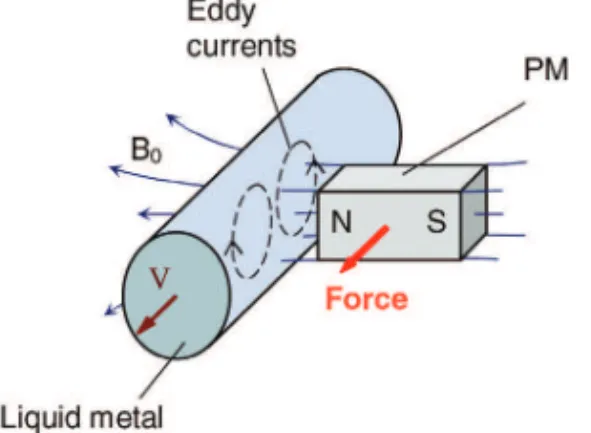
Therefore, we propose a new strategy of defect detection which is almost independent of the exciting current frequencies and thus from skin depths. It is well-known that the interactions of the magnetic field and the eddy currents caused by it lead to a Lorentz force with density f = j x B. Following Newton´s 3rd law it can be stated that for every action there is an equal and opposite reaction. When, for example, a liquid metal moves in the magnetic field this Lorentz force will brake the flow. The Lorentz force density is roughly f ~ σ v B2, where σ is the electrical conductivity of the fluid, v its velocity, and B the magnitude of the magnetic field [5]. This fact is well-known and has found a variety of applications for flow control in metallurgy and crystal growth [6, 7]. Several more papers describe different methods for modelling of eddy current problems including permanent magnets and moving parts [8-12]. A less widely recognized fact is also that by virtue of Newton´s law, an opposite force acts upon the magnetic-field-generating system and drags it along the flow direction as if the magnetic field lines were invisible obstacles. This force is proportional to the velocity and the conductivity of the fluid [13]. Its measurement is the key idea of the so-called Lorentz Force Velocimetry (LFV) [14]. The principle is shown in Fig. 1.
Fig. 1 –Principle sketch of Lorentz force velocimetry showing the action of a permanent magnet (PM) upon the flow of an electrically conducting fluid.
The magnetic-field-generating system can also consist of coils or a combination of coils, permanent magnets, and ferromagnetic material (from [5]).
2 Experiments
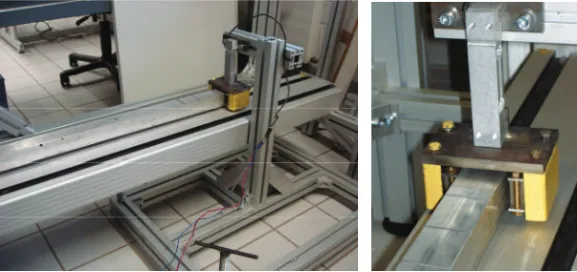
In the experimental studies the liquid metal (Fig. 1) was replaced by a massive Aluminium bar as a test object prepared with a set of different defects. The bar was moved with constant velocity in a magnetic field generated by a permanent magnet system.
Fig. 2 –Aluminium bar (prepared with a set of defects) is moving through a uniform magnetic field, whereas the Lorentz force
acting on the permanent magnet is measured.
Several flat surface slots and boreholes of different diameters along the bar were used to simulate cracks and defects (Fig. 2). Two types of magnet systems were applied generating either a homogeneous or an inhomogeneous magnetic field in which the Aluminium bar was moving. In both cases the forces acting on the NdFeB-magnets were measured.
3 Force
measurements
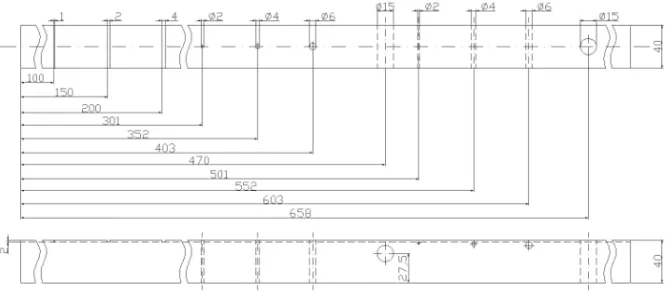
In first tests the forces acting on the magnet systems were measured while an Aluminium bar was moving with a constant velocity of 15 cm/s through the magnetic field. The Aluminium bar was prepared with three surface slots of different widths (1, 2 and 4 mm) but the same depth of 2mm, three small horizontal and vertical boreholes (diameters 2, 4 and 6mm) and two big boreholes (diameter 15mm). The defect positions along the specimen are given in Fig. 3.
Due to the fact that a constant velocity for the bar movement was chosen the changes in the measured force signals can directly be related to the corresponding defect positions.
Fig. 3 –Aluminium specimen used for the experiments of eddy current defect inspection by means of force measurements.
Table 1
Defect positions detected from force measurements: bar movement velocity: 15 cm/s)
surface slots (slot) of 1, 2, 4 mm; vertical boreholes (BV) of 2, 4, 6 mm; horizontal boreholes (BH) of 2, 4, 6 mm;
big boreholes, vertical (BB-V), horizontal (BB-H), 15 mm
Defect Time [s]
Position (center of defect) [mm]
Slot-1 0,4 100,50
Slot-2 0,73 151,00
Slot-3 1,07 202,00
BV-1 1,73 301,00
BV-2 2,07 352,00
BV-3 2,4 403,00
BB-H 2,82 470,00
BH-1 3,07 501,00
BH-2 3,4 552,00
BH-3 3,73 603,00
-636.5 -636.2 -635.9 -635.6 -635.3 -635 -634.7 -634.4 -634.1
0 50 100 150 200 250 300 350 400 450 500 550 600 650 700
Koordinate, mm
Kr
af
t,
m
N
Fig. 4 –Measurement results of the force acting on the magnet system versus position if the Aluminium bar is moving through the magnetic field with constant velocity.
4
Computation of the fields
Fig. 5 – Magnetic flux density (top) and electrical current density distribution (bottom) in the Aluminium bar due to the homogeneous magnetic field system,
The configuration shown in Fig. 2 was simulated using the Maxwell3D FEM software. Fig. 5 shows the obtained magnetic field distribution (top) and the current density distribution (bottom) for the case where the bar is moved through an almost homogeneous magnetic field caused by two bar magnets inside an iron yoke. It can be seen that the magnetic field is almost homogeneous in the bar whereas the current density shows maximum values near the lower corners of the permanent magnets.
5
Eddy current testing of moving objects
Eddy current testing by means of force measurements requires relative movements between the magnet system and the specimen under test. From the numerical simulation point of view it is easier to analyze a fixed magnet system and a moving specimen. In this case the governing equation is
(
)
1 ext t ⎛ ⎞ ∂σ + ∇ ×⎜ ∇ × ⎟− σ × ∇ × =
∂ ⎝μ ⎠
A
A v A J (1)
where A is the magnetic vector potential, B the magnetic flux density, σ the electrical conductivity of the specimen and v its velocity. If permanent magnets are used this equation can be rewritten as
(
)
1
0
⎛ ⎞
∇ ×⎜ ∇ × − ⎟− σ × ∇ × =
μ
⎝ A Br⎠ v A (2)
with the remanent flux density Br.
6 Force
computation
Calculation of the magnetic force is fundamental in modelling of a coupled magneto-mechanical system. For rigid movement only knowledge of the total force is necessary, while for a system with deformable material it is essential to know the local force distribution. There are three different force calculation methods available in numerical modelling [16-18]:
1. Maxwell stress tensor
2. Method of virtual displacement 3. Lorentz force
Whereas the first two methods can be used to calculate the total force, local force calculations are usually based on Lorentz formula J×B in conductors, and on 1 2
2 grad
− H μ in magnetized materials.
Aluminium plate is moving with different constant velocities in it’s vicinity (Fig. 6).
Fig. 6 – 2D test configuration used for the simulation study An Aluminium plate (150mm long, 6mm thick), with a surface slot (4mm deep, widths varying between 1 and 5mm) is moving close to a
fixed permanent magnet (15mm width, 5mm height).
Whereas the Lorentz force (FL) acting on the magnet was measured during
movement of the Aluminium plate, the force per length (fL) was computed in the
plate:
d
Alu
S
S
=
∫
×L
f J B (3)
7 Numerical
computation
approach
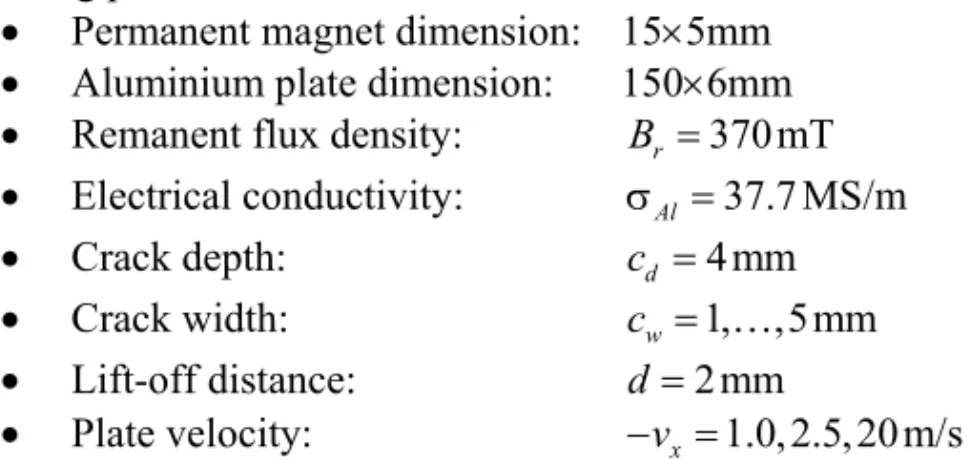
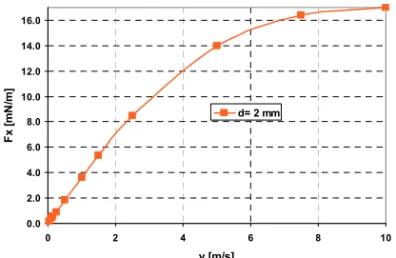
2D numerical simulations were performed with a magnetostatics AC/DC module of the COMSOL 3.3 FEM-software. Equation (2) was solved using the following parameters:
• Permanent magnet dimension: 15×5mm
• Aluminium plate dimension: 150×6mm
• Remanent flux density: Br =370 mT
• Electrical conductivity: σ =Al 37.7 MS/m
• Crack depth: cd =4 mm
• Crack width: cw =1,…,5 mm
• Lift-off distance: d =2 mm
• Plate velocity: − =vx 1.0, 2.5, 20 m/s
Fig. 7 – Computational results: magnetic field of the permanent magnet (red lines); eddy current distributions due to Aluminium plate movement in the
negative x-direction (velocity = 1.0, 2.5, 20m/s, crack width = 5mm).
0.0 2.0 4.0 6.0 8.0 10.0 12.0 14.0 16.0
0 2 4 6 8 10
v [m/s]
Fx
[
m
N
/m
]
d= 2 mm
0.0 2.0 4.0 6.0 8.0 10.0 12.0
1 3 5 7 9 11 13 15
d [mm]
Fx [
m
N
/m
]
v=2.5 m/s
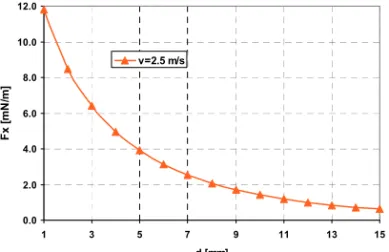
Fig. 9 – Lorentz force vs. lift-off distance for a fixed velocity of vx =2.5 m/s.
Fx vs crack width (v=2.5 m/s, d=2 mm)
75 80 85 90 95 100 105
-60 -50 -40 -30 -20 -10 0 10 20 30 40 50 60
x [mm]
Fx
[%
]
cw = 1mm cw = 3mm cw = 5mm
Fig. 10 – Lorentz force vs. x-coordinate (along the plate), normalized to the force without a crack; lift-off d=2 mm; crack width cw=1, 3, 5 mm.
8 Conclusion
A numerical simulation study using the COMSOL 3.3 FEM-software has shown that it is possible to detect cracks in conductors by means of measuring the Lorentz force acting on a permanent magnet system, due to the conductor movement. Although this was shown only for a 2D case, similar results can be expected for 3D problems as well. Further investigations have to be done in order to verify the detection of defects which are located rather deep inside the conductor, using this novel Lorentz force eddy current testing technique.
9 References
[1] D.C. Dobson, F. Santosa: Nondestructive Evaluation of Plates using Eddy Current Methods, Int. Journal of Engineering Science, Vol. 36, 1998, pp. 395-409.
[3] D. Premel, A. Baussard: Eddy-current Evaluation of Three-dimensional Flaws in Flat Conductive Materials using a Bayesian Approach, Inverse Problems, Vol. 18, 2002, pp. 1873-1889.
[4] Y. Tsuchida, T. Chady, M. Enokizono: Development of a Moving Magnetic Flux Type Sensor using Shading Coils for ECT, IEEE Trans. Magnetics, Vol. 34, No. 4, 1998, pp. 1309-1311.
[5] A. Thess, E.V. Votyakov, Y. Kolesnikov: Lorentz Force Velocimetry, Physical Review Letters, Vol. 96, 2006, 164501.
[6] P.A. Davidson: Magnetohydrodynamics in Material Processing, Annu. Rev. Fluid Mech., Vol. 31, 1999, pp. 273-300.
[7] J.A. Shercliff: The Theory of Electromagnetic Flow Measurement, Cambridge University Press, Cambridge, 1962.
[8] M. Tsuchimoto, M. Hashimoto, A. Yamashita, K. Miya: Experimental Estimation of Electromagnetic Forces on Non-magnetic and Ferromagnetic Thin Plates, Meas. Sci. Technol., Vol. 6, 1995, pp. 893-897.
[9] D. Rodger, N. Allen, P.C. Coles, S. Street, P.J. Leonhard, J.F. Eastham: Finite Element Calculation of Forces on a DC Magnet moving over an Iron Rail, IEEE Trans. Magnetics, Vol. 30, No. 6, 1994, pp. 4680-4682.
[10] M. Enokizono, T. Tsuchida, T. Chady: Crack Size and Shape Determination by Moving Magnetic Field Type Sensor, IEEE Trans. Magnetics, Vol. 34, No. 4, 1998, pp. 1252-1254. [11] Y.S. Sun, W. Lord, G. Katragadda: Motion Induced Remote Field Eddy Current Effect in a
Magnetostatic Non-destructive Testing Tool: A Finite Element Prediction, IEEE Trans. Magnetics, Vol. 30, No. 5, 1994, pp. 3304-3307.
[12] Y.S. Sun, W. Lord, G. Katragadda: Influences of Velocity on Signal Responses of Magnetostatic Non-destructive Testing Tools: A Prediction from Finite Element Analysis, IEEE Trans. Magnetics, Vol. 30, No. 5, 1994, pp. 3308-3311.
[13] A. Thess, E. Votyakov, B. Knaepen, O. Zikanov: Theory of the Lorentz Force Flowmeter, New Journal of Physics, Vol. 9, Aug. 2007.
[14] A. Thess, Y. Kolesnikov, C. Karcher: patent pending.
[15] A. Thess, Y. Kolesnikov, H. Brauer, C. Resagk: patent pending.
[16] Z. Ren: Comparison of Different Force Calculation Methods in 3D Finite Element Model-ling, IEEE Trans. Magnetics, Vol. 30, No. 5, 1994, pp. 3471-3474.
[17] M. Bartsch, T. Weiland: 2D and 3D Calculation of Forces, IEEE Trans. Magnetics, Vol. 30, No. 5, 1994, pp. 3467-3470.