S CIE
NT OR
U M
ACTA
Acta Sci. Pol., Technol. Aliment. 6(2) 2007, 29-40
Corresponding author – Adres do korespondencji: Dr in . Małgorzata Ziarno, Department of
THE INFLUENCE OF CHOLESTEROL
AND BIOMASS CONCENTRATION ON THE UPTAKE
OF CHOLESTEROL BY LACTOBACILLUS
FROM MRS BROTH
Małgorzata Ziarno
Warsaw Agricultural University SGGW
Abstract. The aim of this study was the determination of some factors influence (i.e. the vitality of bacteria cells and the cholesterol concentration) on the ability of selected
Lac-tobacillus sp. to cholesterol uptake during culture in MRS broth. Three Lactobacillus
strains (Lb. delbrueckii subsp. bulgaricus, Lb. acidophilus, Lb. casei) isolated from com-mercial single species lyophilized dairy starter cultures and three Lactobacillus strains (Lb. plantarum, Lb. delbrueckii subsp. bulgaricus, Lb. acidophilus) originated from commercial pharmaceuticals were used in this study. The uptake of cholesterol from MRS broth during the growth of Lactobacillus sp., expressed as the difference between the final and the initial concentrations of cholesterol, ranged from 0.053 to 0.153 g/dm3, apart from the initial cholesterol content and the origin of Lactobacillus sp. The results confirmed that biomass concentration have a statistically significant effect on uptake of cholesterol. The ten-fold increase of the amount of intact cells biomass caused about 1.5-2-fold in-crease of the amount of cholesterol removed. The influence of the concentration of bio-mass of alive cells on the removal of cholesterol was bigger than in case of the heat-sterilized cells.
Key words: cholesterol, dairy starter cultures, cholesterol uptake, Lactobacillus, lactic
acid bacteria
INTRODUCTION
Several studies on humans have suggested a cholesterol-lowering action of dairy
products fermented by lactic acid bacteria. Many in vitro reports deal with
bacteria. The ability to uptake of cholesterol in laboratory culture media has been shown
for numerous Lactobacillus, such as Lb. acidophilus, Lb. delbrueckii subsp. bulgaricus,
Lb. casei, Lb. gasseri, Lb. amylovorus [Gilliland et al. 1985, Rasic et al. 1992, Walker and Gilliland 1993, Buck and Gilliland 1994, Tahri et al. 1996, Noh et al. 1997, Brashears et al. 1998, Grill et al. 2000, Lin and Chen 2000]. It has been suggested that sources of variation in hypocholesterolemic effect may be due to the different bacterial strains used in fermentation as well as due to the differences in level of hypocholes-terolemic compounds in yoghurt [Jaspers et al. 1984].
Removal of cholesterol by microorganisms present in food could reduce the amount of cholesterol available for human organism. Several studies have indicated that con-sumption of certain cultured dairy products resulted in reduction of serum cholesterol. This seems to be a proof that probiotic and traditional strains of Lactobacillus genera originated from dairy starter cultures or other sources possess ability to cholesterol uptake. However, not all Lactobacillus used for human have been studied in this re-spect. The extension of the range of this study will permit sensitively to qualify, whether and when the process of cholesterol uptake by cells of lactic acid bacteria hap-pens. It will permit also to ascertain, which factors decide about the uptake of choles-terol by bacteria (i.e. pH, temperature, the vitality of bacteria cells, the time of culturing, the secretion of active matters, the cholesterol concentration).
The aim of this study was the determination of some factors influence on the ability
of selected Lactobacillus sp. to cholesterol uptake during culture in MRS broth.
MATERIALS AND METHODS
Bacterial cultures and culture conditions. Three Lactobacillus strains (Lb. del-brueckii subsp. bulgaricus, Lb. acidophilus, Lb. casei) isolated from commercial single
species lyophilized dairy starter cultures and three Lactobacillus strains (Lb. plantarum,
Lb. delbrueckii subsp. bulgaricus, Lb. acidophilus) originated from commercial phar-maceuticals were used in this study. The cultures were grown twice in MRS broth (Merck) in 37°C for 24 h, than were used for study.
Cholesterol solution preparation. Crystalline cholesterol, of chemical purity > 99% (Sigma-Aldrich), was hot dissolved in 99% ethanol and Tween 80, mixed in 3:1
ratio. Cholesterol solution had a concentration 3.0 g of cholesterol in 1 dm3. This
solu-tion was used in experiments. The sterilely measured porsolu-tion of this solusolu-tion was added to MRS broth in such a quantity, to reach the final concentration of cholesterol.
Influence of the initial concentration of cholesterol on the ability of Lactobacil-lus to uptake of cholesterol. The Lactobacillus strains were cultured in MRS broth contained the cholesterol at different initial concentration ranged from 0.083 g/dm3 to
1.895 g/dm3. The experiments were performed at 37°C for 24 h. Such culturing
condi-tions made possible the growth of LAB. The experiments have been performed in three-fold repetition.
the experiments: 10-fold concentrated (10×), normal (1×) and 1-time dissolved (0.1×). The experiments have been performed in three-fold repetition.
Determination of cholesterol content. Cholesterol concentration was assayed with the enzymatic diagnostic test Cholésterol RTU® (BioMérieux). Absorbance was meas-ured with a spectrophotometer Helios Gamma (Thermo Elektron Corporation) at the wavelength 500 nm. Before cholesterol concentration in MRS broth was assayed the content of tubes was centrifuged in ultra-speed centrifuge (6000 r.p.m., 7 min, 4°C) in order to separate bacterial cells biomass and obtain clear MRS broth supernatant. The cultures’ ability for cholesterol uptake was calculated as loss of its concentration in MRS broth supernatant after the end of culture. The percent of cholesterol removed from MRS broth by Lactobacillus sp. has been expressed as the percent of the initial concentration of cholesterol.
Number of Lactobacillus sp. cells. The number of Lactobacillus sp. was assayed
with plate method. Inoculated plates were incubated in conditions optimal for
Lactoba-cillus sp.: MRS Agar (Merck), 37°C for 72 h, anaerobic conditions.
Statistical analysis of results. The statistical analysis of results is accomplished with the help of STATGRAPHICS Plus 5.1 programme. An analysis of variance (one-way or multifactor ANOVA) in order to show the significance of the results has been performed. Since no P-values are less than 0.05, none of the factors have a statistically significant effect on the dependent variable at the 95.0% confidence level.
RESULTS
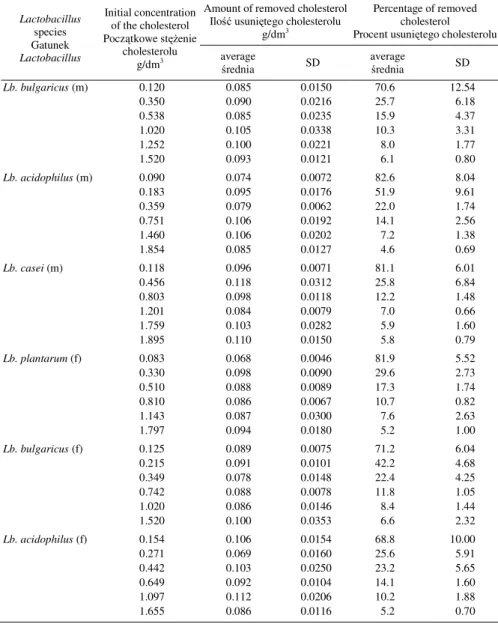
Cultures of Lactobacillus examined in this study showed abilities to remove
choles-terol from culture broth which did not depend on the initial concentration of cholescholes-terol (Table 1). This lack of influence of the initial concentration of cholesterol on the uptake of this substance is very interesting. The uptake of cholesterol from MRS broth during the growth of Lactobacillus sp., expressed as the difference between the final and the
initial concentrations of cholesterol, ranged from 0.053 to 0.153 g/dm3, apart from the
initial cholesterol content and the origin of Lactobacillus sp. (p = 0.2006). The amount
of cholesterol uptake by Lb. delbrueckii subsp. bulgaricus isolated from dairy starters
(0.093 ±0.0214 g/dm3) did not differ from the amount of cholesterol removed by Lb.
delbrueckii subsp. bulgaricus originated from pharmaceutical (0.089 ±0.0150 g/dm3).
The amount of cholesterol removed by Lb. acidophilus isolated from dairy starters
(0.091 ±0.0139 g/dm3) did not differ from the amount of cholesterol uptake by Lb.
aci-dophilus originated from pharmaceutical (0.095 ±0.0165 g/dm3). Only strain of Lb. casei removed significantly more cholesterol than Lb. plantarum and Lb. delbrueckii
subsp. bulgaricus isolated from pharmaceuticals (p < 0.05).
The amount of cholesterol removed from MRS broth, expressed as the percent of the initial concentration of cholesterol, depended on initial cholesterol content (p < 0.05)
but did not depend on the origin of Lactobacillus sp. (p = 0.2293). The highest percent
of cholesterol uptake has been observed in case of MRS broth containing the lowest initial concentration of cholesterol.
At the same time it was checked if the addition of cholesterol solution inhibits or
stimulates growth of Lactobacillus sp. (Fig. 1). The initial log of numbers of
Table 1. The influence of the initial concentration of the cholesterol on the degree of its uptake by chosen Lactobacillus (the average and standard deviation from three experiments)
Tabela 1. Wpływ pocz tkowego st enia cholesterolu na stopie jego zwi zania przez wybrane Lactobacillus ( rednia i odchylenie standardowe z trzech do wiadcze )
Amount of removed cholesterol Ilo usuni tego cholesterolu
g/dm3
Percentage of removed cholesterol Procent usuni tego cholesterolu Lactobacillus
species Gatunek Lactobacillus
Initial concentration of the cholesterol Pocz tkowe st enie
cholesterolu
g/dm3 average
rednia SD
average
rednia SD
Lb. bulgaricus (m) 0.120 0.350 0.538 1.020 1.252 1.520 0.085 0.090 0.085 0.105 0.100 0.093 0.0150 0.0216 0.0235 0.0338 0.0221 0.0121 70.6 25.7 15.9 10.3 8.0 6.1 12.54 6.18 4.37 3.31 1.77 0.80
Lb. acidophilus (m) 0.090 0.183 0.359 0.751 1.460 1.854 0.074 0.095 0.079 0.106 0.106 0.085 0.0072 0.0176 0.0062 0.0192 0.0202 0.0127 82.6 51.9 22.0 14.1 7.2 4.6 8.04 9.61 1.74 2.56 1.38 0.69
Lb. casei (m) 0.118 0.456 0.803 1.201 1.759 1.895 0.096 0.118 0.098 0.084 0.103 0.110 0.0071 0.0312 0.0118 0.0079 0.0282 0.0150 81.1 25.8 12.2 7.0 5.9 5.8 6.01 6.84 1.48 0.66 1.60 0.79
Lb. plantarum (f) 0.083 0.330 0.510 0.810 1.143 1.797 0.068 0.098 0.088 0.086 0.087 0.094 0.0046 0.0090 0.0089 0.0067 0.0300 0.0180 81.9 29.6 17.3 10.7 7.6 5.2 5.52 2.73 1.74 0.82 2.63 1.00
Lb. bulgaricus (f) 0.125 0.215 0.349 0.742 1.020 1.520 0.089 0.091 0.078 0.088 0.086 0.100 0.0075 0.0101 0.0148 0.0078 0.0146 0.0353 71.2 42.2 22.4 11.8 8.4 6.6 6.04 4.68 4.25 1.05 1.44 2.32
Lb. acidophilus (f) 0.154 0.271 0.442 0.649 1.097 1.655 0.106 0.069 0.103 0.092 0.112 0.086 0.0154 0.0160 0.0250 0.0104 0.0206 0.0116 68.8 25.6 23.2 14.1 10.2 5.2 10.00 5.91 5.65 1.60 1.88 0.70
Legend: m – cultures originating from commercial dairy starters, f – cultures originating from commercial pharmaceuticals, SD – standard deviation.
Fig. 1. Growth of Lactobacillus strains in MRS broths (the average from three experi-ments): m – cultures originating from commercial dairy starters, f – cultures originating from commercial pharmaceuticals, darkgrey posts – initial number of lactobacilli, posts grey and white – final number of lactobacilli after incubation at 37°C for 24 h
Rys. 1. Wzrost szczepów Lactobacillus w bulionach MRS ( rednia z trzech do wiad-cze ): m – kultury pochodz ce z komercyjnych starterów mleczarskich, f – kultury po-chodz ce z handlowych preparatów farmaceutycznych, słupki ciemnoszare – pocz tkowa liczba pałeczek mlekowych, słupki jasnoszare i białe – ko cowa liczba pałeczek po ho-dowli w temperaturze 37°C przez 24 h
subsp. bulgaricus, Lb. acidophilus and Lb. casei originated from dairy starters, Lb. plantarum, Lb. delbrueckii subsp. bulgaricus, Lb. acidophilus isolated from pharmaceu-ticals, respectively. No statistically significant differences were observed between the
logarithms of Lactobacillus sp. number in cultures containing different level of
choles-terol solution (p = 0.9910, p = 0.9341, p = 0.3786, p = 0.9553, p = 0.6963, p = 0.4853 for cultures of Lb. delbrueckii subsp. bulgaricus, Lb. acidophilus and Lb. casei origi-nated from dairy starters, Lb. plantarum, Lb. delbrueckii subsp. bulgaricus, Lb. aci-dophilus isolated from pharmaceuticals, respectively).
The influence of the concentration of heat-sterilized biomass on the uptake of cho-lesterol is presented in the Figure 2. For Lb. delbrueckii subsp. bulgaricus, Lb. aci-dophilus and Lb. casei isolated from starter cultures, the initial cholesterol concentration was 0.350 g/dm3, 0.810 g/dm3 and 0.460 g/dm3 respectively. For Lb. plantarum, Lb. delbrueckii subsp. bulgaricus and Lb. acidophilus originated from pharmaceuticals, the
initial cholesterol concentration was 0.245 g/dm3, 0.810 g/dm3 and 0.460 g/dm3
respec-tively. The results confirmed that even cells which were not able to multiply, had ability to remove cholesterol. Statistical analysis confirmed that biomass concentration and
type of Lactobacillus sp. have a statistically significant effect on uptake of cholesterol at
5.00 5.50 6.00 6.50 7.00 7.50 8.00 8.50 9.00
lo
g
C
F
U
/c
m
3 –
l
o
g
j
.t
.k
./
c
m
3
Lb. bulgaricus (m)
Lb. acidophilus (m)
Lb. casei (m)
Lb. plantarum (f)
Lb. bulgaricus (f)
Lb. acidophilus (f)
Fig. 2. The influence of the concentration of biomass of dead cells on the uptake of cholesterol by Lactobacillus strains (the average from three ex-periments): m – cultures originating from commercial dairy starters, f – cultures originating from commercial pharmaceuticals
Rys. 2. Wpływ st enia biomasy martwych komórek na wi zanie chole-sterolu przez szczepy Lactobacillus ( rednia z trzech do wiadcze ): m – kultury pochodz ce z komercyjnych starterów mleczarskich, f – kultury pochodz ce z handlowych preparatów farmaceutycznych
the 95.0% confidence level (p < 0.05). The more amount of heat-sterilized biomass the more cholesterol removed. The ten-fold increase of the amount of biomass caused about 1.5-2-fold increase of the amount of cholesterol removed. In case of biomass at normal concentration (1×), the amount of cholesterol removed by heat-sterilized cells ranged from 0.023 ±0.0031 g/dm3 to 0.049 ±0.0134 g/dm3 (av. 7.4% ±1.81). But in case of
biomass 10×, the amount of cholesterol removed ranged from 0.052 ±0.0055 g/dm3 to
0.093 ±0.0156 g/dm3 (av. 16.2% ±2.78). And in case of the lower biomass
concentra-tion (0.1×), the amount of cholesterol removed ranged from 0.007 ±0.0055 g/dm3 to
0.022 ±0.0019 g/dm3 (av. 5.8% ±1.32). The type of Lactobacillus sp. had a statistically
significant effect on uptake of cholesterol (p < 0.05). Lb. delbrueckii subsp. bulgaricus
originated from dairy starter, Lb. casei and Lb. plantarum removed statistically less
cholesterol than other cultures.
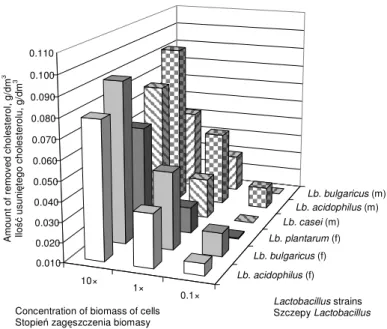
The uptake of cholesterol by alive cells looks totally different. The influence of the concentration of biomass of alive cells on the removal of cholesterol was smaller than in
case of the heat-sterilized cells (Fig. 3). For Lb. delbrueckii subsp. bulgaricus, Lb.
aci-dophilus and Lb. casei isolated from starter cultures, the initial cholesterol concentration was 0.350 g/dm3, 0.810 g/dm3 and 0.460 g/dm3 respectively. For Lb. plantarum, Lb. delbrueckii subsp. bulgaricus and Lb. acidophilus originated from pharmaceuticals, the
10× 1×
0.1×
Lb. bulgaricus (m) Lb. acidophilus (m) Lb. casei (m)
Lb. plantarum (f)
Lb. bulgaricus (f)
Lb. acidophilus (f) 0.010
0.020 0.030 0.040 0.050 0.060 0.070 0.080 0.090 0.100 0.110
A
m
o
u
n
t
o
f
re
m
o
v
e
d
c
h
o
le
s
te
ro
l,
g
/d
m
3
Il
o
u
s
u
n
i
te
g
o
c
h
o
le
s
te
ro
lu
,
g
/d
m
3
Concentration of biomass of cells Stopie zag szczenia biomasy
Fig. 3. The influence of the concentration of biomass of alive cells on the uptake of cholesterol by Lactobacillus strains (the average from three ex-periments): m – cultures originating from commercial dairy starters, f – cultures originating from commercial pharmaceuticals
Rys. 3. Wpływ st enia biomasy ywych komórek na wi zanie cholestero-lu przez szczepy Lactobacilcholestero-lus ( rednia z trzech do wiadcze ): m – kultury pochodz ce z komercyjnych starterów mleczarskich, f – kultury pochodz -ce z handlowych preparatów farma-ceutycznych
initial cholesterol concentration was 0.245 g/dm3, 0.810 g/dm3 and 0.460 g/dm3
respec-tively. The amount of cholesterol removed from MRS broth by alive cell, expressed as the difference between the final and the initial concentrations of cholesterol, ranged
from 0.079 ±0.0126 g/dm3 to 0.112 ±0.0007 g/dm3, apart from the origin of
Lactobacil-lus sp. (p = 0.5936). The initial biomass concentration had a statistically significant effect on uptake of cholesterol at the 95.0% confidence level (p = 0.0025), but this in-fluence was weaker than in case of the heat-sterilized cells. The percent of cholesterol removed from MRS broth, expressed as the percent of the initial concentration of cho-lesterol, depended on the initial biomass concentration (p = 0.0298) and the type of
culture (p = 0.001). The percent of cholesterol removed by Lb. delbrueckii subsp.
bul-garicus originated from dairy starters (29.4% ±4.31) differed from the percent of
cho-lesterol removed by Lb. delbrueckii subsp. bulgaricus isolated from pharmaceutical
(12.2% ±3.85). The percent of cholesterol removed by Lb. acidophilus isolated from
dairy starter (13.8% ±0.96) also differed from the percent of cholesterol removed by Lb.
acidophilus originated from pharmaceutical (22.3% ±1.29). The percent of cholesterol
removed by Lb. casei and Lb. plantarum was 20.3% ±2.25 and 37.9% ±10.41,
respec-tively. The last mentioned value (received for Lb. plantarum) gets out of the low the initial content of cholesterol in MRS broth (0.245 g/dm3) but not of the ability of Lb. plantarum used.
10× 1×
0.1×
Lb. bulgaricus (m) Lb. acidophilus (m) Lb. casei (m)
Lb. plantarum (f)
Lb. bulgaricus (f)
Lb. acidophilus (f) 0.010
0.020 0.030 0.040 0.050 0.060 0.070 0.080 0.090 0.100 0.110
Concentration of biomass of cells Stopie zag szczenia biomasy
Lactobacillus strains Szczepy Lactobacillus
A
m
o
u
n
t
o
f
re
m
o
v
e
d
c
h
o
le
s
te
ro
l,
g
/d
m
3
Il
o
u
s
u
n
i
te
g
o
c
h
o
le
s
te
ro
lu
,
g
/d
m
DISCUSSION
Monocultures of Lactobacillus studied in this study, being isolated from dairy starter
cultures and pharmaceuticals, were characterised by high ability to uptake of cholesterol during their growth and simultaneous reduction of its concentration in culture broth.
The value of the uptake of cholesterol represented in the Table 1 confirms that way of the presentation of the results of analyses is very important for appropriate
interpreta-tion of the results. It seems that Lactobacillus sp. can bind the definite quantity of
cho-lesterol, aside from of this how much it is found in the growth medium.
The results obtained are difficult to discuss due to a lot of study published concern-ing the uptake of cholesterol by lactic acid bacteria in culture broth in presence of bile
salts or bile acids. Many in vitro experiments demonstrated that removal of cholesterol
from the growth medium results from its precipitation together with deconjugated bile salts and not from its uptake by bacteria [Gilliland et al. 1985, Klaver and Meer 1993,
Walker and Gilliland 1993, Brashears et al. 1998, Grill et al. 2000]. Three strains of Lb.
delbrueckii subsp. bulgaricus, studied by Rasic et al. [1992] showed high removal
abil-ity: 0.102 ±0.0818 g/dm3, 0.123 ±0.0507 g/dm3 and 0.276 ±0.0425 g of cholesterol in 1
dm3 of MRS broth, respectively. And these values are a little higher that this one re-ceived in this study. But Rasic et al. used MRS broth containing 10% PPLO (serum) as a cholesterol source, and bacteria were cultured using 2% inocula for 18 h incubation at
37°C. Cited Authors observed that strains of Lb. acidophilus removed significantly
more cholesterol at 37°C than strains of Lb. delbrueckii subsp. bulgaricus, with the
exception of one strain of Lb. delbrueckii subsp. bulgaricus. In comparison, three
strains of Lb. acidophilus removed 0.177 ±0.0335 g/dm3, 0.222 ±0.0557 g/dm3, 0.225
±0.0453 g of cholesterol in 1 dm3 of MRS broth.
Also Gilliland and Walker [1989] and Nielsen and Gilliland [1985] reported the
dif-ferent ability to uptake of cholesterol by various strains of Lb. acidophilus and Lb.
ca-sei. This can lead to observed variations in hypocholesterolemic effect of milk products
fermented by different bacterial strains.
It should be noticed that the ability to uptake of cholesterol by Lactobacillus in MRS
broth without bile salts addition is very important from the point of view of food sciences. The obtained results suggested that similar cholesterol removal could take place during food fermentation or cold storage, before that bacteria reach human intestinal tract.
It has been shown that the addition of cholesterol does not inhibit or stimulate growth of Lactobacillus sp. (Fig. 1). Previous our study about the growth of selected lactic acid bacteria in media containing the cholesterol solution and without it proven lack of significant influence of this addition to dynamic of those bacteria growth [Ziarno et al. 2006, 2007]. The lack of the influence of the concentrations of cholesterol in MRS broth on the growth of Lactobacillus sp. has been shown earlier by us but there is no
other information in literature about study like this concerning Lactobacillus sp.
Kimoto et al. [2002] observed that presence of cholesterol stimulated to some extent growth of cells of Lc. lactis subsp. lactis biovar. diacetylactis N7 strain. Kimoto et al. used GM17-THIO broth with 0.2% sodium taurocholate as a medium for bacteria cul-ture and bacterial growth was determined by measuring the optical density of bacterial cells at 620 nm.
incorporation of cholesterol into the cellular membrane are the most frequently sug-gested mechanisms of lactic bacteria activity on cholesterol level [Hosono and Tonooka 1995, Noh et al. 1997, Brashears et al. 1998]. Hosono and Tonooka [1995] and Usman and Hosono [1999 a] suggest that the differences in quantity of removed cholesterol are caused by chemical and structural properties of a peptidoglycan present in cellular walls of those bacteria. According to them, this peptidoglycan possessing various amino acid compositions in various bacteria is this component that makes cholesterol attachment (assimilation) to cellular walls possible.
The data from many in vitro studies show that some strains of Lactobacillus are able
to take up cholesterol into their cellular membrane [Gilliland et al. 1985, Rasic et al. 1992, Noh et al. 1997, Lin and Chen 2000]. Noh et al. [1997] demonstrated the ability
of a strain of Lb. acidophilus to incorporate cholesterol from growth broth into cellular
membranes during growth. Cholesterol removed by Lb. acidophilus ATCC 43121 was
not metabolically degraded; most of it was recovered with the cells.
The cell membrane is the primary target for the substances present in the environ-ments of the bacteria. Therefore, its physical properties and fluidity need constant regu-lation in response to this environment. Taranto et al. [2003] observed that the exposure of Lb. reuteri to cholesterol produces changes in the cellular ultra-structure. The cul-tures growth in presence of cholesterol solution displayed a decrease in glycolipids and a low ratio of saturated:unsaturated fatty acids. The cultures growth in presence of the mixture of cholesterol and bile salts displayed a decrease in phospholipids, glycolipids and also a double ratio of saturated:unsaturated fatty acids. It is possible that cholesterol or bile salts form hydrogen bonds with the hydrogen-accepting groups present in phos-pholipids and glycolipids. These hydrogen bonds would interfere the binding of terol or bile salts to the lipid fraction, decreasing to a certain extent the effect of choles-terol or bile salts upon the cells. In addition, in case of culture in broth containing cho-lesterol and bile salts, chocho-lesterol co-precipitated with the deconjugated bile acids but 20% of the initial cholesterol concentration remained tightly bound to the wall/membrane fraction [Taranto et al. 2003]. Therefore it is difficult to compare results of experiences obtained in the presence of bile salts with these effected without this presence.
In present study interesting results were obtained in respect to the concentration and
the bioactivity of biomass of cultures of Lactobacillus. The results confirmed that even
when cell are not able to multiply, the uptake of cholesterol occurs and depends on the amount of bacterial cell biomass. But the degree of the removal of cholesterol is the highest during the growth of bacteria. Aside from of the concentration of the biomass, the alive biomass removed more cholesterol than the biomass of dead cells. In the case of the biomass 10-fold dissolved than 10-fold concentrated greater difference was ob-served. Comparing the binding of cholesterol by the biomasses of alive cells and the biomasses of the dead cells, the concentration of the alive cells biomass seems to be less important than the concentration of the dead cells biomass.
Usman and Hosono [1999b] showed that the cholesterol-binding ability of two
strains of Lb. gasseri decreased with increased storage and was related to the number of
viable cells. Brashears and Gilliland [1995] suggested that the decrease in viable cells during storage would result in apparent reduced binding of cholesterol.
Comparing Figure 3 and 4 of this study, it can be inferred that the binding of
choles-terol by Lactobacillus sp. happens with two ways: by adhesion of cholesterol to the
mem-brane of alive cells. In this study the lowest ability of cholesterol uptake was observed for the 10-fold dissolved biomass of the bacteria. The cells from the 10-fold dissolved biomass have a great chance of multiplying as they have less the competition and more of the nutritional components, in proportion to 10-fold concentrated biomass.
The results of this study are compatible with the results obtained by Hosono and Tonooka [1995]. They suspended 10 mg of lyophilized cells of chosen LAB cells in
1 cm3 of cholesterol-ethanol solution (0.100 mg of cholesterol in 1 ml of 60% ethanol)
then the final volume was incubated at 37°C. Their study confirmed that LAB from various fermented milk products was able to remove cholesterol. Binding ability toward cholesterol was observed in all the strains tested even that in these experiments bacteria had not the possibility to multiply. The highest binding ability was observed immedi-ately after incubation was started. It could suggest that binding of cholesterol with intact cells of lactic acid bacteria occurs very quickly and does not need time. Cited Authors showed that intact cells could remove cholesterol at different temperature of incubation (between 10°C and 70°C) and after the autoclaving. The results of heat treatment on the binding activity showed that binding of cholesterol was not largely affected by autoclav-ing. It is suggested that binding of cholesterol to the bacterial cells may be a physical phenomenon and cell wall related. In described conditions of experiences the binding patterns were not different from those obtained with no heat treated cells. This is
con-forming to results obtained in this study and concerning the binding abilities of
Lacto-bacillus sp. cells which have not the possibility to multiply (were killed or incubated at low temperature).
The observations made in this study are conforming to the results of the experiment carried out by Tabuchi et al. [2004]. They incubated 10 mg of viable cells or heat steril-ized cells of Lactobacillus GG in one milliliter of cholesterol solution in 60% ethanol
(0.100 g/dm3) at 37°C for 60 min. The ability to decrease in cholesterol in vitro was not
different between viable Lb. GG cells and heat-sterilized Lb. GG cells. This observation
indicated also that the reaction between Lb. GG and cholesterol is due to a direct binding.
The experiments carried out by Tabuchi et al. [2004] suggested that viable cells and heat-sterilized cells might absorb the cholesterol in the fermented dairy products as well as in the small intestine due to their binding action. Cited Authors carried our in vivo
experiments with the four-week-old male Wistar rats. Rats were fed high-cholesterol
diets containing viable Lb. GG cells or heat-sterilized Lb. GG cells for 14 days. Viable
and heat-sterilized Lb. GG cells significantly decreased serum total cholesterol and liver
cholesterol, more than the rats fed high-cholesterol diet alone. The liver cholesterol was significantly lower in the viable cell group than that in the heat-sterilized cell group.
These results indicated that the hypocholesterolemic action of viable Lb. GG cells was
higher than that of heat-sterilized Lb. GG cells.
The results obtained in the present study showed that Lactobacillus cells have
rela-tively high cholesterol binding abilities and that the culture conditions are very
impor-tant for this process. If incorporated into or attached to cells of Lactobacillus sp. during
growth in the fermented product or in the small intestine, cholesterol is likely to be unavailable for absorption into the human blood. The results of this study concerning the uptake of cholesterol by different Lactobacillus sp. cultures may be of interest in selecting desirable strains for the manufacture of dairy starter culture or pharmaceutical.
From the present study, it can be concluded that Lactobacillus are effective in binding
SUMMARY
1. Lactobacillus isolates originating from commercial dairy starter cultures and hu-man pharmaceuticals are able to remove cholesterol from MRS broth even in absent of bile salts.
2. Studied Lactobacillus isolates showed various abilities to uptake of cholesterol
from culture broth, depending on the various factors i.e. biological activity and concen-tration of bacterial biomass.
3. There is a significant difference in cholesterol uptake ability between dead and
alive cells of Lactobacillus isolates. The alive cells removed more cholesterol from
MRS broth than dead cells did.
REFERENCES
Brashears M.M., Gilliland S.E., 1995. Survival during frozen and subsequent refrigerated storage of Lactobacillus acidophilus cells as influenced by the growth phase. J. Dairy Sci. 78, 2326- -2335.
Brashears M.M., Gilliland S.E., Buck L.M., 1998. Bile salt deconjugation and cholesterol re-moval from media by Lactobacillus casei. J. Dairy Sci. 81, 2103-2110.
Buck L.M., Gilliland S.E., 1994. Comparisons of freshly isolated strains of Lactobacillus aci-dophilus of human intestinal origin for ability to assimilate cholesterol during growth. J. Dairy Sci. 77, 2925-2933.
Gilliland S.E., Nelson C.R., Maxwell C., 1985. Assimilation of cholesterol by Lactobacillus acidophilus. Appl. Environ. Microbiol. 49, 377-381.
Gilliland S.E., Walker D.K., 1989. Factors to consider when selecting a culture of Lactobacillus acidophilus as a dietary adjunct to produce a hypocholesterolemic effect in humans. J. Dairy Sci. 73, 905-911.
Grill J.P., Cayuela C., Antoine J.M., Schneider F., 2000. Effects of Lactobacillus amylovorus and Bifidobacterium breve on cholesterol. Let. Appl. Microbiol. 31, 154-156.
Hosono A., Tonooka T., 1995. Binding of cholesterol with lactic acid bacterial cells. Milchwis-senschaft 50, 556-560.
Jaspers D.A., Massey L.K., Luedecke L.O., 1984. Effect of consuming yogurts prepared with three culture strains on human serum lipoproteins. J. Food Sci. 49, 1178-1181.
Kimoto H., Ohmono S., Okamoto T., 2002. Cholesterol removal from media by lactococci. J. Dairy Sci. 85, 3182-3188.
Klaver F.A.M., Meer Van Der R., 1993. The assumed assimilation of cholesterol by Lactobacillus sp. and Bifidobacterium bifidum is due to their bile salt-deconjugating activity. Appl. Environ. Microbiol. 59, 1120-1124.
Lin M.Y., Chen T.W., 2000. Reduction of cholesterol by Lactobacillus acidophilus in culture broth. J. Food Drug Anal. 8, 97-102.
Nielsen J.W., Gilliland S.E., 1985. Variations in cholesterol assimilation by individual strains of L. acidophilus and L. casei from human intestines. J. Dairy Sci. 68 (Suppl. 1), 83.
Noh D.O., Kim S.H., Gilliland S.E., 1997. Incorporation of cholesterol into the cellular membrane of Lactobacillus acidophilus ATCC 43121. J. Dairy Sci. 80, 3107-3113.
Rasic J.L., Vujicic I.F., Skringer M., Vulic M., 1992. Assimilation of cholesterol by some culture of lactic acid bacteria and bifidobacteria. Biotechnol. Lett. 14, 39-44.
Tahri K., Grill J.P., Schneider F., 1996. Bifidobacteria strain behaviour toward cholesterol: copre-cipitation with bile salts and assimilation. Curr. Microbiol. 33, 187-193.
Taranto M.P., Fernandez Murga M.L., Lorca G., Valdez G.F. de., 2003. Bile salts and cholesterol induce changes in the lipid cell membrane of Lactobacillus reuteri. J. Appl. Microbiol. 95, 86-91.
Usman B., Hosono A., 1999 a. Binding of cholesterol the cells and peptidoglycan of Lactobacil-lus gasseri. Milchwissenschaft 54, 495-498.
Usman B., Hosono A., 1999 b. Viability of Lactobacillus gasseri and its cholesterol-binding and antimutagenic activities during subsequent refrigerated storage in nonfermented milk. J. Dairy Sci. 82, 2536-2542.
Walker D.R., Gilliland S.E., 1993. Relationship among bile tolerance, bile salt deconjugation, and assimilation of cholesterol by Lactobacillus acidophilus. J. Dairy Sci. 76, 956-961.
Ziarno M., S kul E., Lafraya Aguado A., 2007. Cholesterol assimilation by commercial yoghurt starter cultures. Acta Sci. Pol. Technol. Aliment. 6, 83-94.
Ziarno M., S kul E., Makowska M., 2006. Wi zanie cholesterolu przez kultury starterowe mezo-filnych paciorkowców mlekowych [The assimilation of cholesterol by starter cultures of me-sophilic lactococci]. Biotechnologia 2, 234-246 [in Polish].
WPŁYW ST ENIA CHOLESTEROLU I BIOMASY
NA USUWANIE CHOLESTEROLU
PRZEZ BAKTERIE RODZAJU LACTOBACILLUS Z BULIONU MRS
Streszczenie. Celem pracy było okre lenie wpływu niektórych czynników (pocz tkowego st enia cholesterolu i ywotno ci komórek bakteryjnych) na zdolno wybranych pałe-czek mlekowych do usuwania cholesterolu w bulionie MRS. W badaniach u yto trzy mo-nokultury pałeczek mlekowych Lb. delbrueckii subsp. bulgaricus, Lb. acidophilus, Lb. casei wyizolowane z jednogatunkowych mleczarskich kultur starterowych oraz trzy mon-okultury pałeczek mlekowych Lb. plantarum, Lb. delbrueckii subsp. bulgaricus, Lb. aci-dophilus pochodz ce z handlowych preparatów farmaceutycznych. Usuwanie cholesterolu bulionu MRS podczas rozwoju pałeczek, wyra one jako ró nica pomi dzy ko cowym i pocz tkowym st eniem cholesterolu w podło u, wynosiła od 0,053 do 0,153 g/dm3, nie-zale nie do pocz tkowego st enia cholesterolu i pochodzenia monokultur pałeczek. Wy-niki potwierdziły, e st enie biomasy komórkowej statystycznie istotnie wpływa na usu-ni cie cholesterolu. Dziesi ciokrotne zwi kszeusu-nie ilo ci biomasy martwych komórek skutkowało około 1,5-2-krotnym wzrostem ilo ci usuni tego cholesterolu. Wpływ kon-centracji biomasy ywych komórek na usuwanie cholesterolu był wi kszy ni w wypadku biomasy komórek zabitych termicznie.
Słowa kluczowe: cholesterol, mleczarskie kultury starterowe, usuwanie cholesterolu, Lactobacillus, bakterie fermentacji mlekowej
Accepted for print – Zaakceptowano do druku: 26.03.2007
For citation – Do cytowania: Ziarno M., 2007. The influence of cholesterol and biomass
concen-tration on the uptake of cholesterol by Lactobacillus from MRS broth. Acta Sci. Pol., Technol.