Do Online Voting Patterns Reflect Evolved
Features of Human Cognition? An
Exploratory Empirical Investigation
Maria Priestley, Alex Mesoudi¤*
Department of Anthropology, Durham University, Durham, United Kingdom
¤ Current address: Human Biological and Cultural Evolution Group, Department of Biosciences, College of
Life and Environmental Sciences, University of Exeter, Penryn, United Kingdom
Abstract
Online votes or ratings can assist internet users in evaluating the credibility and appeal of the information which they encounter. For example, aggregator websites such as Reddit allow users to up-vote submitted content to make it more prominent, and down-vote content to make it less prominent. Here we argue that decisions over what to up- or down-vote may be guided by evolved features of human cognition. We predict that internet users should be more likely to up-vote content that others have also up-voted (social influence), content that has been submitted by particularly liked or respected users (model-based bias), content that constitutes evolutionarily salient or relevant information (content bias), and content that follows group norms and, in particular, prosocial norms. 489 respondents from the online social voting community Reddit rated the extent to which they felt different traits influenced their voting. Statistical analyses confirmed that norm-following and prosociality, as well as various content biases such as emotional content and originality, were rated as important motivators of voting. Social influence had a smaller effect than expected, while attitudes to-wards the submitter had little effect. This exploratory empirical investigation suggests that online voting communities can provide an important test-bed for evolutionary theories of human social information use, and that evolved features of human cognition may guide on-line behaviour just as it guides behaviour in the offon-line world.
Introduction
The internet is becoming increasingly central to people’s lives. For many people who live in in-dustrialised countries it is now a major means of acquiring and transmitting information, of so-cial interaction and communication, of entertainment, and of buying and selling goods. With this increased use has inevitably come a proliferation of information. Internet users are faced with a barrage of news stories, articles, products, services and other content that they could never directly and exhaustively evaluate for themselves.
a11111
OPEN ACCESS
Citation:Priestley M, Mesoudi A (2015) Do Online Voting Patterns Reflect Evolved Features of Human Cognition? An Exploratory Empirical Investigation. PLoS ONE 10(6): e0129703. doi:10.1371/journal. pone.0129703
Academic Editor:Frederic Amblard, University Toulouse 1 Capitole, FRANCE
Received:September 21, 2014
Accepted:May 12, 2015
Published:June 11, 2015
Copyright:© 2015 Priestley, Mesoudi. This is an open access article distributed under the terms of the Creative Commons Attribution License, which permits unrestricted use, distribution, and reproduction in any medium, provided the original author and source are credited.
Data Availability Statement:All relevant data is available in the manuscript and its Supporting Information files.
Funding:The authors received no specific funding for this work.
Competing Interests:Alex Mesoudi declares his role as PLOS ONE Section Editor. This does not alter
the authors’adherence to PLOS ONE Editorial
Consequently, many internet users rely on aggregator websites, or aggregation mechanisms built into other websites, to make decisions about what to read, view, buy, visit or endorse [1,2]. Dedicated aggregator websites such as Reddit (www.reddit.com) allow users to submit comments and posts that typically contain links to news stories, articles, images and videos found on other websites. These submissions can be up-voted or down-voted by other users to influence the content’s position and subsequent visibility. Similarly, retail websites such as Am-azon (www.amAm-azon.com) ask customers to evaluate other customers’product reviews, and preferentially display reviews that have been rated the most helpful. Websites such as Reddit and Amazon are therefore using bottom-up, user-driven aggregated evaluations to filter infor-mation that would otherwise be overwhelming. This is in contrast to, say, traditional news sources such as print newspapers, which rely on editors to select content to present to readers in a top-down fashion.
This raises the question of how users decide to up-vote or down-vote content on such web-sites. In this exploratory empirical study we surveyed 489 Reddit users (known on the site as
‘Redditors’) asking them about their reasons for up- or down-voting content. Reddit was cho-sen because it is one of the most popular and prominent aggregator sites. It is currently in the top 50 of the world’s most visited websites [3], and it has over 100 million unique visitors per month, of which just over 3 million are registered users who cast over 20 million votes [4].
We are particularly interested in applying the novel framework of cultural evolutionary the-ory to online voting decisions. The field of cultural evolution [5–11] concerns (i) the way in which human cognition has biologically evolved to acquire, process and transmit information in an evolutionarily adaptive manner, such as by preferentially learning from successful indi-viduals or by copying others only when one’s personal information is unreliable; and (ii) how these‘social learning strategies’[12,13] affect long-term cultural dynamics, i.e. how they influ-ence change and variation in attitudes, beliefs, knowledge and other forms of culturally-trans-mitted information. Given that online voting is fundamentally concerned with the evaluation of information that originates from other people, and with the decision to transmit that infor-mation to others (by making it more or less prominent), we think it is plausible that psycholog-ical mechanisms that have evolved to serve these functions in the offline world may also apply to the online world. Note that there is strong overlap between cultural evolution and social psy-chology [14], and many of the same findings and predictions can be found in each tradition.
We therefore make the following general predictions concerning Redditors’self-reported motivations for voting on content:
Prediction 1: Social influence
Evolutionary models have formally examined the adaptiveness ofsocial learning, defined as copying the knowledge or behaviour of other individuals, relative toasocial learning, defined as personally evaluating behaviours or knowledge with no influence from others [15]. One predic-tion of these models is that social learning should be used when asocial learning is particularly costly or ambiguous [16,17]. This prediction has received empirical support in both cultural evolution [18,19] and social psychology [20] experiments. Note that while this is a generally adaptive strategy, it can in certain cases lead to maladaptive‘informational cascades’where in-dividuals copy inappropriate information from others without directly evaluating its effective-ness [21].
on a news aggregation website similar to Reddit [22] supports this prediction, finding that arti-ficially up-voting a comment significantly increased the likelihood that actual users would sub-sequently up-vote that comment. Another study used replicate cultural markets to show that song preferences are susceptible to social influence, given that different songs became popular in different markets [23,24]. Our survey provides a test of whether Redditors are aware of the effect of social influence or not.
Prediction 2: Informational content
Evolutionary models predict that people should preferentially copy and transmit useful or rele-vant information [6,16,25,26]. Empirical studies have identified various criteria for‘usefulness’
or‘relevance’such as that the information concerns social interactions [27,28], contains super-natural or non-intuitive concepts [29,30], or elicits emotional reactions of disgust [31,32]. For our purposes, we might predict that Redditors up-vote content that has characteristics such as wide anticipated appeal or uniqueness. One recent study conducted textual analysis of user re-views on a retail website [33], finding that the rated helpfulness of a review is predicted by the review’s length, detail and understandability (e.g. use of short rather than long words). Our study represents a test of whether Redditors are aware of these effects. We might also expect Redditors to up-vote content that they personally agree with, and down-vote content that they personally disagree with, given evidence that people typically transform information to fit pre-existing beliefs [14,34].
Prediction 3: Model-based bias
The fitness benefits of social learning can be further improved through selective learning from evidently skilful, successful or prestigious individuals, as they may be especially likely to possess useful information [12,35]. This has again been supported by experimental studies where par-ticipants preferentially copy successful individuals in various tasks [18,19,36,37] as well as copy individuals who others have looked at or shown deference in some way [38,39]. Here, we might predict that Redditors will report preferentially up-voting content that is submitted by individuals who they like and/or respect, and down-voting content that is submitted by indi-viduals who they dislike and/or do not respect.
Prediction 4: Group norm enforcement
Norms are defined as“learned behavioral standards shared and enforced by a community”
[40] p.218. Social psychologists have long demonstrated the powerful role that norms play in directing human behaviour and judgement [41,42], while recent developmental psychology studies show that from a very early age children internalise and follow norms for even arbitrary behaviours [43]. Chudek and Henrich [40] argue that culture-gene coevolution has resulted in this powerful norm-psychology given that there were likely fitness benefits to both coordinat-ing group behaviour, and adoptcoordinat-ing majority behaviours that represent the accumulated wis-dom of previous generations.
that compliance with Reddit norms will be an important influence on Redditors’voting decisions.
Prediction 5: Enforcement of prosocial norms
Although in theory any behaviour can be stabilised as a social norm [44], there has been much interest in prosocial (or altruistic) norms which entail a cost to the individual and a benefit to the group [40]. Prosocial norms have been detected using economic games in which people willingly punish others who under-contribute to public goods [45]. This altruistic punishment has been observed across all human societies that have been studied [46,47], and especially in the Western societies from which the majority of our respondents come. One explanation for the widespread existence of prosocial norms is cultural group selection [6,16,40], wherein throughout human history groups with stable prosocial norms out-competed and replaced groups without such prosocial norms (although other theories based on purely individual ben-efit have also been proposed: [48]).
The occurrence of anti-social behaviour on the internet is well known (e.g.‘trolling’). As noted above, Reddit is an established and successful online community, so we might expect Redditors to possess norms designed to prevent anti-social posts from disrupting that commu-nity. Our final prediction is therefore that Redditors will up-vote content that exhibits prosocial sentiments (e.g. praise or helpfulness), and down-vote content that exhibits anti-social senti-ments (e.g. personal abuse).
Overview
To summarise, our aim in this study is to examine whether people report their online voting to be motivated by (i) the votes of others viasocial influence, (ii) theinformational contentof posts, (iii) the characteristics of the poster, viamodel-based bias, (iv) the enforcement ofgroup
norms, and (v) the enforcement ofprosociality. All of these predictions derive from prior
mod-els and lab experiments that aim to identify the adaptive design features of human information use. Some predictions have already been tested in an online voting context (e.g. [22,33]), al-though not using self-report surveys. While self-report surveys have many weaknesses, and people may well not be aware of the actual reasons behind their voting decisions [49], it is in-structive to know the explicit motivations of online voters, and whether these match with the results of online experiments [22,23] and corpus analyses [33].
We take a two-stage approach to our survey. To avoid guiding our respondents towards the predictions above, we first take advantage of a subreddit called“Theory of Reddit”where fre-quent voters post their motivations for up- and down-voting content. From these we assembled a list of 29 commonly-stated reasons, which contained the predicted reasons but also a range of others. We then surveyed 489 Redditors to see which of these 29 were most important, how they clustered together, and whether the characteristics of Redditors (e.g. their age, gender, or time on the site) predicted their evaluation of each.
Materials and Methods
Ethics statement
Participants
Respondents were recruited through notices posted in subreddits that are concerned with how Reddit communities work (www.reddit.com/r/TheoryOfReddit), anthropology (www.reddit. com/r/Anthropology) and surveys (www.reddit.com/r/SampleSize). These subreddits were chosen because their users were expected to be interested in being part of the study. Partici-pants were invited to follow a link to an online survey, which was hosted between 12thto 20th November 2013 using SurveyGizmo (www.surveygizmo.com) survey software. The sample consisted of 489 Redditors (236 females, 248 males, 5 gendered as“other”). The participants had a mean age of 26 years (s.d. = 7.78) with an age range of 18 to 64. The majority of partici-pants were located in the United States (68.1%), Canada (8.0%), United Kingdom (5.9%) or Australia (3.5%), with the remaining 14.5% coming from 33 countries none of which individu-ally exceeded 1.6% (8 participants).
Materials
We distributed a survey to each participant that contained qualitative and quantitative ques-tions in order to gain an insight into Redditors' motivaques-tions for voting, as well as brief demo-graphic questions (seeS1 Filefor full survey text). The first qualitative part of the survey asked participants to vote on a sample of 15 Reddit comments and then to write brief explanations for these decisions. The quantitative part of the survey contained generic questions about what influences the respondents’usual voting behaviour on Reddit. This paper focuses only on the quantitative results from the second part of the survey.
During the first phase, the search term“upvote downvote”was used inside the subreddit
“Theory of Reddit”to look for posts where Redditors previously discussed their motivations for voting. Search results were sorted by relevance and four posts whose titles referred to moti-vations for voting were opened. One of the researchers (MP) then read and analysed these posts and their response comments, which included a total of 180 comments made by Reddit users. A dramaturgical qualitative coding framework described in [50] was used to consider the users’objectives, conflicts, tactics, attitudes, emotions and subtexts when analysing their writ-ten motivations for voting. This preliminary investigation identified 29 recurring themes upon which the quantitative questions in the survey were based. These characteristics encompassed traits that were necessary to address the predictions (e.g. content sounding intelligent, agree-ment or disagreeagree-ment, aggression or consideration for other people etc.), as well as other unan-ticipated qualities. Participants were asked to rate the importance of these 29 characteristics as influences on upvotes and downvotes, placing their answers on a 5 point Likert scale ranging from“not important”to“very important”.
content and content that is accompanied by Gold badges, which can act as indicators of com-mendation or popularity on Reddit.
Analyses
All analyses were conducted using R version 2.8.0 [51]. First, a correlation matrix was calculat-ed for the 29 variables concerncalculat-ed with different content characteristics as influences on voting. Principal Components Analysis (PCA) was used to explore whether these responses were orga-nised in ways that reflected a smaller number of broad underlying forces, using the‘principal’
function in R packagepsych[52]. The number of extracted factors was based on Eigenvalues greater than 1, and orthogonal (varimax) rotation was applied to better identify each item with a single factor.
Factor scores were created for each individual by calculating the mean of the raw scores cor-responding to all items loading on a factor, as recommended for exploratory studies such as this one [53]. Consequently, factor scores retained the scale metric of the original Likert items, allowing for easier interpretation in subsequent analyses. These factor scores were then used as dependent variables in a series of ordinal logistic regression models to see if the importance scores of different voting influences varied depending on the voters' personal traits. Ordinal lo-gistic regression was used because the dependent variables were 5-point Likert responses and were therefore not normally distributed. We used the clm and clmm functions in the R package ordinal [54] (clm gave identical results to the more popular polr function for ordinal logistic re-gression, but also allowed us to model random effects via the clmm function). Thirteen predic-tors were included in the models. Continuous predicpredic-tors were the frequency of the
respondent’s Reddit (i) visits, (ii) votes and (iii) contributions, (iv) their age, and the extent to which respondents report their voting being influenced by (v) their emotional reaction to the post, (vi) their objective evaluation of the post, (vii) the poster’s reputation, and (viii) the mem-bership duration of the poster. Categorical predictors were the respondents' (ix) location coun-try, (x) gender, (xi) Reddit membership duration, and whether they take more notice of (xii) up-voted content and (xiii) gold-badged content. Country was entered as a random effect given that shared location may generate non-independence in responses. For gender,‘male’
served as the baseline against which‘female’and‘other’were compared. For Reddit member-ship duration,‘1–6 months’served as the baseline against which‘6–12 months’,‘1–2 years’,‘2–
5 years’and‘more than 5 years’were compared. To avoid inflated Type I error rates associated with stepwise regression [55], we ran an initial full model with all thirteen predictors and then removed predictors with p>0.05. Model comparison was then used to check that all remaining
predictors significantly improved model fit; where they did not they were removed. The re-maining best-fit models are presented here. The full data file is available asS1 Dataset.
Results
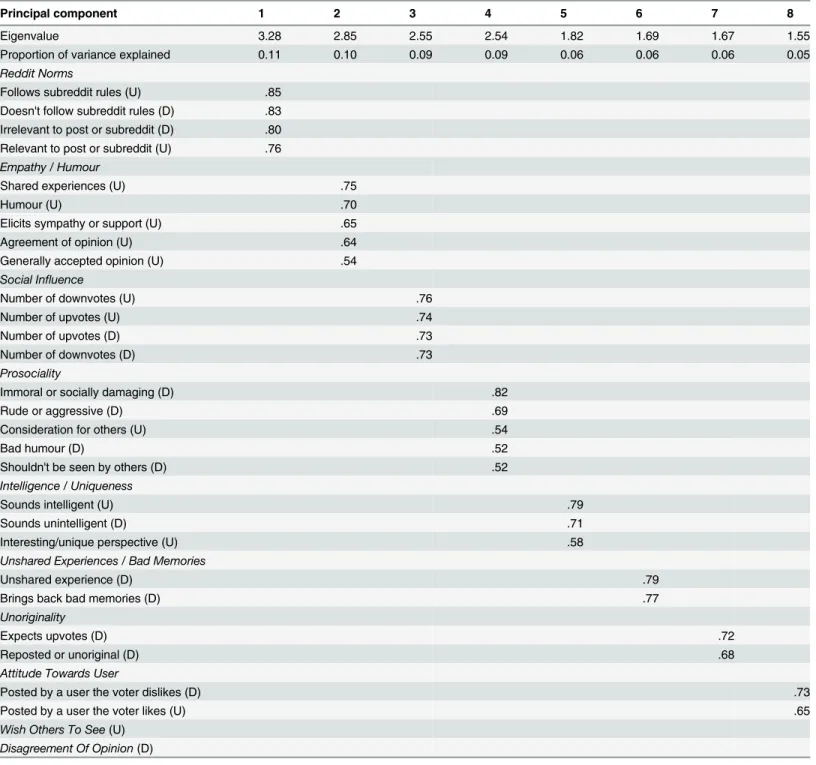
The full list of 29 content characteristics selected for inclusion in the survey can be seen in the left-hand column ofTable 1. These were all deemed appropriate for PCA analysis, since the Kaiser-Meyer-Olkin measure of sampling adequacy was 0.8 and Bartlett’s test of sphericity was highly significant (p<0.001). Eight principal components were extracted and they explained
61.85% of the total variance, as shown inTable 1. We labelled these factorsReddit Norms
(whether content follows the rules of Reddit),Empathy / Humour(whether content elicits em-pathy, agreement or humour),Social Influence(the content’s existing number of up-votes or down-votes),Prosociality(whether content is considered socially damaging, rude or inconsid-erate),Intelligence / Uniqueness(whether the content sounds intelligent, interesting or unique),
content is posted by a liked or disliked user). Two variables remained unfactored,Disagreement
Of OpinionandWish Others To See(whether the voter thinks that the content should be
viewed by other users). After the calculation of mean importance scores for each factor (seeS1 Table), the factorUnshared Experiences / Bad Memorieswas dropped from further analyses Table 1. Principal Components Analysis for 29 importance score items.
Principal component 1 2 3 4 5 6 7 8
Eigenvalue 3.28 2.85 2.55 2.54 1.82 1.69 1.67 1.55
Proportion of variance explained 0.11 0.10 0.09 0.09 0.06 0.06 0.06 0.05
Reddit Norms
Follows subreddit rules (U) .85 Doesn't follow subreddit rules (D) .83 Irrelevant to post or subreddit (D) .80 Relevant to post or subreddit (U) .76
Empathy / Humour
Shared experiences (U) .75
Humour (U) .70
Elicits sympathy or support (U) .65
Agreement of opinion (U) .64
Generally accepted opinion (U) .54
Social Influence
Number of downvotes (U) .76
Number of upvotes (U) .74
Number of upvotes (D) .73
Number of downvotes (D) .73
Prosociality
Immoral or socially damaging (D) .82
Rude or aggressive (D) .69
Consideration for others (U) .54
Bad humour (D) .52
Shouldn't be seen by others (D) .52
Intelligence / Uniqueness
Sounds intelligent (U) .79
Sounds unintelligent (D) .71
Interesting/unique perspective (U) .58
Unshared Experiences / Bad Memories
Unshared experience (D) .79
Brings back bad memories (D) .77
Unoriginality
Expects upvotes (D) .72
Reposted or unoriginal (D) .68
Attitude Towards User
Posted by a user the voter dislikes (D) .73
Posted by a user the voter likes (U) .65
Wish Others To See(U)
Disagreement Of Opinion(D)
Variables relate to upvotes (U) and downvotes (D). Factor loadings between +/-0.5 omitted. Proposed names for each emergent factor are italicised.
Disagreement Of OpinionandWish Others To Seeremained as unfactored variables.
due to low importance.Fig 1shows the mean importance scores for the seven remaining fac-tors and the two unfactored variables.
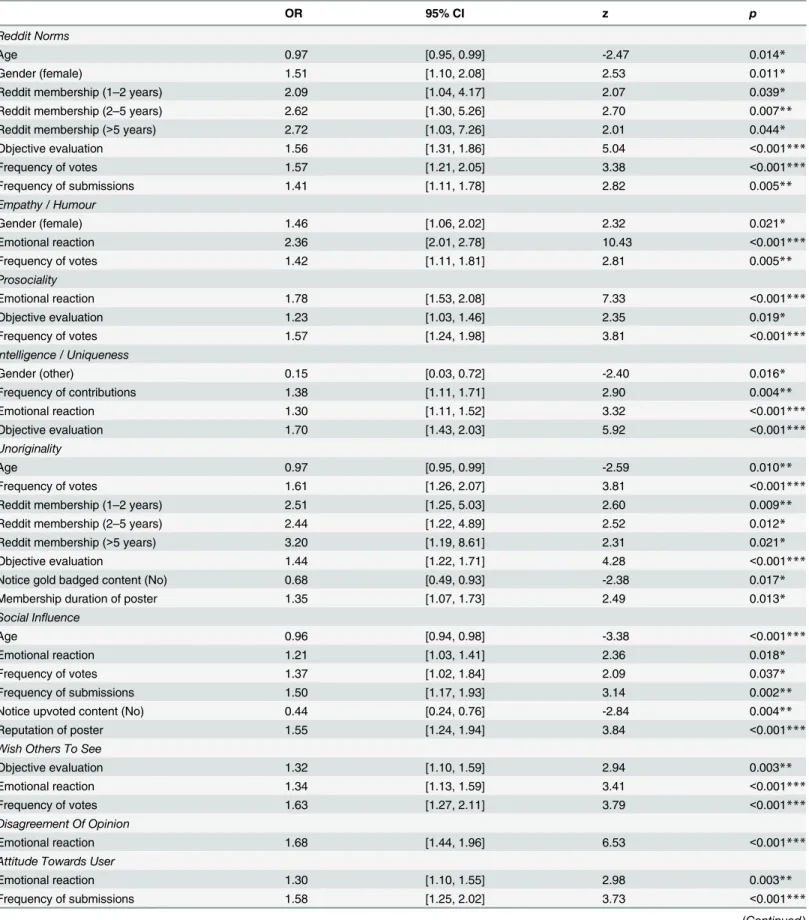
We then regressed factor scores on our individual difference variables, to better understand which kind of Reddit user valued each factor.Table 2shows significant predictors from the best-fitting regression model for each factor. We provide odds ratios (ORs) and their confi-dence intervals rather than beta coefficients as ORs are the most easily interpreted effect size measure from ordinal logistic regressions. ORs indicate the relative change in the odds of dif-ferent outcomes occurring per unit change in a predictor. An OR = 1 indicates no change, and thus no effect. An OR = 1.10 for, say, the age predictor indicates that for every one-unit in-crease in age (by one year), the odds of choosing one level of the Likert-scale outcome variable (e.g. 5 =“Very important”) is 1.10 times the odds of choosing any lower level (e.g. 1 =“Not im-portant”, 2, 3 or 4). Note that we cannot directly compare ORs for predictors in the same model that have different scales. For example, age is continuous ranging from 18–64, while gender has three categories, so a one-unit increase in age is different to a shift from male to fe-male or other.
The country variable was entered as a random effect in all models. However, none of these multi-level models showed significantly better fit compared to a model without country as a random effect. This indicates that country did not influence responses, most likely because the majority of our respondents were in Western countries (seeMethods). The models inTable 2 therefore do not contain country as a random effect.
Table 2shows thatReddit Normswas rated as more important by younger respondents, women, longer-term Reddit members, respondents who evaluated posts based on objective cri-teria, more frequent voters, and more frequent contributors.Empathy / Humourwas rated higher by women, by respondents who report evaluating posts based on emotional reaction, and more frequent voters.Prosocialitywas rated as more important by more frequent voters, and by respondents who use both objective evaluations and emotional reactions. Emotional re-action (OR = 1.78, 95% CI [1.53, 2.08]) had a larger effect than objective evaluation (OR = 1.23, 95% CI [1.03, 1.46]), with non-overlapping confidence intervals (note that these predictors are comparable because they were measured on the same scales).Intelligence / Uniquenesswas rated as more important by more frequent contributors and by respondents who use both ob-jective evaluation and emotional reaction. Respondents reporting their gender as“other” ap-pear to give lower importance compared to males, but this finding is unlikely to be reliable as the number of respondents who identified with this gender was very small (n = 5). Objective evaluation (OR = 1.70, 95% CI [1.43, 2.03]) had a larger effect than emotional reaction (OR = 1.30, 95% CI [1.11, 1.52]), although with slightly overlapping confidence intervals.
Unoriginalitywas rated more important by younger respondents, longer-term Reddit
mem-bers, more frequent voters, by respondents who use objective evaluation, by respondents who took notice of gold-badged content, and by respondents who use the membership duration of the poster.Social Influencewas rated more important by younger respondents, respondents who use emotional reaction, more frequent voters and posters, respondents who notice upvoted content, and respondents who use the reputation of the poster.Wish Others To See
Following the discovery of a significant relationship between age andSocial Influence, addi-tional tests were used to see if there were significant age differences in other questions associat-ed with this variable. Mann-Whitney U tests showassociat-ed that people who answerassociat-ed“yes”to“Do you take more notice of highly upvoted content?”were significantly younger (mean
rank = 239.08) than those who answered“no”(mean rank = 288.11; z = -2.51, p<.05).
Simi-larly, people who answered“yes”to“Do you take more notice of content accompanied by Gold badges?”were significantly younger (mean rank = 223.63) than those who answered“no”
(mean rank = 266.64; z = -3.37, p<.05). For other possible markers of social influence,
Spear-man's Rank Order correlations showed that correlations between age and the perceived influ-ence of the poster’s reputation (rs= -.071, p>.05) and the poster’s membership duration (rs=
-.011, p>.05) were non-significant.
Descriptive analyses showed that content creators’reputation and Reddit membership dura-tion did not have a big perceived influence on the participants’voting decisions, eliciting mean influence scores of 1.42 (s.d. = 0.78) and 1.25 (s.d. = 0.65) respectively on a 5 point Likert scale.
Discussion
The aim of this study was to explore the self-reported motivations of frequent content voters on the popular aggregator website Reddit. We were particularly interested in whether these motivations might reflect features of human cognition and learning that have evolved in the offline world to process social information in an adaptive manner, as predicted by the formal models and experiments of cultural evolutionary theory.
An initial qualitative review of subreddit discussions in which Redditors themselves pro-posed reasons for up- and down-voting content yielded 29 potential motivations. These were then used in a quantitative survey of 489 active Redditors to assess their importance in a much larger sample, and identify individual differences between Redditors in their ratings of each. Principal Components Analysis revealed eight clusters of reasons. In descending order of per-ceived importance, these wereWish Others To See,Intelligence / Uniqueness,Reddit Norms,
Prosociality,Unoriginality,Empathy / Humour,Disagreement Of Opinion,Social Influenceand
Attitude Towards User. The factorUnshared Experiences / Bad Memorieswas dropped due to
low importance.
Some of these factors clearly map onto the predicted motivations for information sharing identified in the Introduction based on evolutionary principles. The factorSocial Influencewas Fig 1. Mean importance of emergent influences on voting.Values are mean Likert responses on a scale of 1–5. Error bars indicate standard error.
Table 2. Factor scores regressed on individual difference variables.
OR 95% CI z p
Reddit Norms
Age 0.97 [0.95, 0.99] -2.47 0.014*
Gender (female) 1.51 [1.10, 2.08] 2.53 0.011*
Reddit membership (1–2 years) 2.09 [1.04, 4.17] 2.07 0.039*
Reddit membership (2–5 years) 2.62 [1.30, 5.26] 2.70 0.007**
Reddit membership (>5 years) 2.72 [1.03, 7.26] 2.01 0.044*
Objective evaluation 1.56 [1.31, 1.86] 5.04 <0.001***
Frequency of votes 1.57 [1.21, 2.05] 3.38 <0.001***
Frequency of submissions 1.41 [1.11, 1.78] 2.82 0.005**
Empathy / Humour
Gender (female) 1.46 [1.06, 2.02] 2.32 0.021*
Emotional reaction 2.36 [2.01, 2.78] 10.43 <0.001***
Frequency of votes 1.42 [1.11, 1.81] 2.81 0.005**
Prosociality
Emotional reaction 1.78 [1.53, 2.08] 7.33 <0.001***
Objective evaluation 1.23 [1.03, 1.46] 2.35 0.019*
Frequency of votes 1.57 [1.24, 1.98] 3.81 <0.001***
Intelligence / Uniqueness
Gender (other) 0.15 [0.03, 0.72] -2.40 0.016*
Frequency of contributions 1.38 [1.11, 1.71] 2.90 0.004**
Emotional reaction 1.30 [1.11, 1.52] 3.32 <0.001***
Objective evaluation 1.70 [1.43, 2.03] 5.92 <0.001***
Unoriginality
Age 0.97 [0.95, 0.99] -2.59 0.010**
Frequency of votes 1.61 [1.26, 2.07] 3.81 <0.001***
Reddit membership (1–2 years) 2.51 [1.25, 5.03] 2.60 0.009**
Reddit membership (2–5 years) 2.44 [1.22, 4.89] 2.52 0.012*
Reddit membership (>5 years) 3.20 [1.19, 8.61] 2.31 0.021*
Objective evaluation 1.44 [1.22, 1.71] 4.28 <0.001***
Notice gold badged content (No) 0.68 [0.49, 0.93] -2.38 0.017*
Membership duration of poster 1.35 [1.07, 1.73] 2.49 0.013*
Social Influence
Age 0.96 [0.94, 0.98] -3.38 <0.001***
Emotional reaction 1.21 [1.03, 1.41] 2.36 0.018*
Frequency of votes 1.37 [1.02, 1.84] 2.09 0.037*
Frequency of submissions 1.50 [1.17, 1.93] 3.14 0.002**
Notice upvoted content (No) 0.44 [0.24, 0.76] -2.84 0.004**
Reputation of poster 1.55 [1.24, 1.94] 3.84 <0.001***
Wish Others To See
Objective evaluation 1.32 [1.10, 1.59] 2.94 0.003**
Emotional reaction 1.34 [1.13, 1.59] 3.41 <0.001***
Frequency of votes 1.63 [1.27, 2.11] 3.79 <0.001***
Disagreement Of Opinion
Emotional reaction 1.68 [1.44, 1.96] 6.53 <0.001***
Attitude Towards User
Emotional reaction 1.30 [1.10, 1.55] 2.98 0.003**
Frequency of submissions 1.58 [1.25, 2.02] 3.73 <0.001***
predicted (Prediction 1) based both on theoretical analyses of the costs and benefits of social in-formation use [15–17] and previous experiments showing social influence in online voting de-cisions [22]. However,Social Influencewas here reported to be relatively unimportant
compared to other factors (seeFig 1), with a mean importance score of just 1.66 (sd = 0.76) on a scale of 1–5. Previous randomized experiments [22] have shown that artificially introducing positive up-votes increased the chance of subsequent positive ratings by 32%, a not insubstan-tial effect. This mismatch may be because Redditors, like people in general [49], are unaware of the power of social influence over their behaviour. This combination of strong effect yet lack of awareness in those affected raises ethical questions over the power that social media websites, advertisers and other organisations may have over our online behaviour. We also found that younger respondents attributed a greater importance toSocial Influence, a finding that was fur-ther supported by results showing that younger respondents were significantly more likely to report taking notice of highly up-voted content and Gold badges. It may be that younger people are simply more aware of the effect of social influence. Alternatively, younger people may gen-uinely be more susceptible to social influence, a possibility that deserves further study. As would be expected, and confirming the validity of our measures, respondents who attributed a greater importance toSocial Influencealso reported taking more notice of up-voted content and the reputation of the poster.
The following of group norms (Prediction 4) was reflected in the factorReddit Norms, which concerned whether the submission obeyed the rules of, and is relevant to, the particular subreddit. Obviously human cognition has not biologically evolved to follow the rules of sub-reddits specifically, but evidence suggests that wehaveevolved to readily absorb and follow whatever local social norms we encounter [40–43]. Our findings reinforce this notion.Reddit
Normswas rated of high importance (mean = 3.71, sd = 1.11; seeFig 1). Interestingly, norm
compliance was rated as more important by younger respondents, longer-serving Redditors, and more frequent voters and posters. The effect of age is similar to that forSocial Influence, with younger respondents more likely to acquire group norms via social learning. The other predictors may reflect an experience-dependent socialisation period, with more experienced Redditors having become more familiar with the norms of the Reddit community and thus more likely to have observed them in operation and being enforced.Reddit Normswas also rated as more important by female respondents, an unanticipated sex difference that deserves further investigation.
As predicted, norms specifically related to prosociality (Prediction 5) were rated as impor-tant by our respondents in the form of theProsocialityfactor. Respondents were willing to up-vote (reward) submissions that reflect prosocial attitudes, and down-up-vote (punish) submissions that reflect abuse or aggression. Interestingly, the biggest individual difference variable that predictedProsocialitywas whether the respondent used emotional responses as a guide to Table 2. (Continued)
OR 95% CI z p
Reputation of poster 2.60 [2.07, 3.30] 8.03 <0.001***
Membership duration of poster 1.49 [1.14, 1.95] 2.91 0.004**
Significance codes: p<0.001:‘***’,
p<0.01:‘**’,
p<0.05:‘*’.
OR = Odds Ratios, CI = Confidence Intervals
voting. This fits with recent studies showing that people are more cooperative when they use intuitive emotional processing rather than lengthy reflection and deliberation [45,56], and sug-gests that deep-seated evolved motivations for prosociality may shape online interactions.
Our second prediction (Prediction 2) concerned informational content, reflecting previous research suggesting that human cognition has evolved to bias information towards particularly salient representations, or‘cultural attractors’, via‘content biases’[6,16,25,26,30]. In our study this appears to be reflected in more than one factor:Wish Others To See,Intelligence /
Unique-ness,Unoriginality,Empathy / Humour, andDisagreement Of Opinioncan all be seen as relating
to the content of the submission. This suggests that there is no single criterion for informational content. The first factor,Wish Others To See(i.e. the up-voting of content that the respondent wants others to see), received the highest overall importance score (mean = 4.27, sd = 1.00), but is rather understandable given that this is the purpose of voting. This factor is not very theoreti-cally informative given that it does not specify why the respondent wants content to be viewed by others, and how they select such content.Intelligence / UniquenessandUnoriginalityare more specific, suggesting that respondents use the perceived quality of a post as a guide to vot-ing, e.g. whether it is intelligently coherent, or whether it is unique or original such that it will be novel to other Redditors. This reflects previous content analyses of up-voted reviews [33]. An important individual difference variable for both of these factors was whether the respondent uses objective criteria to guide their voting, which makes sense given that intelligence and origi-nality can be objectively assessed.
Empathy / Humouralso relates to the informational content of submissions, with
respon-dents reporting being likely to up-vote content that refers to shared experiences, that elicits sympathy or support, that contains humour, or that the respondent agrees with (Table 1). Pre-vious studies have shown that people are likely to remember and share emotionally salient in-formation [31,32,57]. Individuals who report voting based on their emotional reaction to content giveEmpathy / Humourespecially high importance. Female respondents also rated this factor as more important than male respondents, in line with previous behavioural and neurobiological findings that women show superior empathy than men [58] and women more than men find the production of humour attractive [59].
As part of Prediction 2 we expected that respondents should up-vote content that fits with their pre-existing attitudes and beliefs, and down-vote content they disagree with. In the study, however, agreement and disagreement did not cluster together:Disagreement Of Opinion fac-tored on its own and was rated as relatively unimportant (mean = 2.69, sd = 1.23), while Agree-mentwas grouped withEmpathy / Humour. This may be a result of our self-report
methodology, with respondents unwilling to admit to partisan voting based on their prior be-liefs. However, it may be a genuine result driven by the community values that redditors are en-couraged to adhere to, where down-voting based on personal opinion is particularly frowned upon.
It is important to acknowledge the limitations of our study. First, the reliance on self-report measures may not be representative of the true motivations behind voting behaviour, as we note above in relation to social influence. Second, the recruitment of respondents through tar-geted subreddits means that the sample may not be representative of the general user base of Reddit, or internet users in general. Third, the requirement to fill out a lengthy survey may have biased towards the recruitment of individuals with especially prosocial tendencies, which may have biased the results concerning prosociality in particular. For these reasons our find-ings should be treated with scepticism until they can be replicated with broader samples and more focused methods to address the emergent themes with greater precision.
In conclusion, this exploratory empirical study demonstrates that Redditors’patterns of content voting can offer unique avenues of research into people’s interactions with information and its providers, and suggests a novel arena for testing evolutionary theories of social informa-tion use. Whereas expressions of fondness, agreement, aversions or punishments can be subjec-tive in traditional settings, online votes provide clearly delineated forms of action that are well suited to empirical investigation.
Supporting Information
S1 Dataset. Survey data.The full data from the survey as a tab-delimited txt file. (TXT)
S1 File. Full survey.The full survey distributed to participants. (PDF)
S1 Table. Mean importance scores and standard deviations for voting influences. (DOC)
Acknowledgments
We are grateful to the Redditors who took part in the study for their valuable contributions, to Nils Klowait for useful discussions relating to Reddit, and to Luke Matthews and an anony-mous reviewer for valuable comments on a previous version of the manuscript.
Author Contributions
Conceived and designed the experiments: MP AM. Performed the experiments: MP. Analyzed the data: MP AM. Contributed reagents/materials/analysis tools: MP. Wrote the paper: MP AM.
References
1. Gilbert E (2013) Widespread underprovision on Reddit. Proceedings of the 2013 Conference on Com-puter Supported Cooperative Work. CSCW‘13. New York, NY, USA: ACM. pp. 803–808. Available:
http://doi.acm.org/10.1145/2441776.2441866.
2. Jessen J, Jørgensen AH (2012) Aggregated trustworthiness: Redefining online credibility through so-cial validation. First Monday 17. Available:http://firstmonday.org/ojs/index.php/fm/article/viewArticle/ 3731.
3. Alexa (n.d.). Available:http://www.alexa.com/siteinfo/reddit.com.
4. Reddit (n.d.). Available:http://www.reddit.com/about/.
5. Mesoudi A (2011) Cultural evolution. Chicago, IL: University of Chicago Press.
6. Richerson PJ, Boyd R (2005) Not by genes alone. Chicago: University of Chicago Press.
7. Richerson PJ, Christiansen MH (2013) Cultural evolution: Society, technology, language, and religion. Cambridge MA: MIT Press.
9. Cavalli-Sforza LL, Feldman MW (1981) Cultural transmission and evolution. Princeton: Princeton Univ. Press.
10. Whiten A, Hinde RA, Laland KN, Stringer CB (2012) Culture evolves. Oxford, UK: Oxford University Press.
11. Henrich J, McElreath R (2003) The evolution of cultural evolution. Evol Anthropol 12: 123–135. doi:10. 1002/evan.10110
12. Laland KN (2004) Social learning strategies. Anim Learn Behav 32: 4–14. doi:10.3758/BF03196002 13. Rendell L, Fogarty L, Hoppitt WJE, Morgan TJH, Webster MM, Laland KN (2011) Cognitive culture:
the-oretical and empirical insights into social learning strategies. Trends Cogn Sci 15: 68–76. doi:10.1016/ j.tics.2010.12.002PMID:21215677
14. Mesoudi A (2009) How cultural evolutionary theory can inform social psychology and vice versa. Psy-chol Rev 116: 929–952. doi:10.1037/a0017062PMID:19839691
15. Aoki K, Feldman MW (2013) Evolution of learning strategies in temporally and spatially variable envi-ronments: A review of theory. Theor Popul Biol 90: 64–81. doi:10.1016/j.tpb.2013.09.002
16. Boyd R, Richerson PJ (1985) Culture and the evolutionary process. Chicago, IL: University of Chicago Press.
17. Boyd R, Richerson PJ (1995) Why does culture increase human adaptability? Ethol Sociobiol 16: 125–
143. doi:10.1016/0162-3095(94)00073-G
18. Mesoudi A, O’Brien MJ (2008) The cultural transmission of Great Basin projectile point technology I: An experimental simulation. Am Antiq 73: 3–28. doi:10.2307/25470456
19. Morgan TJH, Rendell LE, Ehn M, Hoppitt W, Laland KN (2011) The evolutionary basis of human social learning. Proc R Soc B Biol Sci 279: 653–662. doi:10.1098/rspb.2011.1172
20. Bandura A (1977) Social learning theory. Oxford: Prentice-Hall.
21. Giraldeau L-A, Valone TJ, Templeton JJ (2002) Potential disadvantages of using socially acquired in-formation. Philos Trans R Soc Lond B Biol Sci 357: 1559–1566. doi:10.1098/rstb.2002.1065PMID:
12495513
22. Muchnik L, Aral S, Taylor SJ (2013) Social influence bias: a randomized experiment. Science 341: 647–651. doi:10.1126/science.1240466PMID:23929980
23. Salganik M, Dodds P, Watts D (2006) Experimental study of inequality and unpredictability in an artifi-cial cultural market. Science 311: 854–856. PMID:16469928
24. Salganik MJ, Watts DJ (2009) Web-based experiments for the study of collective social dynamics in cultural markets. Top Cogn Sci 1: 439–468. doi:10.1111/j.1756-8765.2009.01030.xPMID:25164996 25. Sperber D (1996) Explaining culture: a naturalistic approach. Oxford: Oxford University Press.
26. Sperber D, Wilson D (1985) Relevance: Communication and cognition. Oxford: Blackwell.
27. Mesoudi A, Whiten A, Dunbar R (2006) A bias for social information in human cultural transmission. Br J Psychol 97: 405–423. doi:10.1348/000712605X85871PMID:16848951
28. Stubbersfield JM, Tehrani JJ, Flynn EG (2014) Serial killers, spiders and cybersex: Social and survival information bias in the transmission of urban legends. Br J Psychol: n/a—n/a. doi:10.1111/bjop.12073 29. Norenzayan A, Atran S, Faulkner J, Schaller M (2006) Memory and mystery: the cultural selection of
minimally counterintuitive narratives. Cogn Sci 30: 531–553. doi:10.1207/s15516709cog0000_68
PMID:21702824
30. Sperber D, Hirschfeld LA (2004) The cognitive foundations of cultural stability and diversity. Trends Cogn Sci 8: 40–46. doi:10.1016/j.tics.2003.11.002PMID:14697402
31. Heath C, Bell C, Sternberg E (2001) Emotional selection in memes: The case of urban legends. J Pers Soc Psychol 81: 1028–1041. doi:10.1037/0022-3514.81.6.1028PMID:11761305
32. Eriksson K, Coultas JC (2014) Corpses, maggots, poodles and rats: emotional selection operating in three phases of cultural transmission of urban legends. J Cogn Cult 14: 1–26. doi: 10.1163/15685373-12342107
33. Cao Q, Duan W, Gan Q (2011) Exploring determinants of voting for the“helpfulness”of online user re-views: A text mining approach. Decis Support Syst 50: 511–521. doi:10.1016/j.dss.2010.11.009 34. Allport GW, Postman L (1947) The psychology of rumor. Oxford: Henry Holt.
36. Mesoudi A (2011) An experimental comparison of human social learning strategies: payoff-biased so-cial learning is adaptive but underused. Evol Hum Behav 32: 334–342. doi:10.1016/j.evolhumbehav. 2010.12.001
37. McElreath R, Bell AV, Efferson C, Lubell M, Richerson PJ, Waring T (2008) Beyond existence and aim-ing outside the laboratory: estimataim-ing frequency-dependent and pay-off-biased social learnaim-ing strate-gies. Philos Trans R Soc B Biol Sci 363: 3515–3528. doi:10.1098/rstb.2008.0131PMID:18799416 38. Chudek M, Heller S, Birch S, Henrich J (2012) Prestige-biased cultural learning: bystander’s differential
attention to potential models influences children’s learning. Evol Hum Behav 33: 46–56. doi:10.1016/j. evolhumbehav.2011.05.005
39. Atkisson C, O’Brien MJ, Mesoudi A (2011) Adult learners in a novel environment use prestige-biased social learning. Evol Psychol 10: 519–537.
40. Chudek M, Henrich J (2011) Culture—gene coevolution, norm-psychology and the emergence of human prosociality. Trends Cogn Sci 15: 218–226. doi:10.1016/j.tics.2011.03.003PMID:21482176 41. Cialdini RB, Goldstein NJ (2004) Social influence: compliance and conformity. Annu Rev Psychol 55:
591–621. doi:10.1146/annurev.psych.55.090902.142015PMID:14744228
42. Sripada CS, Stich S (2006) A framework for the psychology of norms. In: Carruthers P, Laurence S, Stich S, editors. The innate mind: Culture and cognition. Oxford: Oxford University Press. pp. 280–301.
43. Rakoczy H, Warneken F, Tomasello M (2008) The sources of normativity: Young children’s awareness of the normative structure of games. Dev Psychol 44: 875–881. doi:10.1037/0012-1649.44.3.875
PMID:18473651
44. Boyd R, Richerson PJ (1992) Punishment allows the evolution of cooperation (or anything else) in siz-able groups. Ethol Sociobiol 13: 171–195. doi:10.1016/0162-3095(92)90032-Y
45. Fehr E, Gächter S (2002) Altruistic punishment in humans. Nature 415: 137–140. doi:10.1038/ 415137aPMID:11805825
46. Henrich J, Boyd R, Bowles S, Camerer C, Fehr E, Gintis H, et al. (2005)“Economic man”in cross-cul-tural perspective: Behavioral experiments in 15 small-scale societies. Behav Brain Sci 28: 795–815. doi:10.1017/S0140525X05000142PMID:16372952
47. Gächter S, Herrmann B, Thöni C (2010) Culture and cooperation. Philos Trans R Soc B Biol Sci 365: 2651–2661. doi:10.1098/rstb.2010.0135PMID:20679109
48. West SA, El Mouden C, Gardner A (2011) Sixteen common misconceptions about the evolution of co-operation in humans. Evol Hum Behav 32: 231–262. doi:10.1016/j.evolhumbehav.2010.08.001 49. Nisbett RE, Wilson TD (1977) Telling more than we can know: Verbal reports on mental processes.
Psychol Rev 84: 231–259. doi:10.1037/0033-295X.84.3.231
50. Saldana J (2012) The coding manual for qualitative researchers. 2nd ed. London, UK: SAGE.
51. R Core Team (2014) R: A language and environment for statistical computing. Vienna, Austria: R Foundation for Statistical Computing. Available:www.R-project.org. doi:10.1016/j.jneumeth.2014.06. 019PMID:24970579
52. Revelle W (2014) Psych: Procedures for personality and psychological research. R. Northwestern Uni-versity, Evanston, Illinois, USA. Available:http://CRAN.R-project.org/package = psychVersion=1.4.8.
53. DiStefano C, Zhu M, MîndrilăD (2009) Understanding and using factor scores: Considerations for the
applied researcher. Pract Assess Res Eval 14 Available:http://pareonline.net/getvn.asp?v=14&n=20.
54. Christensen RHB (2014) Ordinal: Regression models for ordinal data R package version 2014.11–14. Available:http://www.cran.r-project.org/package = ordinal/.
55. Mundry R, Nunn CL (2009) Stepwise model fitting and statistical inference: Turning noise into signal pollution. Am Nat 173: 119–123. doi:10.1086/593303PMID:19049440
56. Rand DG, Greene JD, Nowak MA (2012) Spontaneous giving and calculated greed. Nature 489: 427–430. doi:10.1038/nature11467PMID:22996558
57. Berger J, Milkman KL (2012) What makes online content viral? J Mark Res 49: 192–205. doi:10.1509/ jmr.10.0353
58. Schulte-Rüther M, Markowitsch HJ, Shah NJ, Fink GR, Piefke M (2008) Gender differences in brain networks supporting empathy. NeuroImage 42: 393–403. doi:10.1016/j.neuroimage.2008.04.180
PMID:18514546