Transcripts and MicroRNAs Responding to
Salt Stress in
Musa acuminata
Colla (AAA
Group) cv. Berangan Roots
Wan Sin Lee1,2, Ranganath Gudimella1,2, Gwo Rong Wong1,2, Martti Tapani Tammi2,3, Norzulaani Khalid1,2, Jennifer Ann Harikrishna1,2*
1Institute of Biological Sciences, Faculty of Science, University of Malaya, Kuala Lumpur, Malaysia, 2Centre for Research in Biotechnology for Agriculture, University of Malaya, Kuala Lumpur, Malaysia, 3Bioinformatics, Sime Darby Technology Centre Sdn Bhd, Serdang, Selangor, Malaysia
Abstract
Physiological responses to stress are controlled by expression of a large number of genes, many of which are regulated by microRNAs. Since most banana cultivars are salt-sensitive, improved understanding of genetic regulation of salt induced stress responses in banana can support future crop management and improvement in the face of increasing soil salinity related to irrigation and climate change. In this study we focused on determining miRNA and their targets that respond to NaCl exposure and used transcriptome sequencing of RNA and small RNA from control and NaCl-treated banana roots to assemble a cultivar-specific reference transcriptome and identify orthologous andMusa-specific miRNA re-sponding to salinity. We observed that, banana roots responded to salinity stress with changes in expression for a large number of genes (9.5% of 31,390 expressed unigenes) and reduction in levels of many miRNA, including several novel miRNA and banana-specific miRNA-target pairs. Banana roots expressed a unique set of orthologous andMusa-specific miRNAs of which 59 respond to salt stress in a dose-dependent manner. Gene expression patterns of miRNA compared with those of their predicted mRNA targets indicated that a majority of the differentially expressed miRNAs were down-regulated in response to in-creased salinity, allowing inin-creased expression of targets involved in diverse biological pro-cesses including stress signaling, stress defence, transport, cellular homeostasis,
metabolism and other stress-related functions. This study may contribute to the understand-ing of gene regulation and abiotic stress response of roots and the high-throughput se-quencing data sets generated may serve as important resources related to salt tolerance traits for functional genomic studies and genetic improvement in banana.
Introduction
Crops worldwide are threatened by increased soil salinity due to accumulation of salt delivered along with irrigation water and by coastal flooding and the high evapotranspiration rates
OPEN ACCESS
Citation:Lee WS, Gudimella R, Wong GR, Tammi MT, Khalid N, Harikrishna JA (2015) Transcripts and MicroRNAs Responding to Salt Stress inMusa acuminataColla (AAA Group) cv. Berangan Roots. PLoS ONE 10(5): e0127526. doi:10.1371/journal. pone.0127526
Academic Editor:Shao Jun Dai, Northeast Forestry University, CHINA
Received:September 12, 2014
Accepted:April 15, 2015
Published:May 20, 2015
Copyright:© 2015 Lee et al. This is an open access article distributed under the terms of theCreative Commons Attribution License, which permits unrestricted use, distribution, and reproduction in any medium, provided the original author and source are credited.
Data Availability Statement:The sequenced reads of sRNA and the short reads of RNA-seq (mRNA) have been deposited in NCBI’s Sequence Read Archive (SRA) database with the following accession numbers: SRX535343 for control sRNA, SRX535344 for 100 mM NaCl treatment sRNA, SRX535345 for 300 mM NaCl treatment sRNA, SRX535340 for control mRNA and SRX535341 for300 mM NaCl treatment mRNA.
01-99-06-caused by climate change. Soil salinity has been predicted to increase to about 30% of the world’s arable land by 2025 and 50% by the year 2050 [1] and currently over 11% of irrigated areas of arable land have been salinized by irrigation [2]. One promising approach to address the problem of soil salinity is to increase our understanding of response of plants to salinity-re-lated stress. Yield of cultivated banana (the world’s most important fruit crop) has been found to be reduced by about 50% [3] and plant height was reduced by about 75% [4] under salt stress. Since banana is sensitive to salt stress, it represents a model for investigating the genetic sources of salt sensitivity.
Plant stress response mechanisms have been broadly categorised into stress avoidance, and stress tolerance, the latter being used when stress is severe [5]. Increased levels of salinity stress affect plants by a combination of acute osmotic stress, followed by Na+and Cl-ion toxicity [6]. A common avoidance response to high salinity is a change in root growth, or negative halo-tropism [7] with the response varying in response to the gradient, timing and duration of stress (reviewed in [5,6]). Although several stress response genes and pathways are starting to be un-derstood, including signal transduction, activation of ion channels and growth factor regulated modification of plant architecture and in particular, root morphology, the complexity and in-teraction of the pathways, and differences between plants, leave much to be learned about the genetic regulation of plant responses and for the development and selection of salinity stress tolerant crops.
MicroRNAs (miRNA) regulate diverse life processes in plants, largely through the negative regulation of transcription factors, and have important roles in growth, development, physiolo-gy, stress responses and RNA interference pathways including miRNA and siRNA biogenesis (reviewed in [8]). A number of miRNA families have been shown to modulate various abiotic stress responses in plants, including responses to salinity (reviewed in [9]). Patterns of miRNA expression in various plant tissues and under various salinity conditions are being revealed through high-throughput based studies, for example inZea maysroot [10],Arabidopsis thali-anaseedlings [11],Populus euphraticashoots [12],Saccharum sp. leaves [13],Triticum aesti-vumL. seedling leaves [14],Brassica juncea(Czern) L. seedlings [15], switchgrass seedlings [16] andGossypium hirsutumL. leaves and roots [17]. However, relatively few studies have fo-cused specifically on roots, despite this being the main tissue exposed and reacting to salinity.
In this study we used a deep sequencing approach to investigate the expression and role of miRNA in banana roots in order to identify orthologous and new miRNAs related to response to salinity. We also predict targets of the differentially expressed miRNAs which may have roles in the response of banana roots to salinity stress.
Results
Transcriptome
De novoassembly of transcriptomes and mapping of assembled sequences to theMusa acuminatareference genome (A-genome). Over 12.2 million and 11.2 million, 90-bp
paired-end reads were generated from non-stressed control and 300 mM NaCl treated roots, respectively (Table A inS1 File). These paired-end sequences in FASTQ format were deposited in Short Read Archive (SRA) of National Centre for Biotechnology Information (NCBI) and are available under BioProject accession PRJNA246442. All together these reads accounted for 2.1 Gb of transcriptomic sequence data. Both transcriptomes contained more than 92% of high quality reads and more than 93% of high quality bases (Phred score Q>20) (Table A inS1
File). The 11,352,903 and 10,504,837 high quality reads (Table A inS1 File) from each data set were assembled into 69,441 and 74,525 contigs representing 49,576 and 56,572 unigenes from the control and NaCl-treated roots, respectively and were used to form a set of non-redundant 0101EA001 (JAH), FRGS-FP005/2011A (JAH, NK),
RG006-09BIO (JAH, NK), PS126/2008A (WSL), SLAI fellowship (WSL) and PV109/2011A (RG) through the University of Malaya. The funders had no role in study design, data collection and analysis, decision to publish, or preparation of the manuscript. Co-author MTT is employed by Sime Darby Technology Centre Sdn Bhd. Sime Darby Technology Centre Sdn Bhd provided support in the form of salary for author MTT, but did not have any additional role in the study design, data collection and analysis, decision to publish, or preparation of the manuscript. The specific role of this author is articulated in the‘author contributions’section.
representative transcripts containing 31,390 unigenes with a mean length of 517-nt and an N50 of 669-nt (Table B inS1 File). The mean coverage per base (CPB) per unigene of the as-sembled transcriptomes is 45.33X in CTR and 38.57X in TR300 (Table C inS1 File). More than 80% of the contigs assembled in CTR and TR300 were sized 100–400 nt (Figure A inS1 File). The assembled sequences showed increased length after assembly and clustering into uni-genes (Figure A inS1 File). More than 80% of the assembled scaffolds and unigenes are of high quality with zero ambiguous nucleotides (Figure B inS1 File). Over 99.5% of ourde novo as-sembled unigenes can be mapped to theMusagenome [18] (Fig 1and Table D inS1 File).
Fig 1. Distribution of expressed transcripts on a referenceMusaGenome [18].Black (outer ring): chromosomes of the referenceMusaA-genome, scale in Mb; orange:de novoassembled unigenes; green: orthologous microRNAs; maroon:Musa-specific microRNAs.
These unigenes were distributed along the 11 chromosomes and unrandom sequences of the
Musareference genome. The number of unigenes that could be mapped to each chromosome ranged from 2,000 to 3,200, or 6 to 10% of the unigenes (Table D inS1 File).
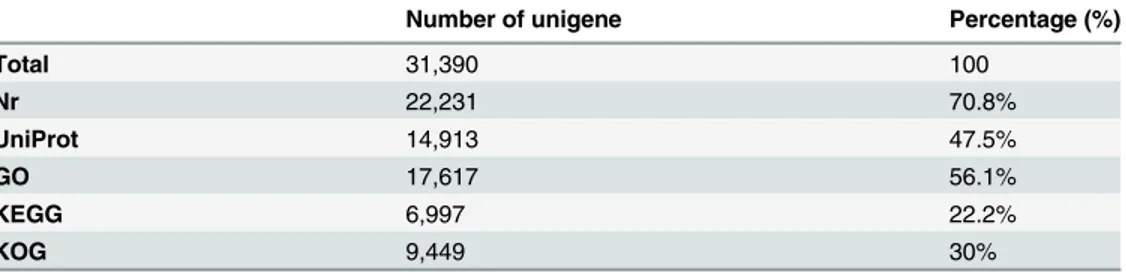
Functional assignment of the banana transcriptomic sequences. Of the 31,390 clustered unigenes, 70.8% (22,231) found matches in the GenBank non-redundant protein database (Nr) and 47.5% (14,913) in the UniProt (Table 1). A majority of the BLAST hits areOryza sativa
protein sequences in the Nr database, followed byVitis vinifera,Glycine max,Populus tricho-carpa,Arabidopsis thalianaandZea mays(Figure C inS1 File). About 56% or 17,617 of the as-sembled unigenes were assigned to at least one Gene Ontology (GO) term, 30% or 9,449 to 25 categories in Eukaryotic Orthologous Groups of Proteins (KOG), and 22.2% or 6,997 to 136 pathways in Kyoto Encyclopedia of Genes and Genomes (KEGG) (Table 1).
Transcripts quantification and differential expression in salt-stressed banana roots.
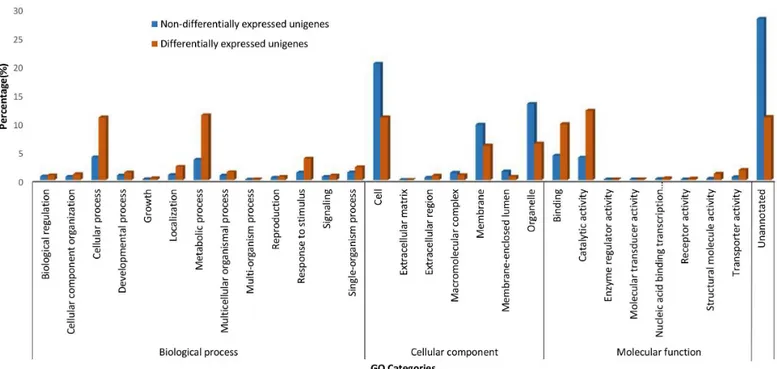
After being normalized to Transcript Per Million (TPM), 9.5% or 2,993 of thede novoassembled unigenes were observed to be differently expressed in salt-stressed banana root with absolute log2(CTR/TR300) equal to or higher than 1 and False Discovery Rate<0.05 (Fig 2). More tran-scripts (unigenes) were up-regulated (57.5% or 1,720) than down-regulated (42.5% or 1,273) in banana roots upon 300 mM NaCl treatment (Fig 2). Among these unigenes, the largest propor-tion was assigned to the catalytic activity (molecular funcpropor-tion) and metabolic process (biological process) enriched Gene Ontology terms (Fig 2). A majority of the differentially-expressed uni-genes in the salt-stressed banana roots were assigned to carbohydrate transport and metabolism, general function prediction, and post-translational modifications, protein turnover, chaperones of the Eukaryotic Orthologous Groups of Proteins (KOG) (Figure D inS1 File). In KEGG path-ways assignment, the differentially expressed unigenes were predominantly classified in the starch and sucrose metabolism pathways, followed by phenylalanine metabolism, cysteine and methionine metabolism, and phenylpropanoid biosynthesis pathways (Figure E inS1 File).
microRNA
Overview of the small RNA libraries. Deep sequencing of small RNA libraries con-structed from banana roots treated with low salinity (100 mM NaCl), TR100, high salinity (300 mM NaCl), TR300 and untreated control, CTR using an Illumina GAxII sequencing platform generated more than 18 million tags in each library. About 14.8, 13.8 and 14.5 million high quality clean reads ranging from 17–30 nt were produced respectively from TR100, TR300 and CTR and used for small RNA (miRNA) annotation (Table E inS1 File). The Illumina small RNA sequence reads described in this study are available under NCBI’s BioProject accession PRJNA246442. About 1.91 (CTR), 1.75 (TR100) and 0.91 (TR300) million non-redundant
Table 1. Functional annotation of banana root transcriptome (all unigenes).
Number of unigene Percentage (%)
Total 31,390 100
Nr 22,231 70.8%
UniProt 14,913 47.5%
GO 17,617 56.1%
KEGG 6,997 22.2%
KOG 9,449 30%
Nr: GenBank non-redundant protein database; GO: Gene Ontology; KEGG: Kyoto Encyclopaedia of Genes and Genomes; KOG: Eukaryotic Orthologous Groups of Protein.
sequence reads (~53% to 60% of the non-redundant reads), could be mapped to the reference
Musagenome [18] (Table E inS1 File). The 21-nt sequence reads were dominant in all the three libraries, with 20-nt or 24-nt reads the next most abundant. Unlike CTR and TR100, TR300 had a higher percentage of 20-nt sRNA than 24-nt (Figure F inS1 File). Rfam and Plant MicroRNA Database (PMRD) annotation of the small RNA sequences (Figure G inS1 File) showed that the vast majority (>88%) of the sequence reads in the banana root sRNA libraries are sequences with no known function. Among the reads annotated with an identity, miRNA sequences were the most abundant forming 6–10% of the sRNA libraries (Figure G inS1 File). The second most abundant small RNA with an identity was rRNA, forming 1–2% in each li-brary while each of the other known small RNAs (tRNA, snRNA and snoRNA) formed less than 1% of the sRNA libraries (Figure G inS1 File).
Annotation of miRNAs and their distribution in the A-genome. Matching our small RNA dataset to the Plant MicroRNA Database (PMRD-http://bioinformatics.cau.edu.cn/ PMRD/), we identified 153 (39 families), 149 (40 families) and 128 (35 families) orthologous miRNA sequences in CTR, TR100 and TR300 small RNA libraries respectively (Table F inS1 File). Using our RNA-Seq transcriptome data, we identified 110, 115 and 91 target RNA tran-scripts for the orthologous miRNAs present in CTR, TR100 and TR300 respectively (Table F in
S1 File). All together, 181 miRNAs from 47 miRNA families, and a non-redundant set of 247 related target transcripts were found in this study (Table F inS1 File). From the deeply se-quenced banana root sRNAomes in this study, we identified 56 putativeMusa-specific miR-NAs (non-redundant), which are not reported in species other thanMusaspecies to date, and 120 predicted target transcripts (Table G inS1 File). When mapped to the genome sequence, both the orthologous andMusa-specific miRNAs were distributed in all 11 chromosomes and the unrandom sequence of the reference banana genome as shown inFig 1.
Fig 2. Gene Ontology (GO) assignments.GO assignment for the transcripts (unigene) differentially-expressed and non-differentially-expressed in the salt-stressed banana roots.
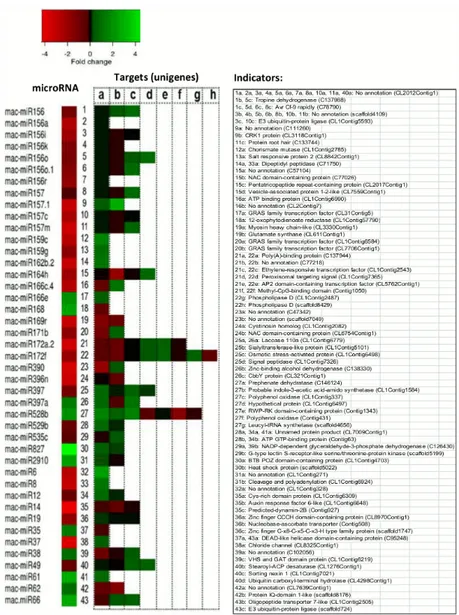
Differentially-expressed miRNAs in the 100 mM and 300 mM NaCl-treated banana roots. We found 43 orthologous miRNAs (belonging to 20 miRNA families) and 16Musa -specific putative miRNAs were differentially expressed upon salt stress in banana roots in ei-ther 100 mM or 300 mM NaCl treatment, in comparison to the control (Fig 3). These miRNAs showed different expression patterns when different magnitudes of salt stress (100 mM and 300 mM NaCl) were applied (Fig 3).
Fig 3. Orthologous andMusa-specific miRNAs differentially expressed in 100 mM and 300 mM NaCl. Statistically significant (absolute log2fold change1 and FDR cut-off<0.05) changes in miRNA expression
in banana roots treated with 100 mM and 300 mM in comparison to untreated control (0 mM NaCl).
Some of these miRNAs showed increased expression levels in both 100 mM and 300 mM NaCl. These include miR397a, miR528, miR827, miR35, miR38, mac-miR54, mac-miR60, mac-miR61, mac-miR62 and mac-miR66 (Fig 3). Whereas miRNAs includ-ing mac-miR156, mac-miR156k, mac-miR159c, mac-miR164h, mac-miR166c.4, mac-miR167g, miR172a.2, miR396a, miR5139, miR8, miR14, miR19 and mac-miR37 were among the miRNAs down-regulated in both 100 mM and 300 mM NaCl (Fig 3).
Some of these differentially expressed miRNAs were up-regulated in 100 mM NaCl but down-regulated in 300 mM. These include miR156a, miR56i, miR156o, mac-miR156o.1, mac-miR156r, mac-miR157m, mac-miR159g, mac-miR162b, mac-miR162b.2, mac-miR167t, mac-miR169r, mac-miR171b, mac-miR396n, mac-miR529b, mac-miR12 and mac-miR49 (Fig 3). Whereas miRNAs, including miR166b.3, miR166e, miR166i, miR166m, miR166t, miR168, miRf10192-akr, miR5, mac-miR46 and mac-miR49, were down-regulated in 100 mM NaCl but up-regulated in 300 mM NaCl (Fig 3). Some of the miRNAs showed other expression patterns, such as up-regulation (miR156a.3 and miR2910) or down-regulation (miR162, miR167m, mac-miR397 and mac-miR535) in TR300 but no change in expression in TR100.
A majority of the targets (found in the assembled unigenes) for these differentially expressed miRNAs are functionally related to binding (molecular function), cellular process (biological process), cell (cellular component) and membrane (cellular component) as shown in Figure H inS1 File.
Differentially-expressed miRNAs in 300 mM NaCl-treated banana roots and their pre-dicted targets. Forty three miRNAs (both orthologous andMusa-specific) were differentially expressed in 300 mM with at least one target in the banana root transcriptome (Fig 4). Most of these differentially expressed miRNAs showed an inverse expression pattern to at least one of their predicted targets, with the exception of mac-miR166e, mac-miR169r, mac-miR396n, mac-miR827, mac-miR14 and mac-miR61 (Fig 4).
We found 12Musa-specific miRNAs, which have not been reported yet in plants other than
Musaspecies, differentially expressed in salt-stressed banana roots (300 mM NaCl) with at least one target found in the banana root transcriptomes (Fig 4). Among the 12Musa-specific miRNAs that were differentially expressed, sequences of two miRNAs (miR6 and mac-miR19) were previously reported inMusa balbisiana[19].
A majority of the differentially-expressed miRNAs were down-regulated (Figs3and4) while at least one of their predicted targets were up-regulated in the salt-stressed banana roots (TR300). These include mac-miR156, mac-miR156a,i,k,o,o.1,r, mac-miR157, mac-miR157.1, miR157c,m, miR159c,g, miR162b.2, miR164h, miR166c.4, miR171b, miR172a.2, miR172f, miR390, miR397, miR529b, mac-miR535c, mac-miR6, mac-miR8, mac-miR12, mac-miR19, mac-miR37 and mac-miR49 (Fig 4).
Some differentially-expressed miRNAs were up-regulated (including miR168, mac-miR397a, mac-miR528b, mac-miR35, mac-miR38, mac-miR62 and mac-miR66) and at least one of their targets were down-regulated (Fig 4). A small number of the differentially-expressed miRNAs showed the same expression pattern (either up- or down-regulation) as their targets, as shown inFig 4. These miRNAs include miR166e, miR169r, miR396n, mac-miR827, mac-miR2910, mac-miR14 and mac-miR61.
coding for structural proteins such as protein root hair (targetted by mac-miR157), chloride channel (targetted by miR37) and oligopeptide transporter 7-like (targetted by miR66); enzymes involved in metabolism, such as, glutamate synthase (targetted by mac-miR169) and tropine dehydrogenase (targetted by mac-miR156), as well as transcripts coding for unknown or hypothetical proteins (Fig 4).
Among the unknown transcripts predicted to be targetted by the differentially-expressed miRNAs, only one transcript, unigene CL1Contig328, was found with a domain annotation using InterProScan (http://www.ebi.ac.uk/Tools/pfa/iprscan/). This unigene, which is targetted by mac-miR6, contains a dehydrin domain (InterProScan ID: IPR000167).
Experimental validation of salinity-stress induced miRNA and mRNA targets. We per-formed RT-qPCR for 12 of the miRNAs that were determined as differentially expressed in salt-stressed banana root transcriptomes and for 14 of their corresponding targets, in order to
Fig 4. Differentially-expressed miRNAs in 300 mM NaCl.Orthologous andMusa-specific miRNAs with statistically significant expression change (absolute log2fold change1 and FDR cut-off<0.05) in banana
roots upon 300 mM NaCl treatment, and their corresponding targets (unigenes) in the RNA-Seq data. Numbers and letters refer to the predicted target sequences as shown in the right panel.
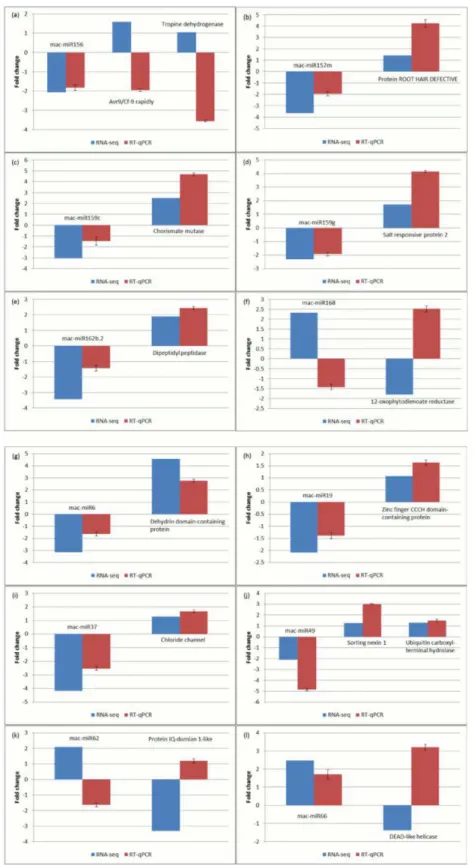
validate the RNA-seq data. The miRNA were selected to include 6 plant orthologous miRNA and 6Musa-specific miRNA. The RT-qPCR results showed general agreement with the gene expression patterns determined by RNA-seq (Fig5b,5c,5d,5e,5g,5h,5iand5j), with only 2 out of the 12 miRNA and 5 of the 14 miRNA-target profiles showing discrepancy between the methods (Fig5a,5f,5kand5l).
Discussion
Salinity adversely affects productivity and quality of crops and the world-wide increase in sali-nization of arable land poses a risk to global food security. Cultivated bananas are salt sensitive and so an understanding of the molecular basis of their salt stress response may help when forming strategies for improving salinity tolerance in banana and other economically impor-tant crops. Plant roots are the primary site of perception for water-limiting stress, including sa-linity and drought [20]. Thus understanding the genetic regulation underlying the
physiological changes in roots in response to salinity stress, are key to the development of strat-egies for crop improvement in the face of environmental degradation and climate change. In this study we applied high throughput sequencing to profile transcriptomes, including the functional small RNA, of salt-stressed banana roots.
High quality
de novo
salt stress transcriptome assembly for
M
.
acuminata
cv. Berangan
A large number of banana varieties are grown around the world, and while most cultivars are comprised of either A or A and B genomes, which both have published reference genome se-quences [18,19], transcriptome data adds useful information on gene expression in addition to providing cultivar-specific data for better prediction of miRNA targets. Here, around 3 Gbp of gene expression data from banana roots (two transcriptomes of ~2.1 Gbp and three small RNA libraries of ~ 900 Mbp) provided data for the assembly of 31,390 unigenes, which compares well with the 36,542 and 36,638 predicted protein-coding gene models in the reference ge-nomes forMusa acuminata[18] andMusa balbisiana[19] respectively. The unigenes assem-bled from Illumina HiSeq 2000 data have a mean length of 517 bp, which is only 6.7% shorter than the previously reported banana root transcriptome assembled from 9.3 Gbp data generat-ed using the same sequencing platform [21]. More than 99.5% of the unigenes from thede novotranscriptome assembly in this study can be mapped to the A-genome with a high degree of matching (mis-match score of<3) reflecting the high quality of the assembly.
Salt stress-responsive genes in banana roots
A sizable proportion of the unigenes (9.5%) and miRNA (~25%) showed differential expres-sion between salinity stress and control conditions, suggesting that a large number of genes and miRNA are involved in the banana salinity response. The functional roles of annotated genes that were differentially regulated in response to elevated salinity, were broadly similar to those reported for other plants. Catalytic activities, metabolic processes, cellular processes, binding, and cell and cell parts are the highly represented GO terms observed in this present study (Fig 2), and these GO terms are generally enriched in response to salt stress in other plants, for example, in salt-stressed roots in soybean [22], in two desert poplar species [23], in the leaf tissues ofPetunia hybrida[24] and in a recretohalophyte,Reaumuria trigyna[25]. En-richment in these GO terms may indicate plant plasticity in response to salt stress through switches of biochemical and morphological activities in cells.
Fig 5. Real-time quantitative PCR analyses of selected miRNAs and their predicted target mRNAs in root tissues of banana plantlets grown under 300 mM NaCl treatment.MiRNA and their corresponding target mRNA are arranged to appear together in each graph (a)-(f) plant orthologous miRNA; (g)-(l)Musa -specific miRNA. Fold changes in gene expression shown are relative to the expression in the non-stressed roots (control). RNA-seq and PCR data are both shown in linear scale. Errors bars indicate mean±standard deviations obtained from three biological replicates.
metabolism, and phenylpropanoid biosynthesis pathways (Figure E inS1 File), as also observed in transcriptomes of other plants, such as those of rice roots, in response to salt stress [26]. Sugar metabolism and mobilization are important for osmotic adjustment and stress adapta-tion in plants [27,28]. It has been reported that salt tolerance is correlated with metabolism and allocation of carbohydrate in the leaves, stems and roots where hexoses accumulated and induced a feedback repression to photosynthesis in the salt-stressed perennial ryegrass [29]. Phenylalanine, cysteine and methionine are important amino acids in plants. Phenylalanine serves as a precursor for the synthesis of various vital metabolites in plants [30], whereas cyste-ine is a precursor for the biosynthesis of various important molecules, including vitamins, co-factors, antioxidants and compounds for defence [31]. Methionine is an important precursor or donor for the metabolism of various other primary and secondary metabolites [32]. The reg-ulation of genes involved in these metabolic pathways may help banana roots to cope with salt stress through the production of a broad range of metabolites, as has previously been reported in various plants (reviewed in [33]). In addition, the deep-sequencing approach used in our study revealed a large number of unannotated genes found to be differentially expressed in ba-nana roots during salt stress (Fig 2). Future investigation to study their functions, may elucidate additional mechanisms for salinity stress tolerance with potential for application in combating abiotic stress in crops such as banana. Interestingly, some of the unannotated genes are pre-dicted targets of salinity stress-responsive miRNA, including the dehydrin-domain carrying CL1Contig328, a predicted target of novel Musa-specific mac-miR6, whose inverse expression patterns were confirmed by RT-qPCR in the current study (Fig 5g).
The high proportion of miRNA responding to stress seen in our data, is also observed in data from similar studies [14,15] and probably reflects the high level of regulatory changes re-quired to achieve physiological responses to extreme conditions. Functional annotation of the differentially expressed genes, reflected the changes expected in severely stressed tissues, in-volving signaling, transport, defense and repair pathways, similar to the observations of changes in the banana proteome in response to drought [34]. Here, we chose to focus on the transcripts (mRNA) that were predicted targets of differentially expressed miRNA with an aim to use the changes in expression observed in the complementary data sets to validate one an-other. Among the orthologous miRNA sequences that were differentially expressed in response to salinity treatments, many have previously been reported from similar genomic-based studies in other plants (Fig 6), validating the quality of the small RNA data in the current study.
Novel miRNA and miRNA-functions revealed by small RNA
high-throughput sequencing of banana roots
Fig 6. Salt-stress responsive miRNAs.Salt-stress responsive miRNAs are the statistically significant differentially-expressed miRNAs reported in the following studies: 1. Present study withMusa acuminata
roots; 300 mM NaCl treatment; sRNA-Seq; log2fold change1 or-1 and FDR<0.05; 2.Zea maysroots;
responding to salinity stress, differences between the miRNA families reported as responding to salinity in different plants (Fig 6) may also reflect differences between the treatments and the tissues sampled. For example it has been observed that gene expression patterns change at dif-ferent times after exposure to salinity stress and that differences in nutrient availability affect salt sensitivity in the root (reviewed in [5]).
MiRNAs responded to salt stress in a dose-dependent manner
The varying response of the miRNA to the different levels of NaCl applied to banana roots (Fig 3) suggests the possibility of different sets of miRNA functions, depending on the magnitude of stress. This would be expected, as physiological responses to drought stress, for example, de-pend on stress severity, as well as on duration and the stage of plant life cycle [35]. Thus the overall genetic regulation, including the set of miRNA induced or repressed, is likely to vary with the environmental conditions to which the plant is exposed.
MicroRNAs were predicted to target important salt stress-responsive
genes in banana roots
The number of miRNAs that are differentially expressed following exposure to high salinity in banana roots, leads us to suggest that a large network of miRNA and miRNA-regulated genes may be directly involved in plant adaptation and survival. Most of the differentially-expressed miRNAs showed an inverse expression pattern with at least one of their predicted targets (Fig 4), as would be expected if mRNA cleavage occurs. This was also validated by RT-qPCR for most (8/12) of the miRNA-mRNA target pairs tested (Fig 5). RNA cleavage is the major mode of posttranscriptional gene silencing via miRNAs in plants, although there are several cases where miRNA targets are translationally inhibited but not cleaved (reviewed in [8]), and this may be the case for the differentially expressed miRNAs not showing an inverse expression pat-tern with their predicted target mRNA. However, it is possible that some of the predicted tar-gets are not true tartar-gets of the miRNAs in banana root and additional functional confirmation would be required to rule this out. In our discussion here, we focus on miRNA and targets showing inverse expression profiles under the same conditions, with an aim to improve confi-dence in the predictions from the transcriptome and small RNA data. We also note that differ-ential expression for 5/6 plant orthologous miRNA and 5/6Musa-specific miRNA under salinity stress could be validated when tested in RT-qPCR (Fig 5).
Several of the predicted miRNA-target pairs that were differentially expressed during salinity stress in banana roots, have functions relating to stress response, adaptation and survival in plants. Of particular interest are those related to root development, which included miRNA families showing reduced expression with corresponding targets having increased expression levels in salinity stressed roots: Four distinct miR157 sequences were down-regulated in the salt-stressed banana roots, while their predicted target mRNAs including CDPK-related kinase (CRK1) and ROOT HAIR DEFECTIVE 3 (RHD3) were up-regulated (Figs4and5b). Tran-scriptome data (RNA-seq) studies in Arabidopsis roots showed CDPK-related kinase to be in-duced in response to phosphate deprivation and have an association with root hair development [36]. RNA-seq of white lupin roots showed that ROOT HAIR DEFECTIVE-LIKE proteins were sp. leaves; 170 and 340 mM NaCl treatments; sRNA-Seq; validated by RT-qPCR, with p<0.05 [13]; 6.
Triticum aestivumL. seedling leaves; 300 mM NaCl treatment; RT-qPCR; fold change>1.5 [14]; 7.Brassica
juncea(Czern) L. seedlings; 150 and 250 mM NaCl treatments; sRNA-Seq; log2fold change1 or-1 [15];
8.Panicum virgatumseedlings; 0.5% NaCl; sRNA-Seq; log2fold change1 or-1 and P-value0.01 [16];
9.Gossypium hirsutumleaves and roots; 0.1, 0.25 and 0.5% NaCl treatments; RT-qPCR [17]
expressed in roots and were proposed as a positive regulator of root hair formation [37]. CRK is involved in hormone signalling and root growth in Arabidopsis [38] while RHD3 (a GTP-bind-ing protein) has been associated with root development in poplar [39]. An miR171 family mem-ber (mac-miR171b) was down-regulated in the salt-stressed banana roots while two predicted targets, members of the GIBBERELLIN-INSENSITIVE, REPRESSOR of ga1-3 and SCARE-CROW (GRAS) family transcription factors, which also have been reported to control lateral root development [40], showed differential expression, one raised and the other down-regulated (Fig 4). These patterns of expression indicate that a reduced level of these miRNAs, permits in-creased levels of proteins required for root adaptation in response to high salinity. In the study on RNA-seq of white lupin [37] (mentioned above) members of the GRAS family transcription factors were also shown to be up-regulated in roots during development and thus regarded as a positive regulator of root hair formation. The regulation of root plasticity during stress remains a relatively poorly understood area of plant molecular biology that is critical for plant breeding and the development of abiotic stress resistant crops in the face of environmental degradation and climate change [5,41]. The miRNA-target models identified in banana roots here, expand the potential pathways of miRNA regulation during salinity stress.
A second important aspect of plant responses to stress, is signal transduction and in this study we observed several signaling-related miRNA-target pairs that were differentially ex-pressed in response to high salinity. These included transcription factor AP2 regulation by mac-miR172a.2 and mac-miR172f (Fig 4). AP2 domain-containing transcription factors have been reported to be a stress regulator with positive roles in abiotic stress responses inMedicago sativaandJatropha curcas[42,43] and are also up-regulated during salt stress in soybean roots [22]. Other potential targets of mac-miR172f which were up-regulated in the salinity stressed banana roots, included phospholipase D (PLD), which has been shown to enhance abiotic stress tolerance in plants [44], and a peroxisomal targeting signal. Several phospholipase D genes have been reported in an RNA-seq analysis of an oak species and were suggested to be in-volved in drought avoidance [45]. Plant peroxisomes have been reported to be involved in re-sponses to abiotic and biotic stresses [46]. A predicted target of mac-miR397, osmotic stress-activated protein kinase, also up-regulated in the stressed banana root, has been reported to be involved in nitric oxide signaling and a hyperosmotic stress response in tobacco [47]. Similarly, a putative signal peptidase and a sialyl transferase (glycosyltransferase), other predicted targets of mac-miR397, were upregulated. Other signaling related miRNA-targets pairs in which the target mRNA was up-regulated in the stressed root samples include mac-miR529b with an ATP/GTP binding protein target and mac-miR535c with a putative G-type lectin S-receptor-like serine/threonine-protein kinase (GsSRK) target. GsSRK from soybean has been shown to be induced by salt stress and to improve plant tolerance to salt stress when heterologously ex-pressed in Arabidopsis [48]. The increased levels of the several potential targets of banana miR172, miR397, miR529 and miR535, which were down-regulated during salinity stress, sug-gest an important network of regulation and signalling in the banana root, to enable multiple physiological responses.
early biosynthesis step of phenylalanine and tyrosine, the precursors to a number of secondary metabolites important for development and stress responses in Arabidopsis [50]. Salt respon-sive protein 2 has been described as an early salt stress response gene found in tomato root ana-lyzed using suppression subtractive hybridization and microarray [51]. Several other studies have reported roles for miR159 in salt stress responses (Fig 6).
The current study identified a number ofMusa-specific miRNA (i.e. with a qualifying pre-cursor sequence in the banana genome, but no qualifying match to any known miRNA), sever-al of which were differentisever-ally expressed in response to elevated ssever-alinity (Fig 4). This includes the mac-miR6 and its predicted dehydrin-domain carrying target (CL1Contig328), a predicted zinc finger CCCH domain-containing protein (target of mac-miR19), a chloride channel pro-tein (target of mac-miR37), an auxin transport-associated propro-tein SORTING NEXIN 1 (target of mac-miR49) and a DEAD-like helicase (target of mac-miR35 and mac-miR66). All of the predicted mRNA targets have been associated with salinity responding pathways, for example chloride channels function as both ion channel and transporter in plants [52]. In each case, the
Musa-specific regulatory miRNA showed an inverse level of expression to that of its target mRNA in the salt-treated roots with the majority showing an increase in expression of target in the salinity-stressed root, as validated by RT-qPCR for all five miRNA and for their mRNA tar-gets, with the exception of DEAD-like helicase (the predicted target of mac-miR66,Fig 5). Sev-eral differentially-expressedMusa-specific miRNA had predicted targets with no known function. Among these, only CL1Contig328, a predicted target of mac-miR6, had a matching domain annotation, which was for dehyrin. Dehydrins are LEAII-family proteins involved in plant responses to cold, drought and salinity, which all result in cell dehydration [53] and has been reported in a transcriptomic study of salt-stressed roots in rice [54] thus a role in the stressed banana root seems plausable.
In general, the targets that showed inverse expression pattern with their corresponding miR-NAs differentially expressed in the 300 mM NaCl-stressed banana showed increased expres-sion levels, while their regulating miRNA was repressed. The main functions were related to the physiological changes in root adaption, signaling and general stress responses expected to result from the experimental conditions. Several of the miRNA have multiple predicted targets and some transcripts, such as ATP/GTP-binding protein, NADP-GAPDH, CL2012Contig1 and CL7009Contig, are probably highly regulated as in this present study they were targeted by more than one miRNA family (Fig 4). Some hypothetical or unnamed proteins and unannotat-ed genes were prunannotat-edictunannotat-ed as miRNA targets and showunannotat-ed inverse expression pattern with their corresponding salt stress-responsive miRNAs (Fig 4). They are CL2012Contig (target of mac-miR156 and mac-miR49), C111260 (target of mac-miR157), CL1Contig6497 (target of miR528), CL7009Contig1 (target of miR529), C102056 (target of mac-miR38) and CL7639 (target of mac-miR62). These miRNA targets are probably novel transcripts or proteins ex-pressed in the banana roots in response to salinity stress and are of interest for future function-al investigation. Many of the affected processes and pathways observed in banana in our current study, are also reported for other plant salt-stress transcriptomes, indicating that miRNA-regulated genes form a significant proportion of genes responding to salinity stress and highlighting the role of miRNAs in the regulation of responses to salt stress in plants. The predicted miRNA-mRNA regulatory models in this present study may provide clues for further investigations that can potentially lead to crop genetic improvement for enhanced tolerance to abiotic stresses. This may be through marker assisted breeding or molecular breeding ap-proaches, for example, the overexpression of miRNA169 has been used to improve drought tol-erance in tomato [55]. In addition to the plant orthologous andMusa-specific (‘novel’)
Conclusions
The banana response to salinity stress includes changes in expression levels of a large number of genes and miRNA, including severalMusa-specific miRNA sequences and miRNA targets. Most of the miRNA respond differently to different levels of salinity, with a larger number re-pressed in roots exposed to 300mM NaCl. This likely reflects different programs of response for root adaptation or tissue necrosis for plant survival strategies, as the functions of many of the predicted miRNA targets relate to important pathways for signaling and physiological ad-aptation, in particular root development. To our knowledge, this is the first report of high-throughput genetic resources for an abiotic stress response in banana. The high-high-throughput se-quencing data generated in this present study may serve as important genetic resources for salt-tolerance traits used for functional genomic studies and genetic improvement in banana.
Materials and Methods
Ethics
The conduct of this research was approved by the grant management committee of the Univer-sity of Malaya, headed by the Director of Institute of Research Management and Monitoring, Professor Noorsaadah Abdul Rahman ([email protected]), and does not involve the use of any human, animal and endangered or protected plant species as materials.
Plant materials and samples treatments
Clonal tissue culture derived banana plantlets,Musa acuminatacultivar Berangan (AAA trip-loid genome) possessed healthy roots were used in this study. Only plantlets sized 6–8 cm were selected for stress treatments.In vitrobanana plantlets were treated on MS basal medium sup-plemented with 0 mM (CTR), 100 mM (TR100) and 300 mM (TR300) NaCl respectively for 48 hours prior to RNA isolation. Root tissues were pooled randomly from 3–4 plantlets in each treatment for RNA isolation.
RNA isolation
RNA was isolated from banana roots using a CTAB-based RNA isolation method [56] with an additional extraction step using phenol-chloroform-isoamylalcohol (25:24:1). Absorbance at 260 nm and 280 nm was determined spectrophotometrically and the Agilent 2100 Bioanalyzer (Agilent Technologies Inc., Santa Clara, CA, USA) was used for determining RNA integrity. Only RNA samples with A260/A280 ratio ranged 1.8–2.2, A230/A260 ratio higher than 1 and RNA integrity number (RIN) higher than 8 were used for small RNA and transcriptomic li-braries construction and sequencing using Illumina GAxII and HiSeq 2000 platforms (Illumina Inc., San Diego, CA, USA).
Illumina paired-end cDNA library construction and sequencing
(RNA-Seq)
mRNA into short fragments. Random hexamer primers (Illumina Inc., San Diego, CA, USA) were used to synthesize the first-strand cDNA from these short fragments. The second-strand cDNA was synthesized in reaction buffer containing dNTPs, RNaseH and DNA polymerase I. Short fragments were then purified with QIAQuick PCR extraction kit (Qiagen, Hilden, Ger-many) and resolved with EB buffer for end repair and addition of poly(A). After that, the short fragments are connected with sequencing adapters. After the agarose gel electrophoresis, the suitable fragments were selected for the PCR amplification as templates. Lastly, the library was sequenced using Illumina HiSeq 2000. The insert of the library is approximately 200 bp and both ends of the libraries were sequenced. The raw reads were processed to remove adapter se-quences, empty reads and low quality sequences (containing ambiguous sese-quences,‘N’). High quality (HQ) clean reads were determined and selected from the RNA-Seq data and were used for further analysis. The short reads of RNA-seq have been deposited in NCBI’s Sequence Read Archive (SRA) database with accession numbers SRX535340 and SRX535341 for control and 300 mM NaCl treatment respectively.
De novo
transcriptome assembly
After removal of adapters and low quality sequences, the clean reads were assembled into con-tigs, scaffolds and unigenes using a short reads assembling program, SOAPdenovoassembler version 1.05 (http://soap.genomics.org.cn/soapdenovo.html) [57]. The clean reads were assem-bled using the 63-mer version of SOAPdenovoand a K-mer size of 51. The SOAPdenovo as-sembler was used to combine sequence reads to form longer fragments without an ambigouos nucleotides (‘N’). The assembled sequences containing no‘N’s are called contigs. Then
SOAP-denovowas used to connect and link the contigs into scaffolds. The unknown bases in the scaf-folds were filled with‘N's. Paired-end reads were used again for gap filling of scaffolds by using GapCloser v.12 for SOAPdenovo (http://soap.genomics.org.cn/soapdenovo.html) to obtain se-quences with the least‘N’s that could not be extended on either end. Such sequences are de-fined as unigenes. The assembled unigenes from both the transcriptomes CTR and TR300 were clustered together using TGI clustering tool 2.1 to form a set of non-redundant unigenes. After clustering, thede novoassembled unigenes were mapped to the referenceMusagenome [18] using BWA version 0.6.1 [58], with mismatch score less than 3.
Functional annotation of transcriptome
Thede novoassembled unigenes were assigned with putative identities and/or functional anno-tations by similarity searches against the publicly available reference protein databases. Stand-alone BLASTX was carried out using NCBI’s BLASTALL tool for similarity searches against the NCBI non-redundant (nr) protein database (Dec 29, 2011, 4:42 PM, Version 4, with 16,785,757 sequences) with a stringent cut-off E-value of 1e-10. The unigenes were also searched against the Uni-Prot database (Feb 28, 2012, 7:17 PM, Version 4, with 534,242 se-quences) using standalone BLASTX with the same cut-off E-value. Blast2GO program (http:// www.blast2go.com/b2ghome) version 2.7 was used to assign Gene Ontology (GO,http://www. geneontology.org/) terms and Kyoto Encyclopedia of Genes and Genomes (KEGG,http:// www.genome.jp/kegg/) pathways to the unigenes. Eukaryotic Orthologous Groups of Proteins (KOG) assignment was carried out using the NCBI’s BLASTALL tool.
Transcripts quantification and differential gene expression in salt stress
transcriptome
(TPM) [59]. An R package, DEGSeq (version 1.15,http://bioinfo.au.tsinghua.edu.cn/software/ degseq) was used to identify differentially expressed unigenes based on binomial assumptions for the read count, using a multiple averaging (MA) plot based random sampling model (MARS) [60] as reported in [61–62]. The transcripts normalization and differential gene ex-pression were calculated using an R script. Only unigenes with at least 10 read counts present in the library were used for transcript quantification. False Discovery Rate (FDR) was calculat-ed using the DEGSeq package with Benjamini-Hochberg multiple test correction [63]. FDR 0.05 and log2ratio equal to or higher than 1 were set as threshold values to select for differen-tially expressed transcripts.
Illumina small RNA library construction and sequencing (sRNA-Seq)
Small RNA library construction for Illumina sequencing was carried out using Illumina’s kit according to the manufacturer’s recommendations. In brief, small RNAs of 16 to 28 nt were re-covered from high resolution gel (15% (w/v) PAGE) and then ligated with 5’and 3’Illumina adapters using T4 RNA ligase. The small RNA-adapters ligation products were amplified by RT-PCR using Illumina’s small RNA primer set and the cDNA was sequenced using Illumina Genome Analyzer, GA IIx platform following the manufacturer’s instructions. The sequenced short reads have been deposited in NCBI’s Sequence Read Archive (SRA) database with acces-sion numbers SRX535343, SRX535344 and SRX535345 for control, 100 mM and 300 mM NaCl treatments respectively.microRNA (miRNA) annotation
The Illumina small RNA sequence reads of banana root described in this study are available under NCBI’s BioProject accession PRJNA246442. Short Read Mapping Package (SHRiMP version 2.2.3,http://compbio.cs.toronto.edu/shrimp/) [64] was used to map the filtered reads to Rfam 11.0 (http://rfam.xfam.org/) [65] with no mismatch allowed. The small RNA se-quences that matched with the non-protein-coding RNA sese-quences including rRNA, tRNA, small nuclear RNA (snRNA) and small nucleolar RNA (snoRNA) in Rfam were removed from further analysis. Sequences below 19 and above 24 nucleotides were also removed from the data set and not used in further analysis. The filtered reads were used to search for orthologous miRNAs. A non-redundant dataset was produced from the Plant microRNA Database (PMRD June 11, 2012 update,http://bioinformatics.cau.edu.cn/PMRD/) [66] and used as an ortholo-gous plant miRNA reference set. A Python script was used to align the small RNAs with the reference set and only one mismatch was allowed for the alignment. The orthologous miRNA matches were named according to the original gene name except the species name, which was replaced withMusa acuminata(mac-).
After removal of sequences that matched to entries in the Rfam 11.0 and PMRD databases (June 11, 2012 update), the remaining small RNA sequences were used for the prediction of
Musa-specific miRNAs, which were sequences not reported as miRNA in species other than
maximum of 3 mismatches was allowed between the miRNA:miRNAduplex; miRNA and miRNA
formed a duplex with 3’overhangs; (iv) predicted minimum folding energy (MFE) was between -15 kcal/mol to -47.2 kcal/mol.Musa-specific miRNAs were arbitrarily named starting at‘1’and using the miRBase gene nomenclature [72].
microRNA differential expression in sRNA-Seq data
MiRNA read counts were normalized to tags per million (TPM) in order to compare miRNA expression across libraries (CTR, TR100 and TR300). The TPM was calculated as follows: nor-malized expression, TPM = (actual miRNA count/total clean read) x 1,000,000. Differential miRNA expression was determined using DEGSeq [60] with absolute log2Fold change equals to or higher than 1 and cut-off false discovery rate (FDR) value less than 0.05. Expression change was plotted in heatmaps using gplots package (http://cran.r-project.org/web/packages/ gplots/index.html) from bioconductor in R.
MicroRNA target prediction
The salt-stressed banana root transcriptomes (mRNA-Seq) in this study were used as reference data to predict miRNA targets using the psRNAtarget online server [73].
Quantitative Real-Time RT-PCR
Reverse transcription and real-time PCR were performed to examine and validate expression pattern of 12 selected miRNAs and 14 target mRNAs. All primers involved in RT-qPCR were purchased from Integrated DNA Technologies (IDT) and the primer sequences were listed in Tables I–K inS1 File.
For miRNA, miRNA-specific stem-loop RT primers (Table I inS1 File) were designed and prepared based on a published method [74] and used for reverse transcription of the purified total RNA. Reverse transcription was performed according to a published method [75] using SuperScript III First-Strand Synthesis System (invitrogen, Life Technologies, Thermo Fisher Scientific Corporation, Waltham, MA, USA) and the cDNA was then used for real-time PCR using gene specific forward primers and universal reverse primer (Table J inS1 File).
For target mRNAs, genomic DNA elimination and reverse transcription were performed using QuantiTect Reverse Transcription Kit (QIAGEN, Hilden, Germany). Primers for real-time PCR were designed using PrimeQuest IDT (Integrated DNA technologies,https://sg. idtdna.com/PrimerQuest/Home/Index) (Table K inS1 File).
All real-time PCR analyses were carried out in a 20-μl reaction using Power SYBR Master Mix (Life Technologies, Thermo Fisher Scientific Corporation, Waltham, MA, USA) and per-formed on the QuantStudio 12K Flex real-time PCR platform (Applied Biosystems, Life Tech-nologies, Thermo Fisher Scientific Corporation, Waltham, MA, USA). The reactions were incubated in 8-tube strips at 95°C for 10 min, followed by 40 cycles of 95°C for 15 s and 60°C for 1 minute. Dissociation curves for all target genes were established at the end of PCR cycle at 95°C for 15 s, 60°C for 1 minute, followed by 95°C for 15 s. The dissociation curves are shown in Fig I inS1 File. U6 was used as the reference gene. All reactions were run in triplicates for three biological replicates. The results were analyzed by Delta Delta CTmethod.
Supporting Information
(Figure D). KEGG pathway assignment (Figure E). Length distribution of clean reads in small RNA libraries (Figure F). Classification of small RNA using PMRD and Rfam databases as refer-ence (Figure G). Gene Ontology (GO) assignment for targets of the differentially expressed miR-NAs in salt-stressed banana roots (Figure H). Dissociation curves of RT-qPCR for selected orthologous microRNAs (a-f) andMusa-specific microRNAs (g-l) (Figure I). Dissociation curves of RT-qPCR for selected target mRNAs (Figure J). Paired-end transcriptome sequencing (RNA-Seq) output (Table A).De novoassembly of banana root transcriptomes (Table B). Cover-age of the assembled transcriptomes (Table C). Mapping of thede novoassembled unigenes to the reference A-genome (Table D). Statistics of small RNA sequence reads (Table E). Annotation of orthologous miRNAs in banana root sRNAomes (Table F). PutativeMusa-specific miRNAs in banana root sRNAomes (Table G). Functions of predicted salinity-responsive miRNA / mRNA targets in banana roots (Table H). Stem-loop (SL) primers used for reverse transcription (RT) of microRNAs (Table I). Primers used for real-time RT-qPCR analyses of microRNAs (Table J). Primers used for real-time RT-qPCR analyses of target mRNAs (Table K). (DOCX)
Acknowledgments
We would like to thank the Beijing Genomic Institute, Shenzhen, China for the technical sup-port in Illumina sequencing. We would also like to thank Alena Sanusi for her
editorial assistance.
Author Contributions
Conceived and designed the experiments: NK JAH. Performed the experiments: WSL RG GRW. Analyzed the data: WSL RG GRW MT NK JAH. Contributed reagents/materials/analy-sis tools: WSL RG GRW MT NK JAH. Wrote the paper: WSL RG GRW MT NK JAH.
References
1. Wang W, Vinocur B, Altman A (2003) Plant responses to drought, salinity and extreme temperatures: towards genetic engineering for stress tolerance. Planta 218: 1–14. PMID:14513379
2. FAO (2011) The state of the world’s land and water resources for food and agriculture (SOLAW)— Man-aging systems at risk. Food and Agriculture Organization of the United Nations, Rome and Earthscan, London.
3. Israeli Y, Lahav E, Nameri N (1986) The effect of salinity and sodium adsorption ratio in the irrigation water, on growth and productivity of bananas under irrigation conditions. Fruits 41: 297–302. 4. Yano-Melo AM, Saggin OJ, Maia LC (2003) Tolerance of mycorrhized banana (Musa sp. cv. Pacovan)
plantlets to saline stress. Agric Ecosyst Environ 95: 343–348.
5. Pierik R, Testerink C (2014) The art of being flexible: how to escape from shade, salt and drought. Plant Physiol 166: 5–22. doi:10.1104/pp.114.239160PMID:24972713
6. Deinlein U, Stephan AB, Horie T, Luo W, Xu G, Schroeder JI (2014) Plant salt-tolerance mechanisms. Trends Plant Sci 19: 371–379. doi:10.1016/j.tplants.2014.02.001PMID:24630845
7. Galvan-Ampudia CS, Julkowska MM, Darwish E, Gandullo J, Korver RA, Brunoud G, et al. (2003) Halo-tropism is a response of plant roots to avoid a saline environment. Curr Biol 23: 2044–2050.
8. Rogers K, Chen X (2013) Biogenesis, turnover, and mode of action of plant microRNAs. Plant Cell 25: 2383–2399. doi:10.1105/tpc.113.113159PMID:23881412
9. Kumar R (2014) Role of microRNAs in biotic and abiotic stress responses in crop plants. Appl Biochem Biotechnol 174: 93–115. doi:10.1007/s12010-014-0914-2PMID:24869742
10. Ding D, Zhang L, Wang H, Liu Z, Zhang Z, Zheng Y (2009) Differential expression of miRNAs in re-sponse to salt stress in maize roots. Ann Bot 103: 29–38. doi:10.1093/aob/mcn205PMID:18952624 11. Liu HH, Tian X, Li YJ, Wu CA, Zheng CC (2008) Microarray-based analysis of stress-regulated
12. Li B, Duan H, Li J, Deng XW, Yin W, Xia X (2013) Global identification of miRNAs and targets in Popu-lus euphratica under salt stress. Plant Mol Biol 81: 525–539. doi:10.1007/s11103-013-0010-yPMID: 23430564
13. Carnavale Bottino M, Rosario S, Grativol C, Thiebaut F, Rojas CA, Farrineli L, et al. (2013) High-throughput sequencing of small RNA transcriptome reveals salt stress regulated microRNAs in sugar-cane. PLoS One 8: e59423. doi:10.1371/journal.pone.0059423PMID:23544066
14. Wang B, Sun YF, Song N, Wei JP, Wang XJ, Feng H, et al. (2014) MicroRNAs involving in cold, wound-ing and salt stresses in Triticum aestivum L. Plant Physiol Biochem 80: 90–96. doi:10.1016/j.plaphy. 2014.03.020PMID:24735552
15. Bhardwaj AR, Joshi G, Pandey R, Kukreja B, Goel S, Jagannath A, et al. (2014) A genome-wide per-spective of miRNAome in response to high temperature, salinity and drought stresses in Brassica jun-cea (Czern) L. PLoS One 9: e92456. doi:10.1371/journal.pone.0092456PMID:24671003
16. Xie F, Stewart CN, Taki FA, He Q, Liu H, Zhang B (2014) High-throughput deep sequencing shows that microRNAs play important roles in switchgrass responses to drought and salinity stress. Plant Biotech-nol J 12: 354–366. doi:10.1111/pbi.12142PMID:24283289
17. Wang M, Wang Q, Zhang B (2013) Response of miRNAs and their targets to salt and drought stresses in cotton (Gossypium hirsutum L.). Gene 530: 26–32. doi:10.1016/j.gene.2013.08.009PMID:23948080 18. D'Hont A, Denoeud F, Aury JM, Baurens FC, Carreel F, Garsmeur O, et al. (2012) The banana (Musa acuminata) genome and the evolution of monocotyledonous plants. Nature 488: 213–217. doi:10. 1038/nature11241PMID:22801500
19. Davey MW, Gudimella R, Harikrishna JA, Sin LW, Khalid N, Keulemans J (2013) "A draft Musa balbisi-ana genome sequence for molecular genetics in polyploid, inter- and intra-specific Musa hybrids". BMC Genomics 14: 683. doi:10.1186/1471-2164-14-683PMID:24094114
20. Zhao Q, Zhang H, Wang T, Chen S, Dai S (2013) Proteomics-based investigation of salt-responsive mechanisms in plant roots. J Proteomics 82: 230–253. doi:10.1016/j.jprot.2013.01.024PMID:23385356 21. Li CY, Deng GM, Yang J, Viljoen A, Jin Y, Kuang RB, et al. (2012) Transcriptome profiling of resistant
and susceptible Cavendish banana roots following inoculation with Fusarium oxysporum f. sp. cubense tropical race 4. BMC Genomics 13: 374. doi:10.1186/1471-2164-13-374PMID:22863187
22. Belamkar V, Weeks NT, Bharti AK, Farmer AD, Graham MA, Cannon SB (2014) Comprehensive charac-terization and RNA-Seq profiling of the HD-Zip transcription factor family in soybean (Glycine max) during dehydration and salt stress. BMC Genomics 15: 950. doi:10.1186/1471-2164-15-950PMID:25362847 23. Zhang J, Feng J, Lu J, Yang Y, Zhang X, Wan D, et al. (2014) Transcriptome differences between two sister desert poplar species under salt stress. BMC Genomics 15: 337. doi: 10.1186/1471-2164-15-337PMID:24886148
24. Villarino GH, Bombarely A, Giovannoni JJ, Scanlon MJ, Mattson NS (2014) Transcriptomic analysis of Petunia hybrida in response to salt stress using high throughput RNA sequencing. PLoS One 9: e94651. doi:10.1371/journal.pone.0094651PMID:24722556
25. Dang ZH, Zheng LL, Wang J, Gao Z, Wu SB, Qi Z, et al. (2013) Transcriptomic profiling of the salt-stress response in the wild recretohalophyte Reaumuria trigyna. BMC Genomics 14: 29. doi:10.1186/ 1471-2164-14-29PMID:23324106
26. Mizuno H, Kawahara Y, Sakai H, Kanamori H, Wakimoto H, Yamagata H, et al. (2010) Massive parallel sequencing of mRNA in identification of unannotated salinity stress-inducible transcripts in rice (Oryza sativa L.). BMC Genomics 11: 683. doi:10.1186/1471-2164-11-683PMID:21122150
27. Janz D, Behnke K, Schnitzler JP, Kanawati B, Schmitt-Kopplin P, Polle A (2010) Pathway analysis of the transcriptome and metabolome of salt sensitive and tolerant poplar species reveals evolutionary adaption of stress tolerance mechanisms. BMC Plant Biol 10: 150. doi:10.1186/1471-2229-10-150 PMID:20637123
28. Misic D, Dragicevic M, Siler B, Nestorovic Zivkovic J, Maksimovic V, Momcilovic I, et al. (2012) Sugars and acid invertase mediate the physiological response of Schenkia spicata root cultures to salt stress. J Plant Physiol 169: 1281–1289. doi:10.1016/j.jplph.2012.04.018PMID:22795677
29. Hu T, Hu L, Zhang X, Zhang P, Zhao Z, Fu J (2013) Differential responses of CO2 assimilation, carbo-hydrate allocation and gene expression to NaCl stress in perennial ryegrass with different salt toler-ance. PLoS One 8: e66090. doi:10.1371/journal.pone.0066090PMID:23799072
30. Yoo H, Widhalm JR, Qian Y, Maeda H, Cooper BR, Jannasch AS, et al. (2013) An alternative pathway contributes to phenylalanine biosynthesis in plants via a cytosolic tyrosine:phenylpyruvate aminotrans-ferase. Nat Commun 4: 2833. doi:10.1038/ncomms3833PMID:24270997
32. Amir R (2010) Current understanding of the factors regulating methionine content in vegetative tissues of higher plants. Amino Acids 39: 917–931. doi:10.1007/s00726-010-0482-xPMID:20140469 33. Ramakrishna A, Ravishankar GA (2011) Influence of abiotic stress signals on secondary metabolites in
plants. Plant Signal Behav 6: 1720–1731. doi:10.4161/psb.6.11.17613PMID:22041989
34. Vanhove AC, Vermaelen W, Panis B, Swennen R, Carpentier SC (2012) Screening the banana biodi-versity for drought tolerance: can an in vitro growth model and proteomics be used as a tool to discover tolerant varieties and understand homeostasis. Front Plant Sci 3: 176. doi:10.3389/fpls.2012.00176 PMID:22876254
35. Claeys H, Inze D (2013) The agony of choice: how plants balance growth and survival under water-lim-iting conditions. Plant Physiol 162: 1768–1779. doi:10.1104/pp.113.220921PMID:23766368 36. Lan P, Li W, Schmidt W (2013) Genome-wide co-expression analysis predicts protein kinases as
im-portant regulators of phosphate deficiency-induced root hair remodeling in Arabidopsis. BMC Geno-mics 14: 210. doi:10.1186/1471-2164-14-210PMID:23547783
37. Secco D, Shou H, Whelan J, Berkowitz O (2014) RNA-seq analysis identifies an intricate regulatory net-work controlling cluster root development in white lupin. BMC Genomics 15: 230. doi: 10.1186/1471-2164-15-230PMID:24666749
38. Rigo G, Ayaydin F, Tietz O, Zsigmond L, Kovacs H, Pay A, et al. (2013) Inactivation of plasma mem-brane-localized CDPK-RELATED KINASE5 decelerates PIN2 exocytosis and root gravitropic response in Arabidopsis. Plant Cell 25: 1592–1608. doi:10.1105/tpc.113.110452PMID:23673979
39. Xu M, Xie W, Huang M (2012) Overexpression of PeRHD3 alters the root architecture in Populus. Bio-chem Biophys Res Commun 424: 239–244. doi:10.1016/j.bbrc.2012.06.083PMID:22732403 40. Tian H, Jia Y, Niu T, Yu Q, Ding Z (2014) The key players of the primary root growth and development
also function in lateral roots in Arabidopsis. Plant Cell Rep 33: 745–753. doi: 10.1007/s00299-014-1575-xPMID:24504658
41. Lynch JP (2013) Steep, cheap and deep: an ideotype to optimize water and N acquisition by maize root systems. Ann Bot 112: 347–357. doi:10.1093/aob/mcs293PMID:23328767
42. Zhang JY, Broeckling CD, Blancaflor EB, Sledge MK, Sumner LW, Wang ZY (2005) Overexpression of WXP1, a putative Medicago truncatula AP2 domain-containing transcription factor gene, increases cu-ticular wax accumulation and enhances drought tolerance in transgenic alfalfa (Medicago sativa). Plant J 42: 689–707. PMID:15918883
43. Tang M, Liu X, Deng H, Shen S (2011) Over-expression of JcDREB, a putative AP2/EREBP domain-containing transcription factor gene in woody biodiesel plant Jatropha curcas, enhances salt and freez-ing tolerance in transgenic Arabidopsis thaliana. Plant Sci 181: 623–631. doi:10.1016/j.plantsci.2011. 06.014PMID:21958703
44. Wang J, Ding B, Guo Y, Li M, Chen S, Huang G, et al. (2014) Overexpression of a wheat phospholipase D gene, TaPLDalpha, enhances tolerance to drought and osmotic stress in Arabidopsis thaliana. Planta 240: 103–115. doi:10.1007/s00425-014-2066-6PMID:24705986
45. Torre S, Tattini M, Brunetti C, Fineschi S, Fini A, Ferrini F, et al. (2014) RNA-seq analysis of Quercus pubescens Leaves: de novo transcriptome assembly, annotation and functional markers development. PLoS One 9: e112487. doi:10.1371/journal.pone.0112487PMID:25393112
46. Hu J, Baker A, Bartel B, Linka N, Mullen RT, Reumann S, et al. (2012) Plant peroxisomes: biogenesis and function. Plant Cell 24: 2279–2303. doi:10.1105/tpc.112.096586PMID:22669882
47. Wawer I, Bucholc M, Astier J, Anielska-Mazur A, Dahan J, Kulik A, et al. (2010) Regulation of Nicotiana tabacum osmotic stress-activated protein kinase and its cellular partner GAPDH by nitric oxide in re-sponse to salinity. Biochem J 429: 73–83. doi:10.1042/BJ20100492PMID:20397974
48. Sun XL, Yu QY, Tang LL, Ji W, Bai X, Cai H, et al. (2013) GsSRK, a G-type lectin S-receptor-like ser-ine/threonine protein kinase, is a positive regulator of plant tolerance to salt stress. J Plant Physiol 170: 505–515. doi:10.1016/j.jplph.2012.11.017PMID:23276523
49. Davy A, Thomsen KK, Juliano MA, Alves LC, Svendsen I, Simpson DJ (2000) Purification and charac-terization of barley dipeptidyl peptidase IV. Plant Physiol 122: 425–432. PMID:10677435
50. Mobley EM, Kunkel BN, Keith B (1999) Identification, characterization and comparative analysis of a novel chorismate mutase gene in Arabidopsis thaliana. Gene 240: 115–123. PMID:10564818 51. Ouyang B, Yang T, Li H, Zhang L, Zhang Y, Zhang J, et al. (2007) Identification of early salt stress
re-sponse genes in tomato root by suppression subtractive hybridization and microarray analysis. J Exp Bot 58: 507–520. PMID:17210988
53. Kosova K, Vitamvas P, Prasil IT (2014) Wheat and barley dehydrins under cold, drought, and salinity—
what can LEA-II proteins tell us about plant stress response? Front Plant Sci 5: 343. doi:10.3389/fpls. 2014.00343PMID:25071816
54. Mizuno H, Kawahara Y, Sakai H, Kanamori H, Wakimoto H, Yamagata H, et al. (2010) Massive parallel sequencing of mRNA in identification of unannotated salinity stress-inducible transcripts in rice (Oryza sativa L.). BMC Genomics 11: 683. doi:10.1186/1471-2164-11-683PMID:21122150
55. Zhang X, Zou Z, Gong P, Zhang J, Ziaf K, Li H, et al. (2011) Over-expression of microRNA169 confers enhanced drought tolerance to tomato. Biotechnol Lett 33: 403–409. doi:10.1007/s10529-010-0436-0 PMID:20960221
56. Kiefer E, Heller W, Ernst D (2000) A simple and efficient protocol for isolation of functional RNA from plant tissues rich in secondary metabolites. Plant Mol Biol Report 18: 33–39.
57. Li R, Zhu H, Ruan J, Qian W, Fang X, Shi Z, et al. (2010) De novo assembly of human genomes with massively parallel short read sequencing. Genome Res 20: 265–272. doi:10.1101/gr.097261.109 PMID:20019144
58. Li H, Durbin R (2009) Fast and accurate short read alignment with Burrows-Wheeler transform. Bioin-formatics 25: 1754–1760. doi:10.1093/bioinformatics/btp324PMID:19451168
59. Audic S, Claverie JM (1997) The significance of digital gene expression profiles. Genome Res 7: 986–
995. PMID:9331369
60. Wang L, Feng Z, Wang X, Zhang X (2010) DEGseq: an R package for identifying differentially express-ed genes from RNA-seq data. Bioinformatics 26: 136–138. doi:10.1093/bioinformatics/btp612PMID: 19855105
61. Lee J, Ji Y, Liang S, Cai G, Muller P (2011) On differential gene expression using RNA-Seq data. Can-cer Inform 10: 205–215. doi:10.4137/CIN.S7473PMID:21863128
62. Wu Z, Jenkins BD, Rynearson TA, Dyhrman ST, Saito MA, Mercier M, et al. (2010) Empirical bayes analysis of sequencing-based transcriptional profiling without replicates. BMC Bioinformatics 11: 564. doi:10.1186/1471-2105-11-564PMID:21080965
63. Benjamini Y, Hochberg Y (1995) Controlling the false discovery rate: a practical and powerful approach to multiple testing. J R Statist Soc B 57: 289–300.
64. Rumble SM, Lacroute P, Dalca AV, Fiume M, Sidow A, Brudno M (2009) SHRiMP: accurate mapping of short color-space reads. PLoS Comput Biol 5: e1000386. doi:10.1371/journal.pcbi.1000386PMID: 19461883
65. Griffiths-Jones S, Moxon S, Marshall M, Khanna A, Eddy SR, Bateman A (2005) Rfam: annotating non-coding RNAs in complete genomes. Nucleic Acids Res 33: D121–124. PMID:15608160
66. Zhang Z, Yu J, Li D, Liu F, Zhou X, Wang T, et al. (2010) PMRD: plant microRNA database. Nucleic Acids Res 38: D806–813. doi:10.1093/nar/gkp818PMID:19808935
67. Friedlander MR, Mackowiak SD, Li N, Chen W, Rajewsky N (2012) miRDeep2 accurately identifies known and hundreds of novel microRNA genes in seven animal clades. Nucleic Acids Res 40: 37–52. doi:10.1093/nar/gkr688PMID:21911355
68. Meyers BC, Axtell MJ, Bartel B, Bartel DP, Baulcombe D, Bowman JL, et al. (2008) Criteria for annota-tion of plant MicroRNAs. Plant Cell 20: 3186–3190. doi:10.1105/tpc.108.064311PMID:19074682 69. Langmead B, Trapnell C, Pop M, Salzberg SL (2009) Ultrafast and memory-efficient alignment of short
DNA sequences to the human genome. Genome Biol 10: R25. doi:10.1186/gb-2009-10-3-r25PMID: 19261174
70. Hofacker IL (2003) Vienna RNA secondary structure server. Nucleic Acids Res 31: 3429–3431. PMID: 12824340
71. Bonnet E, Wuyts J, Rouze P, Van de Peer Y (2004) Evidence that microRNA precursors, unlike other non-coding RNAs, have lower folding free energies than random sequences. Bioinformatics 20: 2911–
2917. PMID:15217813
72. Griffiths-Jones S, Grocock RJ, van Dongen S, Bateman A, Enright AJ (2006) miRBase: microRNA se-quences, targets and gene nomenclature. Nucleic Acids Res 34: D140–144. PMID:16381832 73. Dai X, Zhao PX (2011) psRNATarget: a plant small RNA target analysis server. Nucleic Acids Res 39:
W155–159. doi:10.1093/nar/gkr319PMID:21622958
74. Kramer MF (2011) Stem-loop RT-qPCR for miRNAs. Curr Protoc Mol Biol Chapter 15: Unit 15 10. 75. Varkonyi-Gasic E, Wu R, Wood M, Walton EF, Hellens RP (2007) Protocol: a highly sensitive RT-PCR
![Fig 1. Distribution of expressed transcripts on a reference Musa Genome [18]. Black (outer ring): chromosomes of the reference Musa A-genome, scale in Mb; orange: de novo assembled unigenes; green: orthologous microRNAs; maroon: Musa-specific microRNAs.](https://thumb-eu.123doks.com/thumbv2/123dok_br/16371440.191126/3.918.62.787.292.1006/distribution-transcripts-chromosomes-reference-assembled-orthologous-micrornas-micrornas.webp)