430 - Acta Cirúrgica Brasileira - Vol. 27 (6) 2012
12 - ORIGINAL ARTICLE
SHORT COMMUNICATION
May titanium spiral tacks contribute to intra-abdominal adhesion formation?
1Grampos espirais de titânio podem contribuir para a formação de aderências intra-abdominais?
Alberto GoldenbergI, Carlos Eduardo RivasII, Gustavo SchvartsmanIII
IPhD, Associate Professor, Surgical Gastroenterology Division, Department of Surgery, Paulista School of Medicine (EPM), Federal University of Sao
Paulo, (UNIFESP), Brazil. Conception, design, intellectual and scientiic content of the study, manuscript writing and inal revision.
IIMD, Volunteer,Surgical Gastroenterology Division, Department of Surgery, EPM/UNIFESP, Sao Paulo-SP, Brazil. Helped with technical procedures,
collection and processing study informations.
IIIGraduate student, Scientiic Initiation Program (PIBIC),Surgical Gastroenterology Division, Department of Surgery, EPM/UNIFESP, Sao Paulo-SP,
Brazil. Involved with technical procedures and acquisition of data.
ABSTRACT
PURPOSE:To verify iftitanium spiral tacks may contribute to intra-abdominal adhesion formation in rabbits.
METHODS: Ten New Zealand white rabbits were used. Through videolaparoscopic surgery two titanium spiral tacks (ProTack®,
Covidien®) were applied in the right lank. After 30 days the animals were submitted to evaluate peritoneal cavity by videolaparoscopy. RESULTS: No adhesion was foundwhere thetitanium spiral tacks were placed.
CONCLUSION:Titanium spiral tacks for ixation do not cause adhesions in rabbits.
Key words: Titanium. Surgical Fixation Devices. Tissue Adhesions. Rabbits.
RESUMO
OBJETIVO: Veriicar se grampos espirais de titânio podem contribuir para a formação de aderências intra-abdominais em coelhos. MÉTODOS: Foram utilizados 10 coelhos albinos linhagem Nova Zelândia. Por meio de vídeo laparoscopia foram aplicados dois
grampos metálicos espirais de titânio (ProTack®, Covidien®) na região do lanco direito. Após 30 dias, os animais foram submetidos à
laparoscopia para avaliação da cavidade peritoneal.
RESULTADOS: Não foi encontrada nenhuma aderência aos grampos aplicados.
May titanium spiral tacks contribute to intra-abdominal adhesion formation?
Acta Cirúrgica Brasileira - Vol. 27 (6) 2012 - 431 Introduction
Inlammatory response and adhesions formation of
synthetic mesh prostheses inserted inside peritoneal cavity has been our research line1-3.
Other authors bring into question if adhesions are provoked by prostheses or by the ixation procedure.
Karahasanoglu et al.4compared formation of adhesions
between titanium spiral tacks and suture to ixed mesh in pigs, showing signiicant incidence of adhesion with the metallic tacks.
Eriksen et al.5compared the ixation of mesh with ibrin
sealant and titanium in pigs. They did not ind statistic signiicant
differences in adhesions.
Gungor et al.6 realized a comparative evaluation of
adhesions on intraperitoneal ixation materials by a laparoscopic study in rats. They observed that after 15 days adhesions were greater with nickel titanium clips than with polilactic acid stitches or with titanium spiral tacks. No adhesions with ibrin sealant were
found.
In general prostheses are ixed with metallic tacks. Authors observed the formation of adhesions with
permanent mesh ixation devices4,5,7,8.
Our goal is to investigate if titanium spiral tacks may contribute to intra-abdominal adhesion formation in rabbits.
Methods
Ten New Zealand (Oryctolagus cuniculus) white rabbits, three
month age, weighting between 2000 and 2500g, were used. This investigation was approved by the Committee of Ethics in Research with animals of Albert Einstein Teaching and Research Institute, cared by specialized veterinarians.
The surgical procedures were done at the experimental
laboratory of this Institute.
All rabbits were kept in abstinence from food for 12
hours and under standard conditions.
Anesthesia was induced using intramuscular
acepromazina (Acepran® 1%) ten minutes before the procedure.
Then, intramuscular ketamine plus xylazine were used.
Abdominal wall was completely clipped and disinfected with povidone-iodine and all procedures were performed under sterile technique.
A periumbilical incision (1cm) was made to craft
pneumoperitoneum using a Verres needle puncture (8mmHg
steady pressure). Two 5mm trocars were placed: 30° scope (umbilical incision) and tacker device (left lank).
Titanium spiral tacks (ProTack®, Covidien®) were used.
Two titanium spiral tacks were applied in the right lank.
Aponeurosis was closed with poligalactine 2-0 and skin with nylon 4-0. The peritoneum was left open.
After recovery, animals returned to their cages with food
and water ad libitum, with daily follow up for 30 days.
All events were registered. After the period of observation the animals were anesthetized again and submitted to a new videolaparoscopy procedure to ind the occurrence of adhesions.
A periumbilical incision (1cm) was made to craft
pneumoperitoneum using a Verres needle puncture (8mmHg
steady pressure). A 5mm trocar was placed and introduced a 5mm 30° scope.
Abdominal cavity was evaluated and tacker’s sites
investigated.
The whole procedure was documented.
After laparoscopy the animals were euthanized by
anesthetic drugs.
Results
All animals had good postoperative recovery without any
complications.
The duration of surgeries was between 10 and 20 minutes with no dificulty to place the tacks.
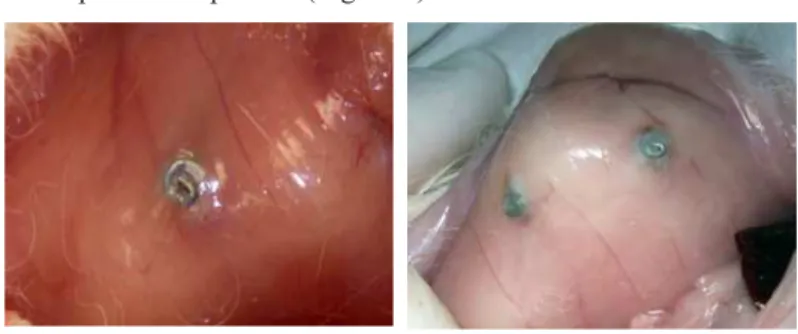
No adhesions were observed through laparoscopy where the clips were implanted (Figure 1).
FIGURE 1 - No adhesion found and peritonealization of the
titanium tacks was observed.
Discussion
Mesh ixation in abdominal cavity is important to avoid
dislocation7, but may cause adhesions8.
There are few studies about ixation materials without
the presence of prostheses6.
Non-use of prosthesis takes away the inluence of
adhesions formation.
Goldenberg A et al.
432 - Acta Cirúrgica Brasileira - Vol. 27 (6) 2012
adhesions with prostheses in contact with viscera, independent of
the type and protection of the mesh1-3.
Rabbits are used in research to evaluate types of mesh
and it is a satisfactory biological model1-3.
Authors that studied mesh ixation and respective
adhesions used prosthesis, that dificults conclusions4,6,7,8.
Only one author studied four different types of ixation
without the use of meshes in rats6.
We applied two titanium spiral tacks in each animal simulating ixation of the mesh.
The clips were positioned in the same place and both were near each other.
Thirty days are enough to evaluate adhesions formation.
We did not ind any adhesions at this time.
Adhesions ind in our previous studies must be considered due to prosthesis other than to the ixation procedure.
Conclusion
Titanium spiral tacks do not contribute to intra-abdominal adhesion formation in rabbits.
References
1. Goldenberg A, Matone J, Marcondes W, Herbella FAM, Farah
JFM. Comparative study of inlammatory response and adhesions formation after ixation of different meshes for inguinal hernia repair in rabbits. Acta Cir Bras. 2005;20:347-52.
2. Aydos RD, Silva IS, Goldenberg S, Goldenberg A, Simões MJ,
Takita LC, Nigro AJT. Estudo comparativo do efeito das telas de
politetraluoroetileno expandido e de polipropileno, colocadas
por laparoscopia, em hérnias ventrais produzidas em coelhos.
Acta Cir Bras. 1999;14(2). Disponível em www.scielo.br/acb. 3. Brandão SC, Goldenberg S, Goldenberg A, Amaral DM, Pias VMS, Portella AO. Efeitos da tela de politetraluoroetileno expandido colocada no espaço pré-peritoneal por vídeolaparoscopia em suínos. Acta Cir Bras.1998;13(3). Disponível em www.scielo.
br/acb.
4. Karahasanoglu T, Onur E, Baca B, Hamzaoglu I, Pekmezci S, Boler DE, Kilic N, Altug T. Spiral tacks may contribute to intra-abdominal
adhesion formation. Surg Today. 2004;34:860-4.
5. Eriksen JR, Bech JI, Linnemann D, Rosenberg J. Laparoscopic intraperitoneal mesh ixation with ibrin sealant (Tisseel) vs. titanium tacks: a randomised controlled experimental study in pigs Hernia. 2008;12:483-91.
6. Gungor B, Malazgirt Z, Topgül K, Gök A, Bilgin M, Yürüker S.
Comparative evaluation of adhesions to intraperitoneally placed
ixation materials: a laparoscopic study in rats: adhesions to ixation materials.Indian J Surg. 2010;72:475-80.
7. Joels CS, Matthews BD, Kercher KW, Austin C, Norton HJ,
Williams TC, Heniford BT. Evaluation of adhesion formation, mesh
ixation strength, and hydroxyproline content after intraabdominal placement of polytetraluoroethylene mesh secured using titanium
spiral tacks, nitinol anchors, and polypropylene suture or polyglactin
910 suture. Surg Endosc. 2005;19:780-5.
8. Byrd JF, Agee N, Swan RZ, Lau KN, Heath JJ, Mckillop IH,
Sindram D, Martinie JB, Iannitti DA. Evaluation of absorbable
and permanent mesh ixation devices: adhesion formation and mechanical strength. Hernia. 2011;15:553-8.
Correspondence: Alberto Goldenberg
Rua Brigadeiro Armando Trompowsky, 705 05655-050 São Paulo – SP Brasil
Tel.: (55 11)2151-5214 Fax: (55 11)3746-7363
Received: February 18, 2012 Review: April 14, 2012 Accepted: May 16, 2012 Conlict of interest: none
Financial source: none
1Research performed at experimental laboratory of Albert Einstein