Article
Study On the Use of Oxidant Scrubbers for Elimination of Interferences Due to
Nitrogen Dioxide in Analysis of Atmospheric Dimethylsulfide
Beatriz A. Rodrigues, Luís R.M. Pitombo, Arnaldo A. Cardoso*
Departamento de Química Analítica, Universidade Estadual Paulista, CP 355, 14800-900, Araraquara - SP, Brazil
Neste trabalho foi avaliado o desempenho de filtros para dióxido de nitrogênio, buscando evitar perdas durante a amostragem de sulfetos orgânicos, provocadas por oxidantes atmosféricos. Diferentes compostos e misturas foram usadas para recobrir superfícies sólidas empregadas na preparação destes filtros. Um sistema automatizado de análise em fluxo foi utilizado para comparar a eficiência de retenção de dióxido de nitrogênio pelos filtros. Entre os materiais testados na preparação dos filtros, as melhores escolhas foram papel ou lã de vidro impregnados com a mistura de sulfato de ferro (II), ácido sulfúrico e ácido pirogalico e ainda os filtros feitos de papel impregnados com trietanolamina. Os resultados obtidos em laboratório com mistura de gás padrão de dimetilsulfeto e experimentos em campo confirmaram a qualidade dos filtros e indicaram que eles podem ser utilizados para evitar a oxidação de sulfetos orgânicos durante a sua amostragem.
In this work, oxidant scrubbers were evaluated for their ability to prevent sampling losses of dimethylsulfide caused by reactions with nitrogen dioxide. Various compounds and mixtures were used in the preparation of the oxidant scrubbers. An automatic flow analysis device was used to compare scrubbing efficiency for nitrogen dioxide. Among the scrubbers tested, the best were shown to be the one made with filter paper or glass wool coated with iron (II) sulfate, sulfuric acid and pyrogallic acid, and the one made from with paper coated with triethanolamine. The results obtained under laboratory conditions, using dimethylsulfide standard gas, and in field experiments confirmed that these scrubbers are suitable for the prevention of oxidation during sampling.
Keywords: dimethylsulfide, atmospheric trace gases, sampling technique, nitrogen dioxide scavenger.
Printed in Brazil 0103 - 5053 $6.00+0.00
Introduction
Sulfur gases and their reaction products play an impor-tant role in the chemistry of the global troposphere and in the biogeochemical sulfur cycle1-5. Sulfur compounds are re-leased into the atmosphere by various natural and anthropo-genic sources. A substantial increase in anthropoanthropo-genic sul-fur emission has taken place in the last century. It is respon-sible for malodorous odor in sewage systems, in pulp and paperindustry6-8. In petrochemical processes sulfur com-pounds can be emitted and cause air pollution during oil pros-pecting, refining and when fuel is burned7,9,10. A few de-cades ago, biogenic H2S was believed to be the dominant form in which gaseous sulfur was released to the atmosphere. The importance of H2S emission has been continually re-vised ever since3-5,11. Current thought attributes an increas-ing role to dimethylsulfide (CH3)2S (DMS).
Although knowledge of the chemistry of sulfur com-pounds in the environment has much improved, there is
evidence to suggest that determination of reduced sulfur compounds may often be subject to significant inaccura-cies11. The main source of uncertainty associated with these data occurs during the collection step. Frequently, the analy-sis of these compounds requires a cryogenic preconcentra-tion step to enhance low atmospheric concentrapreconcentra-tions. The cotrapping of water has been a complex problem: the ice may limit sample volumes and water may be injected into columns12 . However, the mainproblem is the destruction of sulfur compounds by oxidizing species11-15. The species commonly present in the atmosphere, which may cause sam-pling losses, include ozone (O3), nitrogen dioxide (NO2) and hydrogen peroxide (H2O2).
Several types of oxidant scrubbers have been suggested to remove oxidants during cryogenic preconcentration. Braman and co-workers16 used glass pearl coated with
Na2CO3, Barnard co-workers17 and Andreae and
Raemdonck18 used packed tubes containing Na
Johnson19 used glass fiber filters coated with NaOH. A KOH filter scrubber presented rapid loss of efficiency com-pared to carbonate-based Anakrom scrubbers20. Hofmann co-workers12used a Nafion drier in combination with cot-ton wadding as an oxidant scavenger. Davison and Allen13 investigated in-line scrubbers utilizing Na2CO3, FeSO4.7H2O, KI or KBr, either pure or coated onto a chro-matographic support, which they found to be ineffective for oxidant removal in moderately polluted air. The KI scrub-bers were, however, effective when used in clean remote marine air. Comparing the various oxidant scrubbers, Kittler co-workers14 found the KI/glycerol/Vitrex filter to be supe-rior to the scrubbers using KOH, NaOH, MnO2 and Na2CO3. Other methods have included neutral aqueous potassium iodide21, ferrous sulfate22 and 100% cotton wadding in combination with a Nafion drier23. Although much work has been done on the analysis of organic sulfides, the na-ture of the oxidant interference remains largely unknown. The development and use of new scrubbers is an empirical process11 . So far there is no consensus about the use of oxidant scrubbers in the analysis of reduced sulfides.
The present work describes the development of oxi-dant scrubbers for organic sulfide analysis in air.The oxi-dant scrubbers were made out of solid supports coated with reactive species, to remove the oxidants before the collection of organic sulfide. Comparative data on the scrub-bers was obtained by automated flow analysis. Dimethylsulfide, the commonest organic sulfide found in the air, and nitrogen dioxide, the most common oxidant found in the air, were used in the development of this work.
Experimental
Method of sampling and analysis of organic sulfides
The method used to sample and analyze organic sulfides is non-cryogenic and has already been reported24,25. Glass wool coated with sodium tetrachloropalladate (II) was shown to be very efficient for the collection of dimethylsulfide (DMS). The resulting complex ([Pd(DMS)2Cl2]) is only slightly soluble in water, but readily soluble in organic solvents. The solutions showed a well-defined absorption peak in the near UV region (e=17.05 x10³ l mol-1 cm-1 at 303 nm) and the absorbance values were proportional to the amount of DMS present. Gases such as H2S, CO, CS2, COS, NH3 and SO2 did not cause interference because they neither react with sodium tetrachloropalladate (II) nor produce compounds soluble in the solvents used to extract the [Pd(DMS)2Cl2](s). Oxidants such as nitrogen dioxide react with complexed DMS, interfering in subsequent DMS estimation.
The sodium tetrachloropalladate (II) solution was
prepared by dissolving 0.6 mmol PdCl2 and 5.1 mmol NaCl in 55 mL of 0.1 mol L hydrochloric acid. This solution was used to coat 1.0 g of glass wool. The coating procedure was that recommended in the previous paper24 .
Sampling and analysis followed the protocol: a) a sor-bent tube containing substarte was connected to the stream of the DMS gas mixture; b) after collection of DMS, the pack-ing substrate was transferred to an extraction tube; c) the contents of the extraction tube were shaken with toluene until dissolution of [Pd(DMS)2Cl2] was complete; d) the solution was transferred to a 5.0 mL volumetric flask and the volume was adjusted; e) a photometric measurement was made at 303 nm with a Varian-Cary 219 spectrophotometer, using quartz cuvettes of 10.0 mm optical path length.
Gas generation
The experimental arrangement is shown in Figure 1. The pumped air was purified in a column containing, in sequence, silica gel, soda lime and activated carbon. The air stream was maintained at a steady temperature by a coil and flowed into a glass chamber containing a permeation tube. The air flow was controlled at 430 mLmin-1 using a critical orifice. For the DMS standard gas mixture, a permeation tube emit-ting 519 ngDMS min-1 at 30ºC (VICI Metronics, Santa Clara, CA) was used. For the NO2 standard gas mixture, the per-meation tube described by Teckentrup and Klockow26, filled with condensed NO2 gas was used. The permeation rate of NO2 was evaluated by the oxidation of an iodine solution, according to the procedure described by Littman
and Benoliel27.The permeation rate measured was
1.2µg NO2 min-1 at 27ºC.
Figure 1. Schematic diagram of apparatus used to produce the gas mixture. a) silica gel; b) soda lime; c) activated carbon; d) permeation tube; e) thermostat bath; f) NO2 scrubber; g) sorbent tube (Na2PdCl4); h) critical orifice; i) air pump.
Oxidant scrubber materials
which should enhance the reactions with nitrogen dioxide. At first, 24 different compositions were tested. The support-ing material was prepared from Whatman qualitative filter paper cut into small discs of 5mm diameter. The filter paper was soaked in solution, using 50 mLof aqueous solution per 2.5 g. of filter paper. The filters were dried at 60ºC in an stove with air circulation, producing the oxidant scrubber materi-als, which were stored in a desiccator in the dark.
Use of packed scrubbers
A glass tube with flow connections as in Figure 2 (1.5 cm internal diameter, 10 cm length) was filled with 3 g im-pregnated filter discs and closed with a Teflon stopper. The scrubber discs were retained in the tube with silanized wool glass. Kittler and co-workers14 proposed visual indication of the oxidation of iodide solution to measure the capacity of substrates for retention of oxidant. The blue/purple col-oration of a starch-based iodine indicator was used to com-pare of several scrubbing systems. This visual comparison of the filters showed a discrepancy of up 24% among repli-cates. With the purpose of improving this evaluation stan-dard, the measurement of the iodine formed by oxidation was adapted for automated flow analysis (Figure 3). The solution was prepared as suggested by Littman and Benoliel27 and contained about 200g potassium iodide, 36g disodium phosphate dodecahydrate, and 14g potassium dihydrogen phosphate per liter of solution. The solution of iodine in 20% potassium iodide and starch exhibits a blue color with a characteristic absorption spectrum and an in-tense maximum at 477 nm. In this procedure, the scrubber was connected to the stream of air containing nitrogen di-oxide. The air, after passing through the scrubber, readily oxidized the iodide to iodine by any nitrogen dioxide re-maining. The absorbance of the iodine solution was con-tinuously measured and recorded. The fast formation of iodine was a signal of scrubber breakthrough.
Results and Discussion
Interference of nitrogen dioxide
The reaction of nitrogen dioxide with the dimethylsulfide collected as [Pd(DMS)2Cl2](s) was evaluated. The procedure involved two steps: first the Na2PdCl4(s) sorbent tube was connected up to the stream of DMS gas mixture standard for 30 min; in the second step, air containing nitrogen dioxide was passed through the sorbent tube in different periods of time. The absorption spectra of the products formed are shown in Figure 4. The absorption spectra of compounds formed by reaction of nitrogen dioxide with the [Pd(DMS)2Cl2](s) showed the transformation of this compound.
Figure 2. Construction of glass scrubber tube.
Figure 3. Schematic diagram of automated flow analysis for the measurement of iodine formation. a) air pump; b) security flask; c) bubble flask; d) NO2 scrubber; e) permeation chamber; f) permeation tube; g) coil of glass; h) thermostat bath; i) iodide solution; j) peristaltic pump; l) spectrophotometer; m) chart recorder.
Figure 4. Absorption spectra of compounds formed from the reaction of nitrogen dioxide and [Pd(DMS)2Cl2]. The time that the air/NO2 passed through the sorbent tube was: t= 0 min (A); t= 30 min (B) and, t= 6 h (C).
Efficiency of oxidant scrubbers
are two parameters which must be determined for a specific analytical method applied to the compound of interest. If, as here, a sampling time of 30 min at flow rate 430 mL min-1 is chosen for organic sulfide in air, then the oxidant scrub-ber should remain effective during this period. As a param-eter for evaluating the efficiency of oxidant scrubbers for 30 min of sampling, the capacity of a mixture of NO2 and air to oxidize the iodide was first measured. When the air con-taining nitrogen dioxide was passed directly through the iodide solution at 430 ml min-1, the absorbance of the solu-tion increased linearly (Figure 5), and after 30 min, the sig-nal measured was 0.330 (absorbance units), corresponding to the iodine formed by reaction of 36 µg of NO2. In se-quence, each one of the scrubbers was connected to the system upstream of the iodide solution and the absorbance of the solution measured. The oxidation of iodide depended on the quantity of NO2 not retained by the scrubber. To evaluate the efficiency of each oxidant scrubber with re-spect to retention of NO2 during a 30 min sampling interval, the following equation was used:
(
)
e= 0 330−A x 0 330 100
30
.
. (1)
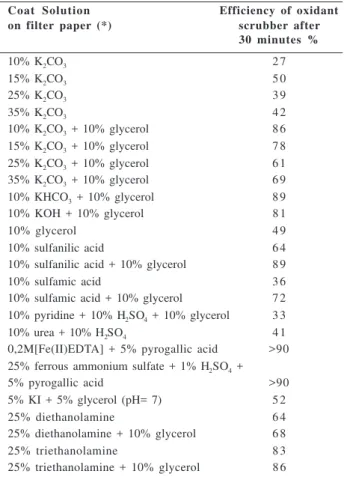
where e is the efficiency in percentage of an oxidant scrub-ber in retention of NO2 after 30 min; 0.330 is the absorbance of the iodide solution after containing nitrogen dioxide was passed through the solution for 30 min; and A30 is the ab-sorbance of the iodide solution after scrubbed air contained nitrogen dioxide had been passed through the solution for 30 min. Table 1 lists scrubber performance for the 24 different compositions of coating solution studied. The results showed a discrepancy of up to 5% among replicates.
Effects of reduction of the amount of oxidant scrubber material
In order to design a scrubber that was more compact and easier to handle, the amounts of sorbent materials were reduced and the efficiency of scrubbers re-evaluated. Some sorbent were not tested because their preparation is more laborious. These experiments were carried out using a Teflon tube (0.3 cm internal diameter and 7.5 cm length) fitted with connectors on each end. The packing substrates, about 0.3 g, were held inside the Teflon tube by silanized glass wool. The results showed that the scrubbers maintained a good retention capacity for nitrogen dioxide (Table 2). These scrubbers were then evaluated during collection of DMS onto sampling tubes located downstream of the scrubbers.
Recovery of DMS using different oxidant scrubbers
It is important that the oxidant scrubbers should neither react with DMS, nor adsorb DMS present in the sample air stream. Tests were conducted to measure possible losses of Figure 5. Absorbance of iodine formed. Air with NO2 (36 µg mL-1)
was scrubbed and passed through iodide solution; The oxidant scrubbers used were made with the following coating solutions: a) 10% (m/v) K2CO3; b) 5% (m/v) KI + 5% (v/V) glycerol (pH =7); c) 25% (m/v) ferrous ammonium sulfate + 1% (v/v) sulfuric acid + 5% (m/v) pyrogallic acid; d) air with NO2 passed through iodide solution with no scrubber.
Table 1. Efficiency of oxidant scrubber in retention of 36 µg NO2
for 30 min. The glass tube was filled with different oxidant scrubber materials of coated supporting material (3 g). Scrubber capacity was evaluated by oxidation of iodide solution.
Coat Solution Efficiency of oxidant
on filter paper (*) scrubber after
30 minutes %
10% K2CO3 2 7
15% K2CO3 5 0
25% K2CO3 3 9
35% K2CO3 4 2
10% K2CO3 + 10% glycerol 8 6
15% K2CO3 + 10% glycerol 7 8
25% K2CO3 + 10% glycerol 6 1
35% K2CO3 + 10% glycerol 6 9
10% KHCO3 + 10% glycerol 8 9
10% KOH + 10% glycerol 8 1
10% glycerol 4 9
10% sulfanilic acid 6 4
10% sulfanilic acid + 10% glycerol 8 9
10% sulfamic acid 3 6
10% sulfamic acid + 10% glycerol 7 2
10% pyridine + 10% H2SO4 + 10% glycerol 3 3
10% urea + 10% H2SO4 4 1
0,2M[Fe(II)EDTA] + 5% pyrogallic acid >90 25% ferrous ammonium sulfate + 1% H2SO4 +
5% pyrogallic acid >90
5% KI + 5% glycerol (pH= 7) 5 2
25% diethanolamine 6 4
25% diethanolamine + 10% glycerol 6 8
25% triethanolamine 8 3
25% triethanolamine + 10% glycerol 8 6
analyte. The DMS standard gas was passed through the oxidant scrubber, and it was collected in the sampling tube over 30 min intervals. Table 3 shows the results of these experiments. The best coating solutions used were: a) 25% (m/v) ferrous ammonium sulfate, 1% (v/v) sulfuric acid and 5% pyrogallic acid; b) 25% triethanolamine. These solutions were also used to coat different supporting materials includ-ing: glass wool (fiber medium), silica gel (1-4 mm), and glass pearl (3 mm diameter). Scrubbers containing these materials were tested with the DMS standard gas using the same pro-cedure. Only the solution of 25% (m/v) ferrous ammonium sulfate, 1% (v/v) sulfuric acid and 5% (v/v) pyrogallic acid
coated on glass wool was shown to be inert towards DMS. Test of oxidant scrubbers in field sampling
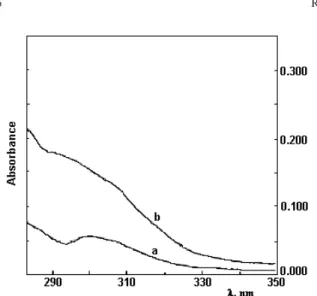
The analytical method reported here in was used to measure atmospheric DMS levels in the environment. The basic system for sampling comprised an air pump, a gasmeter, a sampling tube (glass wool coated with Na2PdCl4) and a scrubber. A dust filter made from silanized glass wool was placed in front of the filter pack. The oxi-dant scrubber made from the solution of 25% (m/v) ferrous ammonium sulfate, 1% (v/v) sulfuric acid and 5% (v/v) py-rogallic acid coated on to filter paper was used because it was easier to handle than the other filters. All samples were collected for 3 h because the levels of DMS were unknown. The sampling was conducted at the Chemistry Institute (Araraquara SP Brasil), July 1995. This site is an urban area and the trace gas compositions may have been affected by the presence of an automobile traffic highway within 500 m, and emissions from anaerobic wastewater treatment 2 Km distant. In the winter (June and July), periodic episodes of odor pollution have been noted at this site. Measurements carried out on polluted days resulted that the level of DMS varied from 3.8-12.4 µg m3. Figure 6 shows the absorption spectra of solutions resulting from field sampling with and without scrubbers. When the scrubber was used, the or-ganic solution obtained from the sampling tube, showed a well-defined absorption peak, with the maximum absorbance at 303 nm characteristic of unoxidized [Pd(DMS)2Cl2]. On the other hand, when the filter pack was removed during sampling, the absorption spectrum of the solution obtained showed the existence of oxidized [Pd(DMS)2Cl2].
Conclusion
Direct analysis of DMS is generally impossible due to their low concentrations in air, which are frequently below the direct quantification limits of the current methods. Deter-mination of atmospheric DMS employing preconcentration can result in very large sampling losses unless potential oxi-dants in the air sample are removed prior to the concentra-tion step. Although much work has been done on the analy-Table 2. Efficiency of oxidant scrubber in retention of 36 µg NO2
using the Teflon tube of 0.3 cm internal diameter and 7.5 cm length and with 0,3 g of coated support material.
Coat Solution Efficiency of oxidant
on filter paper (*) scrubber %
10% K2CO3 + 10% glycerol 5 2
10% sulfanilic acid + 10% glycerol 5 2
10% sulfamic acid + 10% glycerol 6 9
25% ferrous ammonium sulfate +
1% H2SO4 + 5% pyrogallic acid >90
25% diethanolamine 6 4
25% triethanolamine 8 5
Table 3. Interference of oxidant scrubbers in sampling of DMS. The DMS standard gas solution was passed through each scrubber collected for 30 min (15.6 µg DMS).
Scrubber Relative DMS Recovery
%
10% K2CO3 + 10% glycerol 7 1
10% sulfanilic acid + 10% glycerol 7 6 10% sulfamic acid + 10% glycerol 7 1 25% ferrous ammonium sulfate +
1% H2SO4 + 5% pyrogallic acid 9 7
25% diethanolamine 8 2
25% triethanolamine 9 6
Studies of preservation DMS collected in sampling tube
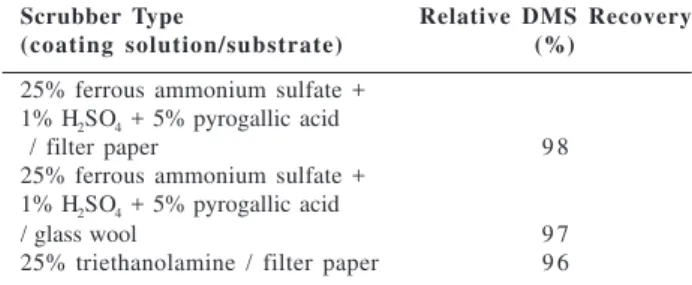
The stability of DMS collected as [Pd(DMS)2Cl2](s) was assessed. DMS (15.6 µg) was initially collected in the sam-pling tube, after which the air/nitrogen dioxide mixture, scrubbed by passage through one of three devices, was passed through the sampling tube for 2 h (about 144 µg NO2). The results show (Table 4) that the scrubbers employed can be used suc-cessfully for retention of NO2, and hence preservation of DMS collected. It should be noted that the NO2 concentration used in this experiment was many times higher than typical NO2 concentrations found in the polluted ambient atmosphere.
Table 4. Losses of DMS collected. DMS (15.6 µg) was collected on the sorbent, then the scrubbed air/NO2 mixture was passed through
the Pd(DMS)2Cl2 for 2 h (14.4 mg NO2).
Scrubber Type Relative DMS Recovery
(coating solution/substrate) (%)
25% ferrous ammonium sulfate + 1% H2SO4 + 5% pyrogallic acid
/ filter paper 9 8
25% ferrous ammonium sulfate + 1% H2SO4 + 5% pyrogallic acid
/ glass wool 9 7
sis of DMS in air, the nature of the oxidant interference re-mains largely unknown. The gas phase reaction of DMS with atmospheric oxidants such as ozone or NO2 is extremely slow28,29. In the preconcentration procedure it is possible that the through surface sorption the concentration of both oxidant and sulfur compound are increased such that the reaction proceeds more rapidly than in the gas phase11.
Oxidant scrubbers were evaluated for their ability to pre-vent sampling losses of DMS. The comparison of the filters showed a discrepancy of up to 5% among replicates. Scrub-bers utilizing either (a) a mixture of 25% ferrous ammonium sulfate, 1% H2SO4 and 5% pyrogallic acid or (b) 25% trietha-nolamine possess efficient retention capacity for NO2.The scrubbers are easy to prepare and to store. The results showed that these scrubbers are suitable for the preserva-tion of dimethylsulfide collected during atmospheric sam-pling. Furthermore, the technique employing such scrub-bers, combined with the Na2PdCl4 sorbent used for precon-centration and analysis of DMS in ambient air, requires mini-mal sample handling and instrumentation. Results obtained under laboratory conditions and during the course of a small field experiment confirm that the use of a scrubber in combi-nation with a Na2PdCl4 sorbent is suitable for measurements of DMS. Therefore, the described method offers a useful alternative for the determination of DMS in ambient air. In addition, use of the scrubbers described could probably be adapted to other analytical techniques of precocentration such as cryogenic trapping or adsoption on a solid support.
Acknowledgments
This work was abstracted from the PhD thesis submit-ted by B. A Rodrigues to the Instituto de Química de Araraquara, State University of São Paulo, Brazil (UNESP).
The authors wish to acknowledge the financial support of the Coordenação do Aperfeiçoamento de Pessoal de Nïvel Superior (CAPES) and Conselho Nacional do Desenvolvi-mento Científico e Tecnológico (CNPq), Brazil.
References
1. Cullis, C. F.;.Hirschler, M. M. Atmos. Environ.1980,
14, 1263.
2. Moller, D. Atmos Environ1984, 18, 29.
3. Kellogg, W. W; Candle, R. D.;.Allen, R. E; Lazrus; A. L; Martel, J. A Science 1972, 175, 587
4. Berresheeim, H. J. Geophys. Res. 1987, 92,13245 5. Cardoso A. A., ; Pitombo, L. R. M. Quím. Nova1992,
15, 219.
6. Cruse, H; Pomeroy, R. D. J. Amer. Waters Works Assoc. 1969, 61,677
7. Finnerty, W. R. in Bioconversion of Waste Materials to Industrial Product; Martin, A. M. Ed; Elservier New York,1991, p 475-500.
8. de Souza, T. L. C. JAPCA 1988, 38, 792
9. Kohl, A.; Riesenfeld, F. Gas Purification; 4th ed. Gulf Publishing Company, Texas, 1985.
10. Taver, G. A.; Dasgupta, P. K. Atmos Environ 1995,
29, 1291
11. Saltzman, E. S.;.Cooper, D. J. In Biogenic Sulfur in the Environment; Saltzman, E.S.; Cooper, D.J. Ed, Washington, ACS symposium serie,1989, p. 330-335. 12. Hofmann, U.; Hofmann, R; Kesselmeier, J. Atmos
Environ 1992, 26, 2445.
13. Davison, B. M; Allen A. G. Atmos Environ 1994,
28, 1721.
14. Kittler, P.; Swan, H.; Ivey, J. Atmos. Environ.1992,
26, 2661.
15. Wardencki, W. J.Chromatogr.A 1998, 793, 1 16. Braman, R. S.; Ammons, J. M.;Bricker, J. L. Anal. Chem.
1978, 50, 992.
17. Barnard, W. R.; Andreae, M. O.; Watkins, W. E.; Bingemer, H.; Georgii, H. W. J.Geophys. Res. 1982,
87, 787.
18. Andreae, M. O.; Raemdonck, H. Science 1983,
221, 744.
19. Bates, T. S.; Johnson, J. E. EOS 1990, 71, 1254. 20. Saltzman, E.; Copper D. J. Atmos.Chem.1988, 6, 191 21. Cooper, D. J.; Saltzman, E. S. J. Atmos Chem.1991,
12, 153.
22. Watts, S. F. Environ. Technol. Lett.1989, 10, 777. 23. Persson, C.; Leck, C. Anal. Chem.1994, 66, 983 24. Pitombo, L. R. M.; Cardoso, A. A. Intern. J. Environ.
Anal. Chem. 1994, 54, 221.
25. Cardoso, A. A. Tetracloropaladato (II) de Sódio
Sobre Sólidos, Sorventes Para Preconcentração de Compostos Reduzidos de Enxofre, Instituto de Química, USP 1991, Ph.D. thesis.
26. Teckentrup, A.; Klockow, D. Anal. Chem. 1978, 50, 1728.
27. Littman, F. E.; Benoliel, R. W. Anal.Chem. 1953, 25, 1480. 28. Yin, F.; Grosjean; Seinfeld; J. H. J. Geophys. Res. 1986,
91, 14417
29. Grosjean; D. Environ. Sci. Technol. 1984, 18, 460.

![Figure 4. Absorption spectra of compounds formed from the reaction of nitrogen dioxide and [Pd(DMS) 2 Cl 2 ]](https://thumb-eu.123doks.com/thumbv2/123dok_br/16289709.185263/3.892.214.348.875.1104/figure-absorption-spectra-compounds-formed-reaction-nitrogen-dioxide.webp)