See descusseons, stats, and author profeles for thes publecateon at: https://www.researchgate.net/publecateon/282044685
Does a mandibular RDP and new maxillary CD
improve masticatory efficiency and quality of
life in patients with a mandibular Kennedy
class I arch?
ARTICLE in CLINICAL ORAL INVESTIGATIONS · SEPTEMBER 2015
Impact Factor: 2.35 · DOI: 10.1007/s00784-015-1596-z
READS
39
5 AUTHORS, INCLUDING:
K.C. Deas
São Paulo State Uneversety
6PUBLICATIONS 15CITATIONS
SEE PROFILE
Adreana F.P. Carreero
Uneversedade Federal do Reo Grande do Norte
45PUBLICATIONS 125CITATIONS
SEE PROFILE
C.M.B.M. Resende
Uneversedade Federal do Reo Grande do Norte
5PUBLICATIONS 16CITATIONS
SEE PROFILE
Welson mestrener Juneor
Uneversety of São Paulo
12PUBLICATIONS 47CITATIONS
SEE PROFILE
ORIGINAL ARTICLE
Does a mandibular RDP and new maxillary CD improve
masticatory efficiency and quality of life in patients
with a mandibular Kennedy class I arch?
Kássia De Carvalho Dias1,5&Adriana Da Fonte Porto Carreiro2&
Camila Maria Bastos Machado Resende3&Ana Clara Soares Paiva Tôrres3&
Wilson Mestriner Júnior4
Received: 26 October 2014 / Accepted: 9 September 2015
#Springer-Verlag Berlin Heidelberg 2015
Abstract
ObjectivesTo evaluate the change in masticatory efficiency and quality of life of patients treated with mandibular Kennedy class I removable partial dentures (RPDs) and max-illary complete dentures at the Department of Dentistry of the Federal University of Rio Grande do Norte.
Materials and methodsA total of 33 Kennedy class I patients were rehabilitated with maxillary complete dentures, and mandibular RPDs were selected for this non-randomized pro-spective intervention study. The patients had a mean age of 59.1 years. Masticatory efficiency was evaluated by colori-metric assay using fuchsin capsules. The measurements were conducted at baseline and 2 and 6 months after prosthesis insertion. Quality of life was evaluated using the Oral Health Impact Profile (OHIP-14) at baseline and 6 months after den-ture insertion. The Kolmogorov-Smirnov normality test was applied. Masticatory efficiency was evaluated by repeated measures ANOVA. Oral health-related quality of life was compared using the pairedttest.
Results There was no statistically significant difference in masticatory efficiency after denture insertion (p= 0.101). Significant differences were found (p=0.010) for oral health-related quality of life. A significant improvement in psycho-logical discomfort (p< 0.01) and psychological disability (p<0.01) was observed. Mean difference value (95 % confi-dence interval) was 6.8 (3.8 to 9.7) points, reflecting a low impact of oral health on quality of life, considering the 0–56 range of variation of the OHIP-14 and a Cohen’sdof 1.13. Conclusion According to the results of the present study, re-habilitation with Kennedy class I RPDs and complete dentures did not influence masticatory efficiency but improved oral health-related quality of life.
Clinical relevance The association between the patient’s qual-ity of life and the masticatory efficiency is important for treat-ment predictability.
Keywords Mandible . Mastication . Quality of life . Partially edentulous arch . Dental prosthesis
* Kássia De Carvalho Dias
Adriana Da Fonte Porto Carreiro [email protected]
Camila Maria Bastos Machado Resende [email protected]
Ana Clara Soares Paiva Tôrres [email protected]
Wilson Mestriner Júnior [email protected]
1 Department of Dental Materials and Prosthodontics, Oral
Rehabilitation Program—Araraquara School of Dentistry
UNESP—Univ. Estadual Paulista, Centro,
14801903 Araraquara, SP, Brazil
2
Center of Health Science, Department of Dentistry, Federal University of Rio Grande do Norte, Avenida Salgado Filho, 1787, Lagoa Nova, 59056-000 Natal, RN, Brazil
3
Center of Health Science, Federal University of Rio Grande do Norte, Avenida Senador Salgado Filho, 1787, Lagoa Nova, 59056-000 Natal, RN, Brazil
4
Department of Pediatric Clinic and Preventive and Sanitary Dentistry, University of São Paulo, Dental School of Ribeirão Preto, Avenida do Café s/no, Monte Alegre, 14040-904 Ribeirão Preto, SP, Brazil
5 Department of Dental Materials and Prosthodontics, UNESP
—Univ.
Introduction
The oral rehabilitation of edentulous patients aims to restore masticatory function, impairment of which can restrict nutri-tion and digesnutri-tion, and improve esthetics [1]. Walls et al. [2] stated that dentition is a significant factor for efficient chewing, which is important for the maintenance of bodily nutrition as well as systemic, psychological, and physical functions. However, other studies have suggested that nutri-tion does not improve after the fitting of new dentures [3–5]. Awad et al. [3] suggested that implant overdentures do not have a more positive post-treatment effect on the nutritional state of elderly edentate individuals than new complete den-tures. Similarly, Khoo el al. [4] demonstrated that the insertion of mandibular implant-supported overdentures did not cause an improvement in body mass index (BMI), serum albumin value, or nutritional status. Muller et al. [5] found no differ-ence in chewing efficiency between an implant overdenture group and a mandibular complete denture group, in terms of BMI, nutritional assessment, and blood markers, reflecting the fact that nutritional intake is complex and not solely deter-mined by dental condition.
Several methods of evaluating the masticatory performance of Kennedy class patients, with or without free-end removable partial dentures, have been suggested. However, no significant difference was found when comparing patients who used RPDs and those who did not. Those studies that found a dif-ference in terms of gender and occlusal units employed inac-curate methods of evaluation [6,7]. In addition, chewing force has at times been evaluated as a single, isolated factor, despite the fact that other factors, such as craniofacial dimensions, may also influence the chewing force [8]. A reduction in mas-ticatory function may also be related to reduced occlusal con-tact [9], which deteriorates after the loss of posterior teeth.
According evaluations of oral health-related quality of life, the lack of rehabilitation after tooth loss affects quality of life. In this sense, partial edentulism represents a negative factor, as it causes pain and influences chewing, phonetics, and esthetics [9,10].
Oral health-related quality of life (OHRQoL) is the pa-tient’s perspective of his or her oral health. Several question-naires have been developed to evaluate the association be-tween quality of life and oral health. According to Locker’s conceptual model, the Oral Health Impact Profile (OHIP) has verified satisfactory psychometric properties and has been demonstrated to be the most sensitive method of detecting dissatisfaction with prosthetic rehabilitation [11–13]. The OHIP-14 is a concise questionnaire showing similar results to the original, and longer, OHIP-49 [14,15].
Partial edentulism affects chewing and the quality of life of patients. There are some limitations with the use of a remov-able partial denture due to the supporting structures. A clasp-retained RPD, a low-cost rehabilitation, can contribute to the
restoration of some oral functions lost after tooth loss, and studies have shown that such treatment often leads to an im-provement in OHRQoL [16]. Arabi et al. [17] found that the effects of prosthodontic interventions on patient perception seem to last for at least 2 years, including in a group treated with a RPD. While better quality of life results have been obtained with fixed dentures, additional studies are required to evaluate the effect of conventional fixed and removable dentures in a global context [16,17]. Little data is available from randomized controlled clinical trials (RCTs) of treatment options. Most of the studies evaluating oral health-related quality of life applied the test within the 5 years following rehabilitation [18].
The recent increase in the number of publications focusing on the long-term effects of prosthodontic interventions on pa-tient perceptions implies a steadily increasing interest in this information [17,19]. However, although OHRQoL is expect-ed to be an important outcome of prosthodontics therapy, cross-sectional and longitudinal data, according to John et al. [16], is available mainly for patients treated with complete dentures or implant-supported overdentures, such as in the studies of Allen et al. [19] and Heydecke et al. [20]. Furthermore, evaluation of masticatory performance and qual-ity of life together can contribute to improved choice of treat-ment and positively influence the prognosis. Therefore, the aim of this study was to evaluate the influence of new free-end removable partial dentures and maxillary complete den-tures on masticatory function and quality of life in Kennedy class I patients. The hypothesis was that RPD would have a positive effect on masticatory efficiency and on oral health-related quality of life.
Materials and methods
Setting and participants
A non-randomized prospective intervention study (2 and 6 months) was conducted. Kennedy class I patients were re-habilitated with maxillary complete dentures and mandibular RPDs. The treatment was conducted at the Department of Dentistry of the Federal University of Rio Grande do Norte (UFRN). Preexisting dentures were replaced due to poor qual-ity. The mean number of remaining mandibular teeth was 6 (±1.1), ranging from 4 to 8 at baseline for the group without RDP. The mean number of remaining mandibular teeth was 5 (±1.5), ranging from 2 to 7 at baseline for the group with RDP. The occlusal units (OUs) ranged from 0 to 2, with a mean of 0.54 (±0.7) OU at baseline for the group without RDP, and ranging from 0 to 2, with a mean of 0.56 (±0.7) OU for the group with RDP. The study was approved by the Research Ethics Committee of University Hospital Onofre Lopes (pro-tocol #60244).
In order to determine the socioeconomic profile of the re-search subjects, participants answered a questionnaire on health care, education level, and monthly individual income, categorized by the number of minimum wages, which is de-fined as the lowest wage that a company can pay an employee, established by law and reassessed every year based on the cost of living of the population. Table1shows the socioeconomic information of the patients. Of the patients, 57.5 % had health insurance coverage, while 51.5 % had not finished secondary education, and 60.6 % had a monthly individual income 0–2 times the minimum wage.
A total of 30 patients were evaluated in each period, reveal-ing a 50 % difference in masticatory efficiency between base-line and 6 months afterward, with a 95 % level of confidence and 80 % power.
The inclusion criteria were that all patients should wear a maxillary complete denture (CD) or a mandibular Kennedy class I RPD. Temporomandibular disorders, facial deformi-ties, and reduced occlusal vertical dimension were considered exclusion criteria.
New prostheses were fabricated for all the patients in the present study. The patients were treated by predoctoral stu-dents at the Dental School of the Federal University of Rio Grande do Norte under the mentoring of the prosthodontics professor (Adriana da Fonte Porto Carreiro). Six clinical steps were conducted according to the procedures suggested by Carr et al. [21]. The first step involved gathering patient infor-mation, while the second stage comprised treatment planning. The third step was functional impression, while the fourth stage consisted of occlusal relation and tooth distribution. The fifth step included denture insertion and occlusal adjust-ment. Bilateral balanced occlusion was established, and acryl-ic resin artifacryl-icial teeth Biolux and Trilux (Dental Vipi Ltd., São Paulo, Brazil) were used.
Each denture was designed with an occlusal rest in the mesial surface of the posterior tooth, a cingulum rest in com-posite resin far from the edentulous area, a T-bar clasp in the posterior and anterior teeth adjacent to the free-end area, a lingual bar (8 mm between the free gingival margin and the mouth floor), or a lingual plate as major connectors. The me-tallic framework was fabricated in cobalt-chromium (Co-Cr) alloy. Recall appointments were conducted at 24 h; 7, 15, 30, and 60 days; and 6 months after denture insertion.
For fabrication of the maxillary CD, first the anatomical impressions were made, and the study models obtained. Secondly, the preparation and adjustment of the orientation plans were performed. After the mounting had been made in the semi-adjustable articulator, the proof of the artificial teeth was made. Finally, installation and control were carried out.
Measuring took place at baseline and 2 and 6 months after prosthesis insertion. Quality of life was evaluated using the OHIP-14 at baseline and 6 months after denture insertion. Baseline was characterized by patients requiring treatment regardless of the presence of previous dentures. All patients had a maxillary complete denture (n=33), and some of the patients had a mandibular RPD (n=11).
Assessment of masticatory function
Masticatory efficiency data was based on the ability to chew natural or artificial food tested using a colorimetric assay, as suggested by Santos et al. [22]. In the present study, rectangu-lar (50 mm×35 mm) capsules (Laboratory JP-Farmacêutica, Ribeirão Preto, Brazil) with a PVC external layer (0.2 mm in thickness) containing 250 g of fuchsin beads were used. Each bead was coated with Eudragite E100® (Rohm Pharma GmbH, Weiterstadt West, Germany) and standardized to 1 mm in diameter. The beads exhibited resistance to kneading, as was previously established using a universal testing ma-chine (Dental School of Ribeirão Preto, University of São Paulo, São Paulo, Brazil) [22].
The patients were asked to chew the capsules for 20 s dur-ing masticatory efficiency testdur-ing. No additional information was provided to simulate habitual chewing. All patients were comfortably seated with their feet flat on the floor. At the end, the capsules were evaluated in the laboratory of the Department of Biochemistry at the Center of Health Science of UFRN.
The capsules were opened by a technician with no knowl-edge of the rehabilitation process of the patients. The capsule content was dissolved in 5 ml of distilled water, and the solu-tions were mechanically mixed (Mechanical Shaker Certomat MV, B. Braun Biotech International, Melsungen, Germany) for 30 s.
The solution was filtered in a gray filter paper-0.007 (Quantitative filter paper Quanty, J. Prolab®, São José dos Pinhais, Brazil) to remove the beads that were not triturated. Table 1 Sample distribution according to socioeconomic profile:
absolute values (n) and percentage
Socioeconomic profile
Health insurance coverage Number Percent
Covered 19 57.5
Not covered 14 42.4
Level of education
Elementary education 4 12.1
Secondary school 17 51.5
Higher education 12 36.3
Individual monthly income
0–2 minimum wages 20 60.6
3–4 minimum wages 11 33.3
5 or more minimum wages 2 6.0
Total 33 100
Masticatory efficiency was calculated based on the absor-bance of the fuchsin solution measured in a spectrophotometer (Ultrospec 2100 pro UV/Visible Spectrophotometer, GE Healthcare, Piscataway, New Jersey, USA). The higher the absorbance values, the better the masticatory efficiency of the patient.
Assessment of OHRQoL
Oral health-related quality of life was assessed using the OHIP-14 questionnaire, which is a simplified form of the OHIP-49 questionnaire. The OHIP-14 has been tested and validated in its Portuguese language version [23]. This ques-tionnaire contained a total of 14 questions, with two questions for each of the following parameters: functional limitation, pain, psychological discomfort, physical disability, psycho-logical disability, social disability, and inability. Responses were given on a five-point scale (0=never, 1=hardly ever, 2=occasionally, 3=fairly often, and 4=very often). Higher scores implied poorer OHRQoL, as the OHIP index measures the frequency of problems. The OHIP-14 variation range is 0– 56. The patients answered the questionnaire without any in-terference from the researchers. The OHIP-14 questionnaire was applied before and 6 months after RPD rehabilitation, as the Portuguese version asks the patient to provide information about the preceding 6 months, representing the minimum pe-riod for a new evaluation [23]. The results were evaluated using the additive method, representing the sum of the points (0–4) assigned to the responses to each item.
Statistical analysis
Data was inserted into an Excel 2007 (Microsoft, Redmond, Washington, USA) spreadsheet and transferred to the SPSS® statistics 17.0 for Windows (SPSS Inc., Chicago, Illinois, USA) program for comparison of all variables. The Kolmogorov-Smirnov normality test was applied. Since data fitted normal distribution, masticatory efficiency was evaluat-ed by repeatevaluat-ed measures ANOVA. Oral health-relatevaluat-ed quality of life was compared using the pairedttest. In this phase, the mean differences between groups and the effect size (ES) of Cohen’sdwere also calculated to determine the strength of the difference between the baseline and follow-up [24]. All anal-yses were conducted at 5 % level of significance.
Results
The sample included 33 patients (7 males and 26 females) with a mean age of 59.2 (±10.1) (39–82) years. Of the patients, 57.5 % had health insurance, 51.5 % had concluded secondary school, and 60.6 % reported a monthly income of 0 to 2 minimum wages (Table1).
When making the comparison between the number of re-maining teeth and groups of patients with or without PPR at baseline, no statistically significant difference was observed between the groups in terms of the number of remaining teeth (p=0.122).
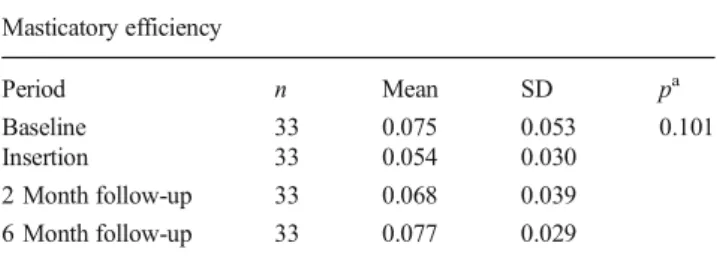
No statistically significant difference (p=0.101) was ob-served in the masticatory efficiency variable for all periods, although there was a change immediately after the provision of the new dentures, and after 2 and 6 months, these values had again returned to baseline level (Table2).
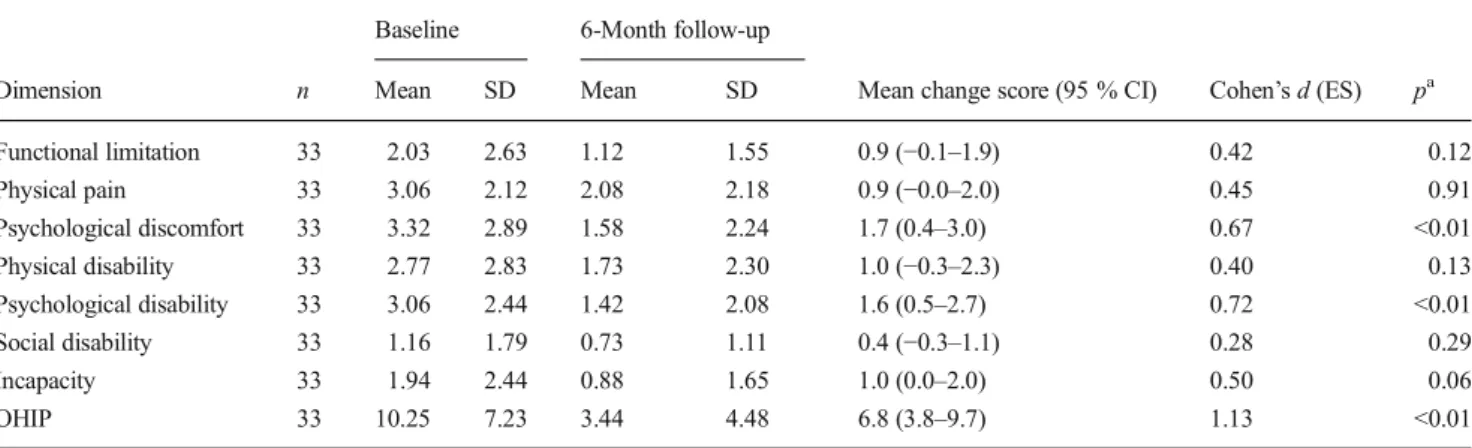
Table3shows improvement in oral health-related quality of life 6 months after installation of the new RPD, in terms of general OHIP-14 results and the evaluation of seven dimen-sions. The OHIP-14 results were reduced by 66 % (additive method) (baseline 10.2 and 6 months 3.4), showing a statisti-cally significant positive impact of oral health on quality of life (p<0.01). Mean difference value (95 % confidence inter-val) was 6.8 (3.8 to 9.7) points, and Cohen’sd was 1.13. According to Cohen, an effect size ofd=0.2 is considered to be small, 0.5 medium, and 0.8 large [24]. Therefore, the effect sizes based on these changes were considered large. Significant improvement in psychological discomfort (p< 0.01) and psychological disability (p<0.01) was also observed.
Discussion
There was no statistically significant difference in masticatory efficiency after denture insertion. However, significant differ-ences in oral health-related quality of life were observed. It is important to highlight that the aim of this study was not to determine masticatory efficacy in RPD patients but to evaluate the effect of RPD on the masticatory efficacy of each patient, displaying results before and after rehabilitation.
Masticatory efficiency is an important statistic, but evalu-ating it is not an easy process. Several methods have been
Table 2 Values of absolute frequency, mean, and standard deviation of masticatory efficiency of all individuals at different periods of evaluation
Masticatory efficiency
Period n Mean SD pa
Baseline 33 0.075 0.053 0.101
Insertion 33 0.054 0.030
2 Month follow-up 33 0.068 0.039
6 Month follow-up 33 0.077 0.029
The higher the average value, the better the patient’s masticatory
efficiency
nsample size
a
Repeated measures ANOVA
suggested [25–28], most of which are based on the ability of food trituration measured by different graduated sieves. According to Nakasima et al. [29], these methods are not standardized as food may change due to pH alteration and saliva. In addition, these methods cannot easily be performed in clinical practice [30].
In the present study, there was no material loss by swallowing, something that is typically observed with chewing and swallowing food. Furthermore, the capsules were immediately evaluated, preserving their physical proper-ties and avoiding dissolution in saliva. However, it is known that the use of standardized test materials based on silicon compounds during masticatory analysis with the sieving method neutralized saliva interference issues [31].
According to the results of the present study, Kennedy class I RPDs did not result in a positive effect on masticatory effi-ciency at the different evaluation times. However, the number of remaining mandibular occlusal unities may have influenced the results, as this factor was not standardized among the in-dividuals. The absence of standardization of the number of remaining teeth and consequently the number of occlusal units influenced the uniformity of the sample, as the study included patients with different characteristics classed according to oral function, which included chewing ability [32].
The other possible explanation for these results could be related to the methodology applied. The colorimetric method seems to be less specific when detecting small differences between treatments. According to Silva et al. [33], the cap-sules are tough and hard to chew. These authors also pointed out that the sieve method might be more suitable for evaluat-ing patients with posterior partial edentulism.
The lack of statistical significance in relation to the masti-catory efficiency variable may be explained by the effect of a small sample size, which might be too small to detect the observed difference.
The masticatory efficiency values reported in the study are in accordance with those obtained by the study by Ribeiro
et al. [34], which used the same method to evaluate patients wearing complete dentures. Aras et al. [6] observed no signif-icant improvement in masticatory efficiency over time when wearing RPDs, as was found in the present study.
Wolfart et al.[19] conducted a multicenter randomized con-trolled trial with 215 patients and did not find a statistically significant difference between treatments with shortened den-tal arches (SDAs) and RPDs after different periods of evalua-tion (before; 6 weeks, 6, and 12 months after treatment; and thereafter annually for 5 years). However, better quality of life was observed within each group using the OHIP-49 question-naire, as was also found in the present research.
The mean values are directly proportional to masticatory efficiency, or in other words, the higher the average value, the better the masticatory efficiency of the patient (Table2). It was noted that after the installation of new prostheses, there was a decrease in values of efficiency, indicating that during this period, the patient is adapting to the new condition, as he or she had been accustomed to the use of old dentures. Therefore, it is very important to maintain control and maintenance ap-pointments after the installation of new prostheses. After 2 and 6 months of use, these values increased, indicating that it, a period of adaptation, is necessary for the patient to learn to chew satisfactorily with the new prosthesis.
According to Strassburger et al. [35], tools such as OHIPs have been widely used for evaluation of the impact of dental prosthesis on patient satisfaction and oral health-related qual-ity of life. The OHIP-14 values declined 6 months after den-ture insertion, and a statistical difference was observed in comparison with the initial condition. McGrath and Bedi [10] reported that individuals with tooth loss and no dental rehabilitation exhibited a significant reduction in oral health-related quality of life.
The decrease in the standard deviation (SD) of the sum OHIP scores after 6 months was an indicator of the beneficial effect of the treatment in terms of the perception of quality of life of the patient. As the OHIP is a problem index and the Table 3 OHIP values of the respective dimensions in relation to time: baseline and 6 months after wearing an RPD
Baseline 6-Month follow-up
Dimension n Mean SD Mean SD Mean change score (95 % CI) Cohen’sd(ES) pa
Functional limitation 33 2.03 2.63 1.12 1.55 0.9 (−0.1–1.9) 0.42 0.12
Physical pain 33 3.06 2.12 2.08 2.18 0.9 (−0.0–2.0) 0.45 0.91
Psychological discomfort 33 3.32 2.89 1.58 2.24 1.7 (0.4–3.0) 0.67 <0.01
Physical disability 33 2.77 2.83 1.73 2.30 1.0 (−0.3–2.3) 0.40 0.13
Psychological disability 33 3.06 2.44 1.42 2.08 1.6 (0.5–2.7) 0.72 <0.01
Social disability 33 1.16 1.79 0.73 1.11 0.4 (−0.3–1.1) 0.28 0.29
Incapacity 33 1.94 2.44 0.88 1.65 1.0 (0.0–2.0) 0.50 0.06
OHIP 33 10.25 7.23 3.44 4.48 6.8 (3.8–9.7) 1.13 <0.01
a
numbers of problems decrease after treatment, there was a decrease in variance in the scores and consequently a decrease in SD (Table3).
The OHIP-14 questionnaire was selected as it presents sim-ilar properties to the original OHIP-49. As OHIP-14 is con-cise, it is a less time-consuming approach in evaluating oral health and quality of life [15].
The sample type was non-probabilistic and voluntary, in which participants were chosen by the criteria of availability and convenience. This type of sample was chosen because of the difficulty in finding patients with the same maxilla tooth-less and full arch Kennedy class I mandibular characteristics, and operational difficulties, as all these patients needed to be rehabilitated at the end of the study. This type of sample was chosen because of the difficulty in obtaining a probabilistic sample, which would have been the ideal approach. Therefore, one limitation of the study is an inability to gener-alize the results for other groups, as well as the possibility of selection bias.
Another limitation of the study was that it was not con-trolled and randomized. In addition, there was no standardiza-tion for the number of remaining occlusal unities.
The inclusion of patients requiring RPD rehabilitation was an additional limitation of this study as some characteristics (i.e., extensive free-end area) probably influenced masticatory efficacy results. Another limitation of the present study was the short follow-up period.
Although no statistically significant difference in mastica-tory efficacy was found before and 6 months after using a mandibular RPD, improvement in quality of life was observed 6 months after denture insertion. These findings probably re-sulted from the association between several factors related to well-being and quality of life measured by the OHIP-14. The functional limitation of chewing is only one of the OHIP-14 dimensions, while other results, including reduced psycholog-ical discomfort and disability, influenced the improvement in quality of life. Furthermore, while the applied test for masti-catory function is an objective measure, OHRQoL is a subjec-tive measure of the patient’s perspective, and these two per-spectives do not necessarily match. This highlights the fact that OHRQoL is the more important measure of oral function, as it presents the patient’s perspective or, in other words, what a patient perceives, which is of uppermost importance.
Further studies are required to evaluate the effect of RPDs on masticatory efficiency and quality of life in Kennedy class I arches.
Conclusion
The results of the present study indicated that dental rehabil-itation with mandibular Kennedy class I RPDs and maxillary complete dentures did not influence masticatory efficiency.
However, these forms of treatment had a positive impact on patient oral health-related quality of life.
Compliance with ethical standards
Ethical standards All procedures performed in studies involving hu-man participants were in accordance with the ethical standards of the institutional and/or national research committee and with the 1964 Helsinki Declaration and its later amendments or comparable ethical standards.
Informed consent Informed consent was obtained from all individual participants included in the study.
Conflict of interest The authors declare that no conflicts of interest exist with regard to the present study.
References
1. Altenhoevel A, Norman K, Smoliner C, Peroz I (2012) The impact
of self-perceived masticatory function on nutrition and
gastrointes-tinal complaints in the elderly. J Nutr Health Aging 16(2):175–178
2. Walls AWG, Steele JG, Sheiham A, Marcenes W, Moynihan PJ
(2000) Oral health and nutrition in older people. J Public Health
Dent 60(4):304–307
3. Awad MA, Morais JA, Wollin S, Khalil A, Gray-Donald K, Feine
JS (2012) Implant overdentures and nutrition: a randomized
con-trolled trial. J Dent Res 91(1):39–46
4. Khoo HD, Chai J, Chow TW (2013) Prosthetic outcome, patient
complaints, and nutritional effects on elderly patients with
magnet-retained, implant-supported overdentures—a 1-year report. Int J
Oral Maxillofac Implants 28(5):1278–1285
5. Müller F, Duvernay E, Loup A, Vazquez L, Herrmann FR,
Schimmel M (2013) Implant-supported mandibular overdentures in very old adults: a randomized controlled trial. J Dent Res 92:
154S–160S
6. Aras K, Hasanreisoğlu U, Shinogaya T (2009) Masticatory
performance, maximum occlusal force, and occlusal contact area in patients with bilaterally missing molars and distal ex-tension removable partial dentures. Int J Prosthodont 22(2):
204–209
7. Tumrasvin W, Fueki K, Ohyama T (2006) Factors associated with
masticatory performance in unilateral distal extension removable
partial denture patients. J Prosthodont 15(1):25–31
8. Gomes SG, Custodio W, Faot F, Cury AA, Garcia RC (2011)
Chewing side, bite force symmetry, and occlusal contact area of subjects with different facial vertical patterns. Braz Oral Res
25(5):446–452
9. Lujan-Climent M, Martinez-Gomis J, Palau S, Ayuso-Montero R,
Salsench J, Peraire M (2008) Influence of static and dynamic oc-clusal characteristics and muscle force on masticatory performance
in dentate adults. Eur J Oral Sci 116(3):229–236
10. McGrath C, Bedi R (2002) Measuring the impact of oral health
on life quality in two national surveys and functionalist versus hermeneutic approaches. Community Dent Oral Epidemiol
30(4):254–259
11. Locker D, Allen F (2007) What do measures of“oral
health-related quality of life” measure? Community Dent Oral
Epidemiol 35:401–411
12. Locker D (1988) Measuring oral health: a conceptual framework.
Community Dent Health 5:3–18
13. Montero J, López JF, Vicente MP, Galindo MP, Albaladejo A, Bravo (2011) Comparative validity of the OIDP and OHIP-14 in describing the impact of oral health on quality of life in a cross-sectional study performed in Spanish adults. Med Oral Patol Oral
Cir Bucal 16:816–821
14. Slade GD, Spencer AJ (1994) Development and evaluation of the
oral health impact profile. Community Dent Health 11:3–11
15. Slade GD (1997) Derivation and validation of a short-form oral
health impact profile. Community Dent Oral Epidemiol 25(4):
284–290
16. John MT, Slade GD, Szentpétery A, Setz JM (2004) Oral
health-related quality of life in patients treated with fixed, removable, and complete dentures 1 month and 6 to 12 months after treatment. Int J
Prosthodont 17(5):503–511
17. Aarabi G, John MT, Schierz O, Heydecke G, Reissmann DR (2014)
The course of prosthodontic patients’oral health-related quality of
life over a period of 2 years. J Dent 43:261–268
18. Furuyama C, Takaba M, Inukai M, Mulligan R, Igarashi Y, Baba K
(2012) Oral health-related quality of life in patients treated by implant-supported fixed dentures and removable partial dentures.
Clin Oral Implants Res 23(8):958–962
19. Wolfart S, Müller F, Gerß J, Heyedcke G, Marré B, Böning K,
Wöstmann B, Kern M, Mundt T, Hannak W, Brückner J, Passia N, Jahn F, Hartmann S, Stark H, Richter EJ, Gernet W, Luthardt RG, Walter MH (2014) The randomized shortened dental arch study:oral health-related quality of life. Clin Oral Investig 18(2):
525–533
20. Heydecke G, Locker D, Awad MA, Lund JP, Feine JS (2003) Oral
and general health-related quality of life with conventional and
implant dentures. Community Dent Oral Epidemiol 31:161–168
21. Carr AB, McGivney GP, Brown DT (2005) McCracken’s
remov-able partial prosthodontics. Support for the distal extension denture base, 11th edn. Elsevier Mosby, Missouri
22. Santos CE, Freitas O, Spadaro ACC, Mestriner-Junior W (2006)
Development of a colorimetric system for evaluation of the
masti-catory efficiency. Braz Dent J 17(2):95–99
23. Oliveira BH, Nadanovsky P (2005) Psycometric properties of the
Brazilian version of the oral health impact profile-short form.
Community Dent Oral Epidemiol 33:307–314
24. Cohen J (1988) Statistical power analysis for the behavioral
sci-ences, 2nd edn. Lawrence Earlbaum Associates, Hillsdale
25. Manly RS, Braley LC (1950) Masticatory performance and
effi-ciency. J Dent Res 29:448–462
26. Liedberg B, Spiechowicz E, Owall B (1995) Mastication with and
without removable partial dentures: an intraindividual study.
Dysphagia 10:107–112
27. Matsui Y, Ohono K, Michi K, Hata H, Yamagawa K, Ohtsuka
S (1996) The evaluation of masticatory function with low ad-hesive color-developing chewing gum. J Oral Rehabil 23(4):
251–256
28. Prinz JF (1999) Quantitative evaluation of the effect of bolus size
and number of chewing strokes on the intra-oral mixing of a
two-color chewing gum. J Oral Rehabil 26(3):243–247
29. Nakasima A, Higashi K, Ichinose M (1989) A new, simple and
accurate method for evaluating masticatory ability. J Oral Rehabil
16(4):373–380
30. Sato S, Fueki H, Sato H, Sueda S, Shiozaki T, Kato M et al (2003)
Validity and reliability of a newly developed method for evaluating masticatory function using discriminant analysis. J Oral Rehabil
30(2):146–151
31. Edlund J, Lamm CJ (1980) Masticatory efficiency. J Oral Rehabil
7(2):123–130
32. Kayser AF (1981) Shortened dental arches and oral function. J Oral
Rehabil 8(5):457–462
33. Silva MO, Zancopé K, Mestriner Júnior W, Prado CJ, Neves FD,
Simamoto Júnior PC (2011) Mastigatory function avaluation by two methods: colorimetry and sifters. Rev Odontol Bras Cent
20(53):125–128
34. Ribeiro JA, Resende CMBM, Mestriner Júnior W, Roncalli AG,
Lopes ALC, Carreiro AFP (2012) Evaluation of complete denture quality and masticatory efficiency in denture wears. Int J
Prosthodont 25(6):625–630
35. Strassburger C, Kerschbaum T, Heydecke G (2006) Influence of
implant and conventional prostheses on satisfaction and quality of life: a literature review. Part 2: qualitative analysis and evaluation of