AMTD
6, 2327–2352, 2013Dimensionality reduction in Bayesian
estimation algorithms
G. W. Petty
Title Page
Abstract Introduction
Conclusions References
Tables Figures
◭ ◮
◭ ◮
Back Close
Full Screen / Esc
Printer-friendly Version Interactive Discussion
Discussion
P
a
per
|
Dis
cussion
P
a
per
|
Discussion
P
a
per
|
Discussio
n
P
a
per
|
Atmos. Meas. Tech. Discuss., 6, 2327–2352, 2013 www.atmos-meas-tech-discuss.net/6/2327/2013/ doi:10.5194/amtd-6-2327-2013
© Author(s) 2013. CC Attribution 3.0 License.
Atmospheric Measurement
Techniques
Open Access
Discussions
Geoscientiic Geoscientiic
Geoscientiic Geoscientiic
This discussion paper is/has been under review for the journal Atmospheric Measurement Techniques (AMT). Please refer to the corresponding final paper in AMT if available.
Dimensionality reduction in Bayesian
estimation algorithms
G. W. Petty
Department of Atmospheric and Oceanic Sciences, University of Wisconsin-Madison, USA
Received: 15 February 2013 – Accepted: 15 February 2013 – Published: 4 March 2013
Correspondence to: G. W. Petty ([email protected])
AMTD
6, 2327–2352, 2013Dimensionality reduction in Bayesian
estimation algorithms
G. W. Petty
Title Page
Abstract Introduction
Conclusions References
Tables Figures
◭ ◮
◭ ◮
Back Close
Full Screen / Esc
Printer-friendly Version Interactive Discussion
Discussion
P
a
per
|
Dis
cussion
P
a
per
|
Discussion
P
a
per
|
Discussio
n
P
a
per
|
Abstract
An idealized synthetic database loosely resembling 3-channel passive microwave ob-servations of precipitation against a variable background is employed to examine the performance of a conventional Bayesian retrieval algorithm. For this dataset, algorithm performance is found to be poor owing to an irreconcilable conflict between the need
5
to find matches in the dependent database versus the need to exclude inappropriate matches. It is argued that the likelihood of such conflicts increases sharply with the dimensionality of the observation space of real satellite sensors, which may utilize 9 to 13 channels to retrieve precipitation, for example.
An objective method is described for distilling the relevant information content from
10
N real channels into a much smaller number (M) of pseudochannels while also reg-ularizing the background (geophysical plus instrument) noise component. The pseu-dochannels are linear combinations of the originalNchannels obtained via a two-stage principal component analysis of the dependent dataset. Bayesian retrievals based on a single pseudochannel applied to the independent dataset yield striking improvements
15
in overall performance.
The differences between the conventional Bayesian retrieval and reduced-dimensional Bayesian retrieval suggest that a major potential problem with conven-tional multichannel retrievals – whether Bayesian or not – lies in the common but of-ten inappropriate assumption of diagonal error covariance. The dimensional reduction
20
AMTD
6, 2327–2352, 2013Dimensionality reduction in Bayesian
estimation algorithms
G. W. Petty
Title Page
Abstract Introduction
Conclusions References
Tables Figures
◭ ◮
◭ ◮
Back Close
Full Screen / Esc
Printer-friendly Version Interactive Discussion
Discussion
P
a
per
|
Dis
cussion
P
a
per
|
Discussion
P
a
per
|
Discussio
n
P
a
per
|
1 Introduction
Satellite remote sensing entails the indirect determination of a property, or set of prop-erties, of the environment based on measurements of top-of-the-atmosphere radiances at appropriate wavelengths. Conceptual frameworks for undertaking satellite retrievals range from simple ad hoc methods to the iterative inversion of complex physical models
5
of observed radiances.
For remote sensing problems involving highly non-linear and/or difficult-to-model re-lationships between observation vectors and environmental states, it is increasingly common to rely on so-called Bayesian estimation methods. One of the principal ar-eas of application of Bayesian methods (but by no means the only one) has been in
10
the area of precipitation retrieval from passive and/or active microwave observations (Evans et al., 1995; Olson et al., 1996, 2006; Haddad et al., 1997; Marzano et al., 1999; Bauer et al., 2001; Kummerow et al., 2001, 2011; Tassa et al., 2003; Di Michele et al., 2005; Grecu and Olson, 2006; Chiu and Petty, 2006; Viltard et al., 2006; Seo et al., 2008).
15
This paper has two purposes: (a) to draw attention to certain practical limitations of Bayesian algorithms as typically implemented, and (b) to describe and demonstrate an objective method of dimensional reduction that substantially improves the robustness of Bayesian retrievals in certain remote sensing applications.
The Bayesian methodology is examined here in the context of idealized retrievals
20
of surface precipitation rate. However, the issues raised, and their proposed solution, should have considerably broader applicability.
1.1 Bayesian estimation
Bayesian retrieval algorithms purport to obtain estimates of an environmental vari-able (e.g. rain rate) via application of Bayes’ Theorem (Bayes and Price, 1763). In
25
AMTD
6, 2327–2352, 2013Dimensionality reduction in Bayesian
estimation algorithms
G. W. Petty
Title Page
Abstract Introduction
Conclusions References
Tables Figures
◭ ◮
◭ ◮
Back Close
Full Screen / Esc
Printer-friendly Version Interactive Discussion
Discussion
P
a
per
|
Dis
cussion
P
a
per
|
Discussion
P
a
per
|
Discussio
n
P
a
per
|
by
P(R|x)∝P(x|R)P(R) (1)
whereP(R) is the unconditional (prior) probability density function (PDF) of the scalar variableR to be estimated andP(x|R) is the multidimensional PDF of the observation vectorxconditioned on a specific value ofR.
5
With only one known exception (Chiu and Petty, 2006), the prior joint and marginal PDFs are represented not as the continuous functions implied by Eq. (1) but rather via a large database of candidate solutions with associated observed or modeled multi-channel radiances. This variation has been aptly called a Bayesian Monte Carlo (BMC) method (L’Ecuyer and Stephens, 2002), although that more precise terminology does
10
not seem to have achieved wider usage.
Moreover, while a true Bayes Theorem-based retrieval should in principle be able to yield a complete posterior PDF ofR as demonstrated by Chiu and Petty (2006), it is typical in practice to extract only an expectation value based on a weighted average of the small set of discrete solution vectors in the database that approximately match the
15
observations.
1.2 Practical limitations
Bayes Theorem has the advantage of providing a rigorous and complete statistical ba-sis for optimal satellite retrievals, provided only that the requisites PDFs are known. However, this advantage can only be fully realized only under fairly restrictive
condi-20
tions:
– The prior joint distribution of environmental variables must be well-characterized over the full spectrum of possibilities and with adequate sampling density relative to the assumed observation error (L’Ecuyer and Stephens, 2002).
– The database must be small enough to be efficiently searchable, a requirement
25
AMTD
6, 2327–2352, 2013Dimensionality reduction in Bayesian
estimation algorithms
G. W. Petty
Title Page
Abstract Introduction
Conclusions References
Tables Figures
◭ ◮
◭ ◮
Back Close
Full Screen / Esc
Printer-friendly Version Interactive Discussion
Discussion
P
a
per
|
Dis
cussion
P
a
per
|
Discussion
P
a
per
|
Discussio
n
P
a
per
|
– The sensor observations attached to each candidate state must be physically re-alistic not only on a channel-by-channel basis but also in terms of its consistency with the high-dimensional manifold encompassing actual observations. This con-sistency can be difficult to achieve when physical model calculations, rather than actual observations, supply the radiance vector (Panegrossi et al., 1998).
5
– The observation/modeling error covariance must be correctly specified in order to optimize both the selection and the weighting of candidate solutions (L’Ecuyer and Stephens, 2002).
This paper is motivated by the observation that all of the above challenges increase exponentially as the dimensionality of the search space increases. For example,
imag-10
ine that a mere 104solution vectors evenly distributed throughout a 3-dimensional ob-servation space is minimally adequate to characterize the prior distribution of environ-ment states and their associated observation vectors. Depending on interchannel and intervariable correlations, up to 1012 candidate solutions might be required to achieve comparable density when Bayesian retrievals are directly based on the radiance
obser-15
vations of, say, a nine-channel instrument like the Tropical Rainfall Measuring Mission (TRMM) Microwave Imager (TMI; Kummerow et al., 1998).
Even if the overall density seems adequate, infrequent combinations of environmen-tal variables – e.g. those associated with a severe storm or hurricane – will still tend to appear as outliers in an inadequately populated corner of channel space, in which
20
case either no suitable match may be found at all or else the match sample may be small and potentially nonrepresentative.
Moreover, it usually proves difficult to confidently specify the optimal match or weight-ing criteria in a high-dimensional space. Formally, one usually specifies an error co-variance that serves as the basis for assessing consistency between an observation
25
AMTD
6, 2327–2352, 2013Dimensionality reduction in Bayesian
estimation algorithms
G. W. Petty
Title Page
Abstract Introduction
Conclusions References
Tables Figures
◭ ◮
◭ ◮
Back Close
Full Screen / Esc
Printer-friendly Version Interactive Discussion
Discussion
P
a
per
|
Dis
cussion
P
a
per
|
Discussion
P
a
per
|
Discussio
n
P
a
per
|
algorithm for TRMM (Kummerow et al., 2011), for example, among many other retrieval and assimilation schemes.
Note further that while the formal error covariance follows from an analysis of model and/or instrument error alone, this specification is only useful if the database is densely populated relative to that expected error. When the density is low, as is especially the
5
case for less common scenes, one must often either arbitrarily expand the the search neighborhood until one or more nominal matches are found or else flag the retrieval for that observation as “missing” owing to a failure to find matches within the prescribed tolerance.
Finally, while the neighborhood that constitutes a match in observation space should
10
in general be an arbitrarily oriented hyperellipsoid with appropriate major and minor axes, as specified by the true error covariance matrix, the convenient but arbitrary sub-stitution of a diagonal covariance matrix automatically – and usually inappropriately – implies an ellipsoid or spheroid with principal axes perfectly aligned with channel coordinate axes. The retrieval algorithm may thus include inappropriate candidate
so-15
lutions and/or exclude appropriate ones, leading to significant retrieval biases under some conditions, especially when the correct solutions lie in close proximity to incor-rect solutions. As will be demonstrated below, the inappropriate assumption of diagonal covariance can severely degrade retrieval performance.
1.3 Objectives
20
In this paper, we demonstrate some important practical limitations of the Bayesian method as typically applied to satellite retrievals. Rather than use real satellite data, we construct an idealized synthetic database comprising only three simulated “channels” and associated with a single scene variable, “rain rate.” These channels are subject to considerable variability due to prescribed background noise. As is characteristic of
25
AMTD
6, 2327–2352, 2013Dimensionality reduction in Bayesian
estimation algorithms
G. W. Petty
Title Page
Abstract Introduction
Conclusions References
Tables Figures
◭ ◮
◭ ◮
Back Close
Full Screen / Esc
Printer-friendly Version Interactive Discussion
Discussion
P
a
per
|
Dis
cussion
P
a
per
|
Discussion
P
a
per
|
Discussio
n
P
a
per
|
We first show that conventional Bayesian retrievals in 3-channel space can lead to nearly useless estimates owing to match failures and/or over-averaging. We then demonstrate a technique for reducing the dimensionality of the database and for ob-taining significantly more robust retrievals from the same data and using the same Bayesian framework. In effect, we derive a smaller number of “pseudochannels” – i.e.
5
linear transformations of the original channels or simple functions thereof – that retain most of the desired signal while rejecting a large part of the background noise. What remains of the background noise is decorrelated and scaled to unit variance.
Note that while the benefits of appropriate dimensional reduction should hold in gen-eral for any database-type retrieval problem, the particular dimensional reduction
algo-10
rithm described below is most directly applicable to semi-continuous variables like rain rate or cloud liquid water path for which admissible values are either exactly zero or positive.
2 Synthetic database
A Gaussian pseudorandom number generator was used to create 20 000 vectors
15
of three-channel “background brightness temperatures” with prescribed mean x=
(220, 240, 250) and covariance
S=
506 81 −205 81 173 140
−205 140 269
. (2)
These statistical properties are arbitrary apart from the desire that the synthetic data lie in an oblique 3-D plane with added uncorrelated random noise having unit variance.
20
AMTD
6, 2327–2352, 2013Dimensionality reduction in Bayesian
estimation algorithms
G. W. Petty
Title Page
Abstract Introduction
Conclusions References
Tables Figures
◭ ◮
◭ ◮
Back Close
Full Screen / Esc
Printer-friendly Version Interactive Discussion
Discussion
P
a
per
|
Dis
cussion
P
a
per
|
Discussion
P
a
per
|
Discussio
n
P
a
per
|
so that raining scenes are simply non-raining scenes with an added brightness tem-perature perturbation given byRaˆ. This idealized rain signal is of course considerably cleaner than that encountered in real satellite observations and serves our purpose of highlighting retrieval issues associated with the Bayesian framework as as opposed to the physics.
5
This dataset is split evenly into a “training dataset” (TRAIN) and a “validation dataset” (VAL), each consisting of 10 000 “observations.” Our objective is to utilize the TRAIN data to implement a Bayesian algorithm capable of achieving reasonable performance when applied to the independent VAL data. Because the two data sets are statistically identical, problems we identify will be associated exclusively with issues relating to
10
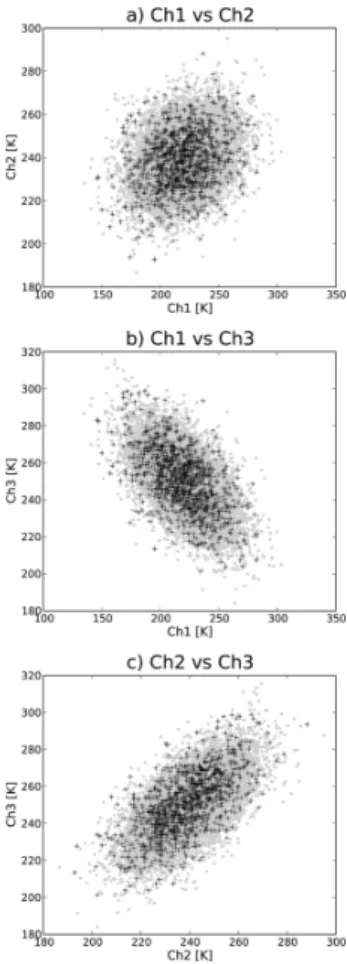
sampling density and dimensionality, not to representativeness or modeling error. Two-dimensional scatter plots for each possible pair of channels are depicted for the TRAIN data in Fig. 1. The most important feature revealed in these plots is that no two channels are sufficient by themselves to distinguish between raining and non-raining scenes. It cannot even be discerned from these plots whether the raining scenes are
15
in any way separable from the non-raining scenes, let alone whether it is possible to reliably estimate rain rate using all three channels.
In fact, the background noise in this demonstration is confined to a 3-dimensional plane (apart from 1 K Gaussian noise), and the subtler rain “signature” ˆahas, by design, a component normal to that plane. There is thus indeed some degree of separation in
20
3-channel space between the raining and non-raining pixels, though it would be visible in a 2-D plot only under an appropriate rotation relative to the original channels. The question addressed in the next section is whether a conventional Bayesian retrieval algorithm that relies on matching of observations in 3-channel space and employing the usual assumption of diagonal error covariance can successfully pull the relatively
25
AMTD
6, 2327–2352, 2013Dimensionality reduction in Bayesian
estimation algorithms
G. W. Petty
Title Page
Abstract Introduction
Conclusions References
Tables Figures
◭ ◮
◭ ◮
Back Close
Full Screen / Esc
Printer-friendly Version Interactive Discussion
Discussion
P
a
per
|
Dis
cussion
P
a
per
|
Discussion
P
a
per
|
Discussio
n
P
a
per
|
3 Bayesian retrieval in channel space
3.1 Method
We begin with a straightforward retrieval method conceptually similar to that currently used for TMI and envisaged as well for the future GPM Microwave Imager. The TRAIN data serves as a database that is searched for scenes that match a given observation
5
vector to within a specified tolerance. Specifically, each prospective match is assigned a weight given byw=exp(−s), where
s=X
i
xi−x′i σi
!2
, (3)
wherexi is the observation from theith channel,x′i is the corresponding value for the
database entry, andσi is a channel-dependent uncertainty that captures modeling error 10
and/or observation error. As previously noted, a rigorous calculation ofsshould actually be based on a full error covariance matrixS, of which σi2 are the diagonal elements, but this is typically not done. For the idealized experiments described herein, we take
σto have the same value for all “channels.”
Consistent with the current implementation of the Goddard Profiling algorithm
15
(GPROF; Kummerow et al., 2001, 2011) for the TRMM Microwave Imager, we admit only matches for whichw >0.01. The retrieval for a given observation vector is then given by
ˆ
R=
PP
j=1wjRj′ PP
j=1wj
, (4)
whereP is the number of qualifying matches.
20
AMTD
6, 2327–2352, 2013Dimensionality reduction in Bayesian
estimation algorithms
G. W. Petty
Title Page
Abstract Introduction
Conclusions References
Tables Figures
◭ ◮
◭ ◮
Back Close
Full Screen / Esc
Printer-friendly Version Interactive Discussion
Discussion
P
a
per
|
Dis
cussion
P
a
per
|
Discussion
P
a
per
|
Discussio
n
P
a
per
|
may permit error statistics to be derived as well. In principle, we can always increase
σ until sufficient matches are found, but the benefits of increased sample size must be weighed against the loss of retrieval quality that results from treating increasingly dissimilar scenes as “matches.”
As noted earlier, the problem of finding matches within a sufficiently small
neighbor-5
hood of the observation is dependent on the local density of the training sample in ob-servation space. The higher-dimensional the obob-servation space, the larger the training database must be to ensure adequate density in any given neighborhood. Moreover, extreme values of the variable to be retrieved will usually occupy the most sparsely populated regions in channel space.
10
3.2 Application to TRAIN data
It is instructive to apply the above algorithm to the same observations stored in the TRAIN database, not only as a sanity check but to illustrate an important consideration in the choice ofσ. We know that even an arbitrarily small value ofσwill still yield an ex-act match in every case, because each observation passed to the algorithm is present
15
in the database. Of interest here is what happens when the tolerance is loosened so as to find additional matches.
Figure 2 depicts scatter plots of the retrieved versus actual “rain rate” for four different choices ofσ. Forσ=0.03 (Fig. 2a), the agreement is essentially perfect, because for each observation, exactly one match is found, and that match is the observation itself.
20
But forσ >0.1 (Fig. 2b–d), there is an increasing tendency toward underestimation of the true rain rate, because now dissimilar scenes are being included in the average, most of which have a significantly different (usually zero) rain rate. Forσ=1.0 (Fig. 2d), the result is nearly useless on a pixel-by-pixel basis, even though the mean rain rate for all pixels will still be correct.
25
The initial conclusion to draw from this comparison is thateven when exact matches to all observations are available in the database, the use of an inappropriately large
AMTD
6, 2327–2352, 2013Dimensionality reduction in Bayesian
estimation algorithms
G. W. Petty
Title Page
Abstract Introduction
Conclusions References
Tables Figures
◭ ◮
◭ ◮
Back Close
Full Screen / Esc
Printer-friendly Version Interactive Discussion
Discussion
P
a
per
|
Dis
cussion
P
a
per
|
Discussion
P
a
per
|
Discussio
n
P
a
per
|
3.3 Application to VAL data
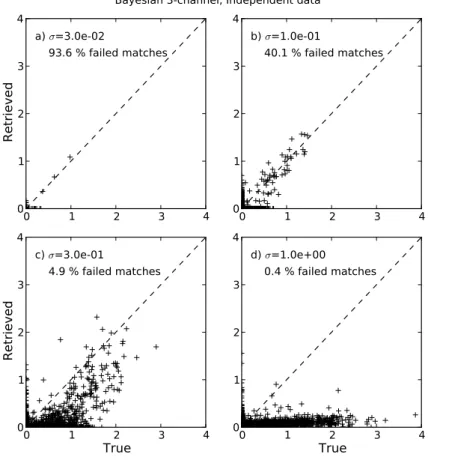
We now apply the same algorithm to the independent VAL data. Statistically, these data are identical to those in the TRAIN database, but there likely to be very few exact matches. Consequently, whenσ=0.03, the match failure rate is an unacceptably large 94 % (Fig. 3a). Moreover, the failure rate is highest by far for the non-zero rain rate
5
scenes, since these are more thinly spread in channel space.
When σ=0.1, the match failure rate is still 40 %, but at least there is some sem-blance of skill in the retrieval for those pixels that do have matches (Fig. 3b). Again, the failure rate specifically for precipitating pixels is far higher, so that an average of only the successfully matched observations would yield a severe underestimate of the
10
true mean value of “rain rate”. Increasing σ further eliminates most of the match fail-ures but leads to the same collapse of retrieval skill and systematic low bias previously shown for the dependent (TRAIN) data set. In summary, there is no single value of
σ that yields an acceptable tradeoffbetween match rate and algorithm performance, despite our reliance on a database of 10 000 entries populating a mere 3-dimensional
15
observation space.
The GPROF algorithm, to give one example, recognizes this problem and undertakes multiple passes through the data base. If a match is not found for a given value ofσ, the value is doubled and the search repeated. In this way, it is ensured that matches will eventually be found for all observations, albeit with very loose tolerances for the
20
rarest combinations of channel values.
Figure 4 illustrates the results of this procedure applied to our synthetic database. There are now no match failures, but the quality of the retrieval remains poor, with a great many underestimated values of larger “rain rates” and a similar number of non-zero retrievals where there the true value is non-zero. Less apparent is that this procedure
25
AMTD
6, 2327–2352, 2013Dimensionality reduction in Bayesian
estimation algorithms
G. W. Petty
Title Page
Abstract Introduction
Conclusions References
Tables Figures
◭ ◮
◭ ◮
Back Close
Full Screen / Esc
Printer-friendly Version Interactive Discussion
Discussion
P
a
per
|
Dis
cussion
P
a
per
|
Discussion
P
a
per
|
Discussio
n
P
a
per
|
(or low-raining) scenes are included in the retrieval, while high rain rates in the tail of the distribution typically require large σ with the consequent incorporation of poorer matches (typically lower rain rates) into the retrieval.
3.4 Preliminary assessment
In view of the poor performance of the Bayesian scheme in the above demonstration,
5
one might reasonably ask whether the signal-to-noise ratio is simply too poor in the synthetic data set for any retrieval method to yield high-quality results, at least using a solution database comprising only 10 000 entries.
In fact, it will be shown shortly that retrieval performance is markedly improved simply by first applying an operator that retains sensitivity to the rain rate signal while rejecting
10
most of the background noise and by using the single resulting pseudochannel as an index into the TRAIN database.
4 Dimensional reduction
4.1 General goals
In the present context, the process of dimensional reduction entails the following:
15
1. Starting with the original set of sensor channels, find linear transformations that normalize and decorrelate the temporal and spatial background variabilitity (geo-physical noise). That is, we want our transformed channels to have unit variance and zero cross-correlation when only scenes containing no rain are considered. 2. From those first-stage transformed channels, perform a second linear
transforma-20
AMTD
6, 2327–2352, 2013Dimensionality reduction in Bayesian
estimation algorithms
G. W. Petty
Title Page
Abstract Introduction
Conclusions References
Tables Figures
◭ ◮
◭ ◮
Back Close
Full Screen / Esc
Printer-friendly Version Interactive Discussion
Discussion
P
a
per
|
Dis
cussion
P
a
per
|
Discussion
P
a
per
|
Discussio
n
P
a
per
|
3. Utilize those pseudochannels in place of the larger number of original channels in a lower-dimensional Bayesian retrieval scheme.
Note that while principal component analysis (PCA) is utilized in the first two steps and is, in general, a common method for dimensional reduction, a single-stage PCA decomposition of a data set does not accomplish either of the two steps on its own.
5
4.2 Details
4.2.1 Stage 1
The following procedure is applied to pixels for which the variabley to be retrieved is zero. In the present case, this condition is satisfied by 90 % of the database, or 9000 observations.
10
First, we compute the meanhXiand the covarianceSx for the rain-free pixels. From
Sx, we then compute the eigenvectorsExand eigenvaluesΛx. We define the first-stage
transformed channelsy via
yi =λ−x,1i/2[(x− hxi)TEx]i. (5)
15
That is, we take the projection of (x− hxi) onto theith eigenvector and then scale by square root of the eigenvalue to obtain unit variance. With appropriate definitions of the coefficient matrixA, the above operation reduces to
y=A(x− hxi). (6)
20
hyi=0 andSy=Ifor the set of transformed channels when observing the background only, but they otherwise retain all of the same information as found in the originalx, Thus, we may now conveniently treat the total background noise (instrument plus geo-physical) as having unit variance and zero correlation between transformed channels
y.
AMTD
6, 2327–2352, 2013Dimensionality reduction in Bayesian
estimation algorithms
G. W. Petty
Title Page
Abstract Introduction
Conclusions References
Tables Figures
◭ ◮
◭ ◮
Back Close
Full Screen / Esc
Printer-friendly Version Interactive Discussion
Discussion
P
a
per
|
Dis
cussion
P
a
per
|
Discussion
P
a
per
|
Discussio
n
P
a
per
|
4.2.2 Stage 2
We now apply Eq. (6) to the 10 000 precipitating scenesyrwithR >0. Unlike the case for rain-free scenes, the variance in each transformed channel yi is now larger than
unity owing to the added effects of precipitation on top of the background variability. To isolate that added variance, we computeSy,r≡ hyryr
T
iand compute eigenvectorsEy,r
5
and eigenvaluesΛy,r.
We now define the precipitationpseudochannels
z≡yTEy,r. (7)
Outside of precipitation, these pseudochannels still have zero mean and unit uncorre-lated variance. For precipitating scenes, however, the added variability will have been
10
pushed into the first few eigenvectorsEy,r.
We may keep the firstM elements ofzso as to account for at least, say, 95 % of the variance computed from the sums of the eigenvalues. The rest are discarded. For the synthetic dataset discussed above,M=1.
The first- and second-stage linear transformation may be combined to give
15
z1...M =B(x− hxi), (8)
whereBis anM×N matrix of coefficients consistent with Eqs. (5) and (7). Note, by the way, that for the present dataset,M=1 and thereforeBis a 1×Nmatrix or, equivalently, a vector corresponding in direction to the third eigenvector of the complete dataset. We could have arrived atBmore directly in this particular case, but the dimensional
20
AMTD
6, 2327–2352, 2013Dimensionality reduction in Bayesian
estimation algorithms
G. W. Petty
Title Page
Abstract Introduction
Conclusions References
Tables Figures
◭ ◮
◭ ◮
Back Close
Full Screen / Esc
Printer-friendly Version Interactive Discussion
Discussion
P
a
per
|
Dis
cussion
P
a
per
|
Discussion
P
a
per
|
Discussio
n
P
a
per
|
5 Bayesian retrieval in pseudochannel space
Using the pseudochannel transformations derived above, we may undertake Bayesian retrievals in M-dimensional space rather than the originalN-dimensional space. The procedure is otherwise identical to that described in Sect. 3. For our synthetic database,
M=1.
5
Figure 5 depicts results of the algorithm applied to the dependent (TRAIN) data for selected values ofσ, analogous to Fig. 2 (note that values ofσhere cannot be directly compared with the values ofσ for the 3-D retrievals, owing to the difference in scaling of the observation vector). We see an increase in retrieval error with larger values of
σ, but the degradation is not nearly as severe as was the case for the original retrieval
10
using three channels.
Figure 6 depicts results for the independent (VAL) data, analogous to Fig. 3. The improvement relative to 3-D retrieval is striking. The match failure rate is extremely low for all but the smallest values ofσ, and the errors are generally small and unbiased. For larger values of σ, there is a hint of underestimation at the low end of the scale
15
owing to inclusion of nearby zero values.
Finally, Fig. 7 depicts the results obtained when an iterative increase in σ is used to ensure that matches are found for all observations. These results may be directly compared to the results of the same procedure applied to 3-D Bayesian retrievals in Fig. 4. The improvement in retrieval performance is striking.
20
6 Conclusions and discussion
Starting with an idealized synthetic database that loosely resembles 3-channel passive microwave observations of precipitation against a highly variable background (e.g. het-eregeneous land surfaces and/or land-water mixes), we examined the performance of a conventional Bayesian retrieval algorithm that searched for matches in the full
three-25
AMTD
6, 2327–2352, 2013Dimensionality reduction in Bayesian
estimation algorithms
G. W. Petty
Title Page
Abstract Introduction
Conclusions References
Tables Figures
◭ ◮
◭ ◮
Back Close
Full Screen / Esc
Printer-friendly Version Interactive Discussion
Discussion
P
a
per
|
Dis
cussion
P
a
per
|
Discussion
P
a
per
|
Discussio
n
P
a
per
|
to the dependent (TRAIN) data, performance suffers when the match criterion is too loose (i.e. largeσ). Conversely, when the same algorithm was applied to the indepen-dent (VAL) dataset, the match failure rate was unacceptably high unless the match criterion was loose.
The net result of both effects was that retrievals were quite poor for the independent
5
data set, even when σ was iteratively adjusted, as shown in Fig. 4. Of course, the need to use largeσ to overcome a high match failure rate is a function of the size of the dependent dataset. In the present demonstration, the TRAIN dataset consisted of 10 000 unique entries. If we were to employ a much larger database, the match failure rate would go down, allowing smaller σ and presumably leading to improved overall
10
performance.
But as one moves to more realistic retrieval problems employing more sensor chan-nels – e.g. the nine chanchan-nels of the TMI or the 13 chanchan-nels of the GMI – the “curse of dimensionality” (Bellman, 1961) greatly magnifies the size of the database required to adequately populate the observation space and thus to ensure not only the existence
15
of suitable matches for any given observation but also, it would be hoped, a statistically representativedistributionof such matches.
Of course it might be possible to reduce dimensionality in some cases by simply throwing out channels that are deemed to provide little information. As clearly seen in Fig. 1, this would not have been possible in the present demonstration. With
higher-20
dimensional real satellite data, the decision as to which channels do or not contain useful information is nontrivial and undoubtedly context-dependent.
To mitigate the problem of dimensionality in Bayesian retrievals, we described an algorithm for objectively distilling the relevant information content fromN channels into a smaller number (M) pseudochannels while also regularizing the background
(geo-25
physical plus instrument) noise component. In the present demonstration,M=3 and
N=1. In the application of this method to TMI data described by Petty and Li (2013),
AMTD
6, 2327–2352, 2013Dimensionality reduction in Bayesian
estimation algorithms
G. W. Petty
Title Page
Abstract Introduction
Conclusions References
Tables Figures
◭ ◮
◭ ◮
Back Close
Full Screen / Esc
Printer-friendly Version Interactive Discussion
Discussion
P
a
per
|
Dis
cussion
P
a
per
|
Discussion
P
a
per
|
Discussio
n
P
a
per
|
Bayesian retrievals based on the single “pseudochannel” derived for the synthetic dataset were shown to yield striking improvements in overall performance, as shown in Fig. 7. These empirical results, more than any theoretical arguments, underline the likely benefits of dimensional reduction in Bayesian retrievals relying on a database of multichannel observations as a proxy for the prior joint and marginal PDFs.
5
It must be reiterated that the details of the particular dimensional reduction method given here depend on one being able to stratify the dependent dataset into two subsets: one representing the “pure” background (e.g. rain-free or cloud-free), and the other representing non-zero values of the variable to be retrieved (e.g. raining or cloudy). For variables where this is not possible, another dimensional reduction algorithm would
10
need to be employed; however, the benefits for Bayesian retrievals should be similar. As discussed in the introduction, it might have been possible in principle to achieve the same results for the 3-D channel-based retrieval as for the 1-D pseudochannel-based retrieval, provided that an appropriate covariance matrix were specified for the computation of the weights for candidate matches. In the present demonstration, the
15
covariance in question would have corresponded to a match zone shaped like a highly flattened spheroid oriented exactly parallel to the plane containing most of the back-ground variability in Fig. 1. That is, channel variations orthogonal to the principal plane of background variability would be given far greater weight than variations spectrally consistent with the background variability. In short, the appropriate covariance would
20
be non-diagonal, and retrieval performance would depend strongly on getting it exactly right.
From our results and from the above considerations, we conjecture that a major potential problem with conventional multichannel retrievals and assimilation schemes – whether Bayesian or not – lies in the very common but often inappropriate assumption
25
AMTD
6, 2327–2352, 2013Dimensionality reduction in Bayesian
estimation algorithms
G. W. Petty
Title Page
Abstract Introduction
Conclusions References
Tables Figures
◭ ◮
◭ ◮
Back Close
Full Screen / Esc
Printer-friendly Version Interactive Discussion
Discussion
P
a
per
|
Dis
cussion
P
a
per
|
Discussion
P
a
per
|
Discussio
n
P
a
per
|
Acknowledgements. Helpful comments by Tristan L’Ecuyer and an anonymous reviewer led to improvements in the manuscript. This research was supported by NASA Grant NNX10AGAH69G.
References
Bauer, P., Amayenc, P., Kummerow, C., and Smith, E.: Over-ocean rainfall retrieval from multi-5
sensor data of the Tropical Rainfall Measuring Mission. Part II: Algorithm implementation, J. Atmos. Ocean Tech., 18, 1838–1855, 2001. 2329
Bayes, T. and Price, R.: An essay towards solving a problem in the doctrine of chance, by the late Rev., Mr. Bayes, F. R. S. communicated by Mr. Prices, in a letter to John Canton, A. M. F. R. S., Philos. T. R. Soc. Lond., 53, 370–418, 1763. 2329
10
Bellman, R.: Adaptive Control Processes: a Guided Tour, Princeton University Press, 1961. 2342
Chiu, J.-Y. and Petty, G.: Bayesian retrieval of complete posterior PDFs of oceanic rain rate from microwave observations, J. Appl. Meteorol. Clim., 45, 1073–1095, 2006. 2329, 2330 Di Michele, S., Tassa, A., Mugnai, A., Marzano, F., Bauer, P., and Baptista, J.: Bayesian algo-15
rithm for microwave-based precipitation retrieval: Description and application to TMI mea-surements over ocean, IEEE T. Geosci. Remote, 43, 778–791, 2005. 2329
Evans, K., Turk, J., Wong, J., and Stephens, T.: A Bayesian approach to microwave precipitation profile retrieval, J. Appl. Meteorol., 34, 260–279, 1995. 2329
Grecu, M. and Olson, W.: Bayesian estimation of precipitation from satellite passive microwave 20
observations using combined radar-radiometer retrievals, J. Appl. Meteorol. Clim., 45, 416– 433, 2006. 2329
Haddad, Z., Smith, E., Kummerow, C., Iguchi, T., Farrar, M., Durden, S., Alves, M., and Ol-son, W.: The TRMM “day-1” radar/radiometer combined rain-profiling algorithm, J. Meteorol. Soc. Jpn., 75, 799–809, 1997. 2329
25
Kummerow, C., Barnes, W., Kozu, T., Shiue, J., and Simpson, J.: The tropical rainfall measuring mission (TRMM) sensor package, J. Atmos. Ocean Tech., 15, 809–817, 1998. 2331
AMTD
6, 2327–2352, 2013Dimensionality reduction in Bayesian
estimation algorithms
G. W. Petty
Title Page
Abstract Introduction
Conclusions References
Tables Figures
◭ ◮
◭ ◮
Back Close
Full Screen / Esc
Printer-friendly Version Interactive Discussion
Discussion
P
a
per
|
Dis
cussion
P
a
per
|
Discussion
P
a
per
|
Discussio
n
P
a
per
|
estimation from passive microwave sensors, J. Appl. Meteorol., 40, 1801–1820, 2001. 2329, 2335
Kummerow, C. D., Ringerud, S., Crook, J., Randel, D., and Berg, W.: An observationally gener-ated a priori database for microwave rainfall retrievals, J. Atmos. Ocean Tech., 28, 113–130, 2011. 2329, 2332, 2335
5
L’Ecuyer, T. and Stephens, G.: An uncertainty model for Bayesian Monte Carlo retrieval algo-rithms: application to the TRMM observing system, Q. J. Roy. Meteor. Soc., 128, 1713–1737, 2002. 2330, 2331
Marzano, F., Mugnai, A., Panegrossi, G., Pierdicca, N., Smith, E., and Turk, J.: Bayesian esti-mation of precipitating cloud parameters from combined measurements of spaceborne mi-10
crowave radiometer and radar, IEEE T. Geosci. Remote, 37, 596–613, 1999. 2329
Olson, W., Kummerow, C., Heymsfield, G., and Giglio, L.: A method for combined passive-active microwave retrievals of cloud and precipitation profiles, J. Appl. Meteorol., 35, 1763–1789, 1996. 2329
Olson, W., Kummerow, C., Yang, S., Petty, G., Tao, W., Bell, T., Braun, S., Wang, Y., Lang, S., 15
Johnson, D., and Chiu, C.: Precipitation and latent heating distributions from satellite passive microwave radiometry. Part I: Improved method and uncertainties, J. Appl. Meteorol. Clim., 45, 702–720, 2006. 2329
Panegrossi, G., Dietrich, S., Marzano, F., Mugnai, A., Smith, E., Xiang, X., Tripoli, G., Wang, P., and Baptista, J.: Use of cloud model microphysics for passive microwave-based precipitation 20
retrieval: Significance of consistency between model and measurement manifolds, J. Atmos. Sci., 55, 1644–1673, 1998. 2331
Petty, G. and Li, K.: Improved passive microwave precipitation retrievals over land and ocean. 1. Algorithm description., J. Atmos. Ocean. Tech., in review, 2013. 2342
Seo, E.-K., Sohn, B.-J., Liu, G., Ryu, G.-H., and Han, H.-J.: Improvement of microwave rainfall 25
retrievals in Bayesian retrieval algorithms, J. Meteorol. Soc. Jpn., 86, 405–409, 2008. 2329 Tassa, A., Di Michele, S., Mugnai, A., Marzano, F., and Baptista, J.: Cloud model-based
Bayesian technique for precipitation profile retrieval from the tropical rainfall measuring mis-sion microwave imager, Radio Sci., 38, 8074, doi:10.1029/2002RS002674, 2003. 2329 Viltard, N., Burlaud, C., and Kummerow, C.: Rain retrieval from TMI brightness temperature 30
AMTD
6, 2327–2352, 2013Dimensionality reduction in Bayesian
estimation algorithms
G. W. Petty
Title Page
Abstract Introduction
Conclusions References
Tables Figures
◭ ◮
◭ ◮
Back Close
Full Screen / Esc
Printer-friendly Version Interactive Discussion
Discussion
P
a
per
|
Dis
cussion
P
a
per
|
Discussion
P
a
per
|
Discussio
n
P
a
per
|
AMTD
6, 2327–2352, 2013Dimensionality reduction in Bayesian
estimation algorithms
G. W. Petty
Title Page
Abstract Introduction
Conclusions References
Tables Figures
◭ ◮
◭ ◮
Back Close
Full Screen / Esc
Printer-friendly Version Interactive Discussion
Discussion
P
a
per
|
Dis
cussion
P
a
per
|
Discussion
P
a
per
|
Discussio
n
P
a
per
|
AMTD
6, 2327–2352, 2013Dimensionality reduction in Bayesian
estimation algorithms
G. W. Petty
Title Page
Abstract Introduction
Conclusions References
Tables Figures
◭ ◮
◭ ◮
Back Close
Full Screen / Esc
Printer-friendly Version Interactive Discussion
Discussion
P
a
per
|
Dis
cussion
P
a
per
|
Discussion
P
a
per
|
Discussio
n
P
a
per
|
AMTD
6, 2327–2352, 2013Dimensionality reduction in Bayesian
estimation algorithms
G. W. Petty
Title Page
Abstract Introduction
Conclusions References
Tables Figures
◭ ◮
◭ ◮
Back Close
Full Screen / Esc
Printer-friendly Version Interactive Discussion
Discussion
P
a
per
|
Dis
cussion
P
a
per
|
Discussion
P
a
per
|
Discussio
n
P
a
per
|
0
1
2
3
4
True
0
1
2
3
4
Retrieved
Bayesian 3-channel, Iterated σ
AMTD
6, 2327–2352, 2013Dimensionality reduction in Bayesian
estimation algorithms
G. W. Petty
Title Page
Abstract Introduction
Conclusions References
Tables Figures
◭ ◮
◭ ◮
Back Close
Full Screen / Esc
Printer-friendly Version Interactive Discussion
Discussion
P
a
per
|
Dis
cussion
P
a
per
|
Discussion
P
a
per
|
Discussio
n
P
a
per
|
AMTD
6, 2327–2352, 2013Dimensionality reduction in Bayesian
estimation algorithms
G. W. Petty
Title Page
Abstract Introduction
Conclusions References
Tables Figures
◭ ◮
◭ ◮
Back Close
Full Screen / Esc
Printer-friendly Version Interactive Discussion
Discussion
P
a
per
|
Dis
cussion
P
a
per
|
Discussion
P
a
per
|
Discussio
n
P
a
per
|
AMTD
6, 2327–2352, 2013Dimensionality reduction in Bayesian
estimation algorithms
G. W. Petty
Title Page
Abstract Introduction
Conclusions References
Tables Figures
◭ ◮
◭ ◮
Back Close
Full Screen / Esc
Printer-friendly Version Interactive Discussion
Discussion
P
a
per
|
Dis
cussion
P
a
per
|
Discussion
P
a
per
|
Discussio
n
P
a
per
|