© 2014 Nasrat and Ibrahim, This open access article is distributed under a Creative Commons Attribution (CC-BY) 3.0 license
doi:10.3844/ajeassp.2012.157.162 Published Online 5 (2) 2012 (http://www.thescipub.com/ajeas.toc)
EPOXY INSULATORS
’
’
’
’
LIFETIME PREDICTION
IMPLEMENTING NEURAL NETWORK TECHNIQUE
1
Nasrat, L.S. and
2A.M. Ibrahim
1Department of Electrical Power and Machines, Faculty of Engineering, South Valley University, Aswan, Egypt
2Department of Electrical Power and Machines,
Faculty of Engineering, Ain Shams University, 1 El-Sarayat St, Abbassia, Cairo, Egypt
Received 2012-05-26, Revised 2012-08-07; Accepted 2012-08-07
ABSTRACT
Due to wide implementation of Epoxy insulators in industrial applications and its economic implications; development of various Epoxy insulator materials has to be evaluated along with a reliable prediction methodology of their lifetimes. In this study, a new methodology based on Artificial-Neural-Networks (ANN) is developed to predict Epoxy insulators lifetime using laboratory measurements of their surface leakage current under accelerated aging. The effect of adding fillers with various concentration rates to the Epoxy insulators such as; Calcium Silicate (CaSiO2), Mica and Magnesium Oxide (Mg(OH)2) on their lifetimes is compared with the base case (no filler and dry condition). Furthermore, the lifetime of each specimen under study is examined under various weather conditions such as dry, wet, salt wet (NaCl) and hydro carbon solvent Naphtha. The obtained results are weighing against the experimental measured data based on two ANN techniques; i.e., Feed-Forward-Neural-Network (FNN) and Recurrent-Feed-Forward-Neural-Network (RNN). The results obtained from the FNN and RNN are compared to validate the proposed methodology to predict the lifetime of epoxy insulators in terms of the type and percentage concentration of filler. The obtained Epoxy insulators predicted lifetime under various filler concentrations and weather conditions are compared and conclusions are reported.
Keywords: Recurrent-Neural-Network (RNN), Feed-Forward-Neural-Network (FNN), Artificial-Neural-Networks (ANN), Processing Elements (PE)
1. INTRODUCTION
Electrical aging of polymer insulated materials is still poorly known phenomena and the physical sense of the various parameters involved in the aging models is far from being obvious (Crine, 2007; 2005). Polymeric insulators have been worldwide applied, due to their lightweight, excellence in mechanical strength and possess superior contamination performances compared with the conventional porcelain or glass (Izumi et al., 2000). However, the long-term characteristics of the mechanical, electrical and contamination characteristics of the material have not been sufficiently clarified and the establishment of its assessment and diagnostic methods is desired (Hackam, 1998). Both the mechanical and electrical properties of polymers can be further improved or modified by the addition of inorganic fillers. These fillers increase the mechanical strength and
change the electrical properties of the composites (Brosseu et at., 2001; Ng et al., 2001).
possess superficial chemical changes caused by weathering and dry band arcing, erosion and tracking, which may ultimately lead to failure of the insulators (Gorur et al., 1988), difficult to evaluate service life, unknown reliability and difficult to detect faulty insulators. During normal dry conditions, the electrostatic field determines the voltage distribution of dry insulator and very small capacitive leakage current flows across the entire insulator. On the other hand, during wet conditions, the insulator’s resistive surface leakage current is much higher than that of the dry insulator condition. Furthermore, the leakage current increases with increasing contaminant flow rate, with other conditions, due to the increased loss of hydrophobicity as well as reduced the surface resistivity of the insulator (Kindersberg et al., 1996). Therefore, the long-term characteristics of the mechanical, electrical and contamination characteristics of the material have not been sufficiently clarified and the establishment of its assessment and diagnostic methods is desired (Kim and Hackam, 1995). In the last two decades, a vareity of prediction models have been proposed in the literatures that include time-series models, regression models, artifitial neural network models, adaptive neuro-fuzzy interface system and support vector machine models (Gensoglu and Uyar, 2009).
In order to determin the flashover behaviour of polluted high voltage insulators, the researchers have been brought to establish a modeling using artifitial neural networks (Gencoglu and Cebeci, 2009). This research work aims to predict the lifetime of Epoxy insulators with different compositions of various fillers. It focuses on estimating an appropriate percentage concentration of filler such as; CaSiO2, Mica and Mg(OH)2 which produces enhancements of the epoxy lifetime under dry condition. The effect of contamination conditions such as; wet, NaCl and Naphtha on the lifetime prediction of epoxy insulators and composites is evaluated. A reliable FNN methodology has been proposed and developed to estimate the insulator lifetime using experimental data of insulator’s leakage currents as a function of for various epoxy samples with different types and concentrations of filler under various reagent conditions. The obtained results are verified with various sets of experimental data.
of simple highly interconnected processing elements (artificial neuron) in architecture inspired by the structure of cerebral cortex of the brain. They can be used to solve complex and nonlinear engineering problems by learning from previous experience, without looking for complex mathematical relationships between inputs and outputs. Once a neural network with an appropriate input and output signals is trained, it will contain the non-linearity of the desired mapping in the neural network, avoiding the knowledge of complex non-linear relationships (Oonsivilai et al., 2007; Oonsivilai and Oonsivilai, 2007).
2.2. Recurrent Neural Network (RNN)
2.3. Feed-Forward Neural Network (FNN)
FNN can be classified into a single layer or multilayer Neural Networks. In this study, only multilayer FNN architecture is used. It consists of nset input-layer (X); h set of hidden-layer (H) and o set of output-layer (Y) as shown in Fig. 1. The hidden layer unit j receives input i through synoptic weights IWij.Unit jcomputes a function of the input signal Xiand the weights IWij and passes its output in the next successive layer using (1) and (2) (Tsoukalas and Uhrig, 1997; Rajasekaran and Pai, 2004). Towards the hidden layer:
n i i 1
net (t) = x (t)IW +θ
j ij j
=
∑
j j
y (t) = f(net (t)) (1)
Away from the hidden layer:
k
k i jk k
j=1
net (t) =
∑
y (t)LW +θk k
y (t) = f(net (t)) (2)
Where:
Xi, Hj, Yk =Input, hidden and output neurons respectively
Fig. 1. Multilayer FNN architecture
Fig. 2. Recurrent neural network structure
N = The number of inputs
F = The layer output function (of any differentiable type)
θj and θk = The biases at the respective layers
2.4. Recurrent Neural Network (RNN)
Recurrent network is the connections interval neural in feedback shown in Fig. 1 by connecting the output of one or more Processing Elements (PE) in the same or preceding layers. Figure 2 shows RNN’s structure; Input patterns have P1, P2… PR, (R= number of elements in input layer). a1(k)is output of hidden layer 1and input of hidden layer 2,a2(k) is output of hidden layer 2 anda3(k) is final output. Have f1, f2 and f3 are transfer function, a1(k), a2(k)and a3(k)can be calculated from the algebraic equation as follow Eq. 3-5:
1 1 1 1
1,1 1,1
a (k) = f (IW P + LW a (k -1) + b ) (3)
2 2 1 2 2
2,1 2,11
a (k) = f (LW a (k) + LW a (k -1) + b ) (4)
3 3 2 3
3,2
a (k) = f (LW a (k) + b ) (5)
Where:
IW1, 1 = Weights value connections between input layer 1 with hidden layer 1 LW2,1 = Weights value connections between
hidden layer 1 with hidden layer 2 LW3,2 = Weights value connections between
hidden layers 2 with output layer 3 b1, b2 andb3 = bias values in hidden layers 1 and 2 and
output layer 3 respectively.
Training neural network by gradient descent algorithm with tan-sigmoid transfer function using neural network toolbox of MATLAB software:
-(n + b)
1 f[×] = logsig(n, b) =
1 + e
Where as:
N = Summation output B = Bias adjust.
2.5. Experimental Tests
2.6. Material Under Study
NaCl and Naphtha conditions. The samples are made of cylindrical rods having 12 mm diameter and 100 mm long. Two copper electrodes have been fixed into the samples, one at the top and the other at the bottom.
2.7. Set up Test
The applied voltage under this study is obtained from a single phase high voltage transformer (150kV-15 kVA). An autotransformer is used to adjust the primary voltage of the AC test system smoothly. The applied voltage under this study between two copper electrodes is adjusted to be 20 kV. The applied voltages are measured throughout a digital measuring instrument DMI551. The surface leakage current (mA) measurements are performed by means of a special system, which can register time variations of a voltage drop across a shunt resistor, supply voltage and phase shift between them.
lifetime of epoxy samples under dry test scenario condition are the highest among the samples’ corresponding other test scenarios under study. Among the different samples of the dry test scenario, the no-filler sample has the highest lifetime up to 161 hrs.
3.2. Prediction of Lifetime by Neural Network
for Epoxy Insulators
Experiments are performed on real time basis dataset that consists of ten samples with different filler percentages and types. Each of the ten materials is tested under four different conditions (dry, wet, NaCl and naphtha). In each case, an electric current is applied and recorded at different times. Our aim is to predict the lifetime epoxy insulators.
Table 1. Epoxy Insulators with various Filler Materials under study
Ca SiO2 Mica Mg(OH)2
Filler No Filler --- ---
---Sample code W C1 C2 C3 M1 M2 M3 G1 G2 G3
Filler Rate (%) 0 25 40 50 25 40 50 20 25 30
Table 2. Experimental Epoxy insulators Lifetime (hrs) with various filler concentrations and test scenarios under study
CaSiO3 Mica Mg(HO)2
No filler --- --- --- Scenario-I: Dry Test W C1 C2 C3 M1 M2 M3 G1 G2 G3 Epoxy insulators Lifetime (hrs) 161.00 149.00 130.00 109.00 84.00 106.00 140.00 70.00 62.00 59.00 Lifetime Portion of the Base Case (p.u.) 1.00 0.88 0.81 0.68 0.52 0.66 0.87 0.43 0.39 0.37 Scenario-II: Wet Test 103.00 110.00 88.00 65.00 51.00 62.00 91.00 48.00 39.00 37.00 Lifetime Portion of the Base Case (p.u.) 0.64 0.68 0.55 0.4 0.32 0.39 0.57 0.3 0.24 0.23 Scenario-III: Naph Test 60.00 78.00 69.00 62.00 33.00 43.00 50.00 30.00 24.00 20.00 Lifetime Portion of the Base Case (p.u.) 0.37 0.48 0.42 0.39 0.2 0.27 0.31 0.19 0.15 0.12 Scenario-VI: NaCl Test 49.00 68.00 60.00 53.00 25.00 31.00 37.00 23.00 15.00 12.00 Lifetime Portion of the Base Case (p.u.) 0.30 0.42 0.37 0.33 0.16 0.19 0.23 0.14 0.09 0.07
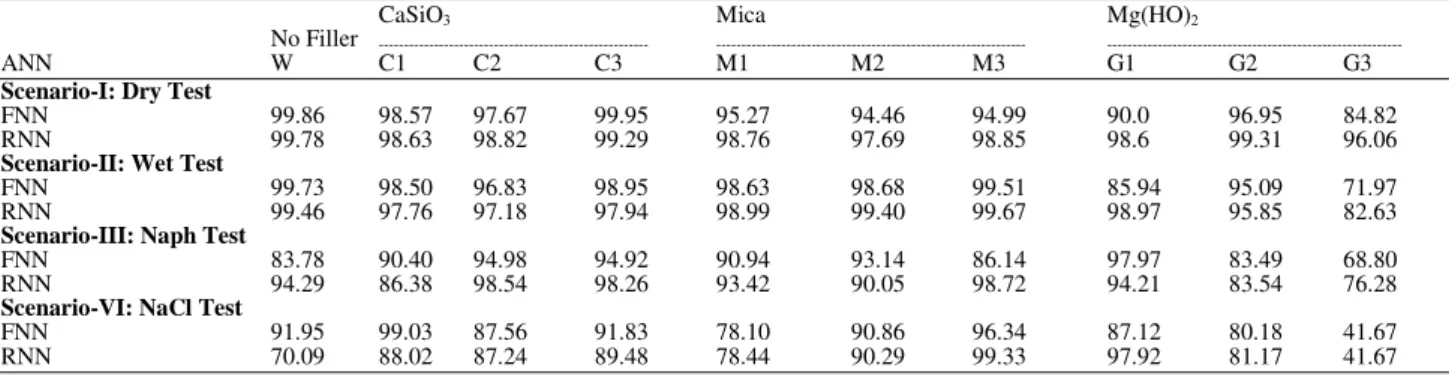
Table 3. FNN and RNN accuracy (%) for predicting Epoxy insulators Lifetime with various filler concentrations and test scenarios under
CaSiO3 Mica Mg(HO)2
No Filler --- ---
---ANN W C1 C2 C3 M1 M2 M3 G1 G2 G3
Scenario-I: Dry Test
FNN 99.86 98.57 97.67 99.95 95.27 94.46 94.99 90.0 96.95 84.82 RNN 99.78 98.63 98.82 99.29 98.76 97.69 98.85 98.6 99.31 96.06
Scenario-II: Wet Test
FNN 99.73 98.50 96.83 98.95 98.63 98.68 99.51 85.94 95.09 71.97 RNN 99.46 97.76 97.18 97.94 98.99 99.40 99.67 98.97 95.85 82.63
Scenario-III: Naph Test
FNN 83.78 90.40 94.98 94.92 90.94 93.14 86.14 97.97 83.49 68.80 RNN 94.29 86.38 98.54 98.26 93.42 90.05 98.72 94.21 83.54 76.28
Scenario-VI: NaCl Test
Fig. 3. Prediction of FNN outputs and RNN outputs for Epoxy Insulator without Filler under Wet Test Scenario
Fig. 4. Prediction of FNN outputs and RNN outputs for Epoxy Insulator with Mg(OH)2 Filler under NaCl Test Scenario
Both FNN and RNN are applied in order to predict the lifetime of epoxy insulators. Each has three layers (input, hidden and output). The inputs to the ANN are chosen so that they consist of the weather conditions, types of filler, concentration rates of fillers and the leakage currents at different times. ANN has only one output, which predicts the lifetime of epoxy insulators. A tan-sigmoid function producing outputs in the range of [-1, 1] is used as a transfer function for each neuron in the hidden layer while linear transfer function is used for the output layer.
The dataset is split into training and test sets; 90% of the training set is kept for training the neural network while 10% is used as validation set. Neural networks with one hidden layer are used with five hidden neurons. The neural network that produces the best accuracy on the validation set among the runs is chosen for prediction. The learning factor, which controls the rate of convergence and stability, is chosen to be 0.05. The
training process is preceded until the average error between the actual output and the desired output reaches an acceptable value, which is taken to be 0.001. Table 3 summarizes the percentage accuracies of different contamination conditions and fillers for FNN and RNN.
Figure 3 and 4 display how the outputs generated by FNN and RNN fit the target outputs. It is noticed that in most cases, FNN perform well as shown in Fig. 3. But for more complex curves as in Fig. 4, the resulted outputs don’t fit the target outputs in some intervals.
4. DISCUSSION
In this study, the leakage current of Epoxy material is estimated under accelerated aging. Surface aging of epoxy samples is investigated under different conditions. The effects of adding different fillers to the epoxy resin on the electrical performance of epoxy insulators are studied. From the experimental work it has been found that the suitable percentage of filler added to the epoxy specimens is 25% of calcium silicate under the different environmental conditions (NaCl and naphtha).
FNN is compared with RNN for similar samples to predict the lifetime of epoxy insulators in terms of the type and percentage concentration of filler. It is applied to real world datasets. The FNN showed a good performance on most of the datasets. The obtained results from RNN showed higher accuracy than those obtained using FNN.
6. REFERENCES
Brosseu, C., P. Queffelec and P. Talbot, 2001. Microwave characterization of filled polymers. J. Applied Phys., 89: 4532-4540. DOI: 10.1063/1.1343521
Crine, J.P., 2005. On the interpretation of some electrical aging and relaxation phenomena in solid dielectrics. IEEE Trans. Dielec. Elect. Ins., 12: 1089-1107. DOI: 10.1109/TDEI.2005.1561789
Crine, J.P., 2007. A molecular model for the electrical aging of XLPE. Proceedings of the Annual Report-Conference on Electrical Insulation and Dielectric Phenomena, Oct. 14-17, IEEE Xplore Press,
Vancouver, BC., pp: 608-610.
DOI: 10.1109/CEIDP.2007.4451572
Dean, J.M., N.E. Verghese, H.Q. Pham and F.S. Bates, 2003. Nanostructure toughened epoxy resins.
Macromolecules, 36: 9267-9270. DOI:
10.1021/ma034807y
Ellis, B., 1993. Chemistry and Technology of Epoxy Resins. 1st Edn., Blackie Academic and Professional, London, ISBN-10: 0751400955, pp: 332.
Gencoglu, M.T. and M. Cebeci, 2009. Investigation of pollution flashover on high voltage insulators using artifitial neural network. Exp. Syst. Appli., 36: 7338-7345. DOI: 10.1016/j.eswa.2008.11.008
DOI: 10.1109/61.193898
Hackam, R.H., 1998. Outdoor high voltage polymeric insulators. Proceedings of the International Symposium on Electrical Insulating Materials, Sep. 27-30, IEEE Xplore Press, Toyohashi, pp: 1-16. DOI: 10.1109/ISEIM.1998.741674
Ieda, M., M. Nagao and M. Hikita, 1994. High-field conduction and breakdown in insulating polymers. Present situation and future prospects. IEEE Trans. Dielect. Elect. Ins., 1: 934-945. DOI: 10.1109/94.326660
Izumi, K., T. Takahashi, H. Homma and T. Kuroyagi, 2000. Development of line post type polymer insulation arm for 154 kV. IEEE Trans. Power Deliv., 15: 1304-1310. DOI: 10.1109/61.891519 Kim, S.H. and R. Hackam, 1995. Effects of saline-water
flow rate and air speed on leakage current in RTV coatings. IEEE Trans. Power Deliv., 10: 1956-1964. DOI: 10.1109/61.473357
Kindersberg, J., A. Scutz, H.C. Karner and R.V. Huir, 1996. Service performance, material design and applications of composite insulators with silicone rubber housings. CIGRE 33-303.
Ng, C.B., B.J. Ash, L.S. Schadler and R.W. Siegel, 2001. A study of the mechanical and permeability properties of nano- and micron- TiO2 filled epoxy composites. Adv. Compos. Lett., 10: 101-111.
Oonsivilai, A., R. Boonwuitiwiwat, T.
Kulworawanichpong and P. Pao-La-Or, 2007. Artificial neural network approach to electric field approximation around overhead power transmission lines. ACTA Press.
Oonsivilai, R. and A. Oonsivilai, 2007. Probabilistic neural network classification for model β-Glucan suspensions. Proceedings of the 7th WSEAS International Conference on Simulation, Modelling and Optimization, (SMO’ 07), ACM Press, Wisconsin, USA., pp: 159-164.
Rajasekaran, S. and G.A.V. Pai, 2004. Neural Networks, Fuzzy Logic and Genetic Algorithms: Synthesis and Applications. 1st Edn., Prentice-Hall of India, New Delhi, ISBN-10: 8120321863, pp: 456.