OSD
8, 2503–2525, 2011Variational assimilation of
Lagrangian trajectories
J. A. U. Nilsson et al.
Title Page
Abstract Introduction
Conclusions References
Tables Figures
◭ ◮
◭ ◮
Back Close
Full Screen / Esc
Printer-friendly Version Interactive Discussion
Discussion
P
a
per
|
Dis
cussion
P
a
per
|
Discussion
P
a
per
|
Discussio
n
P
a
per
|
Ocean Sci. Discuss., 8, 2503–2525, 2011 www.ocean-sci-discuss.net/8/2503/2011/ doi:10.5194/osd-8-2503-2011
© Author(s) 2011. CC Attribution 3.0 License.
Ocean Science Discussions
This discussion paper is/has been under review for the journal Ocean Science (OS). Please refer to the corresponding final paper in OS if available.
Variational assimilation of Lagrangian
trajectories in the Mediterranean ocean
Forecasting System
J. A. U. Nilsson1, S. Dobricic2, N. Pinardi3, P.-M. Poulain4, and D. Pettenuzzo1
1
Istituto Nazionale di Geofisica e Vulcanologia (INGV), Viale Aldo Moro 44, 40127 Bologna, Italy
2
Centro EuroMediterraneo per i Cambiamenti Climatici (CMCC), Viale Aldo Moro 44, 40127 Bologna, Italy
3
Corso di Scienze Ambientali, Bologna University, Ravenna, Italy
4
The National Institute of Oceanography and Applied Geophysics (OGS), Trieste, Italy
Received: 21 November 2011 – Accepted: 7 December 2011 – Published: 20 December 2011 Correspondence to: J. A. U. Nilsson ([email protected])
OSD
8, 2503–2525, 2011Variational assimilation of
Lagrangian trajectories
J. A. U. Nilsson et al.
Title Page
Abstract Introduction
Conclusions References
Tables Figures
◭ ◮
◭ ◮
Back Close
Full Screen / Esc
Printer-friendly Version Interactive Discussion
Discussion
P
a
per
|
Dis
cussion
P
a
per
|
Discussion
P
a
per
|
Discussio
n
P
a
per
|
Abstract
A novel method for three-dimensional variational assimilation of Lagrangian data with a primitive-equation ocean model is proposed. The assimilation scheme was imple-mented in the Mediterranean ocean Forecasting System and evaluated for a 4-month period. Four experiments were designed to assess the impact of trajectory
assimila-5
tion on the model output, i.e. the sea-surface height, velocity, temperature and salinity fields. It was found from the drifter and Argo trajectory assimilation experiment that the forecast skill of surface-drifter trajectories improved by 15 %, that of intermediate-depth float trajectories by 20 %, and moreover, the forecasted sea-surface height fields im-proved locally by 5 % compared to satellite data, while the quality of the temperature
10
and salinity fields remained at previous levels. In conclusion, the addition of Lagrangian trajectory assimilation proved to reduce the uncertainties in the model fields, thus yield-ing a higher accuracy of the ocean forecasts.
1 Introduction
A novel method to correct ocean surface-velocity field predictions has been developed
15
by implementing variational data assimilation of Lagrangian surface-drifter trajectories in the Mediterranean ocean Forecasting System (MFS). Assimilation of drifter obser-vations in ocean models has previously been attempted using various numerical meth-ods, e.g. optimal interpolation (Molcard et al., 2003), nudging (Fan et al., 2004), and Kalman filtering (Ozgokmen et al., 2003), all with promising results.
20
The MFS provides operational forecasts and analyses for the Mediterranean Sea since 1998 (Pinardi et al., 2003), and the output is useful for multi-purpose near-real-time applications, such as search-and-rescue operations and oil-spill predictions (Coppini et al., 2011). In order to guarantee state-of-art ocean analyses, a three-dimensional data assimilation scheme called OceanVar (Dobricic and Pinardi, 2008) is
25
OSD
8, 2503–2525, 2011Variational assimilation of
Lagrangian trajectories
J. A. U. Nilsson et al.
Title Page
Abstract Introduction
Conclusions References
Tables Figures
◭ ◮
◭ ◮
Back Close
Full Screen / Esc
Printer-friendly Version Interactive Discussion
Discussion
P
a
per
|
Dis
cussion
P
a
per
|
Discussion
P
a
per
|
Discussio
n
P
a
per
|
The scope of the present study is to show some encouraging first results due to the implementation of the new drifter trajectory assimilation scheme. Moreover, ad-ditional numerical experiments were undertaken where drifter data were assimilated together with Argo float trajectories at intermediate depth. It will be shown that the three-dimensional data-assimilation scheme (OceanVar) in MFS is capable of
simul-5
taneously correcting the surface and sub-surface velocity fields through Lagrangian trajectory increments. In addition, the modified MFS is able to maintain previous qual-ity levels of the daily-mean sea surface height (SSH), temperature, and salinqual-ity model fields.
The study is structured as follows: Section 2 provides a brief overview of the MFS
10
and the OceanVar assimilation scheme. The observational data sets and the numer-ical experiments are detailed in Sect. 3, the results are subsequently presented and discussed in Sect. 4, and finally Sect. 5 comprises some conclusions and an outlook.
2 The Mediterranean ocean Forecasting System
2.1 The ocean general circulation model
15
The Mediterranean Forecasting System is a daily 10-day forecast system in opera-tional use since 1998 (Pinardi et al., 2003; Pinardi and Coppini, 2010). In the present study we employ the ocean general circulation model (OGCM) described by Tonani et al. (2008) with a horizontal resolution of 1/16◦
×1/16◦ and 71 un-evenly spaced
vertical levels with a 3-m resolution near the surface; the model output is saved as
20
daily-averaged temperature, salinity, sea-level and horizontal velocity fields.
Satellite-observed sea level anomalies (SLAs Le Traon et al., 2003) and sea-surface temperatures (SSTs, Marullo et al., 2007), as well as temperature and salinity profiles from expendable bathytermographs (XBTs, Manzella et al., 2007) and Argo-float pro-filers (Poulain et al., 2007) are assimilated daily by OceanVar. The heat flux, on the
25
OSD
8, 2503–2525, 2011Variational assimilation of
Lagrangian trajectories
J. A. U. Nilsson et al.
Title Page
Abstract Introduction
Conclusions References
Tables Figures
◭ ◮
◭ ◮
Back Close
Full Screen / Esc
Printer-friendly Version Interactive Discussion
Discussion
P
a
per
|
Dis
cussion
P
a
per
|
Discussion
P
a
per
|
Discussio
n
P
a
per
|
2.2 The OceanVar assimilation scheme
The model fields produced by the OGCM are corrected daily by the OceanVar data assimilation scheme described by Dobricic and Pinardi (2008). This procedure involves the minimization of a cost function that finds a maximum likelihood model state estimate based on the OGCM forecast of the background model state as well as all available
5
observations. The corrected state vector contains the temperature, salinity, velocity and sea-level.
The non-linear cost function is linearized around the background state, minimized by iterations, and the resulting model increments are used to re-initialize the OGCM. The
misfits, viz. the differences between the background fields and the observations, are
10
saved daily, as they are useful for evaluating the quality of the model output. The assim-ilation of surface-drifter positions requires the implementation of a non-linear trajectory model in the observational operator that maps the model to the observational space, hence facilitating comparisons between the Lagrangian observations and the modelled Eulerian fields. The non-linear particle advection equation was discretized and used for
15
this purpose, and its application proved successful for assimilating Argo-float positions in the Mediterranean Sea; detailed descriptions of the trajectory model implementa-tion and evaluaimplementa-tions of the numerical experiments are available in Taillandier et al. (2006a,b); Nilsson et al. (2011).
Here, this trajectory model has been modified to also assimilate surface-drifter
tra-20
jectories, where drifter-position forecasts were calculated by daily 24-h integrations of the trajectory equation. The analyzed positions are obtained by minimizing the lin-earized cost function around the background positions, viz. by reducing the distance between the observed and forecasted Lagrangian trajectory end-points. By variation-ally adding increments to the Eulerian model fields, the uncertainties related to model
25
OSD
8, 2503–2525, 2011Variational assimilation of
Lagrangian trajectories
J. A. U. Nilsson et al.
Title Page
Abstract Introduction
Conclusions References
Tables Figures
◭ ◮
◭ ◮
Back Close
Full Screen / Esc
Printer-friendly Version Interactive Discussion
Discussion
P
a
per
|
Dis
cussion
P
a
per
|
Discussion
P
a
per
|
Discussio
n
P
a
per
|
3 Design of the model experiments
3.1 Lagrangian observations
In this study, we describe the assimilation of surface-drifter positions as well as sub-surface float positions, a procedure undertaken separately and in concert. The Mediter-ranean Surface Velocity Programme (MedSVP) has managed surface drifter
opera-5
tions and has archived drifter data since 1986 in the Mediterranean and Black seas, and in the present study drifter data from the Eastern Mediterranean (Gerin et al., 2009) were used. The quantity of drifters operating simultaneously reached about 20 in mid-November 2005, providing a good opportunity for data assimilation in fall 2005. All drifters were SVP designs with a surface buoy and a sub-surface drogue centred
10
at a nominal depth of 15 m (Gerin et al., 2009), hence, these observations are rep-resentative of the near-surface circulation. The surface drifter positions were edited, interpolated, low-pass filtered to remove high frequency currents (periods less than 36 h) and sub-sampled at daily intervals. Argo-float data, originating from the Corio-lis Operational Oceanography data center, were post-processed and quality checked
15
by Menna and Poulain (2010). These floats are programmed to descend to a parking depth of 350 m followed by a 4.5-day drifting period, whereafter they complete the cycle by re-emerging at the sea surface to transmit data via the Argos satellite system. The Argos positioning uncertainties related to the drifter and Argo float coordinates were approximated to 1000 m (Gerin et al., 2009) and 250–1500 m (Menna and Poulain,
20
2010), respectively.
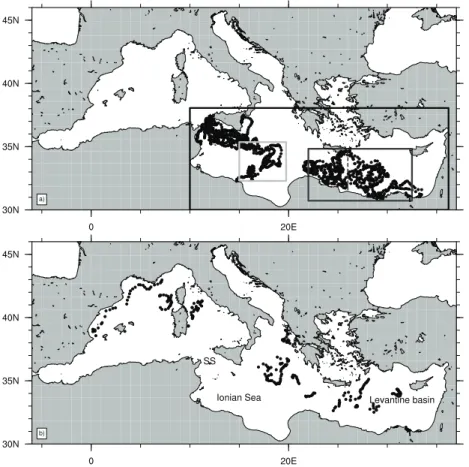
An overview of the available surface-drifter and Argo-float positions is provided in Fig. 1. Two sub-regions with large amounts of surface drifter data can be indentified from Fig. 1a: east of the Strait of Sicily and across the central part of the Ionian Sea, as well as the south-western part of the Levantine basin. The Argo-float data (cf.
25
OSD
8, 2503–2525, 2011Variational assimilation of
Lagrangian trajectories
J. A. U. Nilsson et al.
Title Page
Abstract Introduction
Conclusions References
Tables Figures
◭ ◮
◭ ◮
Back Close
Full Screen / Esc
Printer-friendly Version Interactive Discussion
Discussion
P
a
per
|
Dis
cussion
P
a
per
|
Discussion
P
a
per
|
Discussio
n
P
a
per
|
3.2 Numerical experiment set-ups
Four experiments were designed to evaluate the influence of Lagrangian trajectory as-similation on the model fields, subsequently referred to as CTRL, SURF, SURF2, and ARGO (cf. Table 1). All experiments were initialized with the same forcing fields on 1 September 2005, and stopped after 4 months on 31 December 2005. A sensitivity test
5
showed that applying a 5000-m drifter position observational error secured a stable convergence of OceanVar and yielded the best model results in terms of root-mean-square (RMS) misfits. It is noteworthy that the magnitude of this error is significantly larger than the applied observational error for the Argo-float positions in OceanVar (2000 m, Nilsson et al., 2011), however, it is smaller than the model horizontal
reso-10
lution which is∼7 km. Moreover, forecasting accurately the highly variable small- and
meso scale dynamics in the upper ocean is a great challenge, and thus, in this con-text, the observational errors of these Lagrangian data sets could be interpreted as a measure of the uncertainties of the modelled surface and intermediate-depth velocity fields.
15
The control experiment (CTRL) assimilated daily satellite SLA and SST data as well as temperature and salinity profiles, whereas the SURF experiment also included ob-servations of drifter positions. Moreover, in the SURF2 experiment surface-drifter and Argo-float positions were assimilated, and thus the surface as well as the intermediate-depth trajectories were simultaneously modified. The ARGO experiment
20
OSD
8, 2503–2525, 2011Variational assimilation of
Lagrangian trajectories
J. A. U. Nilsson et al.
Title Page
Abstract Introduction
Conclusions References
Tables Figures
◭ ◮
◭ ◮
Back Close
Full Screen / Esc
Printer-friendly Version Interactive Discussion
Discussion
P
a
per
|
Dis
cussion
P
a
per
|
Discussion
P
a
per
|
Discussio
n
P
a
per
|
4 Results and discussion
4.1 Statistical analysis
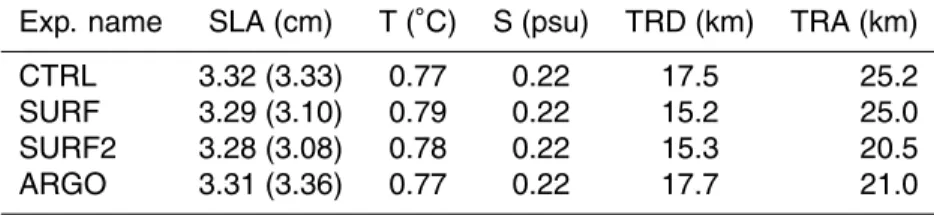
The impact of Lagrangian data assimilation of surface-drifter data on the model output was evaluated in terms of 4-month basin-average RMS misfits between the observed and forecasted temperature and salinity values, as well as the drifter and float trajectory
5
end-point estimates. The SLA RMS misfits were calculated both as basin averages and in close vicinity of the drifters (1◦radius and a 3-day time span); this since applying
only basin-mean statistics for SLA could lead to underestimating the local effects of
the surface-drifter trajectory assimilation due to the large amount of satellite-observed data in areas without surface drifters. All RMS misfits are provided in Table 2, and
10
in particular, the “near-drifter” SLA RMS misfits are given within the brackets next to corresponding basin-average values.
It was found that the quality of the forecasted surface temperature and salinity fields remained at the previous levels of∼0.7◦C and ∼0.2 psu, respectively (Tonani et al., 2009). The quality of the forecasted SLA improved by 5 % in the proximity of the
as-15
similated drifter positions, yielding a decrease of RMS differences from 3.3 cm in CTRL
and ARGO to 3.1 cm in the SURF and SURF2 experiments. (The basin average SLA RMS misfits remained around 3.3 cm for all experiments.) Moreover, the accuracy of the 24-h drifter-trajectory forecasts at the sea surface improved by 15 % when drifter assimilation was introduced in OceanVar, here evaluated in terms of RMS distances
20
between the observed and forecasted drifter-trajectory end-points, yielding 17.5 and 15.2 km in the CTRL and SURF experiments, respectively. The quality of the SURF2-forecasted SLA, temperature and salinity fields as well as the surface-drifter trajectories was maintained compared to the accuracy of the SURF fields, while the 5-day float-trajectory forecasts improved by 20 %, with, notably, RMS misfit distances decreasing
25
OSD
8, 2503–2525, 2011Variational assimilation of
Lagrangian trajectories
J. A. U. Nilsson et al.
Title Page
Abstract Introduction
Conclusions References
Tables Figures
◭ ◮
◭ ◮
Back Close
Full Screen / Esc
Printer-friendly Version Interactive Discussion
Discussion
P
a
per
|
Dis
cussion
P
a
per
|
Discussion
P
a
per
|
Discussio
n
P
a
per
|
temperature and salinity fields, and improved sub-surface trajectory forecasts. (The RMS misfit between the observed and forecasted float-trajectory end points was found to be around 20 km during the autumn of 2005.)
In conclusion, these statistical results indicate that OceanVar is capable of correcting the pressure-gradient field at different vertical levels using two different Lagrangian
ob-5
servational data sets without compromising (and indeed improving slightly) the quality of the other forecast variables.
4.2 Influence of Lagrangian data assimilation on the surface fields
Since the drifter data were located in the Eastern Mediterranean basin during the 4-month test period, the comparisons of the model experiment results have been limited
10
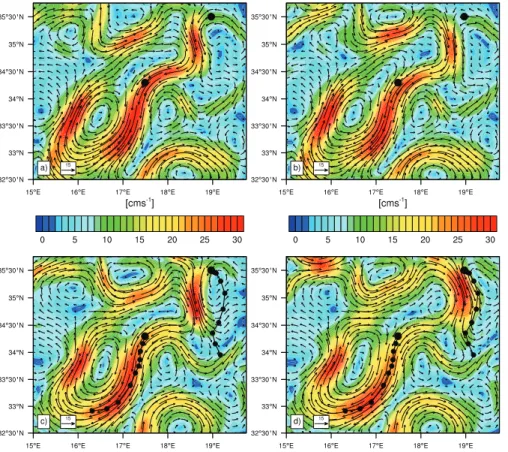
to this area. Next, the influence of surface-drifter-trajectory assimilation on the horizon-tal surface velocity and the SSH fields will be considered. Figure 2 gives an example of the development of the CTRL and SURF velocity fields at a depth of 15 m during 1–10 November 2005. In this period there were approximately four operating drifters (Gerin et al., 2009), including two units located in the Ionian Sea (57 319 to the east,
15
and 59 733 to the west in the figure). The CTRL model results were compared (and validated) with these observations, and it was found that the circulation in the vicinity of drifter 59 733 was well reproduced in the output on 10 November, whereas the ve-locity field near drifter 57 319 was less accurate. An a posteriori control of the SURF experiment output showed that these velocity fields were in better agreement with the
20
observed (and assimilated) Lagrangian trajectories, indicating that OceanVar is capa-ble of converging the model fields towards the drifter positions in a satisfactory manner.
Another example is provided for mid-December 2005 when∼20 drifters were available
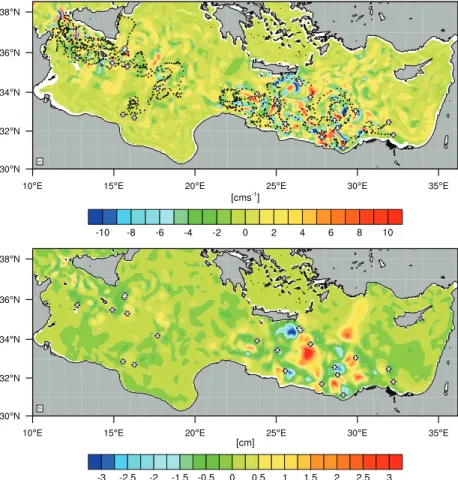
per day. The day-to-day differences in the model fields (21–22 December) were
cal-culated and the subsequent differences between the CTRL and SURF residual fields
25
OSD
8, 2503–2525, 2011Variational assimilation of
Lagrangian trajectories
J. A. U. Nilsson et al.
Title Page
Abstract Introduction
Conclusions References
Tables Figures
◭ ◮
◭ ◮
Back Close
Full Screen / Esc
Printer-friendly Version Interactive Discussion
Discussion
P
a
per
|
Dis
cussion
P
a
per
|
Discussion
P
a
per
|
Discussio
n
P
a
per
|
proximity of the drifters but not necessarily to the last assimilated positions obtained on 21 December. This suggests that previous corrections of the velocity field are still
present in the “model memory”, and some differences are located at distance from the
surface drifters, indicating a horizontal propagation of the model field corrections. Sim-ilar results were found for glider observations in Dobricic et al. (2010) and for Argo-float
5
trajectories in Nilsson et al. (2011). Moreover, the most distinct residuals in both the
velocity and SSH fields, in particular in the Cretan Passage and offthe North African
coast, are likely to be caused by lateral shifts of the meso-scale features (gyres, eddies, coastal current meandering) due to drifter assimilation.
The statistical analysis of the model results indicated a modest improvement of the
10
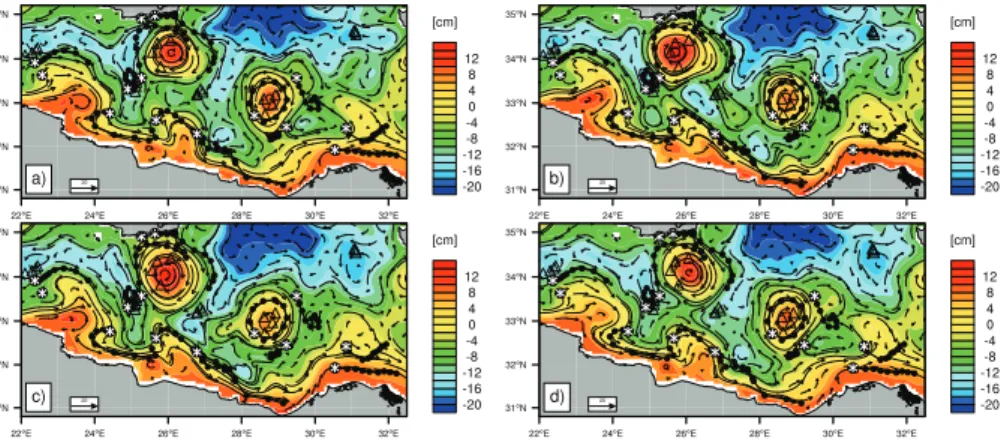
SSH forecast quality in the vicinity of the assimilated surface drifters. The SSH fields from all four numerical experiments on 22 December 2005 are presented in Fig. 4, with the corresponding velocity vector fields at 15 m depth superimposed. Here the drifter observations during 13–22 December are indicated by dots and the Argo-float positions during 1–22 December by triangles. The main features of the surface dynamics can
15
be recognized in all cases, viz. the near-coastal currents and semi-permanent anti-cyclones (Pinardi and Masetti, 2000; Gerin et al., 2009; Hamad et al., 2005). The location of SSH minima and maxima as well as the intensity and direction of the surface currents, however, varies between the experiments, most notably in the vicinity the drifters and the floats. The modelled surface temperature and salinity fields showed
20
corresponding shifts of the horizontal gradients compared to the SSH fields due to drifter assimilation (not shown).
It can be concluded that the drifter assimilation has an ameliorating impact on the quality of the modelled small- and meso-scale dynamics in the surface layer. In partic-ular, assimilation changed the meandering patterns of the Libyo-Egyptian (LE) current
25
(along the African coast near 26–28◦E), and shifted slightly the location and shape of
the Iera-Petra (IP,∼26◦E, 34◦N) and Mersa-Matruh (MM,∼29◦E, 33◦N) in the SURF
OSD
8, 2503–2525, 2011Variational assimilation of
Lagrangian trajectories
J. A. U. Nilsson et al.
Title Page
Abstract Introduction
Conclusions References
Tables Figures
◭ ◮
◭ ◮
Back Close
Full Screen / Esc
Printer-friendly Version Interactive Discussion
Discussion
P
a
per
|
Dis
cussion
P
a
per
|
Discussion
P
a
per
|
Discussio
n
P
a
per
|
CTRL results, and furthermore, the quality of the SURF2 SSH fields was slightly im-proved compared to the SURF results. Thus the SSH fields from the drifter assimilation experiments were found to be more realistic than the CTRL fields, since the modelled sea-level gradients are in better agreement with the observed drifter trajectories (as to be expected in areas characterized by geostrophic flow).
5
It should be noted that the SSH and surface velocity fields in Fig. 4 from the CTRL and ARGO experiments bear large resemblances in the near-drifter areas (same “er-rors”), while similarities were found in the SURF2 and ARGO flow structures near the observed and assimilated Argo floats (similar corrections of surface fields due to intermediate-depth trajectory assimilation). This example indicates how suble the
ve-10
locity field corrections have been blended into the model fields from the Lagrangian data assimilation experiments, to be compared with the less accurate CTRL output. Furthermore, these findings confirm that assimilation of sub-surface trajectories can influence and occasionally improve the strength and direction of the modelled surface flow, as suggested in Nilsson et al. (2011).
15
4.3 Impact on the intermediate velocity fields due to surface trajectory corrections
Here, it is investigated if assimilation of Lagrangian surface drifter data can influence the meso-scale dynamics at intermediate depth. The RMS misfits between the ob-served and forecasted drifter positions indicated that surface-drifter assimilation could
20
also improve the forecasting capabilities of the Argo trajectories at 350 m depth, cf. 20.5 km (SURF2) and 21 km (ARGO) in Table 2. However, it should be kept in mind
that the difference between these estimates is on the order of the Lagrangian
observa-tional errors thus the improvements made on the intermediate-depth velocity fields due to drifter assimilationon should not be overinterpreted.
25
OSD
8, 2503–2525, 2011Variational assimilation of
Lagrangian trajectories
J. A. U. Nilsson et al.
Title Page
Abstract Introduction
Conclusions References
Tables Figures
◭ ◮
◭ ◮
Back Close
Full Screen / Esc
Printer-friendly Version Interactive Discussion
Discussion
P
a
per
|
Dis
cussion
P
a
per
|
Discussion
P
a
per
|
Discussio
n
P
a
per
|
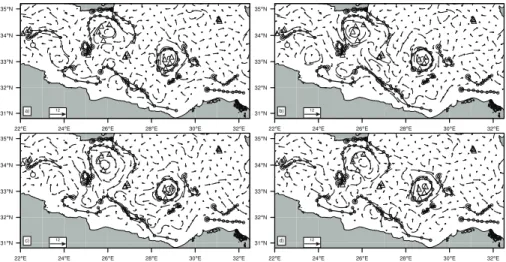
such as the changes in the small-scale dynamics along the LE current as well as the locations and dimensions of the IP and MM gyres. Furthermore, the model results pre-sented in this figure show that surface drifter assimilation is capable of influencing, and possibly correcting, the Levantine circulation down to at least 350 m depth. The assim-ilation of the Argo float trajectories have also yielded improvements in the intermediate
5
depth velocity field, and in particular can be pointed out the area near 31◦E, 35◦N,
where the data assimilation appear to have had a decelerating effect of the near-float
velocity field.
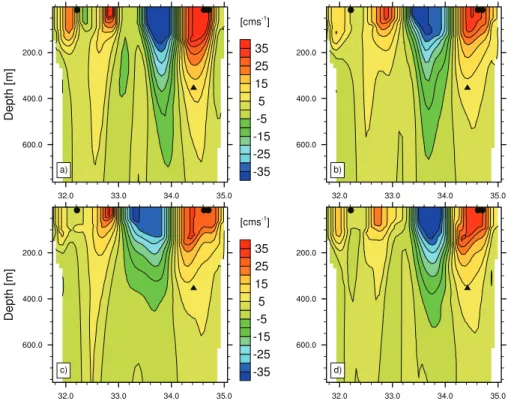
Finally, a transect along 26◦E was made of the zonal flow across the Cretan passage
on 22 December 2005 (cf. Fig. 6), in order to illustrate the differences between each
ex-10
periment’s representation of the velocity field in the vertical plane. This transect, on this day, was opportune for detailed analysis as 3 drifters (nr 59 753 at 26◦12′E, 34◦37′N; nr 59 757 at 26◦15′E, 34◦42′N; and, nr 59 755 at 25◦39′E, 32◦12′N) and one float (nr 50 755 at 26◦4′E, 34◦25′N) were located near the 26◦E-meridional, which provided
favorable circumstances for evaluating effects of combined surface and intermediate
15
depth Lagrangian data assimilation.
The strong east- and westward velocities of the Atlantic waters in the upper 200 m (Hamad et al., 2006) of the transect are caused by the LE current and the IP gyre,
showing typical velocities of 10–30 cm s−1 (Gerin et al., 2009). The strength of the
surface velocities vary between the four experiments on the order of±5–10 cm s−1(cf.
20
Fig. 3a), and this is mostly related to the laterally shifted baroclinic-instability front of the meandering coastal current (cf. Fig. 4). The IP gyre seem to be clearly influenced by the Lagrangian assimilation of drifter and Argo data, both in terms of current velocities and the vertical extent of the gyre. Some of the velocity variability could be explained by the fact that the gyre is centered differently in each model field, however, also Figs. 4
25
and 5 reveal changes in the flow field intensity. The two model setups including float
trajectory assimilation appear to have a limiting effect on the gyre depth. In the CTRL
and SURF velocity output, the intense core of the IP gyre extends down to∼600 m,
OSD
8, 2503–2525, 2011Variational assimilation of
Lagrangian trajectories
J. A. U. Nilsson et al.
Title Page
Abstract Introduction
Conclusions References
Tables Figures
◭ ◮
◭ ◮
Back Close
Full Screen / Esc
Printer-friendly Version Interactive Discussion
Discussion
P
a
per
|
Dis
cussion
P
a
per
|
Discussion
P
a
per
|
Discussio
n
P
a
per
|
This modified gyre depth would be in general agreement with the results due to Popov (2004) who estimated observationally the vertical scales of the IP gyre to approximately 500 m. Moreover, the results from the SURF2 and ARGO experiments imply, that float assimilation have tended to reduce the velocities of the intermediate layer waters also in this case.
5
5 Conclusions
Four numerical experiments have been presented where variational assimilation of La-grangian observations from Eastern-Mediterranean surface drifters and Argo floats (to-gether and separately) was undertaken for a 4-month period, thus changing the Eule-rian SSH, temperature, salinity and velocity fields in an OGCM. The results of these
10
investigations indicate that the quality of the surface and intermediate-depth velocity fields improved when the Lagrangian data sets were assimilated, yielding more accu-rate surface-drifter and Argo-float position forecasts (∼15 and∼20 %, respectively) in
terms of relative differences in RMS misfits. The basin-mean RMS misfits of
tempera-ture and salinity remained unchanged, while the local impact close to the drifters could
15
not be evaluated due to lack of observations. Moreover, the SSH gradient fields from the drifter-assimilation experiment proved to be in better agreement with observations
(the SSH forecast improved locally by∼5 %) compared to the output from the control
experiment.
Local studies of the model fields from the four experiments gave an interesting insight
20
on the influence of Lagrangian trajectory corrections on the surface and intermediate velocity fields. It was shown that the best quality of the model output was obtained when all observational data sets were assimilated simultaneously by OceanVar. Improving the accuracy of the predicted surface meso-scale dynamics can be of particular interest for improving oil-spill predictions and the capability of back-tracking objects at sea, both
25
OSD
8, 2503–2525, 2011Variational assimilation of
Lagrangian trajectories
J. A. U. Nilsson et al.
Title Page
Abstract Introduction
Conclusions References
Tables Figures
◭ ◮
◭ ◮
Back Close
Full Screen / Esc
Printer-friendly Version Interactive Discussion
Discussion
P
a
per
|
Dis
cussion
P
a
per
|
Discussion
P
a
per
|
Discussio
n
P
a
per
|
In the present study, the influence of inertial currents on the model analyses have not been taken into account, since these frequencies are outside of the time range dealt with here (36-h low-pass filtered observations and daily-average model fields).
However, it would be important to examine these effects in detail within the framework
of drifter trajectory assimilation in a future study.
5
Acknowledgements. This work was part of the activities in the INGV study program
“Pro-gramma Internazionale di Studi Avanzati sull’Ambiente e sul Clima”, funded by the “Fondazione Cassa di Risparmio di Bologna”, and it was supported by the European Commission MyOcean Project (SPA.2007.1.1.01, development of upgrade capabilities for existing GMES fast-track services and related operational services, grant agreement 218812-1-FP7-SPACE 2007-1).
10
Post-processed drifter and float data sets were obtained from the MedSVP (http://nettuno. ogs.trieste.it/sire/medsvp), and the MedArgo Centre (http://nettuno.ogs.trieste.it/sire/medargo), OGS, Italy. J.A.U.N. acknowledges the support of Galostiftelsen Stockholm and the Foundation Blanceflor Ludoviso-Boncompagni, nee Bildt. Thanks are due to the Nordic Institute for The-oretical Physics for their program on Predictability. P.M.P. was partially supported by the US
15
Office of Naval Research under grants N000140510281 and N000140610391.
References
Coppini, G., De Dominicis, M., Zodiatis, G., Lardner, R., Pinardi, N., Santoleri, R., Colella, S., Bignami, F., Hayes, D. R., Soloviev, D., Georgiou, G., and Kallos, G.: Hindcast of oil-spill pollution during the Lebanon crisis in the Eastern Mediterranean, July–August 2006, Mar.
20
Pollut. Bul., 62, 140–143, doi:10.1016/j.marpolbul.2010.08.021, 2011. 2504
Dobricic, S. and Pinardi, N.: An oceanographic three-dimensional variational data assimilation scheme, Ocean Modell., 22, 89–105, 2008. 2504, 2506
Dobricic, S., Pinardi, N., Adani, M., Bonazzi, A., Fratianni, C., and Tonani, M.: Mediterranean Forecasting System: an improved assimilation scheme for sea-level anomaly and its
valida-25
tion, Q. J. R. Meteorol. Soc., 131, 3627–3642, 2005. 2505
OSD
8, 2503–2525, 2011Variational assimilation of
Lagrangian trajectories
J. A. U. Nilsson et al.
Title Page
Abstract Introduction
Conclusions References
Tables Figures
◭ ◮
◭ ◮
Back Close
Full Screen / Esc
Printer-friendly Version Interactive Discussion
Discussion
P
a
per
|
Dis
cussion
P
a
per
|
Discussion
P
a
per
|
Discussio
n
P
a
per
|
Fan, S., Oey, L.-Y., and Hamilton, P.: Assimilation of drifter and satellite data in a model of the Northeastern Gulf of Mexico, Cont. Shelf. Res., 24, 1001–1013, 2004. 2504
Gerin, R., Poulain, P.-M., Taupier-Letage, I., Millot, C., Ben Ismail, S., and Sammari, C.: Surface circulation in the Eastern Mediterranean using drifters (2005–2007), Ocean Sci., 5, 559–574,
5
doi:10.5194/os-5-559-2009, 2009. 2507, 2510, 2511, 2513
Hamad, N., Millot, C., and Taupier-Letage, I.: A new hypothesis about the surface circulation in the eastern basin of the Mediterranean Sea, Prog. Oceanogr., 66, 287–298, 2005. 2511 Hamad, N., Millot, C., and Taupier-Letage, I.: The surface circulation in the eastern basin of the
Mediterranean Sea, Sci. Mar., 70 (3), 457–503, 2006. 2513
10
Le Traon, P. Y., Nadal, F., and Ducet, N.: An improved mapping method of multisatellite altimeter data, J. Atm. Ocean. Technol., 15, 522–533, 2003. 2505
Manzella, G. M. R., Reseghetti, F., Coppini, G., Borghini, M., Cruzado, A., Galli, C., Gertman, I., Gervais, T., Hayes, D., Millot, C., Murashkovsky, A., ¨Ozsoy, E., Tziavos, C., Velasquez, Z., and Zodiatis, G.: The improvements of the ships of opportunity program in MFS-TEP, Ocean
15
Sci., 3, 245–258, doi:10.5194/os-3-245-2007, 2007. 2505
Marullo, S., Buongiorno Nardelli, B., Guarracino, M., and Santoleri, R.: Observing the Mediter-ranean Sea from space: 21 years of Pathfinder-AVHRR sea surface temperatures (1985 to 2005): re-analysis and validation, Ocean Sci., 3, 299–310, doi:10.5194/os-3-299-2007, 2007. 2505
20
Menna, M. and Poulain, P. M.: Mediterranean intermediate circulation estimated from Argo data in 2003–2010, Ocean Sci., 6, 331–343, doi:10.5194/os-6-331-2010, 2010. 2507
Molcard, A., Piterbarg, L. I., Griffa, A. M. O. T., and Mariano, A. J.: Assimilation of drifter observations for the reconstruction of the Eularian circulation field, J. Geophys. Res., 108, 3056, doi:10.1029/2001JC001240, 2003. 2504
25
Nilsson, J. A. U., Dobricic, S., Pinardi, N., Taillandier, V., and Poulain, P.-M.: On the assess-ment of Argo float trajectory assimilation in the Mediterranean Forecasting System, Ocean. Dynam., 61, 1475–1490, doi:10.1007/s10236-011-0437-0, 2011. 2504, 2506, 2508, 2509, 2511, 2512
Ozgokmen, T. M., Molcard, A., Chin, T. M., Piterbarg, L. I., and Griffa, A.: Assimilation of drifter
30
observations in primitive equation models of midlatitude ocean circulation, J. Geophys. Res., 108, 3238, doi:10.1029/2002JC001719, 2003. 2504
OSD
8, 2503–2525, 2011Variational assimilation of
Lagrangian trajectories
J. A. U. Nilsson et al.
Title Page
Abstract Introduction
Conclusions References
Tables Figures
◭ ◮
◭ ◮
Back Close
Full Screen / Esc
Printer-friendly Version Interactive Discussion
Discussion
P
a
per
|
Dis
cussion
P
a
per
|
Discussion
P
a
per
|
Discussio
n
P
a
per
|
2505
Pinardi, N. and Masetti, E.: Variability of the large scale general circulation of the Mediterranean Sea from observations and modelling: a review, Palaeogeogr. Palaeoclimatol. Palaeoecol., 158, 153–173, 2000. 2511
5
Pinardi, N., Allen, I., Demirov, E., De Mey, P., Korres, G., Lascaratos, A., Le Traon, P.-Y., Mail-lard, C., Manzella, G., and Tziavos, C.: The Mediterranean ocean forecasting system: first phase of implementation (1998–2001), Ann. Geophys., 21, 3–20, doi:10.5194/angeo-21-3-2003, 2003. 2504, 2505
Popov, Y.: Genesis and structure of the anticyclonic Ierapetra zone in the Levantine basin,
10
Phys. Oceanogr., 14(4), 234–242, 2004. 2514
Poulain, P.-M., Barbanti, R., Font, J., Cruzado, A., Millot, C., Gertman, I., Griffa, A., Molcard, A., Rupolo, V., Le Bras, S., and Petit de la Villeon, L.: MedArgo: a drifting profiler program in the Mediterranean Sea, Ocean Sci., 3, 379–395, doi:10.5194/os-3-379-2007, 2007. 2505 Taillandier, V., Griffa, A., Poulain, P.-M., and B ´eranger, K.: Assimilation of ARGO float
posi-15
tions in the North Western Mediterranean Sea and impact on ocean circulation simulations, Geophys. Res. Lett., 33, L11604, doi:10.1029/2005GL025552, 2006a. 2506
Taillandier V., Griffa A., and Molcard A.: A variational approach for the reconstruction of regional scale Eularian velocity fields from Lagrangian data, Ocean Modell., 13, 1–24, 2006b. 2506 Tonani, M., Pinardi, N., Dobricic, S., Pujol, I., and Fratianni, C.: A high-resolution free-surface
20
OSD
8, 2503–2525, 2011Variational assimilation of
Lagrangian trajectories
J. A. U. Nilsson et al.
Title Page
Abstract Introduction
Conclusions References
Tables Figures
◭ ◮
◭ ◮
Back Close
Full Screen / Esc
Printer-friendly Version Interactive Discussion
Discussion
P
a
per
|
Dis
cussion
P
a
per
|
Discussion
P
a
per
|
Discussio
n
P
a
per
|
Table 1. Design of numerical experiments, the assimilated observations are marked with X.
SLA (sea level anomalies), TEM (temperature profiles), SAL (salinity profiles), TRD (surface drifter positions), and TRA (Argo float positions).
Exp. name SLA TEM SAL TRD TRA
CTRL X X X SURF X X X X
SURF2 X X X X X
OSD
8, 2503–2525, 2011Variational assimilation of
Lagrangian trajectories
J. A. U. Nilsson et al.
Title Page
Abstract Introduction
Conclusions References
Tables Figures
◭ ◮
◭ ◮
Back Close
Full Screen / Esc
Printer-friendly Version Interactive Discussion
Discussion
P
a
per
|
Dis
cussion
P
a
per
|
Discussion
P
a
per
|
Discussio
n
P
a
per
|
Table 2.4-month basin-average RMS misfits between model values and observations for
sea-level anomalies, sea-surface temperature and salinity, as well as surface-drifter and Argo-float positions. “Near-drifter” SLA RMS misfits are given within the brackets.
Exp. name SLA (cm) T (◦C) S (psu) TRD (km) TRA (km)
OSD
8, 2503–2525, 2011Variational assimilation of
Lagrangian trajectories
J. A. U. Nilsson et al.
Title Page
Abstract Introduction
Conclusions References
Tables Figures
◭ ◮
◭ ◮
Back Close
Full Screen / Esc
Printer-friendly Version Interactive Discussion
Discussion
P
a
per
|
Dis
cussion
P
a
per
|
Discussion
P
a
per
|
Discussio
n
P
a
per
|
Fig. 1.Distribution of Lagrangian observations during the test period 1 September–31
OSD
8, 2503–2525, 2011Variational assimilation of
Lagrangian trajectories
J. A. U. Nilsson et al.
Title Page
Abstract Introduction
Conclusions References
Tables Figures
◭ ◮
◭ ◮
Back Close
Full Screen / Esc
Printer-friendly Version Interactive Discussion
Discussion
P
a
per
|
Dis
cussion
P
a
per
|
Discussion
P
a
per
|
Discussio
n
P
a
per
|
Fig. 2.Upper panels: Velocity fields at 15 m depth on 1 November 2005 from the(a)CTRL, and
OSD
8, 2503–2525, 2011Variational assimilation of
Lagrangian trajectories
J. A. U. Nilsson et al.
Title Page
Abstract Introduction
Conclusions References
Tables Figures
◭ ◮
◭ ◮
Back Close
Full Screen / Esc
Printer-friendly Version Interactive Discussion
Discussion
P
a
per
|
Dis
cussion
P
a
per
|
Discussion
P
a
per
|
Discussio
n
P
a
per
|
Fig. 3.Differences between the day-to-day residuals from 21 to 22 December 2005 of the CTRL
OSD
8, 2503–2525, 2011Variational assimilation of
Lagrangian trajectories
J. A. U. Nilsson et al.
Title Page
Abstract Introduction
Conclusions References
Tables Figures
◭ ◮
◭ ◮
Back Close
Full Screen / Esc
Printer-friendly Version Interactive Discussion
Discussion
P
a
per
|
Dis
cussion
P
a
per
|
Discussion
P
a
per
|
Discussio
n
P
a
per
|
Fig. 4.Sea-surface height fields (cm) on 22 December 2005 with superimposed velocity vector
OSD
8, 2503–2525, 2011Variational assimilation of
Lagrangian trajectories
J. A. U. Nilsson et al.
Title Page
Abstract Introduction
Conclusions References
Tables Figures
◭ ◮
◭ ◮
Back Close
Full Screen / Esc
Printer-friendly Version Interactive Discussion
Discussion
P
a
per
|
Dis
cussion
P
a
per
|
Discussion
P
a
per
|
Discussio
n
P
a
per
|
Fig. 5. Velocity vector fields at 365-m depth on 22 December 2005 from the (a) CTRL, (b)
OSD
8, 2503–2525, 2011Variational assimilation of
Lagrangian trajectories
J. A. U. Nilsson et al.
Title Page
Abstract Introduction
Conclusions References
Tables Figures
◭ ◮
◭ ◮
Back Close
Full Screen / Esc
Printer-friendly Version Interactive Discussion
Discussion
P
a
per
|
Dis
cussion
P
a
per
|
Discussion
P
a
per
|
Discussio
n
P
a
per
|
Fig. 6. Zonal velocity transect across the Cretan Passage (26◦E) on 22 December 2005: (a)