O R I G I N A L A R T I C L E UDC: 616.89-008.441.3-08::616.89-008.454 DOI: 10.2298/VSP131223047M
Correlation and characteristics of self-rating and clinically rating
depression among alcoholics in the course of early abstinence
Povezanost i karakteristike samoprocene i klini
č
ke procene depresije kod
alkoholi
č
ara u toku rane apstinencije
Gordana Mandić-Gajić, Radomir Samardžić, Željko Špirić
Clinic for Psychiatry, Military Medical Academy, Belgrade, Serbia; Faculty of Medicine of the Military Medical Academy, University of Defence, Belgrade, Serbia
Abstract
Background/Aim. Depression is an alcoholism relapse risk factor, but frequently stays underdiagnosed among treated al-coholics. The correlation and characteristics of self-reported and clinically assessed depression in the course of early alcohol abstinence were explored. Methods. A total of 100 inpatient, primary male alcoholics (20–60 years) diagnosed according to Classificaton of Mental and Behavioural Disorders (ICD-10) and Diagnostic and Statistical Manual of Mental Disorders (DSM-IV) were recruited consecutively. The Hamilton De-pression Rating Scale (HDRS) and Beck DeDe-pression Inventory (BDI) were scored on admission (T1), after 4 weeks (T2) and after 8 weeks (T3). Student's t-test, repeated measures ANOVA and Pearson's correlation between the scores were done (p < 0.05). Factor analyses of symptoms were per-formed. Results: On HDRS T1, T2, T3 90,7%, 39.5%, 17.4% alcoholics were depressive, respectively. The mean HDRS vs BDI scores on T1, T2 and T3 were 15.16 ± 6.34, 7.35 ± 4.18, 4.23 ± 2.93 vs 14.20 ± 9.56, 8.14 ± 7.35, 5.30 ± 4.94, respec-tively. Depression severity significantly lowered in the course of abstinence (ANOVA). The HRDS and BDI correlations on T1, T2 and T3 were significant (r1 = 0.763, r2 = 0.684, r3 = 0.613 respectively). Dysphoric mood, anxious, vegetative and cognitive HDRS subscales on T1, T2 and T3 were detected, but not BDI factors, thus BDI symptoms were analysed. Conclusions. The majority of alcoholics had depression on admission. A predominant mild-degree with a significant low-ering of depression severity and positive significant correla-tions between HRDS and BDI scores in the course of absti-nence were detected. The dysphoric mood on the HDRS sub-scale, and self-blame, anhedonia and guilt BDI symtoms were most prominent and persisted. The BDI could be a useful tool not only for routine screening and reassessment of depression, but also for exploring emotional content during early absti-nence and planning tailored integrative therapy and relapse prevention for alcoholics.
Key words:
alcoholism; depression; comorbidity; psychiatric status rating scales; self-evaluation programs.
Apstrakt
Uvod/Cilj. Depresija predstavlja faktor rizika za relaps alkoholizma, ali je često nedijagnostikovana kod lečenih alkoholičara. Ispitani su povezanost i karakteristike samo-procene i samo-procene depresije kod alkoholičara u toku rane apstinencije. Metode. U ispitivanje je bilo uključeno 100 primarnih alkoholičara muškog pola, starosti 20–60 godina (dijagnostikovani prema Međunarodnoj klasifikaciji bolesti – MKB-10 i Dijagnostičko-statističkom priručniku – DSM-IV). Depresija je bila procenjena Hamiltonovom skalom (HDRS) i Bekovim upitnikom (BDI) na prijemu (T1), posle četiri (T2) i osam nedelja (T3). Razlike skorova bile su testirane Studentovim t-testom i ponovljenim me-renjima ANOVA. Primenjena je i Pearsonova korelacija (p < 0.05), kao i faktorska analiza simptoma. Rezultati. Na HDRS skali u vremenima T1, T2, T3 bilo je depresiv-no 90,7%, 39,5%, oddepresiv-nosdepresiv-no 17,4% alkoholičara. Prosečni skorovi HAMD vs BDI u vremenima T1, T2 i T3 bili su 15,16 ± 6,34, 7,35 ± 4,18, 4,23 ± 2,93 vs 14,20 ± 9,56, 8,14 ± 7,35, 5,30 ± 4,94. Opadanje težine depresije na ANOVA i korelacije između HRDS i BDI u vremenima T1, T2 i T3 (r1 = 0.763, r2 = 0,684, r3 = 0,613) bile su značajne. Na sva tri merenja bile su prisutne sve četiri HDRS supskale (disforično raspoloženje, anksiozna, vege-tativna i kognitivna), ali BDI faktori nisu nađeni, pa su analizirani BDI simptomi. Zaključak. Na prijemu, većina alkoholičara imala je prosečno blagu depresiju. U toku osam nedelja, značajno je opao intenzitet depresije sa pozi-tivnom korelacijom između HDRS i BDI. Posle osam ne-delja perzistirala je kao najprominentnija Hamiltonova supskala disforičnog raspoloženja, a na BDI simptomi sa-mooptuživanja, osećaji gubika zadovoljstva i krivice. BDI bi mogao biti koristan ne samo za rutinsko isitivanje i pra-ćenje depresije, već i za procenu unutrašnjeg sadržaja dep-resije u ranoj apstinenciji radi planiranja intergrativnog le-čenja i prevencije relapsa kod alkoholičara.
Ključne reči:
Introduction
Alcoholism and depression often co-occur as con-firmed in numerous both clinical and population investiga-tions 1–3. Several decades ago depression was not treated in dependent alcoholics because clinicians experience was that depressive symptoms were transitory during alcohol withdrawal 4, 5. Alcohol-induced depression withdraws after the four-week abstinence and explains almost one half of depression episodes prevalence in alcoholics lives and it does not require treatment 6. A prospective study showed that after a year of abstinence, male alcoholics were at more than twofold increased risk of severe depression comparing to general population 7. A study on relapse pre-vention has shown that the most frequent determinant for relapse in the treatment of alcoholics was depressive mood in the early phase of abstinence 8. Follow-up of the treated alcoholics has shown that relapse after 5 months more often occurs in those who had more expressed depression at the beginning of abstinence 9. Depression disorder found out after 3 weeks from the beginning of abstinence represents a greater risk of relapse after 6 months of maintained absti-nence 8. Depression persistence after alcohol withdrawal makes treatment of alcoholics more complicated 10. It is still insufficiently clear how comorbid depression changes during alcoholism therapy as well as which one is the most effective for both disorders 11. Small differences observed in clinical features among alcoholics with and without pression are a particular problem because those with de-pression are more similar to the ones without dede-pression than to depressive patients 12. On the other hand, alcoholics have less clear insight about their own health and emotional condition at the beginning of the abstinence and it is also associated with the previous long period of masking emo-tions and self-medication with alcohol. There is a challenge for clinicians to recognize depression symptoms even on admission and then to anticipate whether these symptoms will be temporary or persistent 13, 6. For this reason it is im-portant not only to assess depression, but also to follow-up it in the course of early abstinence with the aim to apply timely therapy 14. Interaction between depressive symptoms and therapist focus on the emotional status of the alcoholics is an important predictor of their successful treatment 15, 16. In order to explore emotional status and plan the treatment, it would be useful to determine depression quality because alcoholics experience abstinence as the lost pleasure and they are reluctant to necessary treatment. It would be inter-esting to compare objective assessment and subjective de-pression rating, because usage of the scale by clinicians needs time and additional education, while self-rating for depression screening is simple and fast. Also, self-rating can be a simple method to obtain important information on emotional content of alcoholics who rarely spontaneously explain their depressive symptoms. For this reason it could be useful to do not only detection, but also to follow-up de-pression in the course of early abstinence phase and to ana-lyze its content with the purpose to improve integrative therapies for alcoholics.
The aim of this study was to examine correlations and characteristics of clinical rating and self-rating depression among alcoholics in the course of early abstinence.
Methods
Study design
The study was performed prospectively in the 8-week period at the Department for Psychiatry of the Military Medical Academy, Belgrade. The depressive symptoms were assessed at the three following times: on admission (T1), re-peated after 4 weeks (T2) and after 8 weeks (T3) of the ab-stinence period. The patients underwent the period of 4 weeks in-patient and 4 weeks abstinence-focused day inte-grative program for alcoholics.
Subjects
A total of 100 male alcoholics, aged between 20 and 60 years, consecutively recruited on admission in a closed ward for 4 weeks and in the day program unit for the next 4 weeks were studied. Inclusion criteria were alcohol dependence syndrome diagnosed according to Clasification of Mental and Behavioural Disorders – ICD-10 (World Health Organi-sation, 1992) 17 and Diagnostic and Statistic Manual of Men-tal Disorders – DSM-IV (American Psychiatric Association, 1995) 18. The subjects were primary alcoholics and the time-line metod was used for depression and primary alcoholism distinction 6. Exclusion criteria were a lifetime history of any DSM-IV Axis I disorder included depressive disorder and any psychiatric comorbidity or additional illegal substance abuse. Medical disorders were excluded by a clinical history, routine blood tests and complete physical exam. Examination was done independently by two physicians. The psychotropic medication, other than benzodiazepines and disulfiram were not allowed. Nine participants were excluded due to relpase and 5 had missed follow-up data resulting in a final sample of 86 alcoholics. Alcoholand drug screen were monitored.
The study protocol was approved by the Local Ethics Board and prior to the investigation written informed con-sents from all the subjects were obtained. The investigation was carried out according to the principles of good clinical practice and according to the Declaration of Helsinki.
Procedures
Sociodemographic characteristics and the pattern of al-cohol use were obtained by the semistructured clinical inter-wiev on the baseline.
Assessment for depressive symptoms
Depression was evaluated and monitored by the Hamil-ton Rating Scale for Depression (HDRS) and Beck Depres-sion Inventory (BDI).
17 and 24 and over 24 indicate severe depression. The 4 HDRS factors were extracted: dysphoric mood, anxi-ety/agitation, vegetative, and cognitive symptoms accord-ing Brown et al. 20.
The BDI is a paper and pencil questions survey which completion by patient require 5–10 minutes 21. Items are scored on 4-point scale value of 0–3. Score sum indicates degree of severity: 0–9, no or minimal depression; 10–16, mild depression, 17–29, moderate depression and 30–63, se-vere depression. Factor analysis of BDI simptoms extracted only mood factor interpretable in this sample, so we analized each BDI symptom severity.
Statistical Analysis
Descriptive statistics were calculated for all the vari-ables and all data were expressed as mean ± SD. The differ-ence between depression characteristics was calculated using the Student t-test. The p values of 0.05 or below were de-fined as statistically significant. Correlations were calculated using Pearson’s correlation coefficient. The analysis of vari-ance (ANOVA) for repeated measures was aplied to examine differences of the mean depression rates at each time point (T1, T2, T3). Data were analysed in Statistical Package for Social Sciences (SPSS) for Windows.
0 0,2 0,4 0,6 0,8 1 1,2 1,4
1 2 3 4 5 6 7 8 9 10 11 12 13 14 15 16 17 18 19 20 21
T1
T2
T3
Fig. 2 – Mean values of the Beck Depression Inventory (BDI) items scores at the 3-points of measurement (T1 – on admission; T2 – after 4 weeks; T3 – after 8 weeks.
BDI 21 items: 1. sadness; 2. hopelessness; 3. past failure; 4. an-hedonia; 5. guilt; 6. punishment; 7. self-dislike; 8. self-blame; 9. suicidal thoughts; 10. crying; 11. agitation; 12. loss of interest in activities; 13. indecisiveness; 14. worthlessness; 15. loss of en-ergy; 16. insomnia; 17. irritability; 18. decreased appetite; 19. diminished concentration; 20. fatigue; 21. lack of interest in sex.
Results
Participant characteristics
Sociodemographical characteristics showed that the av-erage age of male alcoholics was (ґ ± SD) 43.3 ± 7.3 years. They had the mean 13.7 ± 1.95 years of education. The ma-jority of them (87.1%) were employed and were married (83.7%). The following data from the pattern of alcohol use were gathered: the first alcohol related problems occurred 10.3 ± 7.5 years ago, the average alcohol consumption in the month before the assessment was 65.5 ± 27.5 alcohol units per day.
Depression characteristics
The average mild-degree depression severity was de-tected by both scales on admission. The mean scores for HDRS and BDI were 15.16 ± 6.34 and 14.20 ± 9.56, respec-tively. The mean scores decreased in the course of the study. After 4 weeks they were 7.35 ± 4.18 for HDRS and 8.14 ± 7.35 for BDI. Finally, after 8 weeks the mean scores were 4.23 ± 2.93 for HDRS, and 5.30 ± 4.94 for BDI.
One-way repeated measures ANOVA were conducted to compare the scores for each scale. There were a signifi-cant differences between each repeated time points; for HDRS Wilks' Lambda = 0.44, F (84) = 53.71, p < 0.01; and for BDI Wilks’ Lambda = 0.834, F (84) = 203.82; p < 0.01.
Depression was assessed in the majority of alcoholics on admission: in 90.7% on HDRS (mild 51.2%, moderate 31.6% and 7% severe degree) and 59.3% on BDI (mild 22.1%, moderate 29.1% and 8.1% severe degree). After 4 weeks (T2) depressive were 39.5% alcoholics on HDRS (mild 36.0%, and moderate 3.5% degree) and 30.2% on BDI (mild 15.1%, moderate 12.8%, and 2.3 % severe degree).
Af-ter 8 weeks (T3) there were only 17.4% mild depresive alco-holics on HDRS, and 16.3% on BDI (mild 10.5%, moderate 4.6%, and 1.2 % severe degree).
A significant positive correlation between the mean HDRS and the mean BDI sum scores was detected at all the 3 measuring points: r = 0.763(T1), r = 0.684 (T2), r = 0.613 (T3), respectively (p < 0.01 for all corellations).
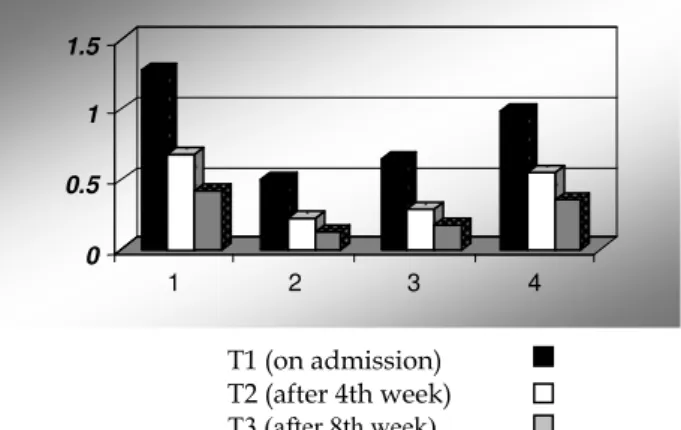
Figure 1 showed the all 4 HDRS subscales presented in the course of 8 weeks of abstinence that decreased from baseline (T1) to T 2 and T3 time points.
0 0.5 1 1.5
1 2 3 4
T1 (on admission) T2 (after 4th week) T3 (after 8th week)
Fig. 1 – Mean values of Hamilton Rating subscale scores at 3-time measurement (T1, T2, T3)
Subsclases: 1. Dysphoric mood; 2. Dysfurctional cognitions; 3. Vegetative symptoms and 4. Anxiety/agitation.
Discussion
The depression prevalence in the treated alcoholics is quite irregular, which can be partly explained by various evaluation instruments and treatment settings. Major depres-sion was assessed by HDRS among 33.4% of the treated al-coholics on admission and varied from 29% to 53% in dif-ferent clinical researches 21. By combination of the cut-off score on HDRS and BDI moderate up to severe depression was detected in 33.3% of outpatient alcoholics 22. In this pa-per the average severity of depression at the beginning of ab-stinence on the upper level of mild degree was detected with a significant decrease of the HDRS sum and BDI sum scores during the 8 week abstinence. Other authors have also re-ported reducing depression severity within the period of in-patient detoxification and abstinence 23, 24.
Analyzing the frequency of depression severity levels in our sample it was observed that the majority of alcoholics were depressive on admission (HDRS vs BDI: 90.7% vs 59.3%) with the presence of mild, moderate and severe de-pression levels. After 4 weeks the HDRS confirmed persis-tent only mild (36%) and moderate depression (3.5%), and after 8 weeks only mild depression persisted in 17.4% alco-holics. Another researchers found severe depression on HDRS among 25% vs 44% in-patient male alcoholics on admission and 11.4% vs 6% after the 4-week treatment 25, 26.
Various instruments for clinical evaluation of depression in alcoholics were used by many investigators. HDRS is a golden rule in diagnostics of depression and this observer rating scale was used to minimise influences on the selfrating depres-sion scale. When used for the clinical sample of male alcohol-ics HDRS showed sensitivity of 100% and specificity of 96%, while BDI showed 67% of sensitivity and 69% of specificity and HDRS and BDI correlation was significant r = 0.29 27. This paper determined statistically significant positive correlation for BDI and HDRS in all the three points of measurements with r1 = 0.763(T1), r2 = 0.684 (T2) and r3 = 0.613 (T3).
Depressive syndrome represents a constellation of symp-tom groups, but except for the screening and evaluation of de-pression severity, attention is not sufficiently paid to some symptoms, so plenty of the obtained items is left unused for ex-ploration of depression content. In this study the most promi-nent HDRS subscale through all the 3 measurements was dys-phoric mood, followed by anxiety, than vegetative and cogni-tive subscale and it was found that each of them decreased in T2 and T3 reassesments. Another author found that the more prominent were anxiety and vegetative subscale among male alcoholics after 4 weeks of abstinence 20. Our results with less prominent vegetative and anxiety subscales suggested that it was unlikely that the association of depression is highly influ-enced by alcohol withdrawal syndrome.
Factor analysis of BDI symptoms was performed, but ex-cept depressive mood, other factors were not found in this study. Other authors reported inconsistent findings of the factor model of the BDI in clinical sample of alcoholics 28. For this reason the BDI items were analyzed in order to recognize de-pression quality in alcoholics on the basis of their self-rating. After 8 weeks the most persistent and prominent BDI
symp-toms were: self-blame, anhedonia and guilt, and after 4 weeks the most prominent symptoms together with the aforemen-tioned ones were also punishment and past failure. However, at the beginning of abstinence the following symptoms together with the aforementioned persistent ones were: insomnia, sad-ness, irritability, agitation and fatigue. The alcohol withdrawal through the psychobiological stress mechanisms and changed neuroadaptation results in marked symptoms of anxiety as well as of vegetative ones which most often withdraw spontaneously within 3 weeks 29. Depression and outcome of the treated alco-holism are significantly associated, but there is no evidence of the strong, direct causative correlation 5, 22. In male alcoholics with more expressed depression at the beginning of abstinence, relapse was more often noticed after 5 months 30. In our sample mild depression on admission was observed, on average. In clinical practice attention is mostly paid to major depression, but the mild one is often overlooked and underestimated. How-ever, the presence not only of major but also of mild depression in alcoholics has predictive importance concerning the course and outcome of their treatment. In a year follow-up after in-patient treatment, the male alcoholics with mild to moderate depression evaluated on admission by the BDI had 2.9 times and with severe depression 4.9 times higher risk of relapse in comparison to non-depressive alcoholics 31.
Comorbid depression has unfavourable affect upon the outcome of treated alcoholism so that integrative psychosocial and pharmacological treatment of dependence is recommend-able together with the combination of antidepressive agents and cognitive-behaviour therapy 32. The focus is on the treat-ment of dependence and antidepressive agents show moderate effect 10, 14, 15. The first step is early diagnosis of depression even on admission 31. Taking into consideration that antide-pressive therapy was not included in this study, partial remis-sion of depresremis-sion should be attributed to discontinued alcohol withdrawal as well as to the absent toxic effect of alcohol.
This study is limited to data from the small clinical sample of male alcoholics and also to the short follow-up pe-riod. Further investigations regarding the course of depres-sion, and the impact on possible therapeutic consequences with large samples of both genders and within the longer pe-riod of time are needed.
Conclusion
R E F E R E N C E S
1. Manninen L, Poikolainen K, Vartianen E, Laatikainen T. Haevy drinking occasions and depression. Alcohol Alcohol 2006; 41(3): 293−9.
2. Curran GM, Booth BM, Kirchner JE, Deneke DE. Recognition and management of depression in a substance use disorder treat-ment population. Am J Drug Alcohol Abuse 2007; 33(4): 563−9.
3. Gopalakrishnan R, Ross J, O'Brien C, Oslin D. Course of late-life depression with alcoholism following combination therapy.
J Stud Alcohol Drugs 2009; 70(2): 237−41.
4. Kessler RC, Berglund P, Demler O, Jin R, Koretz D, Merikangas KR, et al. The epidemiology of major depressive disorder: re-sults from the National Comorbidity Survey Replication (NCS-R). JAMA 2003; 289(23): 3095−105.
5. Petrakis IL, Leslie D, Rosenheck R. The use of antidepressants in alcohol dependent veterans. J Clin Psychiatry 2003; 64(8): 865−70.
6. Liappas J, Paparrigopoulos E, Tzavellas G, Christodoulou G. Impact of alcohol detoxification on anxiety and depressive symptoms. Drug Alcohol Depend 2002; 68(2): 215−20.
7. Schuckit MA, Smith TL, Danko GP, Pierson J, Trim R,
Nurnberger JI, et al. A comparison of factors associated with substance-induced versus independent depressions. J Stud
Al-cohol Drugs 2007; 68(6): 805−12.
8. Gilman SE, Abraham HD. A longitudinal study of the order of onset of alcohol dependence and major depression Drug Al-cohol Depend 2001; 63(3): 277−86.
9. Driessen M, Meier S, Hill A, Wetterling T, Lange W, Junghanns K. The course of anxiety, depression and drinking behaviours af-ter completed detoxification in alcoholics with and without comorbid anxiety and depressive disorders. Alcohol Alcohol 2001; 36(3): 249−55.
10.Brower KJ, Aldrich MS, Robinson EA, Zucker RA, Greden JF. In-somnia, self-medication, and relapse to alcoholism. Am J Psy-ciatry 2001; 158(3): 399−404.
11.Nunes EV, Levin FR. Treatment of depression in patients with alcohol or other drug dependence: a meta-analysis. JAMA 2004; 291(15): 1887−96.
12.Wagner T, Krampe H, Stawicki S, Reinhold J, Jahn H, Mahlke K, et al. Substantial decrease of psychiatric comorbidity in chronic alcoholics upon integrated outpatient treatment - re-sults of a prospective study. J Psychiatr Res 2004; 38(6):619−35.
13.Wang J, Patten SB. Prospective study of frequent heavy alco-hol use and the risk of major depression in the Canadian general population. Depress Anxiety 2002; 15(1): 42−5. 14.Kiefer F, Barocka A. Secondary depression in weaned
alcohol-ics: implications of lesch's typology of chronic alcoholism. Alcohol Alcohol 1999; 34(6): 916−7.
15.Moak DH, Anton RF, Latham PK, Voronin KE, Waid RL,
Durazo-Arvizu R. Sertraline and cognitive behavioral therapy for depressed alcoholics: results of a placebo-controlled trial. J Clin Psychopharmacol 2003; 23(6): 553−62.
16. Karno MP, Longabaugh R. Patient depressive symptoms and thera-pist focus on emotional material: a new look at Project MATCH. J Stud Alcohol 2003; 64(5):607−15.
17. World Health Organization. The ICD-10 Classification of Mental and Behavioural Disorders: Clinical Descriptions and Diagnostic Guidelines. Geneva, Switzerland: World Health Organization; 1992.
18. American Psychiatric Association. Diagnostic and Statistical Manual of Mental Disorders. 4th ed. Washington, DC: American Psychiatric Association; 1994.
19. Hamilton M. A rating scale for depression. J Neurol Neurosurg Psychiatry 1960; 23(1): 56−62.
20. Brown SA, Inaba RK, Gillin JC, Schuckit MA, Stewart MA, Irwin MR. Alcoholism and affective disorder: clinical course of depres-sive symptoms. Am J Psychiatry 1995; 152(1): 45−52.
21. Beck AT, Ward CH, Mendelson M, Mock J, Erbaugh J. An inventory for measuring depression. Arch Gen Psychiatry 1961; 4: 561−71. 22. Lejoyeux M, Lehert P. Alcohol-use disorders and depression:
re-sults from individual patient data meta-analysis of the acam-prosate-controlled studies. Alcohol Alcohol 2011; 46(1):61−7. 23. Steer RA, McElroy MG, Beck AT. Correlates of self-reported and
clinically assessed depression in outpatient alcoholics. J Clin Psy-chol 1983; 39(1): 144−9.
24. Schuckit MA. Alcohol use disorders. Lancet 2009; 373(9662): 492−501.
25. Conner KR, Pinquart M, Gamble SA. Meta-analysis of depression and substance use among individuals with alcohol use disorders. J Subst Abuse Treat 2009; 37: 127−37.
26. Nakamura MM, Overall JE, Hollister LE, Radcliffe E. Factors affect-ing outcome of depressive symptoms in alcoholics. Alcohol Clin Exp Res 1983; 7(2): 188−93.
27. Brawn SA, Schuckit MA. Changes in depression among abstinent alcoholics. J Stud Alcohol 1988; 49(5): 412−7.
28. Willenbring MI. Measurement of depression in alcoholics J Stud Al-cohol 1986; 47(5): 367−72.
29. Dunkel D, Froehlich S, Antretter E, Haring C. Replication of a two-factor model of the Beck Depression Inventory in alcohol dependents and suicide attempters. Psychopathology 2002; 35(4): 228−33.
30. Wetterling T, Junghanns K. Psychopathology of alcoholics during withdrawal and early abstinence. Eur Psychiatry 2000; 15(8): 483−8.
31. Strowig AB. Relapse determinants reported by men treated for al-cohol addiction: the prominence of depressed mood. J Subst Abuse Treat 2000; 19(4): 469−74.
32. Curran GM, Flynn HA, Kirchner J, Booth BM. Depression after alco-hol treatment as a risk factor for relapse among male veterans. J Subst Abuse Treat 2000; 19(3): 259−65.