Article
Printed in Brazil - ©2016 Sociedade Brasileira de Química0103 - 5053 $6.00+0.00
*e-mail: [email protected]
Analysis of Blotter Papers Employed in the Commercialization of New
Hallucinogenic Substances of the 2,5-Dimethoxy-
N
-(2-methoxybenzyl)
Phenethylamine Series Seized in the City of Bogotá by Applying Gas
Chromatography Coupled to a Selective Mass Ion Trap Detector
Diego A. Sánchez Robayo,a,b William F. Garzón Mendez,b Gonzalo Taborda Ocampoa and
Milton Rosero Moreano*,a
aDepartment of Chemistry, Faculty of Natural and Exact Sciences, Universidad de Caldas, Calle 65 No. 26-10, Manizales, Colombia
bChemistry Group, Central-Level, Attorney General of Colombia, Diagonal 22B No. 52-01, Building L, 3rd floor, Bogotá, Colombia
In recent years, the production, distribution and consumption of so-called new psychoactive substances, such as synthetic cannabinoids, synthetic cathinones, and phenethylamines, have increased worldwide. The present work reports the identification of such substances found in samples of blotter papers that were seized in the city of Bogotá in accordance with the analytical method implemented in the chemistry laboratories of the Attorney General of Colombia. Using gas chromatography coupled to a selective mass ion trap detector, the presence of phenethylamine derivatives, mainly from the 2,5-dimethoxy-N-(2-methoxybenzyl) phenethylamine series, was detected. Among them, 2-(4-chloro-2,5-dimethoxy-N-(2-methoxybenzyl)) phenethylamine, 2-(4-bromo-2,5-dimethoxy-N-(2-methoxybenzyl)) phenethylamine, and
2-(4-iodo-2,5-dimethoxy-N-(2-methoxybenzyl)) phenethylamine (m/z 150, 121, 91) were prevalent. The 2,5-dimethoxy-N -(2-methoxybenzyl) phenethylamine series derivatives correspond to proved powerful hallucinogens that have not yet been subjected to international control and supervision.
Keywords: synthetic drugs, blotter papers, phenethylamines, NBOMe series, GC-MS IT
Introduction
Since the year 2012, the forensic chemistry laboratory of the Attorney General of Colombia has noted an increase in the quantity of blotter paper samples received for substance analysis as part of judicial investigations for the crimes of trafficking, possession, or distribution of drugs according to the Colombian Penal Code. Moreover, the gas chromatography coupled to a selective mass detector (GC-MS) analyses show no lysergic acid diethylamide (LSD) content, as has been traditionally found.
The blotter papers with logos and bright colors are used as suppport for the distribution of synthetic drugs whose effects are achieved in the microgram level; recent results have shown that blotter papers1,2 are used for impregnation
and subsequent marketing of new hallucinogenic drugs or a mixture of drugs derived from the tryptamine and
phenethylamine families.3 In the latter drug family, it is
common to find previously described derivatives from the 2,5-dimethoxy-phenethylamine (2C series),4,5 which
are known as the 2,5-dimethoxy-N-(2-methoxybenzyl) phenethylamine (NBOMe) family; this last group of novel synthetic hallucinogens6 is synthesized by substituting
the nitrogen (N) of the 2C series with a 2-methoxybenzyl (BOMe) group.1
Figure 1 shows the structural relationship between the 2C series and its derivative NBOMe.
Substitutions in the 2C structure, such as the addition of methoxy groups in carbons 2 and 5 of the benzene ring or a halogen substitution in the R1 position, increase the hallucinogenic effect of the substance.4,5
The high hallucinogenic potential of NBOMe series derivatives lies in the fact that they are powerful agonists of serotonin receptors; these receptors are implicated in the pathophysiology of depression, schizophrenia and hallucinogenic activity.6
Few scientific studies have shown the toxicological effects caused by the ingestion of NBOMe series substances.6-8 Research has been primarily focused on
human post mortem detection9,10 and in some cases, in the
field of clinical pharmacology;11-13 in Colombia, the only
study that has been reported was performed in 2010 and focused on the analysis of substances commercialized in the city of Bogotá under the name synthetic drugs.14
Colombian law, unlike that of other countries,15 does
not regulate the production and distribution of derivatives of the NBOMe series because these derivatives are not officially included in the lists for control and supervision of psychotropic substances provided by the United Nations. This situation favors the continuous production and distribution of new psychoactive substances by criminals. Moreover, recent research shows that these substances can be used as adulterants of traditional drugs.3-15
The aim of the present study is to propose a method for the qualitative analysis of substances of the NBOMe series found in blotter papers using gas chromatography coupled to a selective mass ion trap detector (GC-MS IT). This analytical method was tested using samples collected in the city of Bogotá with the aim of providing evidence regarding the marketing of new psychoactive substances.
Experimental
Reagents
Methanol high-performance liquid chromatography (HPLC) grade was purchased from Scientific Products
(Bogotá, Colombia). Tetracosane with purity of 99% was acquired from Sigma-Aldrich (St. Louis, MO, USA) and was employed as internal standard. A C8-C40 alkanes calibration standard (98%) was acquired from Casa Cientifica (Bogotá, Colombia). Certified analytical standards of 25H-NBOMe, 25E-NBOMe, 25C-NBOMe, 25B-NBOMe, and 25I-NBOMe with purity between 99.4 and 99.9% were purchased from Química M. G. S. A. S. (Bogotá, Colombia) and certified analytical standards of other types of drugs were acquired from Lipomed through Química M. G. S. A. S. Samples of blotter papers linked to crimes related to the manufacturing, trafficking and sale of drugs (n = 48) were collected in the city of Bogotá and transported to the chemistry laboratory of the Attorney General of Colombia (Figure 2).
GC-MS IT
The analysis using GC-MS IT was performed on an Agilent 7890A-240MS instrument (Santa Clara, CA, USA).16 The extracts were automatically injected in a
split 20:1 mode. An Agilent VF-5MS capillary column (30 m × 250 µm × 0.25 µm, (5%-phenyl)-methylpolysiloxane) was used for chromatographic separation. Helium (grade 5.0, purity 99.999%, 1 mL min-1) was used as the carrier gas. The
column temperature was initially maintained at 100 °C for 30 s and then increased to 280 °C at a rate of 12 °C min-1
for a total run time of 20.5 min. The mass spectrometer operated in an electron impact mode (70 eV), and the ion-source temperature was 250 °C. Fragment acquisition was achieved in the scan mode in a scan range of 29 to 450 Da (see characteristic fragments in Table 1) with an injection volume of 1.0 µL. The identification of the analytes found in the blotter paper samples was accomplished by comparing the retention times and the characteristics of the analytes with those of the reference standards used.
Figure 1. General chemical structure of the 2C series (a); NBOMe (b) and 25R1-NBOMe (c).
Extraction procedure
Whole blotter paper (dose) of dimensions 0.7 × 0.7 cm was transferred into sample glass vial (1.5 mL), 100 µL of internal standard (1000 mg L-1) and 900 µL of methanol
were added, and the vial was sonicated for 10 min. The extracts were analyzed directly by GC-MS IT.
Results and Discussion
By following a standard method applied by the United Nations Office on Drugs and Crime (UNODC)17 for
the qualitative detection of substances impregnated in blotter papers some important analytical characteristics were verified. The detection limits for 25H-NBOMe, 25E-NBOMe, 25C-NBOMe, 25B-NBOMe, and 25I-NBOMe were experimentally determined using serial dilutions. The resulting values were 9.1, 10.1, 9.1, 10.7, and 9.5 mg L-1, respectively. Chromatography parameters and
Kovats retention indices were also determined (Table 1). An excellent chromatographic resolution was obtained for the analyzed components (higher than 1.5). The analytes of interest were eluted at retention times greater than 14 min; separation of a large number of commonly abused drugs is achieved in less time. The Kovats retention indices for the compounds of interest were calculated according to the chromatographic conditions, and analogous results to the retention time of an alkane that contains between 24 and 28 carbon atoms were obtained.
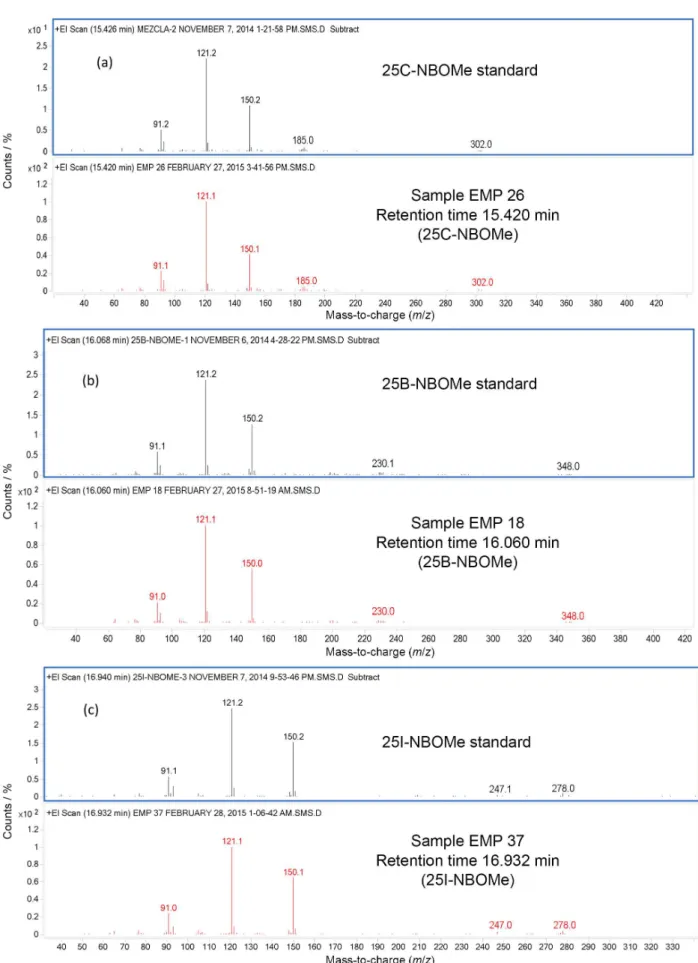
The signal of the compounds of the NBOMe series does not coelute with signals from other drugs of synthetic type and the mass spectra are different for each compound according to the abundances of the characteristic fragments; the analysis method is selective and specific for the analytes of interest (Table 1 and Figure 3).
The developed method has shown good performance in terms of reproducibility and repeatability because no statistical differences were found in the retention times
Table 1. Chromatographic parameters for the analytes of interest
Substancea Retention
time / min Peak width (W) Resolution (R)
Relative retention (α)
Retention (capacity) factor (K´)
Theoretical plate
(efficiency) (N) Kovats index
Characteristic fragment (m/z)
25H-NBOMe 14.340 ± 0.003 0.084 4.88 12.57 1.03 471908 2459 91, 121, 150,
165, 270
25E-NBOMe 14.923 ± 0.006 0.105 6.19 13.12 1.04 324439 2548 91, 121, 150,
180, 296
25C-NBOMe 15.425 ± 0.009 0.095 2.17 13.60 1.01 426292 2626 91, 121, 150,
185, 302
25B-NBOMe 16.068 ± 0.009 0.095 6.81 14.21 1.05 462584 2723 91, 121, 150,
230, 348
25I-NBOMe 16.941 ± 0.012 0.080 10.02 15.03 1.06 724706 2838 91, 121, 150,
247, 278
a4-R1-2,5-Dimethoxyphenyl-N-[(2-methoxyphenyl)methyl]ethanamine, where R1 refers to a hydrogen (H), ethyl group (E), chlorine (C), bromine (B),
or iodine (I).
and mass spectra between the certified analytical standards of the NBOMe and the real samples with respect to the target analytes.
The GC-MS IT analysis of the 48 blotter paper samples led to the detection of 25E-NBOMe, 25C-NBOMe, 25B-NBOMe, and 25I-NBOMe. Moreover, impregnated amphetamine derivatives of the 4-X-2,5-dimethoxyamphetamine (DOX) series were found, which correspond to synthetic drugs developed during the 1980s;4
the presence of escaline (4-ethoxy-mescaline) was also detected in two samples. The identification was performed according to the retention time of each analyte and its respective mass fragmentation based on the literature and forensic libraries.2-18 Table 2 shows the fragment
characteristics of the substances found in the blotter paper samples.
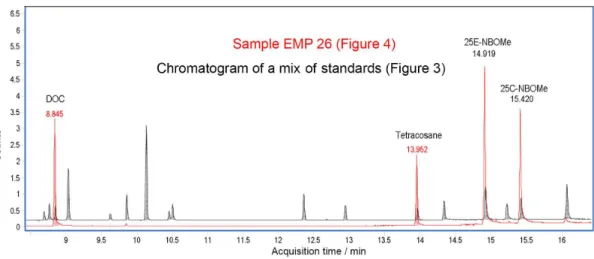
Interestingly, a mixture of several of these substances was found in five samples. In other words, in a single blotter paper sample, more than one abused drug was found. Figure 4 shows the results for one of these samples.
The comparison between a real sample and a standard is shown in Figure 5 (chromatograms) and Figure 6 (mass spectra with the result of different samples).
Figure 7 shows the results of the analyzed samples. It
is noteworthy that four samples contain two analytes, and one sample contains three impregnated substances.
Conclusions
The developed method enables the identification of the NBOMe series and other drugs in blotter paper samples, which is used as part of the evidence for the solution of different crime cases related with traffic and consumption
Table 2. Average retention time and fragment characteristics of the substances found in the blotter paper samples
Substance Molecular weight / (g mol-1) Retention time / min Characteristic fragment (m/z)
25E-NBOMea 329.44 14.918 91, 121, 150, 180, 296
25C-NBOMea 335.83 15.421 91, 121, 150, 185, 302
25B-NBOMea 380.28 16.065 91, 121, 150, 230, 348
25I-NBOMea 427.28 16.936 91, 121, 150, 247, 278
Escaline 225.14 8.881 123, 167, 196, 225
DOC 229.08 8.850 44, 125, 171, 186
DOI 321.02 10.502 44, 145, 247, 278
a4-R1-2,5-Dimethoxyphenyl-N-[(2-methoxyphenyl)methyl]ethanamine, where R1 refers to an ethyl group (E), chlorine (C), bromine (B), or iodine (I).
DOC: 2,5-dimethoxy-4-chloroamphetamine; DOI: 2,5-dimethoxy-4-iodoamphetamine.
Figure 4. Chromatogram of sample 26.
Figure 7. Number of blotter paper samples containing abused drugs.
of new emergent abused drugs in Bogotá’s streets by the Attorney General of Colombia.
Different abused drugs, mainly phenethylamine derivatives of the NBOMe series and amphetamine derivatives of the DOX series, were found in the samples of blotter papers; all of these substances have a proved hallucinogenic potential. 25C-NBOMe was the predominant substance in more than half of the samples studied. One substance found in two samples was escaline, which corresponds to a hallucinogenic derivative of mescaline that is more powerful than mescaline;4 it is a less
common drug, which may indicate a new alternate market of emerging hallucinogens.
These results show that in the city of Bogotá, blotter papers commonly used for LSD marketing contain other types of substances that belong mainly to the NBOMe series and present effects similar to LSD. This situation alarms different authorities, considering the toxicological effects that could be produced by the consumption of novel drugs or a mixture of these drugs, as shown in the present work. This is the first work performed in Colombia that shows the evolution of new drugs of abuse and the first work in Bogotá showing the commercialization of escaline as an impregnated drug in blotter paper.
References
1. Zuba, D.; Sekula, K.; Forensic Sci. Int. 2013, 227, 7. 2. Casale, J.; Hays, P.; Microgram J. 2012, 9, 84.
3. Giné, C. V.; Espinosa, I. F.; Vilamala, M. V.; Drug Test. Anal.
2014, 6, 819.
4. Shulgin, A.; Shulgin, A.; Phenethylamines I Have Known and Loved: A Chemical Love Story;Transform Press: Berkeley, 2002.
5. Dean, B. V.; Stellpflug, S.; J. Med. Toxicol. 2013, 9, 172. 6. Ettrup, A.; Hansen, M.; Santini, M. A.; Paine, J.; Gillings, N.;
Palner, M.; Knudsen, G. M.; Eur. J. Nucl. Med. Mol. Imaging
2011, 38, 681.
7. Suzuki, J.; Dekker, M. A.; Valenti, E. S.; Cruz, F. A. A.; Correa, A. M.; Poklis, J. L.; Poklis, A.; Psychosomatics2015, 56, 129.
8. Halberstadt, A.; Geyer, M.; Neuropharmacology2014, 77, 200. 9. Poklis, J. L.; Devers, K. G.; Arbefeville, E. F.; Pearson, J. M.;
Houston, E.; Poklis, A.; Forensic Sci. Int.2014, 234, 14. 10. Armenian, P.; Gerona, R. R.; Am. J. Emerg. Med. 2014, 11, 3. 11. Rose, S. R.; Poklis, J. L.; Poklis, A.; Clin. Toxicol.2013, 51,
174.
12. Poklis, J. L.; Charles, J.; Wolf, C. E.; Poklis, A.; Biomed. Chromatogr. 2013, 27, 1794.
13. Stellpflug, S. J.; Kealey, S. E.; Hegarty, C. B.; Janis, G. C.; J. Med. Toxicol.2014, 10, 45.
14. Contreras, H. H. B.; Revista de la Integración2010, 6, 105. 15. https://www.unodc.org/LSS/Page/NPS/LegalResponses
accessed in December 2015.
16. http://www.unodc.org/pdf/scientific/stnar34.pdf accessed in December 2015.
17. http://www.unodc.org/documents/scientific/validation_E.pdf accessed in December 2015.
18. http://forendex.southernforensic.org/ accessed in December 2015.
Submitted: July 24, 2015