Key words:
Ureter; Body Height; Stents; Human Engineering; Cadaver
Int Braz J Urol. 2013; 39: 248-56
__________________ Submitted for publication: August 22, 2012
__________________ Accepted after revision: December 21, 2012 Introduction: In some occasions, correlations between human structures can help
plan-ning surgical intra-abdominal interventions. The previous determination of ureteral leng-th helps pre-operatory planning of surgeries, reduces costs of auxiliary exams, leng-the correct choice of double-J catheter with low morbidity and fewer symptoms, and an adequate adhesion to treatment.
Objective: To evaluate ureteral length in adult cadavers and to analyze its correlation with anthropometric measures.
Materials and Methods: From April 2009 to January 2012 we determined ureteral length of adult cadavers submitted to necropsy and obtained the following measures: height, distance from shoulder to wrist, elbow-wrist, xiphoid appendix-umbilicus, umbilicus--pubis, xiphoid appendix-pubis and between iliac spines. We analyzed the correlations between ureteral length and those anthropometric measures.
Results: We dissected 115 ureters from 115 adult corpses from April 2009 to January 2012. Median ureteral length didn’t vary between sexes or according to height. It was observed no correlation among ureteral length and all considered anthropometric me-asures in all analyzed subgroups and in general population. There were no significant differences between right and left ureteral measures.
Conclusions: There is no difference of ureteral length in relation to height or gender (male or female). There is no significant correlation among ureteral length and the considered anthropometric measures.
INTRODUCTION
The search of human body proportionali-ty is ancient and has not ended. The first recor-ded observation of human body proportions was made by the roman architect Vitruvius, posteriorly disseminated by Leonardo da Vinci’s masterpiece “The Vitruvian man” (1).
In some occasions, correlations between different human structures could help planning intra-abdominal surgeries. In the era of minimally invasive surgeries, the previous knowledge of
ure-cing costs, without the need of invasive subsidiary exams, such as cystoscopy or radiological profiles (for example, intravenous pyelography or com-puterized tomography). The correct choice of the length of a double-J catheter reduces symptoms and morbidity (2-7) and one of the determinants is the catheter length (3,8,9). A very long catheter can cause irritative symptoms, while a short one allows migration (3,8,10,11).
Some authors searched for correlations between ureteral length and anthropomorphic
Analysis of ureteral length in adult cadavers
_______________________________________________
Hugo F. F. Novaes, Paula C. S. Leite, Rafaela A. Almeida, Ney C. B. Sorte, Ubirajara Barroso Júnior
Urology Department, Fundação para o Desenvolvimento da Ciência. Escola Bahiana de Medicina e Saúde Pública, Bahia, Brazil
ABSTRACT
ARTICLE
INFO
correlations with no clinical use (2,12), while others haven’t found any (3,10). Such studies were conducted using image or endoscopic methods.
There are no Brazilian data about urete-ral length or studies about correlations between ureteral and anthropometric measures using ca-davers. So we decided to dissect ureters of human cadavers submitted to necropsies at the medical legal institute, and determined their lengths and correlations with some anthropometric measures. According to our knowledge, this is the first Brazi-lian study that correlates ureteral length with an-thropometric data and the first in medical litera-ture to determine these measures in cadavers (the measurement is more accurate than other methods being used so far).
MATERIALS AND METHODS
This is a transverse study that evaluates the length of ureters (point of interest) and other anthropometric measures (predictors) in one par-ticular moment. Data were collected from April 2009 to January 2012 and were obtained from the dissection of cadaveric ureters of patients with more than 16 years old, submitted to necropsy at the Medical Legal Institute Nina Rodrigues, in Sal-vador, Bahia.
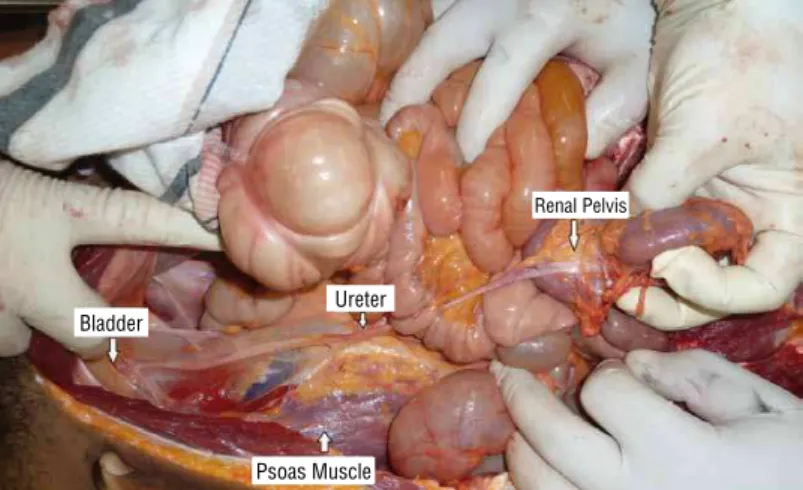
The necropsied cadavers (with violent or natural cause of death) were submitted to retro-peritoneal dissection (Figure-1), separating and removing the kidney and corresponding ureter with its bladder insertion (Figure-2). Renal pelvis
Figure 1 - Retroperitoneum.
Figure 2 - Kidney, ureter and bladder cuff.
Bladder
Ureter
Ureter
kidney Insertion of the
Ureter Bladder
Psoas Muscle
was detached from the renal parenchyma and the whole structure (renal pelvis, ureter and bladder insertion) was rectified at the bench (Figure-3). The ureter was delimited by the ureteral-pielic junc-tion (UPJ) and ureteral-bladder juncjunc-tion (UBV). UPJ was identified at the point of proximal en-largement of the ureter and the UBV at the point of distal enlargement. In case of doubt, the extre-mities were opened longitudinally to help identify these points (Figure-4). The dissection was done bilaterally and at the bench the structure was rec-tified in order to measure the ureteral length using a millimetric scale with 5 mm gradation.
The following measures were also obtai-ned: distance from shoulder to wrist (acromial
process-head of the ulna), elbow-wrist (olecra-non-head of the ulna), xiphoid appendix-umbili-cus, umbilicus-pubis, xiphoid appendix-pubis and between iliac spines. The cadavers were randomly chosen, and those with primary or secondary ure-teral diseases leading to anatomic distortion (me-gaureter, neoplasms, adhesions, duplicity), urete-ral trauma or previous ureteurete-ral surgery (confirmed or suspected) or any evident ureteral disease were excluded.
Calculation of the sample was made using the software BioEstat 5.0, based on the data of Jeon et al. (4), that described a correlation betwe-en height and ureteral lbetwe-ength with a correlation coefficient r = 0.369. With a statistical power of
Figure 3 - Ureter (red arrows indicate UPJ at left and UBJ at right).
90% with a type error I of 5%, it was verified the need of a sample of 83 ureters.
For statistical analysis, the sample was cate-gorized according to gender (male and female) and height (subgroup H1: cadavers with less than 165 cm height, subgroup H2: height from 166 to 175 cm; and subgroup H3: height equal or superior to 176 cm). Student t test was used for the analysis of the ureteral length according to gender. For analysis of ureteral length according to height subgroups, it was used analysis of variance (ANOVA).
Pearson correlation was used to analyze the correlation between ureteral length and the an-thropometric measures. Multiple linear regression was used to evaluate the possibility of obtaining a predictor equation of ureteral length. Backward strategy was used to determine the predictive va-riables of the final model. In order to correct the possible effects of extreme values, it was obtained correlation and regression analysis of all values of
ureteral lengths and to all values that, in a normal standardized scale, had z scores of -1.96 to 1.96.
P values lower than 5% (p < 0.05) were considered significant. All analysis were made using SPSS software version 14.0.
This study was approved by the Medical Ethical Committee of our institution and by the scientific board of the medical legal institute.
RESULTS
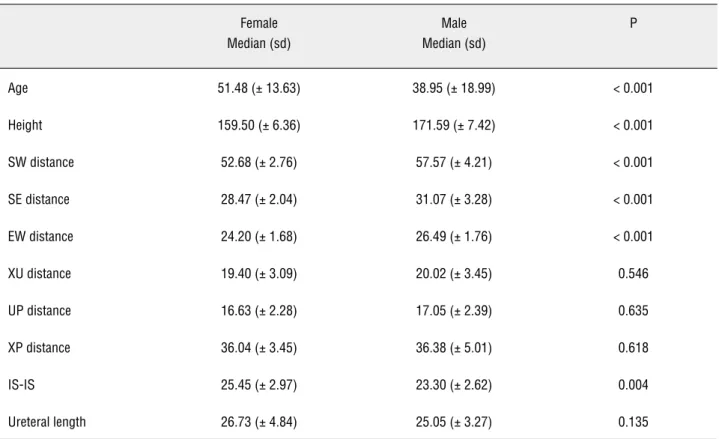
The ureters of 115 adult cadavers were dissected, with ages equal or superior to 16 years old, from April 2009 to January 2012. Twenty two were female and 93 male (1 female: 4.22 male). Median female age (standard deviation) was 51.48 (± 13.63) and 38.95 (± 19.0) male (p = 0.002). Median (standard deviation) height was 159.5 (± 6.36) for females and 171.59 (± 7.42) for males (p ≤ 0.001) (Table-1).
Table 1 - Different aspects of the studied population.
Female Median (sd)
Male Median (sd)
P
Age 51.48 (± 13.63) 38.95 (± 18.99) < 0.001
Height 159.50 (± 6.36) 171.59 (± 7.42) < 0.001
SW distance 52.68 (± 2.76) 57.57 (± 4.21) < 0.001
SE distance 28.47 (± 2.04) 31.07 (± 3.28) < 0.001
EW distance 24.20 (± 1.68) 26.49 (± 1.76) < 0.001
XU distance 19.40 (± 3.09) 20.02 (± 3.45) 0.546
UP distance 16.63 (± 2.28) 17.05 (± 2.39) 0.635
XP distance 36.04 (± 3.45) 36.38 (± 5.01) 0.618
IS-IS 25.45 (± 2.97) 23.30 (± 2.62) 0.004
Ureteral length 26.73 (± 4.84) 25.05 (± 3.27) 0.135
SW: Shoulder-wrist; SE: Shoulder-elbow; EW: Elbow-wrist; XU: xiphoid appendix-umbilicus; UP: umbilicus-pubis; XP: xiphoid appendix-pubis;
Medial ureteral length (standard deviation) was 25.36 (± 3.67) cm. When we analyzed urete-ral length according to gender, there was no sig-nificant differences (p = 0.135), although female ureters presented a median length (sd) of 26.73 (± 4.85) and male ureters 25.05 (± 3.26) cm (Table-1).
When we analyzed the height subgroups, there were also no statistical differences of urete-ral length: medial length (sd) of subgroups H1, H2 and H3 were respectively 25.09 (± 4.88) cm, 25.51 (± 2.99) cm and 25.46 (± 3.07) cm (p = 0.860).
Among 115 analyzed cadavers, there were only 7 with different contralateral measures of ureters, varying from 1.5 to 6.5 cm. In these ca-ses, left ureter was longer than the contralateral in three corpses. No pathologies were identified in these 7 cadavers.
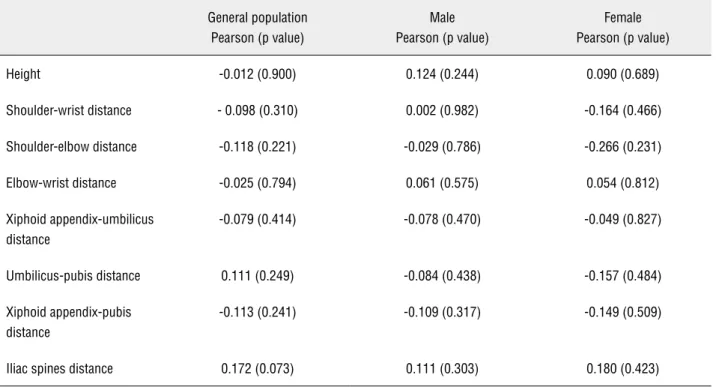
There were no correlations between ure-teral length and anthropometric measures in ge-neral population (Table-2). When the sample was categorized according to gender, there was also no correlation (Table-2). There were low correlations in some analysis of the population categorized according to height. Among the 34 cadavers of
subgroup H1, ureteral length correlated with the shoulder-elbow distance, with a Pearson index of -0.368 (p = 0.038). In subgroup H2, there was also a low correlation between height and ureteral length (Pearson index -0.337 and p = 0.013). In subgroup H3, it was identified a correlation be-tween height and ureteral left length, with Pearson index of -0.292 and p = 0.042 (Table-3). And fi-nally, when we categorized the population simul-taneously according to gender and height, there were no significant correlations (Tables 4 and 5).
DISCUSSION
Median ureteral length was 14 to 37 cm (median 25.36 ± 3.67 cm) in accordance to litera-ture (16 to 35 cm) (2-4,8,10). There was no statis-tical significant difference between men (25.05 ± 3.27 cm) and women (26.73 ± 4.84 cm) (p = 0.135), although median height of male population was bigger (171.59 ± 7.42 cm male and 159.50 ± 6.36 cm female) (p < 0.001). The cause of this finding is unknown, but probably due to the larger pel-vis of women, with a longer ureteral path. There
Table 2 - Correlations between ureteral length and several anthropometric measures.
General population Pearson (p value)
Male Pearson (p value)
Female Pearson (p value)
Height -0.012 (0.900) 0.124 (0.244) 0.090 (0.689)
Shoulder-wrist distance - 0.098 (0.310) 0.002 (0.982) -0.164 (0.466)
Shoulder-elbow distance -0.118 (0.221) -0.029 (0.786) -0.266 (0.231)
Elbow-wrist distance -0.025 (0.794) 0.061 (0.575) 0.054 (0.812)
Xiphoid appendix-umbilicus distance
-0.079 (0.414) -0.078 (0.470) -0.049 (0.827)
Umbilicus-pubis distance 0.111 (0.249) -0.084 (0.438) -0.157 (0.484)
Xiphoid appendix-pubis distance
Table 3 - Correlations between ureteral length and other anthropometric measures in general population according to height.
H1 Pearson (p value)
H2 Pearson (p value)
H3 Pearson (p value)
Height -0.119 (0.496) -0.337 (0.013) 0.329 (0.116)
Shoulder-wrist distance -0.316 (0.073) -0.058 (0.683) 0.127 (0.562)
Shoulder-elbow distance -0.363 (0.038) -0.060 (0.672) 0.117 (0.596)
Elbow-wrist distance -0.137 (0.447) -0.012 (0.931) 0.119 (0.588)
Xiphoid appendix-umbilicus distance -0.096 (0.594) -0.237 (0.090) 0.118 (0.593)
Umbilicus-pubis distance -0.096 (0.595) 0.034 (0.811) -0.429 (0.046)
Xiphoid appendix-pubis distance -0.144 (0.424) -0.127 (0.369) 0.053 (0.814)
Iliac spines distance 0.249 (0.163) 0.088 (0.537) 0.178 (0.418)
Obs: The indicated values in the table refer to Pearson coefficients and the significance of parametrical analysis (). H1: Cadavers with height equal or inferior to 165 cm; H2: cadavers with height from 166 to 175 cm; H3: cadavers with height equal or superior to 176 cm.
Table 4 - Correlations between ureteral length and other anthropometric measures in male population according to height.
H1 Pearson (p value)
H2 Pearson (p value)
H3 Pearson (p value)
Height -0.124 (0.625) -0.322 (0.024) 0.329 (0.116)
Shoulder-wrist distance -0.258 (0.335) -0.041 (0.783) 0.127 (0.562)
Shoulder-elbow distance -0.162 (0.548) -0.059 (0.693) 0.117 (0.596)
Elbow-wrist distance -0.334 (0.207) -0.030 (0.840) 0.119 (0.588)
Xiphoid appendix-umbilicus distance -0.295 (0.267) -0.268 (0.069) 0.118 (0.593)
Umbilicus-pubis distance -0.089 (0.744) 0.029 (0.847) -0.429 (0.046)
Xiphoid appendix-pubis distance -0.108 (0.690) -0.154 (0.303) 0.053 (0.814)
Iliac spines distance 0.227 (0.398) 0.002 (0.987) 0.178 (0.418)
was also no statistical difference between dis-tances in both sexes (xiphoid appendix-pubis (p = 0.618), xiphoid appendix-umbilicus (p = 0.546) and umbilicus-pubis (p = 0.635) independently of the subgroups of height, suggesting that the abdo-minal length of ureter doesn’t alter according to gender or subgroup of height, and therefore, the distance between the kidney and the bladder may also not vary.
There was also no statistical difference of ureteral length according to the subgroups of hei-ght. Median ureteral length in subgroup H1 (hei-ght equal or lower than 165 cm) was 25.09 ± 4.88 cm, in subgroup H2 (height from 166 to 175 cm) 25.51 ± 2.99 cm and in subgroup H3 (height equal or superior to 176 cm) was 25.46 ± 3.07 cm (p = 0.860). Accordingly, we observed that correlation between height and abdominal length (represen-ted by the distances from xiphoid appendix-umbi-licus, umbilicus-pubis, xiphoid appendix-pubis) is low (r = 0.282 with p = 0.003; r = 0.295 with p = 0.002; and r = 0.227 with p = 0.019, respectively),
catheter should not be based upon height and is recommended the use of a median length catheter to all population.
In only 7 of a total of 115 necropsied ca-davers there were differences between length of right and left ureters. Hruby et al. (2) analyzed 100 patients with endoscopy and also didn’t find any difference, while Paick et al. (3) found 1 cm difference between left and right ureters in a sam-ple of 203 patients. The 5 mm scale used in our work could justify the lack of observance of small differences between contralateral units. Another difficulty to compare data with living beings is related to the way of obtaining the measures. In vivo, ureters can contract or dilate according to manipulation, and image exams may not reflect the correct measure of the ureteral length.
There was no significant correlation be-tween ureteral length and the studied anthropome-tric measures, in general population or according to gender or height. Hruby et al. (2) in a similar study used endoscopy and radioscopy to
measu-Table 5 - Correlations between ureteral length and other anthropometric measures in the female population according to height.
H1 Pearson (p value)
H2 Pearson (p value)
Height -0.017 (0.948) -0.526 (0.362)
Shoulder-wrist distance -0.273 (0.288) 0.103 (0.870)
Shoulder-elbow distance -0.477 (0.053) 0.158 (0.800)
Elbow-wrist distance -0.019 (0.942) -0.395 (0.511)
Xiphoid appendix-umbilicus distance -0.011 (0.966) 0.229 (0.710)
Umbilicus-pubis distance -0.145 (0.578) -0.158 (0.800)
Xiphoid appendix-pubis distance -0.121 (0.643) 0.103 (0.870)
Iliac spines distance 0.112 (0.668) 0.289 (0.637)
elbow-wrist distance, and established an equation that predicts ureteral length in only 26% (2). Bre-au et al. (12) and Jeon et al. (4) also reported weak correlations between height and ureteral length. Shah et al. (10) and Pilcher et al. (8) found no cor-relations between height and ureteral length. In view of these facts, this study reaffirms previous works regarding the lack of correlation between different segments of the human body and the ureteral length, making impossible the proposal of a predictive formula. The absence of correlation between height and ureteral length would also ex-plain the absence of difference of ureteral length according to different heights.
Among all limitations of this study, we point out that the sample was a convenient one, that represented the black population with low in-come of Salvador (except for one white cadaver, all others were black or brown). Brazil has a vast territorial extension, with a very heterogeneous population with African, European and Asiatic descendents. And these differences are more evi-dent in different regions of the country, with di-fferent median heights. Low income populations are more prone to deficits of physical develop-ment, with lower heights. However, since it was not found any correlation between height and all other anthropometric measures, probably this bias did not interfere the results.
CONCLUSIONS
There are no significant statistical diffe-rences in median ureteral length according to di-fferent genders or heights; median length is 25.36 (± 3.67) cm.
There is not a significant correlation be-tween ureteral length and all evaluated segments of human body, making impossible the prediction of the length of the ureter accordingly.
CONFLICT OF INTEREST
None declared.
REFERENCES
1. Schott GD: The extent of man from Vitruvius to Marfan. Lancet. 1992; 340: 1518-20.
2. Hruby GW, Ames CD, Yan Y, Monga M, Landman J: Cor-relation of ureteric length with anthropometric variables of surface body habitus. BJU Int. 2007; 99: 1119-22. 3. Paick SH, Park HK, Byun SS, Oh SJ, Kim HH: Direct
ure-teric length measurement from intravenous pyelography: does height represent ureteric length? Urol Res. 2005; 33: 199-202.
4. Jeon SS, Choi YS, Hong JH: Determination of ideal stent length for endourologic surgery. J Endourol. 2007; 21: 906-10.
5. Ho CH, Huang KH, Chen SC, Pu YS, Liu SP, Yu HJ: Choos-ing the ideal length of a double-pigtail ureteral stent ac-cording to body height: study based on a Chinese popula-tion. Urol Int. 2009; 83: 70-4.
6. Lee BK, Paick SH, Park HK, Kim HG, Lho YS: Is a 22 cm Ureteric Stent Appropriate for Korean Patients Smaller than 175 cm in Height? Korean J Urol. 2010; 51: 642-6. 7. Kawahara T, Ito H, Terao H, Yoshida M, Ogawa T, Uemura H,
et al.: Choosing an appropriate length of loop type ureteral stent using direct ureteral length measurement. Urol Int. 2012; 88: 48-53.
8. Pilcher JM, Patel U: Choosing the correct length of ureteric stent: a formula based on the patient’s height compared with direct ureteric measurement. Clin Radiol. 2002; 57: 59-62.
9. Ho CH, Chen SC, Chung SD, Lee YJ, Chen J, Yu HJ, et al.: Determining the appropriate length of a double-pigtail ure-teral stent by both stent configurations and related symp-toms. J Endourol. 2008; 22: 1427-31.
10. Shah J, Kulkarni RP: Height does not predict ureteric length. Clin Radiol. 2005; 60: 812-4.
11. Slaton JW, Kropp KA: Proximal ureteral stent migration: an avoidable complication? J Urol. 1996; 155: 58-61. 12. Breau RH, Norman RW: Optimal prevention and
manage-ment of proximal ureteral stent migration and remigration. J Urol. 2001; 166: 890-3.
_____________________
EDITORIAL COMMENT
The fact that few studies on the anatomy ureteral in the years fifty and seventy to reflect the originality of this article highlighted (1,2). As for its clinical applicability in adult surgi-cal matter of finding not occur significant diffe-rence in mean length ureteral between different age and height between males and females, and the average length of 25.36 (± 3.67) cm. As the author rightly emphasizes the difficulty of
com-paring the data in the literature relates to the way of obtaining measurements, since in vivo, the ureter can contract and shorten as their han-dling, and imaging studies may not reflect the exact measurement ureteral length as most exis-ting studies can cite as published by Chew et al., 2007 (3).
Remember important study in our country’s existing anatomy of the ureteropelvic junction by Sampaio published in 1996 with gre-at applicability to endopielotomia technique (4).
REFERENCES
1. Benjamin JA, Tobin CE: Abnormalities of the kidneys, ure-ters, and perinephric fascia: anatomic and clinical study. J Urol. 1951; 65: 715-33.
2. Wexler NS, Roberts JA: A correlation of anatomic and physiologic parameters in the ureter. Invest Urol. 1974; 11: 286-7.
3. Chew BH, Knudsen BE, Nott L, Pautler SE, Razvi H, Amann J, et al.: Pilot study of ureteral movement in stented pa-tients: first step in understanding dynamic ureteral anatomy to improve stent comfort. J Endourol. 2007; 21: 1069-75. 4. Sampaio FJ: The dilemma of the crossing vessel at the
ureteropelvic junction: precise anatomic study. J Endourol. 1996; 10: 411-5.
Dr. Maurício Hachul