Key words:
Neoplasms; Prostatectomy; Urinary Incontinence; Pelvic Floor; Quality of Life
Int Braz J Urol. 2013; 39: 182-8
__________________ Submitted for publication: April 24, 2012
__________________ Accepted after revision: January 10, 2013
Purpose: To evaluate preoperative rectal electrical stimulation in the recovery of urinary continence in patients who undergo radical retropubic prostatectomy.
Materials and Methods: Patients were divided into 3 randomized groups: control, pelvic exercises, and electrical stimulation. A 1 hour pad-test, the ICIQ-SF, and the SF-36 were performed 1, 3, and 6 months after the surgical procedure.
Results: Of the 58 patients who were initially included in the study, 9 were excluded due to radiotherapy after surgical intervention, an indwelling urethral catheter for more than 30 days, high surgical risk, loss of follow-up, or incomplete participation in the study routines and spontaneous interruption. Forty-nine patients concluded the study (15 in the control group, 17 in the exercise group, and 17 in the electrical stimulation group). We did not observe any significant difference in the pad test (p > 0.05), the 8 domains of the SF-36, or ICIQ-SF score compared with control groups (control, exercise, and electrical stimulation).
Conclusion: Preoperative rectal electrical stimulation has no impact on continence status in patients who undergo radical retropubic prostatectomy. There is no difference in the three above mentioned groups with regard to urinary leakage and quality of life.
INTRODUCTION
Radical retropubic prostatectomy (RPP) is the chief option in the treatment of prostate cancer. Although it is a routine procedure that has impro-ved with regard to technique, urinary incontinence (UI) remains a significant condition (1,2). Despite total urinary control, the majority of patients ex-periences some period of UI following surgery (2). Because UI negatively affects quality of life and can delay a return to social and professional activities (3), patients desire a rapid recovery of continence.
Several studies have described various mo-dalities of pelvic floor muscle rehabilitation (PFMR), including Kegel exercises with or without biofee-dback and electrical stimulation post-RPP (2,4-6). PFMR can enhance the return of urinary control after RPP. Some groups have conducted PFMR pre-operatively and postpre-operatively (7), but few have analyzed the impact of PFMR that is performed exclusively before the procedure (8,9). PFMR has been hypothesized to prepare the urethral sphincter mechanism and pelvic floor muscles preoperatively, which remains to be demonstrated.
Results of preoperative electrical stimulation of pelvic
floor muscles in the continence status following radical
retropubic prostatectomy
_______________________________________________
Carla Elaine Laurienzo, Carlos Alberto Ricetto Sacomani, Telma Ribeiro Rodrigues, Stênio de Cássio
Zequi, Gustavo Cardoso Guimarães, Ademar Lopes
Department of Physiotherapy (CEL, TRR), Department of Pelvic Surgery (CARS, SCZ, AL) and Department of Urology (GCG), A.C. Camargo hospital, Antonio Prudente foundation, Sao Paulo, Brazil
ABSTRACT
ARTICLE
INFO
The aim of our study was to evaluate elec-trical stimulation of the pelvic floor muscles prior to radical retropubic prostatectomy to accelerate the recovery of continence.
MATERIALS AND METHODS
Patients with prostate cancer (stage T2) and candidates for RPP who were referred for tre-atment at the Pelvic Surgery Department of A.C. Camargo Hospital were eligible for the study. Ex-clusion criteria included: radiotherapy (previous or after RPP); previous transurethral resection; pre-existing neurological disease; urinary fistula after RPP; prolonged indwelling urethral cathete-rization (more than 15 days); clinical situations that rendered the patient unsuitable for surgical procedure; failure to attend all PFMR or electri-cal stimulation sessions; loss of follow-up and desistance. The surgical intervention (RPP) was performed by four highly skilled and experienced surgeons and included nerve-sparring technique, according to Walsh.
Outcome evaluation
After approval by the ethical committee and internal review board, 58 consecutive males were included in this analysis. All subjects recei-ved and signed an informed consent form. The patients were randomized (computer-generated list using Research Randomizer, v4) and divided into 3 groups: control (only verbal instructions to contract the perineum); Kegel exercises alone; and electrical stimulation plus Kegel exercises.
The electrical stimulation (ES) group un-derwent ten preoperative physiotherapy sessions, with variable frequency (respecting scheduled surgery), using electrical stimulation and rectal pelvic exercises.
Electrical stimulation of this group was conducted with the Phenix equipment (VIVAL-TIS®) via rectal probe length of approximately 12 cm, width 2.5 cm and approximate weight 04 g.
The parameters used included parame-ters for muscle strengthening, to tonic fibers and phasic fibers:
To tonic fibers: Frequency: 20 Hz (Hertz); Pulse Width: 700µs (microseconds),
Rise Time: 02 seconds Descent time: 02 seconds Working Time: 06 seconds Rest Time: 06 seconds. Intensity was used to determine the visible con-traction of the pelvic floor. The duration of the stimulation was 10 minutes.
To phasic fibers: Frequency: 65Hz; Pul-se Width: 150µs, RiPul-se Time: 02 Pul-seconds; Descent time: 02 seconds Working Time: 06 seconds Rest Time: 18 seconds. It was also used to determine the intensity visible contraction of the pelvic floor. The duration of the stimulation was 05 minutes.
The electrical stimulation group, in the same preoperative sessions, also performed five (5) types of exercises to contract the pelvic floor cles: consecutive contractions of pelvic floor mus-cles for 5 seconds in dorsal decubitus (10 times), in the same position with the waist elevated (10 times), lying down with legs adduction against a plastic ball (10 times), and tenfold exercises stan-ding and flexing the hips to approximately 60º.
The exercise group performed 10 (ten) pre-operative physiotherapy sessions, with variable frequency (respecting scheduled surgery), using only the pelvic exercises. The exercises were exac-tly the same exercises of the electrical stimulation group, already described above.
The control group did not perform any type of therapeutic intervention in the preopera-tive period. The patients in this group were exa-mined only once, before the surgery, when the evaluation was performed and when they received information about the anatomy of the prostate re-gion (as in the other groups).
PFMR was performed in the preoperative period by the same physiotherapist (C.E.L.). All pa-tients were then evaluated after RPP at 1, 3, and 6 months by 1 hour pad test, International Consul-tation on Incontinence Questionnaire- Short Form (ICIQ-SF), and the Medical Outcomes Study 36-Item Short Form Health Survey (SF-36). No pa-tient received PFMR postoperatively.
The ICIQ-SF and SF-36 were considered secondary outcome measures and were self-admi-nistered. Possible doubts were solved with a diffe-rent physiotherapist (T.R.R.).
Statistical analysis
The groups were compared by chi-square association test (for qualitative variables) and Kruskal-Wallis test (for quantitative variables). Comparisons of the SF-36, ICIQ-SF, and pad test scores between the groups during the follow-up period were made by two-way analysis of varian-ce (ANOVA), in which 1 factor was a repeated me-asurement (month) and the other was an indepen-dent factor (group).
When there was a significant difference, post hoc Tukey HSD test was used to detect the difference. Differences between groups were con-sidered, whereas within-group differences were disregarded. Odds ratios of the groups at each as-sessment (1, 3, and 6 months after the operation) were also calculated to determine the likelihood of developing urinary incontinence. In the pad test, the cutoff point for continence was ≤ 2 grams and > 2 grams for incontinence.
In all analyses, differences were signifi-cant at p < 0.050. The statistical analyses were performed using Statistica, version 7 (for ANOVA) and SPSS, version 16.0 (for all other analyses).
RESULTS
Nine men were excluded during the evalu-ation (2 for failing to attend all sessions, 2 due to desistance, 1 adjuvant radiotherapy, 1 postopera-tive urethral stenosis, 1 urinary fistula, 1 unsuita-ble for surgery due to cardiovascular risk, and 1 inadequate follow-up). Thus, 49 remained eligible for the study (15 in Group 1; 17 in Group 2; 17 in Group 3). The mean age of the patients was similar (p = 0.556) in all groups (Group 1: 64 ± 8 years; Group 2: 62 ± 7 years; Group 3: 60 ± 8 years).
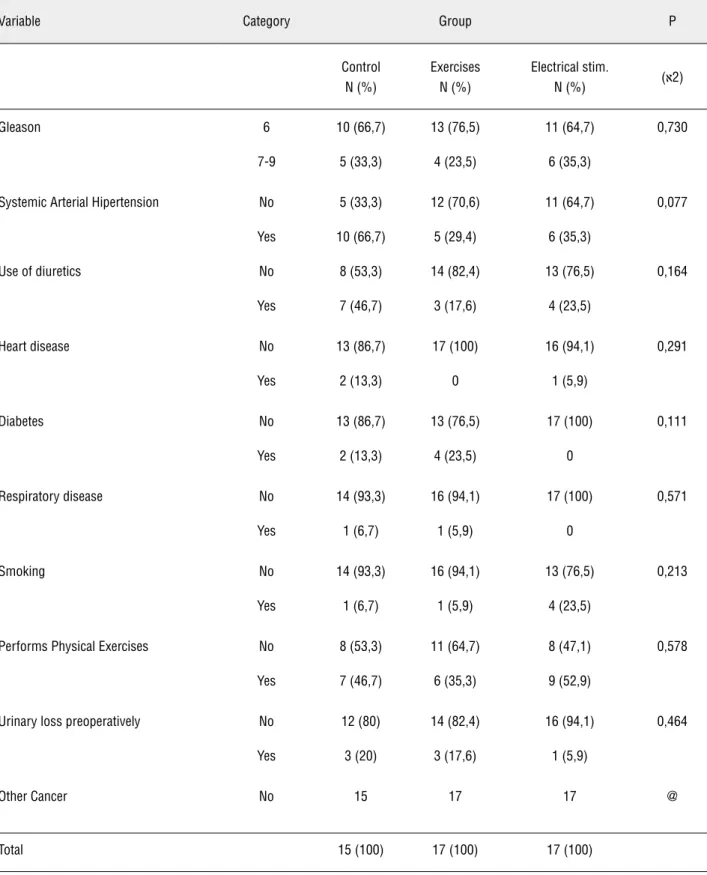
There were no significant differences be-tween groups with respect to clinical and demo-graphic data. Table-1 shows baseline characte-ristics of the groups, regarding the qualitative variables.
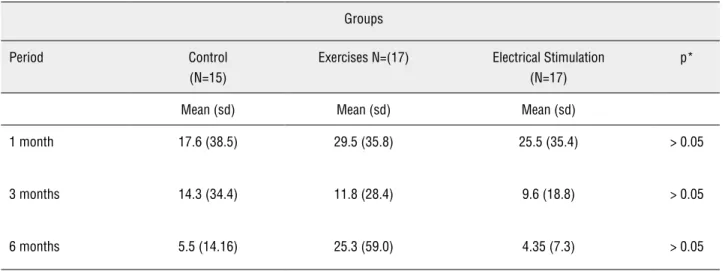
The pad test (Table-2 and Figure-1) sho-wed no significant difference between the 3 groups at first, third, and sixth months of follow--up (p > 0.05). Based on the odds ratios (ORs) be-tween groups, there was no significant difference (p > 0.05), with a 95% confidence interval. Using a cutoff of 2 grams, the ORs between Groups 1 and 2 and between Groups 1 and 3 were 1.2 and 0.71 at 1 month, 1.14 and 1.14 at 3 months, and 1.39 and 2.71 at the end of the study (Month 6), respectively.
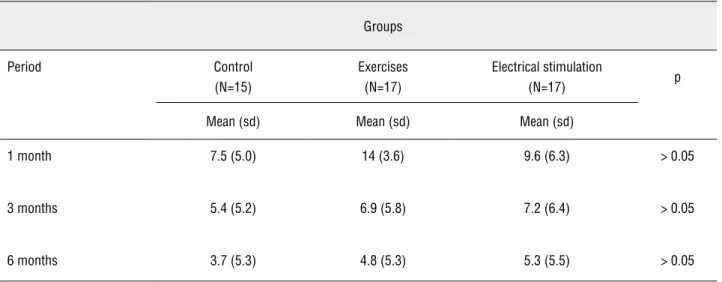
There was no significant difference in ICIQ-SF score between the 3 groups at 1, 3, and 6 months of follow-up (p > 0.05) (Table-3).
There were no differences between groups on the various domains of the SF-36 (p > 0.05).
DISCUSSION
Urinary control usually recovers gradually during the first year after RPP (10). However, even temporary UI can negatively affect one’s quality of life and delay his return to social and profes-sional activities.
Previous studies have focused on PFMR as a method to anticipate adequate urinary control after RPP, most of which reported better results when PFMR was used after RPP. Unfortunately, the optimal start and stop points, modality of PFMR, and duration and frequency of the treat-ment remain unknown.
Filocamo et al. (4) analyzed 300 conse-cutive patients who were randomized into 2 groups. One hundred fifty men were referred to a physiotherapist for pelvic exercises, and another 150 individuals were not given formal instruc-tions for PFMR. Nineteen percent of the treated group achieved adequate continence during the first month following RPP, rising to 95% after 6 months. In the control group, 8% reported good urinary control at the first month versus 65% af-ter 6 months.
Table 1 - Comparison between groups according to qualitative variables control (N = 49).
Variable Category Group P
Control N (%)
Exercises N (%)
Electrical stim.
N (%) (א2)
Gleason 6 10 (66,7) 13 (76,5) 11 (64,7) 0,730
7-9 5 (33,3) 4 (23,5) 6 (35,3)
Systemic Arterial Hipertension No 5 (33,3) 12 (70,6) 11 (64,7) 0,077
Yes 10 (66,7) 5 (29,4) 6 (35,3)
Use of diuretics No 8 (53,3) 14 (82,4) 13 (76,5) 0,164
Yes 7 (46,7) 3 (17,6) 4 (23,5)
Heart disease No 13 (86,7) 17 (100) 16 (94,1) 0,291
Yes 2 (13,3) 0 1 (5,9)
Diabetes No 13 (86,7) 13 (76,5) 17 (100) 0,111
Yes 2 (13,3) 4 (23,5) 0
Respiratory disease No 14 (93,3) 16 (94,1) 17 (100) 0,571
Yes 1 (6,7) 1 (5,9) 0
Smoking No 14 (93,3) 16 (94,1) 13 (76,5) 0,213
Yes 1 (6,7) 1 (5,9) 4 (23,5)
Performs Physical Exercises No 8 (53,3) 11 (64,7) 8 (47,1) 0,578
Yes 7 (46,7) 6 (35,3) 9 (52,9)
Urinary loss preoperatively No 12 (80) 14 (82,4) 16 (94,1) 0,464
Yes 3 (20) 3 (17,6) 1 (5,9)
Other Cancer No 15 17 17 @
Total 15 (100) 17 (100) 17 (100)
Table 2 - Comparison of pad test scores between groups during follow-up.
Groups
Period Control
(N=15)
Exercises N=(17) Electrical Stimulation (N=17)
p*
Mean (sd) Mean (sd) Mean (sd)
1 month 17.6 (38.5) 29.5 (35.8) 25.5 (35.4) > 0.05
3 months 14.3 (34.4) 11.8 (28.4) 9.6 (18.8) > 0.05
6 months 5.5 (14.16) 25.3 (59.0) 4.35 (7.3) > 0.05
Figure 1 - Comparison of pad test results between groups during follow-up.
15 15 15 17 17 17 17 17 17 control
N=
exercises electrical stimul.
group were continent versus 75% in the verbal instruction group. They also described a short pe-riod of incontinence immediately after RPP.
Few studies have examined PFMR before RPP. Although Burgio et al. (11) noted an impro-vement in continence and a decreased time to achieve urinary control in patients who attended one session of assisted biofeedback pelvic floor training and performed exercises at home, other
groups failed to describe any benefits of PFMR exclusively in the preoperative period.
Considering the possibility that chronic electrical stimulation of tonic and phasic myofi-bers increases muscle strength, we also evalua-ted preoperative electrical stimulation of pelvic floor muscles using a rectal probe, comparing this method with Kegel exercises without biofe-edback and with a control group that received only verbal instructions. The primary outcome was the 1 hour pad test score; quality of life questionnaires (ICIQ-SF score and SF-36) were used as secondary measures. Neither variable di-ffered, and the social and physical aspects of the SF-36 were unaffected by PFMR. The ICIQ-SF revealed no changes in the impact of inconti-nence on quality of life between the 3 groups, reinforcing the poor results of PFMR regarding this area.
CONCLUSIONS
Preoperative rectal electrical stimulation has no impact on continence status in patients who undergo radical retropubic prostatectomy re-garding urinary leakage and quality of life.
FINANCIAL SUPPORT
Sao Paulo State Foundation for Research Support – FAPESP (number 08/54585-1)
CONFLICT OF INTEREST
None declared.
REFERENCES
1. Liu L, Coker AL, Du XL, Cormier JN, Ford CE, Fang S: Long-term survival after radical prostatectomy compared to other treatments in older men with local/regional prostate cancer. J Surg Oncol. 2008; 97: 583-91.
2. Van Kampen M, De Weerdt W, Van Poppel H, De Ridder D, Feys H, Baert L: Effect of pelvic-floor re-education on duration and degree of incontinence after radical prosta-tectomy: a randomised controlled trial. Lancet. 2000; 355: 98-102.
3. Moore KN, Valiquette L, Chetner MP, Byrniak S, Herbison GP: Return to continence after radical retropubic prostatec-tomy: a randomized trial of verbal and written instructions versus therapist-directed pelvic floor muscle therapy. Urol-ogy. 2008; 72: 1280-6.
4. Filocamo MT, Li Marzi V, Del Popolo G, Cecconi F, Marzoc-co M, Tosto A, et al.: Effectiveness of early pelvic floor re-habilitation treatment for post-prostatectomy incontinence. Eur Urol. 2005; 48: 734-8.
5. Mariotti G, Sciarra A, Gentilucci A, Salciccia S, Alfarone A, Di Pierro G, et al.: Early recovery of urinary continence af-ter radical prostatectomy using early pelvic floor electrical stimulation and biofeedback associated treatment. J Urol. 2009; 181: 1788-93.
6. Ribeiro LH, Prota C, Gomes CM, de Bessa J Jr, Boldarine MP, Dall’Oglio MF, et al.: Long-term effect of early post-operative pelvic floor biofeedback on continence in men undergoing radical prostatectomy: a prospective, random-ized, controlled trial. J Urol. 2010; 184: 1034-9.
7. Bauer RM, Bastian PJ, Gozzi C, Stief CG: Postprostatec-tomy incontinence: all about diagnosis and management. Eur Urol. 2009; 55: 322-33.
8. Bales GT, Gerber GS, Minor TX, Mhoon DA, McFarland JM, Kim HL, et al.: Effect of preoperative biofeedback/pel-vic floor training on continence in men undergoing radical prostatectomy. Urology. 2000; 56: 627-30.
9. Tobía I, González MS, Martínez P, Tejerizo JC, Gueglio G, Damia O, et al.: Randomized study on urinary continence after radical prostatectomy with previous kinesic perineal physiotherapy. Arch Esp Urol. 2008; 61: 793-8.
Table 3 - Comparison of ICIQ-SF scores between groups during follow-up.
Groups
Period Control
(N=15)
Exercises (N=17)
Electrical stimulation
(N=17) p
Mean (sd) Mean (sd) Mean (sd)
1 month 7.5 (5.0) 14 (3.6) 9.6 (6.3) > 0.05
3 months 5.4 (5.2) 6.9 (5.8) 7.2 (6.4) > 0.05
12. Parekh AR, Feng MI, Kirages D, Bremner H, Kaswick J, Aboseif S: The role of pelvic floor exercises on post-pros-tatectomy incontinence. J Urol. 2003; 170: 130-3.
_____________________
Correspondence address:Dr. Carlos Alberto Ricetto Sacomani Hospital A.C. Camargo Rua Antonio Prudente, 211, Liberdade
São Paulo, SP, Brazil E-mail: [email protected]
10. Van Kampen M, De Weerdt W, Van Poppel H, Baert L: Uri-nary incontinence following transurethral, transvesical and radical prostatectomy. Retrospective study of 489 patients. Acta Urol Belg. 1997; 65: 1-7.