1Pesquisador Titular e Chefe, Laboratóorio de Neuropsicologia Clínica, Setor de Neurociências, Departamento de Pediatria, Instituto F e rnandes Figueira, FIOCRUZ, Rio de Janeiro, RJ, and Professor Adjunto Doutor, Setor de Neurociências, Centro de Ciências Médicas, Universidade Federal Fluminense, Niterói RJ, Brasil;2Medical Off i c e r, Department of Nutrition, World Health Organization, Geneva, Switzerland. Research supported by FUNPENE.
Received 30 May 2006. Accepted 16 August 2006.
Dr. Gilberto N.O. Brito - Caixa Postal 100846 - 24001-970 Niteroi RJ - Brasil. E-mail: [email protected]
GROWTH STATUS AND ACADEMIC PERFORMANCE
IN BRAZILIAN SCHOOL AGE CHILDREN
Growth retardation impairs mathematical,
but not reading and spelling abilities
Gilberto N.O. Brito
1, Mercedes de Onis
2ABSTRACT -Aim:To assess the effect of child growth status on academic achievement and the association between child growth and academic standing. Method:The heights of 722 middle-school children were m e a s u red using standard pro c e d u res and height-for-age z (HAZ) scores were calculated based on an inter-national re f e rence. Academic perf o rmance was assessed by an adaptation of the Wide Range Achievement Test (WRAT3) composed of Reading, Arithmetic and Spelling. Results:C h i l d ren in the group with higher HAZ scores perf o rmed better than children in the group with lower HAZ scores only on the Arithmetic sub-test. This finding was confirmed by a multiple re g ression model analysis of the data. In addition, only per-f o rmance on the Arithmetic subtest was positively associated with HAZ. Conclusion:These results indi-cate that growth retardation impacts specifically on the development of arithmetic (numeracy) skills and a re consistent with a three-fold model of life course influences on health including latency, cumulative and pathway effects.
KEY WORDS: child growth, achievement, academic standing, mathematical ability, cognitive development, neurobehavior.
Crescimento e desempenho acadêmico em escolares brasileiros: retardo no crescimento inter-fere com a matemática mas não com a leitura e a escrita
RESUMO -Objetivo:Examinar o efeito do crescimento no desempenho acadêmico e a associação entre c rescimento e competência acadêmica. Método:A estatura de 722 escolares da rede pública de Niterói foi medida através de procedimentos padronizados e escores padronizados da estatura para a idade (HAZ) foram calculados com base em referência internacional. O desempenho acadêmico foi avaliado através de uma adaptação do Wide Range Achievement Test (WRAT3) composto de leitura, aritmética e ditado. Resultados:Crianças com HAZs mais elevados apresentaram um desempenho melhor do que crianças com HAZs mais baixos somente na aritmética. Este achado foi confirmado por uma análise de modelo de re g re s s ã o múltipla dos dados. Ademais, somente o rendimento em aritmética mostrou uma associação positiva com H A Z . Conclusão:Os resultados indicam que o re t a rdo no crescimento impacta especificamente no desen-volvimento de competência em matemática e são consistentes com um modelo de influências durante o curso da vida que inclui efeitos de latência, cumulativos e de trajetória.
PA L AV R A S - C H AVE: crescimento, desempenho acadêmico, competência em matemática, desenvolvimento cognitivo, neurocomportamento.
The deleterious effects of growth retardation as evaluated by low height-for-age during infancy and early childhood on behavior and cognitive functions in late childhood are well-known1-4. Along this line,
Brito and deOnis5demonstrated a significant
associ-ation between growth status and hyperactive/
con-duct problem and inattentive behaviors and also between growth status and a qualitative rating of academic perf o rmance by the teachers of school chil-d ren in the greater metropolitan area of Rio chil-de Janeiro, Brasil.
the association between growth status and academ-ic perf o rmance is of a general nature or specifacadem-ic to reading, spelling or arithmetic. In addition, the qual-itative rating of academic perf o rmance in the re p o rt of Brito and deOnis5impedes a more precise
quan-titative evaluation of the effects of growth status on academic achievement.
The objective of the present study was to deter-mine the effect of growth status on the academic standing of school children in the greater metro p o l-itan area of Rio de Janeiro as assessed by an achieve-ment test composed of Spelling, Arithmetic and Reading subtests. On the basis of the findings that g rowth status is associated with hyperactive/conduct p roblem and inattentive behaviors5and that poor
attentional control can disrupt mathematical pro c e-d u re s6 , 7, it was hypothetized that growth impairm e n t
m o re likely interf e res with arithmetic (numeracy) abilities in comparison with reading and spelling (lit-eracy).
METHOD
Participants – All 920 children re g i s t e red in the 5t h
t h rough 8t hgrades (middle school) of Instituto de Educação
P rof. Ismael Coutinho (IEPIC), a large public schoo l in the m e t ropolitan area of Rio de Janeiro (Niterói), part i c i p a t e d in this study. As re p o rted pre v i o u s l y5 , 8 - 1 4, we selected t his
school not only because of its large enrollment but also because it attracts children from all ethnic and soci oeco-nomic groups, although mostly from lower social classes, and with place of residence in communities distributed t h roughout Niteroi, a city located across the Guanabara Bay from Rio de Janeiro, and adjacent localities (São Gonçalo, Maricá e Itaboraí). A total of 198 participants who requested school transfer or otherwise dropped out of IEPIC w e re excluded from the study because their data could not be completed. There f o re, the final number of part i c i p a n t s was 722 children (281 boys and 441 girls) with a mean age of 13.5 years (SD=1.4). Two hundred and ninety three chil-d ren (40.6%) were Caucasian, 275 (38.1%) were of African a n c e s t ry and 154 (21.3%) were of a multiple-race gro u p . The distribution of the occupation of the fathers of the p a rticipants, according to Hollingshead and Redlich1 5, was:
1 (N=28, 3.9%), 2 (N=21, 2.9%), 3 (N=83, 11.5%), 4 (N=90, 12.5%), 5 (N=43, 6.0%), 6 (N=197, 27.3%), 7 (N=225, 31.2%); i n f o rmation could not be obtained for the occupation of the fathers of 35 (4.8%) children. The distribution of the occupation of the mothers of the participants, also accord-ing to Hollaccord-ingshead and Redlich (1958), was: 1 (N=22, 3.1%), 2 (N=27, 3.7%), 3 (N=26, 3.6%), 4 (N=38, 5.3%), 5 (N=8, 1.1%), 6 (N=84, 11.6%), 7 (N=409, 56.6%); information could not be obtained for the occupation of the mothers of 108 (15.0%) children. Occupational levels 1 and 2 include uni-versity-educated executives, business managers in larg e c o n c e rns, and major and lesser professionals; occupation-al levels 3 and 4 comprise administrative personnel,
owers of small independent businesses and minor pro f e s s i o n-als; and occupational levels 5, 6 and 7 include skilled, semi-skilled and unsemi-skilled laborers with lower educational lev-els. In addition, 243 (33.7%) children had failed at least one grade in school at the time they participated in the study. Seventy two (9.97%) participants were left-handed for writ-ing, a frequency distribution consistent with data re p o rt-ed elsewhere1 3 , 1 6. The children had their auditory and
al function screened and the presence of auditory or visu-al dysfunction was treated as a variable in data anvisu-alysis; 37 (5.1%) and 150 (20.8%) participants were deemed to have auditory and visual dysfunction, respectively.
The study was approved by the Bo ard of Directors of IEPIC and perf o rmed under the auspices of the agre e m e n t celebrated between IEPIC and the Instituto Fern a n d e s Figueira of the Fundação Oswaldo Cruz (FIOCRUZ).
A n t h ropometric measurements –P ro c e d u res for anthro-pometric measurements have been described in a pre v i o u s a rt i c l e5. Briefly, height was measured following standard
procedures and three measurements were taken for each p a rticipant with the mean value used for data analysis. Age was ascertained through the child’s birth certificate includ-ed in his/her school re c o rds. Height-for-age (HAZ) score s w e re calculated based on the National Center for Health S t a t i s t i c s / World Health Organization (NCHS/WHO) re f e r-ence using the age-specific re g ression equations1 7a n d
implemented in the ANTHRO software1 8. HAZ was then
t reated as a continuous variable in data analysis and also as a categorical variable, i.e., children with HAZ equal or below –1.5 were arbitrarily considered to have an abnor-mally low height-for-age.
Academic assessment – The academic perf o rmance of
the participants was assessed by an adaptation of the Wi d e Range Achievement Te s t - 31 9developed by the author f o r
use in Brazilian school children. In brief, the WRAT3 is com-posed of three subtests: (i) Reading - the recognition and naming of letters and the pron unciation of w ords out of context; (ii) Spelling - w riting of name, letters and word s to dictation; (iii) Arithmetic - counting, reading number symbols, solving oral problems and perf o rming written computations. There are two alternate forms (Blue and Tan) which allow for the initial measure and re a s s e s s m e n t of academic skills.
After each review of the materials, a field-test study with a sample of 5t ht h rough 8t hgrade IEPIC children was
con-ducted and content changes were introduced depending on their response profiles on the two alternate forms (Blue and Tan) of the Brazilian-version of the WRAT3 (Teste do Desempenho Acadêmico3-TDA3). Three such field-test stud-ies were performed in the academic years of 1996 (N=40), 1997 (N=26) and 1998 (N=147) until the two forms were deemed appropriate by the panel of experts. In the pre s-ent study, only one of the two forms of the TDA3 was a d m i n i s t e red to each participant. Half the classes within each grade (5t ht h rough 8t h) were administered the Blue
f o rm whereas the other half filled the Tan form. The form a d m i n i s t e red was determined randomly by the use of a table of random numbers, but with the restriction that the distribution of the forms for the classes was balanced. In addition, only the written computations section of the Arithmetic subtest was administered since the other s ec-tions of this subtest (counting, reading number symbols and solving oral problems) do not apply to middle-school children.
Statistical analysis – The data were analysed using
PC-S A PC-S2 0. We used Proc GLM to perf o rmmulti- and univariate
analyses of variance and Proc REG to perf o rm a stepwise linear multiple re g ression of the data. Proc CORR was used to determine whether growth status correlated with re a d-ing, spelling and arithmetic scores of the TDA3 and the individual correlation was used as the conceptua l unit of e rror rate since this study purported to test the a priori hypothesi s of an associat ion between growth status and arithmetic ability.
RESULTS
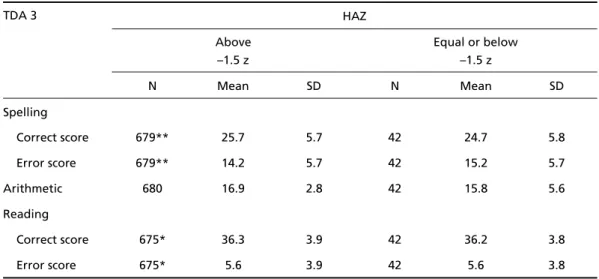
Table shows mean (and SD) correct and erro r s c o res on the Spelling and Reading subtests and mean
(and SD) correct score on the Arithmetic subtest of the TDA3 for children with HAZ scores above –1.5 and children with HAZ scores equal or below this val-ue. Analyses of the data to be re p o rted elsewhere revealed significant effects of sex, age and form of the test. For the present re p o rt, a multivariate analy-sis of variance (MANOVA) of the data demonstrated a significant effect of HAZ group membership (F=2.32, df=5, 670, P=0.04), independent of the effects of sex, age and form of the test. Univariate analyses of vari-ances (ANOVAs) showed a significant effect of HAZ g roup membership on the perf o rmance of the Arithmetic subtest of the TDA3 (F=5.97, df=1, 674, P=0.01), but not on the perf o rmance of the Spelling and Reading subtests. Children in the group of HAZ s c o res above –1.5 perf o rmed significantly better than children in the group with lower HAZ scores on the Arithmetic subtest.
A linear stepwise multiple re g ression model analy-sis of the data confirmed the specificity of the eff e c t of HAZ scores on the perf o rmance of the Arithmetic subtest of the TDA3 (F=4.11, P=0.04). HAZ scores had no effect on perf o rmance of the Spelling and Reading subtests.
In addition, only performance on the Arithmetic subtest was significantly and positively associated with HAZ scores as revealed by a correlation analy-sis of the data (r=0.07, p=0.03) such that the higher the HAZ score the better the perf o rmance of the child.
Table. Mean (and SD) correct and error scores on the Spelling and Reading subtests and mean (and SD) cor -rect score on the Arithmetic subtest of the TDA3 for children with HAZ scores above –1.5 and children with HAZ scores equal or below this value.
TDA 3 HAZ
Above –1.5 z
Equal or below –1.5 z
N Mean SD N Mean SD
Spelling
Correct score 679** 25.7 5.7 42 24.7 5.8
Error score 679** 14.2 5.7 42 15.2 5.7
Arithmetic 680 16.9 2.8 42 15.8 5.6
Reading
Correct score 675* 36.3 3.9 42 36.2 3.8
Error score 675* 5.6 3.9 42 5.6 3.8
DISCUSSION
The results show that growth impairment has a specific effect on the perf o rmance of arithmetic (numeracy), but not on the performance of reading and spelling (literacy), in 5t ht h rough 8t hgrade
(mid-dle) school children. In addition, the data demon-strate that growth status is positively and specifical-ly correlated with competency in arithmetic.
A previous re p o rt5demonstrated a significant and
specific association between growth status and the behavioral domains Hyperactivity/Conduct Pro b l e m and Inattention such that the lower the HAZ of the child the higher the degree of neuro p s y c h o p a t h o l-ogy along those two behavioral domains. In addi-tion, that re p o rt5also showed a significant
associa-tion between HAZ and teacher’s ratings of academ-ic perf o rmance; the lower the HAZ the worse the rat-ing of academic perf o rmance. However, the instru-ments used in that study5 could not determ i n e
whether the association between growth status and academic perf o rmance was of a general nature or specific to reading, spelling or arithmetic. More o v e r, the qualitative rating of academic perf o rmance used in Brito and deOnis5impeded a more precise
quan-titative evaluation of the association of growth sta-tus and academic achievement. The data presented h e reindicate that this association is specific to arith-metic and, additionally, show that children with HAZs lower than –1.5 perf o rmsignificantly worse than chil-d ren with HAZs higher than –1.5 on the arithmetic but not on the reading and spelling subtests of TDA3. The specificity of the effect of growth status on the p e rf o rmance of the arithmetic subtest was confirm e d by multiple regression analysis of the data. The evi-dence herein presented taken in conjunction with the data of Brito and deOnis5suggests that the
spe-cific effect of growth impairment on competency in arithmetic is mediated by the behavioral domains Hyperactivity/Conduct Problem and Inattention. Such a suggestion would be in line with the evidence that poor attentional control is disruptive to mathemat-ical procedures6,7.
The pathway linking physical growth and neu-rocognitive development is probably an extre m e l y complex and multifaceted process involving biolog-ical and psychosocial factors. As emphasized by H e rtzman and Power2 1, “it is well known that
expo-s u re to both beneficial and adverexpo-se circ u m expo-s t a n c e expo-s over the life course will vary for each individual and will constitute a unique life exposure trajectory, which will manifest as diff e rent expressions of health and well-being”. Those authors advanced a thre e - f o l d
model of life-course influences on health including l a t e n c y, cumulative and pathway effects that are not mutually exclusive. According to this model, a laten-cy effect re p resents the relationships between an e x p o s u re at a certain point in the life course and the f u t u re probability of health expressions, irre s p e c t i v e of intervening experience. Cumulative effects re f e r to multiple exposures over the life course whose e ffects on health combine. Finally, pathway eff e c t s signify that dependent sequences of exposures in which exposure at one stage of the life course influ-ence the probability of other exposures later in the life course as well as associated expressions.
H e rtzman and Power2 1envisage the need for
sur-gical treatment of congenital cataracts within the first three months of life for the full re c o v e ry of eye-sight and the association of maternal nutritional defi-ciency in pregnancy with an increased risk of antiso-cial personality disorder and schizophrenia among o ffspring in their adult life as instances of latency e ffects in human populations. Duration of exposure to economic hardship shows a cumulative effect on several health outcomes in adulthood and the path-way effects proposed by those authors pose that ear-ly events influence the life-course trajectory in such a manner as to lead to particular social destinations which then impact health outcome.
The model put forw a rd by Hertzman and Power2 1
In conclusion, the present study found significant and specific effects of growth impairment on the per-f o rmance oper-f arithmetic (numeracy), but not on the p e rf o rmance of reading and spelling (literacy), in a large sample of 5ththrough 8thgrade Brazilian
mid-dle-school children. In addition, it was found that g rowth status is positively and specifically corre l a t-ed with competency in arithmetic. However, it is still possible that growth status is associated with more fundamental aspects of reading and spelling which could not be addressed by the instruments used in this re p o rt as, for example, phonological decoding, phonological awareness and lexical access. Such research is currently underway in my laboratory.
Acknowledgments– The author is grateful to Dr. M e rcedes deOnis for the derivation of HAZ scores, Angela Guedes (NTI-UFF) for assistance in the use of the SAS pack-age, Rubem Goulart (NTI-UFF) for the maintenance of com-puter systems and Tatianna R. Santos for assistance in the p reparation of the manuscript. The author also wishes to thank the children who participated in the study, their teachers and the staff of IEPIC (Instituto de Educação Pro f . Ismael Coutinho).
REFERENCES
1. Berkman DS, Lescano AG, Gilman RH, Lopez SL, Black MM. Eff e c t s of stunting, diarrhoeal disease, and parasitic infection during infancy on cognition in late childhood: a follow-up study. Lancet 2002;359:564-571.
2. Chang SM, Walker SP, Grantham-McGregor S, Powell CA. Early child-hood stunting and later behaviour and school achievement. J Child Psychol Psychiatry 2002;43:775-783.
3. G r a n t h a m - M c G regor SM. A review of studies of the effect of severe malnutrition on mental development. J Nutr 1995;125:2233S-2238S. 4. Gorman KS. Malnutrition and cognitive development: evidence from
experimental/quasi-experimental studies among the mild-to-moder-ate malnourished. J Nutr 1995;125:2239S-2244S.
5. Brito GNO, deOnis M. Growth status, behavior and neuropsycholog-ical performance: a study of Brazilian school age children. A rq Neuro-psiquiatr 2004;62:949-954.
6. Hitch GJ. The role of short-term working memory in mental arithmetic. Cogn Psychol 1978;10:302-323.
7. Geary DC. Mathematics and learning disabilities. J Learn Disabil 2004; 37:4-15.
8. Brito GNO, Lins MFC, Pinto RCA. A behavioral assessment scale for Attention Deficit Disorder in Brazilian children based on DSM-III-R criteria. J Abn Child Psychol 1995;23:509-520.
9. Brito GNO, Santos TR. The Bender Gestalt Test in 5- to 15-year- o l d Brazilian children: Norms and validity. Braz J Med Biol Res 1996;29: 1513-1518.
10. Brito GNO, Alfradique GMN, Pereira CCS, Porto CMB, Santos TR. Developmental norms for eight instruments used in the neuro p s y c h o-logical assessment of children: Studies in Brazil. Braz J Med Biol Res 1998;31:399-412.
11. Brito GNO. Escala de Avaliação do Comportam ento Infantil para o Professor (EACI-P). Rio de Janeiro: Editora Entreletras, 1999:1-32. 12. Brito GNO, Pereira CCS, Santos-Morales TR. Behavioral and neuro p s
y-chological correlates of hyperactivity and inattention in Brazilian school children. Dev Med Child Neurol 1999;41:732-739.
13. Brito GNO, Santos-Morales TR. Lateral pre f e rences in 8- to 15-year- o l d Brazilian children assessed with the Edinburgh Inventory: Diff e re n t m e a s u res of handedness and comparison with younger children and adults. Dev Neuropsychol 1999;16:433-453.
14. Brito GNO, Santos-Morales TR. Developmental norms for the Gard n e r Steadiness Test and the Purdue Pegboard: A study with children of a Metropolitan school in Brazil. Braz J Med Biol Res 2002;35:931-949. 15. Hollingshead AB, Redlich FC. Social class and mental illness. New
York: Wiley, 1958.
16. Brito GNO, Lins MFC, Paumgartten FJR, Brito LSO. Hand preference in 4- to 7-year-old children: An analysis with the Edinburgh Inventory in Brazil. Dev Neuropsychol 1992;8:59-68.
17. Dibley MJ, Goldsby JB, Staehling NW, Trowbridge FL. Development of normalized curves for the international growth re f e rence: historical and technical considerations. Am J Clin Nutr 1987;46:736-748. 18. World Health Organization and US Centers for Disease Contro l .
ANTHRO software. Version 2000. Geneva: WHO, 2002.
19. Wilkinson GS. WRAT3: Wide Range Achievement Test. Wi l m i n g t o n , Wide Range, 1993:1-188.
20. SAS Institute. SAS/STAT user’s guide. Vol. 2. 4t hed. Cary: SAS Institute;
1990.