Characteristics and progression of children with
acute viral bronchiolitis subjected to mechanical
ventilation
INTRODUCTION
Acute viral bronchiolitis (AVB) is the most prevalent respiratory disease among children under two years old. Some of the risk factors of AVB are male gender, age under one year old, formula feeding, and low socioeconomic level.(1,2)
Approximately 1 to 3% of infants with AVB require hospitalization, and 5 Roberta Ferlini1, Flávia Ohlweiler Pinheiro2, Cinara
Andreolio3, Paulo Roberto Antonacci Carvalho4, Jefferson Pedro Piva4
1. Pediatric Intensive Care Unit, Hospital da Criança Santo Antônio - Porto Alegre (RS), Brazil. 2. Pediatric Intensive Care Unit, Hospital Moinhos de Vento - Porto Alegre (RS), Brazil. 3. Pediatric Intensive Care Unit, Hospital de Clínicas de Porto Alegre - Porto Alegre (RS), Brazil. 4. Department of Pediatrics, Universidade Federal do Rio Grande do Sul - Porto Alegre (RS), Brazil.
Objective: To analyze the
characteristics of children with acute viral bronchiolitis subjected to mechanical ventilation for three consecutive years and to correlate their progression with mechanical ventilation parameters and luid balance.
Methods: Longitudinal study of a series of infants (< one year old) subjected to mechanical ventilation for acute viral bronchitis from January 2012 to September 2014 in the pediatric intensive care unit. he children’s clinical records were reviewed, and their anthropometric data, mechanical ventilation parameters, luid balance, clinical progression, and major complications were recorded.
Results: Sixty-six infants (3.0 ± 2.0 months old and with an average weight of 4.7 ± 1.4kg) were included, of whom 62% were boys; a virus was identiied in 86%. he average duration of mechanical ventilation was 6.5 ± 2.9 days, and the average length of stay in the pediatric intensive care unit was 9.1 ± 3.5 days; the mortality rate was 1.5% (1/66). he peak inspiratory pressure Conflict of interest: None.
Submitted November 13, 2015 Accepted December 5, 2015
Corresponding author: Roberta Ferlini
Unidade de Terapia Intensiva do Hospital das Clínicas de Porto Alegre
Rua Ramiro Barcelos, 2.350
Zip code: 90035-903 - Porto Alegre (RS), Brazil E-mail: [email protected]
Responsible editor: Werther Brunow de Carvalho
Características e evolução de crianças com bronquiolite viral
aguda submetidas à ventilação mecânica
ABSTRACT
Keywords: Bronchiolitis; Respiration, artiicial; Respiratory syncytial viruses; Edema; Child; Intensive care units
remained at 30cmH2O during the irst
four days of mechanical ventilation and then decreased before extubation
(25 cmH2O; p < 0.05). Pneumothorax
occurred in 10% of the sample and extubation failure in 9%, which was due to upper airway obstruction in half of the cases. he cumulative luid balance on mechanical ventilation day four was 402 ± 254mL, which corresponds to an increase of 9.0 ± 5.9% in body weight. hirty-seven patients (56%) exhibited a weight gain of 10% or more, which was not signiicantly associated with the ventilation parameters on mechanical ventilation day four, extubation failure, duration of mechanical ventilation or length of stay in the pediatric intensive care unit.
Conclusion: he rate of mechanical ventilation for acute viral bronchiolitis remains constant, being associated with low mortality, few adverse efects, and positive cumulative luid balance during the irst days. Better luid control might reduce the duration of mechanical ventilation.
to 15% of them require admission to an intensive care unit (ICU).(3,4) Higher risk of admission to pediatric ICU
(PICU), need for mechanical ventilation (MV), long stay at the hospital, and death are associated with low weight, age under 30 days old, prematurity, congenital heart defect, chronic lung disease, and immunodeiciency.(3,5,6)
AVB is a seasonal viral disease; the main etiologic agent is respiratory syncytial virus, which is present in more than 50% of the cases.(7-9)
AVB characteristically afects the lower airways, being related to bronchiolar obstruction secondary to mucosal edema and the accumulation of mucus and necrotic epithelial cells. AVB is usually a self-limited condition, but in susceptible patients, it might progress to severe respiratory failure requiring MV.(10) Laboratory tests are
nonspeciic, and the chest radiograph characteristically exhibits pulmonary hyperinlation and interstitial iniltrates to varying degrees.(11)
Patients with AVB under MV tend to develop water retention caused by the stimulation of the renin-angiotensin-aldosterone system via the increased secretion of antidiuretic hormone and natriuretic peptide.(12-14)
hese mechanisms induce sodium retention, with a consequent reduction in urine output. In addition, the use of sedatives and analgesics favors the development of peripheral vasoplegia, with a consequent reduction in the venous return and worsening of peripheral edema.(15)
Volume resuscitation is commonly performed in PICUs, being essential in the early management of patients with severe diseases and a high risk of death. Nevertheless, once the acute stage is overcome, attention should be paid to the negative efects of this type of intervention, especially in patients with acute lung disease.(16) Many
studies have found an association between positive luid balance and unfavorable outcomes in critically ill patients.(17-19) A positive cumulative luid balance over
15% is associated with prolonged MV, a longer ICU stay, and higher mortality.(19-21)
he aim of the present study was to analyze the characteristics of children with acute viral bronchiolitis subjected to mechanical ventilation for three consecutive years and to investigate the relationship between the luid balance with mechanical ventilation parameters and the patients’ progression.
METHODS
he present was a longitudinal study of a case series that included all children under one year old who had AVB and were subjected to MV in the PICU of the
Hospital de Clínicas de Porto Alegre from January 2012 to September 2014. he study was approved by the research and ethics committee of the Universidade Federal do Rio Grande do Sul, with a waiver of informed consent by the children’s parents or guardians. he investigators agreed to use the collected data only for the purposes of the study, to communicate the results, and to preserve the participants’ anonymity.
In the present study, AVB was deined as a single acute episode of wheezing associated with upper airway symptoms and respiratory dysfunction in infants under one year old and requiring invasive ventilatory support. he chest radiographs of all the infants included in the study exhibited images compatible with obstructive disease (pulmonary hyperinlation with or without interstitial iniltrates). All of the participants were subjected to the detection of viruses in nasopharyngeal secretions by immunoluorescence.
Infants with a history of more than two episodes of AVB; infants with chronic pulmonary disease, recurrent wheezing, previous use of MV due to lung disease, tracheostomy, diagnosis of kidney failure, or congenital heart defects with increased pulmonary blood low; and very-low-birth-weight premature infants (birth weight less than 1,500g) were excluded from the study.
Data collection was performed by one of the researchers through a review of online medical records stored in the AGHW system, available at the Hospital de Clínicas de Porto Alegre, for later analysis of the following data: date of birth, date of admission, date of onset and end of MV, and date of discharge/death; gender; age; weight; Pediatric Index of Mortality 2 (PIM 2) score; comorbidities (prematurity, suspected or conirmed genetic disorders, heart disease with hemodynamic repercussion on echocardiogram assessment and/or coinfection upon admission); viruses detected in nasopharyngeal secretions (adenovirus, parainluenza virus, inluenza B virus, respiratory syncytial virus) and H1N1; complications (coinfection, pneumothorax, acute respiratory distress syndrome, shock, cardiopulmonary arrest); extubation failure within the irst 72 hours requiring reintubation; duration of MV, length of stay in the PICU; and time to death.
deined this schedule to ensure that the data collection would be complete because in the investigated service, the daily patient data are entered into the system at midnight. In addition, the corresponding data are most coherent because the ventilatory status is more stable at the indicated times, as well as a function of the overall management of the investigated PICU. Our service uses SERVOi devices, and the patients were subjected to synchronized intermittent mandatory ventilation (SIMV) with pressure support.
Finally, we also recorded the cumulative luid balance, in mL/kg/hour, corresponding to the irst three days the patients were fully under MV. he luid balance is calculated by adding the total amount of luids administered to the patient (per oral and parenteral routes) and then subtracting the luids lost through physiological excretions, sample collection, and external drains. he cumulative luid balance was calculated based on the data recorded on MV days one, two, three, and four, always at midnight.
he primary outcomes of the study were the following: percentage of the cumulative luid balance on MV day four and total duration of MV. he duration of the observation period was established on the grounds that the peak of the bronchiolitis progression occurs close to the ifth day after its onset. he secondary outcomes were as follows: ventilatory parameters on day four and at the time of extubation, length of the PICU stay, and death.
Based on previous studies conducted in the same geographical area,(22) we estimated that the rate of infants
under one year old with AVB and requiring MV was 20 to 25 per year. As the study comprised three winter seasons, assuming that 10% of the candidates would exhibit comorbidities or would meet some other exclusion criterion, the number of infants with AVB subjected to MV eligible for inclusion in the study would range from 55 to 60.
he patients’ data were transcribed onto an Excel for Windows (Microsoft Oice) spreadsheet designed
ad hoc for the purposes of the present study. he data were subjected to descriptive statistics, expressed in absolute numbers and percentages, and compared using chi-square or Fisher’s exact test. Continuous variables were expressed as the mean and standard deviation and compared using Student’s t-test or analysis of variance (ANOVA). Continuous variables without a normal distribution were expressed as the median and corresponding interquartile range and were compared using the Mann-Whitney U or Kruskal-Wallis test.
RESULTS
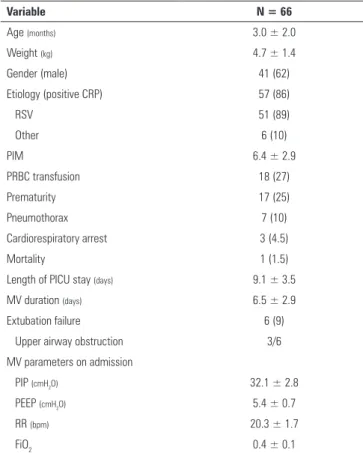
During the study period (2012-2014), which included three winter seasons, 66 infants with AVB were subjected to MV; this population represented 5.6% of the admissions along the investigated period (66/1,178). he average age of the patients was 3.0 ± 2.0 months old, with an average weight of 4.7 ± 1.4kg; 41 (62%) were boys, and 17 (25%) were premature (Table 1). he average PIM2 score was 6.4 ± 2.9. A virus was identiied in 86% of the samples, with respiratory syncytial virus being most commonly found (comprising 89% of the cases with a positive diagnosis). Other detected viruses (concomitant or not with the respiratory syncytial virus) were parainluenza (7%), inluenza B (3.5%), and adenovirus (3.5%). H1N1 virus was isolated in 7% of the cases with a positive diagnosis. No infant was dehydrated upon PICU admission. Eighteen patients (27%) received packed red blood cell transfusions while under MV; the hemoglobin concentration at the time of transfusion was 8.1 ± 0.8g/dL.
Table 1 - Characteristics of infants with acute viral bronchiolitis subjected to mechanical ventilation
Variable N = 66
Age (months) 3.0 ± 2.0
Weight (kg) 4.7 ± 1.4
Gender (male) 41 (62)
Etiology (positive CRP) 57 (86)
RSV 51 (89)
Other 6 (10)
PIM 6.4 ± 2.9
PRBC transfusion 18 (27)
Prematurity 17 (25)
Pneumothorax 7 (10)
Cardiorespiratory arrest 3 (4.5)
Mortality 1 (1.5)
Length of PICU stay (days) 9.1 ± 3.5
MV duration (days) 6.5 ± 2.9
Extubation failure 6 (9)
Upper airway obstruction 3/6
MV parameters on admission
PIP (cmH2O) 32.1 ± 2.8
PEEP (cmH2O) 5.4 ± 0.7
RR (bpm) 20.3 ± 1.7
FiO2 0.4 ± 0.1
he average duration of MV was 6.5 ± 2.9 days, and the average length of stay in the PICU was 9.1 ± 3.5 days (Table 1). he mortality rate was 1.5% (1/66); the single case of death occurred on MV day three and was due to refractory septic shock. he rate of extubation failure within the irst 48 hours after MV discontinuation was 9% (6/66), due to upper airway obstruction in 50% of the cases and to fatigue in the remainder of the patients. Pneumothorax was detected in 10% of the patients, and cardiorespiratory arrest occurred in 4.5%.
he average values of the MV parameters after adjustment to the results of the irst venous blood gas test were as follows: PIP 32.1 ± 2.8cmH2O, PEEP 5.4 ± 0.7cmH2O; RR 20.3 ± 1.7bpm (breaths per minute), and FiO2 0.4 ± 0.1. he average PIP remained at approximately
30cmH2O during the irst four MV days, exhibiting
a signiicant decrease at the pre-extubation assessment only, to approximately 25 cmH2O (p < 0.05) with a tidal volume of 10 to 13mL/kg. Moreover, the RR remained stable during the irst days under MV (20bpm), decreasing to 10bpm at pre-extubation (p < 0.05) (Figure 1).
Figure 1 - Variation in the fraction of inspired oxygen, peak inspiratory pressure, positive end-expiratory pressure, and respiratory rate corresponding to infants with acute viral bronchiolitis subjected to mechanical ventilation. PIP - peak inspiratory pressure; PEEP - positive end-expiratory pressure; RR - respiratory rate; D - day; D-EXT - extubation day;
* p < 0.05.
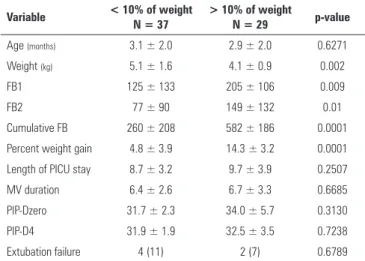
he average cumulative luid balance on MV day four was 402 ± 254mL, which corresponded to an average increase of 9.0 ± 5.9% of the patients’ weight on day one. In 29 infants (44%), the body weight increased more than 10% along the irst four days of MV. Upon analyzing the sample in two groups, namely, infants with weight variation over or below 10%, we did not ind a signiicant diference in the PIP value on MV day four, MV duration, length of PICU stay, or extubation failure (Table 2 and Figure 2).
Figure 2 - Progression of the daily fluid balance in infants with acute viral bronchiolitis subjected to mechanical ventilation. The average cumulative fluid balance on mechanical ventilation day four was 402 ± 254mL/kg, which corresponds to a variation of 9.0 ± 5.9% in the body weight compared with day one. D - day; D-EXT - extubation day.
Table 2 - Clinical characteristics of infants with acute viral bronchiolitis subjected to mechanical ventilation according to the degree of water retention on mechanical ventilation day four
Variable < 10% of weight
N = 37
> 10% of weight
N = 29 p-value
Age (months) 3.1 ± 2.0 2.9 ± 2.0 0.6271
Weight (kg) 5.1 ± 1.6 4.1 ± 0.9 0.002
FB1 125 ± 133 205 ± 106 0.009
FB2 77 ± 90 149 ± 132 0.01
Cumulative FB 260 ± 208 582 ± 186 0.0001
Percent weight gain 4.8 ± 3.9 14.3 ± 3.2 0.0001
Length of PICU stay 8.7 ± 3.2 9.7 ± 3.9 0.2507
MV duration 6.4 ± 2.6 6.7 ± 3.3 0.6685
PIP-Dzero 31.7 ± 2.3 34.0 ± 5.7 0.3130
PIP-D4 31.9 ± 1.9 32.5 ± 3.5 0.7238
Extubation failure 4 (11) 2 (7) 0.6789
FB - fluid balance; PICU - pediatric intensive care unit; MV - mechanical ventilation; PIP-Dzero - peak inspiratory pressure on day zero; PIP-D4 - peak inspiratory pressure on day four. Results are expressed as N (%) or as the mean ± standard deviation.
DISCUSSION
AVB is the most prevalent respiratory illness among children under two years old; its severity is higher among premature infants and infants with previous pulmonary disease, immunodeiciency, or congenital heart defects.(23)
In the present study of infants with AVB subjected to MV (conducted along three consecutive winter seasons), we were able to conirm these data, as 25% of the patients were premature and 27% exhibited anemia requiring blood transfusion.
populations (low-weight, small, and premature infants), and prolonged MV (approximately seven days), the mortality rate is low, approximately 1 to 5%.(22,24)
According to previous studies, the mortality rate is directly correlated with the respiratory pattern exhibited by the patients, being lower among patients predominantly exhibiting low airway obstruction (classic bronchiolitis). In turn, the rates of complications and mortality are higher among patients who progress to acute respiratory distress syndrome.(22) Notably, the single death in our study was
due to refractory septic shock.
By afecting the small airways, AVB promotes an increase in airlow resistance during both inspiration and expiration.(22,25) Bronchiolar inlammation might lead
to early closure of the lower airways, with consequent air trapping and even atelectasis of small areas of the lung. When airlow resistance is considerably increased, the maintenance of alveolar ventilation requires higher inspiratory pressures (with eventual recruitment) as well as longer inspiratory and expiratory times as a function of the elevated time constant. herefore, as in previous studies, we found that a higher PIP (approximately
30cmH2O) and a lower RR (20bpm, on average) were
used during the period of MV and signiicantly reduced at pre-extubation only.(22)
As recovery from and reversion of the obstructive condition do not occur uniformly, we chose to use high PIP levels even during the pre-extubation stage. his strategy allows the patient to breathe spontaneously between the cycles with low inspiratory pressure (e.g., pressure support), while the mandatory breaths with higher PIP ventilate the lung areas that are still partially collapsed and thus oppose greater resistance, which would not be adequately ‘recruited; by ventilation at low pressure. In the present study, we found that this strategy was associated with a low incidence of extubation failure (9%), as half of these cases were due to upper airway obstruction. In addition, the application of this strategy was not associated with an increased incidence of pneumothorax (10% of the cases).
Obviously, the strategy consisting of MV with a higher PIP combined with low RR, low PEEP, and low FiO2 values cannot be applied to patients with progressive hypoxemia and whose condition is compatible with acute respiratory distress syndrome. In such cases, ventilatory measures speciic for this condition should
be implemented.(26) Patents with AVB who progress
to acute respiratory distress syndrome might exhibit excessive inactivation of the endogenous surfactant,(27)
and in some cases, the ventilation strategy might be complemented by the administration of an exogenous surfactant.(28)
Studies performed in recent years have reported a relationship between early luid overload and increased morbidity and mortality among children with severe acute pulmonary disease, causing a signiicant increase in the MV duration, need for oxygen, and length of PICU stay.(19,21,29,30) In our study, we found a signiicant
increase in the cumulative luid balance during the irst four days of MV; however, diferent from the reports in the literature, we were not able to ind a relationship between luid overload and unfavorable outcomes, such as increased MV duration, longer PICU stay, or higher mortality. We did not ind any association between positive luid balance and the need for a higher PIP on the same day. his deleterious efect of positive luid balance likely did not manifest in the present study as a function of the sample size, which lacked the statistical power required for such a purpose.
he present study has limitations derived from its retrospective design, the possible loss of some information, and the fact that the therapeutic measures were not strictly standardized. In addition, the investigation was conducted at a single center and thus represents the local experience, which may or may not be extrapolated to other centers. hese limitations notwithstanding, almost all of our results agree with those reported in the current literature.
CONCLUSION
Objetivo: Analisar as características de crianças com bronquiolite viral aguda submetidas à ventilação mecânica em 3 anos consecutivos, relacionando a evolução com os parâmetros de ventilação mecânica e o balanço hídrico.
Métodos: Estudo longitudinal de uma série de casos de lactentes (< 1 ano) submetidos à ventilação mecânica por bronquiolite viral aguda entre janeiro de 2012 e setembro de 2014 na unidade de terapia intensiva pediátrica. Os prontuários foram revisados e foram coletados dados antropométricos e dados referentes à ventilação mecânica, ao balanço hídrico, à evolução e a complicações maiores.
Resultados: Incluídos 66 lactentes (3,0 ± 2,0 meses e peso médio de 4,7 ± 1,4kg), sendo 62% do sexo masculino, com etiologia viral identiicada em 86%. O tempo médio de ventilação mecânica foi 6,5 ± 2,9 dias, tempo de unidade de terapia intensiva pediátrica de 9,1 ± 3,5 dias, com mortalidade de 1,5% (1/66). O pico de pressão inspiratória médio
manteve-se em 30cmH2O nos 4 primeiros dias de ventilação
mecânica, reduzindo-se na pré-extubação (25cmH2O;
p < 0,05). Pneumotórax ocorreu em 10% e falha de extubação em 9%, sendo a metade por obstrução alta. O balanço hídrico cumulativo no quarto dia de ventilação mecânica foi 402 ± 254mL, correspondendo a um aumento de 9,0 ± 5,9% no peso. Tiveram aumento de 10% ou mais no peso 37 pacientes (56%),
sem associação signiicativa aos parâmetros ventilatórios no 4º
dia de ventilação mecânica, falha de extubação ou tempos de ventilação mecânica e unidade de terapia intensiva pediátrica.
Conclusão: A taxa de ventilação mecânica na bronquiolite viral aguda tem se mantido constante, apresentando baixa mortalidade, poucos efeitos adversos e associada a balanço hídrico cumulativo positivo nos primeiros dias. Melhor controle hídrico poderia reduzir o tempo de ventilação mecânica.
RESUMO
Descritores: Bronquiolite; Respiração artiicial; Vírus sinciciais respiratórios; Edema; Criança; Unidades de terapia intensiva
REFERENCES
1. Stockman LJ, Curns AT, Anderson LJ, Fischer-Langley G. Respiratory syncytial virus-associated hospitalizations among infants and young children in the United States,1997-2006. Pediatr Infect Dis J. 2012;31(1):5-9. 2. Wright M, Piedimonte G. Respiratory syncytial virus prevention and
therapy: past, present, and future. Pediatr Pulmonol. 2011;46(4):324-47. 3. Wang EE, Law BJ, Stephens D. Pediatric Investigators Collaborative
Network on Infections in Canada (PICNIC) prospective study of risk factors and outcomes in patients hospitalized with respiratory syncytial viral lower respiratory tract infection. J Pediatr. 1995;126(2):212-9.
4. Shay DK, Holman RC, Roosevelt GE, Clarke MJ, Anderson LJ. Bronchiolitis-associated mortality and estimates of respiratory syncytial virus-Bronchiolitis-associated deaths among US children, 1979-1997. J Infect Dis. 2001;183(1):16-22. 5. Oñoro G, Pérez Suárez E, Iglesias Bouzas MI, Serrano A, Martínez De
Azagra A, García-Teresa MA, et al. [Severe bronchiolitis. Changes in epidemiology and respiratory support]. An Pediatr (Barc). 2011;74(6):371-6. Spanish.
6. Holman RC, Shay DK, Curns AT, Lingappa JR, Anderson LJ. Risk factors for bronchiolitis-associated deaths among infants in the United States. Pediatr Infect Dis J. 2003;22(6):483-90.
7. Ricart S, Marcos MA, Sarda M, Anton A, Muñoz-Almagro C, Pumarola T, et al. Clinical risk factors are more relevant than respiratory viruses in predicting bronchiolitis severity. Pediatr Pulmonol. 2013;48(5):456-63. 8. Antunes H, Rodrigues H, Silva N, Ferreira C, Carvalho F, Ramalho H, et al.
Etiology of bronchiolitis in a hospitalized pediatric population: prospective multicenter study. J Clin Virol. 2010;48(2):134-6.
9. Calvo C, Pozo F, García-García ML, Sanchez M, Lopez-Valero M, Pérez-Breña P, et al. Detection of new respiratory viruses in hospitalized infants with bronchiolitis: a three-year prospective study. Acta Paediatr. 2010;99(6):883-7.
10. Bonnet D, Schmaltz AA, Feltes TF. Infection by the respiratory syncytial virus in infants and young children at high risk. Cardiol Young. 2005;15(3):256-65. 11. Lubrano R, Cecchetti C, Elli M, Tomasello C, Guido G, Di Nardo M, et al.
Prognostic value of extravascular lung water index in critically ill children with acute respiratory failure. Intensive Care Med. 2011;37(1):124-31.
12. Annat G, Viale JP, Bui Xuan B, Hadj Aissa O, Benzoni D, Vincent M, et al. Effect of PEEP ventilation on renal function, plasma renin, aldosterone, neurophysins and urinary ADH, and prostaglandins. Anesthesiology. 1983;58(2):136-41.
13. Leithner C, Frass M, Pacher R, Hartter E, Pesl H, Woloszczuk W. Mechanical ventilation with positive end-expiratory pressure decreases releases of alpha-atrial natriuretic peptide. Crit Care Med. 1987;15(5):484-8. 14. Costa KN, Carvalho WB, Kopelman BI, Didio R. Dosagem do fator
natriurético atrial em pacientes pediátricos submetidos à ventilação mecânica. Rev Assoc Med Bras. 2000;46(4):320-4.
15. Piva J, Alquati T, Garcia PC, Fiori H, Einloft P, Bruno F. Norepinephrine infusion increases urine output in children under sedative and analgesic infusion. Rev Assoc Med Bras. 2014;60(3):208-15.
16. Jozwiak M, Silva S, Persichini R, Anguel N, Osman D, Richard C, et al. Extravascular lung water is an independent prognostic factor in patients with acute respiratory distress syndrome. Crit Care Med. 2013;41(2):472-80. 17. Stewart RM, Park PK, Hunt JP, Mclntyre RC Jr, McCarthy J, Zarzabal LA,
Michalek JE; National Institutes of Health/National Heart, Lung, and Blood Institute Acute Respiratory Distress Syndrome Clinical Trials Network. National Institutes of Health/National Heart, Lung, and Blood Institute Acute Respiratory Distress Syndrome Clinical Trials Network: Less is more: improved outcomes in surgical patients with conservative fluid administration and central venous catheter monitoring. J Am Coll Surg. 2009;208(5):725-35; discussion 735-7. Erratum in J Am Coll Surg. 2009;209(2):295. 18. Sadaka F, Juarez M, Naydenov S, O’Brien J. Fluid resuscitation in septic
shock: the effect of increasing fluid balance in mortality. J Intensive Care Med. 2014;29(4):213-7.
19. Flori HR, Church G, Liu KD, Gildengorin G, Matthay MA. Positive fluid balance is associated with higher mortality and prolonged mechanical ventilation in pediatric patients with acute lung injury. Crit Care Res Pract. 2011;2011:854142.
21. Arikan AA, Zappitelli M, Goldstein SL, Naipaul A, Jefferson LS, Loftis LL. Fluid overload is associated with impaired oxygenation and morbidity in critically ill children. Pediatr Crit Care Med. 2012;13(3):253-8.
22. Bueno FU, Piva JP, Garcia PC, Lago PM, Einloft PR. Outcome and characteristics of infants with acute viral bronchiolitis submitted to mechanical ventilation in a Brazilian pediatric intensive care. Rev Bras Ter Intensiva. 2009;21(2):174-82.
23. Nicolai A, Ferrara M, Schiavariello C, Gentile F, Grande ME, Alessandroni C, et al. Viral bronchiolitis in children: a common condition with few therapeutic options. Early Hum Dev. 2013;89 Suppl 3:S7-11.
24. Byington CL, Wilkes J, Korgenski K, Sheng X. Respiratory syncytial virus-associated mortality in hospitalized infants and young children. Pediatrics. 2015;135(1):e24-31.
25. Greenough A. Role of ventilation in RSV disease: CPAP, ventilation, HFO, ECMO. Paediatr Respir Rev. 2009;10 Suppl 1:26-8.
26. ARDS Definition Task Force, Ranieri VM, Rubenfeld GD, Thompson BT, Ferguson ND, Caldwell E, Fan E, et al. Acute respiratory distress syndrome: the Berlin Definition. JAMA. 2012;307(23):2526-33.
27. Hartmann F, Fiori HH, Ramos Garcia PC, Piva J, Fiori RM. Surfactant deficiency in infants with severe acute viral bronchiolitis. J Pediatr. 2014;164(6):1432-5.
28. Jat KR, Chawla D. Surfactant therapy for bronchiolitis in critically ill infants. Cochrane Database Syst Rev. 2015;8:CD009194. Review.
29. Valentine SL, Sapru A, Higgerson RA, Spinella PC, Flori HR, Graham DA, Brett M, Convery M, Christie LM, Karamessinis L, Randolph AG; Pediatric Acute Lung Injury and Sepsis Investigator’s (PALISI) Network; Acute Respiratory Distress Syndrome Clinical Research Network (ARDSnet). Fluid balance in critically ill children with acute lung injury. Crit Care Med. 2012;40(10):2883-9.