www.reumatologia.com.br
REVISTA BRASILEIRA DE
REUMATOLOGIA
Original article
Randomized controlled trial of a therapeutic intervention
group in patients with ibromyalgia syndrome
Marielza R. Ismael Martins
a,*, Cristiane Carnaval Gritti
b, Randolfo dos Santos Junior
b,
Maria Carolina Luizetto de Araújo
b, Lilian Chessa Dias
b, Marcos Henrique D’all Aglio Foss
a,
Larissa Batista de Andrade
b, Carlos Eduardo D’all Aglio Rocha
aa Department of Neurological Sciences, Faculdade de Medicina de São José do Rio Preto, São José do Rio Preto, SP, Brazil b Service of Pain Clinics, Faculdade de Medicina de São José do Rio Preto, São José do Rio Preto, SP, Brazil
a r t i c l e i n f o
Article history:
Received on 6 February 2013 Accepted on 15 October 2013
Keywords:
Fibromyalgia Controlled study Group intervention
a b s t r a c t
Objective: To evaluate the eficacy of a weekly interdisciplinary program (WIP) consisted of educational activities, physical therapy, stretching, ergonomics, posture guidance com-bined with cognitive behavioral strategies and approaches to psychosocial and occupa-tional factors in order to determine whether this intervention would be effective to short and medium-term improvement of symptoms in these patients.
Methods: This was a single-center study, randomized single blind controlled trial with a sample test group (T), with a diagnosis of FMS (n = 12), and a control group (C) subjected to Pain Clinic referral (n = 15). The instruments used at two different times were the Fibromy-algia Impact Questionnaire (FIQ), Visual Analogue Scale (VAS) and Post-Sleep Protocol (PSI). To assess quality of life, we used the SF-12.
Results: In samples, both groups were predominantly female, mean age of 42.5 ± 9.8 years, 43% married, average schooling of 8.3 ± 4.5 years. It was reported a mean of 4.2 years pain and an average of two years for the diagnosis of SFM from the group T. There was statisti-cal difference between the groups in terms of eficacy post intervention WIP, in almost all outcome measures.
Conclusion: It was found that weekly interdisciplinary program (WIP) has contributed to improving the quality of life of patients with ibromyalgia.
© 2014 Sociedade Brasileira de Reumatologia. Published by Elsevier Editora Ltda. All rights reserved.
* Corresponding author.
E-mail: [email protected] (M.R.I. Martins).
Estudo randomizado e controlado de uma intervenção terapêutica grupal em pacientes com síndrome ibromiálgica
Palavras-chave:
Fibromialgia Estudo controlado Intervenção grupal
r e s u m o
Objetivo: Avaliar a eicácia de um programa interdisciplinar semanal (PIS) composto de ati-vidades educativas, terapias físicas, alongamento, ergonomia, orientações posturais com-binado com estratégias cognitivas e comportamentais e abordagens de aspectos psicosso-ciais e ocupacionais, a im de determinar se esta intervenção seria efetiva em curto e médio prazos para melhora dos sintomas destes pacientes.
Casuística e métodos: Trata-se de um estudo unicêntrico, randomizado, simples cego e con-trolado com amostra de um grupo-teste (T), com diagnóstico de SFM (n = 12), e de um grupo-controle (C) submetido a interconsulta na Clínica da Dor (n = 15). Os instrumentos utilizados em dois momentos distintos foram: Questionário de Impacto de Fibromialgia (FIQ), Escala Visual Analógica (EVA) e Protocolo Pós-Sono (PSI). Para avaliar a qualidade de vida, foi utilizado o Questionário SF-12.
Resultados: Na amostra dos dois grupos houve predomínio do gênero feminino, média de idade de 42,5±9,8 anos, 43% casados e média de escolaridade de 8,3±4,5 anos. Foi relatado um tempo médio de dor de 4,2 anos e uma média de dois anos para o diagnóstico de SFM no grupo T. Houve diferença estatística entre os grupos, em relação à eicácia pós-interven-ção do PIS, em quase todos os desfechos analisados.
Conclusão: Veriicou-se que o programa interdisciplinar semanal (PIS) contribuiu para me-lhora da qualidade de vida dos pacientes ibromiálgicos.
© 2014 Sociedade Brasileira de Reumatologia. Publicado por Elsevier Editora Ltda. Todos os direitos reservados.
Introduction
The ibromyalgia syndrome (FMS) is a rheumatic syndrome of unknown etiology that predominantly affects women. It is characterized by diffuse and chronic musculoskeletal pain, in addition to speciic anatomical sites with pain elicited by pal-pation, called tender points. Other symptoms such as fatigue, sleep disturbances, morning stiffness and psychological dis-orders such as anxiety and depression are often associated.1-3
Statistic data shows that FMS affects 3-5% of general popu-lation, occurring in all ages with chronic symptoms that can luctuate throughout the day and with inactivity, compromis-ing about a quarter of those affected.3
The clinical picture of FMS is complex, and several works4,5
propose multidisciplinary teams to perform interventions, highlighting programs with exercise sessions,4 relaxation,5
stress management and compartmental cognitive therapy6
that consist in extending the adherence to treatment and mo-tivating patients to remain active.7
The mean duration of interdisciplinary programs varies from one to six months, usually performed with groups of 10 and 25 individuals. The justiication for choosing this type of intervention proves itself by improving the quality of life and health status of patients with FMS.8,9
Regarding the pathogenesis of FMS, it is not well deined yet, although psychosomatic phenomena occur in most patients.10 In addition to this possible effect, some areas of
the nervous system functioning may represent a role in the pathogenesis of FMS, which include: changes in pain sen-sitivity,11,12 and also on autonomic and neuroendocrine
sys-tems.13-15 Bacterial and viral agents may also be related to the
origin of this syndrome,16 and there is some association
be-tween the disease and infection by hepatitis virus C.11
Considering that SFM probably has multifactorial etiology that still remains unclear, recent trials17,18 reported that the
reorientation of attention for the treatment of the patients to this combination of factors and the education of these pa-tients (so that they can control their symptoms) are measures that could promote changes in behavior and improve their functional capacity.
Given this context, the objective of this trial was to evalu-ate the eficacy of a weekly interdisciplinary program (WIP) consisting of educational activities, physical therapy, stretch-ing, ergonomics and postural orientations combined with cognitive-behavioral strategies and approaches to psychoso-cial and occupational features, in order to determine whether this intervention would be effective in the short and medium terms to improve the symptoms of these patients.
Patients and Methods
thera-pist, physiotherathera-pist, psychologist and social worker. After participating in this program, a revaluation was performed using the same instruments.
To perform WIP, 12 patients diagnosed with FMS (test group – TG) were recruited according to criteria of the Ameri-can College of Rheumatology,1 of both genders, with enough
cognitive level to understand the procedures and follow the directions given. Patients with psychiatric disease and no clinical follow-up in the Pain Clinic, Hospital de Base, were excluded. The control group (CG) consisted of patients who were in interconsultation in the Pain Clinic and without diag-nosis of musculoskeletal and neurological disorders, or with disabling complaints in these systems, with a recommenda-tion for walking (pelvic pain, migraine, inlammatory bowel pain post-herpetic neuralgia).
CG consisted of subjects matched for age and educational level in relation to TG (n = 15). The evaluation of the subjects in both groups was performed using the Fibromyalgia Impact Questionnaire (FIQ),19 involving 20 questions divided into
10 items (functional capacity, feeling good, work absentee-ism, interference of symptoms at work, pain, fatigue, morn-ing stiffness, mornmorn-ing tiredness, anxiety and depression), in which nine of them have a higher score as the worst condi-tion, with the exception of the item “feeling good”. Seven of the nine items (4th to 10th) are scored using a visual analogue scale, i.e., between 0 and 10.
Functional capacity is estimated by answering 10 ques-tions, with answers from 0 to 3, which are added at the end of the questionnaire, ranging between 0 and 30. The “work ab-senteeism” and “feeling good” questions are scored on week-days, originally ranging from 0 to 5; the Visual Analogue Scale (VAS),20 which consists of measuring the intensity of pain in
the patient and is an important tool to verify more reliably the evolution of the patient during treatment and even at every visit, consists of a limited strip of 10 cm in length, represent-ing a continuum of the painful experience; this strip has in her ends anchor-words: “no pain” and “worst pain possible”. The participants are instructed to report the intensity of pain sensation to a point of this line, and the scores can range from zero to 10 and are obtained by measuring, in millimeters, the distance between the end anchored by the words “without pain” and the point marked by the participant; the Post-Sleep Protocol (PSP),21 which assesses the sleep quality and features
30 items divided into three categories: pre-sleeping (at bed-time), during sleep and post-sleeping (awakening) (30-390; higher scores are related to better quality of sleep). To assess the quality of life, the Generic Quality of Life SF-1222
question-naire was used. It consists of 12 questions that address the physical component (functional capacity and limitation by physical aspects) and the mental component (pain, vitality, social functioning, limitations due to emotional problems and mental health), and their results are expressed by a score in a scale of zero to 100 by researched component (worst – best general health, cutoff score ≤ 50).
To assess depressive and anxiety symptoms, we used the Hospital Anxiety and Depression (HAD) scale,23 translated and
validated in Brazil, which consists of a self-report instrument containing 14 multiple choice questions, composed of two in-terleaved sub-scales: one for anxiety-state (7 questions) and another for depression-state (7 questions). HAD scores range
from 0 to 21 points, and the subjects with scores < 7 are con-sidered without signiicant clinical symptoms for anxiety and/or depression; scores ≥ 8 and ≤ 10, with mild symptoms; scores ≥ 11 and ≤ 14, with moderate symptoms; and scores ≥ 15 and ≤ 21, with severe symptoms of anxiety and/or depres-sion.
During the sessions, exercises to strengthen the muscle and to improve cardiovascular itness were conducted, con-sisting of stretching exercises of muscle groups of the shoul-der and pelvic girdle, lower limb muscles, gluteus, abdominals and quadriceps, as well as body correction and awareness, and ergonomics. The sessions were initiated with relaxation techniques to combat muscle tension. Educational, psychoso-cial and occupational programs were also developed to help understand and manage ibromyalgia, with the monitoring of vital signs at the beginning and end of each treatment session and the questioning on the use of drugs by patients. All the participants were instructed and taught to practice a series of daily exercises at home. It emphasized the need to maintain the home exercise program, and guidelines were given on the correct way to perform ADLs and AVPs.
Analyses were performed using ANOVA. This descriptive parametric statistical test was selected for inferential analy-ses, because the dependent variables of this trial were quanti-tative (interval scale). The signiicance level used for the tests was 0.05.
Results
The twenty-seven subjects enrolled in both groups adhered totally to the program, with no occurrence of sample loss.
The mean age was 42.5 ± 9.8 years, ranging from 28-67 years; most of the participants were female (64%). The mean duration of pain was 4.2 years, with an average of two years for the clinical diagnosis of FMS in TG. Table 1 lists the charac-terization of the sample for the two groups (T and C).
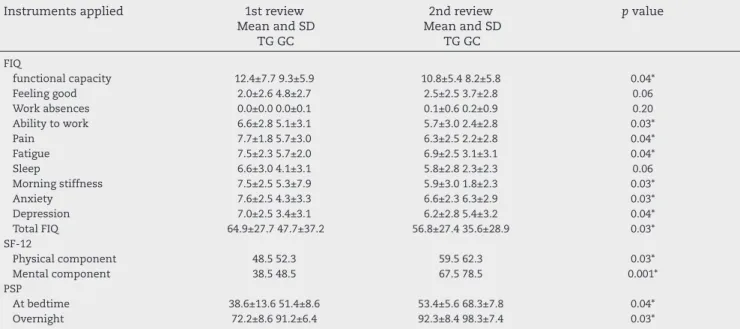
During the experimental phase, all patients in the T group maintained their pharmacological routine. Signiicant differ-ence was observed between the groups regarding the func-tional capacity and work absenteeism, observed in the FIQ questionnaire. As for the other questionnaires used in this trial, data of mean and standard deviation (SD) can be ob-tained from Table 2.
It is important to notice, in Fig. 1, the frequency of de-pressive and anxiety symptoms. It is noteworthy that 50% of patients with FMS in T group had depressive symptoms, and 33% had moderate to severe symptoms. 78% of these in-dividuals had symptoms of anxiety, and in 43% of them the symptoms were severe.
Discussion
With regard to functional capacity, it was found that in group T the activities in WIP improved the energy that comes from the symptoms of chronic fatigue and stiffness, corrobo-rating other trials.23,24
Other work on the impairment of muscle contractility in a group of i bromyalgia patients is associated with a higher
perception of effort and reduced maximal exercise capac-ity. Due to this fact, the inclusion of physical activity in the treatment of these patients would improve their functional responses, with decreased fatigue and increased functional capacity.25
Firestone et al.26 evaluated the impact of a program of group
therapy for patients with i bromyalgia. The sessions consist-ed of behavioral modii cations, stress rconsist-eduction techniques, strategies to improve l exibility and physical performance, in addition to sessions for familial help. The sessions were held weekly for a period of six months. The authors report promis-ing results obtained in the short and long terms.
There was also a decrease in symptoms of depression and anxiety in WIP participants.
Among the various factors affecting the QoL of i bromyal-gia patients, Aliciati et al.27 suggest that the presence of
de-pression predisposes patients to impaired social functioning, and Clark et al.23 reported that the inclusion of these patients
in multidisciplinary groups favors the practice of daily living activities, mobility and quality of body movements and of physical i tness, thereby improving their quality of life. Table 1 – Data on sociodemographic variables for T
(n = 12) and C groups (n = 15) Variable Group n Mean ±
SD
%
Age Test Control
12 15
39,5±7,8 45,5±8,3 Gender Test
Control 12 15
8,3 ± 4,5 years
Female 62 Female 55 Marital
status
Test 12 Married 52 Single 28 Divorced 20 Control 15 Married 43 Single 37 Divorced 13 Widowed 7 Education Test 12 Fundamental 32
Secondary 48 Superior 20 15 Fundamental 37
Secondary 45 Superior 18 Employment
situation
Test 12 Formal work 12 Sick-leave aid 58
Retired 4 Informal work 26 Control 15 Formal work 20 Sick-leave aid 48
Retired 6 Informal work 26
Table 2 – Change in mean values of FIQ, SF-12 and Post-Sleep Protocol (SIP) questionnaire domains throughout the follow-up period, expressed as mean ± standard deviation and variation
Instruments applied 1st review
Mean and SD TG GC
2nd review Mean and SD
TG GC
p value
FIQ
functional capacity Feeling good Work absences Ability to work Pain Fatigue Sleep Morning stiffness Anxiety Depression Total FIQ 12.4±7.7 9.3±5.9 2.0±2.6 4.8±2.7 0.0±0.0 0.0±0.1 6.6±2.8 5.1±3.1 7.7±1.8 5.7±3.0 7.5±2.3 5.7±2.0 6.6±3.0 4.1±3.1 7.5±2.5 5.3±7.9 7.6±2.5 4.3±3.3 7.0±2.5 3.4±3.1 64.9±27.7 47.7±37.2 10.8±5.4 8.2±5.8 2.5±2.5 3.7±2.8 0.1±0.6 0.2±0.9 5.7±3.0 2.4±2.8 6.3±2.5 2.2±2.8 6.9±2.5 3.1±3.1 5.8±2.8 2.3±2.3 5.9±3.0 1.8±2.3 6.6±2.3 6.3±2.9 6.2±2.8 5.4±3.2 56.8±27.4 35.6±28.9 0.04* 0.06 0.20 0.03* 0.04* 0.04* 0.06 0.03* 0.03* 0.04* 0.03* SF-12 Physical component Mental component 48.5 52.3 38.5 48.5 59.5 62.3 67.5 78.5 0.03* 0.001* PSP At bedtime Overnight 38.6±13.6 51.4±8.6 72.2±8.6 91.2±6.4 53.4±5.6 68.3±7.8 92.3±8.4 98.3±7.4 0.04* 0.03* * statistically signii cant difference, p < 0.05.
0% 10% 20% 30% 40% 50% 60% 70% 80% GT GC
fi
DEPRESSION ANXIETYRegarding the prescription of activities and exercises to patients with FMS, orientations, as well as pharmacologi-cal prescriptions with dose, duration and speciic intervals, were performed. The concern in relation to the intensity and execution of the proposed and previously trained activities in WIP began gradually, considering the preferences of pa-tients, their comorbidities, medication use, and functional capacity.
Corroborating this procedure, the trial by Miró et al.28
in-volved different areas in action groups with expertise on i-bromyalgia patients, showing that they are promoters of pain relief, generating well-being and contributing signiicantly to the quality of the patients’ life.
Regarding the sleep, some trials29,30 relate a worst
sleep-ing period to a greater number of tender points in patients with ibromyalgia. Sleep disturbances were also associated with chronicity of pain complaints. It is known that individu-als with chronic pain, such as those with FMS, have a persis-tent health condition that changes their life. The goal of their treatment is to control FMS and not to seek its elimination; therefore, the sleep pattern assessment becomes a sensitive indicator that should be considered. In this trial, after the in-tervention of WIP (with approaches focused on body biome-chanics, kinesiology, ergonomics, psychosocial aspects and improvement of cardiorespiratory capacity), a better sleep pattern was noted in these individuals.
Follow-up studies with FMS patients are scarce, as well as those on the health care, that should have an interdisciplin-ary planning, but they have been performed separately by each professional.
The actions resultant of WIP revealed that the approach to patients with FMS should be multifactorial; this strategy enables the understanding of this syndrome as a summation of disorders that end up manifesting itself by the association of a variety of symptoms.
Conclusion
The treatment of ibromyalgia patients should follow multi-factorial models; this will allow a systematic development of the necessary abilities to the transition from rehabilitation in the maintenance of an active and independent lifestyle.
Conlicts of interest
The authors declare no conlicts of interest.
R E F E R E N C E S
1. Wolfe F, Smythe HA, Yunus MB, Bennett RM, Bombardier C, Goldenberg DL et al. The American College of Rheumatology 1990 Criteria for the classiication of ibromyalgia. Report of the Multicenter Criteria Committee. Arthritis Rheum. 1990; 33:160-72.
2. Martins MRI, Polvero L, Rocha CE, Foss MH, Santos Junior R. Uso de questionários para avaliar a multidimensionalidade e a qualidade de vida do ibromiálgico.Rev Bras Reumatol. 2012;52:21-26.
3. Mease PJ et al. Identifying the clinical domains of ibromyalgia: Contributions from clinician and patient Delphi exercises. Arthritis Care Res. 2008;39:952-60.
4. Da Costa D, Abrahamowicz M, Lowensteyn I et al. A randomized clinical trial of an individualized home-based exercise programme for women with ibromyalgia. Rheumatology (Oxford). 2005;44:1422-7.
5. Boomershine CS, Emir B, Wang Y, Zlateva G. Simplifying Fibromyalgia Assessment: The VASFIQ Brief Symptom Scale. Ther Adv Musculoskelet Dis. 2011;3:215-26.
6. Veldhuijzen DS, Sondaal SF, Oosterman JM. Intact cognitive inhibition in patients with ibromyalgia but evidence of declined processing speed. J Pain. 2012;13:507-15.
7. Persson E, Lexell J, Eklund M, Rivano-Fischer M. Positive effects of a musculoskeletal pain rehabilitation program regardless of pain duration or diagnosis. PM R. 2012;4:355-66.
8. Ayan C, Alvarez MJ, Alonso-Cortés B, Barrientos MJ, Valencia M, Martín V. Health education home-based program in females with ibromyalgia: a pilot study. J Back Musculoskelet Rehabil. 2009;22:99-105.
9. Mannerkorpi K, Henriksson C. Non-pharmacological treatment of chronic widespread musculoskeletal pain. Best Pract Res Clin Rheumatol. 2007;21:513-34.
10. Orlandi AC, Ventura C, Gallinaro AL, Costa RA, Lage LV. Improvement in pain, fatigue, and subjective sleep quality through sleep hygiene tips in patients with ibromyalgia. Rev Bras Reumatol. 2012;52:672-678.
11. Endresen GK. Mycoplasma blood infection in chronic fatigue and ibromyalgia syndromes. Rheumatol Int. 2003;23:211-5. 12. Buskila D, Atzeni F, Sarzi-Puttini P. Etiology of ibromyalgia: the
possible role of infection and vaccination. Autoimmun Rev. 2008;8:41-3.
13. Suleı˘manova GP, Grekhov RA, Kharchenko SA, Aleksandrov AV, Zborovskiı˘ AB. Psychosomatic relationships in patients with primary ibromyalgia syndrome. Klin Med. 2009;87:55-9. 14. Riberto M, Pato TR. Fisiopatologia da ibromialgia. Acta Fisiatr.
2004;11:78-81.
15. Bellometti S, Galzigna L. Function of the hypothalamic adrenal axis in patients with ibromyalgia syndrome undergoing mud-pack treatment. Int J Clin Pharmacol Res. 1999;19:27-33. 16. Sarzi-Puttini P, Atzeni F, Cazzola M. Neuroendocrine therapy
of ibromyalgia syndrome: an update. Ann N Y Acad Sci. 2010;1193:91-7.
17. Torma LM, Houck GM, Wagnild GM, Messecar D, Jones KD. Growing old with ibromyalgia: factors that predict physical function. Nurs Res. 2012;3:212-8
18. Jahan F, Nanji K, Qidwai W, Qasim R. Fibromyalgia syndrome: an overview of pathophysiology, diagnosis and management. Oman Med J. 2012;27:192-5.
19. Marques AP, Santos AMB, Assumpção A, Matsutani LA, Lage LV, Pereira CAB. Validação da versão brasileira do Fibromyalgia Impact Questionnaire (FIQ). Rev Bras Reumatol. 2006;46:24-31. 20. Pimenta CAM. Escalas de avaliação de dor. In: Teixeira MD (ed).
Dor: conceitos gerais. São Paulo: Limay, 1994 pp. 46-56. 21. Webb WB, Bonnet M, Blume G. A post-sleep inventory. Percept
Motor Skills. 1976;43:987-93.
22. Camelier A. Avaliação da qualidade de vida relacionada à saúde em pacientes com DPOC: estudo de base populacional com o SF-12 na cidade de São Paulo-SP. [tese]. São Paulo: Universidade Federal de São Paulo, 2004.
23. Clark P, Paiva ES, Ginovker A, PA. A patient and physician survey of ibromyalgia across Latin America and Europe. BMC Musculoskelet Disord. 2013;14:188.
24. Zigmond AS, Snaith RP. The hospital anxiety and depression scale. Acta Psychiatr Scand. 1983;67:361-370.
26. Firestone KA, Holton KF, Mist SD, Wright CL, Jones KD. Optimizing ibromyalgia management. Nurse Pract. 2012;37:12-21.
27. Aliciati A, Sgiarovello P, Atzeni F, Sarzi-Puttini P. Psychiatric problems in ibromyalgia: clinical and neurobiological links between mood disorders and ibromyalgia. Reumatismo. 2012;64:268-74.
28. Miró E, Martínez MP, Sánchez AI, Prados G, Medina A. When is pain related to emotional distress and daily functioning
in ibromyalgia syndrome? The mediating roles of self-eficacy and sleep quality. Br J Health Psychol. 2011;16:799-814.
29. Consoli G, Marazziti D, Ciapparelli A, Bazzichi L, Massimetti G, Giacomelli C et al. The impact of mood, anxiety, and sleep disorders on ibromyalgia. Compr Psychiatry. 2012; 53:962-7. 30. Gui M, Pedroni CR, Rossini S, Reimão R, Barbosa CMR.