241
APPLIED GEO-INFORMATICS FOR FLOOD MANAGEMENT
George G. van der Meulen
Compuplan Knowledge Institute of Applied geo-Informatics (CKI), Maasstraat 5, 5431 EB Cuijk, The Netherlands
Phone: +31-653-164103; Fax: +31-485-471471; E-mail: [email protected]
ABSTRACT
A major response to disasters, flood disasters in particular, is the production and availability of flood (hazard/risk) maps. Flood maps are static, therefore it would be better, to concentrate and emphasize upon interactive, web accessible systems for professionals and general public as well. Computers, web technology, internet capacity and speed are no longer a bottleneck to to providing an interactive opportunity and once aware of that opportunity, a strong demand for more comprehensive and more complex flood management systems come to the fore. However, as a result, new constraints appear. During the last 20 years, substantial progress has been made in the geo-informatics development of flood disaster systems, from prototyping efforts to comprehensive, integrated systems. Achievements made concerned prototyping of concept modeling for understanding and evaluation reasons unto systems to be applied to flood risk areas through most phases of the safety cycle in use with flood disaster decision makers and fighters. The purpose of this paper concerns to explain these achievements, in historical order, underlining their progress, increasing complexity and comprehensiveness, and paying attention for a final opportunity of an interactive and integrative system approach. For that reason, an overview is given, followed by a discussion about the preferable follow-ups, from scientific and professional demand points of view.
Keywords: disaster management; evacuation, information technology, safety cycle, spatial planning
Abbreviations and Nomenclature: Delft-FLS, 1-D flood simulation system; DSS, decision support system; Excimap, a European exchange circle on flood mapping; FLIWAS, flood information and warning system; GIS, geographical information systems; IPCC, international panel climatic change; IULWP, integrated urban land and water planning; PoldEvac, polder flooding and evacuation system; SC, safety cycle; UNCED, united nations conference environment development; UNDRO, united nations disaster reduction organization.
1. INTRODUCTION
In all flood risk cases, protection against and mitigation of the effects of floods is required. Various scenarios and works are proposed, partly executed, subject to dynamics of such systems and also subject to huge financial efforts to realize the works in a context of integrated technical, ecological, environmental, human required involvement, e.g., Project organization Room for the River [25].
That context necessitates the acceptation that flood disaster management requires an on-going approach with distinctive phases, each of them requiring different activities, emphasizing distinctive information demands notwithstanding the fact that the whole concerns a process, which is fundamentally cyclic. This process is named safety cycle (SC), and often used as a guiding principle of (operational) decision making and management.
242 2. METHODS
2.1. Some definitions
A „disaster‟ (or hazard) is defined in the Dutch Act on Disasters as: a serious disturbance of the general safety, by which life and health of many people and/or material interests is under direct risk, and for which a coordinated effort of departments, services, and organizations of various disciplines is required. Adequate disaster management is a complex matter. It needs multi-disciplinary support, preferably with the aid of applied geo-spatial informatics, that is, software including special user interfacing, (flood safety) mapping and knowledge based systems [13].
The concept of Safety Cycle (SC) has been developed to support decision makers in case of a potential or actual crisis such as fire fighting, disaster management and huge accidents.
The SC is subdivided into 5 stages of concern, integrated sets of activities. In each stage of the SC risk reduction can be achieved. The stages distinguished are: pro-action, prevention, preparation, repression / response, and, after-care (/ recovery / rehabilitation / reconstruction).
2.2. Flood safety mapping
At the various governmental levels (EU, member state‟s central, provincial and local governments, and connected regional bodies, such as e.g. the Water Boards), more and more attention is paid to visualize potential dangers in maps. In the Netherlands, serious efforts have been made to create safety maps, mainly as a reaction to two events in particular, notably the explosion of an ammunition storage site, and the flood (risk) disasters along the Meuse and Rhine in 1993 and 1995. Safety maps are (publicly) available and accessible through provincial websites. The national Safety Website (www.minbzk.nl/veiligheid) explains the various disasters and their potential risks, and provide per kind of disaster a reasoning about risks, how to understand safety maps, etc. A special, extensive section deals with flood disasters.
What is true for the Netherlands, is also true for many other European countries. According to outcomes of the EXCIMAP inventory project [4], a wide variety of flood maps already exists in Europe [20, 1]. It mentions the existence of a very interesting entrance to such information, through the internet, where a click on a country on the European map provides overwhelming information on this mapping topic. The required flood risk information during the full extent of a disaster event varies. For this reason, information provision through safety maps will differ according to the so-called SC phases.
Another, crucial part of disaster management concerns evacuation: “evacuation maps are still relatively rare in the European Union ( ….) found for Germany (Hamburg), while in The Netherlands they are in development” [1]. Such maps may literally not exist in the Netherlands, however software system application outcomes are available and the website accessible since 2002. These concern the results of the EC Interreg II C IRMA (Initiatives Rhine and Meuse
Activities) programme‟s “PoldEvac system”, awarded as best practice in the IRMA closing ceremony in Düsseldorf, April 2004 [15]. These flood and evacuation modules are explained in the next section.
2.3. Development and research
In line with the paper purpose, efforts on information provisions to decision makers, professionals and general public will be explained. These efforts have a long history, going through initial steps, prototyping and real-world applications. During the time, scientific and professional considerations resulted in comprehensive and integrated systems, which finally led to interactive and website accessible systems. These stepping-stones are selected on time, on-going evaluation, choices and progress criteria. The process includes:
A support handbook on disasters for the UN Disaster Decade compiled by UNDRO [26]), several software prototypes have been produced (1987-„88). As a result, information became digitally accessible and visible, giving support to the training of involved (Third World) decision making;
As a consequence of the so-called greenhouse effect, the seawater level is expected to rise. Scenarios concerning The Netherlands are described in a presentation during a Pacific Regional Sciences Conference in Cairns, Australia [23]. They referred to a map about potential inundation areas in The Netherlands [2]. During two coastal zone management conferences of UNESCO-IHP, in Hamburg and in Bangkok
(1989-„91), a software prototype, called SeaWater, has been introduced. Its concept was in line with IPCC research and policymaking for coastal zone protection [7], and the IPCC [8] methodology for vulnerability assessment. Applied to height contour lines of the Netherlands, it highlighted vulnerability due to possible sea level rise.
243
concerns a next step of flood prototyping. The result of WCoast was primarily a tool, emphasizing vulnerability of various coastal zones, such as: delta, island, and reef. The tool provided those present a tool to show these flood risks to colleagues, once returned home.
Aware of the aforementioned prototypes, the Ministry of Traffic and Water Management of the Netherlands/Technical Advisory Committee to Minister requested a further prototype. Instead of flood risk from the sea, attention should be paid to a possible inundation of a fictitious polder area as a consequence of a river dike breach, in combination with actions of repression/response, notably evacuation. The prototype concept is called DamSim, damage simulator (1992-„93).
In the course of the years following, the prototyping moved to comprehensive (software) system development, data collections and applications regarding flood risk areas, in Europe and later-on in Asia:
EC Interreg II C IRMA programme: flood and evacuation PoldEvac system and application (1997-2003,
„04),
EC EuropeAid Asia Urbs programme: Augilath decentralization project, urban floods from river and spatial plan design for Sena municipality (2000-„03), and,
Remote, distance learning, applications of these two systems..
In the following, each of them will be briefly explained.
2.4. Models development and applications
a. EC Interreg IIC IRMA programme
During 1993-‟94, the DamSim prototype was evaluated through the Minister‟s Advisory Committee. From its evaluation, the need to further elaborate this approach was obvious. An elaboration applied to real flood circumstances followed soon.
In early February 1995, the water levels in several European rivers were extremely high, particularly the Rhine/Waal river threatened the dikes of the Dutch polders. A few days later, a mass evacuation decision was taken. About 250,000 polder inhabitants were evacuated. Talking afterwards, the dikes, although at several sites very weak and structurally damaged (e.g., through water piping), kept the water out of the polders. This almost flood event was reason to consider the initiative for a real-world flood disaster management project. Deliberations with many regional, national and supra-national organization resulted in 1997 in a project under the European Commission‟s Interregional Interreg (II C) IRMA programme, called “PoldEvac”.
The project was a transnational, cross-bordering project including Dutch polders in the Nijmegen region and the Duffelt polder in Germany (Kleve and Wesel regions). PoldEvac as a system approach embraces a complex and comprehensive concept of (geo-) decision support. The software application system PoldEvac integrates several modules relevant to the collection of knowledge for decision making under (inundation) risk circumstances and for flood disaster fighting, notably:
244
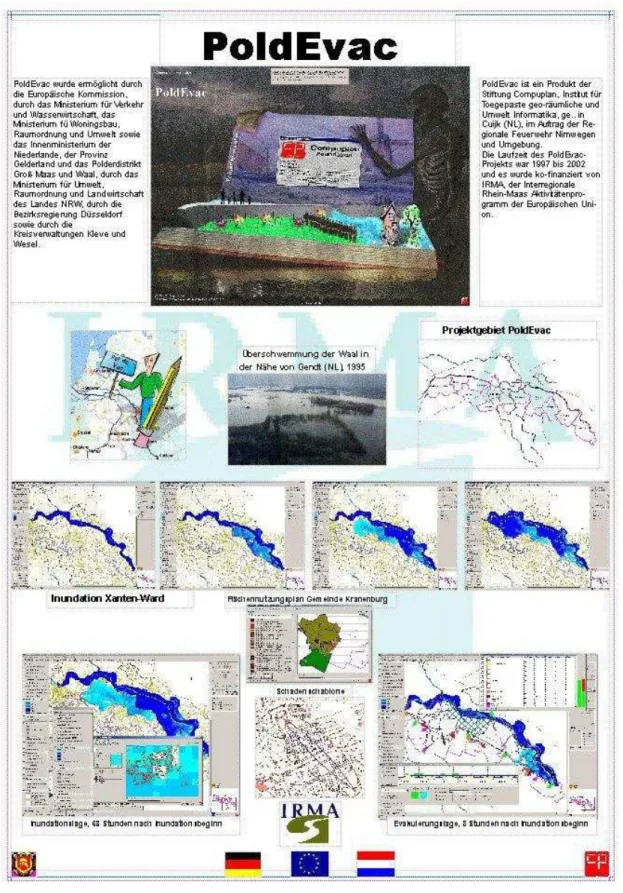
Figure 1: Overview of a flood, time-tempo inundation film and evacuation, using the PoldEvac system, applied to the Dutch-German cross-bordering Duffelt region,
245
2. Inundation/flood module concerns the visualization of a simulated flood process in case of a dike breach and a consequent polder inundation, that is, where and when, fixed in „time-tempo‟ flood films. Flood films are inundation scenarios, simulated for locations along the Rhine, Waal and Meuse rivers (see figure 1). Insight into the consequences of a polder inundation showed to be crucial support to decision making. Various scenarios showed that the flood process may last for a substantial time, while the path of the flood is not per se straightforward, due to elevation and barriers in the landscape.
3. Evacuation module calculates the departure of people, animals and others in case of flood risk. The pro-active as well as operational traffic calculations are based on a concept of leaving the inundation area with dry feet. The used road network consists of large scale geo-objects, with all necessary data for evacuation calculations. The evacuation process is steered with the aid of the flood films. The executed evacuation simulations, beyond limited evacuation as a preventive precaution, showed remarkable outcomes, requiring decision making and intervention. A striking example concerned an inundation which caused a full closure of a part of the polder area, because its entrance/exit roads were blocked due to early flooding.
4. Traffic and transport network module is for the road data handling to prepare the evacuation module calculations. This module contains also a traffic circulation monitoring tool which is relevant in pro-active and repression/response phases. This tool follows operationally the dynamics of traffic loads. It registers possible accidents, disconnects road segments with an accident from the evacuation roads network and recalculates an optimal departure of vehicles out of the inundation area. Within the PoldEvac application it highlighted network bottlenecks necessitating adaptation of some pre-selected evacuation networks. Moreover, the module includes a special tool for the disaster fighters, that is, save navigation and in case needed a (safe) re-routing. This tool showed to be relevant in cases of accidents with hazardous chemical substances.
5. Module concerning hazardous chemical accidents simulates the possible emissions and explosions. It uses geographically large-scale object‟s attribute data containing storage information (e.g., SIRA, Soveto II). The module connects with some (marketed) chemical substances databases which explain the details of the substances. Simulated accidents with certain chemicals raised awareness on the sometimes extensive areal effects of emission and/or explosion. That information is of course crucial for operational disaster reduction workers. Once the huge amount of objects with hazardous substances present in the polder areas were displayed in a map, it underlined the position that a possible disaster never comes alone. Moreover, during a flood disaster, such substances will most probably also cause environmental damages.
6. Fire fighting module contains primarily information needed during the repression phase of a fire, also seen as a possible companion of another occurring (flood) disaster. The information regards special objects, sirens, extinguisher water resources and hydrant locations, sewerage network and discharge opportunities, and an option for a direct incident locator connected to the control-switch room of the regional fire brigade/safety organization.
In the PoldEvac application, the sewage network data provided information about where to close certain sewage trunks to avoid flood water pushing sewage water run-off into the elevated living quarters.
7. Land use plan module concerns an initial step towards digital availability of land use (plan) information. The module (see example in figure 2) includes digital data regarding the so-called detailed land use plans, planning measurement tools such as distance measurement, circle representations, etc., and design tools to be seen as an optional issue.
246
Figure 2: Land use plans for all municipalities in the Maas & Waal Polder, displayed in an aggregated way defined by the Province of Gelderland
Within the context of Europe, there is a growing need to present flood maps in various languages, and the usage of uniform approaches in flood (risk) assessments, map legend and presentation [1]. The PoldEvac system directly caters for this demand. On-line, three languages are available: Dutch, German and English; in the case of UrbFlood, both an English and a Thai user interface is included.
But cross-bordering there is another relevant (communication) issue that requires harmonization through the software, notably the differing coordinate systems in use. PoldEvac handles and displays the Dutch Triangle (RD) and the German Gauss-Krüger coordinate systems simultaneously. The same is true with regard to the Dutch and German cadastral systems, land use plans and hazardous chemical substances. Integration concerns not only the modular sub-parts but also and even more important the contents (as far as relevant).
b. Urban flooding in Sena, Thailand
In the PoldEvac project, the spatial planning module was primarily limited to a digital provision of land use information fixed in plans, available for decision support. However, the link between inundation and land use plan design concerning locations between and along polder dikes that required intervention to reduce risks was still absent.
Although at that moment not assuming the relevance of it, in another project, performed for scientific reasons and to fill that gap, integration between inundation and land use planning was subject of study from the start of the project.
This project, under the European Commission‟s EuropeAid AsiaUrbs programme, is called “Augilath”, embracing
property valuation and taxation, land use planning, and flood management, executed in a framework of decentralization. One of the included municipalities is Sena, located in Ayutthaya province [14].
Two software programs have been conceptualized, taking Thai circumstances into account, and produced. The flood
program is called “UrbFlood”, urban flooding management (see figure 3), and the spatial planning program is called
247
Figure 3: UrbFlood applied to Sena municipality: screen images, showing clockwise respectively water levels in Maenam Noi at sluice location), Sena topography with contour lines, air photo with high water in surrounding river
248
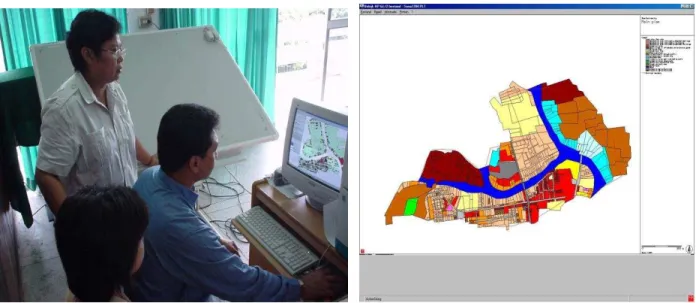
Figure 4: Local land use plan design with the aid of LPD, at the left hand side a hands-on design effort, at the right hand side, LPD application result to Sena municipality
The unexpected event that happened during the course of the project, in October 2001, visible in the chart in the previous figure concerned a top peak in the water level of the Maenam Noi, the river branch that cuts through the urban area of Sena municipality.
From (GPS) height data contour lines for the area are calculated. These contour lines are applied in the flood simulations in UrbFlood to investigate flood areal extensions in combination with several raised water levels in the river.
As such, the outcomes are comparable with flood hazard (risk) maps. UrbFlood is, moreover, of interest through its
search of „break-even‟ lines in the urban territory, where the costs of civil engineering works would be minimized while flood protection is maximized. This applied to existing roads in particular.
With the aid of LPD, a local land use plan has been designed, using the outcomes of the UrbFlood simulations, aware of break-even lines in the urban territory, after improvement (e.g., elevation) to be used as possible protection barriers.
c. Internet/website flood model accessibility
Professionals and general public, nowadays, want easy access to information in general, and to (flood and evacuation) disaster information in particular. Access should be preferably available and accessible through internet and/or website.
That demand may be motivated as information demand to know and to be prepared; this applies to e.g., PoldEvac scenarios.
Moreover, internet and website offer excellent opportunities for remote, distance learning; this applies to (less
249
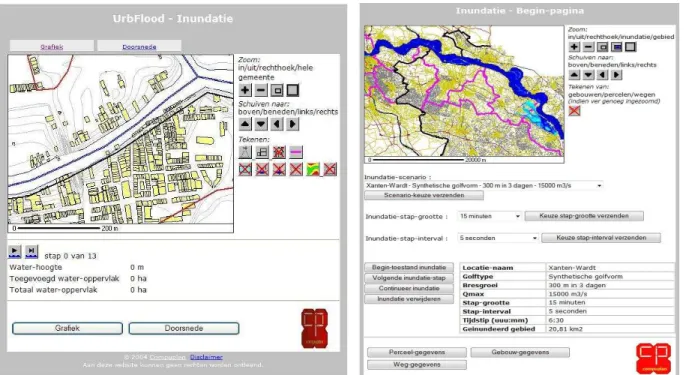
Figure 5: Two examples of interactive inundation software through web site application, left hand side: UrbFloodWeb showing stage 0, in-zoomed urban area of Sena, some directly at risk ‘illegal’ occupancies of the river side (buildings on poles) are visible, and, right hand side: PoldEvacWeb, showing one of the 36 scenarios, in
combination with flood parameters, inundation started near Xanten in Kreis Wesel
Particularly in case of PoldEvac, on-line, web access to inundation and evacuation simulations allows choice making concerning:
Breach location
Breach parameters and scenario
Step-wise display of progress of flood and evacuation process Detail study of object data concerning risk and vulnerability
Building awareness of the time-tempo and areal course of these processes
Distinguished accessibility to data for professionals and public in general.
For both systems, PoldEvac and UrbFlood, website applications are available (see figure 5), showing mainlines of the applications, interactively, time-tempo, using the full project‟s geo- and attribute databases and simulations as well.
3. RESULTS AND DISCUSSION 3.1. Results
PoldEvac (see figure 1) is a cross-bordering system applied to 9 Dutch polder municipalities (Beuningen, Druten, Groesbeek, Heumen, Maas en Waal, Millingen aan de Rijn, Nijmegen, Ubbergen and Wijchen) and 3 German municipalities (Kleve and Kranenburg in Kreis Kleve, and Xanten in Kreis Wesel). Within the PoldEvac project, 68 inundation scenarios were computed for 12 breach locations along Rhine, Waal and Meuse, and differentiated according to breach growth and wave type. The time-tempo inundation simulations are produced with the aid of DelftFLS [19]. Floods are simulated as worst cases. Furthermore, this module includes a wide variety of information producing options such as water level, depth, involved population, specially built objects with regard to elderly, health care, hospitals, properties, height and number of floors in buildings, land uses, affected roads.
250
shortest time/distance (road network related) areas calculated out of the available exit location of the polder evacuation area.
Evacuation road network with connected exit locations.
Municipal or sub-area assignments to the specified evacuation network.
Evacuation movement processes on the evacuation road network in direct connection with time-tempo inundation scenarios as fixed in flood films.
Evacuation based upon a dry-feet leave approach.
Capacity oriented approach for the evacuation process across the evacuation road network.
Traffic flow monitor for the handling of (temporary) traffic barriers caused by e.g., accidents and the ascertainment of a consequent re-evacuation flow pattern.
The resulting maps provide information on areas to be evacuated for preventive reasons, areas to be evacuated in case of an occurring dike breach and consequent inundation, time-tempo warning stages, evacuation routes, polder exit opportunities where evacuees are collected for further instructions (e.g., emergency measures, sheltering, registration). Possible evacuation routes are calculated and examples are visible through the internet (see hereafter in section remote, distance learning).
The governments of countries within the European Union, aware of the problems since 1993 (and more in particularly since 1995: Rhine and Meuse floods), and since 1999 (Rhone and Elbe floods) are aware that historical reasons are also responsible for high flood risks. They published policy reports in which they argued that the rivers should get back space as much as possible. This space should reduce the high water levels, particularly during rainy and post-winter (melting) periods.
For that reason, the German government assigned extensive areas for retention to temporarily keep and store huge
water volumes in countryside‟s low-population-density areas.
The Dutch government through its Project organization Room for the River [25], in its Spatial Planning Key Decision Room for the River policy report, combined various measures including deepening, shifting so-called summer-dikes, taking away artificial river flow corrections giving back a part of the curvature of historical streaming path, shifting, strengthening and heightening the so-called winter-dikes, assigning retention basins for temporary storage of the high level river water (even by breaking protection barriers when required), and adapting and updating its spatial, specific plans to avoid occupancies adjacent to and in the river embankments.
Flood disasters are therefore no longer seen as an exclusive field of technicians and civil engineers anymore. Studying inundation problems in Europe along Rhine and Meuse makes clear that current flood risks are historically born as an outcome of human preference to habitat near water (to harvest fish, for trading and travel) and spatial (urban and regional) planning to optimize socio-economic land use.
A historical overview of development and applications of disaster management is of scientific interest. Moreover, a difference of approach can be observed. Safety maps are static representations of possible dangers in case of calamities. A geo-spatial information and decision support system approach provides better opportunities, under actual circumstances to adapt interactively (e.g., intervention on system parameters and current event data) and to produce more adequate information. The development and performances of such models highlight conceptual progress, making increasingly use of available advanced (geo-) technological development information.
There is a rather strong link between flood management, SC connected decision support and policy making through the outcomes of the geo-informatics approach. In 1993 and in 1995 river flood management in the Netherlands was de facto repression only, a response to fight a suddenly occurring flooding. There was little policy making, decision makers were insufficiently prepared, managerially as well as operationally. As a consequence of the two flood events, responses included:
A drastic policy change and intervention (e.g., Room for the river programme, improving and strengthening of river dikes)
Serious interest for geo-informatics modeling, applications and information dissemination to support flood management and decision making
Preparation and implementation of physical plans with various technical solutions Large scale exercises for professionals
Production and web site accessibility of flood risk maps.
251
the inundation progress can be followed in connection with raising water level of the river branches that run through the municipality. Based upon the UrbFlood outcomes, Sena implemented a flood barrier along the urbanized area adjacent to the river, simultaneously useful when walking and sightseeing.
3,2. Discussion
From a safety perspective, a scientific discussion is relevant about preferences and where to put emphasis upon.
Emphasis could be a matter of both development, quality of system‟s application outcomes, and information
delivery and communication towards involved professionals and civilians. Seeing the recent stronger climate change than ever before [9] there is obvious reason to pay special attention to these matters. Moreover, safety, as risk perception, is experienced differently across the world. Flood risk is seen worldwide as the largest threat [5]. Nevertheless, it is recognized that between countries the officially implied flood protection levels differ. That is a chance, a safety statement, assuming a flood occurrence once in a certain period of years, or a flood return period on average. In some cases the protection level can really be judged as too low, taken into account that huge human and economic consequences are at stake, e.g. in case of an about 10 million inhabitants counting metropolitan city such as Bangkok [18]. Four examples underline that judgement, notably: Netherlands densely populated Randstad‟s
coastal zone 1: 10,000 , Viet Nam Hanoi 1: 250, London 1: 1,000 and Thailand‟s Bangkok Metropolitan Area 1: 100.
From (Dutch) government side [10], safety maps are explained in at least two ways, notably: (1) kind of relational information provided, and (2) target group addressed. The following forms of information are discussed: potential flood area, flood barrier failure chance, inundation progress in case of a failure according to worst case considerations, flood effects, flood risk (result of chance times effects), insurance, and evacuation advices. For several disasters, risk maps are produced and accessible, mainly through provincial websites. Target groups are both professionals and general public (inhabitants, industries).
A comparable way of working is found in the Excimap handbook on flood mapping in Europe [11]. In one of its directives in 2004, the European Commission dictates the production of flood maps to be ready in each member state prior to 2014, and consequent flood risk management plans prior to 2016.
The availability of flood risk maps is of course crucial for understanding, awareness and overall managerial decision making. Nevertheless, as said earlier, they are too static for adequate decision making through all stages of the SC, a problem that is more serious under operational circumstances. Furthermore, they are subject to considerations such as not showing everything (e.g. to reduce risks of terror) unto keeping the information secret [12] which at least limits their professional quality to disaster managers and fighters.
Interactive and more integrated approaches, as described, assumed that data is adequate and updated on time, do not have that disadvantage.
An interactive approach is more effective. A static map shows primarily the extent of the inundation area, with or without flood depths. A (obviously more) integrative approach such as PoldEvac, offers various user interactive opportunities within inundation and evacuation modules, such as:
Indication of the breach location (connected with nearest scenarios set) Specification of breach moment
Scenario choice (according to parameters)
Progress of inundation and evacuation is clock-connected (continuous) Interruption of the progress is possible at any moment (for detail study)
Intervention in the evacuation traffic circulation network in case of monitored blockage due to a traffic accident
Access to underlying attribute data of objects (buildings, land parcels, road segments) Variation of map layers displayed, with data integration
Mix of vector and grid map information.
The way of modeling in PoldEvac offers a potential role for real-time applications. Moreover, because the progress in the flood films is expressed in 1 sq. km grids, a nearest breach scenario offers directly a useful estimation of the inundation course. Pre-modeling through PoldEvac is particularly relevant in the pro-active phase, such as learning about the consequences and constraints. In some cases it shows that early effects of the flood limits certain evacuation possibilities, e.g., disconnection of the only exit roads.
252
information, accessible through internet. Moreover, an evacuation module is added. This module concerns a so-called origin-destination transport, applied to a small-scale transportation network, using zones or settlements as departure origins. Under operational circumstances, however, this module is not applicable to the required traffic progress monitoring.
Evaluations of various flooding and evacuation systems, developed and applied under successive European Interreg programmes in the period 1995-2007, show a continued demand for integrative and comprehensive disaster management in general and flooding and evacuation management in particular. To meet the recognized demands of decision makers involved in (flood) disaster management, a new initiative called “RIP”, was proposed recently [16]. RIP is an acronym for „Revival of an Integrative system approach for Polder flood disaster & evacuation management‟, relevant to both managerial and operational flood disaster decision making. Relevance of integration comes to the fore in many urban circumstances. An example is the Dordrecht Urban Flood Management project where the planning of houses in new residential areas are flood-prove designed, an integration of flood risk prevention and city architecture [24]. In other cases the Law on Water Levees, can substantially contribute to reduction of flood risk and enhance safety, notably through a prohibition of building constructions in flood protected zones [6].
An integrated comprehensive approach placed in a framework of SC can also contribute to a necessary strategy to disaster risk reduction. Therefore changes are necessary [21]. Prior to disasters, attention should be paid to areas where risk reduction investments have the largest impact (such as the break-even lines in the Sena UrbFlood application).
In the coming years, the UrbFlood concept will be a stepping-stone towards IULWP, integrated urban land and water planning, a decentralized flood protection management approach applied to a selection of Thai municipalities [17]. IULWP concerns a cooperation between Thai and Dutch organizations and knowledge institutes. The intention of IULWP is the conceptualization of an application model as a later-on provision to other municipalities, with emphasis upon pro-action and integration.
Flood protection in Thailand is primarily a matter of the central government now. The central government‟s departments responsible for flood protection follow the safety cycle approach (prevention, preparation, repression, after care/reconstruction) but do not include a pro-active phase. The currently executed decentralization offers a challenge to local authorities, to take pro-actively the lead, taking the responsibility to protect its own territory at short term, for reasons of sustainability focusing particularly upon no-regret measures. In that light, the IULWP decentralized model development is seen as a necessity.
Beyond elevation related interventions, attention paid to river adaptation and land use planning are (amongst others) essential in order to identify changes that could substantially reduce future risk. Also there is good reason to pay extra attention to planning in general as it directs (or could direct) decision making pro-actively in terms of protection level and the time horizon to be considered. In that sense, planning in general prepares the necessary interventions and therewith a sustainable flood protection in the long run.
4. CONCLUSIONS
A lot of experience and expertise has been gained in the field of (flood) disaster management in the previous two decades, both on national and regional, including transnational and cross-bordering levels. This is particularly true for computer aided system approaches to be available to support decision makers under conditions of disaster risks. This is also true for the systems explained in this paper, theoretically as fixed in concepts and applied (pro-actively). Practically, still, lots of efforts are required to mature these systems with the purpose to guarantee the quality of results (e.g., continuous updated and reliable data), applicability under various disaster (risk) circumstances (e.g., SC phases, control room, moving disaster fighting vehicles), response effectiveness (e.g., durable order on evacuation network, sufficient guidance of disaster area leaving transport, people, cattle, etc., sufficient coordination and tuning), and adaptation strength (e.g., durability and flexibility of response and after care measures applied).
253 5. ACKNOWLEDGEMENTS
Research, development of tools and applications have been (co-)funded through Ministry of Water Management in the Netherlands (Technical Commission of Water Protection), European Commission (DG Regional Development, Interreg programme; DG External Relations, EuropeAid), directly or indirectly.
The software modules mentioned are products of Compuplan Knowledge Institute of Applied geo- Informatics (CKI), Cuijk, the Netherlands (www.compuplan.nl). Mentioned distance learning tools are accessible through its website.
6. REFERENCES
[1]. Alphen, J. van, F. Martini , R. Loat , R. Slomp and R. Passchier 2009. Flood Risk Mapping in Europe, experiences and best practices. Journal of Flood Risk Management (2009 accepted paper), 1-10.
[2]. Bruin (1989), M. de, and, G. Pepping: Zeespiegelstijging, working paper, Dept. of Regional Economics, Free University of Amsterdam.
[3]. CKI, 1993. WCOAST, a geographical information and decision support system for coastal zone research and management. In: Misdorp, R., T. van Heuvel, B. Mieremet and R. Klein. CZM Toolbox. Tools and applications for Coastal Zone Management. International Conference on Coastal Zone Management , International Coastal Zone Management Centre/Ministry of Transport, Public Works and Water Management, Noordwijkerhout, 1993, 37-49.
[4]. Alphen, J. and R. Passchier (eds.), 2007. Atlas of Flood Maps. Examples of 19 European countries, USA and Japan. EXCIMAP, European Exchange Circle on Flood Mapping
[5]. Dykstra, E.H., 2007. Risk!! “Oh, no! Oh, my! Oh, dear! Oh, well…”. Ministry of Interior, the Netherlands.
Nieuwsbrief Crisisbeheersing, 5 (3), 18-21.
[6]. Feunekes, J.J., and H.G.O. Hinderink, 2008. Ruimte voor robuuste waterkeringen. Het Waterschap. Tijdschrift voor Waterschapbestuur en Waterschapsbeheer. (12) , 26.
[7]. IPCC, 1991. The seven steps to the Assessment of the vulnerability of coastal areas to sea level rise. A common methodology, Intergovernmental Panel on Climate Change, Response strategies Working group, Advisory Groupon Assessing vulnerability to sea level rise and coastal zone management, September 1991, revision no. 1.
[8]. IPCC, 1992. Global climate change and the rising challenge of the sea, Intergovernmental Panel on Climate Change, Response Strategies working group, Report of Coastal zone management Subgroup.
[9]. IPCC, 2007. Climate Change Impacts, Adaptation and Vulnerability, fourth assessment report.
[10]. IPO, Department of Water Management and Ministry of Interior of the Netherlands, 2007. Overstromingsrisicokaarten, brochure, The Hague.
[11]. Martini, F. and R. Loat 2007. Handbook on good practices for flood management in Europe. Emmeloord. [12]. Meulen, B. van der, 2007. Openbaarheid en veiligheid in de Algemene wet overheidsinformatie. Ministry of
Interior, the Netherlands. Nieuwsbrief Crisisbeheersing, 5 (3), 8-9.
[13]. Meulen, G.G. van der, 1995. Applied spatial and environmental informatics, a handbook on advanced methods and techniques for spatial and environmental planning, problem solving, and decision making. HSD Manual No.9, publication of the Asian Institute of Technology, Human Settlements Development Programme, School ofEnvironment, Resources and Development, Bangkok..
[14]. Meulen, G.G. van der, (ed.), 2003. AUGILATH. Asia Urbs Geo-Informatics for Local Authorities in Thailand, Conference Proceedings, 12 December 2002, Bangkok, isbn 90-5287-007-1.
[15]. Meulen, G.G. van der, 2005. PoldEvac: A case study on Polder Inundation and Evacuation Modelling in a Flood Prone Area near the Border of Germany and the Netherlands. In: J. van Duivendijk: Manual on Planning of Structural Approaches to Flood Management”, ICID-CIID, International Commission on Irrigation and Drainage, 102-113.
[16]. Meulen, G.G. van der, 2008. RIP, Revival of an Integrative system approach for Polder flood disaster & evacuation management. In: Freude am Fluß, Conference proceedings, Radboud University, Nijmegen, 22-24 October 2008, internet (www.ru.nl).
[17]. Meulen, G. van der, 2011. Integrated Urban Land & Water Plans, decentralized flood protection approach for municipalities in Thailand. Provisional project report. CKI, Cuijk.
[18]. Meulen, G. van der, R. Klomp, J. Dijkman, A. Mynett and L. Janssen, 2011. Thai delta and coastal zone management. Final report of the Water Identification mission from the Netherlandfs in Thailand, 4-12 February2011, Netherlands Water Partnership, The Hague.
254
[20]. Moel de, H., J. Van Alphen, and J.C.J.H Aerts, 2009. Flood maps in Europe, methods, availability and use. In: Natural Hazards Earth Systems Sciences, (9), 289-301..
[21]. Moench, M. and S. Stapleton, 2007. Water climate, Risk and Adaption. In: Co-operative Programme on Water and Climate. Working paper 01
[22]. Moody, R., 2008. Water in stroomversnelling op de agenda. HIS en FLIWAS. In: Gis Magazine, (4), 8-9. [23]. Nijkamp, P., 1991. Climate change, sea level rise and Dutch defense strategies, paper presented at Pacific
Regional Science Conference (PRESCO), Cairns, July 1991.
[24]. Prinsen, M., 2008. Dordrecht neemt overstromingsrisico mee in stedebouwkundig plan. Praktijkproject, in: Urban Flood Management. 21-23.
[25]. Projectorganisation Room for the River, 2007. National Programme Room for the River. Integrated Flood Alleviation Measures in The Netherlands, The Hague.
[26]. UNDRO, 1991. Mitigation natural disasters. Phenomena, effects and options. A manual for policy makers and planners. Geneva.