www.adv-radio-sci.net/8/43/2010/ doi:10.5194/ars-8-43-2010
© Author(s) 2010. CC Attribution 3.0 License.
Radio Science
Phaseless spherical near-field antenna measurements for low and
medium gain antennas
C. H. Schmidt1,2, S. F. Razavi1, T. F. Eibert2, and Y. Rahmat-Samii1
1Department of Electrical Engineering, University of California, Los Angeles, USA 2Lehrstuhl f¨ur Hochfrequenztechnik, Technische Universit¨at M¨unchen, Germany
Abstract.The characterisation of antenna radiation patterns by measurements in the near-field and a following near-field far-field transformation require accurate amplitude and phase data. Especially at higher frequencies phase measurements are demanding in terms of instrumentation and measurement accuracy. Phaseless techniques which require amplitude only data on one or more measurement surfaces are therefore of special interest. In this paper a phaseless spherical algorithm based on spherical modal expansion is presented. The algo-rithm works with amplitude only near-field data measured on two spheres of different radii and is therefore not restricted to certain types of antennas as for planar measurements for example. Simulated as well as measured results of low and medium gain antennas are shown.
1 Introduction
The radiation characteristic of an antenna under test (AUT) is typically defined at far-field distance and is therefore to be measured in the far-field region of the AUT. Two com-mon alternatives to direct measurements in the far-field are compact range measurements (Balanis, 2008) which emulate far-field conditions at close distance to the AUT and secondly near-field measurement techniques. The far-field of an AUT consists of the same modes as the near-field. Therefore it is possible to determine performance of the AUT from a mea-surement in the radiating near-field. The field modes are de-termined and processed to the far-field by a post-processing near-field far-field transformation (Yaghjian, 1986). Espe-cially for electrically large AUTs which satisfy far-field con-ditions at a far distance (≈2D2/λ,Dbeing the diameter of the minimum sphere enclosing the AUT and λ the wave-length), near-field measurements can be carried out much
Correspondence to:C. H. Schmidt ([email protected])
closer to the AUT in relatively small sized measurement fa-cilities.
A critical requirement for the near-field far-field transfor-mation is the accurate knowledge of the near-fields ampli-tude and phase. Ampliampli-tude measurements are less critical in terms of measurement equipment and accuracy compared to phase measurements, even for high frequencies. This is why phaseless measurement techniques (Yaccarino and Rahmat-Samii, 1999; Pierri et al., 1999; Las-Heras and Sarkar, 2002; Costanzo et al., 2005; Soldovieri et al., 2005; Schejball et al., 2008) have obtained considerable interest in research. Costly vector network analysers are no longer required for phase measurements and also phaseless techniques show some su-perior robustness for some classes of errors (Razavi and Rahmat-Samii, 2008). The lack of phase information is often compensated either by further amplitude only measurements on additional surfaces or by measurements with additional probes. The Iterative Fourier Technique (IFT) (Razavi and Rahmat-Samii, 2006) is known from planar phaseless mea-surements and requires amplitude only meamea-surements on two planes. Planar measurement techniques (Kerns, 1981) rely on the finite sized scan plane in front of the AUT and are therefore only suitable for highly directive antennas.
A more common approach for the measurement of medium and low gain antennas is the spherical measure-ment technique (Hansen, 1988), where the radiated fields of the AUT over a sphere are recorded and the radiation in backward direction is also considered. To utilise the advan-tages of phaseless measurements, a phaseless spherical trans-formation algorithm based on a spherical modal expansion has been presented (Schmidt and Rahmat-Samii, 2009) and applied to a low gain patch antenna. The algorithm is par-ticularly suitable for low as well as medium gain antennas and utilises measured amplitude only near-field data on two spheres. A modal expansion representing the radiation char-acteristic of the AUT is obtained in an iterative manner with some similarities to the IFT.
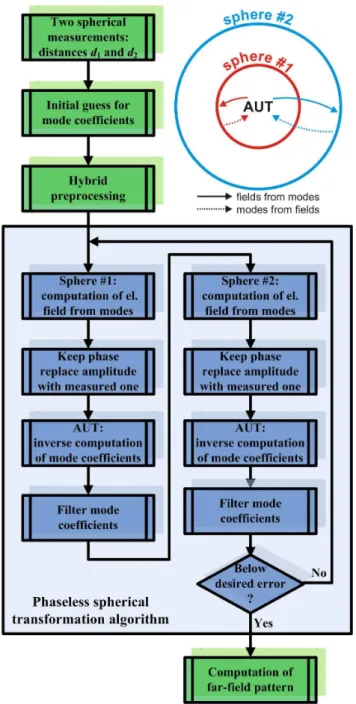
Fig. 1. Flowchart of phaseless spherical transformation algorithm working with amplitude only data on two spheres.
gain antenna measurements. In Sect. 2 a brief fundamen-tal background of spherical near-field measurements is given whereas Sect. 3 introduces the phaseless spherical algorithm. Section 4 shows measured results of a low gain patch antenna and considers simulated near-field scenarios of a medium gain horn antenna. Characteristics of medium gain anten-nas within the phaseless spherical algorithm are addressed considering the example of a simulated Narda standard gain horn.
N=
πD
λ
+10 (2)
depending on the electrical size of the AUTD/λ(Balanis, 2008).
{Q} =[C]−1· {E} (3)
are obtained by inverse solution of the field problem. [C]is the coupling matrix, containing discrete values of the spheri-cal modes for discrete measurement points.{E}is the vector containing the amplitude and phase near-field values mea-sured on a sphere. Once the mode expansion coefficients are known, the desired far-field pattern can be computed us-ing asymptotic expressions for the spherical modes (Hansen, 1988).
In general a probe correction is required to compensate for the field probe effects on a near-field measurement. For spherical measurements and in particular if the probe is not too close to the AUT, probe effects might be sufficiently small and might even be neglected (Hindman and Fooshe, 1998). Therefore the presented phaseless spherical algo-rithm neglects the probe correction for simplicity. Nev-ertheless it is possible to adapt the technique to one of the several probe corrected spherical near-field algorithms, e.g. Hansen (1988); Laitinen et al. (2005); Laitinen and Breinbjerg (2008); Leibfritz and Landstorfer (2006).
3 Phaseless spherical algorithm
The phaseless spherical algorithm determines a modal ex-pansion of the AUT fields from amplitude only near-field measurements on two spheres. The individual steps are shown in the flowchart in Fig. 1. The algorithm starts with an initial guess for the mode expansion coefficients
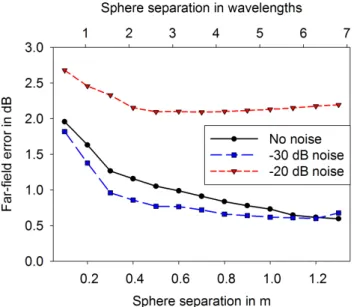
Fig. 2.Deviation of far-field pattern obtained by phaseless spherical algorithm from MoM reference pattern, unweighted average of all points on the sphere (step size 1◦inϑandϕ). Near-field data with and without noise considered.
the first sphere is retained while the field amplitude is re-placed by the measured amplitudeEm1 resulting inE1mp . A new set of mode coefficients{Q}is computed from
E1mp according to Eq. (3). The same procedure is repeated for the second measurement sphere. During the iterations the error norm
ǫ= S P
i=1 r E p ϕ,i 2 + E p ϑ,i 2 − r E m ϕ,i 2 + E m ϑ,i 2!2 S P
i=1
E m ϕ,i 2 + E m ϑ,i
2 (4)
of the total field amplitude on the first measurement sphere is monitored as convergence metric. The subscriptsϕ und ϑ denote the two polarisation components of the measured near-fields andSis the total number of near-field samples on the sphere.
The mode expansion coefficients of an AUT are known to decrease rapidly. Filtering the higher order mode expan-sion coefficients and setting them to zero during the itera-tions helps the algorithm to find a modal expansion of the AUT, which incorporates this behaviour. So undesired rapid oscillations in the far-field pattern can be reduced. An appro-priate filter indexifilteris obtained by a hybrid preprocessing method (Razavi and Rahmat-Samii, 2006) which evaluates the main algorithm for a few iterations and various filter in-dices.ifilteris chosen to minimise the error normǫ.
An important parameter of the phaseless spherical algo-rithm is the separation of the measurement spheres. The lack of phase information in the transformation is overcomed by
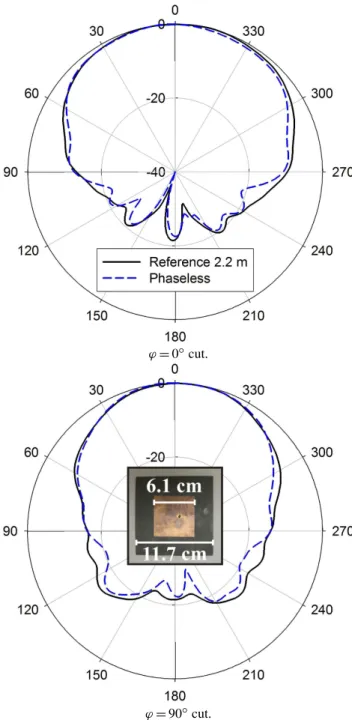
Fig. 3. Measurement setup inside the spherical near-field cham-ber at the Electrical Engineering Department, UCLA, with patch antenna as AUT measured at 1.57 GHz and open ended waveguide probe.
additional amplitude information. Therefore it is required, that the measured amplitude pattern on the second sphere contains additional field information. This can be achieved by placing the first measurement sphere close to the AUT and the second sphere with a preferable high separation to the first one. To evaluate the minimum required sphere separa-tion, a patch antenna (as shown in Sect. 4.1) is considered and electric field values are simulated for various sphere separa-tions using the field simulator FEKO (http://www.feko.info). For the phaseless spherical algorithm, the first sphere re-mains constant whereas the radius of the second sphere is further increased. Figure 2 shows the deviation from the method of moments (MoM) reference far-field pattern, av-eraged over all points in the pattern. Also transformations have been carried out with additive noise added to the ampli-tude only near-field data. A high sphere separation is prefer-able in order to gain further field information on the second sphere with increasing measurement distance. According to this simplified analysis, a minimum sphere separation of at least two wavelengths is recommended.
4 Results
4.1 Patch antenna measurement
ϕ=0◦cut.
ϕ=90◦cut.
Fig. 4. Comparison of patch antenna far-field patterns obtained by phaseless spherical algorithm from amplitude only data on two spheres with NSI reference pattern obtained from amplitude and phase data on a single sphere.
to Eq. (3) for the amplitude only data
E2m measured on the second sphere. In order to have a reference, amplitude and phase have been measured and the far-field pattern has been computed with the NSI2000 software. Figure 4 shows the far-field pattern obtained by the phaseless spherical algo-rithm together with the NSI reference in the principal cuts. The patterns show an acceptable agreement to the reference if one keeps in mind that accurate amplitude and phase
mea-Fig. 5. Simulated near-field phase of horn antenna on sphere of radius 1.75 m.
Fig. 6.Near-field phase of electric/magnetic aperture current distri-bution on sphere of radius 1.75 m, used to compute the initial guess together with simulated/measured amplitude on second sphere.
surements usually give more accurate results due to the com-plete description of the fields also by phase information.
During the measurement, the AUT positioner moves be-tween AUT and probe while measuring the radiation in back-ward direction. This should be considered when evaluating measured patterns in backward direction of the AUT.
4.2 Horn antenna simulation
ϕ=0◦cut.
ϕ=90◦cut.
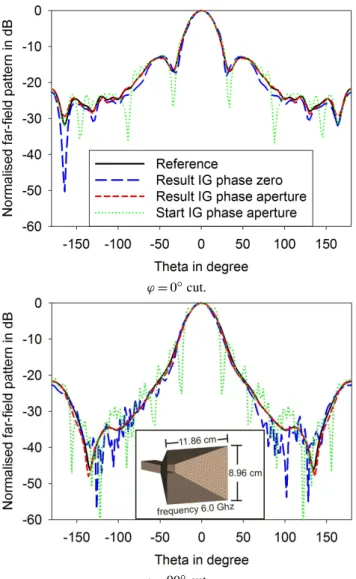
Fig. 7. Comparison of horn antenna far-field patterns obtained by phaseless spherical algorithm from amplitude only data on two spheres with MoM reference pattern.
The initial guess for the mode expansion coefficients is ob-tained from the amplitude only data on the second sphere (re-ferred to as “result IG phase zero” in the figures). The sec-ond initial guess computes the field distribution of an elec-tric/magnetic current distribution in the aperture of the horn. A uniform amplitude and phase distribution is assumed for the currents. The obtained phase on the second measure-ment sphere together with the simulated/measured amplitude is used to compute the initial guess (referred to as “result IG phase aperture” in the figures). Figure 5 shows the phase of the horn antenna on the second measurement sphere, whereas Fig. 6 shows the phase of the aperture current distribution. The aperture phase shows already close agreement with the real phase and so it is suited to compute the initial guess. The far-field pattern obtained by the phaseless spherical al-gorithm is shown in Fig. 7 in the principal cuts. The pattern
Fig. 8. Error normǫof field amplitude error on first measurement sphere for phaseless spherical algorithm utilising simulated ampli-tude only near-field values on two spheres.
obtained by the second initial guess shows a much better per-formance than the first one. The green dotted curve shows the far-field pattern computed from the initial guessQIG employing the aperture phase distribution and demonstrates, how the far-field pattern is finally retrieved from the initial guess by the phaseless spherical algorithm resulting in the red short dashed curve. The error normǫis plotted in Fig. 8 and shows a better performance for the initial guess employ-ing the aperture phase distribution. This was expected since more a priori information of the AUT, in form of a simplified but good approximation of the phase distribution, was used to generate the initial guess.
5 Conclusions
A phaseless spherical near-field transformation algorithm has been presented. The algorithm determines the far-field pat-tern of an antenna from two amplitude only measurements on spheres of different radii in an iterative manner. Due to the spherical measurement configuration, the algorithm is not re-stricted to a particular class of antennas. Two different initial guesses for the mode expansion coefficients as starting point for the algorithm have been considered and evaluated. Sim-ulated and measured results of a low gain patch antenna as well as a medium gain horn antenna have been presented, showing the applicability of the phaseless spherical algo-rithm for these types of antennas.
Acknowledgements. The authors are grateful to Shenheng Xu, Electrical Engineering Department UCLA, for fruitful discussions.
dards, Boulder CO, 1981.
Laitinen, T. and Breinbjerg, O.: A First/Third-Order Probe Correc-tion Technique for Spherical Near-Field Antenna Measurements Using Three Probe Orientations, IEEE Trans. Antennas Propag., 56(5), 1259–1268, 2008.
Laitinen, T., Pivnenko, S., and Breinbjerg, O.: Iterative Probe Cor-rection Technique for Spherical Near-Field Antenna Measure-ments, IEEE Antennas Wireless Propag. Lett., 4, 221–223, 2005. Las-Heras, F. and Sarkar, T.: A Direct Optimization Approach for Source Reconstruction and NF-FF Transformation Using Amplitude-Only Data, IEEE Trans. Antennas Propag., 50(4), 500–510, 2002.
teristics, IEEE Antenn. Propag. M., 50(5), 71–83, 2008. Schmidt, C. H. and Rahmat-Samii, Y.: Phaseless Spherical
Near-Field Antenna Measurements: Concept, Algorithm and Simula-tion, Proc. IEEE AP-S Int. Symp., Charleston, SC, 2009. Soldovieri, F., Liseno, A., D’Elia, G., and Pierri, R.: Global
Con-vergence of Phase Retrieval by Quadratic Approach, IEEE Trans. Antennas Propag., 53(10), 3135–3141, 2005.
Yaccarino, R. and Rahmat-Samii, Y.: Phaseless Bi-Polar Planar Near-Field Measurements and Diagnostics of Array Antennas, IEEE Trans. Antennas Propag., 47(3), 574–583, 1999.