Environmental Research Letters
EDITORIAL • OPEN ACCESS
The growing role of methane in anthropogenic
climate change
To cite this article: M Saunois et al 2016 Environ. Res. Lett.11 120207
View the article online for updates and enhancements.
Related content
Global wetland contribution to 2000–2012 atmospheric methane growth rate dynamics
Benjamin Poulter, Philippe Bousquet, Josep G Canadell et al.
-Enhanced response of global wetland methane emissions to the 2015–2016 El Niño-Southern Oscillation event Zhen Zhang, Niklaus E Zimmermann, Leonardo Calle et al.
-Are the impacts of land use on warming underestimated in climate policy? Natalie M Mahowald, Daniel S Ward, Scott C Doney et al.
-Recent citations
Including animal to plant protein shifts in climate change mitigation policy: a proposed three-step strategy Helen Harwatt
-Agricultural CH4 and N2O emissions of major economies: Consumption-vs. production-based perspectives Mengyao Han et al
-Methane and Global Environmental Change
Dave S. Reay et al
EDITORIAL
The growing role of methane in anthropogenic climate change
M Saunois1, R B Jackson2, P Bousquet1, B Poulter3and J G Canadell4
1 Laboratoire des Sciences du Climat et de l’Environnement, LSCE-IPSL(CEA-CNRS-UVSQ), Université Paris-Saclay, F-91191 Gif-sur-Yvette, France
2 Department of Earth System Science, Woods Institute for the Environment, and Precourt Institute for Energy, Stanford University, Stanford, CA 94305-2210, USA
3 Institute on Ecosystems and Department of Ecology, Montana State University, Bozeman, MT 59717, USA 4 Global Carbon Project, CSIRO Oceans and Atmosphere, Canberra, ACT 2601, Australia
E-mail:[email protected]
Abstract
Unlike CO
2, atmospheric methane concentrations are rising faster than at any time in the past two
decades and, since 2014, are now approaching the most greenhouse-gas-intensive scenarios. The
reasons for this renewed growth are still unclear, primarily because of uncertainties in the global
methane budget. New analysis suggests that the recent rapid rise in global methane concentrations is
predominantly biogenic-most likely from agriculture-with smaller contributions from fossil fuel use
and possibly wetlands. Additional attention is urgently needed to quantify and reduce methane
emissions. Methane mitigation offers rapid climate bene
fi
ts and economic, health and agricultural
co-bene
fi
ts that are highly complementary to CO
2mitigation.
Introduction
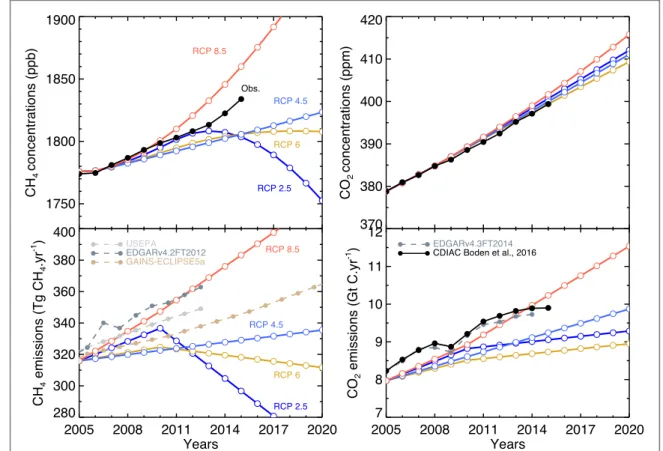
Atmospheric methane (CH4) has experienced puz-zling dynamics over the past 15 years. After a period of relative stagnation in the early 2000 s (+0.5± 3.1 ppb yr−1 increase on average for 2000–2006),
atmospheric methane concentrations have increased rapidly since 2007 at more than ten times this rate (+6.9±2.7 ppb yr−1 for 2007–2015;
figure 1
top left; Dlugokencky2016). The atmospheric growth rate of methane accelerated to+12.5 ppb in 2014 and+9.9 ppb in 2015, reaching an annual average concentration of 1834 ppb in 2015 (Dlugokencky
2016). Because of this acceleration, the evolution of atmospheric methane over the last three years is inconsistent with the mitigation required in the Representative Concentration Pathways(RCP)of 2.5, 4 and 6 W m−2and now most closely aligns with the
RCP 8.5 W m−2(
figure1top left) (Fujinoet al2006, Clarke et al 2007, Riahi et al 2007, van Vuuren et al 2007). This emerging dynamic highlights methane’s growing contribution to global warming relative to the observed slower growth rates of CO2over the past three years (Le Quéréet al2016, ESSD;figure 1 top right, Jackson et al 2016) and a relatively constant growth rate of nitrous oxide(N2O) (Hartmannet al2013).
The global methane budget
The balance of surface sources and sinks determines the global methane budget. Surface sources include methane originating from biogenic (wetlands, lakes, agriculture, waste/landfill, permafrost), thermogenic (fossil fuel usage and natural seeps), pyrogenic(biomass and biofuel burning)or mixed (hydrates, geological) sources. Dominant sinks include methane oxidation by the hydroxyl radical (OH)and other radicals in the atmosphere as well as methanotrophy in soils. Based on a new ensemble of atmospheric studies, global emis-sions are estimated at 559[540–568]Tg CH4.yr−1for
the 2003–2012 decade(Saunois et al2016). Tropical sources, including both natural and anthropogenic sources represent two-thirds of total global emissions and are dominated by emissions from wetlands (figure 2). Approximately two-thirds of global emis-sions are also attributable to anthropogenic activities, including those from both mid-latitudes and the tropics (e.g., agriculture and waste,figure2).
Changes in the methane budget since 2007
Despite substantial knowledge about the location, size and trends of methane sources and sinks, the relative
OPEN ACCESS
P UB L IS H ED
12 December 2016
Original content from this work may be used under the terms of theCreative Commons Attribution 3.0 licence.
Any further distribution of this work must maintain attribution to the author(s)and the title of the work, journal citation and DOI.
contributions explaining the recent atmospheric increase remain uncertain (e.g. Nisbet et al 2014,
2016). Based on activity data and emission factors from various anthropogenic sectors, bottom-up inventories of anthropogenic emissions estimate an increase of fossil-related emissions of 3–4 Tg each year since 2007(EPA2012; EDGAR2014). Using ethane measurements and methane-to-ethane ratios, Hauss-mannet al (2016)also suggest a substantial contrib-ution of fossil-related emissions (18%–73% of the total increase in atmospheric methane). 13CH4 iso-topic observations show a significant depletion of13C in the atmosphere(∼−0.12‰in seven years), suggest-ing that increases in methane emissions after 2006 are primarily biogenic and are more consistent with sources from agriculture than natural wetlands(Nisbet et al 2016; Schaefer et al 2016). Recent bottom-up inventories estimate an increase in agricultural annual emissions of 3–5 Tg between 2006 and 2012, mostly from Africa and Asia, whereas wetland emissions were estimated to be mostly unchanged between 2006 and 2012(Poulteret al2016). Meanwhile, biomass burning emissions decreased by 2–3 Tg yr−1between 2007 and
2013 compared to 2000 and 2006, although the recent El Niño conditions have lead to abnormally large peat
fires in Indonesia (Van der Werf et al 2016). Not
accounting for this long-term decrease in the 13 C-heavy methane source from biomass burning, and based on 13C atmospheric observations and on an enriched database for isotopic source signatures, Schwietzkeet al(2016)evenfind decreasing fossil fuel emissions since 2000, a different conclusion than reached in most other recent studies.
Sinks may also be playing a role in the rapid rise in atmospheric methane over the last decade(figure1). Using a chemistry-transport model run over 40 years, Dalsørenet al(2016)infer a stabilization of OH con-centrations after 2006, in contrast to a total 3% increase since the late 1990s(8% since the 1970s). Stabilized OH concentrations can increase methane lifetimes and may help explain the atmospheric methane increase as well, as a decrease of 1% in atmospheric OH concentrations is roughly equivalent to ∼5 Tg yr−1 of increased methane emissions(e.g. Saunoiset al2016).
These various factors notwithstanding, there is no consensus scenario of methane sources and sinks that explains the atmospheric increase since 2007(Kirschke et al2013). Recent evidence from atmospheric observa-tions suggests three main contributors for emission changes. Thefirst element is an increase in biogenic emissions, mostly from agriculture (13C compatible, Schaeferet al2016). The second is an increase of
fossil-Figure 1.Top: projections of atmospheric methane concentrations(left, ppb)and carbon dioxide concentrations(right, ppm)for the four Representative Concentration Pathway(RCP)scenarios and observed globally averaged atmospheric abundance at marine boundary layer sites from the NOAA network(black, Dlugockenky2016). Tropospheric concentrations from RCP models have been scaled tofit surface observations. Bottom: emissions of methane(left)and carbon dioxide(right)from anthropogenic sources. For methane, four harmonized RCP scenarios are plotted together with the EDGARv4.2FT2012, USEPA and GAINS-ECLIPSE5a inventories. For carbon dioxide, four harmonized RCP scenarios are plotted together with the recent EDGARv4.3FT2014, and CDIAC estimates for fossil and cement-production emissions. RCP concentration data are from Meinshausenet al(2011). Concentrations and emissions from RCP4.5 are above those of RCP6 before 2030.
2
related emissions(ethane-compatible, Haussmanet al
2016). The third is a decrease of biomass burning emis-sions (13C compatible and cancelling a fossil fuel increase, Van der Werfet al2016). The necessity of an anthropogenic emission increase can still be reduced by a possible stagnation of OH concentrations or by regio-nal contributions from wetland emissions, such as emis-sionsfluctuations resulting from drought conditions in South America(e.g., in 2010–2011; Bassoet al2016).
At the regional scale, methane emissions contribut-ing to the observed atmospheric increase since 2006 are most likely tropical, although some mid-latitude regions, such as China, also appear to contribute to the increase(e.g. Bergamaschiet al2013). To date, no sig-nificant contribution to the atmospheric increase from Arctic regions has been found, except in 2007 and attri-butable then to a relatively warm and late summer (Dlugokenckyet al2011). Contrary to a recent estimate based on three different atmospheric inversions (Turneret al2016), no trend in US methane emissions is found in the ensemble of inversions gathered in Sau-noiset al(2016), and thus a substantial contribution of US shale gas industry to the recent methane atmo-spheric increase seems unlikely(Bruhwileret al2016).
Strategies to reduce uncertainties on the
methane budget
Scientific breakthroughs are needed to predict methane emissions today and in the future, particularly with a
changing climate. First, annual to decadal CH4 emis-sions from natural wetlands and other inland water systems are highly uncertain. The sum of all natural methane sources as inferred by process-based bottom-up modelling is too large by about 30% compared to the constraint provided by methane atmospheric mixing ratios. The strategy to address this issue requires developing and synthesizing (i) direct methane flux measurements in thefield to constrain the parametriza-tions of land surface models similarly to Fluxnet-CO2, (ii)process-based models for lakes, rivers, and perma-frost methane emissions(e.g., Tan and Zhuang2015for lakes), and(iii)dynamic global high resolution maps (50–100 m)with all inland water surfaces consistently categorized to avoid double counting emitting surfaces (Yamazakiet al2015).
Second, the partitioning of CH4emissions and sinks by region and process needs to be better constrained by atmospheric observations and process-based models. Beyond the recurring need for a broader network of methane observations, it is essential(i)to extend obser-vations of tracers more specific to individual methane sources and sinks such as methane isotope concentra-tions and emission signatures(Röckmannet al2011; Schaeferet al2016)and ethane(Haussmannet al2016), and(ii)to improve the estimation of magnitude and trend of OH radicals by better quantifying its sources and sinks in chemistry climate models(e.g. Dalsøren et al2016). The latter will benefit from a recent inter-comparison of chemistry climate models(the Chemistry
Figure 2.Annual methane emissions(in Tg yr−1for the 2003–2012 decade)for fourteen continental regions andfive emission
Climate Model Initiative(CCMI)update of Lamarque et al2013)and CMIP6 simulations scheduled for the next IPCC report. Breakthrough technologies already allow high precision measurements of methane and its isotopes at the surface, for instance using cavity ring down spectrometers such as in Maher et al (2014). Future LIDAR measurements from space will provide the first low-bias global estimate of methane atmo-spheric columns all year round beginning in ∼2020
(Kiemleet al2014). The partitioning of emissions will also benefit from efforts to improve and regularly update anthropogenic inventories.
Third, uncertainties in the modelling of atmo-spheric transport and chemistry limit the optimal assimilation of atmospheric observations and increase the uncertainties of the inversion-derived flux esti-mates. Key steps should include the improvement of OHfields and other methane sinks(e.g., methane oxi-dation by other radicals), refinements in the hor-izontal and vertical model grids, parameterization of vertical mixing and representation of stratospheric concentrations. Such modelling improvements could be accomplished through regular inter-comparisons such as TRANSCOM(e.g., Patraet al2011)or CCMI (Lamarqueet al2013)and through additional efforts for model validation(Bergamaschiet al2013).
Mitigation opportunities
Despite important uncertainties in methane sources and sinks, the recent increase in methane concentra-tions suggests a dominant anthropogenic contribution (either biogenic or thermogenic). Methane therefore offers growing opportunities for climate change miti-gation that could allow a return to lower emission trajectories such as RCP6 or RCP4.5. Because of methane’s high global warming potential and short lifetime in the atmosphere compared to CO2, its mitigation offers the possibility to slow climate change efficiently in a shorter time horizon. In addition to climate benefits, reducing methane emissions could help improve human health and crop production through simultaneous reductions in ozone production (Westet al2013; Shindell2016)and provide business and employment opportunities. A diverse set of strategies already exists, as proposed by multilateral partnerships such as the Global Methane Initiative (www.globalmethane.org) and the Climate and the Clean Air Coalition(www.ccacoalition.org), and sup-ported further by the G7 Leaders Declaration in May 2016 (www.whitehouse.gov/the-press-office/2016/ 05/27/g7-ise-shima-leaders-declaration) to ‘ recog-nize the importance of mitigating emissions of short-lived climate pollutants’. These opportunities include (i)venting andflaring of methane in coal-mines, while also improving worker safety, (ii) detecting and removing natural gas leaks, from wellpads upstream through the distribution chain downstream (e.g.,
McKain et al 2015), (iii) covering landfills, which reduces methane emissions while producing biogas for energy and transport usage, and(iv)developing farm bio-digesters, which has been extensively applied in Germany and is spreading to other European countries (e.g., Lebuhn et al2014). Other strategies are being developed but need more research on potential unin-tended consequences. For example, modifying rumi-nants’diet(e.g., linseed fed)to limit methane emissions is currently being examined but needs evaluation against the quality of meat and milk(e.g., Marette and Millet2014)and against emissions of other greenhouse gases such as N2O. Modification of rice agriculture practices(e.g., semi-inundated paddies, dry cultivation) is well tested and promising, assuming yield and quality of the staple food for more than 3 billion people can be guaranteed (e.g., Sun et al 2016). Such mitigation policies in the agriculture and waste sectors are key to reducing methane emissions in most of the high emitting regions(figure2).
Conclusions
Methane appears to play an increasing role in on-going anthropogenic climate change, particularly in light of the slowdown of CO2 fossil fuel emissions over the past three years (figure 1, bottom right). Methane emissions from increasing agricultural activities seem to be a major, possibly dominant, cause of the atmospheric growth trends of the past decade(e.g., Herreroet al 2016). The rapid increase in methane concentrations offers a growing mitigation opportu-nity, acknowledging the need to balance food security and environmental protection (Wollenberg et al
2016). Keeping global warming below 2°C is already a challenging target, with most of the attention placed primarily on CO2emissions. Such a target will become increasingly difficult if reductions in methane emis-sions are not also addressed strongly and rapidly.
Acknowledgments
The authors acknowledge the many scientists and funding agencies whose efforts and support contrib-uted to the new Global Methane Budget released by the Global Carbon Project(globalcarbonproject.org). JGC thanks the support of the NESP-ESCC Hub.
References
Basso L Set al2016 Seasonality and interannual variability of CH4 fluxes from the eastern Amazon Basin inferred from atmospheric mole fraction profilesJ. Geophys. Res. Atmos. 121168–84
Bergamaschi Pet al2013 Atmospheric CH4in thefirst decade of the 21st century: inverse modeling analysis using SCIAMACHY satellite retrievals and NOAA surface measurements J. Geophys. Res.: Atmos.1187350–69
Bruhwiler L Met al2016 US CH4emissions from oil and gas production: have recent large increases been detected? J. Geophys. Res.submitted
4
Clarke Let al2007Scenarios of Greenhouse Gas Emissions and Atmospheric Concentrations. Sub-report 2.1A of Synthesis and Assessment Product 2.1 by the US Climate Change Science Program and the Subcommittee on Global Change Research (Washington, DC: Department of Energy, Office of Biological & Environmental Research)p 154
Dalsøren S Bet al2016 Atmospheric methane evolution the last 40 yearsAtmos. Chem. Phys.163099–126
Dlugokencky E J, Nisbet E G, Fisher R and Lowry D 2011 Global atmospheric methane: budget, changes and dangersPhil. Trans. R. Soc.A3692058–72
Dlugokencky E J 2016NOAA/ESRL(www.esrl.noaa.gov/gmd/
ccgg/trends_ch4/)(Accessed: 18 July 2016)
EDGAR 2014 European Commission, Joint Research Centre(JRC)/
Netherlands Environmental Assessment Agency(PBL)
Emission Database for Global Atmospheric Research
(EDGAR), release EDGARv4.2 FT2012(http://edgar.jrc.ec. europa.eu)
EPA 2012Global Anthropogenic Non-CO2Greenhouse Gas Emissions 1990–2030, EPA 430-R-12-006(Washington, DC: US Environmental Protection Agency)
Fujino Jet al2006 Multi-gas mitigation analysis on stabilization scenarios using AIM global model. Multigas mitigation and climate policyEnergy J.27343–53
Hartmann D Let al2013 Observations: atmosphere and surface Climate Change 2013: The Physical Science Basis. Contribution of Working Group I to the Fifth Assessment Report of the Intergovernmental Panel on Climate Changeed T F Stocker et al(Cambridge: Cambridge University Press)
Hausmann P, Sussmann R and Smale D 2016 Contribution of oil and natural gas production to renewed increase in
atmospheric methane(2007–2014): top-down estimate from ethane and methane column observationsAtmos. Chem. Phys.163227–44
Herrero Met al2016 Greenhouse gas mitigation potentials in the livestock sectorNat. Clim. Change6452–61
Jackson R Bet al2016 Reaching peak emissionsNat. Clim. Change6
7–10
Kiemle Cet al2014 Performance simulations for a spaceborne methane lidar missionJ. Geophys. Res.: Atmos.1194365–79
Kirschke Set al2013 Three decades of global methane sources and sinksNat. Clim. Change6813–23
Lamarque J Fet al2013 The atmospheric chemistry and climate model intercomparison project(ACCMIP): overview and description of models, simulations and climate diagnostics Geosci. Model Dev.6179–206
Lebuhn M, Munk B and Effenberger M 2014 Agricultural biogas production in Germany—from practice to microbiology basicsEnergy Sustainability Soc.410
Le Quéré Cet al2016 Global carbon budget 2016Earth System Science Data(doi:10.5194/essd-8-605-2016)
Maher D T, Santos I R and Tait D R 2014 Mapping methane and carbon dioxide concentrations andδ13C values in the atmosphere of two australian coal seam gasfieldsWater, Air Soil Pollut.2252216
Marette S and Millet G 2014 Economic benefits from promoting linseed in the diet of dairy cows for reducing methane emissions and improving milk qualityFood Policy46140–9
McKain Ket al2015 Methane emissions from natural gas infrastructure and use in the urban region of Boston, MassachusettsProc. Natl Acad. Sci. USA1121941–6
Meinshausen Met al2011 The RCP greenhouse gas concentrations and their extension from 1765 to 2300Clim. Change109213
Nisbet E G, Dlugokencky E J and Bousquet P 2014 Methane on the rise-againScience343493–5
Nisbet E Get al2016 Rising atmospheric methane: 2007–2014 growth and isotopic shiftGlob. Biogeochem. Cycles30
1356–70
Patra P Ket al2011 TransCom model simulations of CH4and related species: linking transport, surfaceflux and chemical loss with CH4variability in the troposphere and lower stratosphereAtmos. Chem. Phys.1112813–37
Poulter Bet al2016 Global wetland contribution to increasing atmospheric methane concentrations(2000–2012), submitted
Riahi K, Gruebler A and Nakicenovic N 2007 Scenarios of long-term socio-economic and environmental development under climate stabilizationTechnol. Forecast. Soc. Change74
887–935
Röckmann Tet al2011 The isotopic composition of methane in the stratosphere: high-altitude balloon sample measurements Atmos. Chem. Phys.1113287–304
Saunois Met al2016 The global methane budget: 2000–2012Earth Syst. Sci. Data Discuss.81–54
Schaefer Het al2016 A 21st century shift from fossil fuel to biogenic methane emissions indicated by 13CH4Science352
80–4
Schwietzke Set al2016 Upward revision of global fossil fuel methane emissions based on isotope databaseNature53888–91
Shindell D T 2016 Crop yield changes induced by emissions of individual climate-altering pollutantsEarth’s Future4
EF000377
Sun H, Zhou S, Fu Z, Chen G, Zou G and Song X 2016 A two-year
field measurement of methane and nitrous oxidefluxes from rice paddies under contrasting climate conditionsSci. Rep.6
28255
Tan Z and Zhuang Q 2015 Arctic lakes are continuous methane sources to the atmosphere under warming conditions Environ. Res. Lett.10054016
Turner A Jet al2016 A large increase in US methane emissions over the past decade inferred from satellite data and surface observationsGeophys. Res. Lett.432218–24
Van der Werf G 2016http://globalfiredata.org/figures.html
(Accessed: November 2016)
van Vuuren D, den Elzen M, Lucas P, Eickhout B, Strengers B, van Ruijven B, Wonink S and van Houdt R 2007 Stabilizing greenhouse gas concentrations at low levels: an assessment of reduction strategies and costsClim. Change81119–59
West J Jet al2013 Co-benefits of mitigating global greenhouse gas emissions for future air quality and human healthNat. Clim. Change3885–9
Wollenberg Eet al2016 Reducing emissions from agriculture to meet the 2°C targetGlob. Change Biol.223859–64