Faculdade de Engenharia da Universidade do Porto
ADAPTIVE FILTERING ALGORITHMS FOR NOISE
CANCELLATION
Rafael Merredin Alves Falcão
Dissertação realizada no âmbito do
Mestrado Integrado em Engenharia Electrotécnica e de Computadores
Major Automação
Orientador: Rodrigo Caiado de Lamare (Doutor)
Coorientador: Rui Esteves Araújo (Doutor)
i
Abstract
The purpose of this thesis is to study the adaptive filters theory for the noise cancellation problem. Firstly the paper presents the theory behind the adaptive filters. Secondly it describes three most commonly adaptive filters which were also used in computer experiments, the LMS, NLMS and RLS algorithms. Furthermore, the study explains some of the applications of adaptive filters, the system identification and prediction problems. It also describes some computer experiments conducted by the author within a general problem, providing its solution by using the LMS, NLMS and the RLS algorithms and comparing the results. Moreover, the work focuses on one of the classes of application of the adaptive filters: the active noise cancellation problem, presenting a general problem, the three different algorithm solutions and a comparison between them. The study continues giving a simulation of a specific problem of noise cancellation in speech signal, using Simulink platform in two different environments. The first one uses a white Gaussian as the noise signal and the second uses a colored noise signal. To solve this problem, both LMS and RLS algorithms were used and results of their applications are being presented in further part of this work. The investigation ends with choosing the best solution to this specific problem and discussing possibilities for future research.
iii
Resumo
Este trabalho foi elaborado com o intuito de estudar a teoria dos filtros adaptativos aplicados ao problema de cancelamento de ruído. Primeiramente o trabalho revê a teoria dos filtros adaptativos. Em seguida, descrevem-se três algoritmos muito utilizados: LMS
(least-mean square), NLMS (normalized least-(least-mean square) e RLS (recursive least square). Mais
adiante, esse estudo explica algumas das aplicações dos filtros adaptativos, a identificação de sistemas e a predição, incluindo alguns experimentos computacionais desenvolvidos pelo autor para alguns problemas genéricos dessas aplicações. Foram fornecidas soluções usando os algoritmos LMS, NLMS e RLS e foram comparados os resultados. O estudo perseguiu com o enfoque em uma das classes de aplicação dos filtros adaptativos: o cancelamento de interferência. Foi apresentado um problema genérico e três diferentes algoritmos para solucionar esse problema, tendo sido comparados os respectivos resultados. A pesquisa continua apresentando simulações de um problema mais específico, o cancelamento de ruído em um sinal de áudio, usando o programa Simulink em dois ambientes distintos. O primeiro usa um ruído branco Gaussiano como sinal de ruído e o segundo usa um sinal de ruído colorido. Para resolver esse problema, foram usados os algoritmos LMS e RLS e os resultados dessas simulações foram apresentados e discutidos. A dissertação termina escolhendo a melhor solução verificada para o problema específico e propondo pesquisas futuras.
v
Acknowledgements
I would like to present my great appreciations to my supervisors, to the professor
Rui Araújo that gave me the opportunity to do this project, to the professor Rodrigo de
Lamare, for his wide support in all the phases of this research, since its origin and also
to the professor David Halliday for his cooperation in this work.
I would also like to thank to my family, for their unconditional support, especially to
my mother for supporting me during the most difficult moments of this journey and for
giving me the strength necessary to keep going.
Finally, I would like to thank to god for this grace granted and to my friends that
also gave me an important help during this period of time.
vii
Contents
List of Figures ... ix
List of Tables ... xiii
Nomenclature ... xv
1.
Introduction ...1
1.1.
Adaptive Filters ...1
1.2.
Active Noise Cancelling ...2
1.3.
Motivation ...2
1.4.
Thesis web page ...3
1.5.
Approach and Thesis Outline ...4
2.
Review of Adaptive Filtering ...5
2.1.
Digital Filters ...5
2.1.1.
Introduction to Digital Filters ...5
2.1.2.
Finite Impulse Response Filter...5
2.1.3.
Infinite Impulse Response Filter ...7
2.1.4.
Wiener Filter ...7
2.1.5.
Summary ... 10
2.2.
Applications of Adaptive Filters ... 10
2.2.1.
General Applications ... 10
2.2.2.
Active Noise Canceller ... 13
2.2.3.
Current Development of the ANC ... 13
2.3.
Adaptive Filtering Algorithms ... 15
2.3.1.
Steepest Descent ... 15
2.3.2.
Least-Mean-Square Algorithm ... 18
2.3.3.
Normalised Least-Mean-Square Algorithm ... 20
2.3.4.
Recursive Least-Squares Algorithm ... 22
2.3.5.
Summary ... 24
3.
Computer experiments with Adaptive Filters ... 25
3.1.
System Identification ... 25
3.1.1.
The problem ... 25
3.1.2.
The LMS Solution ... 26
3.1.3.
The NLMS Solution ... 28
3.1.5.
Comparisons of Results ... 32
3.2.
Linear Prediction ... 35
3.2.1.
The problem ... 35
3.2.2.
The LMS Solution ... 36
3.2.3.
The NLMS Solution ... 38
3.2.4.
The RLS Solution ... 40
3.2.5.
Comparisons of results ... 42
4.
General ANC computer experiments ... 47
4.1.
The Problem ... 47
4.2.
The LMS solution ... 49
4.3.
The NLMS solution ... 52
4.4.
The RLS solution ... 55
4.5.
Results comparison ... 58
5.
Computer simulation with ANC... 61
5.1.
The program ... 61
5.2.
Simulation using the LMS algorithm ... 62
5.2.1.
Input signal corrupted by a white Gaussian noise ... 62
5.2.2.
Input signal corrupted by a colored noise ... 65
5.3.
Simulation using the RLS algorithm ... 67
5.3.1.
Input signal corrupted by a white Gaussian noise ... 67
5.3.2.
Input signal corrupted by colored noise ... 69
6.
Conclusion and Future work ... 73
References ... 75
APRENDIX
I – System identification problem ... i
LMS algorithm ... i
NLMS algorithm ... iii
RLS algorithm ... iv
APRENDIX
II – Prediction problem ... vii
LMS algorithm ... vii
NLMS algorithm ... ix
RLS algorithm ... xi
APRENDIX
III – Interference cancellation problem ... xv
LMS algorithm ... xv
NLMS algorithm ... xvii
ix
List of Figures
Figure 1.1 - Active Noise Canceller ... 2
Figure 1.2 - Website ... 3
Figure 2.1 - Real-time digital filter with analogue input and output... 5
Figure 2.2 - FIR transversal filter ... 6
Figure 2.3 - FIR lattice filter ... 6
Figure 2.4 - IIF lattice filter... 7
Figure 2.5 – General Adaptive Filter... 8
Figure 2.6 - FIR Filter ... 9
Figure 2.7 - System Identification ...11
Figure 2.8 - Inverse Modelling ...11
Figure 2.9 - Prediction ...12
Figure 2.10 - Interference Cancelling ...12
Figure 2.11 - Active Noise Canceller ...13
Figure 2.12 - ANC GMC - Copyright of General Motors [14] ...14
Figure 2.13 - Quiet Comfort 15 from Bose – Copyright of Bose [22] ...14
Figure 2.14 - Transversal Filter...15
Figure 3.1 – System Identification ...26
Figure 3.2 – Desired signal, filter output and error of the LMS algorithm for the system identification given problem ...27
Figure 3.3 - Mean-squared-error of the LMS algorithm...28
Figure 3.4 - Desired signal, filter output and error of the LMS algorithm for the system identification given problem ...29
Figure 3.6 - Desired signal, filter output and error of the LMS algorithm for the system
identification given problem ... 31
Figure 3.7 - Mean-squared-error of the RLS algorithm ... 32
Figure 3.8 - Comparison between the algorithms cost function... 33
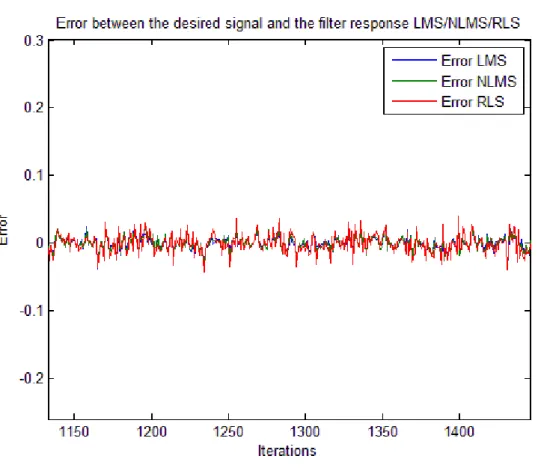
Figure 3.9 - Comparison between the error signals of the algorithms until a few hundred iterations ... 34
Figure 3.10 - Comparison between the error signal of the algorithms after a thousand iterations ... 35
Figure 3.11 - Adaptive filter for linear prediction ... 36
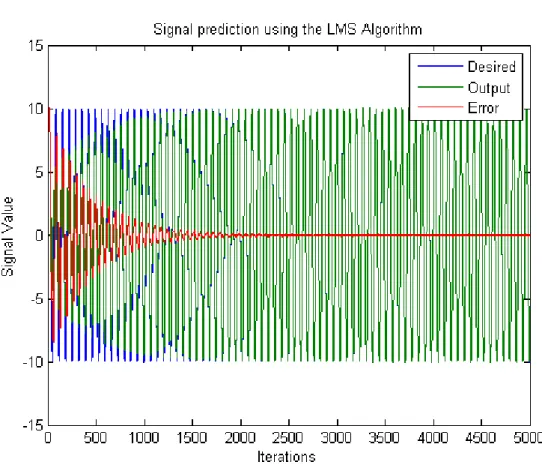
Figure 3.12 - Desired signal, filter output and error of the LMS algorithm for the prediction given problem ... 37
Figure 3.13 - Mean-squared-error of the LMS algorithm ... 38
Figure 3.14 - Desired signal, filter output and error of the NLMS algorithm for the system identification given problem ... 39
Figure 3.15 - Mean-squared-error of the NLMS algorithm ... 40
Figure 3.16 - Desired signal, filter output and error of the RLS algorithm for the system identification given problem ... 41
Figure 3.17 – Least-squares of the RLS algorithm ... 42
Figure 3.18 - Comparison between the algorithms cost function ... 43
Figure 3.19 - Comparison between the error predictions of the three algorithms in a few thousand iterations ... 44
Figure 3.20 - Comparison between the error predictions of the three algorithms after a few hundred thousand iterations ... 45
Figure 4.1 – The active noise canceller problem ... 48
Figure 4.2 - Results of application of the LMS algorithm to the given problem ... 50
Figure 4.3 - Zoom of results shown in figure 4.2 ... 51
Figure 4.4 - Mean-squared-error of the ANC using the LMS algorithm ... 52
Figure 4.5 Results of application of the NLMS algorithm to the given problem ... 53
Figure 4.6 - Zoom of results shown in figure 4.5 ... 54
Figure 4.7 - Mean-squared-error of the ANC using the NLMS algorithm ... 55
Figure 4.8 - Results of application of the RLS algorithm to the given problem ... 56
Figure 4.9 - Zoom of results shown in figure 4.8 ... 57
Figure 4.10 - Least-squares error of the ANC using the RLS algorithm ... 58
xi
Figure 5.1 - Proposed problem for the active noise canceller ...61
Figure 5.2 - LMS active noise canceller using a white Gaussian noise ...63
Figure 5.3 - Relevant signals and algorithm‟s convergence ...64
Figure 5.4 - Relevant signal and squared error after 10 seconds...65
Figure 5.5 - LMS active noise canceller using colored noise...65
Figure 5.6 - Relevant signals and algorithm convergence ...66
Figure 5.7 - Relevant signal and squared error after the algorithm has converged ...67
Figure 5.8 - RLS active noise canceller using a white Gaussian noise ...68
Figure 5.9 - Relevant signals and algorithm‟s convergence ...68
Figure 5.10 - Relevant signal and squared error a few seconds after the convergence ...69
Figure 5.11 - RLS active noise canceller using colored noise ...70
Figure 5.12 - Relevant signals and algorithm convergence ...70
Figure 5.13 - Relevant signal and squared error after the algorithm has converged ...71
Figure 6.1 - ANC prototype scheme ...74
xiii
List of Tables
Table 2.1 - Summary LMS Algorithm ...19
Table 2.2 - Computer complexity of the LMS algorithm ...20
Table 2.3 - Summary of the NLMS algorithm ...21
Table 2.4 - Computer complexity of the NLMS algorithm ...21
Table 2.5 - Summary of the RLS algorithm ...23
xv
Nomenclature
AF Adaptive Filters
ANC Active (Adaptive) Noise Canceller (Cancellation or Cancelling) DF Digital Filters
DSP Digital Signal Processing FIR Finite Impulse Response IC Interference Cancelling IIR Infinite Impulse Response LMS Least-Mean-Squared MSE Mean-Squared Error NC Noise Cancelling
NLMS Normalized Least-Mean-Squared RLS Recursive Least-Squares
SD Steepest Descent WLS Weighted Least-Squares
1
1. Introduction
The objective of this study is to understanding the adaptive filter (AF) theory. This work will show the theory behind the adaptive filters and it will give examples of some applications. The idea of the study is that after consolidating the knowledge of this high level control technique (the adaptive filters) the researcher will have a huge range of application in most diverse areas. There will be presented possible algorithm‟s solutions and their performance results for some applications. Moreover, the work focuses on one class of application which is the main goal of the research. It is the interference cancelling (IC) also known as noise cancelling (NC).
This chapter begins with a succinct overview of adaptive filters. Furthermore, it introduces the final objective of the research: the adaptive noise cancellation (ANC) problem. It also presents the web page built in order to maintain the records of this research. The chapter concludes giving the structure of the thesis, in the „Approach and Thesis Outline‟ section. The material presented below can be found, for example, in [2].
1.1. Adaptive Filters
As their own name suggests, adaptive filters are filters with the ability of adaptation to an unknown environment. This family of filters has been widely applied because of its versatility (capable of operating in an unknown system) and low cost (hardware cost of implementation, compared with the non-adaptive filters, acting in the same system).
The ability of operating in an unknown environment added to the capability of tracking time variations of input statistics makes the adaptive filter a powerful device for signal-processing and control applications [1]. Indeed, adaptive filters can be used in numerous applications and they have been successfully utilized over the years.
As it was before mentioned, the applications of adaptive filters are numerous. For that reason, applications are separated in four basic classes: identification, inverse modelling, prediction and interference cancelling. These classes will be detailed in the next chapter.
All the applications above mentioned, have a common characteristic: an input signal is received for the adaptive filter and compared with a desired response, generating an error. That error is then used to modify the adjustable coefficients of the filter, generally called weight, in order to minimize the error and, in some optimal sense, to make that error being optimized, in some cases tending to zero, and in another tending to a desired signal.
1.2. Active Noise Cancelling
The active noise cancelling (ANC), also called adaptive noise cancelling or active noise canceller belongs to the interference cancelling class. The aim of this algorithm, as the aim of any adaptive filter, is to minimise the noise interference or, in an optimum situation, cancel that perturbation [1-2, 4-5]. The approach adopted in the ANC algorithm, is to try to imitate the original signal s(n).
In this study, the final objective is to use an ANC algorithm to cancel speech noise interference, but this algorithm can be employed to deal with any other type of corrupted signal, as it will be presented in the section 4. A scheme of the ANC can be viewed in figure 1.1, depicted below.
Figure 1.1 - Active Noise Canceller
In the ACN, as explained before, the aim is to minimise the noise interference1 that
corrupts the original input signal. In the figure above, the desired signal d(n) is composed by an unknown signal, that we call s(n) corrupted for an additional noise n2(n), generated for the
interference. The adaptive filter is then installed in a place that the only input is the interference signal n1(n). The signals n1(n) and n2(n) are correlated. The output of the filter
y(n) is compared with the desired signal d(n), generating an error e(n). That error, which is
the system output, is used to adjust the variable weights of the adaptive filter in order to minimise the noise interference. In an optimal situation, the output of the system e(n) is composed by the signal s(n), free of the noise interference n2(n).
1.3. Motivation
When working with signal processing, this signal is susceptible to the noise interference that can arise from a wide variety of sources. With the high level of technology development nowadays, the real-time processes became more and more necessary and popular. Those types of processes are the most vulnerable to the action of noise interference. The noise is the most important environmental factor, which determines the reliability of the system operation in practice.
3
Taking into consideration the factors referred before, added to the fact that most real-time processes are unknown or are not worthy being identified, in the last case, mainly because of money matters. A filter device to work in that situation would be very expansive to implement (hardware cost and software complexity). In that circumstances the adaptive filters were developed.
Adaptive filters had experienced a very fast growth over the years, partly because of their low cost of hardware and relatively low implementation complexity, and partly because of their characteristic of working in an unknown environment and a very good tracking property, being capable of detecting time variations of the system variables.
The acoustic noise, which is the subject of study in this project, has disadvantages since corruption of a system working. It causes physics and psychic problems in humans which are susceptible to the noise action.
The active noise canceller was invented to cancel or, at least, reduce the noise action. Such device has a very important function in everyday life, preventing diseases in humans and disturbances in processes. For reasons such as reduction of expenses, achievement of comfort and many others, the ANC has been subject of research all around the world over the years [6-11, 26-39].
1.4. Thesis web page
For keeping a good record of this research, a thesis web page has been developed. This page is presented in figure 1.2. The home page is composed by the researcher and the theme in the up bottom, followed by the menu containing the sub-pages and a brief abstract of the research, containing an illustration of the problem, an introduction, the aims and the strategy used in this work.
In the „Plan‟ sub-page, it can be found the Gantt chart used for the tasks schedule. That Gantt chart is a good tool for helping the researcher with his time management. The performed tasks are presented in the „Weekly Tasks‟ page. This page contains all the tasks performed during each week. There will be provided weekly reports which confirm the information presented in this page. The „MT – File Management‟ page is used to maintain a record of all the relevant documents produced in this research, such as all the reports, algorithm codes, and thesis versions. In the „Bibliography/Tools‟ page, it can be found in a fast way, all the references used to perform this research and all the software use. Finally, in the „Team/Contact‟ page, it is presented the information about all the members of this investigation and the author‟s contact.
1.5. Approach and Thesis Outline
This work is focussed on a practical development of an active noise canceller to cancel noise in speech. In order to achieve the understanding of the proposed solution, it will be presented some examples of applications of adaptive filters in the other classes of application. The approach chosen in this work, is to start with the AF theory and the most common algorithms, then give examples of these algorithms being used in computer experiments in the diverse areas, and finish with the main theme, the ANC and a practical application, simulation and implication for future research. The strategy is then distributed in the way shown below.
In chapter 2, a review of filters and adaptive filters is given, and some applications are presented along with current development of active noise control.
In chapter 3, there are presented some computer experiments for the following adaptive filter applications: system identification and prediction. There are given the algorithm‟s equations and the results of the experiments obtained by using three different algorithms (LMS, NLMS and RLS) are being shown and compared.
Chapter 4 presents computer experiments for a general active noise cancellation problem. This part of the work also presents and compares the results of the experiments using the LMS, NLMS and RLS algorithms.
Chapter 5 describes a simulation of the ANC problem using Simulink platform. There are presented the results of the simulation using the LMS and RLS algorithms and white Gaussian and colored noise.
Chapter 6, contains the conclusions of this study and implications for future research. The next chapter, starts by giving an overview of the digital filter theory, which is necessary before we introduce the adaptive filter theory.
5
2. Review of Adaptive Filtering
2.1. Digital Filters
The present section has the purpose of describing the digital filters (DF) and their types. Moreover, it gives an overview of the approaches needed in this research.
2.1.1. Introduction to Digital Filters
A filter is a device which changes the original signal‟s wave-shape, amplitude-frequency and/or phase-frequency characteristics to achieve desired objectives [12]. Those objectives are commonly concerned with improving the quality of the signal, reducing/removing the noise, for example, or to extract some relevant information or even to split signals previously combined.
Because of the digital filter‟s characteristic and the fact that the digital devices are increasing the possibility of applications of the digital algorithms, the digital filters have very important roles in digital signal processing (DSP).
In figure 2.1 is depicted a simplified block diagram of a digital filter application.
Figure 2.1 - Real-time digital filter with analogue input and output
where ADC is the analogue-to-digital converter and DAC is the digital-to-analogue converter.
2.1.2. Finite Impulse Response Filter
The finite impulse response (FIR) filter, as its own name suggests, has a finite impulse response. This filter is characterized by the following equations:
( ) ∑ ( ) ( ) ( 2.1 ) ( ) ∑ ( ) ( 2.2 )
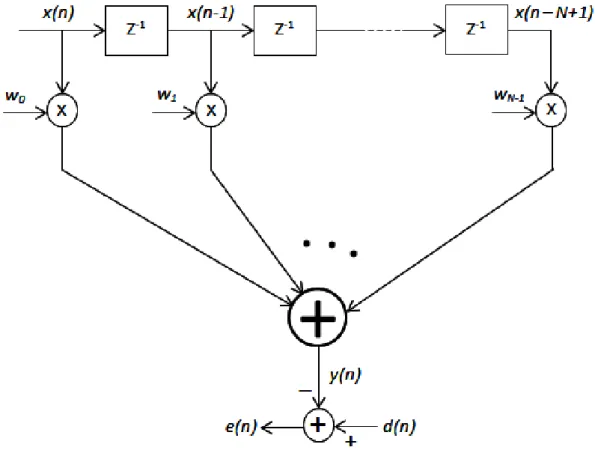
where h(k),k=0,1,…,N-1, are the impulse response coefficients of the filter, H(z) is the transfer function of the filter and N is the number of filter coefficients, called length. The equation (2.1) is the FIR filter difference equation. It describes the filter in its nonrecursive form: the output y(n), do not depend on the past values of the output y(n). When implemented in this nonrecursive form, the filters are always stable. The equation (2.2) is the transfer function of the filter. This equation allows the analysis of the filter.
FIR filters can have a linear phase response and they are very simple to implement. The FIR filter realization used is this study is: Transversal (direct) and Lattice. They both are described in figures 2.2 and 2.3, respectively.
Figure 2.2 - FIR transversal filter
7
2.1.3. Infinite Impulse Response Filter
In contrast to the FIR filter, the infinite impulse response (IIR) filter, as its own name suggests has infinite impulse response. The IIR equations are:
( ) ∑ ( ) ( ) ∑ ( ) ∑ ( ) ( 2.3 )
where h(k) is the impulse response (theoretically infinite), ak and bk are the coefficients of
the filter, and x(n) and y(n) are the input and output to the filter respectively. The IIR‟s transfer function is given by:
( ) ∑ ∑ ( 2.4 ) In equation (2.4) the output sample, y(n), depends on past outputs samples, y(n-k), as well as resent and past inputs samples, x(n-k), that is known as the IIR filter‟s feedback. The strength of the IIR filters comes from that feedback procedure, but the disadvantage of it is that the IIR filter becomes unstable or poor in performance if it is not well designed.
The IIR filter realization dealt in this study is the Lattice one. That design is illustrated in Figure 2.4, depicted below.
Figure 2.4 - IIF lattice filter
2.1.4. Wiener Filter
In order to understand the Wiener filter, we will use several concepts, pictures and equations that can be found in Diniz [4].
Figure 2.5 – General Adaptive Filter
The figure 2.5 depicts a general adaptive filtering problem, having a system connected to an adaptive filter. The objective is that the AF reaches the value of the desired response
d(n), for that, the desired response is compared with the filter output y(n), generating an
error e(n).
The objective function most used in adaptive filtering is the mean-squared error (MSE), described as follows:
, ( )- ( ) , ( )- , ( ) ( ) ( ) ( )- ( 2.5 ) where ( ) is the cost function and E[ * ] represents the expectation of *.
In many applications, the input signal is resulted by the delayed version of the same signal. In those cases, the output of the system can be found by applying a FIR filter to the input signal.
The figure 2.6 illustrates the adaptive FIR filter. The output signal y(n), can be represented as:
( ) ∑* ( ) ( )+ ( ) ( )
( 2.6 )
where x(n) =[x(n) x(n-1) … x(n-N)]T is the system input vector and w(n)=[w
0(n) w1(n)… wN(n)]T
is the tap-weight vector.
Substituting the value of y(n) in equation (2.6) into equation (2.5), we have that:
, ( )- ( ) , ( ) ( ) ( ) ( ) ( ) ( ) ( ) (
9
Figure 2.6 - FIR FilterThe MSE function, for the FIR filter, having fixed coefficients, can be rewritten as:
, ( )- ( ) , ( )- ( ) , ( ) ( )- ( ) , ( ) ( )- ( ) ( 2.8 ) if we define the N x 1 cross-correlation vector between d(n) and x(n) as:
, ( ) ( )- , - ( 2.9 )
and a N x N autocorrelation matrix R as:
, ( ) ( )- [ ] ( 2.10 )
From that equation, it can be noted that the minimum squared error, that is the MSE subject function, can be found by manipulating the tap-weight w(n), supposing that the vector p and the matrix R are known.
The gradient vector of the MSE function related to the filter tap-weight coefficients, is found differentiating the MSE equation with respect to the coefficients w(n), as shown below.
[ ] ( 2.11 )
Equating the gradient vector to zero and taking R as a nonsingular matrix, the optimal values for the tap-weight coefficients w that minimises the object function, we get the Wiener solution, described as:
( 2.12 )
If we substitute the equation (2.12) into the equation (2.8), we can calculate the minimum value of the objective function provided by the Wiener solution, given by:
, ( )- , ( )- ( 2.13 )
2.1.5. Summary
In this section, it was given an overview of the digital filter theory. This introduction was necessary before explaining the adaptive filter theory, because the adaptive filter, as its own name suggests is a kind of digital filter.
The next section presents the adaptive filters‟ applications, showing the general applications, followed by the ANC problem, which is the aim of this research. The section ends with the presentation of some technologies that uses the ANC algorithms.
2.2. Applications of Adaptive Filters
In order to give to the reader a general idea of the range of applications of the AF, general applications will be presented in this section. Moreover, the active noise cancelling problem will be introduced as well as the current development in this area.
2.2.1. General Applications
Because of the adaptive filters versatility, their applications were divided into four classes. Those four basic classes of applications of adaptive filters are listed below:
11
Figure 2.7 - System Identification
1. Identification or Modelling: figure 2.7 depicts the identification problem. In that application, the adaptive filter receives the same input x(n) as the system. The output of the adaptive filter y(n) is then compared with the desired response and output of the system d(n) generating an error. That error e(n) is used to adjust the weight w(n) in order to minimise the error, identifying the system.
Figure 2.8 - Inverse Modelling
2. Inverse Modelling: depicted in figure 2.8, the inverse modelling, also known as deconvolution, has the aim of discovering and tracking the inverse transfer function of the system. This application consists of receiving one input x(n) for the system with its output u(n) connected to the adaptive filter. Then the comparison is made between the filter output y(n) and the desired response
d(n) that consists of the delayed version of the input x(n). The error e(n),
Figure 2.9 - Prediction
3. Prediction: the figure 2.9 describes the logic of the predictor adaptive filter. Having the aim to give the best prediction of a random signal, the adaptive predictor filter relies on applying the past values of the random signal x(n), obtained by applying a delay to that signal provided to the adaptive filter input and comparing its output y(n), with the desired response d(n), that is nothing but, the actual random signal x(n). When the filter output is used to adjust the filter weights, the adaptive filter is called a predictor filter; when the result of the comparison between y(n) and d(n), called e(n), is used to adjust the weights of the filter, it operates as a prediction error filter.
Figure 2.10 - Interference Cancelling
4. Interference Cancelling: the interference cancelling problem, which will be used in the application chosen for this study, noise cancelling, is depicted in the figure 2.10. The idea in this case is following: a desired response d(n), which is nothing but, a primary noisy signal (corrupted by a noise
n2(n)),primary signal = s(n) + n2(n). It is compared with the output of the
adaptive filter y(n), that has as input a reference signal n1(n) which is the
noise source that creates the noise which corrupts the primary signal (noise
n2(n)). The system output e(n) in this case, is the difference between the
filter output y(n) and the desired response d(n). In an optimum situation, this
13
2.2.2. Active Noise Canceller
The scheme of the active noise canceller can be seen in figure 2.11, conveniently copied from the section 1.2, in order to give a better visualisation of the active noise problem.
Figure 2.11 - Active Noise Canceller
The interference signal is a noise that is captured for the reference sensor and applied in the system as a reference signal. The desired signal is detected by the primary sensor. This signal is corrupted for the same noise signal. The adaptive filter generates an initial response, which is compared to the desired signal. That operation generates an error, which is used as the filter feedback, adjusting the filter weight and the system response. In an optimal sense, the response is composed for the originally desired signal.
Different approaches can be used in order to compute the best active noise canceler algorithm to a desired application [26-39], with different responses for a variety of algorithms. It means that every algorithm has its advantages and disadvantages, depending on the application.
2.2.3. Current Development of the ANC
In the last few years, the adaptive or active noise canceller has been widely applied in the industry. The aims could be to increase user comfort, eliminating inconvenient noise to improve the fuel economy of a vehicle.
The last application is the case of the GMC Terrain active noise cancellation. That system is depicted in the figure 2.12. General Motors explains that in the Terrain's „Eco‟ mode, the torque converter clutch engages at lower engine speeds to save fuel [3]. This situation has the disadvantage of creating an internal noise. That problem is solved by the active noise canceller system, which captures the noise with the ANC microphones for posterior cancellation using the car front speakers.
Figure 2.12 - ANC GMC - Copyright of General Motors [14]
The other applications intend to reduce the noise interference of specific sources in order to improve the comfort of the customers. This is the case of the headphones QuietComfort® 15, from the brand Bose, shown in figure 2.13. The headphone is supposed to cancel the surrounding noise interference and deliver the pure sound of the music device.
Figure 2.13 - Quiet Comfort 15 from Bose – Copyright of Bose [22]
There were presented so far some common applications of adaptive filters, followed by a presentation of the main aim of this research, the ANC problem, and examples of technology which uses an ANC algorithm.
The next section presents some of the most used AF algorithms and the computational complexity cost of each of them.
15
2.3. Adaptive Filtering Algorithms
In this section it will be presented some of the many existing adaptive filtering algorithms. In order to achieve the understanding of the algorithms, it will be shown a table with a possible summary to each algorithm.
2.3.1. Steepest Descent
The steepest descent (SD) is a recursive and deterministic feedback system algorithm. It means firstly that starting from some initial value for the tap-weight vector it improves with the increased number of iterations [1]. Secondly, a deterministic feedback system has the characteristic of finding the minimum point in the ensemble-averaged error-surface without knowing that surface.
Figure 2.14 - Transversal Filter
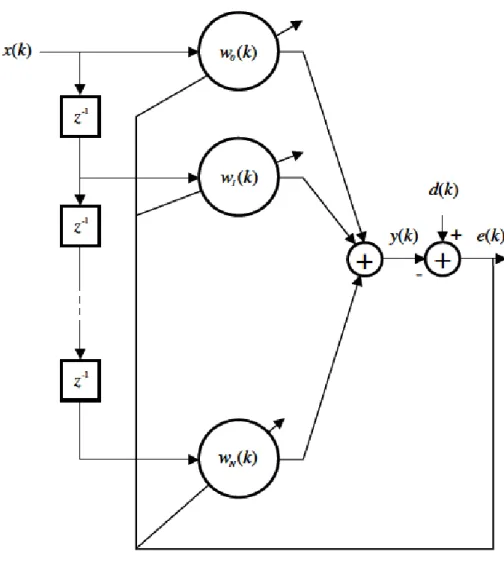
Taking into consideration the transversal filter in the figure 2.14 depicted above and having the filter‟s input x(n), its desired output d(n), the filter tap weights w0, w1, ..., wN-1 as
real-valued sequences, the filter input and the tap-weight vector, are defined by:
, - ( 2.14 ) and
( ) , ( ) ( ) ( )- ( 2.15 ) The filter output is:
( ) ( ) ( 2.16 )
From the equations present in the subsection 2.1.4, we have that:
( ) , ( )- , ( )- ( ) , ( ) ( )- , ( ) ( )- ( 2.17 ) where ( ) is the performance function (MSE), E[ * ] is the expectation of *, e(n)=d(n)-y(n) is the estimation error of the Wiener filter, R=E[x(n) xT(n)] is the auto-correlation matrix of the
filter inputs, p(n) =E[x(n) d(n)] is the cross-correlation vector between the filter input and the desired output.
The single global minimum of the ( ) is given by
( 2.18 )
where wo is the optimum tap-weight vector.
The steepest descent algorithm follows the procedure below, in order to find its optimum solution.
1. Initialize the algorithm within an initial guess of the parameters whose should be optimized in order to compute the minimum MSE.
2. Find the actual gradient function with respect to the parameters.
3. Update the parameters by stepping in the opposite direction of the gradient vector previously found.
4. Repeat the steps 2 and 3 until the variation in the parameters is no more significant. In order to implement the procedure described above, it will be necessary to recall the following equation from subsection 2.1.4:
[ ] ( 2.19 )
where is the gradient vector.
Following the logic of the procedure, we compute the w(n) as being:
( ) ( ) ( 2.20 ) where µ is the positive scalar step-size parameter and is the gradient vector at the point
w=w(n).
17
( ) ( ) , ( )- ( ) , ( ) - ( 2.21 )
In order to prove that the recursive update w(n) converges towards wo, we need to
rearrange the equation (2.21) as the following:
( ) , - ( ) ( 2.22 ) where I is the N x N identity matrix.
Substituting p from equation 2.18 into equation 2.22 and subtracting wo from both sides
of the equation, we find that:
( ) , - ( ) , -, ( ) - ( 2.23 ) Defining a vector v(n), which is a vector of the difference between the tap-weight w(n) and the optimum tap-weight wo, as:
( ) ( ) ( 2.24 )
and substituting in equation 2.23, we find:
( ) , - ( ) ( 2.25 ) In order to compute the recursive scalar equations, we use the fact that:
( 2.26 )
where is the diagonal matrix that contains the eigenvalues λ0, λ1 ,..., λN-1 of R and the
columns of the matrix Q, contains the orthonormal eigenvectors. Substituting the equation (2.26) into the equation (2.25), we found that:
( ) , - ( ) , - ( ) ( 2.27 ) Defining a new support variable as follows:
( ) ( ) ( 2.28 )
and rearranging the equation (2.27), we have:
( ) , - ( ) ( 2.29 ) Having in mind the interval i=0,1,..., N-1, the equivalent recursive scalar equations are given by:
( ) ( ) ( ) ( ) ( ) ( 2.30 ) From the equation (2.24), it is detected that the w(n) converges to wo, only if ( ) is a
vector of zeros. This fact added to the fact that from equation (2.30) the step-size parameter
µ must be selected so that:
| | ( 2.31 )
( 2.32 ) or
( 2.33 )
and finally, the condition necessary to guarantee the convergence of the steepest-descent algorithm is that the step-size parameter µ is:
( 2.34 ) where is the maximum of the eigenvalues .
2.3.2. Least-Mean-Square Algorithm
The least-mean-square (LMS) algorithm belongs to the family of the linear stochastic gradient algorithms. It serves at least two purposes. First, it avoids the need to know the exact signal statistics (e.g., covariance and cross-covariance), which are nevertheless rarely available in practice. Second, these methods possess a tracking mechanism that enables them to track variations in the signal statistics [5].
Its simplicity and operational stability are important features of the LMS algorithm, which does not require measurement of the pertinent correlation functions or a matrix inversion. It makes the LMS algorithm the standard linear adaptive algorithms in terms of applicability [1].
The LMS algorithm is composed by two basic processes:
1. A filtering process, which consists of the computation of a transversal filter output produced by the tap inputs, and later on, compare that output with a desired response, generating an error estimation
2. An adaptive process, which consists of an automatic adjustment of the tap weights using the estimate error
The cost function of this algorithm is the mean-squared error, given by:
( ) | ( )| ( 2.35 )
where J is the cost function, | | is the Euclidean norm and e(n) is the error between the desired response and the filter output.
The estimation error is as follows:
19
were d(n) is the desired response and y(n) is the filter output, The filter output is computed using the equation below:
( ) ( ) ( ) ( 2.37 )
where x(n) is the vector composed by the input x(n) and having the same size as the tap-weight vector w(n).
Taking into consideration the Wiener filter equations, we find that:
( ) ( ) ( ) ( ) [ ̂( ) ̂( ) ( )] ( 2.38 ) for n = 0, 1, 2, …, where is the estimation of the gradient vector of the objective function, ̂ is the estimate of the cross-correlation vector between the desired response and the input signal, ̂ is the correlation matrix of the input signal and µ is the step-size parameters which decides the speed of convergence to the minimum error. The size of the constant µ decides the convergence speed of the algorithm. A small value of the step-size increases the convergence time while a large value increases the excess mean-square error (EMSE) [16].The
µ parameter must satisfy the following requisites:
( 2.39 )
where the tap-input power is given by
∑ ,| ( )|
( 2.40 )
The result of the estimate gradient is given by
̂( ) ( ) ( ) ( ) ( ) ( ) ( ), ( ) ( ) (
( ) ( ) ( 2.41 )
Updating the equation (2.38), we have:
( ) ( ) ( ) ( ) ( 2.42 ) The summary of the LMS algorithm and the computational complexity cost are described in the tables 2.1 and 2.2, respectively.
Table 2.1 - Summary LMS algorithm
Inputs: Tap-weight vector w(n), Input vector x(n), and desired output d(n)
Outputs: Filter output y(n), Tap-weight vector update w(n+1)
Parameters:
M = number of taps µ = step-size parameter
Where tap-input power = ∑ ,| ( )|
Initialization: Having prior knowledge, use it to compute the w(0), otherwise set w(0) = 0 Step 1: Filtering:
( ) ( ) ( )
Step 2: Error Estimation:
( ) ( ) ( )
Step 3: Tap-weight vector adaptation:
( ) ( ) ( ) ( )
Table 2.2 - Computer complexity of the LMS algorithm
Step Equations * + or - / Initialization: w(0) = 0 - - - for n=1, 2, 3, … - - - 1 ( ) ( ) ( ) L L – 1 - 2 ( ) ( ) ( ) - 1 - 3 ( ) ( ) ( ) ( ) L + 2 L - Total 2L + 2 2L -
2.3.3. Normalised Least-Mean-Square Algorithm
In the LMS algorithm studied in the last section, the tap-weight input has a correction ( ) ( ) which is directly proportional to the size of x(n).
When the size of the x(n) is large, the LMS algorithm experiences a gradient noise amplification problem. In order to solve this problem, the normalized least-mean-square (NLMS) algorithm was developed.
The increase of the input x(n) makes very difficult (if not impossible) to choose a µ that guarantees the algorithm‟s stability. Therefore, the NLMS has variable step-size parameter given by:
̅
21
where δ is a small constant, ̅ is the step size parameter of the NLMS ̅ and || * || is the Euclidean norm.
The tap-weight w(n) is now presented as:
( ) ( ) ( ) ( ) ( ) ̅
|| ( )|| ( ) ( ) ( 2.44 )
In table 2.3, it is presented a summary of the NLMS algorithm.
Table 2.3 - Summary of the NLMS algorithm
Inputs: Tap-weight vector w(n), Input vector x(n), and desired output d(n)
Outputs: Filter output y(n), Tap-weight vector update w(n+1)
Parameters:
M = number of taps δ = small constant
̅ = step-size parameter of the NLMS algorithm ̅
Initialization: Having prior knowledge, use it to compute the w(0), otherwise
set w(0) = 0
Step 1: Filtering:
( ) ( ) ( )
Step 2: Error Estimation:
( ) ( ) ( )
Step 3: Tap-weight vector adaptation:
( ) ( ) ̅
|| ( )|| ( ) ( )
The table 2.4 depicts the computational complexity cost of the NLMS algorithm. Table 2.4 - Computer complexity of the NLMS algorithm
Step Equations * + or - /
Initialization: w(0) = 0 - - -
for n=1, 2, 3, … - - -
1 ( ) ( ) ( ) L L - 1 -
3 ( ) ( ) ̅
|| ( )|| ( ) ( ) 2L + 2 2L 1
Total 3L + 2 3L 1
2.3.4. Recursive Least-Squares Algorithm
Contrary to the LMS algorithm, whose aim is to reduce the mean square error, the recursive least-squares algorithm‟s (RLS) objective is to find, recursively, the filter coefficients that minimize the least square cost function. The RLS algorithm has as an advantage a fast convergence, but on the other hand, it has the problem of a high computational complexity.
The cost function of this algorithm is the weighted least-squares (WLS), given by:
( ) ∑
( ) ( 2.45 )
where is called “forgetting factor”, which gives exponentially less weight to older error samples and e(n) is the error, defined by the difference between the desired response
d(n) and the output y(n) produced by a transversal filter whose tap inputs at time n is equal x(n),x(n-1),…,x(n-M+1). The e(n) is defined by:
( ) ( ) ( ) ( ) ( ) ( ) ( 2.46 ) where x(n) is the tap-input vector, defined by:
( ) , ( ) ( ) ( )- ( 2.47 )
w(n) is the tap-weight vector, defined by:
( ) , ( ) ( ) ( )- ( 2.48 ) The minimum value of the cost function J(n), reached when the tap-weights have they optimum value is defined by the normal equations written in matrix form:
( ) ̂( ) ( ) ( 2.49 )
The M-by-M correlation matrix Φ(n), is defined by:
( ) ∑ ( ) ( )
( 2.50 )
The M-by-1 cross-correlation vector z(n) between the tap inputs of the transversal filters and the desired response is defined by:
( ) ∑ ( ) ( )
23
where * denotes de complex conjugation.To compute the RLS we need to apply the matrix inversion Lemma. After applying this method, we have:
( ) ( ) ( ) ( ) ( ) ( 2.52 )
where ( ) is the inverse correlation matrix, λ-1 is the inverse forgetting factor and k(n) is
the gain.
The M-by-1 gain vector k(n) is defined by:
( )
( ) ( )
( ) ( ) ( ) ( 2.53 )
The tap-weight vector w(n) is then calculated using the following expression:
( ) ( ) ( ) ( ) ( 2.54 )
where the * represents the complex conjugation.
In order to achieve the implementation of a RLS algorithm, a summary is presented in table 2.5, shown below.
Table 2.5 - Summary of the RLS algorithm
Inputs: Tap-weight vector, output, d(n), and the correlation matrix ̂ ( ), Input vector, x(n), desired ( )
Outputs: Filter output, ( ), tap-weight vector update, ( ), and the
update of the correlation matrix ( )
Parameters:
M = number of taps
λ = forgetting factor
δ = Small positive constant
Where,
Initialization:
Having prior knowledge, use it to compute the w(0) and the ( ), otherwise set w(0) = 0 and ( )
Where δ is a small positive constant mentioned before and I is an identity matrix
Step 1: Computing the gain vector:
( )
( ) ( )
( ) ( ) ( ) Step 2: Filtering:
( ) ( ) ( )
Step 3: Error Estimation:
Step 4: Tap-weight vector adaptation:
( ) ( ) ( ) ( )
Step 5: ( ) update:
( ) ( ) ( ) ( ) ( )
The computational complexity cost for implementing the RLS algorithm is shown in table 2.6, presented below.
Table 2.6 - Computer complexity of the RLS algorithm
Step Equations * + or - / Initialization: w(0) = 0 and ( ) - - - for n=1, 2, 3, … - - - 1 ( ) ( ) ( ) ( ) ( ) ( ) 2L2 + L 2L2 – 2L + 1 1 2 ( ) ( ) ( ) L L – 1 - 3 ( ) ( ) ( ) - 1 - 4 ( ) ( ) ( ) ( ) L L - 5 ( ) ( ) ( ) ( ) ( ) L2 + L 2L – 1 1 Total 3L2 + 4L 2L2 + 2L 1
2.3.5. Summary
This section has presented some of the most commonly used adaptive filter algorithms and its equations. Moreover, it was presented a summary of those algorithms that can be used for implementing the AF in a real problem. It was also given to the reader, the computational complexity cost of the application of those algorithms. It was shown in order to help the reader when choosing between those algorithms.
The next chapter presents some general computer experiments using the AF algorithms presented in this section. It is also given the result of each algorithm applied for these experiments and a comparison between those results.
25
3. Computer experiments with Adaptive
Filters
This section presents computer experiments for different applications of the adaptive filters. It begins with a purpose of using the adaptive filters in those applications, followed by an algorithm and its result. Chapter 4 explains the active noise canceller and considers the results obtained by applying the algorithm.
3.1. System Identification
System identification is the experimental approach to the modelling of a process or plant (Goodwin and Payne, 1977; Ljung and Soderstrom, 1983; Ljung, 1987; Soderstrom and Stoica, 1988; Astrom and Wittenmark, 1990; Haykin,1996). The adaptive system identification is an important tool that is widely used in the fields of communications, control systems and signal processing [13]. The characteristic of good tracking of time variations is a powerful instrument to the identification of unknown time-varying systems. That characteristic has made the Adaptive filters one of the most popular methods in the system identification problem.
3.1.1. The problem
The system identification problem is illustrated in Figure 3.1. This figure has been conveniently copied from Subsection 2.2.1. In this problem, we have an input signal x(n) common to both the system and the adaptive filter. The filter generates a response y(n) which is compared with the system output d(n) also known as the desired response. The desired response d(n) for the system identification scenario, has added to its value, a noise signal n(n). This comparison generates the error e(n) which is used to recalibrate the tap-weights w(n) of the filter.
For this simulation, the following information is available: A random system wo to be identified, with dimensions (7,1);
The desired response d(n) is accompanied with a white Gaussian noise n(n), with zero mean and variance equal to 0.01, which could be generated by external interference or even by the transmission means;
Figure 3.1 – System Identification
For system identification problem, the error signal e(n) should converge to the value of the noise n(n) added to the system output.
3.1.2. The LMS Solution
The least-mean-square algorithm is an example of an algorithm which can be successfully employed in the identification problem [13, 15-18]. The LMS is led by the mean-squared error cost function. This cost function is calculated by the equation described below.
( ) | ( )| ( 3.1 )
Using the summary presented in subsection 2.3.2 and doing the alterations needed in order to solve the system identification problem, we obtain the following new equation:
( ) ( ) ( ) ( 3.2 ) where d(n) is the desired response of the filter. wo is a vector which represents the system to
be identified. In this particular case, with dimensions (7,1). x(n) is a vector composed by the input x(n) with same dimensions as the vector wo and n(n) is the noise.
The step-size parameter µ was chosen to be 0.02.
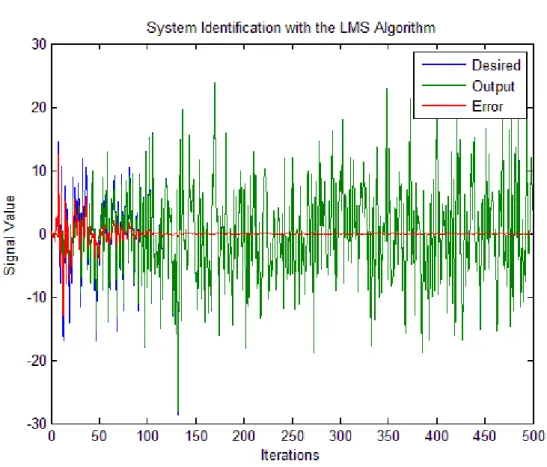
The figure 3.2 shows the result of the adaptive system identification using the LMS algorithm.
27
L = 7, SNR = 40dB, µ = 0.02
Figure 3.2 – Desired signal, filter output and error of the LMS algorithm for the given system
identification‟s problem
This picture shows the value of the desired response d(n), the filter output y(n) and the estimation error e(n) varying according to the number of iterations. From the plot the track characteristics of the adaptive filter can be verified. It starts trying to identify the system, and after about 130 iterations over time, the error starts with a large disturbance until the filter reaches a good tracking of the system and the error starts to be near to its optimum value (zero).
The mean-squared error of the algorithm can be seen in the figure 3.3. The cost function of the LMS algorithm has as aim to minimize the MSE. From this figure it can be detected that after about 150 iterations of the filter, the MSE converges to the noise variance 0.01 or – 40 dB.
L = 7, SNR = 40dB, µ = 0.02
Figure 3.3 - Mean-squared error of the LMS algorithm
3.1.3. The NLMS Solution
The normalized least-mean-square algorithm is normally applied when the size of the input x(n) is too large. The implementation of this algorithm to the same problem has resulted in a faster convergence, keeping the advantages of the LMS solution. The equations below are an adaptation of the equations found in subsection 2.3.3. Here it has been modified in order to reach the system identification problem, which is the actual aim. The new equations are presented below.
( ) ( ) ( ) ( 3.3 ) where d(n) is the desired response, wo is the vector which represents the system to be
identified, having dimensions (7,1). x(n) is the input vector, composed by the x(n) inputs and having the same dimensions as wo and n(n) is the noise.
After some experiments, the constant δ and µ was chosen to be 0.9 and 0.25, respectively.
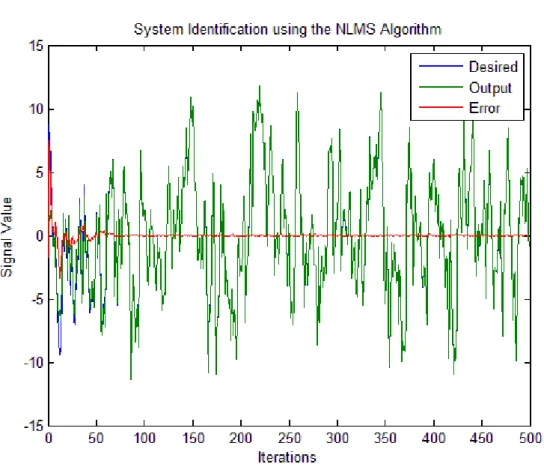
The results of application of the NLMS algorithm, explained before, to solve the system identification problem are described in the figures 3.4 and 3.5. Figure 3.4 shows the desired signal d(n) been tracked by the adaptive filter‟s output y(n), and the resultant error of difference between the signals e(n).
29
L = 7, SNR = 40dB, δ = 0.9, µ = 0.25
Figure 3.4 - Desired signal, filter output and the error of the LMS algorithm for the system identification
given problem
From the figure 3.4 it can be seen that approximately 80-100 iterations are necessary, so that the algorithm reaches a prediction error near to its optimum value, bringing the error near to zero.
Figure 3.5 depicts the evolution of the mean-squared error by the number of the iterations. It can be noticed that after approximately the same number of iterations (100 iterations), the MSE converges to the noise variance, 0.01 or – 40dB.
L = 7, SNR = 40dB, δ = 0.9, µ = 0.25
Figure 3.5 - Mean-squared-error of the NLMS algorithm
3.1.4. The RLS Solution
The recursive least-square algorithm is a very popular adaptive filter algorithm and therefore it is successfully used for system identification [15, 17-18, 20-21]. Leaded by the cost function of the least-squares, this algorithm presents a fast convergence with a good stability. The cost function of the RLS algorithm is described as follows:
( ) ∑
( ) ( 3.4 )
where is the “forgetting factor”, a constant value that serves to give exponentially less weight to older error samples and e(n) is the estimation error.
Using the equations presented in Table 2.5, and performing the alterations necessary to achieve the result aiming the system identification problem, we get the following new equations:
31
where d(n) is the desired response; wo is the vector which represents the system, having
dimension (7,1) in this example; x(n) is the input vector, composed by the input x(n) and having dimension identical to wo; e(n) is the error and y(n) is the filter‟s output.
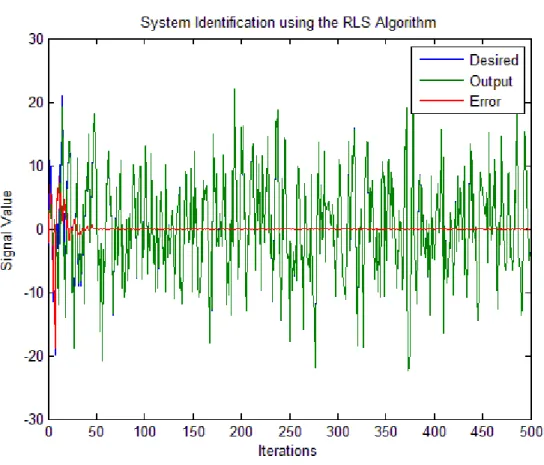
The figure 3.6 shows the result of applying a RLS algorithm to the system identification problem. The RLS was initialized with ( ) . The result of simulations pointed as the best value for this constant which is multiplied to the Identity matrix I. The forgetting factor λ was set to be 0.9.
L = 7, SNR = 40dB, λ = 0.9
Figure 3.6 - Desired signal, filter output and the error of the RLS algorithm for the given system
identification‟s problem
Analysing the figure 3.6, by looking to the red line, which represents the error, it can be observed that the RLS algorithm reaches a tracking behaviour near to its optimum, after approximately 50 iterations of the program, within the error tending to zero.
The figure 3.7 depicts the behaviour of the RLS‟s cost function, the weighted least-squares. After 50 or 60 iterations, the least-squares become close to the value of the variance of the noise, which is 0.01 or – 40dB.
L = 7, SNR = 40dB,λ = 0.9
Figure 3.7 – Weighted least-squares of the RLS algorithm
3.1.5. Comparisons of Results
In real-time applications, it is very important to analyse all the important details before we choose an adaptive algorithm. A small difference could result in elevated cost of implementation, or in a weak system, which is not stable in all variable changes, or even the solution is impossible to be implemented. The choice between using one algorithm instead of another, to the system identification problem, depends mainly on the following factors:
Rate of Convergence: number of iterations required by the algorithm, to converge to a value close to the optimum Wiener solution in the mean-square sense. If the algorithm has a fast rate of convergence, it means that the algorithm adapts rapidly to a stationary unknown environment.
Computational cost: when we talk about computational cost, it includes implementation cost, amount necessary to implement the algorithm in a computer and the number of arithmetic operations. The order of the operations is also important as well as the memory allocation, which is the space necessary to store the data and the program.
Tracking: capacity of the algorithm to track statistical variations in a stationary unknown environment.
33
In this particular application, those three factors have has been analysed. The tracking factor has been analysed in two stages, one after a few hundred of iterations and the other after a few thousand iterations.
The tables 2.2, 2.4 and 2.6, presented in the subsections 2.3.1, 2.3.2 and 2.3.3 respectively, show the computational cost of each algorithm. By analysing those tables, we can detect that the RLS algorithm has a maximum complexity of L2 against L to the LMS and
NLMS. It means that the RLS algorithm requires a higher processing power than the other two. It implies higher cost of hardware.
The figure 3.8 shows a comparison between the rates of convergence of the three proposed algorithms. Investigating the results shown in figure 3.8, it can be detect that the rate of convergence of the RLS algorithm is faster than the other two. Indeed, it can be twice faster than the NLMS and three times faster than the LMS algorithm.
L = 7, SNR = 40dB, µ = 0.02(LMS), δ = 0.9, µ = 0.25(NLMS), λ = 0.9
Figure 3.8 - Comparison between the algorithms cost function
The next analysis is about the value of the prediction error e(n). The figure 3.9 depicts a comparison between the error of the three algorithms during the consecutives iterations of the algorithms. By examining the result, it can be noticed that the RLS algorithm has an error close enough to its optimum Wiener solution in a small number of iterations, about 50 iterations. The RLS presents another good characteristic, which is why it converges to the optimum value of the error prediction, stabilizing nearby this value without big variations since the 50th iteration and during all the period shown in the illustration. The LMS error
prediction starts to converge about 80 iterations, but the disturbance is too big until about 110 iterations, when it starts to show some stability, but still having small disturbances during all the period shown. The NLMS algorithm shows a better response than the LMS, but still slower than the RLS algorithm.
L = 7, SNR = 40dB, µ = 0.02(LMS), δ = 0.9, µ = 0.25(NLMS), λ = 0.9
Figure 3.9 - Comparison between the error signals of the algorithms until a few hundred iterations Exploring Figure 3.9, it can be said that if you want a faster convergence when you are identifying a system, the RLS is the best possible solution, but it is not the only reason why it should be studied. Figure 3.10 shows a comparison between the errors from the three algorithms, after more than a thousand iterations. It can be noticed that the error variations start to be bigger for the RLS than for the LMS algorithm. It is the opposite of what was happening after a few hundred iterations. It is reasonable because the LMS based algorithms are model independent, when the RLS algorithm is model dependent. It means that unless the standard RLS algorithm matches with the underlying model of the environment in which it operates, we would expect a degradation of the performance of the RLS algorithm, due to the mismatch [18]. This problem explains why the LMS based algorithms exhibits a better tracking behaviour.
35
L = 7, SNR = 40dB, µ = 0.02(LMS), δ = 0.9, µ = 0.25(NLMS), λ = 0.9
Figure 3.10 - Comparison between the error signals of the algorithms after a thousand iterations
3.2. Linear Prediction
In the linear prediction problem [40-45], the aim is to predict the value of an unknown signal without having any prior knowledge. The linear prediction can be used to predict measurement error of noise sensors, trajectory of objects in video image and many other applications. This section presents a solution for a given problem of prediction, using the adaptive filter algorithms covered in this study.
3.2.1. The problem
Figure 3.11 depicts an adaptive filter for the prediction problem. As it can be observed, the scheme consists of a random signal, represented by a sinusoid. The filter‟s desired response x(n), a delayed version of the random signal u(n) is the adaptive filter‟s input, the filter generates an output y(n) which is one of the outputs, the error e(n) is a result of the difference between the desired response d(n) added to the white Gaussian noise n(n) with zero mean and variance 0.01 and the filter output y(n) (e(n)=d(n)+n(n)–y(n)). The error e(n) is the second system output.
Figure 3.11 - Adaptive filter for linear prediction
3.2.2. The LMS Solution
In order to apply the LMS to the prediction problem, some alterations in the summary presented in Section 2.3 will be introduced. After doing the necessary changes, we get the following equations:
( ) ( ) ( 3.6 )
( ) ( ) ( ) ( 3.7 )
( ) ( ) ( ) ( ) ( 3.8 )
( ) ( ) ( ) ( ) ( 3.9 ) where x(n) is the random input signal; u(n) is the delayed version of x(n); d(n) is the desired adaptive filter‟s response; w(n) is the tap-weight vector with variable length (chosen to be 7 in this program); u’(n) is the vector composed by the delayed version u(n) of the input signal;
y(n) is the filter‟s output; the prediction error e(n) is given by the desired response d(n) plus
the noise n(n) minus the filter output y(n) and µ is the step-size parameter.
The figure 3.12 illustrate the desired response d(n) (blue line) being tracked for the filter output y(n) (green line) and the error e(n) (red line), resultant of this comparison. It can be noticed that the algorithm presents a small error, near to its optimum value, about 2000 iterations after the initialization. The step-size µ was chosen to be equal to 0.01 after tests analysing the mean-squared error.
37
L = 7, SNR = 40dB, µ = 0.01
Figure 3.12 - Desired signal, filter output and error of the LMS algorithm for the prediction given
![Figure 2.12 - ANC GMC - Copyright of General Motors [14]](https://thumb-eu.123doks.com/thumbv2/123dok_br/18895001.934477/32.892.121.732.104.490/figure-anc-gmc-copyright-general-motors.webp)