46 BrazilianJournalofPhysics,vol. 29, no. 1,March,1999
Entropies Galore!
P. T.Landsb erg
Faculty of Mathematical Studies University of Southampton Southampton;SO17 1BJ;UK.
Received 07 December, 1998
The functional properties of the entropy gives rise to 6 possible types of thermodynamics. Additivity or superadditivity or subadditivity are closely related to extensivity and this is one of the characteristics used to distinguish the 6 types. We give examples (some are somewhat academic) of all of these, except one. For this purpose we draw also on black hole systems which have been proposed. Some of these systems have subadditive entropies, i.e. they tend to fragment rather than clump. After proposing a new entropy function we raise the problem of how to select from these entropy functions. Are some better than others?
I Introduction: Meaning of
ex-tensivity
Discussions of extensivity in thermodynamicsgo back to the 1960ies [1]. There are several non-equivalent def-initions of the extensivity of functions. They are [2, 3], if x;y are three-dimensional vectorsx= (x
1;x2;x3), f(x+y) = f(x) + f(y) (1)
f(2x) = 2f(x) (2)
f(x) = f(x) ( > 0) (3) A statistical mechanical denition can be added. It utilises ratios 1
x
1=x3; 2 x
2=x3 and states that x,1
3 f(
x)f(
1;2) (4)
where the limit x1;x2;x3
!1(for
1;2 xed) is con-sidered.
These denitions are not equivalent. For example, f(x) = x2
1 .
, x2
1+ x 2 2
1 2
satises (3), but not (1). However, if the assumption P :x and y are parallel vectors
is added, then, indeed
(3) + P )(1) :
Again, although (1) implies (2), (1) implies (3) only if the assumption
C0: the function f is continuous in its arguments (5) is added. Without it one can by addition not get much beyond
nf(x) = f(nx) or mn ,1f(
x) = f(mn ,1
x) ; (6) where m and n are positive integers. But with C0 one can reach (3) from (1) via (6).
In this way a table of implications can be set up for the four denitions of extensivity. It is then found that for larger systems (4) implies the other three de-nitions. If C0 is also assumed, then (1) can join (4) in implying the other three denitions.
Let us adopt (1) therefore as the denition of ex-tensivity in this paper. This is in any case a usual denition. A failure of (1) leads then to superadditiv-ity if the left-hand side is greater than the right-hand side, and to subadditivity if it is smaller.
II Types of thermodynamics [4]
P.T. Landsb erg 47
c
Table I: Types of Thermodynamics
1.
SHC
2.S
H
C 3.SH
C
4.S
H
C
5.SHC
6.S
HC
7.SH
C
8.S
H
C
Here we haveSuperadditivity
S
: S(x
+y
)S(x
) + S(y
) [cf(1)] HomogeneityH
: S(x
) = S(x
) [cf(3)]Concavity
C
: S (x
+ (1,)y
)S(x
) + (1,)S(y
)d Note that
C
is quite dierent from C0, introduced above. Also note that herex
andy
can stand for a set of variables or for just one variable.III Types of systems considered
Thersttypeis inspired by the ideal gas and is spec-ied by the entropy
S = k`n, aUvg
Nh
(7) where k; a; g; h are positive constants and v is the volume, U the internal energy and N the number of particles in the gas. It turns out that this example can generate three types of thermodynamics [4, paper II]: h = g+1 : type 1:; H < g+1 : type 4:; h > g+1 : type 6:
(8) Of course type 1 is the normal thermodynamics; type 4 reveals the purpose of the example:
For it was given as a simple classical analogue of the thermodynamics of the Schwarzschild black hole, in that it violates
C
but keepsS
.Second type: For a Schwarzschild black hole of mass M, M0 being a constant, one knows that
S = k (M /M0) 2
; (9)
Its thermodynamics is of type 4 as well. Indeed one can show that this holds more generally [5] for
S = am
+ b : (10)
where > 0; > 1 and b are positive constants, pro-vided b is small enough (See [5], line 1 of Table II).
The thermodynamics of type 8, for which
S
;C
andH
all fail, is rather rare. But it is found for special caseof (10), for example if (a;b > 0) S = am2+ b ; S = am +b ; S = ,a
p m + b ; as for certain dilatonic black holes [5].
As thirdtype, consider a (1 + 1)-dimensional black hole, as discussed in [6], for which
S = k`n(M /M0) (11)
In this case one nds type 2 if M=M0< 4 and type 6 if M=M0> 4.
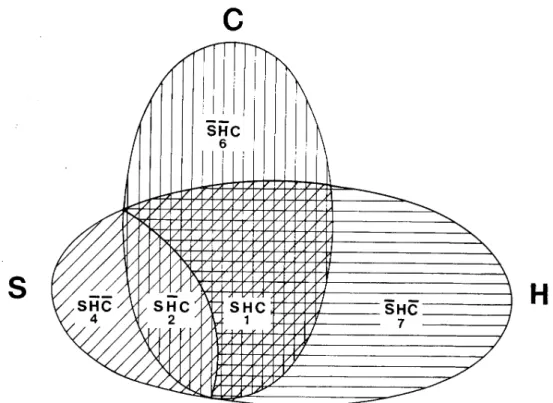
In thesecondandthirdtypes there has in eect been only one independent variable which of course simpli-es the analysis. Fig. 1 givsimpli-es a summary of the rsimpli-esults in the form of a Venn diagram.
It is seen from Fig. 1 that no example has been given of a thermodynamics of types 3, 5 and 7. Types 3 and 5 are actually logically impossible because
S
+H
!C
andC
+H
!S
:For functions which depend on one independent vari-able only we know also ([5]) that
H
!S
;C
which rules out thermodynamics of type 7. We still need an exam-ple of this type. It must involve several independent variables.Broadly speaking, if
S
holds, then two identical sys-tems will tend to \clump" together if they are given a chance, for this way the entropy goes up. This holds for a thermodynamics of types 1,2 and 4. However ifS
48 BrazilianJournalofPhysics,vol. 29, no. 1,March,1999
Figure 1. Venn diagram for thermodynamic types.
IV Entropy choices
The non-extensive nature of the entropy can be en-capsulated in a functionY which vanishes in the case of an extensive entropy:
S(A+B),S(A),S(B) =YS(A)S(B)
whereAandBrepresent the part systems under consid-eration [7]. Let us add superxes R;S;T;U for Renyi, Shannon, Tsallis and a new entropy. Let Q p
q i, where the p
i are the probabilities of the various states of the system involved, and let q be a real constant. Then we can construct a table of matching entropies andY-functions [8]:
c
S (R)(
A) = k 1,q
`nQ Y
(R)= 0 (12)
S (S)(
A) = ,k X
i p
iln p
i
Y
(S)= 0 (13)
S (T)(
A) = k 1,q
(Q,1) Y
(T)= 1 ,q k
(14)
S (U)(
A) = k 1,q
1,
1 Q
Y (U)=
q,1 k
(15)
d For eachS one has lim
q !1 S
(i)( A) =S
(S)(
A), and the new entropy satises S
(U)( A) =S
P.T. Landsb erg 49 A great deal of work has been done using the Tsallis
expression S
(T). The object was to nd various ts to experimental data and limits on values of q, or, more precisely, on the amount by which q is likely to dier from the Shannon value of unity. In the case of the cos-mological background radiation, for example, the best q value lies very close to unity [9]:
jq,1j10 ,4
,10 ,5
:
Physical reasons for departures from simple laws of any kind always exist, since it is well-nigh impossible to take account of all interactions. There is always a further stage! In this particular case one hopes to get a grip on the long-range gravitational eects by going from the Shannon to the Tsallis entropy.
The are, of course, alternatives to (14). Although (15) is a new suggestion [8], people have had the ques-tion of uniqueness at the back of their minds even though there must by now be something like 40 appli-cations of the Tsallis entropy. That is why interesting uniqueness theorems have appeared [10].
Still, alternative entropies can be constructed, based on the process that yielded (15) and others [11]. How do we chose among them? Is the Tsallis entropy the only reasonable contender? And if so, why is this so? Is there a general signicance of the parameterq? Some future studies could usefully be devoted to these ques-tions.
References
[1] L. Galgani and A. Scotti, On subadditivity and convex-ity properties of thermodynamic functions, Pure and Applied Chemistry 22, 229 (1970). Also in Proc.
In-tern. Conf. on Thermodynamics(EdP. T. Landsberg),
Cardi 1970.
P. T. Landsberg, Main ideas in the axiomatics of ther-modynamics,
Pure and Applied Chemistry22, 215 (1970).
[2] J. Dunning-Davies, On the meaning of extensivity, Phys. Lett. 94A, 346 (1983). Extensivity and the Gibbs-Duhem equation, Phys. Lett.37A, 327 (1983). [3] J. Dunning-Davies and P. T. Landsberg, Logical rela-tions among dierent denirela-tions of \extensivity', Phys. Lett.107A, 383 (1985).
J. Dunning-Davies, Thermodynamics of non-extensive system, J. Phys. Chem. Solids49, 705 (1988). [4] P. T. Landsberg and D. Tranah, Thermodynamics of
non-extensive entropies I, Collective Phenomena3, 73 (1980).
D. Tranah and P. T. Landsberg, Thermodynamics of non-extensive entropies II, Collective Phenomena 3, 81 (1980).
[5] P. T. Landsberg and R. B. Mann, Thermodynamic Classications and dilatonic black holes, Gen. Rela-tivity and Gravitation29, 1269 (1997).
[6] P. T. Landsberg and R. B. Mann, New types of thermo-dynamics from (1 + 1)-dimensional black holes, Class. Quantum Grav.10, 2373 (1993).
[7] C. Tsallis, Nonextensive physics: a possible connection between generalized statisical mechanics and quantum groups, Phys. Lett. A195, 329 (1994).
[8] P. T. Landsberg and V. Vedral, Distributions and channel capacities in generalized statistical, mechanics Phys. Lett. A247, 211 (1998).
[9] A. B. Pinheiro and I. Roditi, Non extensive thermo-statistics and deformed structures, Phys. Lett. A242, 296 (1998).
[10] R. J. V. dos Santos, Generalization of Shannon's the-orem for Tsallis entropy, J. Math. Phys. 38, 4104 (1997).