182 V.M.T.S. Barthem et al.
Magnetic properties of electrodeposited Fe-poor Fe-Cu alloys
V.M.T.S. Barthem1, R.D. Noce2,1, W.A.A. Macedo3, D. Givord2
1Instituto de F´ısica, Universidade Federal do Rio de Janeiro, UFRJ, 21945-970, Rio de Janeiro, RJ, Brasil 2Institut N´eel, C.N.R.S./U.J.F., B.P. 166, 38042, Grenoble-Cedex 9, France and
3Centro de Desenvolvimento da Tecnologia Nuclear – CDTN,
Laborat´orio de F´ısica Aplicada Cidade Universit´aria - Pampulha , 31270-901 Belo Horizonte, MG, Brasil
(Received 01/09/2008)
In Fe-Cu alloys prepared by pulsed electrodeposition, Fe clusters form directly within a non-magnetic Cu matrix. The clusters contain around 140 Fe atoms and are superparamagnetic at room temperature. Below 160 K, it is proposed that the clusters order into a so-called superferromagnetic arrangement. This behaviour is ascribed to the persistence of weak exchange interactions mediated by isolated Fe atoms dispersed within the non-magnetic Cu matrix.
Keywords: Fe-Cu alloys, Fe clusters, Superferromagnetism, Electrodeposited alloys
I. INTRODUCTION
Magnetic nanoparticles may be characterized by a number of original properties which distinguish them from usual mag-netic systems. As isolated objects, they may show enhanced magnetic anisotropy, non-collinear magnetic order or super-paramagnetic behaviour [1]. As an ensemble of objects, they may reveal giant magnetoresistance [2] or Giant Hall effect [3]. As an ensemble of magnetically interacting objects, they may show diverse types of magnetic orders [4]. The present study is concerned with this last aspect more specifically. In usual magnetic systems, exchange interactions largely domi-nate over dipolar interactions. In contrast, in nanoparticle as-semblies, exchange and dipolar interactions are often found to be of the same order of magnitude. This is due to the com-bination of two phenomena: (i) - the physical separation ex-isting between the nanoparticles which implies that exchange coupling is much weaker than in usual systems and (ii) - the very large response to a weak magnetic field which is inher-ently associated to the large size of the nanoparticles magnetic moments.
With this in mind, we have undertaken a study of Fe-Cu alloys prepared by electrodeposition. Fe and Cu being im-miscible, the objective was to find procedures leading to the formation of small Fe clusters within a Cu matrix, and ob-tain model systems for the study of magnetic interactions in nanoparticle assemblies. In the present paper, we focus on the Fe-poor part of the Fe-Cu phase diagram The properties of two samples are analysed more specifically, with composi-tion Fe10Cu90and Fe30Cu70respectively.
II. FE-CU ALLOYS
Although Fe and Cu are immiscible elements, it is well known that FexCu100−x metastable alloys may be prepared
by specific methods such as sputtering [5] or mechanical al-loying [6]. Fe-rich alloys crystallize in theα-Fe bcc phase whereas Fe-poor alloys crystallize in the fcc phase of Cu. The x-value, typically between 60 and 80, at which the transition from bcc to fcc structure takes place depends on the prepa-ration method used. Further, a certain range of x-values may exist for which both phases coexist.
Most generally, bcc alloys are ferromagnetic below their Curie temperature, which is much higher than room
tempera-ture. In a recent study, we have analysed the magnetic prop-erties of electrodeposited Fe-Cu alloys [7]. In agreement with previous studies [8-9] we found that Fe-rich alloys are ferro-magnetic with a Curie temperature significantly higher than room temperature and which decreases as the Fe content in the alloy is increased.
III. SAMPLE PREPARATION, CHEMICAL AND STRUCTURAL CHARACTERIZATION
The alloys concerned by the present study were in the form of films prepared by pulsed electrodeposition from a bath composed by: 0.01 or 0.001 M FeSO4.7H2O, 0.001 M CuSO4.5H2O, 1 M KC1, 0.1 M Na2SO4 and 2.2 10−2 M
sodium citrate. A three-electrode conventional cell was used to deposit the alloys. The potentials were measured against a saturated calomel electrode (SCE), which was placed very close to the substrate surface to minimize the ohmic potential drop in the electrolyte. A platinum disc with a surface area of 1.7 cm2was used as anode. The substrates used in all electro-chemical experiments were Si/Ti (20 nm)/Au (40 nm) with Ti and Au sputtered onto Si. The surface area exposed to deposit was 0.3 cm2. Short current pulses (1 ms) were used to favor small grain size formation as well as to minimize hydrogen evolution during the electrochemical process. The film total thickness was about 100 nm. The alloy composition was de-termined by energy dispersive X-ray spectrometry (EDS) and by PIXE. For the two alloys described in the present study, the alloy composition was respectively Fe10Cu90and Fe30Cu70. The films were structurally characterized by scanning elec-tron microscopy (SEM) and atomic force microscopy (AFM). They are formed of small crystallites, typically 40 nm in di-ameter. At the above mentioned compositions, the samples crystallize in the fcc phase, in agreement with previous stud-ies [5,6,8].
IV. MAGNETIC MEASUREMENTS
Brazilian Journal of Physics, vol. 39, no. 1A, April, 2009 183
temperatures is characteric of ferromagnetic-like behaviour or superparamagnetic-like (i. e. involving clusters with Curie temperature above room temperature) behaviour (see sam-ple Fe10Cu90Figure 1). Due to the heterogeneous nature of magnetism in these systems, the nature of the low temper-ature magnetic order requires further analysis. With this in mind the temperature dependences of the low field FC and ZFC magnetizations (underµ0Happ=0.02 T) (Figure 2) were
measured. In Fe10Cu90, the ZFC magnetization increases with temperature at low temperature. It shows a peak at about 120 K, and at higher temperature decreases with increasing temperature. The FC magnetization decreases monotonously with increasing temperature in the entire studied temperature range and the FC and ZFC magnetizations are superimposed above 135 K. These results confirm that magnetic clusters are present, which are superparamagnetic from room temperature to some intermediate temperature, below which the clusters become frozen.
T=4K
T=100K
T=300 K
B
app(T)
FIG. 1: Magnetization curves in Fe10Cu90alloy at different temper-atures
The temperature dependence of the inverse susceptibility in Fe10Cu90derived from the FC magnetization curve of Fig-ure 2 is shown in FigFig-ure 3. The high temperatFig-ure part of the curve is a straight line which intercepts the temperature axis at 160K. This indicates that positive interactions exist between the clusters. The observed behaviour may be analysed within the molecular field model. From the sample volume value, 0.5 10−12m3, the value of the cluster Curie constant,C
cluster,
equal to the inverse of the slope of this line, is obtained as 12.3.Ccluster, may be expressed as :
Ccluster=
NFeµ0nFeµ2Feµ2B
3kB
(1) whereNFe is the number of Fe atoms per unit volume (85
1026 Fe atoms/m3), nFe the number of Fe atoms in a
clus-ter (the Cu atoms are assumed to be non-magnetic) andµFe
the Fe atomic moment assumed to amount to 2µB(µB is the
Bohr magneton). ThenFevalue derived from the
experimen-tal value ofCclusteris 140.
The positive value of the paramagnetic Curie temperature, θc=160K, indicates that the clusters are coupled by
domi-M(
A
m
2 1
0
-8 )
Temperature (K) 30%Fe
FC ZFC
M
(A
m
2 1
0
-9 )
10%Fe
FIG. 2: Field Cooled (FC) and Zero Field Cooled (ZFC) magnetiza-tions measured under an applied field of 0.02T, in the Fe10Cu90and the Fe30Cu70alloys.
1
/
χ
(
1
0
7
T
/(
A
m
2
))
Temperature (K)
θP= 160K
FIG. 3: Thermal variation of 1/χfor Fe10Cu90. θPis the paramag-netic Curie temperature derived by extrapolation of the high temper-ature variation of 1/χ.
nant ferromagnetic interactions. The derived molecular field coefficient, n(=θC/Ccluster) =13 corresponds to a
molecu-lar field of 2.6 T. It may seem surprising that a paramagnetic Curie temperature of 160 K may be found for such a small molecular field value. However, one should consider that the large cluster magnetic moment may become magnetized un-der much smaller magnetic field than an atomic magnetic mo-ment.
contribu-184 V.M.T.S. Barthem et al.
tion is superimposed to the normal ferromagnetic one. Al-though the clusters contribution shows similar behaviour as in Fe10Cu90, it was not possible to apply the same detailed analysis as for sample Fe10Cu90.
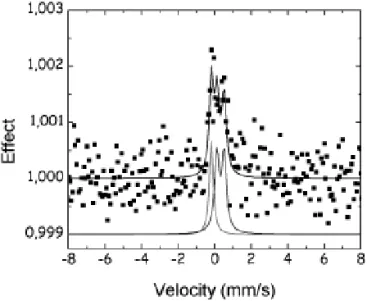
The M¨ossbauer spectrum of an Fe-poor sample (Fe20Cu80) was recorded at room temperature (see Figure 4). A non mag-netic spectrum was observed, in agreement with superpara-magnetic behaviour. This is consistent with the results de-rived above in Fe10Cu90, from magnetization measurements. It confirms the presence of Fe clusters in these alloys. Note that the observed isomer shift found is characteristic of fcc Fe-Cu alloys.
FIG. 4: M¨ossbauer spectrum at room temperature for a Fe20Cu80 alloy
V. ANALYSIS
The presence of Fe clusters in the present Fe-Cu alloys may naturally be associated with the immiscibility of the constitut-ing elements, Fe and Cu. It indicates that, at the deposition temperature, the atoms keep sufficient mobility to assemble and reach a state of lower energy than in the metastable al-loyed state.
We focus on the Fe10Cu90 alloy. The predominance of inter-cluster positive interactions leads us to propose that the clusters orders ferromagnetically below the paramagnetic Curie temperature of 160 K. However the spontaneous mag-netization is significantly lower than the magmag-netization ob-tained at saturation (see Figure 1). Due to the expected het-erogenous nature of the magnetization in these materials it may be suggested that long-range dipolar interactions mani-fest themselves at the scale of groups of clusters, leading to the formation of non-collinear magnetic arrangements.
In a system of magnetic particles diluted in an essen-tially non-magnetic matrix, the magnetic interactions (dipo-lar, RKKY, etc· · ·), are usually distributed about the value 0.
They tend to stabilize cluster glass low-T moment
arrange-ments with no bulk resulting magnetization. The existence of ferromagnetic order in a cluster assembly is termed super-ferromagnetism [10]. It implies that positive exchange in-teractions dominate other inin-teractions [11]. Superferromag-netism has been found essentially in systems made of insu-lating matrices. In the present metallic system, (weak) inter-cluster exchange-coupling may a priori occur (i) via isolated Fe atoms within the Cu matrix or/and (ii) via direct local con-tact between clusters. Below the percolation limit, exchange via direct contact may only lead to the formation of finite-size ferromagnetic domains encompassing several clusters. Thus the observed formation of an infinite cluster suggests that iso-lated Fe atoms are present within the Cu matrix. Note that the transition from superferromagnetism to normal ferromag-netism occurs around x=30, close to the percolation limit (x=28). This suggests that as soon as clusters become in contact, strong inter-cluster exchange interactions develop, of which strength is of the same order of magnitude as intra-cluster interactions.
In previous studies, the properties of Fe-Cu alloys in the as-deposited state were discussed assuming that the Fe atoms were homogeneously distributed within the matrix [5,6,8,9]. Only after annealing, Fe clusters were found to occur. In the present system, the presence of clusters in the as-prepared alloys may be tentatively attributed to the pulsed electrodepo-sition procedure used. The instantaneous depoelectrodepo-sition rate of each given element is very high and due to their respective immiscibility, cluster formation is favoured.
VI. CONCLUSION
In Fe-Cu metastable alloys prepared by pulsed electrode-position, it was shown that Fe clusters form directly within a non-magnetic Cu matrix. The clusters were shown to contain around 140 Fe atoms and to be superparamagnetic at room temperature. Below 160 K it was suggested that the clusters order into a superferromagnetic arrangement. This original behaviour was attributed to the persistence of weak exchange interactions mediated by isolated Fe atoms dispersed within the Cu non-magnetic matrix. Domain observation using low temperature MFM could help in establishing unambiguously the nature of the magnetic order in these materials.
Superferromagnetic materials may show very large mag-netic susceptibility and it has been suggested that they could be used in applications where high magnetic permeability is needed [17]. This includes microelectronics devices (e.g small inductances) and micro-sensors.
Acknowledgment
Brazilian Journal of Physics, vol. 39, no. 1A, April, 2009 185
[1] X. Batlle and A. Labarta J. Phys. D: Appl. Phys.35, R15–R42 (2002).
[2] A.E. Berkowitz, J.R. Mitchell, M.J. Carey, A.P. Young, S. Zhang, F.E. Spada, F.T. Parker, A. Hutten and G. Thomas, Phys. Rev. Lett.,68, 3745 (1992)
[3] A.B. Pakhomov, X. Yan, B. Zhao, Appl. Phys. Lett.67, 3497 (1995)
[4] J.L. Dormann, D. Fiorani, E. Tronc, Adv. Chem. Phys.98, 283 (1997)
[5] C.L. Chien, S.H. Liou, D. Kofalt. W. Yu and T. Egami, Phys. Rev.B33, 3247 (1986)
[6] J. Eckert, J.C. Holzer, W. L. Johnson, J. Appl. Phys.73, 131
(1993)
[7] R.D. Noce, O. Gomes, W. Wolf, S. M. Dore , A. C. de Castro, D. Givord and V.M.T. S.Barthem (unpublished).
[8] Y. Ueda, placeN. Kikuchi, Jpn. J. Appl. Phys.32, 1779 (1993). [9] M.K. Roy, V.S. Subrahmanyam, H.C. Verma, Phys. Lett. A
328,375 (2004).
[10] W. Kleemann, O. Petracic, Ch. Binek, G.N. Kakazei, Y.G. Pogorelov, J.B. Sousa,
S. Cardoso, P.P. Freitas, Phys. Rev.B 63,134423 (2001). [11] D. G. Rancourt and J. M. Daniels, Phys. Rev. B 29, 2410