American Journal of Engineering Research (AJER)
e-ISSN : 2320-0847 p-ISSN : 2320-0936
Volume-03, Issue-06, pp-154-168
www.ajer.org
Research Paper Open Access
A Multi-Variables Multi -Sites Hydrological Forecasting Model
Using Relative Correlations
Prof. Dr. Rafa H Al-Suhili
2and Prof. Dr. Reza Khanbilvardi
21 The Senior Prof. of the Civil Engineering Dept., University of Baghdad, Baghdad, Iraq A Visiting Prof. to
the City College of New York, New York, USA.
2 Director , NOAA-Cooperative Remote Sensing Science and Technology Center Director International
Center for Environmental , Resources and Development Prof. of Civil Engineering Dept, City College of New York, New York, USA
Abstract: -A multi-variables multi-sites hydrological data forecasting model was derived and checked using a
case study. The philosophy of this model is to use the cross-variables correlations, cross-sites correlations and the time lag correlations simultaneously. The case study is of four variables and three sites. The variables are the monthly air temperature, humidity, precipitation, and evaporation; the sites are Sulaimania, Chwarta, and Penjwin, which are located north Iraq. This model represents a modification of the model proposed by Al-Suhili and Mustafa(2013). The model performance was compared with four well known forecasting models developed for the same data. These models are the single-site single-variable first order auto regressive, the multi-variables single-site Matalas(1967), the single-variable multi-sites Matalas(1967), and Al-Suhili and Mustafa models. In addition to that another multi-variables multi-sites model was developed herein similar in its concept to the Matalas(1967) model considering the variables as an additional sites. The results of the six models for three forecasted series for each variable, were compared using the Akaike test which indicates that the developed model is more successful, since it gave the minimum (AIC) values for ( 83.33 %) of the forecasted series. This indicates that the developed model had improved the forecasting performance. Moreover the t-test for monthly means comparison between the models indicates that the developed model has the highest percentage of succeed (94.44%).
Keywords: - Forecasting, Multi-sites, Multi-variables, Cross sites correlation, Serial correlation, Cross
variables correlations, Hydrology,
I.
INTRODUCTION
Weather generation models have been used successfully for a wide array of applications. They became increasingly used in various research topics, including more recently, climate changes studies. They can generate series of climatic data with the same statistical properties as the observed ones. Furthermore, weather generators are able to produce series for any length in time. This allows developing various applications linked to extreme events, such as flood analyses, and draught analysis, hence allowing proper long term water resources management to face the expected draught or flood events. There exist in the literature many types of stochastic models that simulate weather data required for various water resources applications in hydrology, agriculture, ecosystem, climate change studies and long term water resource management.
Single site models of weather generators are used for forecasting a hydrological variable at a single site independent of the same variable at the near sites, and thus ignoring the spatial dependence exhibited by the observed data. On the other hand single variable forecasting models are used for forecasting a hydrological variable in a site independent of the other related variables at the same site, thus ignoring the cross variables relations that may physically exist between these variables. Tobler (1970) mentioned in the first law of
daily precipitation, maximum temperature, minimum temperature, and solar radiation, as cited in Wilks (1999). This model forecast a hydrological variable at multiple sites, hence simulate the cross sites dependency between these sites. The Multi-variables models are similar to the multi-sites model but simulate the cross variables dependency that exists between some variables at a certain site. The two models forms are similar but using cross sites correlations in the first one , while the second one uses the cross variables correlations. Much progress had been made principally in the last 20 years to come up with theoretical frameworks for spatial
analysis Khalili(2007).Some models, such as space–time models have been developed to regionalize the weather
generators. In these models, the precipitation is linked to the atmospheric circulation patterns using conditional distributions and conditional spatial covariance functions Lee et al (2010). The multi-site weather generators presented above are designed using relevant statistic information. Most of these models are either complicated or some are applicable with a certain conditions. There exist in the literature some relatively recent trials to account for the spatial variation in multi-sites. Calder(2007) had proposed a Bayesian dynamic factor process convolution model for multivariate spatial temporal processes and illustrated the utility of the approach in modeling large air quality monitoring data. The underlying latent components are constructed by convolving temporally-evolving processes defined on a grid covering the spatial domain and include both trend and cyclical components. As a result, by summarizing the factors on a regular spatial grid, the variation in information about the pollutant levels over space can be explored.
In real situation both cross variables and cross sites correlation may exist between different hydrological variables at different sites. Al-Suhili et al(2010) had presented a multisite multivariate model for forecasting different water demand types at different areas in the city of Karkouk, north Iraq. This model first relate each demand type with explanatory variables that affect its type, using regression models, then obtaining the residual series of each variable at each site. These residual are then modeled using a multisite Matalas(1967) models for each type of demand. These models were then coupled with the regression equation to simulate the mult-isites multi-variables variation. The last two cited research are those among the little work done on forecasting models of multi-sites multi-variables types. However these model are rather complicated, and/or do not model the process of cross site and cross variables correlation simultaneously, which as mentioned above is the real physical case that exist. Hence researches are further required to develop a simplified sites multi-variables model. Al-Suhili and Mustafa(2013) had proposed a multi-multi-variables multi-sites model that uses relative correlation matrix and a residual matrix as the model parameters to relate the dependent and independent stochastic components of the data. This model represents the dependent stochastic of each variable at a time step as a weighted sum of the dependent stochastic component at the preceding time step and the present independent stochastic components. However these weights are not summed to one, while logically they should be. Moreover the model was applied for only eight months of the year (October to May) excluding these months of zero precipitation values.
In this research a modified multi-sites multi-variables approach is proposed to develop a model that describe the cross variables, cross sites correlation and lag-time correlation structure in the forecasting of multi variables at multi sites simultaneously. This model represents a modification of Al-Suhili and Mustafa model(2013). The modification is done such that the total weights of the weighted components summed to 1, i.e. each variable is resulted from the weighted sum of the other variables in the same site and those in the other sites in addition to the same variable at the preceding time step. This was done by adopting a different method for estimating the parameters of the model. Moreover the model was applied for all the months of the year that includes zero values for the precipitation. The problem was overcome by adding a constant value of 0.1 to the whole precipitation data series, to investigate whether this modification can solve this problem of zero values. This model was applied to a case study of monthly data of four hydrological variables, air temperature,
humidity, precipitation and evaporation at three sites located north Iraq, Sulaimania, Chwarta, and Penjwin.
II.
THE MODEL DEVELOPMENT
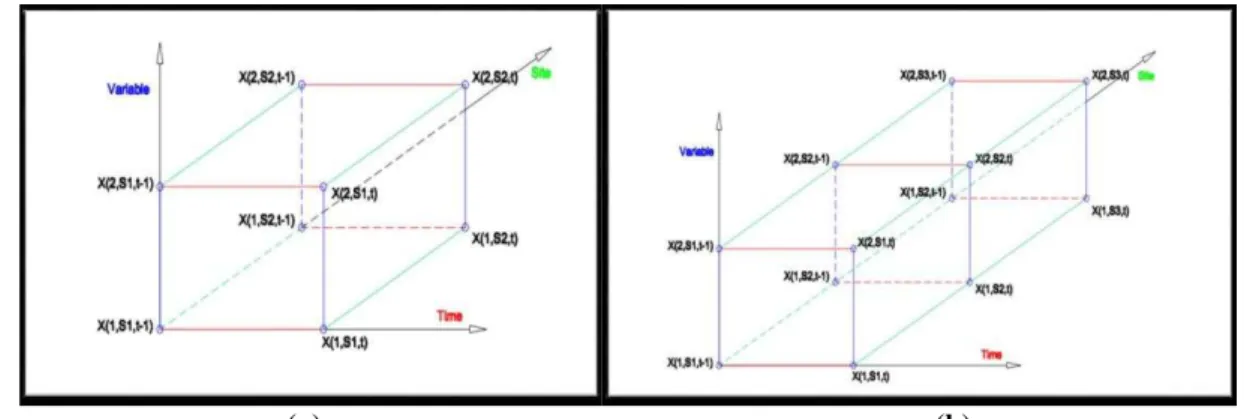
This model can be extended further to (V-variables) and / or (S-sites) and / or (O- time) order. The model concept assume that each variable dependent stochastic component at time t can be expressed as a function of the independent stochastic component for all other variables at time (t), and those dependent component for all variables at time (t-1) at all sites. The expression is weighted by the serial correlation coefficients, cross-site correlation coefficients, cross-variable coefficients and cross-site, cross-variable correlation coefficients. In addition to that; the independent stochastic components are weighted by the residuals of all types of these correlations. These residual correlations are expressed using the same concept of autoregressive first order model (Markov chain). Further modification of this model is to use relative correlation matrix parameters by using correlation values relative to the total sum of correlation for each variable, and the total sum of residuals as a mathematical filter ,as will be shown later.
A model matrix equation for first order time lag, O=1, number of variables=V, and number of sites=S, could be put in the following form:
[ ϵt]v*s,1 = [ρ]v*s,v*s* [ϵt-1] v*s,1 + [σ ] v*s,v*s * [ξt] v*s,1 (1)
Which for V=2,S=3,and O=1, can be represented by the following equation:
[ ϵt]6,1 = [ρ]6,6* [ϵt-1] 6,1 + [σ ] 6,6* [ξt] 6,1 (2)
Where :
= [ ϵt]6,1 (3)
t
= [ϵt-1] 6,1 (4)
= [ξt] 6,1 (5)
t
= [ρ]6,6 (6)
= [σ ] 6,6 (7)
where:
ρ1,1 = ρ [(x1, x1), (s1, s1), (t, t-1) ]= population serial correlation coefficient of variable 1 with itself at site 1 for
time lagged 1
ρ1,2 = ρ [(x1, x2), (s1, s1), (t, t-1) ]= population cross correlation coefficient of variable 1 at site 1 with variable 2
at site 1, for time lagged 1
ρ1,3 = ρ [(x1, x1), (s1, s2), (t, t-1) ]= population cross correlation coefficient of variable 1 at site 1 with variable 1
at site 2, for time lagged 1
ρ1,4 = ρ [(x1, x2), (s1, s2), (t, t-1) ]= population cross correlation coefficient of variable 1 at site 1 with variable 2
ρ1,5 = ρ [(x1, x1), (s1, s3), (t, t-1) ]= population cross correlation coefficient of variable 1 at site 1 with variable 1
at site 3, for time lagged 1
ρ1,6 = ρ [(x1, x2), (s1, s3),(t,t-1) ]= population cross correlation coefficient of variable 1 at site 1 with variable 2
at site 3, for time lagged 1,the definition continues… , finally
ρ6,6 = ρ [(x2, x2), (s3, s3), (t, t-1) ]= population serial correlation coefficient of variable 2 at site 3 with variable
2 at site 3, for time lagged 1.
The designation (ρ i,j ) is used for simplification .
ϵ: is the stochastic dependent component.
ξ: is the stochastic independent component.
σ i,j : is the residual of the correlation coefficient ρ i,j.
The matrix equation (2) can be written for each term, for example for the first term:
ϵ(1,s1,t)= ρ1,1 * ϵ(1,s1,t-1)+ ρ1,2 * ϵ(2,s1,t-1)+ ρ1,3 * ϵ(1,s2,t-1)+ ρ1,4 * ϵ(2,s2,t-1)+
ρ1,5 * ϵ(1,s3,t-1)+ ρ1,6 * ϵ(2,s3,t-1) + σ 1,1 * ξ(1,s1,t)+ σ 1,2 * ξ(2,s1,t)+ σ 1,3 * ξ(1,s2,t)+ σ 1,4 *
ξ(2,s2,t)+ σ 1,5 * ξ(1,s3,t)+ σ 1,6 * ξ(2,s3,t) (8)
Similar equations could be written for the other variables. The correlation coefficient in each equation is filtered by a division summation filter, as in the following equation:
. (9)
Where is the relative correlation coefficient of row i and column j of the matrix given in eq.(6). σ values
are estimated using the following equation:
(10)
Then these σ i,j are also filtered using an equation similar to eq.(9) as follows:
(11)
Then the model matrix equation is the same as that appear in eq.(2), replacing ρi,j values by the
corresponding relative values in equation (6), and σi,j with the corresponding relative values σri,j in equation
(7) . The differences of this model than that proposed by Al-Suhili and Mustafa( 2013), are in eqs(9) and (11),
where for the first equation the denominator is the sum of ρi,j , only , while for the second equation it is the sum
of σ i,j , only. The model can be generalized to any number of variables and number of sites.
III.
THE CASE STUDY AND APPLICATION OF THE MODEL:
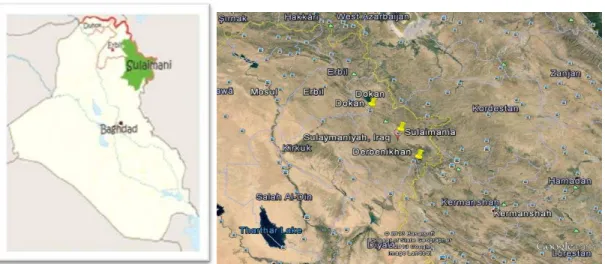
area of (17023 km2). Table 1 shows the names, latitudes, longitudes and elevations of these stations. Figure 2 shows a Google map of the locations of these stations. Table 2 shows the approximate distances between these stations.
The model was applied to the data of the case study described above. The length of the records for the four variables and the three stations is (8) years of monthly values, (2004-2011). The data for the first (5) years, (2004-2008) were used for model building, while the left last 3 years data, (2009-2011) were used for verification. The data includes the precipitation as a variable which has zero values for June, July, August and September, in the selected area of the case study. These months are included in the analysis, by adding a constant value to the precipitation series of 0.1 to avoid the problems that may be created by these zeros. Hence the model was built for the all of the months from January to December, rather than for October to May as proposed by Al-Suhili and Mustafa(2013).
The first step of the modeling process is to check the homogeneity of the data series. The split sample test suggested by Yevjevich(1972 )was applied for this purpose for each data series to test the homogeneity both in mean and standard deviation values . The data sample was divided into two subsamples with sizes (n1=5,and n2=3) as number of years for subsample one and subsample two respectively. The split sample test estimated t-values were compared with the critical t-value. If the t-value estimated is greater than the critical t-value then the data series is considered as non-homogeneous, and thus this non-homogeneity should be removed. The results of this test had showed that there are some variables exhibits non- homogeneity. Tables 3 and 4 show these results, which indicates that non-homogeneity is exist in each of Sulaimania air temperature, Penjwin humidity, Penjwin air temperature, and Penjwin evaporation series, while the series of the other variables are homogeneous. To remove this non-homogeneity the method suggested by Yevjevich (1972 ), was used by applying the following data transformation to the series of the non-homogeneous variables for the n1 years:
(12)
Where,
Hi,j : is the homogenized series at year i, month j of the first sub-sample (old n1 series).
Xi,j : is the original series at year i, month j, of the first sub-sample .
A1, B1: are the linear regression coefficients of the annual means.
A2,B2 : are the linear regression coefficients of the annual standard deviations.
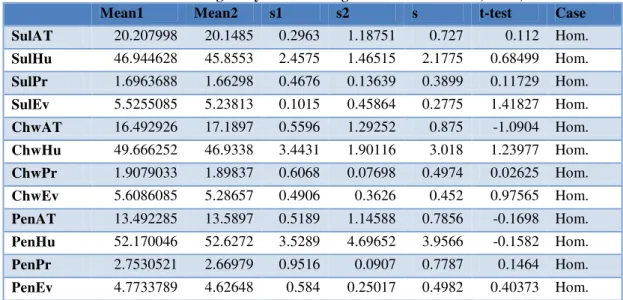
Mean2,Sd2 : are the overall mean and standard deviation of the second sub-sample(recent n2 series). This implies that the data is homogenized according to the second sub-sample, i.e., the most recent one which is the correct way for forecasting. Table 5 shows the values of Mean2, Sd2, A1, B1, A2, and B2, for the non-homogeneous series. Tables 6 and 7 show the results of the split sample test after the application of equation (12), which ensures that the data series are all now homogeneous.
The second step in the modeling process is to check and remove the trend component in the data if it is exist. This was done by finding the linear correlation coefficient (r) of the annual means of the homogenized series, and the T-value related to it. If the t-value estimated is larger than the critical t-value then trend exists, otherwise it is not. The following equation was used to estimate the t-values.
T = (13)
Where
n: is the total size of the sample.
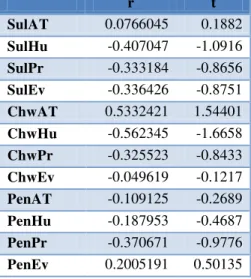
Table 8 shows the trend test results, which indicate the absence of the trend component in all of the data series of the twelve variables.
The third step of the modeling process is the data normalization of the data to reduce the skewness coefficient to zero. The well known Box-Cox transformation Box and Jenkin (1976), was used for this purpose as presented in the following equation:
(14)
Where:
µ : is the power of the transformation.
α : is the shifting parameter.
Table 9 shows the coefficients of the normalization transformation of all of the twelve series. A shifting parameter of constant value 5 is selected to ensure avoiding any mathematical problem that may occur due to the fraction value of the power µ. The power value is found by trial and error so as to select the one that reduce the skewness to almost zero value. However it was found that for the precipitation series in the three locations the required normalization transformation is of high negative value of order less than -4. If these values were selected the series is transformed to values that numerically differ after the 6 digits beyond the point, which means a very high accuracy is needed to perform the analysis which is not assured even if the long format of the Matlab software is used. Hence, for the precipitation series the minimum power value obtained among the other variables was used (-0.55). This transformation power will not let the skewness of the precipitation reduces to nearly zero as required, but at least reduce this skewness to values that are much smaller than the skewness of the homogenized series. Table 11 shows that the skewness coefficients are reduced to almost zeros for the data series, with an exception of the precipitation , which have skewness values less than 1.
The fourth step in the modeling process is to remove the periodic component if it exist to obtain the stochastic dependent component of the series, which is done by using eq.(15), as follows:
= (15)
Where:
ϵi,j : is the obtained dependent stochastic component for year i, month j.
Xbj : is the monthly mean of month j of the normalized series XN.
Sdj : is the monthly standard deviation of month j of the normalized series XN.
The existence of the periodic components is detected by drawing the corrlogram up to at least 25 lags, if the curve exhibits periodicity then the periodic components are exist, otherwise it is not. Figure 3 shows the correlograms of the normalized data, where the periodic component is clear. Figure 4 shows the correlograms of the dependent stochastic component, which indicates the removal of the periodic components.
The fifth step in the modeling process is to estimate the parameters of the model. The ϵi,j obtained
series are used to estimate the Lag-1 serial and cross correlation coefficients ρi,j , and σi,j of matrix eqs. (6) and
(7) respectively, which then used to estimate the model parameters ρri,j and σri,j using eqs.(9), and (11),
respectively.
For the sake of comparison between the developed model and the known forecasting models in the literature, five types of forecasting models were developed for the same data of the case study. For each variable a single variable single site first order autoregressive model ( 8 models), for each site multi-variables single site first order Matalas model(3 models), for each variable a single variable multi-sites first order Matalas model (4 models) ,Al-Suhili and Mustafa multi-variables multi-sites model(1 model), and a multi-variables multi-sites Matalas model(1 model).
IV.
FORECASTING RESULTS AND DISCUSSION
The developed models mentioned above are used for data forecasting, recalling that the estimated parameters above are obtained using the 5 years data series (2004-2008). The forecasted data are for the next 3- years (2009-2011), that could be compared with the observed series available for these years, for the purpose of model validation. The forecasting process was conducted using the following steps:
1. Generation of an independent stochastic component (�) using normally distributed generator, for 3 years, i.e.,
(3*12) values.
2. Calculating the dependent stochastic component (ϵi,j ) using equation (2) and the matrices of ρri,jand σri,j as
shown in eqs.(9), and (11),respectively.
3. Reversing the standardization process by using the same monthly means and monthly standard deviations which were used for each variable to remove periodicity using eq. (15) after rearranging.
4. Applying the inverse power normalization transformation (Box and Cox) for calculating un-normalized variables using normalization parameters for each variable and eq.(14).
In most forecasting situation, accuracy is treated as the overriding criterion for selecting a model. In
many instance the word “accuracy” refers to “goodness of fit,” which in turn refers to how well the forecasting
model is able to reproduce the data that are already known. The model validation is done by using the following steps:
1. Checking if the developed monthly model resembles the general overall statistical characteristics of the observed series.
3. Checking the performance of the model of the hole forecasted series using Akaike test.
The Akaike test can be used also for the purpose of comparison of the forecasting performance between the new multi-variables multi-sites model developed herein and the other models. This performance comparison was made to investigate whether the new model can produce better forecasted data series. For this purpose the Akaike (AIC), test given by the following equation was used:
(16)
Where:
n: is the number of the total forecasted values . K: number of parameters of the model plus 1.
Rss: is the sum of square error between the forecasted value and the corresponding observed value.
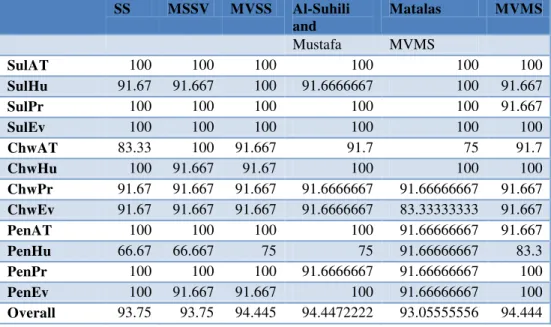
For each site and variable three sets of data are generated, using the six different models mentioned above. The overall statistical characteristics are compared with those observed, for each of the generated series. It is observed that the six models can all give good resemblances for these general statistical properties. For all variables and sites the generated sets resemble the statistical characteristics not exactly with the same values of the observed series but sometimes larger or smaller but within an acceptable range. No distinguishable performance of any of the model can be identified in this comparison of the general statistical properties. Tables 10,11 and 12 show the t-test percent of succeed comparison summary for all of the variables and sites, for the three generated series. As it is obvious from the results of these tables, the generated series for the first four model succeed in (t-test) with high percentages except for the Penjwin station where sometimes low percentage is observed. It is also clear that the developed model had increased the percent of succeed. The developed model had the highest overall percent of succeed among the other models. However the overall succeed percent given by the Al-suhili and Mustafa model is almost similar to that given by the developed model.
As mentioned above for purpose of the comparison between the developed model performance and that of the available forecasting models and developed for the data as mentioned above, the Akaike(1974) test was used. Table 13, shows the Akaike test results for all of the forecasted variables, in each site, obtained using the developed five models and those obtained by the developed model. It is obvious that the developed model had produced for most of the cases the lowest test value, i.e, the better performance. These cases represent (83.33%). Al-Suhili and Mustafa model had gave the lowest test value for the remaining cases (16.66%). However for these cases the developed model had gave the next lowest AIC values. Moreover for these cases it is observed that very small differences are exist between these test values of the new model and the minimum obtained one. Figure 5 shows comparisons between the observed and the generated series using the developed model for the whole three years and between the monthly means of these two series. This figure indicates the capability of the model for forecasting the future variation of all of the variables.
V.
CONCLUSIONS
From the analysis done in this research, the following conclusion could be deduced:
The model parameters can be easily estimated and do not require any extensive mathematical manipulation. The model can preserve the overall statistical properties of the observed series with high accuracy. However this is also observed for the other five models developed for the same variables.
The model can preserve the monthly means of the observed series with excellent accuracy, evaluated using the t-test with overall success (94.4%). This percent is almost the highest among the those obtained by the other model, except that the Al-Suhili and Mustafa model(2013), had presented a very close values.
The comparison of the model performance with the other models performances using the Akaike test had proved that the developed model had a better performance for the most cases(83.33%). Moreover for those remaining cases where Al-suhaili and Mustafa(2013) model had the better performance( minimum AIC value); the test value of the developed model is slightly higher than this minimum value.
REFERENCES
[1] Al-Suhili, R. H. and Mustafa, N.F. " A Multi- variables Multi-sites model for
[2] Hydrological Series Data Forecasting", accepted for publication at the Journal of Eng. College of
Engineering, University of Baghdad, 2003.
[3] Al-Suhili R.H., Al-Kazwini, M. J., and Arselan, C. A.," Multivariate Multisite Model MV.MS. Reg. for
Water Demand Forecasting", Eng. and Tech. Journal Vol. 28, No. 13, 2010, pp 2516-2529.
[4] Akaike, H., 1974, “A New Look at the Statistical Model Identification”, IEEE T. Automat. Contr., 19 (6),
[5] Barzinji K. T., 2003,"Hydrogic Studies for Goizha Dabashan and Other Watersheds in Sulimani Governorate ", M.Sc. thesis submitted to the college of Agriculture, University of Sulaimania.
[6] Box, G.E., and Jenkins, G. M. (1976),"Time Series Analysis and Control", San Francisco, California:
Holden-Day, Inc.
[7] Calder C.A.,2007, “Dynamic Factor Process Convolution Models for Multivariate Space-Time Data with
Application to Air Quality Assessment", J. Environ. Ecol. Stat. Vol.14: pp229-247.
[8] Khalili M, Leconte R. and Brissette F., 2007, "Stochastic Multisite Generation of Daily Precipitation Data
Using Spatial Autocorrelation", J Hydrometeorology, Vol.8, pp 396-412
[9] Lee S. J. and Wents E. A., 2010, "Space-Time Forecasting Using Soft Geo statistics: A Case Study in
Forecasting Municipal Water Demand for Phonex, Arizona", journal of Stochastic Environ Risk Assess vol. 24: pp 283- 295
[10] Matalas N.C., 1967,” Mathematical Assessment of Synthetic hydrology”, journal of Water Resources Researches vol. 3: pp 937-945.
[11] Richardson C. W. and Wright D. A., 1984, "WGEN: A Model for Generating Daily Weather Variables",
United States Department of Agriculture, Agriculture Research Service ARS-8 .
[12] Tobler W., 1970 "A computer Movie Simulating Urban Growth in the Detroit Region". Economic
Geography, 46(2): pp234-240.
[13] Wilks D. S.,1999, "Simultaneous Stochastic Simulation of Daily Precipitation, Temperature and Solar
Radiation at Multiple Sites in Complex Terrain", journal of Elsevier, agricultural and forest meteorology 96:pp 85-101.
[14] Yevjevich, V. M., 1972 "The structure of Hydrologic Time Series", Fort Collins, Colorado State
University
(a) (b)
Fig. 1 Schematic representation of the developed multi-variables multi-sites model, a)MVMS(2,2,1), b) MVMS(2,3,1).
Table 1 North and east coordinates of the metrological stations selected for analysis.
Metrological station N E
Sulaimania 35o 33' 18 " 45o 27' 06"
Dokan 35o 57’ 15” 44o 57' 10"
Fig. 2 Locations of the metrological stations selected for analysis.
Table 2 Approximate distances between the Sulaimania weather stations network (Km.).
Name of Weather Station
Su
laim
an
i
Du
k
an
Dar
b
an
d
ik
h
an
Pen
jwin
C
h
war
ta
Hala
b
jah
B
az
ian
C
h
am
ch
am
al
Sulaimani 0 62.76 54.00 45.88 20.85 63.36 29.17 56.10
Dukan 62.76 0 114.73 97.10 61.20 125.85 42.00 47.90
Darbandikhan 54.00 114.73 0 61.40 68.68 28.36 73.98 90.57
Penjwin 45.88 97.10 61.40 0 36.53 48.22 74.15 102.12
Chwarta 20.85 61.20 68.68 36.53 0 69.73 41.30 69.90
Halabjah 63.36 125.85 28.36 48.22 69.73 0 89.50 111.05
Bazian 29.17 42.00 73.98 74.15 41.30 89.50 0 28.41
Chamchamal 56.10 47.90 90.57 102.12 69.90 111.05 28.41 0
Table 3 Test of homogeneity of the original data in mean, n1=5,n2=3.
Mean1 Mean2 s1 s2 s t-test Case
SulAT 19.9008 20.1485 0.4507 1.18751 0.778 -0.436 Hom.
SulHu 46.9446 45.8553 2.4575 1.46515 2.178 0.68499 Hom.
SulPr 1.69637 1.66298 0.4676 0.13639 0.39 0.11729 Hom.
SulEv 5.52551 5.23813 0.1015 0.45864 0.277 1.41827 Hom.
ChwAT 16.4929 17.1897 0.5596 1.29252 0.875 -1.0904 Hom.
ChwHu 49.6663 46.9338 3.4431 1.90116 3.018 1.23977 Hom.
ChwPr 1.9079 1.89837 0.6068 0.07698 0.497 0.02625 Hom.
ChwEv 5.60861 5.28657 0.4906 0.3626 0.452 0.97565 Hom.
PenAT 13.9755 13.5897 0.7737 1.14588 0.915 0.57744 Hom.
PenHu 63.3525 52.6272 6.9884 4.69652 6.318 2.32467 NonHom.
PenPr 2.75305 2.66979 0.9516 0.0907 0.779 0.1464 Hom.
PenEv 5.46681 4.62648 0.4845 0.25017 0.421 2.7322 NonHom.
Mean1 Mean2 s1 s2 s t-test case
SulAT 10.1889 9.52285 0.2866 0.47757 0.362 2.52179 NonHom.
SulHu 18.7659 17.4115 2.5053 0.99604 2.125 0.8728 Hom.
SulPr 2.18701 1.86037 0.6365 0.28427 0.545 0.82064 Hom.
SulEv 3.69204 3.52068 0.21 0.36782 0.273 0.85961 Hom.
ChwAT 10.5129 9.65657 0.5551 0.6469 0.587 1.99648 Hom.
ChwHu 16.0407 15.7313 2.1606 1.65751 2.007 0.21105 Hom.
ChwPr 2.43547 2.12283 0.8342 0.23539 0.695 0.61639 Hom.
ChwEv 3.8826 3.59904 0.2506 0.02954 0.205 1.89074 Hom.
PenAT 11.3524 9.38528 1.094 0.84784 1.019 2.64447 NonHom.
PenHu 13.033 14.0986 1.492 3.44251 2.331 -0.6259 Hom.
PenPr 3.50955 2.82328 1.3632 0.34376 1.131 0.83116 Hom.
PenEv 4.10278 3.75387 0.5069 0.2391 0.436 1.09505 Hom.
Table 5 Linear fitting equations for removal of non-homogeneity.
A1 B1 R1 A2 B2 R2
SulAT 19.534 0.102 0.342 10.22 -0.062 0.318
SulHu 48.102 -0.348 0.407 20.859 -0.578 0.678
SulPr 1.904 -0.049 0.333 2.481 -0.092 0.425
SulEv 5.601 -0.041 0.336 3.817 -0.042 0.385
ChwAT 15.886 0.193 0.533 10.522 -0.073 0.256
ChwHu 51.877 -0.719 0.562 17.164 -0.275 0.362
ChwPr 2.178 -0.061 0.325 2.834 -0.114 0.422
ChwEv 5.529 -0.009 0.05 3.843 -0.015 0.151
PenAT 14.562 -0.162 0.457 12.504 -0.42 0.741
PenHu 72.717 -2.975 0.904 13.267 0.037 0.04
PenPr 3.213 -0.109 0.371 4.238 -0.219 0.485
PenEv 5.63 -0.106 0.446 3.993 -0.005 0.026
Table 6 Test of homogeneity of the homogenized data in mean, n1=5,n2=3.
Mean1 Mean2 s1 s2 s t-test Case
SulAT 20.207998 20.1485 0.2963 1.18751 0.727 0.112 Hom.
SulHu 46.944628 45.8553 2.4575 1.46515 2.1775 0.68499 Hom.
SulPr 1.6963688 1.66298 0.4676 0.13639 0.3899 0.11729 Hom.
SulEv 5.5255085 5.23813 0.1015 0.45864 0.2775 1.41827 Hom.
ChwAT 16.492926 17.1897 0.5596 1.29252 0.875 -1.0904 Hom.
ChwHu 49.666252 46.9338 3.4431 1.90116 3.018 1.23977 Hom.
ChwPr 1.9079033 1.89837 0.6068 0.07698 0.4974 0.02625 Hom.
ChwEv 5.6086085 5.28657 0.4906 0.3626 0.452 0.97565 Hom.
PenAT 13.492285 13.5897 0.5189 1.14588 0.7856 -0.1698 Hom.
PenHu 52.170046 52.6272 3.5289 4.69652 3.9566 -0.1582 Hom.
PenPr 2.7530521 2.66979 0.9516 0.0907 0.7787 0.1464 Hom.
PenEv 4.7733789 4.62648 0.584 0.25017 0.4982 0.40373 Hom.
Mean1 Mean2 s1 s2 s t-test case
SulAT 9.6723865 9.52285 0.3562 0.47757 0.4008 0.51093 Hom.
SulHu 18.76593 17.4115 2.5053 0.99604 2.1249 0.8728 Hom.
SulPr 2.1870135 1.86037 0.6365 0.28427 0.545 0.82064 Hom.
SulEv 3.6920379 3.52068 0.21 0.36782 0.273 0.85961 Hom.
ChwAT 10.512893 9.65657 0.5551 0.6469 0.5873 1.99648 Hom.
ChwHu 16.040672 15.7313 2.1606 1.65751 2.007 0.21105 Hom.
ChwPr 2.4354703 2.12283 0.8342 0.23539 0.6945 0.61639 Hom.
ChwEv 3.882598 3.59904 0.2506 0.02954 0.2054 1.89074 Hom.
PenAT 9.4755896 9.38528 0.7297 0.84784 0.7711 0.16037 Hom.
PenHu 13.737973 14.0986 1.6012 3.44251 2.379 -0.2075 Hom.
PenPr 3.5095495 2.82328 1.3632 0.34376 1.1306 0.83116 Hom.
PenEv 3.8723131 3.75387 0.4844 0.2391 0.4189 0.38718 Hom.
Table 8 Trend detection test after removing non-homogeneity.
r t
SulAT 0.0766045 0.1882
SulHu -0.407047 -1.0916
SulPr -0.333184 -0.8656
SulEv -0.336426 -0.8751
ChwAT 0.5332421 1.54401
ChwHu -0.562345 -1.6658
ChwPr -0.325523 -0.8433
ChwEv -0.049619 -0.1217
PenAT -0.109125 -0.2689
PenHu -0.187953 -0.4687
PenPr -0.370671 -0.9776
PenEv 0.2005191 0.50135
Table 9 Normalization transformation power, and skewness for data (2004-2008).
Power Skewness
SulAt 1.1 0.007658458
SulHu 0.9 0.008000455
SulPr -0.55 0.756794614
SulEv -0.55 0.001047691
ChwAt 1 0.000888238
ChwHu 1 0.001705557
ChwPr -0.55 0.749611239
ChwEv -0.35 -0.005834051
PenAT 1.05 -0.003692929
PenHu 1.1 -6.97121E-05
PenPr -0.55 0.62709928
0 5 10 15 20 25
-1 -0.8 -0.6 -0.4 -0.2 0 0.2 0.4 0.6 0.8 1
Lag
S
erial C
orre
lati
on C
oeff
icie
nt
0 5 10 15 20 25
-0.5 -0.4 -0.3 -0.2 -0.1 0 0.1 0.2 0.3 0.4 0.5
Lag
S
erial C
orre
latio
n C
oeff
icie
nt
0 5 10 15 20 25
-1 -0.8 -0.6 -0.4 -0.2 0 0.2 0.4 0.6 0.8 1
Lag
S
erial C
orre
lati
on C
oeff
ic
ient
0 5 10 15 20 25
-1 -0.8 -0.6 -0.4 -0.2 0 0.2 0.4 0.6 0.8 1
Lag
S
erial C
orr
elati
on C
oe
ffic
ient
0 5 10 15 20 25 -0.8 -0.6 -0.4 -0.2 0 0.2 0.4 0.6 0.8 Lag Seri al C orr ela tion C oe ffic ie nt
0 5 10 15 20 25
-0.5 -0.4 -0.3 -0.2 -0.1 0 0.1 0.2 0.3 0.4 0.5 Lag S eri al C orr ela tion C oeff ic ie nt
0 5 10 15 20 25
-1 -0.8 -0.6 -0.4 -0.2 0 0.2 0.4 0.6 0.8 1 Lag Seri al C orr ela tion C oe ffic ie nt
0 5 10 15 20 25
-1 -0.8 -0.6 -0.4 -0.2 0 0.2 0.4 0.6 0.8 1 Lag Seri al C orr ela tion C oe ffic ie nt
b1 b2 b3 b4
0 5 10 15 20 25
-0.8 -0.6 -0.4 -0.2 0 0.2 0.4 0.6 0.8 Lag S e ria l C orr ela ti on C o eff ic ie nt
0 5 10 15 20 25
-0.8 -0.6 -0.4 -0.2 0 0.2 0.4 0.6 Lag S e ria l C orr ela ti on C o eff ic ie nt
0 5 10 15 20 25
-1 -0.8 -0.6 -0.4 -0.2 0 0.2 0.4 0.6 0.8 1 Lag S e ria l C orr ela ti on C o eff ic ie nt
0 5 10 15 20 25
-1 -0.8 -0.6 -0.4 -0.2 0 0.2 0.4 0.6 0.8 1 Lag Se ria l C orr ela ti on C o eff ic ie nt
c1 c2 c3 c4
Fig. 3 Correlograms of the normalized data series,a) Sulaimania, b) Chwarta, c) Penjwin, 1) Air temperature,2) Humidity,3) Precipitation,4) Evaporation.
0 1 2 3 4 5 6 7 8 9 10
-1 -0.8 -0.6 -0.4 -0.2 0 0.2 0.4 0.6 0.8 1 Lag S eria l C orre la tion C oe ffic ie nt
0 1 2 3 4 5 6 7 8 9 10
-1 -0.8 -0.6 -0.4 -0.2 0 0.2 0.4 0.6 0.8 1 Lag S eria l C orre la tion C oe ffic ie nt
0 1 2 3 4 5 6 7 8 9 10
-1 -0.8 -0.6 -0.4 -0.2 0 0.2 0.4 0.6 0.8 1 Lag S eria l C orre la tion C oe ffic ie nt
0 1 2 3 4 5 6 7 8 9 10
-1 -0.8 -0.6 -0.4 -0.2 0 0.2 0.4 0.6 0.8 1 Lag S eria l C orr ela tion C oe ffic ie nt
a1 a2 a3 a4
0 1 2 3 4 5 6 7 8 9 10
-1 -0.8 -0.6 -0.4 -0.2 0 0.2 0.4 0.6 0.8 1 Lag S e rial Co rre la tio n C o eff ic ie nt
0 1 2 3 4 5 6 7 8 9 10
-1 -0.8 -0.6 -0.4 -0.2 0 0.2 0.4 0.6 0.8 1 Lag S e rial Co rre la tio n C o eff ic ie nt
0 1 2 3 4 5 6 7 8 9 10
-1 -0.8 -0.6 -0.4 -0.2 0 0.2 0.4 0.6 0.8 1 Lag S e rial Co rre la tio n C o eff ic ie nt
0 1 2 3 4 5 6 7 8 9 10
-1 -0.8 -0.6 -0.4 -0.2 0 0.2 0.4 0.6 0.8 1 Lag Se rial C orr ela tio n C o eff ic ie nt
b1 b2 b3 b4
0 1 2 3 4 5 6 7 8 9 10
-1 -0.8 -0.6 -0.4 -0.2 0 0.2 0.4 0.6 0.8 1 Lag S eria l C orr ela tio n C oeff ic ie nt
0 1 2 3 4 5 6 7 8 9 10
-1 -0.8 -0.6 -0.4 -0.2 0 0.2 0.4 0.6 0.8 1 Lag S eri al C o rre lati on C oe ffic ie n t
0 1 2 3 4 5 6 7 8 9 10
-1 -0.8 -0.6 -0.4 -0.2 0 0.2 0.4 0.6 0.8 1 Lag S eria l C orr ela tio n C oeff ic ie nt
0 1 2 3 4 5 6 7 8 9 10
-1 -0.8 -0.6 -0.4 -0.2 0 0.2 0.4 0.6 0.8 1 Lag Se rial Co rre la tion C oe ffic ie n t
c1 c2 c3 c4
Fig. 4 Correlograms of the dependent stochastic series, a) Sulaimania, b) Chwarta, c) Penjwin, 1) Air temperature,2) Humidity,3) Precipitation,4) Evaporation.
Table 10 Comparison between the percent of succeed in t-test for differences in monthly means of the generated and observed data for set 1 generated series, by each model.
SS MSSV MVSS Al-Suhili and Matalas MVMS
Mustafa MVMS
SulAT 100 91.667 100 100 91.66666667 100
SulHu 100 100 100 83.3333333 91.66666667 100
SulPr 83.33 100 100 91.6666667 100 91.667
SulEv 100 100 100 100 100 100
ChwAT 100 91.667 91.667 91.6666667 91.66666667 91.667
ChwPr 91.67 91.667 83.333 91.6666667 100 91.667
ChwEv 91.67 91.667 91.667 91.6666667 91.66666667 91.667
PenAT 83.33 100 91.667 100 91.66666667 91.667
PenHu 66.67 66.667 83.333 83.3333333 75 83.333
PenPr 100 91.667 91.667 100 91.66666667 100
PenEv 66.67 83.333 100 100 91.66666667 91.667
Overall 90.28 92.361 93.75 94.4444444 92.36111111 94.444
Table 11 Comparison between the percent of succeed in t-test for differences in monthly means of the generated and observed data for set 2 generated series, by each model.
SS MSSV MVSS Al-Suhili and
Matalas MVMS
Mustafa MVMS
SulAT 100 100 100 100 100 100
SulHu 91.67 91.667 100 91.6666667 100 91.667
SulPr 100 100 100 100 100 91.667
SulEv 100 100 100 100 100 100
ChwAT 83.33 100 91.667 91.7 75 91.7
ChwHu 100 91.667 91.67 100 100 100
ChwPr 91.67 91.667 91.667 91.6666667 91.66666667 91.667
ChwEv 91.67 91.667 91.667 91.6666667 83.33333333 91.667
PenAT 100 100 100 100 91.66666667 91.667
PenHu 66.67 66.667 75 75 91.66666667 83.3
PenPr 100 100 100 91.6666667 91.66666667 100
PenEv 100 91.667 91.667 100 91.66666667 100
Overall 93.75 93.75 94.445 94.4472222 93.05555556 94.444
Table 12 Comparison between the percent of succeed in t-test for differences in monthly means of the generated and observed data for set 3 generated series, by each model.
SS MSSV MVSS Al-Suhili and
Matalas MVMS
Mustafa MVMS
SulAT 83.33 91.667 100 100 100 100
SulHu 100 91.667 83.333 83.3333333 100 91.667
SulPr 100 100 91.667 91.6666667 100 100
SulEv 100 100 100 100 100 100
ChwAT 100 100 91.667 91.6666667 91.66666667 100
ChwHu 91.67 100 100 91.6666667 91.66666667 91.667
ChwPr 91.67 100 91.667 100 91.66666667 100
ChwEv 100 83.333 91.667 91.6666667 91.66666667 91.667
PenAT 91.67 100 91.667 100 100 91.667
PenHu 75 66.667 66.667 75 75 75
PenPr 91.67 91.667 91.667 91.6666667 91.66666667 91.667
PenEv 100 100 83.333 100 83.33333333 100
0 5 10 15 20 25 30 35 40 5 10 15 20 25 30 35 (a) Month G e n . a n d O b s . s e r ie s
0 2 4 6 8 10 12
5 10 15 20 25 30 35 (b) Month M o n t h l y M e a n
0 5 10 15 20 25 30 35 40 20 30 40 50 60 70 80 (a) Month G e n . a n d O b s . s e r ie s
0 2 4 6 8 10 12
20 30 40 50 60 70 (b) Month M o n t h l y M e a n
0 5 10 15 20 25 30 35 40 0 2 4 6 8 (a) Month G e n . a n d O b s . s e r ie s
0 2 4 6 8 10 12
0 1 2 3 4 5 6 (b) Month M o n t h l y M e a n
0 5 10 15 20 25 30 35 40 0 5 10 15 (a) Month G e n . a n d O b s . s e r i e s
0 2 4 6 8 10 12
0 2 4 6 8 10 12 (b) Month M o n t h l y M e a n
S1 S2 S3 S4
0 5 10 15 20 25 30 35 40 0 10 20 30 40 (a) Month G e n . a n d O b s . s e r i e s
0 2 4 6 8 10 12
0 10 20 30 40 (b) Month M o n t h ly M e a n
0 5 10 15 20 25 30 35 40 20 30 40 50 60 70 80 (a) Month G e n . a n d O b s . s e r i e s
0 2 4 6 8 10 12
20 30 40 50 60 70 80 (b) Month M o n t h l y M e a n
0 5 10 15 20 25 30 35 40 0 2 4 6 8 (a) Month G e n . a n d O b s . s e r i e s
0 2 4 6 8 10 12
0 2 4 6 8 (b) Month M o n t h l y M e a n
0 5 10 15 20 25 30 35 40 0 2 4 6 8 10 12 (a) Month G e n . a n d O b s . s e r i e s
0 2 4 6 8 10 12
0 2 4 6 8 10 12 (b) Month M o n t h ly M e a n
C1 C2 C3 C4
0 5 10 15 20 25 30 35 40
-10 0 10 20 30 (a) Month G e n . a n d O b s . s e r i e s
0 2 4 6 8 10 12
0 5 10 15 20 25 30 (b) Month M o n t h l y M e a n
0 5 10 15 20 25 30 35 40
30 40 50 60 70 80 (a) Month G e n . a n d O b s . s e r i e s
0 2 4 6 8 10 12
30 40 50 60 70 (b) Month M o n th l y M e a n
0 5 10 15 20 25 30 35 40
0 2 4 6 8 10 12 (a) Month G e n . a n d O b s . s e r ie s
0 2 4 6 8 10 12
0 2 4 6 8 10 (b) Month M o n t h ly M e a n
0 5 10 15 20 25 30 35 40
0 2 4 6 8 10 12 (a) Month G e n . a n d O b s . s e ri e s
0 2 4 6 8 10 12
0 2 4 6 8 10 12 (b) Month M o n t h ly M e a n
P1 P2 P3 P4
Fig. 5 Comparison between observed and forecasted series(2009-2011), S:Sulaimania,C:Chwarta,P:Penjwin,1:Airtemperature, 2:Humidity, 3:Pecipitatio-n Evaporation, a:Three years series, b:Monthly means.