ISSN 0104-6632 Printed in Brazil
www.abeq.org.br/bjche
Vol. 31, No. 02, pp. 497 - 502, April - June, 2014 dx.doi.org/10.1590/0104-6632.20140312s00002302
Brazilian Journal
of Chemical
Engineering
SEPARATION AND EFFECT OF RESIDUAL
MOISTURE IN LIQUID PHASE ADSORPTION
OF XYLENE ON Y ZEOLITES
P. Lahot
1, M. Rani
1and S. Maken
2*1
Department of Chemical Engineering, Deenbandhu Chhotu Ram University of Science & Technology, Murthal-131039, Sonepat, India.
2
Department of Chemistry, Deenbandhu Chhotu Ram University of Science & Technology, Phone: + 91-98965-92603, Fax: + 91-2484-119, Murthal-131039, Sonepat, India.
E-mail: [email protected]
(Submitted: September 25, 2012 ; Accepted: July 1, 2013)
Abstract - The separation of p-xylene and m-xylene from C8 aromatic hydrocarbon feed using Y zeolites is investigated. Effect of residual moisture on p-xylene adsorption on BaY was measured in order to optimize the activation temperature of the adsorbent. The results show that with an increase in temperature the moisture on the adsorbent decreases. An optimum loading of moisture is required for adsorption of xylene on the adsorbents. The Everett equation is used to determine the adsorption capacity and selectivity. It has been found that the adsorbents best suited for the separation of p-xylene, m-xylene, o-xylene and ethyl benzene from the mixture of C8 aromatics are NaY, NaY, BaY and KY, respectively. The XRD results show that the crystallinity of the adsorbent decreases upon exchanging the zeolites to K+ and Ba2+ ions.
Keywords:Adsorption; Adsorption capacity; Optimization of activation temperature; C8 isomers; Zeolite.
INTRODUCTION
Zeolites are crystalline alumino-silicates of natural or synthetic origin with highly ordered structures
(Xiao et al., 1999). They consist of tetrahedral SiO4
and AlO4, interlinked through common oxygen
atoms to give a three dimensional network resulting in channels. These channels contain water molecules and exchangeable alkali metal ions. The inner pore structure depends on the composition, the zeolite type, and the cations. Zeolite Y is represented by the general formula:
(
) (
)
32 2 32 2 160 2
ZeolitesY Na AlO SiO .250H O
Si / Al 1.5 – 3
⎡ ⎤
⎣ ⎦
The cation concentration and ion exchange capac-ity (which is directly proportional to the aluminum
content) decrease with the increase in Si/Al ratio. The acidity tends to increase with an increase in Si/Al ratio. The thermal stability increases from low silica zeolites to high silica zeolites. The high silica zeolites are hydrophobic in nature, while low silica zeolites are more hydrophilic. Zeolites have found widespread application as adsorbents, ion exchange materials, detergent builders and catalysts, especially in petroleum refining, petrochemicals and fluidized
catalytic cracking (Moon et al., 2008; Zhang et al.,
2011; Dalil et al., 2012; Jermy et al., 2011; Kim et al., 2011; Saceda et al., 2012; Induri et al., 2010; Lee et al., 2009; Gaur et al., 2010).
Xylene isomers are of great importance to petrochemical industries since these substances are raw materials for the synthesis of many organic
compounds (Santacesaria et al., 1985). Xylenes are
valuable among the xylenes is p-xylene which is an intermediate for the production of polyethylene-terephthalate fibres, resins and films. m-Xylene has recently found use in the production of purified isophthalic acid, which can be used as copolymer and as a resin. o-Xylene is used to produce phthalic anhydride. Ethylbenzene is used to obtain styrene, an important monomer. The separation of C8 isomers is a difficult operation due to the proximity of their boiling points (boiling range 136 °C-142 °C) (Neuzil, 1972) and the resemblance of the other chemical and physical properties of these hydrocarbons. The com-mercially available process utilizes the highly energy intensive SMB (simulated moving bed) operation for separation of m-xylene. This prompted us to study an adsorption-based fixed-bed separation process for C8 isomers. The aim of the present paper was to find the suitable adsorbents for all C8 aromatic isomers. Our attention, therefore, focused on zeolites, determining the equilibrium and also optimising the activation temperature of the adsorbent for isothermal adsorption runs.
EXPERIMENTAL
Chemical Used
Ethyl benzene (purity 99%, Johnson Matthey), p-xylene (purity 98.5%, National Chemicals), m-xylene (purity 99%, Fluka AG), o-xylene (purity 98.5%, Labort fine Chemical), and iso-octane (purity 99.5%, S.D. Fine-chemical) were used without further purification. All of these were dried over molecular sieve (4A/5A, Fluka Goldie) for several days before the adsorption runs.
In this study, three adsorbents were studied. The synthetic NaY zeolite was first exchanged with barium and potassium ions, and then activated at 150 °C in an oven for 4 h. Y zeolite, described in the US patent and especially used in the Parex unit, is a metal ion-exchanged Y zeolite such as BaY, and KY. The zeolite exhibits hydrophilicity. The zeolite was partly dehydrated, keeping the optimal content of water (3-5 wt. %) before the feed was charged, in order to get the best separation capability.
Ion-Exchange Procedure
An ion exchange occurs when the cations present in the zeolite are exchanged for other cations present externally. The ions selected for exchange were bar-ium and potassbar-ium.
The BaY and KY zeolites were prepared by ion exchange of the pure synthetic NaY zeolite with a Si/Al ratio of 2.52. These materials were received as crystalline powders from Linde division of Union Carbide Corporation. The BaY zeolites was obtained by ion exchange with an aqueous solution of
Ba(NO3)2 at 80 °C for 5 h; then the zeolites were
washed with water and dried in an oven at 70 °C. This process was repeated three times in a similar manner with barium and potassium in order to increase the ion exchange capacity and these were called Samples 1, 2 and 3. The exchange was found to be 65%, 84%, and 92% for Samples 1, 2 and 3, respectively. The degree of exchange of the samples was determined by ICP-OES (inductively coupled plasma-optical
emis-sion spectrometer) (Jobic et al., 2001; Santacesaria
et al., 1982).
Effect of Residual Moisture in Zeolites on Xylene Adsorption
To study the effect of moisture on the morphol-ogy of zeolites, adsorbent samples were activated at temperatures of 50 °C, 100 °C, 150 °C, and 175 °C to optimise the temperature of activation of the zeolite sample.
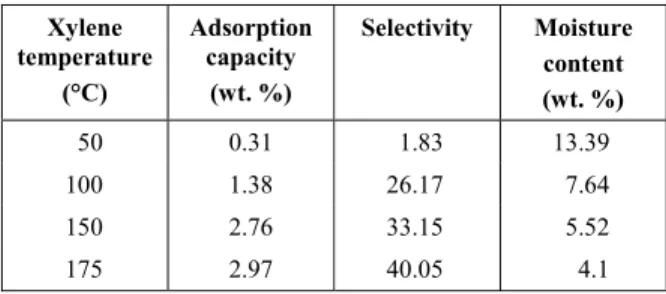
This test was done in the case of the BaY adsorbent. The adsorbent samples were kept in an open dish for 4–5 h to completely saturate the ad-sorbent with moisture. Then these samples were activated at different temperatures (50, 100, 150, 175, and 350 °C) for 4 h and the weight loss observed during activation. The weight loss data are recorded in Table 1.
Table 1: Moisture content and adsorption capacity of the BaY adsorbent at different temperatures.
Xylene temperature
(°C)
Adsorption capacity
(wt. %)
Selectivity Moisture content (wt. %)
50 0.31 1.83 13.39
100 1.38 26.17 7.64
150 2.76 33.15 5.52
175 2.97 40.05 4.1
Adsorption Isotherm Procedure
Measurements of sorption kinetics in the liquid phase were carried out in a specially designed glass bottle. A known quantity (0.5 g) of the zeolite sample was placed in the bottle and activated at 150 °C for 4 h. The weight of the activated sample was deter-mined by weighing the bottle before and after the activation. A known amount of xylene solution in iso-octane was injected into the bottle. The sample bottles were kept in a constant temperature water bath at 20 °C (Julabo, model BRND CTIC 018) for 12 h. This ensures rapid heat transfer between zeolites particles and the surrounding solution, leading to the isothermal conditions, minimization of any surface film, and homogeneity of the solution in the bottle. The composition of the mixture at different time in-tervals was determined using a gas chromatograph (Agilent Technologies 6890 N) with a FID detector and a DB-WAX capillary column (60 m) with high purity helium as a carrier gas. The error in GC
analy-sis was within ± 0.5% (Bellat et al., 1997; Goddard
et al., 1986; Kaushik et al., 2002).
Adsorption Capacity Measurement by Everett Equation
The adsorption equilibrium data were then fitted with the Everett equation, which gives information about the choice of the solvent.
1 2
1
1 1
1 1
1
t s
x x
x
M x M
⎛ ⎞
= ⎜ + ⎟
Δ ⎝ α + ⎠ (1)
where x1 is the mole fraction of p-xylene before
ad-sorption, x2 is the mole fraction of iso-octane before
adsorption, Δx1 is the difference in mole fraction of
p-xylene, Mtis the quantity of feed taken, Ms is the
adsorption capacity, and α1 is the separation factor
or selectivity.
A graph between 1 2
1
t
x x
M Δx and x1 was a straight
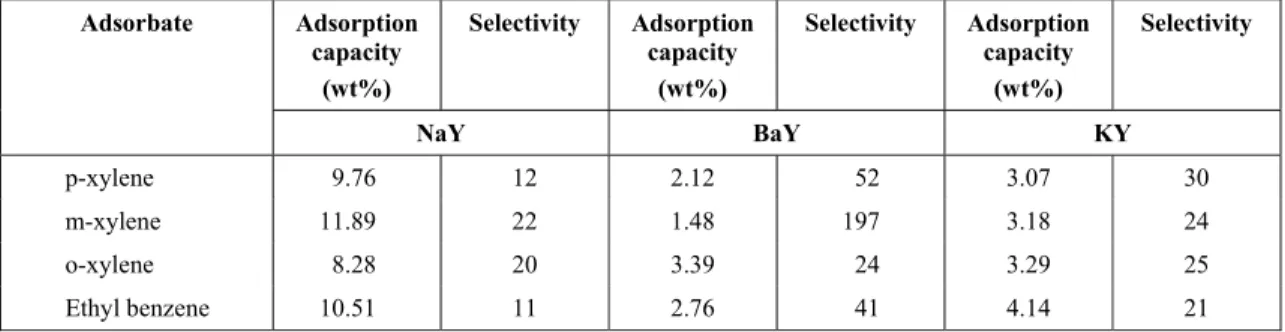
line and the adsorption capacity, as well as the selectivity, were found from the slope and extrapo-lated intercept of the line (Lao et al., 1984), as given in Table 2.
Characterization of the Adsorbent
The adsorbent was characterised by various tech-niques like ICP-OES and PXRD (powder x-ray dif-fraction). ICP-OES gives the concentration of ele-ments present in the given sample. PXRD gives the corresponding crystallinity of the adsorbent. PXRD is a versatile, non-destructive technique that reveals detailed information about the chemical composition and crystallographic structure of natural and manu-factured materials. Quantitative phase analysis of NaY, BaY, and KY at various stages was carried out by PXRD measurements on a Philips X-ray
diffrac-tometer (model) using CuKαradiation and PC-APD
diffraction software. PXRD patterns of each sample
were measured using 10% α-Al2O3 as internal
standard.
Table 2: Adsorption capacity and selectivity of C8 isomers on the adsorbents NaY, BaY and KY.
Adsorption capacity
(wt%)
Selectivity Adsorption capacity
(wt%)
Selectivity Adsorption capacity
(wt%)
Selectivity Adsorbate
NaY BaY KY
p-xylene 9.76 12 2.12 52 3.07 30
m-xylene 11.89 22 1.48 197 3.18 24
o-xylene 8.28 20 3.39 24 3.29 25
RESULTS AND DISCUSSION
Effect of Moisture
The adsorption capacity and selectivity for differ-ent temperatures were obtained in a similar manner as in the case of the adsorption isotherm of xylenes. The adsorption capacity of the adsorbent increases with an increase in temperature as shown in Figure 1. The residual moisture present in the zeolite decreases with an increase in temperature. An optimum level of moisture loading is essential for the adsorption of p-xylene on the zeolite. From the above experiment it is evident that an optimum moisture loading of 4–5.5 wt % is required for maximum adsorption of p-xylene at 20 °C. Hence, the activation temperature of 150 °C was chosen for the adsorption of all xylene isomers.
Eq. conc.(wt%)
0 5 10 15 20 25 30
A d so rb e d q ty ./ 1 0 0 g 0 1 2 3 4 5 6
50oC
100O
C 150OC
175O
C
Figure 1: Optimization of the activation temperature
for the adsorbent BaY.
Adsorption of C8 Aromatics
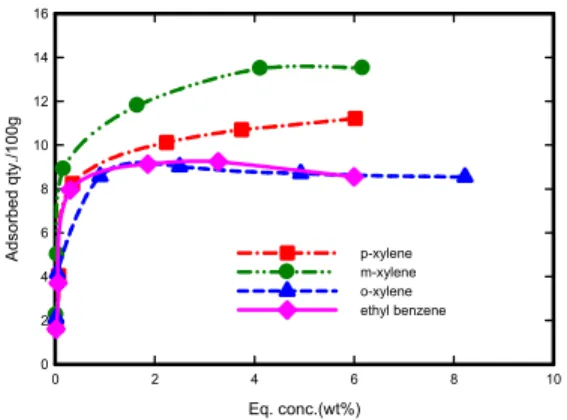
From the adsorption isotherm in Figures 2-4, it has been found that, in the case of NaY, the adsorp-tion capacity of m-xylene as well as p-xylene is higher, according to the adsorption capacities in wt %.
Eq. conc.(wt%)
0 2 4 6 8 10
Ad s o rb e d q ty ./ 1 0 0 g 0 2 4 6 8 10 12 14 16 p-xylene m-xylene o-xylene ethyl benzene
Figure 2: NaY adsorption isotherm at 20 °C.
Eq. conc.(wt%)
0 5 10 15 20 25
Ad so rb e d q ty ./ 1 0 0 g 0 1 2 3 4 5 6 p-xylene m-xylene o-xylene ethylbenzene
Figure 3: BaY adsorption isotherm at 20 °C.
x1
0.00 0.05 0.10 0.15 0.20 0.25
x1 x2 /M t Δ x1 0 5 10 15 20 25
Figure 4: KY adsorption isotherm at 20 °C.
The best suited adsorbent for separation of o-xylene from a mixture of C8 aromatics is BaY. The best suited adsorbent for separation of ethyl benzene from a mixture of C8 aromatics is KY.
Adsorption and Separation Factor Measurement by the Everett Equation
The plot shows the adsorption capacity for all C8 isomers on the adsorbent BaY as presented in Figure 5.
Eq. conc.(wt%)
0 5 10 15 20 25
Ad so rb e d q ty. /1 0 0 g 0 1 2 3 4 5 6 p-xylene m-xylene o-xylene ethylbenzene
Figure 5: Adsorption capacity and selectivity,
The higher slope for m-xylene indicates that m-xylene has more selectivity in comparison to the other three isomers and selectivity for the C8 isomers follow the sequence:
m-xylene > p-xylene > ethylbenzene > o-xylene.
Characterization Result
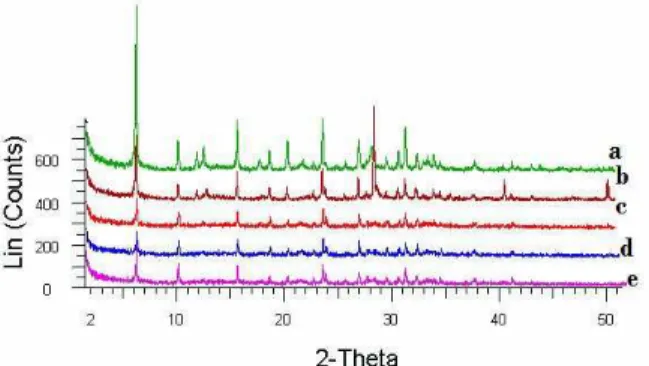
Figure 6 shows that there is a decrease in crystal-linity as sodium ions are replaced by barium ions and potassium ion in NaY and crystallinity follows the order:
Fresh NaY > KY > BaY (sample 1) > BaY (sample 2) > BaY (sample 3).
This is because, as cations exchange with sodium, a loss of crystallinity occurs. As the number of bar-ium cations increase, the crystallinity loss increases. In the case of potassium, the crystallinity loss is lower.
Figure 6: X-Ray diffraction study of the various
adsorbents: (a) NaY; (b) KY; (c) BaY sample 3; (d) BaY sample 2; (e) BaY sample 1.
CONCLUSION
In the present study, adsorption isotherms of the individual xylene isomers were measured in the liquid phase at 20 °C using various Y zeolites. This was carried out to separate each of the individual xylene isomers with high purity. Y zeolites were se-lected as adsorbents because they are widely used in separation processes in industries. The zeolites were exchanged with potassium and barium ions. On exchange of Na by K, the pore opening of the zeolite decrease due to the bulkier size of the K ion. On exchange of Na by Ba the pore opening increases due to the smaller size of Ba and also the number of cations decreases because Ba is divalent. The adsorp-tion of xylene isomers on the Y zeolites depends on the pore opening of the zeolites and also the
interaction of aromatic molecules with the cations in the micropores. The effect of residual moisture on p-xylene adsorption on BaY shows that, with an increase in temperature the moisture on the adsorb-ent decreases. An optimum loading of moisture is required for adsorption of xylene on the adsorbents. It has been found that the best suited adsorbents for the separation of p-xylene, m-xylene, o-xylene and ethyl benzene from the mixture of C8 aromatics are NaY, NaY, BaY and KY, respectively. The XRD results show that the crystallinity of the adsorbent
decreases upon exchanging the zeolites with K+ and
Ba2+ ions.
REFERENCES
Bellat, J. P., Pilverdier, E., Simonot-Grange, M. H. and Jullian, S., Microporous volume and external surface of Y- zeolites accessible to p-xylene and m- xylene. Microporous Materials, 9, 213 (1997). Dalil, M., Sohrabi, M. and Royaee, S. J., Application
of nano-sized cobalt on ZSM-5 zeolite as an active catalyst in Fischer-Tropsch synthesis. J. Ind. Eng. Chem., 18, 690 (2012).
Gaur, A., Park, J. W., Maken, S., Song, H. J. and Park, J. J., Landfill gas (LFG) processing via adsorp-tion and alkanolamine absorpadsorp-tion. Fuel Process-ing Technology, 91, 635 (2010).
Goddard, M. and Ruthven, D. M., Sorption and dif-fusion of C8 aromatic hydrocarbons in faujasite type zeolites. II. Sorption kinetics and intracrys-talline diffusivities. Zeolites, 6, 283 (1986). Induri, S., Sengupta, S. and Basu, J. K., A kinetic
approach to the esterification of maleic anhydride with methanol on H-Y zeolite. J. Ind. Eng. Chem., 16, 467 (2010).
Jermy, B. R., Kim, S. Y., Kim, D. K. and Park, D. W., Optimization of key parameters for effective vanadium substitution into cubic SBA-16 in the presence of co-surfactant at low acidity: Applica-tion in the selective oxidaApplica-tion of ethylbenzene. J. Ind. Eng. Chem., 17, 130 (2011).
Jobic, H., Bée, M., Méthivier, A. and Combet, J., Influence of the cation composition on the dy-namics of xylenes in X-type zeolites. Microporous Mesoporous Materials, 42, 135 (2001).
Kaushik, V. K., Vijayalakshmi, R. P., Choudary, N. V. and Bhat, S. G. T., XPS studies on cation ex-changed zeolite A. Microporous Mesoporous Materials, 51, 139 (2002).
Kim, S. S., Choi, S. H., Lee, S. M. and Hong, S. C.,
Enhanced catalytic activity of Pt/Al2O3 on the
Lao, M. Z. and Ye, Z. H., Phase equilibrium of adsorption separation of xylene isomers with type Y-zeolites. Chem. Eng. Commun., 35, 89 (1984). Lee, J. S., Jhung, S. H., Yoon, J. W., Hwang, Y. K.
and Chang, J. S., Adsorption of methane on porous metal carboxylates. J. Ind. Eng. Chem., 15, 674 (2009).
Moon, J. H., Bae, J. H., Bae, Y. S., Chung, J. T. and Lee, C. H., Hydrogen separation from reforming gas using organic templating silica/alumina com-posite membrane. J. Membrane Sci., 318, 45 (2008). Neuzil, R. W., Aromatic hydrocarbon separation by
adsorbtion. U.S. Patent N. 3,686,342 (1972). Saceda, J. J. F., Rintramee, K., Khabuanchalad, S.,
Prayoonpokarach, S., Leon, R. L. de, and Wittayakun, J., Properties of zeolite Y in various forms and utilization as catalysts or supports for cerium oxide in ethanol oxidation. J. Ind. Eng. Chem., 18, 420 (2012).
Santacesaria, E., Gelosa, D., Danise, P. and Carra, S., Separation of xylenes on Y zeolites in the vapor phase. 1. Determination of the adsorption equilibrium parameters and of the kinetic re-gime. Ind. Eng. Chem. Proc. Des. Dev., 24, 78 (1985).
Santacesaria, E., Morbidelli, M., Danise, P., Mercenari, M. and Carra. S., Separation of xylenes on Y zeolites. 1- Determination of the adsorption equi-librium parameters, selectivities and mass transfer coefficients through finite bath experiments. Ind. Eng. Chem. Proc. Des. Dev., 21, 440 (1982). Xiao, F. S., Qiu, S., Pang, W. and Xu, R., New
developments in microporous materials. Advanced Materials, 11, 1091 (1999).