Resumo
O objetivo desse artigo é apresentar uma revisão do procedimento de calibração do coeiciente de ponderação da resistência para um dado índice de coniabilidade alvo. Coeicientes de ponderação da resistência, para colunas de peris formados a frio, são calculados com um método de coniabilidade de primeira ordem e segundo momento. Foi montado um banco de dados com 323 ensaios de colunas de peris formados a frio, carregadas, concentricamente, com seções U e U enrijecido, e foram obtidas estatísticas para a relação carga de ensaio versus carga predita para os três métodos disponíveis na Norma Brasileira para peris formados a frio: o Método da Largura Efetiva (MLE), o Método da Seção Efetiva (MSE) e o Método da Resistência Direta (MRD). Para a combinação de carga normal, relação carga permanente / carga variável de 1/3 e índice de coniabilidade alvo bo = 2.5, os coeicientes de ponderação da resistência calculados para os três métodos são consistentes com o valor especiicado pela Norma Brasileira. Para todos os métodos, com o índice de coniabilidade alvo bo = 3.0, os coeicientes de ponderação da resistência calculados são maiores que os especiicados pela Norma Brasileira.
Palavras-chave: Peris formados a frio, membros comprimidos, calibração, índice de coniabilidade, coniabilidade estrutural.
Abstract
The objective of this paper is to provide a review of the calibration procedure of the resistance factor for a target reliability index. Resistance factors for cold-formed steel columns are calculated with a irst order second moment reliability approach. A test database of 323 cold-formed steel columns concentrically loaded with plain and lipped C-section was assembled, and test-to-predicted statistics were obtained for the three design methods available in Brazilian cold-formed steel code: the Effective Width Method (EWM), the Effective Section Method (ESM) and the Direct Strength Method (DSM). For the normal load combination, dead-to-live load ratio of 1/3, and target reliability index bo = 2.5, the calculated resistance factors, g, for the three methods are consistent with current value speciied by Brazilian code. For all methods, with target reliability index bo = 3.0, the calculated resistance factors, g, are higher than the current value used in Brazilian code.
Keywords: Cold-formed steel, compression members, calibration, reliability index, Structural Reliability.
Resistance factor calibration for
cold-formed steel compression
members
Calibração de coeficiente de ponderação da
resistência de membros comprimidos de perfis
formados a frio
Marcilio S. R. Freitas
Departamento de Engenharia Civil, Escola de Minas,
Universidade Federal de Ouro Preto. [email protected]
André L. R. Brandão
Universidade Federal de Itajubá, Campus Itabira.
Arlene M. S. Freitas
Departamento de Engenharia Civil, Escola de Minas,
Universidade Federal de Ouro Preto. [email protected]
V
Q=
√
(D
mV
D)
2+(L
m
V
L)
2D
m+ L
m1.Introduction
The fundamental aim of structural reliability analysis is the determination of the reliability of structures under consider-ation of the uncertainties associated with the resistances and loads. The structural performance is assessed by means of mod-els based on physical understanding and empirical data. Due to idealizations, inher-ent physical uncertainties and inadequate or insuficient data the models themselves and the parameters entering the models such as material parameters and load characteristics are uncertain. Structural reliability theory takes basis in the proba-bilistic modeling of these uncertainties and provides methods for the determination of the probability that the structures do not fulill the performance criteria.
By means of structural reliability methods the code formats of the design codes, i.e., the design equations, charac-teristic values and resistance factors may be chosen such that the level of reliability of all structures designed according to the design codes is same. This process including the choice of the desired level of reliability or “target reliability” is usually understood as “code calibration”. Reli-ability based code calibration has been formulated by several researchers (Hsiao, 1989; Ravindra and Galambos, 1978).
This work shows a study of the level of reliability of cold-formed steel (CFS) column designed by the Brazilian code. The aim of this study is the assessment of the reliability index b for two differents
load combinations: (i) 1.2Dn+1.6Ln and (ii) 1.25Dn+1.5Ln and two dead-to-live load ratios of 1/5 and 1/3, and the assessment of the resistance factor for a target reliability index. A widely used method of comput-ing the reliability index b is the First Order Second Moment method (Hsiao, 1989). The results were compared with the tar-get reliability indexes of 2.5 and 3.0, the same levels used in AISI S100 (2007). The study includes the calibration procedure, i.e., the assessment of the resistance fac-tor gfor the load combinations deined. The test-to-predicted strength statistics are employed with the irst order second moment method (FOSM).
2. Resistance factor calculation
Currently the relative reliability of structural design rules including the design equations for CFS members is described in terms of a reliability index, commonly denoted as b. A higher value of b indicates a higher reliability. A widely used method of computing the reliability
index b is the First Order Second Moment method - FOSM (Cornell, 1969; Ravindra and Galambos, 1978; Ellingwood et al., 1980, Freitas et al., 2007). Using this in-dex, the target value, bo, for cold-formed steel compression members usually are 2.5 for Load and Resistance Factor Design
(AISI-LRFD) and 3.0 for Limit States Design (AISI-LSD). The method assumes a lognormal distribution for the resistance
R and the load Q, so that the reliability index b is computed from:
(1)
( )
R
mb =
Q
mln
V
R+ V
Q√
2 2where Rm and Qm are the mean nominal resistance and load effect, respectively,
while VR and VQ are the corresponding coeficients of variations. These terms are
deined by Eqs. (2) to (5).
R
m= R
n(P
mM
mF
m)
(2)Q
m= c (D
m+ L
m)
(3)V
R=
√
V
P+V
M+V
F (4)(5)
2 2 2
where:
Rn = nominal resistance
Pm = mean ratio of experimental to calcu-lated results
Mm = mean ration of actual yield point to minimum speciied value
Fm = mean ratio of actual to speciied column dimensions
c = coeficient
Dm = mean dead load intensity Lm = mean live load intensity Dn = nominal dead load intensity
Ln = nominal live load intensity
VP = coeficient of variation of experimen-tal to calculated results
VM = coeficient of variation relecting material properties uncertainties VF = coeficient of variation relecting
geometric uncertainties
VD = coeficient of variation of the dead load intensities
VL = coeficient of variation of the live load intensities
Load Statistics were analyzed in
El-lingwood et al. (1980), where it was show that Dm = 1.05Dn, VD = 0.10, Lm= Ln,
f
R
n= c (
g
DD
n+
g
LL
n) =
g
DD
n+
g
LcL
nL
n(6)
(
)
where gD and gL are the dead and live load factors, respectively, such that the load combinations are 1.2Dn+1.6Ln for AISI-LRFD and 1.25Dn+1.5Ln for
AISI-LSD and ABNT NBR 14762 (2010). The dead-to-live load ratios, Dn/Ln, are 1/5 in AISI-LRFD and 1/3 in AISI-LSD.
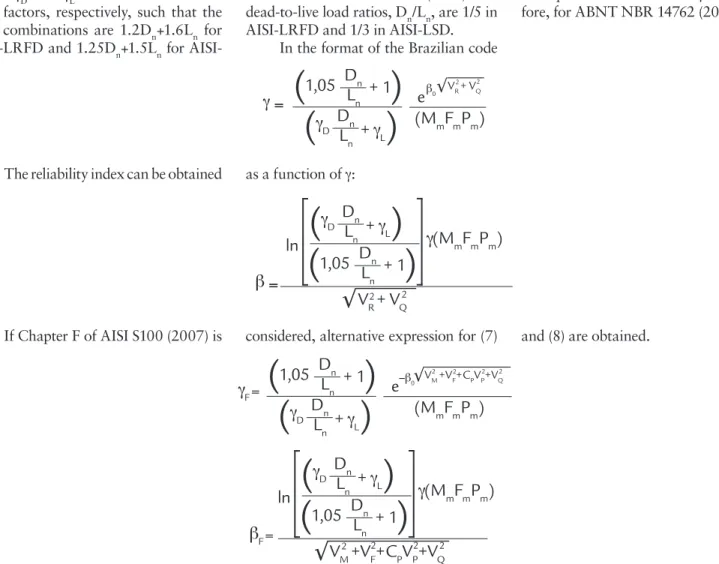
In the format of the Brazilian code
is adopted a resistance factor g=1/f, there-fore, for ABNT NBR 14762 (2010)
e
(
D
n)
g =
(M
mF
mP
m)
1,05
L
n+ 1
(
g
D
n)
D
L
n+
g
LVR+ VQ
√
2 2b0
(7)
The reliability index can be obtained as a function of g:
V
R+ V
Q√
2 2b =
g
(M
mF
mP
m)
(
D
n)
1,05
L
n+ 1
(
g
D
n)
D
L
n+
g
L(8)
If Chapter F of AISI S100 (2007) is considered, alternative expression for (7) and (8) are obtained.
e
(
D
n)
g
F=(M
mF
mP
m)
1,05
L
n+ 1
(
g
D
n)
D
L
n+
g
LVM+VF+CPVP+VQ
√
2-b0
2 2 2
(9)
V
M+V
F+C
PV
P+V
Q√
2 2b
F=g
(M
mF
mP
m)
(
D
n)
1,05
L
n+ 1
(
g
D
n)
D
L
n+
g
Lln
2 2
ln
(10)
3. Statistical data on material and sectional properties and column test database
Bias and variability in the predicted column capacity are accounted for with a material factor M (related to steel yield stress), a fabrication factor F (related to column dimensions), and a professional factor P (quantiies the accuracy of ca-pacity predictions relative to tests). The mean values and coeficients of variation
for material properties (Mm, VM) and fabrication variables (Fm, VF) adopted in this work were taken from Table 17 in NBR 14762(2010). The relevant portions for Cold-formed steel (CFS) compression members of Table 17 are summarized in Table 1.
The CFS column test database
con-tains a total of 323 columns tests from 13 different experimental programs (see Tab. 2). The mean and coeficient of variation, respectively, Pm and VP for the professional factor will be calculated with the column test database and the prediction methods in ABNT NBR 14762 (2010).
Table 1 Statistical data for the determination
of resistance global partial factor.
Type of Component Mm VM Fm VF
Concentrically Loaded Compression Members 1.10 0.10 1.00 0.05
4. Strength prediction methods
Currently, three basic design methods for cold-formed steel mem-bers are formally available in Brazilian speciication ABNT NBR 14762 (2010): the traditional Effective Width Method (EWM), the Effective Section Method (ESM) and the Direct Strength Method
(DSM). DSM predicts column strength using the elastic buckling behavior of the whole cross-section. Unlike the EWM, DSM does not quantify the cross-section instabilities “element-by-element” (Shafer, 2002). The strength approach proposed by the ESM is
Reference Nr. tests(N) Section type
Batista (1989) 12 Lipped C
Chodraui (2006) 16 Plain C, Lipped C
Dat (1980) 43 Lipped C
Desmond et al. (1981) 7 Lipped C
Loughlan (1979) 13 Lipped C
Miller and Pekoz (1994) 44 Lipped C
Moldovan (1994) 64 Plain C, Lipped C
Mulligan (1983) 36 Lipped C
Pu et al (1999) 6 Lipped C
Thomasson (1978) 14 Lipped C
Young and Hancock (2003) 42 Lipped C
Young and Rasmussen (1998a) 12 Lipped C
Young and Rasmussen (1998b) 14 Plain C
Table 2
Groups of experimental data and sections type.
5. Resistance factor results
Resistance factor obtained for CFS loaded compression members are compared with resistance factor used in Brazilian code ABNT NBR 14762 (2010). The resulting reliability indexes are also compared, for two different load combinations: (i) 1.2Dn+1.6Ln and (ii) 1.25Dn+1.5Ln and two dead-to-live load ratios of 1/5 and 1/3, and the assessment of the resistance factor for a target reli-ability index. The resistance factor, g, of 1.2 for concentrically loaded compression members is given by the Brazilian code for cold-formed steel structures. This factor is used in the reliability analysis.
Table 3 presents the results for all the columns in the CFS column test data-base according to Brazilian Speciication, except for ESM method due to columns specimens outside prequaliied dimen-sional limits.
It can be observed from Table 3 that the values of the resistance factor obtained by Eq. (7) are very close to values obtained by Eq. (9), i.e., g @ gF. For the EWM method, with gD=1.2, gL=1.6, Dn/Ln=1/5 and bo = 2.5 (AISI LRFD calibration), the calculated resistance factor, g, is 1.17, or f = 0.85. For the Brazilian code combina-tion gD=1.25 and gL=1.5, and bo = 2.5, the calculated resistance factor, g, with Dn/ Ln=1/5 is 1.23 and with Dn/Ln=1/3 is 1.21 which are consistent with g = 1.2 currently established in ABNT NBR 14672:2010.
For the ESM method, with gD=1.2, gL=1.6 and Dn/Ln=1/5 and bo = 2.5, the calculated resistance factor, g, is 1.15, or f = 0.87. For the Brazilian code combination gD=1.25 and gL=1.5, and bo = 2.5, the cal-culated resistance factor, g, with Dn/Ln=1/5 is 1.21 and with Dn/Ln=1/3 is 1.19 which are consistent with the current value used.
For the DSM method, with gD=1.2, gL=1.6 and Dn/Ln=1/5 and bo = 2.5, the calculated resistance factor, g, is 1.13, or f = 0.88. For the Brazilian code combina-tion gD=1.25 and gL=1.5, and bo = 2.5, the calculated resistance factor, g, with Dn/ Ln=1/5 is 1.19 and with Dn/Ln=1/3 is 1.17 which are consistent with g = 1.2 currently established in ABNT NBR 14672:2010.
For the ESM method, the resis-tance factor has been computed only for columns specimens whose dimensional properties are within the prescribed limits in Brazilian code. Thus, some test data were excluded from analysis in the ESM formulation.
For all methods, assuming gD=1.25, gL=1.5, Dn/Ln=1/3 and bo = 3.0 (AISI LSD calibration), the calculated resistance fac-tors, g, are higher than the current value used in Brazilian code.
Table 3
Test-to-predicted statistics, reliability index b and resistance factor g (all data).
Strength Predictions Methods
1.2Dn + 1.6Ln 1.25Dn + 1.5Ln Dn/Ln
1/5
Dn/Ln 1/3
Dn/Ln 1/5
Dn/Ln 1/3
EWM
N 323 b 2.58 2.62 2.41 2.47
Pm 1.04 g(2.5) 1.17 1.16 1.23 1.21
VP 0.16 g(3.0) 1.35 1.33 1.42 1.39
bF 2.58 2.62 2.41 2.46
gF(2.5) 1.17 1.16 1.23 1.21
gF(3.0) 1.35 1.33 1.42 1.39
ESM
N 243 b 2.65 2.70 2.47 2.54
Pm 1.06 g(2.5) 1.15 1.14 1.21 1.19
VP 0.16 g(3.0) 1.33 1.30 1.39 1.36
bF 2.64 2.69 2.47 2.53
gF(2.5) 1.15 1.14 1.21 1.19
gF(3.0) 1.33 1.30 1.40 1.36
DSM
N 323 b 2.71 2.76 2.53 2.60
Pm 1.06 g(2.5) 1.13 1.12 1.19 1.17
VP 0.15 g(3.0) 1.30 1.28 1.37 1.33
bF 2.71 2.76 2.53 2.60
gF(2.5) 1.13 1.12 1.19 1.17
6. Conclusions
The procedure that has been ad-opted in the resistance factor calibration like in AISI S100 (2007) was described. So resistance factors for cold-formed steel columns were calculated with a irst order second moment reliability approach. A test database of 323 cold-formed steel columns was cold-formed, and
test-to-predicted statistics were obtained for the three design methods formally available in Brazilian code: EWM, ESM and DSM methods.
It could be seen that for load com-bination 1.25Dn+1.5Ln and dead-to-live load ratio of 1/3, and target reliability index bo = 2.5, the calculated resistance
factors, g, for the three methods are consistent with the current value speci-ied by Brazilian code. For all methods, assuming gD=1.25, gL=1.5, Dn/Ln=1/3 and bo = 3.0 (AISI LSD calibration), the calculated resistance factors, g, are higher than the current value used in Brazilian code.
7. Acknowledgements
The authors are grateful for the sup- port by CAPES, CNPq and FAPEMIG.
8. References
AISI-S100 North American Speciication for the Design of Cold-formed Steel Structural Members. American Iron and Steel Institute, Washington, D.C., ANSI/ AISI-S100-07, 2007, 183 p.
ASSOCIAÇÃO BRASILEIRA DE NORMAS TÉCNICAS. ABNT NBR 14762:2010
Dimensionamento de estruturas de aço constituídas por peris formados a frio. Rio de Janeiro, Brasil, 2010.
Batista, E.M Étude de la stabilité des proils parois minces et section ouverte de types U et C. Collection des publications de la Faculté des Sciences Appliquées es no. 119, University of Liege, 1989.
BATISTA, E.M. Effective section method: A general direct method for the design of steel cold-formed members under local–global buckling interaction. Thin-Walled Structures; v.48, Issue 4-5, p. 345-356, 2010.
BRANDÃO, A. L. R. Segurança de estruturas em peris formados a frio. Ouro Preto: Escola de Minas, Universidade Federal de Ouro Preto, 2007. (Dissertação de Mestrado em Engenharia Civil).
CHODRAUI, G. M. B. Análise teórica e experimental de peris de aço formados
a frio submetidos à compressão. São Carlos: Escola de Engenharia de São Carlos, Universidade de São Paulo, 2006. (Tese de doutorado em Engenharia de Estruturas).
CORNELL, A. C. A probability based structural code. ACI Journal, v.66, 12, p.974-985, 1969.
DAT, D. T. The strength of cold-formed steel columns. Cornell University, Department of Structural Engineering Report No. 80-4, Ithaca, NY, 1980.
DESMOND, T. P., PEKOZ, T., and WINTER, G. Edge stiffeners for thin-walled members. ASCE Journal of Structural Division, v.107, n.2, p.329-353, 1981. ELLINGWOOD, B., GALAMBOS, T. V., MACGREGOR, J. G. and CORNELL,
C. A. Development of a probability based load criterion for American National Standard A58: Building code requirements for minimum design loads in buildings and other structures. National Bureau of Standards, U.S. Department of Commerce, 1980.
FREITAS, M. S. R., CASTANHEIRA, A. M., and FREITAS, A. M. S. Coniabilidade de vigas metálicas dimensionadas pela norma brasileira NBR 8800. REM – Revista Escola de Minas, Ouro Preto, v.60, n.2, p.261-269, 2007.
HSIAO, L.E. Reliability Based Criteria for Cold-Formed Steel Members. Missouri: University of Missouri-Rolla, Rolla, 1989. (Ph.D. Thesis).
LOUGHLAN, J. Mode interaction in lipped channel columns under concentric or
eccentric loading. Glasgow: University of Strathclyde, 1979. (Ph.D. Thesis). MILLER, T. H., PEKÖZ, T. Unstiffened strip approach for perforated wall studs.
ASCE Journal of Structural Engineering, v.120, n.2, p.410-421, 1994.
MOLDOVAN, A. Compression tests on cold-formed steel columns with monosymmetrical section. Thin-Walled Structures, v.20, p.241-252, 1994.
MULLIGAN, G. P. The inluence of local buckling on the structural behavior of
PU, Y., GODLEY, M. H. R., BEALE, R. G., LAU, H. H. Prediction of ultimate capacity of perforated lipped channels. ASCE Journal of Structural Engineering, v.125, n.5, p.510-514, 1999.
RAVINDRA, M. K., GALAMBOS, T. V. Load and resistance factor design for steel.
ASCE Journal of the Structural Division, v.104, n.9, p.1337-1353, 1978.
SCHAFER, B. W. Review: the direct strength method of cold-formed steel member design. Journal of Constructional Steel Research;v.4, p.766-778, 2008.
THOMASSON, P. O. Thin-walled C-shaped panels in axial compression. Swedish
Council for Building Research. Report: ISSN-91-540-2820-5, 1978.
YOUNG, B., HANCOCK, G. J. Compression tests of channels with inclined simple edge stiffeners. ASCE Journal of Structural Engineering, v.129, n.10, p.1403-1411, 2003.
YOUNG, B., RASMUSSEN, K. J. R. Design of lipped channel columns. ASCE Journal
of structural engineering, v.124, n.2, p.140-148, 1998a.
YOUNG, B., RASMUSSEN, K. J. R. Tests of ixed-ended plain channel columns.
ASCE Journal of Structural Engineering, v.124, n.2, p.131-139, 1998b.