E-ISSN 2237-2660
Acts as Performances in the Occupation
of the Urban Space: against a
model of city for mega-events
Beatriz Provasi
Pontifícia Universidade Católica do Rio de Janeiro – (PUC-Rio), Rio de Janeiro/RJ, Brazil
ABSTRACT – Acts as Performance in the Occupation of the Urban Space: against a model of city for mega-events – This research focuses on the acts that took the streets of Rio de Janeiro between June 2013 and July 2014. They are observed from both an aesthetic and political perspective, not simply as a criticism toward the model of city developed for mega-events, but rather as a proposal for different ways of inhabiting the urban landscape. By perceiving the plurality of the activated forms of expression and the centrality of direct action in the practice of the protesters, I address these acts with reference to the notion of performance, considering especially the bodies which have occupied the urban space
with their choreopolitics, theatres of invasion, polyphonic choirs,multiple writings, and the
creation of Temporary Autonomous Zones always ready to re (in)ssurect.
Keywords: Street Protests. Performance. Cities. FIFA World Cup. Olympic Games.
RÉSUMÉ – Actes comme Performance dans l’Occupation des Rues: contre un modèle de ville pour les grands évenements – Cette recherches, effectue de juin 2013 à juillet 2014, témoignant des actes qui ont eu lieux dans les rues de Rio de Janeiro, d’un point de vue à la fois esthétique et politique, perçus non seulement comme critiques àun modèle de ville destinée à de grands évenements, mais comme propositions pour un mode autre d’habiter la ville. Considérant la pluralité des formes d’expression mises en place et la centralité des actions directes exercées alors par les manifestants, nous relions de tels actes à la notion de performance, avec une attention particuliére aux corps qui ont occupé les rues avec leurs chorépolitiques, théâtres d’ invasion, chœurs polyphoniques, les multiples écritures, et la
création de Zones Autonomes Temporaires, toujours imminentes.
Mots-clés: Manifestations de Rue. Performance. Villes. Coupe du Monde. Jeux
Olympiques.
RESUMO – Atos como Performance na Ocupação do Espaço Urbano: contra um modelo de cidade para os megaeventos – Esta pesquisa se move entre junho de 2013 e julho de 2014, observando os atos que tomaram as ruas do Rio de Janeiro, em perspectiva a um só tempo estética e política, não apenas como crítica ao modelo de cidade para os megaeventos, mas como proposição de outros modos de habitar a urbe. A partir da percepção da pluralidade de formas de expressão acionadas e da centralidade das ações diretas na prática dos manifestantes, relacionamos os atos à noção de performance, com atenção
especial aos corpos que ocuparam o espaço urbano, com suas coreopolíticas, seus teatros
de invasão, seus coros polifônicos, suas escritas múltiplas, e a criação de Zonas Autônomas Temporárias, sempre prontas a re(in)ssurgir.
Palavras-chave: Manifestações de Rua. Performance. Cidades. Copa do Mundo.
From both an aesthetic and political perspective, this paper discusses the acts that took the streets of Rio de Janeiro between June 2013 and July 2014. From the struggle against the rise of public transportation fares to demonstrations against the World Cup in Brazil, these acts can be perceived not only as a criticism toward a given model of city – one that is justified by the adaptations required for hosting sportive mega-events like the 2014 World Cup and the 2016 Olympic Games – but rather as a proposal for different ways of inhabiting the urban landscape. Be it through the multiplicity of expressive means, or be it through the centrality of direct action in the practices of protesters, it is possible to perceive these acts as performances, considering especially the bodies which have occu-pied the urban space, thus creating Temporary Autonomous Zones (Bey, 2013b). Through their choreopolitics (Lepecki, 2012), theatres of invasion (Carreira, 2008), multiple colors, polyphonic choirs, in-tertextual writings, and a series of other aspects related to the field of aesthetic experience, these acts claim the city as commons and a space for the affirmation of diversity in opposition to a totalizing discourse (de Certeau, 1994) and an excluding urban regime of ex-ception (Agamben, 2004).
What Model of City are these Acts ) Opposed to?
If we recall the moments preceding the World Cup held in Brazil, as the year of 2016 began, there was a terrifying silence about the World Olympics. Since the Olympic Games will be held in Rio de Janeiro, it is worth noting that what was in question behind the “Não vai ter Copa” (There will be no World Cup) cries was the criticism toward the model of city imposed by mega-events, with its exclusionary regime of urban spaces. Besides, alternative ways of inhabiting the city were being developed in the street occupations themselves since the demonstrations calling for the repeal of the
Figure 1 – Ato Grito da Liberdade (Freedom Cry Protest), October 31, 2013, Avenida Rio Branco/ Rio de Janeiro. Photo by Paula Kossatz.
Figure 2 – Act Fora Cabral (Protest against the governor Sérgio Cabral), July 14, 2013, Largo do Machado/RJ. Photo by Fernando Frazão/ABr.
The excluded elements of urbanistic projects related to mega-events are the inhabitants themselves, who reemerge in 2013 in the streets occupation all over Brazil in order to exercise their right to the city. This exclusion is multifaceted: political, economical, social, cultural, environmental, of gender, sexuality, ethnicity, and territorial. In the same way, many emerging voices form a polyphonic chorus against all the silencing. In this sense, it is significant that the main motto of the protests had been the issue of urban mobility, for “[…] the struggle for transportation has the dimension of the city and not of this or that category” (MPL, 2013, p. 16).
In the opinion of the Movimento Passe Livre (MPL - Free Pass Movement) from São Paulo (2013, p. 16), the retaking of urban space, which emerges as a goal of the protests against the increase of bus fares, “[...] is also accomplished as a method through the practice of the protesters who occupy the streets, hence directly deciding its flows and uses”.
The eviction cases in the whole state of Rio de Janeiro prove that the undergoing city project, that is associated with sportive mega-events, is based in the elitization of the city. The existence of popular classes constitutes a hin-drance; it is necessary to relocate the poor in the city for the project to work (ANCOP, 2014, p. 36).
According with the estimates of the Articulação Nacional dos Comitês da Copa e das Olimpíadas (ANCOP, National Articulation of The World Cup and Olympic Games Committees, 2014, p. 21), about 250 thousand people have been forcibly evicted from their homes – and, only in Rio de Janeiro, it amounted to more than 20 thousand families, in the largest wave of evictions in the history of the city – in order to “clean the area for big real estate projects of speculative and commercial nature”, justified by the need of adapting cities for the hosting of mega-events. ANCOP produced a dossier detailing the numerous Human Rights violations in Brazil under this allegation.
In fact, rights violations that are legitimated by necessity are the premises of the state of exception as a govern paradigm in every modern Western democracy, as we can deduce from the analysis of Giorgio Agamben (2004). Whether to contain crisis (political, economical), to ensure the maintenance of order and security, the suspension of juridical order that characterizes the state of exception is paradoxically justified as necessary for the maintenance of consti-tutional order itself and is hence applied as a lawless force of the law
(when the existing norm has no power and non constitutional acts incorporate the force of the law).
character were the extension in the civilian sphere of the authority of the military powers, by accomplishing permanence, they represent the militarization of life itself.
Once turned into rule, this exceptionality becomes especially vis-ible in territories occupied by the poorest population – like the slums. Under the discourse of the war on drugs, the worst barbarities are committed by the police power vested in such lawless force of the law. Death penalty, applied to suspected drug dealers in summary executions and enabled by the judicial precedent of the autos de re-sistência1(aggravated resistance resulting in death), is the institutional
reality that inhabits those territories of exception. Even the death of children becomes justified by the judicial precedent of execution er-ror2, which is perfectly acceptable in this established scenery of war.
The incidence of the measures of exception has found its crown-ing achievement in the establishment of the Pacification Police Units (Unidades de Polícia Pacificadora - UPPs) and, at the same time, it has made the permanent character of the current state of exception explicit. In this aspect, the cries asking Cadê o Amarildo? (Where is Amarildo?) have intensified since the protests of 2013, drawing at-tention for the execution of the mason by military policemen inside the UPP station at Rocinha slum and evidencing the brutal reality of the constant exception in such territories, where the right that is suspended is the most essential one: the right to life itself.
The excesses of police violence and the numerous detentions and imprisonments of activists observed in the protests toward people from different socioeconomic and territorial backgrounds have enabled a wider perception of this exceptionality as extended to the whole social network. In every case, the most drastic measures of exception are still exerted against the poorest population. It is symptomatic that the only case of judicial conviction in the context of the protests so far has been the case of black, homeless, and poor Rafael Braga Vieira, who was arrested after the protest in June 20, 2013, somewhere in the city’s center, holding a disinfectant bottle that was deemed as explosive substance by the court.
In this aspect, mega-events as a pretext for creating necessities do not only accelerate but also deepen undergoing processes of gen-trification3 in the city, further aggravating these situations of
Maré by the army in 2014, and now becomes explicit through the approval of an Anti-terrorism Law. It may be applied to contain politi-cal disorders, hence inscribing exception in the judicial order itself.
What do the Bodies Occupying the Urban Space Create?
Evidently, all the issues mentioned so far have strong biopolitical implications, where an arrangement of the bodies in the city is oper-ated through which André Lepecki (2012) calls choreopolice. From the perspective of choreopolice, unruly, undomesticated, disobedi-ent bodies are not allowed to disturb the established order for the circulation within the urban space. The disciplinary techniques to ensure the docility and utility of the bodies as described by Michel Foucault (1987) are no longer circumscribed to given institutions (schools, prisons, quarters), but fully incorporated and disseminated in the social fabric as the natural order of things. On the other hand, there is also a trend toward disobedience inscribed in bodies themselves, whenever they feel (and they constantly are) violated, as seen in the notable essay of Henry Thoreau (2013)4. It is exactly
these rebellious bodies that interest me, their performances in the protests, their creation of choreopolitics that disturb the so-called proper quotidian use of the spaces.
Through actions such as stepping ahead when the order is to stand still; standing upright (occupying) when the order is to circu-late; returning and returning and returning all over again when the order is to disband and retreat, and even wandering aimlessly when it is necessary to have an objective path, the protests can be perceived from the choreopolitics perspective.
These acts have created dances that were not predicted by the script of the official choreopolicing, and songs that amplify this bold-ness, mocking the violent attempts at ordering the dispersed bod-ies, like the cries Olha eu aqui de novo (Look, here I come again). In August 30, 2013, the headline of the O Globo newspaper has announced a curious subtitle: Black Blocs marched aimlessly5, thus
If the city, according to Lepecki (2012), was being thought as a choreography, there is also another category through which it is possible to consider the motions of the body within the urban space: the city as dramaturgy, as suggested by the work of André Carreira (2008). While Lepecki proposes the term choreopolitics, in Carreira the proposed strategy is named theatre of invasion, as theatrical perfor-mances “which do not content themselves by being out in the street, but seek to incorporate the street flows within the workings of the scene itself, or, on the other hand, subverting these flows through the production of ruptures in everyday rhythms” (Carreira, 2008, p. 69). Both authors bring aesthetics and politics together and, through observing the arrangements of the city and its usual flows dictated by demands in commodities circulation (Carreira, 2008) or the impositions of police order (Lepecki, 2012), they analyze situations that erupt in the streets, thus inserting “[...] momentarily shifts in the operational logic of the city” (Carreira, 2008, p. 69), provoking a sense of oddity and subverting the quotidian usage of spaces.
These momentarily shifts also can be associated with the proposal for the creation of Temporarily Autonomous Zones (TAZ) by Hakim Bey (2013b). By answering negatively to the question “Must we wait until the entire world is freed of political control be-fore even one of us can claim to know freedom?” (Bey, 2013b, p. 2), the author pursues alternative forms of liberation that can be lived
hereand now, even if only temporarily. Impermanence, by the way, is exactly what enables the exercise of autonomy, shifting across time and space to elude everywhere. In opposition to the idea of revolution, that seeks to accomplish permanence but is always pointing toward a future that never comes, or a past that have founded even stronger and more oppressive States, Bey suggests the image of the uprising in order to delineate the contours of TAZ. In the author’s analysis, uprisings are “peak experiences” in comparison to ordinarystandards of consciousness and experience which would not be deemed as extraordinary in case they happened every day. “But such moments of intensity give shape and meaning to the entirety of a life.” (Bey, 2013b, p. 3). Despite their short duration, “[...] things have changed, shifts and integrations have occurred – a difference is made”.
reform elsewhere/elsewhen before the State can crush it (Bey, 2013b, p. 4).
However temporary, these zones are not an end in themselves. Rather, they constantly shift in various directions, disappearing here
to reappear right away, as a nomadic strategy in relation to space and impetuous in relation to time, always liberating new areas. According to Bey, the Temporary Autonomous Zones would be the scenery of our present autonomy, where liberation is perceived during the struggle. They are “[...]the seeds – the weeds cracking through our sidewalks – from this other world into our world” (Bey, 2013b, p. 27).
It is impossible not to relate the occupations that have sparked everywhere in the world over the last years – ranging from Occupy Wall Street (2011) to the occupation in Hong Kong (2014), Catalunya
Square, Spain (2011), and the Cinelândia Square, Brazil (2013), with Hakim Bey’s Temporary Autonomous Zones. Although these occupa-tions had no predetermined ending points, none of them sought to accomplish permanence, neither their participants had the objective of definitively living in the streets. However, these occupations have decisively interfered with the urban flows and the respective percep-tions of spaces; they have left a trace, they made a difference.
In occupying the polis, refusing to circulate, still acts as-sume political, kinetic, and aesthetic aspects, for the occu-pation and permanency show and reveal how the drive and imperative of circulation and unrest are choreographies that police, blockade, and prevent a different vision of life (Lepecki, 2012, p. 57).
Furthermore, besides the local issues which have mobilized and the specific claims which sparked each occupation, all of them are close to self-management organization experiences by the way they have activated communitarian, non-hierarchical ways of life. As ex-pressed by Peter Pál Pelbart (2013, p. 2), “[...] when the streets gates
were knocked down, many other desires have manifested”. And those desires have to do with the question elicited by Bey. After all, why must we wait until the entire world is freed before experiencing of what it is like to be free? These occupations have led to the perception of liberation during the struggle, as a collective practice and quotidian exercise of construction, among differences, of a common space.
extended to the square where several camping tents were set up (see Figure 3). Many other Brazilian cities also had their city councils oc-cupied. Particularly in Rio de Janeiro, the Occupy Rio City Council (Ocupa Câmara Rio) was motivated by popular outrage with the establishment procedures of a Parliamentary Inquiry Committee (Comissão Parlamentar de Inquérito – CPI) to investigate the trans-portation sector. It was almost entirely composed by partisans of the Mayor and opposed to the investigation. But what soon was revealed was that, while a democratic hoax was enacted inside the house of the people, outside the activists taught lessons in direct democracy.
Figure 3 – Occupation Ocupa Câmara Rio, from August 9 to October 15, 2013, Cinelândia/RJ. Photo by Beatriz Provasi.
The Performance-Acts in Question
The proposal for considering the protests as performance acts, therefore, is based in this attention devoted to the body which, in the same action, is aesthetically and politically produced, hence connect-ing at the same time ways of doing and forms of visibility (Rancière, 2005). Performance as a hybrid artistic form that can employ numer-ous means of expression and also as a singular mode of production of presence, occurring moreover as a happening engendered by the performer action, within a zone of indetermination between art and life, is an interesting (mobile) concept to reflect on the acts. The very choice of the term act itself as a reference to the analyzed events is not unbiased, for it can be simultaneously qualified as political and artistic, thus emphasizing the action while journeys, demonstrations, protests, marches, rebellions, and other used nomenclatures do not stress this meaning.
“production of presence”, affects our bodies and give us back the “[...] feeling of our being-in-the-world, in the sense of being part of the physical world of things” (Gumbrecht, 2010, p. 146). In this sense, we can live the acts as aesthetic experiences, in the same way a move in a given sports competition can also affect us as such.
On their turn, sportive events like the World Cup and the Olympic Games would be closer to the idea of spectacle. They are the spectacularization of sports from the perspective of Guy Debord’s Society of the Spectacle (1997, p. 13), where “what was di-rectly lived has moved away into a representation”. Directly living becomes interdicted, for we must only consume the offered spectacle as good spectators.
The spectator’s alienation from and submission to the con-templated object (which is the outcome of his unthink-ing activity) works like this: the more he contemplates, the less he lives; the more readily he recognizes his own needs in the images of need proposed by the dominant sys-tem, the less heunderstands his own existence and his own desires. The externality of the spectacle in relation to the active man appears in the fact that his own gestures are no longer his but those of another who represents them to him (Debord, 1997, p. 24).
It is quite significant that the informal street soccer games known as peladas held by the Popular Assembly at Cinelândia, for instance, on the eve of the World Cup had been repressed by the city guard, because playing soccer in the streets was a political act in itself; not only as criticism toward FIFA’s mega-event, but of active proposal of alternative ways for experiencing sports and inhabiting the city, without spectacular mediation (see Figure 4). These pelada
Figure 4 – Game Peladas against the Cup, May 19, 2014, Cinelândia/RJ. Source: Assembleia Popular na Cinelândia (Facebook page).
In performance, the performer’s life is at stake both in the sense of making oneself present as of putting oneself at risk. Yet, the most important is that one’s acts are a living affirmation of life, there, where life happens. By its turn, spectacle, according to Debord (1997, p. 16), “[...] is the affirmation of appearance and affirmation of all human life, namely social life, as mere appearance”, also present-ing itself as “[...] visible negation of life; the negation of life that has become visible”.
Multicolored and Polyphonic
By observing demonstrations occurred right after the presiden-tial elections of 2014, it was possible to note aesthetic differences that also represent a political difference in relation to the acts mentioned here. The red waves in defense of the Partido dos Trabalhadores (PT – Workers Party) government versus the green-and-yellow waves aimed at throwing it down – in a fictitious polarization that does not disturb the order of the system, neither accomplishes anything with its acts – have nothing in common with the multicolored acts (except for the fact of being a reactionary response), to which belonged the black blocs, together with an infinity of other colors (including red and green-and-yellow), like the shocking pink troops and the shimmering multicolor dots of the glitter vandals (see Figure 5).
Figure 5 – Act Nossa Copa é na Rua (Our World Cup is in the streets) June 12, 2014, Avenida Rio Branco/RJ. Photo by Daniel Santos.
problematizing homophobia in the field of language. These sound tensions caused by multiple voices certainly have stirred noises in many bodies affected by each other.
Another sound experience related to the transposition of bod-ies by other bodbod-ies occurred in the amplification of voices in what became known as the human microphone, when a message announced by one person needs to reach more people and so it is repeated in chorus by the circle formed instantly by the chorus, until it is fully disseminated as a collective voice, reaching the farther spots.
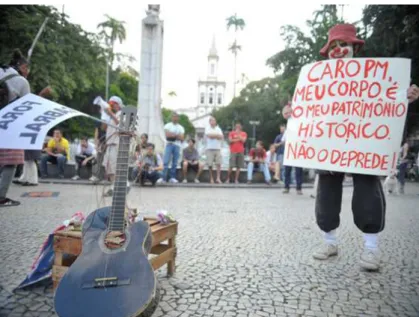
It is worth emphasizing also the presence of musicians who formed bands during the acts and, at certain moments, reminded the Titanic orchestra as the ship drowned or circus bands mocking the tragic slips of the clowns by responding with music to the roaring of police bombs (see Figure 6). The taking of the stairs of Palácio Guanabara (the state government headquarter) was accompanied by a band, in a carnivalesque procession on the dawn of September 22, 2013, after a Mask Ball held at the São Salvador Square, Laranjeiras. It was also with music that carnival was occupied by the atmosphere of the acts, with parodies played by the movement Ocupa Carnaval
(Occupy Carnival), and with the carnivalesque block named Cabral-hada after the governor Sérgio Cabral, on February 27, 2014, also parodying the protest songs themselves, by transforming Poder para o povo (Power to the people) into Poder para o polvo (Power to the octopus), with the merrymakers-activists holding a giant octopus ahead of the block.
One of the most impacting sound experiences, though, did not come from the songs or the cries. It was silence itself. In the act Grito da Liberdade, on October 31, 2013, the protesters have crossed the whole extension of Avenida Rio Branco in silence, many of them gagged, to the sound of a low beat, a voice or two eventually emerg-ing out of the silence to call well known names of victims of state violence (see Figure 7). After five months crying desires in the streets under violent attempts of silencing (the last one took 64 protesters to the prison complex at Bangu, leaving behind a trail of 200 arrested people and one destroyed occupation), this collective focused, silent, rock-steady performance, causing astonishment among passersby. Maybe, it would be “[...] the sound of a state crumbling down, of a new world reemerging from the hands of the people. The solemn, uncomfortable silence, resonating everything that was once said, all of our cries which for almost five months uproar in the streets without being heard”, as in the description of the Ocupa Câmara Rio6. Maybe, this mysterious connection which led a multitude to
remain silent, and this silence to resonate so powerfully, does not allow for any other answer but itself. Between political action and artistic performance, this disturbing silence remains suspended, indecipherably reverberating.
Escraches and Occupation
Among the many acts conceived in a totally diverse manner from traditional marches, I emphasize O casamento da Dona Barat-inha (The Wedding of Little Miss Cockroach, a Brazilian folktale similar to Martina, the beautiful cockroach), whose title immediately denounces the mockery. On the evening of Saturday, July 13, 2013, some dozens of people met in front of the Nossa Senhora do Carmo church, during the wedding of Beatriz Barata [Barata means cock-roach in English), the granddaughter of Jacob Barata, one of the main public transportation businessmen of Rio de Janeiro. While the guests attended the religious ceremony, the street chorus sang:
a, e, i, o, u, todo mundo pra Bangu (a, e, i, o, u, move everybody to Bangu). Many banged on pans, others blew horns, and the singing did not stop, as a soundtrack for the priest’s sermon. The booing and the singing of the protesters followed the guests to their luxury cars. A girl in a bridal gown distributed plastic roaches. A sign advised:
Figure 8 – Act O Casamento da Dona Baratinha, July 13, 2013, Nossa Senhora do Carmo church, Rio de Janeiro. Photo by Luiz Roberto Lima.
Figure 9 – Occupation Ocupa Cabral, June 21, 2013, Avenida Delfim Moreira, Leblon/RJ. Photo by TâniaRego/ABr.
The district came into focus while the struggle against the rise of bus fares (then reduced) gave way to the movement Fora Cabral (Out with Cabral) and was also the stage of great acts as the one which culminated in the depredation of a Toulon store on July 17, 2013. On the following day, astonished with such violence, the neighbors placed flowers at the doorstep of the shop and the government, in immediate response, has called for an emergency meeting with all the security forces of the state. If we recall the treatment conceded to the slaughter of ten people at Favela da Maré a few weeks before (on June 24th), and to which the state power still have not given any satisfactory response, all this commotion and disproportional reac-tion toward the depredareac-tion of patrimony makes it even clearer the project of city that is pursued, with its exception territories and its logic of restoration of objects and expropriation of subjects.
With Vandalism
Before the violence of the state and measures of exception applied to protesters and the poor population, the depredation of both public and private patrimony was considered by protesters as a feasible response through direct action. It is also possible to consider the black bloc tactic actions as both direct and symbolic from its aesthetic dimension. Besides the concept of performance, two other propositions from Hakim Bey contribute to this reflection: Poetic Terrorism (PT) and Sabotage Art (SA). Firstly, the author proposes a series of poetic-terrorist actions designed to provoke aesthetic shocks, whose objectives are activating different possibilities of existence from aesthetic experience, and thus these acts “[...] must categorically be divorced from all conventional structures for art consumption (gal-leries, publications, media)” (Bey, 2013a, p. 7). In order to be effec-tive, such actions must not be perceived as art, but as eruptions in the quotidian order, and never restricted to the sanctions of the law. The author suggests art as crime: crime as art. Secondly, Sabotage Art
combines “action as metaphor” and “creation through destruction”, being “appallingly direct, yet also subtly angled” (Bey, 2013a, p. 11). In this way, Bey tensions the limits and expands boundaries, moving not only between art and non-art, but between creation and destruc-tion on the thresholds of art and crime. The author illustrates it:
To throw money away at the Stock Exchange was pretty decent Poetic Terrorism – but to destroy the money would have been good Art Sabotage. To seize TV transmission & broadcast a few pirated minutes of incendiary Chaote art would constitute a feat of PT – but simply to blow up the transmission tower would be perfectly adequate Art Sabo-tage (Bey, 2013a, p. 12).
Intertextual
Among the actions deemed as vandalism there are also the spray paint writings on the surfaces of the city. In the introduction of the book Les mursont la parole, a collection of graffiti writings on the walls of Paris in May, 1968, Julien Besançon (1968, p. 8-9, my translation) identifies these gestures which write the city as a drive for “knocking down the wall by coloring it” and the “celebration of a participat-ing anonymity”. In fact, content is less important that the action of writing itself, which brings forth a bodily gesture that inscribes itself on the written space. These writings are also performances. In the context of the acts between 2013 and 2014, the proliferation of writings across the city employed not only spray paint used for stencil and graffiti art, but also through different means such as stamping notes of money and projections, thus creating intertextual networks. Even laying bodies were used for writing on the asphalt, as an SOS
denouncing the open air, massive imprisonment promoted by the military police siege on the surroundings of the Saens Peña Square, Tijuca, preventing both protesters and neighbors from leaving the area during the World Cup final (see Figure 10).
Figure 10 – Act World Cup Final, July 23, 2014, Saens Peña Square, Tijuca/RJ. Photo by Camila Nóbrega/Canal Ibase.
already issued arrest warrants as preventive measures for 26 activ-ists (among whom 17 were incarcerated in Bangu and 9 considered fugitives), besides the detention of two minors. After the approval of the Anti-terrorism Act due to the Olympic Games, we can imagine what waits for us.
However, there are acts that creatively manage to appropri-ate the very language of spectacle itself in order to subvert it, thus escaping from repression. That is how activists have employed the traditional street decorations for the World Cup, which, in a gen-eral manner, aim at cheering the Brazilian team and expressing the popular expectation for the Brazilian victory, as a space of critique production. A networked movement of anti-Cup decoration thus formed, disseminating actions across several points of the city.
In strategic spots like the Alzirão, which traditionally hosts celebrations after each Brazilian participation in World Cup games – and is located on the corner of the streets Conde de Bonfim and Alzira Brandão, Tijuca, and the main avenue of Méier, Rua Dias da Cruz – there happened interventions of great repercussion. When the day dawned on May 16, 2014, the asphalt was wet from paint, with a giant SOS Health. Two days later, Méier had received several paint-ings, as a boy holding a plate with a football ball instead of food, and a Brazilian flag overwritten with protests slogans and the inscription
Everything is wrong replacing the motto Order and Progress.
Figure 11 – Anti-World Cup Movement decoration, May\June 2014, Rio de Janeiro. Source: <http:// medialabufrj.net/mnemopolis/atlas/>.
Surprisingly
Figure 12 – Indigenous Resistance Aldeia Maracanã, December 17, 2013, old Indian Museum (Museu do Índio)/RJ. Photo by Mídia NINJA.
As mentioned earlier, all these gestures inscribe another city within the city, one that becomes concrete through the practice of the protesters. If they cannot prevent the advance of the excluding urban project justified by mega-events, surely they have produced a difference. These performers have politically and aesthetically exerted their right to the city, not the one in which we live today, but the city of their desires, of the collective desire, of networks of coopera-tion, of non-hierarchized structures, of the autonomous zones, of non-docile bodies. In the occupation of urban space, rather than questioning a model of city, the protesters have created others and managed to experience them here and now, even if temporarily. And as Temporary Autonomous Zones, who knows where it is going to end? It did not start in 2013 and will not be over in 2016.
Is it Over?
Even though sometimes conflicting, what composed those protests was the conviviality with diversity. Currently, it seems that many people have experimented a collective regression, as in those past lives therapies, jumping ahead in time without considering the years and experiences in our recent past, and hence recovering dichotomies, practices, and discourses that permeated the military coup of 1964 and the following years, and announcing a coup – now institutional – against corrupted communists for the sake of God, the fatherland, and the family. Even our idols are still the same, as says the song of Belchior. Political persecutions, violent actions to restrain diverging thoughts, and intolerance toward differences are doubtlessly the reactionary movements, in the very sense of a reaction against actions toward the establishment of new sociopolitical and cultural practices as the ones observed in the acts analyzed here.
The advance of discourses of hate and practices of fascist intol-erance during the demonstrations in defense of the impeachment of President Dilma Rousseff is doubtlessly scary and worrisome. The blind faith of certain demonstrations in favor of the Workers Party is no less. The media promotes not only an atmosphere of crisis and instability, but also of growing hostility between different sectors of the population. The impeachment propaganda vehicle – masked as
Organizações Globo’s journalism – picks good guys and villains, as though its TV News show was just one more of its soapoperas with a dash of a well edited reality show to define the next elimination. On social media networks, infantilization through mutual aggression is almost scandalizing. And, amidst all this, the youngest are the ones who have taught the greatest lessons in political maturity through the occupation of public schools7.
impeach-ment, whose defense arguments are grounded in the moral, political, and economical fields. Therefore, in a general manner, these protests against the coup eventually are revealed as vulnerable, as actions limited to negotiate with the law (Agamben, 2004), without potency for political action within this state of exception where the law has lost its applicability.
In this context, what seems to echo the voices of 2013 are the actions not related to an end (Agamben, 2004), as the escraches per-formed by the group Levante Popular da Juventude (Popular Youth Uprising) at the front doors of the homes of politicians as vice-president Michel Temer and the congressman Jair Bolsonaro (see Figure 13). Or the networked organizations of the feminist move-ments who have led the marches against the former president of the congress Eduardo Cunha, where a diversity of aesthetic experiences were visible in the composition of the acts, and in their campaigns which have become viral across social media networks as the hash tags
#primeiroassédio (first harassment), #meuamigosecreto (my secret friend) and #belarecatadaedolar (beautiful, candid, and housewife), both affirming subjectivities and reinforcing sorority ties.
Figure 13 – Escrache at Michel Temer’s house, April 21, 2016, São Paulo. Photo by Lina Marinelli.
2014. Matching the single colors, there are monological and repeti-tive choruses, either defending or against the impeachment of Dilma Rousseff. Adding to that, these demonstrations do not effectively interfere in the city flows, occupying only briefly the previously lib-erated spaces, like avenues closed on Sundays for leisure activities, like the Paulista Avenue (São Paulo) and Copacabana Beach (Rio de Janeiro), whether they are wide squares or broad paths where it is possible to join together without causing any harm, like Praça XV, Largo da Carioca, and the Arcos da Lapa (Rio de Janeiro).
However, a movement that gained momentum after the Sen-ate acceptance of the impeachment process on May 12, 2016 can be added to the analyzed acts: the occupation of the Ministry of Cul-ture’s branches in the 27 Brazilian states. By refusing to acknowledge the illegitimate government of Michel Temer, declining the sectoral agenda – supported by some artists – of the reopening of the Min-istry extinguished by one of the first acts of the Temer government, and by declining to negotiate with the interim government deemed as usurper, the Ocupa MinC began constructing in practice the de-mocracy it wishes. Horizontally organized and plural, the occupiers transform their differences into their most powerful potency in the quotidian construction of the common space, aggregating and mo-tivating a plurality of artistic and cultural autonomous movements (see Figure 14).
These movements emerged in relation to the impeachment, some with the same agenda – the defense of democracy – but with utterly distinct forms of action, are illustrative of the differences I have aimed to emphasize. This paper focuses on choreopolitics (Lep-ecki, 2012) and theaters of invasion (Carreira, 2008), the form of how actions of city occupation interfere in the habitual flows and create new urban flows, thus retaking the city in practice – the city politically and aesthetically deemed as a common and a space of multiplicity. All the aspects properly aesthetics related to the acts – the multiple colors and shapes, the polyphonic choruses, and other sound experiences, the choreographies of street occupation and the urban performances, the writings and paintings on walls and streets pavement, as well as vandalism, escraches, and occupations, and a variety of actions which do not fit the limits of this text – act against the ordering of an excluding city marked by exception (Agamben, 2004), hence creating other possible cities whose patrimony is made of subjects, or, retaking de Certeau (2011), of its creative abilities, of the arts of make do. Mobile, temporary (autonomous zones) cities, but constantly reconstructing and re (in)surrecting everywhere because they cannot be entirely demolished, for there are no leaders to be thrown, because they consist of multiple bodies, because they echo even in silence (see Figure 15).
Notes
1 Auto de resistência is the term often used for the registration of casualties resulting from
police action when a suspected offender allegedly offers armed resistance to exempt police
officers from criminal liability. The practice of intentionally altering or staging crime scenes
in order to fake ”autos de resistência” (aggravated resistance) eventually was caught on video and disclosed by the media on September 2015, through the case of the youngster Eduardo Felipe Santos Victor, from Morro da Providência. The video showed police officers placing a gun on the hand of the dead boy and then firing it. Recently, the term was officially banned, what does not ensure that it will also be banned in practice. Available at: <http:// g1.globo.com/rio-de-janeiro/noticia/2015/09/imagens-mostram-pms-mexendo-em-cena-de-homicidio-na-providencia-rio.html>. Accessed: Jan. 30 2016.
2 Execution Error was the expression used by the papers in 2015, based on the inquiry by the Internal Affairs Bureau on the death of Eduardo de Jesus, shot by police officers in front of his house at Complexo do Alemão. The inquiry concludes by stating that the police officers involved acted in self-defense by exchanging fire with armed drug dealers,
and that Eduardo was accidentally hit because he happened to be standing in the line of fire
– what was judicially classified as an “execution error”. Available at: <http://agenciabrasil. ebc.com.br/geral/noticia/2015-11/conclusao-sobre-morte-de-menino-no-alemao-e-rejeitada-pela-anistia>. Accessed: Jan. 30 2016.
3 The term is derived from the English word gentrification and refers to a series of
transformations established in urban centers, raising the value of a given territory and the local cost of living, hence forcing the dislocation of the poor population, whether through direct eviction or precluding the possibility of supporting a household in the affected areas (Bataller, 2012).
to dispose over his life. Denying loyalty to the government and offering resistance against rules one considers unjust (in his case, taxes supported war and slavery) is considered by Thoreau as a peaceful revolution performed through desertion. “Let your life be a counter friction to stop the machine” (Thoreau, 2013, p. 7), advises the author.
5 Available at: <http://oglobo.globo.com/rio/manifestantes-saem-pelas-ruas-do-centro-complicam-transito-9764169>. Accessed: Jan. 30 2016.
6 Available at: <https://www.facebook.com/ocupacamarario/photos/a.561812373877687.10 73741826.561611337231124/600164610042463/?type=3&theater>. Accessed: Jan. 30 2016. 7 In November 2015, 210 public high-schools were occupied in São Paulo by students opposed to the project of reorganization of the state government, which decided for the closure of 94 schools without dialogue with the community involved. Available at: <http:// g1.globo.com/sao-paulo/noticia/2015/11/veja-lista-das-escolas-ocupadas-no-estado-de-sao-paulo.html>. Accessed: Dec. 2 2015. In April 2016, students from Rio de Janeiro occupied 73 schools, demanding improvements in education and also supporting the state teachers’ strike Available at: <https://www.facebook.com/EscolasRJemLuta/photos/a.1513974618909027 .1073741828.1513766855596470/1532565140383308/?type=3&theater>. Accessed: Apr. 11 2016. They were all very young, collectively managing the occupied spaces, leaderless, organized in digital networks, bravely resisting police intimidation. They are students teaching parents and teachers, politicians, and society in general, by questioning in practice the current educational model that is both hierarchized and disconnected from life. They are youngsters who are daily producing the school they desire, with open, horizontal debates, conversation circles, school soirées, actions in the city, and also collectively assuming all the chores required to keep the occupied schools clean and supplied with food. This experience of autonomy in the occupations definitely might become the greatest learning these students will accomplish from their school years; and a lesson they teach us all.
References
AGAMBEN, Giorgio. Estado de Exceção. São Paulo: Boitempo, 2004.
ANCOP. Dossiê Megaeventos e Violações dos Direitos Humanos no Brasil. Articulação
Nacional dos Comitês Populares da Copa, 2014.
BATALLER, Maria Alba Sargatal. O Estudo da Gentrificação. Revista Continentes, Rio
de Janeiro, UFRRJ, ano 1, n. 1, p. 9-37, jul./dez. 2012.
BESANÇON, Julien. Les Murs ont la Parole. Paris: Tchou éditeur, 1968.
BEY, Hakim. CAOS: terrorismo poético e outros crimes exemplares. 2013a. Disponível
em: <http://www.imagomundi.com.br/cultura/caos.pdf>. Acesso em: 08 ago. 2013.
BEY, Hakim. TAZ: zona autônoma temporária. 2013b. Disponível em: <http://www.mom.
arq.ufmg.br/mom/arq_interface/4a_aula/Hakim_Bey_TAZ.pdf>. Acesso em: 14 set. 2013. CARREIRA, André. Teatro de Invasão: redefinindo a ordem da cidade. In. LIMA, Evelyn
Furquim Werneck (Org.). Espaço e Teatro: do edifício teatral à cidade como palco. Rio
CERTEAU, Michel de. A Invenção do Cotidiano: 2. morar, cozinhar. / Michel de Cer-teau, Luce Giard, Pierre Mayol. Petrópolis: Vozes, 2011.
CERTEAU, Michel de. Andando na cidade. Revista do Patrimônio Histórico e Artístico
Nacional, Brasília, IPHAN, n. 23, p. 21-31, 1994.
DEBORD, Guy. A Sociedade do Espetáculo. Rio de Janeiro: Contraponto, 1997.
FOUCAULT, Michel. Vigiar e Punir: nascimento da prisão. Petrópolis: Vozes, 1987.
GUMBRECHT, Hans Ulrich. Produção de Presença: o que o sentido não consegue
transmitir. Rio de Janeiro: Contraponto: Ed. PUC-Rio, 2010.
LEPECKI, André. Coreopolítica e Coreopolícia. Ilha (Revista de Antropologia),
Flori-anópolis, v. 13, n. 1, p. 41-60, jan./jun. (2011) 2012.
MPL, Movimento Passe Livre – São Paulo. Não começou em Salvador, não vai terminar em
São Paulo. In: HARVEY, David; ZIZEK, Slavoj; DAVIS, Mike et al. Cidades Rebeldes:
passe livre e as manifestações que tomaram as ruas do Brasil.São Paulo: Boitempo, 2013.
PÁL PELBART, Peter. “Anota aí: eu sou ninguém”. Folha de São Paulo, Opinião, São
Pau-lo, 19 jul. 2013. Disponível em: <http://www1.folha.uol.com.br/opiniao/2013/07/1313378-peter-pal-pelbart-anota-ai-eu-sou-ninguem.shtml>. Acesso em: 20 jul. 2013.
PROVASI, Beatriz. As Guerras nos Porta-retratos. Rio de Janeiro: Edição da autora, 2014.
RANCIÈRE, Jacques. A Partilha do Sensível: estética e política. São Paulo: Ed. 34, 2005.
ROQUE, Tatiana. Os Novos Movimentos se Constituem a partir de Diagramas (e não de
programas). Revista DR, Rio de Janeiro, n. 1, online, mar. 2015. Disponível em: <http://
www.revistadr.com.br/posts/os-novos-movimentos-se-constituem-a-partir-de-diagramas-e-nao-de-programas>. Acesso em: 02 abr. 2015.
THOREAU, Henry David. A Desobediência Civil. Disponível em:
<http://www.domin-iopublico.gov.br/download/texto/cv000019.pdf>. Acesso em: 13 nov. 2013.
Beatriz Diogo Tavares (in the art field, Beatriz Provasi)is a poet, performer and ac-tress. She holds a Master’s degree in Visual Arts from Universidade Federal do Rio de Janeiro (UFRJ). She is a PhD candidate in Literature, Culture and Contemporaneity at Pontifícia Universidade Católica do Rio de Janeiro (PUC-Rio). Doctoral Fellow-ship funded by the National Counsel of Technological and Scientific Development (CNPq).
E-mail: [email protected]
This unpublished text, translated by Simone do Vale and proofread by Ananyr Porto Fajardo, is also published in Portuguese in this issue.