INTRODUCTION
Growth traits of beef cattle are known to be influ-enced by maternal effects. Early reports (Koch and Clark, 1955; Willham, 1963) mentioned the possible influence of grandmaternal effects. Falconer (1965) considered the maternal effect as a linear function of a mother’s pheno-typic value influenced by all maternal ancestors. The so-called ‘fatty udder syndrome’ is an example of a grand-maternal effect: a granddam with a high grand-maternal ability may over-feed her daughter and thereby have a negative influence on her daughter’s maternal ability by inhibiting development of her udder tissue (Totusek et al., 1971). The importance of maternal effects in beef cattle has been widely reported (Koch, 1972; Baker, 1980; Robison, 1981; Meyer, 1992). Studies on African cattle populations have reported a strong maternal influence on growth traits (Tawah et al., 1993; Khombe et al., 1995; Diop and Van Vleck, 1998).
Animal models used to estimate maternal effects typically include direct and maternal genetic effects and maternal permanent environmental effects and consider the covariance between genetic effects. Meyer (1992) pointed
out that such models may be suboptimal and need to be improved. The objective of this study was to evaluate the influence of including grandmaternal effects in a model for estimating genetic parameters for growth traits in Gobra cattle for which maternal effects have previously been shown to be important.
MATERIAL AND METHODS
The records of weight at birth, 6, 12, and 18 months were obtained from the Gobra herd at the Centre de Recherches Zootechniques de Dahra, Senegal. The pro-duction environment is characterized by a dry tropical cli-mate with two distinct seasons: a long dry season from October to June and a short rainy season from July to Sep-tember. The mean annual rainfall from 1964 to 1988 was 360 mm. The mean annual temperature is 28oC. The veg-etation is described as savanna type dominated by Acacia sp. and annual grasses. Annual biomass production is closely related to the amount of rainfall the area receives each year.
Native pasture is the main source of feed. The quan-tity and quality of the pasture vary considerably during the year. During the rainy season, pastures are of good quality and abundant. During the dry season, the nutritive value of the forage decreases and supplemental feeding with ground nutcake or cottonseed is provided, especially for suckling cows and weaned calves.
Breeding females were randomly assigned to sires (30-50 cows/sire) for a breeding season from December to March. Cows that were not pregnant 3 months after the breeding season started were reassigned to a different bull.
ESTIMATES OF DIRECT, MATERNAL AND GRANDMATERNAL GENETIC EFFECTS
FOR GROWTH TRAITS IN GOBRA CATTLE
M. Diop1, J. Dodenhoff1 and L.D. Van Vleck2
A
BSTRACTEstimates of genetic parameters for birth (N = 3909), weaning (N = 3425), yearling (N = 2764) and final (N = 2144) weights were obtained from the records of Gobra cattle collected at the Centre de Recherches Zootechniques de Dahra, Senegal. Three animal models were fitted to obtain estimates by REML using an average information (AI) approach. Model 1 consid-ered random direct, maternal genetic and maternal permanent environmental effects. In model 2, a general grandmaternal effect was added to the random effects considered in model 1, and in model 3, the general grandmaternal effect was divided into grandmaternal genetic and grandmaternal permanent environmental effects. All models allowed covariances among genetic effects. The inclusion of grandmaternal effects in models 2 and 3 did not change the estimates of the genetic param-eters compared to model 1. Variances attributable to grandmaternal effects became negative and were set close to zero, except for yearling weight for which grandmaternal heritability was 0.03±0.03. The estimates for direct and maternal heritabilities were, respectively, 0.08±0.03 and 0.03±0.02 for birth, 0.20±0.05 and 0.21 ±0.05 for weaning, 0.26± 0.07 and 0.16± 0.07 for yearling and 0.14 ± 0.06 and 0.16±0.06 for final weights. The estimates of the genetic correlation between direct and maternal effects for birth, weaning, yearling and final weights were -0.17±0.40, -0.58 ±0.32, -0.52± 0.34 and -0.34± 0.37, respectively. For yearling weight with grandmaternal heritability estimated to be only 0.03, model 3 gave estimates of the genetic correlation between direct and grandmaternal effects and between maternal and grandmaternal effects of 0.28± 0.48 and -0.33 ±0.67, respectively. Estimates of direct and maternal heritabilities were unchanged when grandmaternal effects were not included in the model.
1Department of Animal Science, (A 218 Animal Sciences) University of
Nebraska, Lincoln, NE 68583-0908, USA. Send correspondence to L.D.V.V.
2USDA-ARS Roman L. Hruska U.S. Meat Animal Research Center, Lincoln,
NE 68583-0908, USA.
Over the years, the size of the herd has fluctuated around 300 cows. Males and females were selected based on weight at 6 months (weaning). Males were again selected based on their weight at 18 months after which the 10 best males underwent a growth performance test before final selection for the two or three bulls to be used as replace-ment bulls. Replacereplace-ment females were selected at 24 months based on their weight. About 5% of the males and 80% of the females selected after weaning were used as replacements. Culling of the cows was based on poor re-productive performance (long calving interval or failure to calve after two breeding seasons) or poor growth per-formance of offspring.
The data for the present analyses consisted of the records of animals born from 1963 to 1989. Consistency checks were performed upon the identification of the ani-mals and their pedigrees. Records of the progeny of sires with less than five progeny were deleted from the analy-sis. The PROC MIXED option of SAS (SAS, 1992) was used to test the significance of the fixed effects of month of birth, year of birth, sex and parity in a model with sire considered to be a random effect.
For estimation of the genetic parameters, three ani-mal models were fitted for the four traits considered :
Model 1: y = Xβ + Z1 a + Z2 m + W1 c + e Model 2: y = Xβ + Z1 a + Z2 m + W1 c + W2 q + e Model 3: y = Xβ + Z1 a + Z2 m + Z3 g + W1 c + W2 q + e
where y is an N x 1 vector of observations, βββββ is the vector of fixed effects of year of birth, month of birth, sex and parity of dam, a, m and g are vectors of breeding values for direct, maternal and grandmaternal genetic effects, c and q are vectors of maternal permanent environmental and grandmaternal permanent environmental effects and e is an N x 1 vector of residual random effects, and X, Z1, Z2, Z3, W1and W2 are known incidence matrices relating observations to their respective fixed and random effects. Matrices Z1, Z2and Z3 were augmented for animals with-out records that were included in the relationship matrix.
For the most complete model (model 3), E (y) = Xβ and
where Nd and Ng are numbers of dams and granddams,
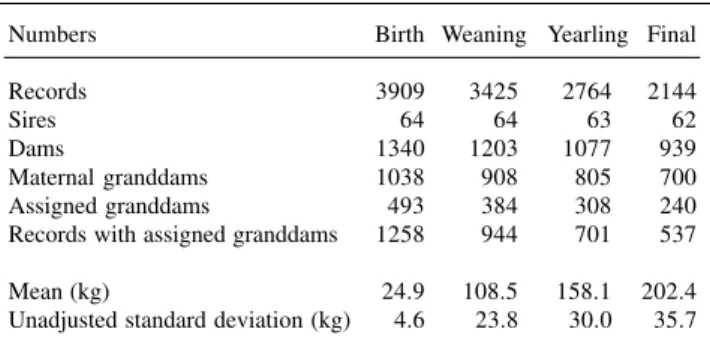
respectively, and N is the number of records, A is the nu-merator relationship matrix among animals in the pedi-gree file, and the I matrices are identity matrices of speci-fied order. Models 2 and 3 require each animal with a record to have a granddam. Therefore, “dummy” granddam identi-fication was assigned for records with unknown granddam implying the assumption that these granddams are unrelated among themselves and unrelated to those with known iden-tification. Table I summarizes the data used in the analyses. Components of variance were estimated by re-stricted maximum likelihood (REML) using an average information algorithm (Johnson and Thompson, 1995). The algorithm is a Newton method which uses first and sec-ond derivatives of the logarithm of the likelihood given the data to find estimates of variance components that maximize the likelihood function.
A preliminary analysis of variance showed that the fixed effects of month and year of birth, sex, and parity were significant. Consequently, these effects were included in all three models.
Estimates of relative variances attributable to ad-ditive direct (h2), maternal (h2) and grandmaternal (h2) genetic effects were calculated as ratios of the estimates of additive direct (σ2), maternal genetic (σ2) and grand-maternal genetic (σ2) variances, respectively, to the phe-notypic variance (σ2). The direct-maternal (r
am), direct-grandmaternal (rag) and maternal-grandmaternal (rmg) ge-netic correlations were estimated as ratios of the direct-maternal (σam), direct-grandmaternal (σag) and maternal-grandmaternal (σmg) genetic covariances to the square roots of the products of σ2 and σ2, σ2 and σ2, and σ2 , and σ2, respectively. The estimates of relative variances attribut-able to maternal permanent environmental effects (c2) and grandmaternal permanent environmental effects (q2) were calculated as the ratios of the estimates of maternal (σ2) and grandmaternal (σ2) permanent environmental variances to the phenotypic variance (σ2).
RESULTS
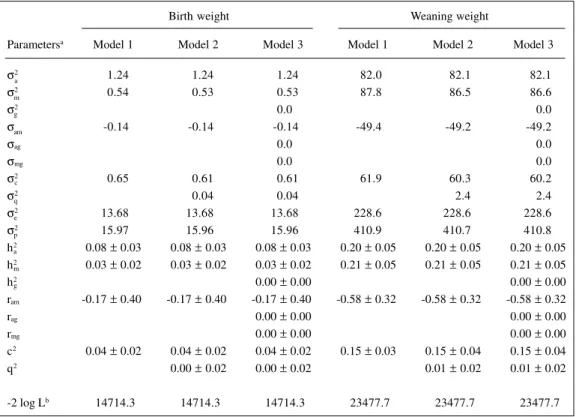
The variance components and estimates of genetic parameters (ratios and correlations) for birth weight are
Table I - Characteristics of the data including weights of Gobra cattle at different ages.
Numbers Birth Weaning Yearling Final
Records 3909 3425 2764 2144
Sires 64 64 63 62
Dams 1340 1203 1077 939
Maternal granddams 1038 908 805 700
Assigned granddams 493 384 308 240
Records with assigned granddams 1258 944 701 537
Mean (kg) 24.9 108.5 158.1 202.4
Unadjusted standard deviation (kg) 4.6 23.8 30.0 35.7
a m g
a m
g
p
a m a g m g
presented in Table II. The direct (h2) and maternal (h2) heritabilities were 0.08 ± 0.03 and 0.03 ± 0.02, respec-tively, for the three models. The estimates were similar for all effects included in all models. The estimates of vari-ances attributable to grandmaternal genetic and/or grand-maternal permanent environmental effects were close to zero in models 2 and 3. The estimate of the correlation between direct and maternal genetic effects was -0.17 ± 0.41. The estimate of c2 was 0.04 ± 0.02 for all models. As expected from the estimates associated with grandmater-nal effects, the three models resulted in essentially the same value for the log likelihood.
The pattern of the estimates for weaning weight (Table II) was similar to that pattern of estimates for birth weight, i.e., the estimates of the variance and co-variance components for included effects were of the same magnitude in the different models. Variances at-tributable to grandmaternal effects were small, with values near zero. The estimates of direct and maternal heritabilities were 0.20 ± 0.05 and 0.21 ± 0.05, respec-tively. The direct-maternal genetic correlation was -0.58
± 0.32 and c2 was 0.15 ± 0.04.
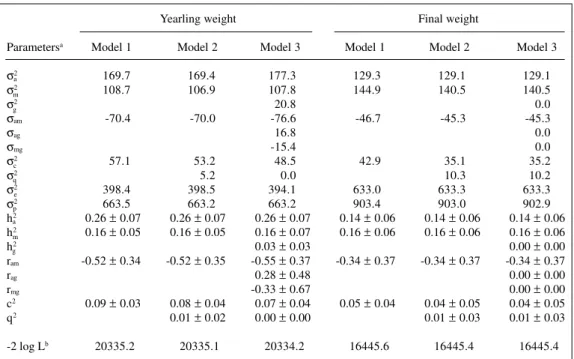
a m The estimates for yearling weight (Table III)
showed that the inclusion of grandmaternal genetic effects in model 3 slightly increased the additive direct genetic variance with an estimate of grandmaternal genetic heri-tability (h2) of 0.03 ± 0.03. The estimated values of the genetic correlations between the direct and grandmater-nal genetic effects (rag) and between the maternal and grandmaternal effects (rmg) were small to moderate with large standard errors (0.28 ± 0.48 and -0.33 ± 0.67, re-spectively). The estimates of variance components attrib-utable to direct and maternal effects and their correlation were similar for the three models. The estimates of h2 and h2 were 0.26 ± 0.07 and 0.16 ± 0.07, respectively. The estimate of ram was -0.55 ± 0.37 for model 3. The estimates of c2 were 0.09 ± 0.03 for model 1 and 0.07 ± 0.04 for model 3.
The estimate of variance for final weight attribut-able to grandmaternal effects was near zero (Tattribut-able III). The estimates of direct (h2) and maternal (h2) heritabilities were 0.14 ± 0.06 and 0.16 ± 0.06, respectively. The esti-mate of c2 was 0.04 ± 0.05. The correlation between the direct and maternal genetic effects was -0.34 ± 0.37.
g
a
m a
m
Table II - Estimates of the components of variance and genetic parameters for birth and weaning weights of Gobra cattle.
Birth weight Weaning weight
Parametersa Model 1 Model 2 Model 3 Model 1 Model 2 Model 3
σ2 1.24 1.24 1.24 82.0 82.1 82.1
σ2 0.54 0.53 0.53 87.8 86.5 86.6
σ2 0.0 0.0
σ -0.14 -0.14 -0.14 -49.4 -49.2 -49.2
σag 0.0 0.0
σmg 0.0 0.0
σ2 0.65 0.61 0.61 61.9 60.3 60.2
σ2 0.04 0.04 2.4 2.4
σ2 13.68 13.68 13.68 228.6 228.6 228.6
σ2 15.97 15.96 15.96 410.9 410.7 410.8
h2 0.08 ± 0.03 0.08 ± 0.03 0.08 ± 0.03 0.20 ± 0.05 0.20 ± 0.05 0.20 ± 0.05
h2 0.03 ± 0.02 0.03 ± 0.02 0.03 ± 0.02 0.21 ± 0.05 0.21 ± 0.05 0.21 ± 0.05
h2 0.00 ± 0.00 0.00 ± 0.00
ram -0.17 ± 0.40 -0.17 ± 0.40 -0.17 ± 0.40 -0.58 ± 0.32 -0.58 ± 0.32 -0.58 ± 0.32
rag 0.00 ± 0.00 0.00 ± 0.00
rmg 0.00 ± 0.00 0.00 ± 0.00
c2 0.04 ± 0.02 0.04 ± 0.02 0.04 ± 0.02 0.15 ± 0.03 0.15 ± 0.04 0.15 ± 0.04
q2 0.00 ± 0.02 0.00 ± 0.02 0.01 ± 0.02 0.01 ± 0.02
-2 log Lb 14714.3 14714.3 14714.3 23477.7 23477.7 23477.7 aσ2, Direct genetic variance; σ2 , maternal genetic variance; σ2, grandmaternal genetic variance; σ
am, direct and
mater-nal genetic covariance; σag, direct and grandmaternal genetic covariance; σmg, maternal and grandmaternal genetic covariance; σ2, maternal permanent environmental variance; σ2, grandmaternal permanent environmental variance; σ2, temporary environmental variance; σ2, phenotypic variance; h2, direct heritability; h2 , maternal heritability; h2,
grandmaternal heritability; ram, direct-maternal genetic correlation; rag, direct-grandmaternal genetic correlation; rmg,
maternal-grandmaternal genetic correlation; c2 = σ2 /σ2, q2 = σ2 /σ2 . b-2 log L = Minus twice the log likelihood given the
data.
a m g
c q
e a m g
c p q p
a
m
g
am
c
q
e
p
a
m
g
DISCUSSION
The inclusion of grandmaternal effects in the model did not change the estimates of the direct and maternal heritabilities or of the genetic correlation between the di-rect and maternal genetic effects for the four traits ana-lyzed. However, for yearling weight, the inclusion of grand-maternal genetic effects in model 3 slightly increased the additive direct genetic variance. The estimates of variance attributable to grandmaternal effects were very small or zero, suggesting that these effects did not play an impor-tant role in these traits in this population of cattle which exhibits large differences in maternal genetic effects. Simi-lar results were found with native Korean cattle (Lee et al., 1998) which also exhibit large differences in 4 month and 6 month weights as a result of maternal genetic ef-fects. Dodenhoff et al. (1998) reported significant varia-tion in weaning weight attributable to grandmaternal ef-fects in a population of Hereford cattle with moderate ex-pression of maternal effects and a large negative correla-tion between direct and maternal genetic effects. These authors noted that when estimates of grandmaternal heri-tability were not zero, the estimates of maternal herita-bility increased, whereas direct heritaherita-bility was not af-fected. A similar pattern was also observed in another population of Hereford cattle that had undergone long-term selection in Montana (USA) (Ferreira, G.B.,
MacNeil, M.D., and Van Vleck, L.D., unpublished results). For yearling weight, there was a small, positive correlation between direct and grandmaternal genetic ef-fects (rag) and a moderate, negative correlation between the maternal and grandmaternal genetic effects (rmg). The standard errors associated with these estimates were large which means they are not significantly different from zero. Dodenhoff et al. (1998) reported small to large positive estimates of rag at weaning for different lines of Hereford cattle. The estimates for rmg were negative and large for weaning weight in these lines. The negative correlation between direct and maternal and between maternal and grandmaternal genetic effects may be explained as the negative influence of dams on the maternal ability of their female offspring through overfeeding (Koch, 1972). Tawah et al. (1993) suggested that these negative correlations may reflect adaptation of the animals to a dry tropical ment where food resources are scarce. In such an environ-ment, small cows tend to meet their nutritional require-ments for maintenance and growth of their calves more easily than larger cows. The latter would produce smaller calves, especially at weaning, than would smaller cows of similar age.
Maternal heritability was important in all cases, except birth weight, with estimates of the same magnitude as for direct heritability. The estimates for weaning weight agreed with values reported for Hereford cattle (Meyer, Table III - Estimates of components of variance and genetic parameters for yearling
and final weights for Gobra cattle.
Yearling weight Final weight
Parametersa Model 1 Model 2 Model 3 Model 1 Model 2 Model 3
σ2 169.7 169.4 177.3 129.3 129.1 129.1
σ2 108.7 106.9 107.8 144.9 140.5 140.5
σ2 20.8 0.0
σam -70.4 -70.0 -76.6 -46.7 -45.3 -45.3
σag 16.8 0.0
σmg -15.4 0.0
σ2 57.1 53.2 48.5 42.9 35.1 35.2
σ2 5.2 0.0 10.3 10.2
σ2 398.4 398.5 394.1 633.0 633.3 633.3
σ2 663.5 663.2 663.2 903.4 903.0 902.9
h2 0.26 ± 0.07 0.26 ± 0.07 0.26 ± 0.07 0.14 ± 0.06 0.14 ± 0.06 0.14 ± 0.06
h2 0.16 ± 0.05 0.16 ± 0.05 0.16 ± 0.07 0.16 ± 0.06 0.16 ± 0.06 0.16 ± 0.06
h2 0.03 ± 0.03 0.00 ± 0.00
ram -0.52 ± 0.34 -0.52 ± 0.35 -0.55 ± 0.37 -0.34 ± 0.37 -0.34 ± 0.37 -0.34 ± 0.37
rag 0.28 ± 0.48 0.00 ± 0.00
rmg -0.33 ± 0.67 0.00 ± 0.00
c2 0.09 ± 0.03 0.08 ± 0.04 0.07 ± 0.04 0.05 ± 0.04 0.04 ± 0.05 0.04 ± 0.05
q2 0.01 ± 0.02 0.00 ± 0.00 0.01 ± 0.03 0.01 ± 0.03
-2 log Lb 20335.2 20335.1 20334.2 16445.6 16445.4 16445.4 aσ2, Direct genetic variance; σ2 , maternal genetic variance; σ2, grandmaternal genetic variance; σ
am, direct and
mater-nal genetic covariance; σag, direct and grandmaternal genetic covariance; σmg, maternal and grandmaternal genetic covariance; σ2, maternal permanent environmental variance; σ2, grandmaternal permanent environmental variance; σ2, temporary environmental variance; σ2, phenotypic variance; h2, direct heritability; h2 , maternal heritability; h2 ,
grandmaternal heritability; ram, direct-maternal genetic correlation; rag, direct-grandmaternal genetic correlation; rmg,
maternal-grandmaternal genetic correlation; c2 = σ2/σ2; q2 = σ2/σ2. b-2 log L = Minus twice the log likelihood given the data. a
m
g
c
q
e
p
a
m
g
a m g
c q
e
p
a m g
c q p
1992), Nelore cattle (Eler et al., 1995), Wakwa and Gudali cattle (Tawah et al., 1993), and Mashona cattle (Khombe et al., 1995). For yearling and final weights, the estimates of direct, but not maternal, heritability were consistent with most published estimates. Maternal effects would be ex-pected to diminish at these ages because the animals no longer depend on their mothers. Relatively high estimates of h2 were also reported by Eler et al. (1995) and Mackinnon et al. (1991) at yearling and later ages, respec-tively. These authors both also suggested that for animals raised on pasture with little or no feed supplement, the length of time between weaning and yearling ages may not be enough to buffer maternal effects present at weaning.
The estimate of the ratio of maternal permanent environmental variance to the phenotypic variance, c2, was larger for weaning weight than for the other traits, as also reported by Eler et al. (1995) and Meyer (1992). Perma-nent environmental effects result from incidents that af-fect all progeny of the same cow. The efaf-fects before wean-ing may be caused by sequels of diseases or accidents to the udder, which will affect the milk production of the dam, whereas the estimate of c2 at later ages may reflect a carry-over effect on weaning weight.
CONCLUSIONS
Grandmaternal effects do not play an important role in the weight of Gobra cattle at birth, weaning (6 months), yearling (12 months) and 18 months of age. In contrast, maternal effects are important, even at 18 months of age. Models for the genetic evaluation of Gobra cattle could safely ignore grandmaternal effects but should include di-rect and maternal genetic effects with the corresponding direct-maternal genetic covariance.
RESUMO
Foram obtidas as estimativas dos pesos ao nascimento (N = 3909), ao desmame (N = 3425), com 1 ano de idade (N = 2764) e final (N = 2144) a partir dos registros de gado Gobra coletados no Centro de Pesquisas em Zootecnia de Dahra, Senegal. Três modelos animais foram adaptados para obter estimativas por REML usando uma abordagem de informação média (AI). O modelo 1 considerou os efeitos ambientais aleatórios direto, genético maternal e maternal permanente. No modelo 2, um efeito geral relativo às avós foi adicionado aos efeitos aleatórios considerados no modelo 1, e no modelo 3 o efeito geral relativo às avós foi dividido em efeitos ambientais genético e permanente. Todos os modelos admitiram covariâncias entre os efeitos genéticos. A inclusão dos efeitos relativos às avós nos modelos 2 e 3 não alterou as estimativas dos parâmetros genéticos comparados com o modelo 1. As variâncias atribuíveis aos efeitos relativos às avós tornaram-se negativas e foram posicionadas próximas a zero, exceto para o peso com 1 ano,
para o qual a herdabilidade relativa à avo foi 0,03 ± 0,03. As
estimativas para as herdabilidades direta e maternal foram,
respectivamente, 0,08 ± 0,03 e 0,03 ± 0,02 para peso ao
nascimento, 0,20 ± 0,05 e 0,21 ± 0,05 para peso ao desmame,
0,26 ± 0,07 e 0,16 ± 0,07 para peso com 1 ano e 0,14 ± 0,06 e
0,16 ± 0,06 para o peso final. As estimativas da correlação
genética entre os efeitos direto e maternal para os pesos ao
nascimento, ao desmame, com 1 ano e final foram -0,17 ± 0,40,
-0,58 ± 0,32, -0,52 ± 0,34 e -0,34 ± 0,37, respectivamente. Para o peso com 1 ano com herdabilidade relativa à avó estimada como sendo apenas 0,03, o modelo 3 deu estimativas da correlação genética entre os efeitos direto e relativo à avó e entre os efeitos maternal e relativo à avó de 0,28 ± 0,48 e -0,33 ± 0,67, respectivamente. As estimativas de herdabilidade direta e mater-nal não se alteraram quando os efeitos relativos à avó não foram incluídos no modelo.
REFERENCES
Baker, R.L. (1980). The role of maternal effects on the efficiency of selection in beef cattle. A review. Proc. N. Z. Soc. Anim. Prod. 40: 285-303. Diop, M. and Van Vleck, L.D. (1998). Estimates of genetic parameters for
growth traits of Gobra cattle. Anim. Sci. 66: 349-355.
Dodenhoff, J., Van Vleck, L.D., Kachman, S.D. and Koch, R.M. (1998). Parameter estimates for direct, maternal and grandmaternal genetic effects for birth weight and weaning weight in Hereford cattle. J. Anim. Sci. 76: 2521-2527.
Eler, J.P., Van Vleck, L.D., Ferraz, J.B.S. and Lôbo, R.B. (1995). Esti-mation of variances due to direct and maternal effects for growth traits of Nelore cattle. J. Anim. Sci. 73: 3253-3258.
Falconer, D.S. (1965). Maternal effects and selection response. In: Genet-ics Today. Proceedings of the XI International Congress of Genet-ics. The Hague, The Netherlands. Vol 3, p. 763.
Johnson, D.L. and Thompson, R. (1995). Restricted maximum likelihood estimation of variance components for univariate animal models us-ing sparse matrix techniques and average information. J. Dairy Sci. 78: 449-456.
Khombe, C.T., Hayes, J.F., Cue, R.I. and Wade, K.M. (1995). Estimation of direct additive and maternal additive genetic effects for weaning weight in Mashona cattle of Zimbabwe using an individual animal model. Anim. Prod. 60: 41-48.
Koch, R.M. (1972). The role of maternal effects in animal breeding. VI. Maternal effects in beef cattle. J. Anim. Sci. 35: 1316-1323. Koch, R.M. and Clark, R.T. (1955). Genetic and environmental
relation-ships among economic characters in beef cattle. III. Evaluating ma-ternal environment. J. Anim. Sci. 14: 979-996.
Lee, J.W., Choi, S.B. and Van Vleck, L.D. (1998). Lack of grandmaternal genetic effects for birth weight, weaning weight, and six month weight in Korean native cattle. Proceedings of the 8th World Congress on Animal Production, Seoul National University, Seoul, Korea. June 28-July 4, 1998. Vol. 2, pp. 630-631.
Mackinnon, M.J., Meyer, K. and Hetzel, J.D.S. (1991). Genetic variation and covariation for growth, parasite resistance and heat tolerance in tropical cattle. Livest. Prod. Sci. 27: 105-122.
Meyer, K. (1992). Variance components due to direct and maternal effects for growth traits of Australian beef cattle. Livest. Prod. Sci. 31: 179-204.
Robison, O.W. (1981). The influence of maternal effects on the efficiency of selection: a review. Livest. Prod. Sci. 8: 121-137.
SAS Institute (1992). SAS/STAT, Release 6.08. SAS Institute Inc., Cary, NC. Tawah, C.L., Mbah, D.A., Rege, J.E.O. and Oumate, H. (1993). Genetic evaluation of birth and weaning weights of Gudali and two-breed synthetic Wakwa beef cattle populations under selection in Cameroon: genetic and phenotypic parameters. Anim. Prod. 57: 73-79. Totusek, R., Stephens, O.F., Kropp, J.R., Holloway, S.W., Knosi, J.W.
and Whiteman, J.V. (1971). Milk production of range cows. Okla. Agric. Ext. Sta.Misc. Pub. 85.
Willham, R.L. (1963). The covariance between relatives for characters com-posed of components contributed by related individuals. Biometrics 19: 18-27.