DOI: 10.1590/0004-282X20160007
ARTICLE
Educational program on fatigue for brain
tumor patients: possibility strategy?
Programa educativo para fadiga em pacientes com tumor cerebral: possibilidade de
estratégia?
Marcela dos Reis Bigatão1, Fernanda Maris Peria2, Daniela P. C. Tirapelli1, Carlos Gilberto Carlotti Junior1
Fatigue is recognized as one of the most common and
dis-tressing adverse efects of cancer disease and treatment1. For
Bower1 and Raf et al. 2, the clinical symptom of fatigue may
include generalized weakness, decreased mental concentra
-tion, insomnia or hypersomnia, and emotional change that cause signiicant impairment to the global quality of life of cancer patients during and after treatment.
he pathogenesis of the relationship between can
-cer and fatigue has not been elucidated, but physiologi
-cal, biochemical and psychological disturbances seem to be involved. Due to its multifactorial nature, several inter
-ventions in the management of cancer-related fatigue have been investigated2.
In a review study, Horneber et al.3 highlight some of the
physiopathological factors of fatigue, including inlammatory cytokine dysregulation, changes in hypothalamic regulator cir
-cuits and serotonergic system in the central nervous system (CNS), and disturbances in circadian and sleep-wake rhythm, gene polymorphisms of regulatory proteins involved in oxida
-tive phosphorylation, B-cell signal transduction, proinlamma
-tory cytokine expression and catecholamine metabolism. Some authors have investigated the frequency of fatigue in patients with glioblastoma and showed that these patients are commonly afected by this symptom, suggesting that oth
-er factors related to radioth-erapy and/or chemoth-erapy, such as depression and tumor site, may have a signiicant impact4.
1Universidade de São Paulo, Faculdade de Medicina de Ribeirão Preto, Departamento de Cirurgia e Anatomia, Ribeirao Preto SP, Brazil;
2Universidade de São Paulo, Faculdade de Medicina de Ribeirão Preto, Departamento de Oncologia, Ribeirao Preto SP, Brazil.
Correspondence: Marcela dos Reis Bigatão; Rua Erno Toth, 20; 13272-081 Valinhos SP, Brasil. E-mail: [email protected] Conflict of interest: There is no conlict of interest to declare.
Received 10 July 2015; Received in inal form 21 September 2015; Accepted 15 October 2015. ABSTRACT
Objective: To evaluate the effectiveness of an educational program on improvement of fatigue and quality of life of patients with high-grade glioma during radiotherapy and chemotherapy treatment. Method: This is a longitudinal, experimental study. Twenty-three patients with high-grade glioma were randomly assigned to one of two groups. Both groups completed the Functional Assessment of Cancer Therapy: Fatigue questionnaire and the Beck Depression Inventory, and one of the groups received the educational intervention. Results and Conclusions: The groups did not show any change in quality of life and fatigue in this study, for this reason, the educational program did not present any signiicant difference. However, there was a signiicant difference in depressive symptoms during the educational program showing positive evidence for its applicability.
Keywords: glioma, fatigue, depression, quality of life, health education. RESUMO
Objetivo: Veriicar a efetividade de um programa educativo na melhora da fadiga e dos sintomas depressivos em pacientes com glioma de alto grau durante o tratamento com radioterapia e quimioterapia. Método: Trata-se de estudo longitudinal e experimental. Foram incluídos 23 pacientes com glioma de alto grau e divididos aleatoriamente em 2 grupos. Os dois grupos responderam os questionários Functional Assessment of Cancer Therapy: Fatigue e Inventário de Depressão de Beck, porém somente um foi inserido ao programa educativo. Resultados e Conclusões: Os grupos não apresentaram alteração na fadiga ao longo desse estudo, assim o programa educativo não mostrou diferença signiicativa, porém nos sintomas depressivos, o programa educativo trouxe diferença quando estava sendo realizado mostrando evidências positivas para sua aplicabilidade.
Fatigue is reported by more than 80% of patients with prima
-ry brain tumor during radiotherapy5.
Gliomas are CNS tumors derived from glial cells, and comprise approximately 40%-60% of all CNS primary tumors, being the most common among adults6.
Biological characteristics of glioblastomas include rapid growth, which frequently evolve into increased intracranial pressure. Depending on its exact location, glioblastomas may cause neurological deicits, including slow thinking, ataxia, changed behavior, dizziness, motor deicits, visual impair
-ment (blurred vision, diplopia), epilepsy, recurrent syncope, and in more severe cases, severe sleepiness and coma7.
According to the literature, the survival time of patients with glioblastoma multiforme is 10-24 months. he usual treat
-ment is surgery, followed by radiotherapy and chemotherapy in some cases. In 2005, temozolomide (TMZ) was approved by the Food and Drugs Administration (FDA) as a irst-line chemotherapeutic treatment for glioblastoma. Radiotherapy plus concomitant and adjuvant temozolomide have demon
-strated meaningful clinical results, with statistically signii
-cant survival advantage and minimal toxicity8.
here is no gold-standard for fatigue treatment, possibly due to its multifactorial etiology and lack of knowledge of un
-derlying mechanisms. However, some of the pharmacologi
-cal or non-pharmacologi-cal approaches have been found to contribute to reduce cancer-related fatigue.
he most frequently used non-pharmacological approach
-es are physical activity (exercise), psychosocial interventions, including educational interventions, management of work and rest times, and relaxation and attention techniques1,3,9.
Among the psychosocial interventions, which include education, counseling, and support groups, the educational therapy and the cognitive-behavioral therapy have shown signiicant beneits to patients9.
Educational therapies aim to provide general information about fatigue and to introduce new concepts regarding en
-ergy conservation, self-care, and confrontation techniques9.
Energy conservation is deined as an individualized, in
-tentional planning aimed at preventing to prevent a decrease in patient’s energy. Strategies for energy conservation include identiication of priorities, delegation of tasks, avoidance of unnecessary ambulation, and scheduling activities that re
-quire high-energy use during periods of peak energy10.
his study is aimed at identifying fatigue in patients with high-grade glioma during radiotherapy and chemotherapy, and evaluating the efectiveness of an educational program in terms of fatigue and quality of life.
METHOD
Twenty-three patients (aged 55 years [29-85 years]) with a di
-agnosis of high-grade glioma, initiating treatment at the oncologic neurosurgery outpatient clinic of the General Hospital of Ribeirão
Preto Medical School, University of São Paulo (HCFRMP-USP) and at the General Hospital of the University of Campinas were included in the study. his was a quantitative, longitudinal, exper
-imental study, which was approved by the Ethics Committee of HCFRMP-USP (process number 9242/2011).
Subjects were assigned to one of two groups. In the irst group (group I, n = 10, 5 men), patients completed the Functional Assessment of Cancer herapy-Fatigue (FACIT-F) and the Brazilian validated version of the Beck Depression Inventory (BDI) at three time points: before radiotherapy ad
-ministered in combination with TMZ according to local and international treatment protocols, one month after concur
-rent radiotherapy with TMZ, and after the third cycle of TMZ alone, corresponding to a mean of 6 months of follow-up. here were four dropouts because of clinical reasons or death. In the second group (group II, n = 13, 7 men), the subjects underwent the same protocol as group I, followed by an educa
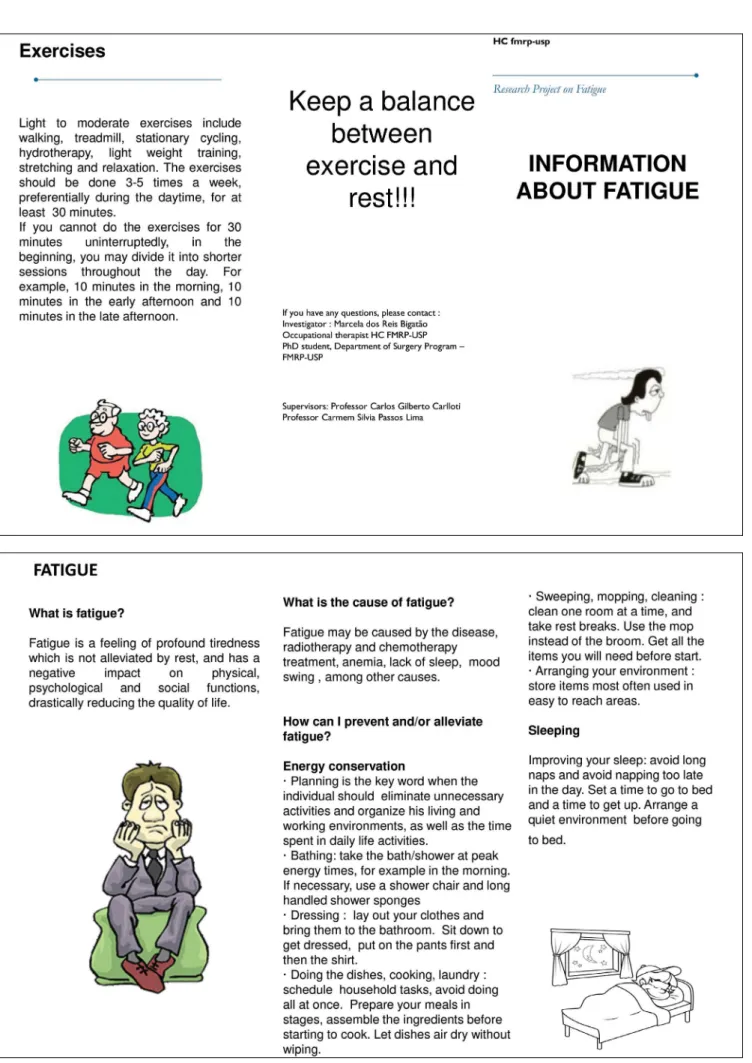
-tional program, in which patients received an informative lealet (Figure 1) and preventive information about fatigue. Printed ma
-terials allow the patients to read them afterwards, and be used as guidelines. Four patients were excluded because of clinical reasons or death, and 5 (56%) patients adhered to the program.
he lealet aimed at promoting health education re
-garding fatigue. he content of the lealet focused a non-pharmacological approach of fatigue, and was designed based on four types of contents (references to current liter
-ature on the subject): informational, energy conservation, physical exercise (walking) and sleep management.
At the time when patients received the lealets, the in
-vestigator read it with the patient and gave them individu
-al instructions on how to perform daily routine activities (bathing, clothing, mobility, eating, personal hygiene) using as little energy as possible. In addition, all patients attend
-ed seven occupational therapy sessions, in which they re
-ported their daily activities and diiculties to perform them. he irst session was carried out before the administration of radiotherapy combined with TMZ, the ive following ses
-sions were conducted during this treatment, the sixth ses
-sion at one month after radiotherapy, and the last ses-sion at the third cycle of exclusive chemotherapy.
Data analysis
A mixed-efects regression model was used for compari
-sons between groups and time points. he analysis was per
-formed using Proc MIXED of SAS® 9.2 software.
RESULTS
FACIT- F
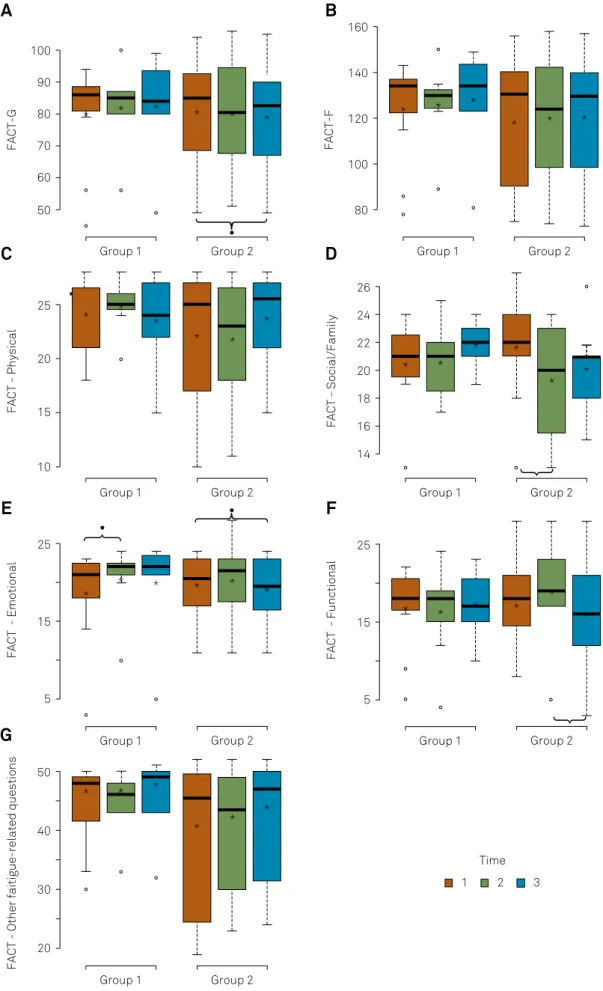
Figure 2. Comparisons between-group (groups I and II) and intra-groups at three time points (post-surgery, one month after radiotherapy, and three months after the TMZ chemotherapy) of FACIT-G and FACIT-F (physical well-being, social/family well-being, emotional well-being, functional well-being and other fatigue-related questions) scores using mixed-effects regression model.
Time 2
1 3
Group 1
FACT - Emotional
25
15
5 *
* *
Group 2
* * *
FACT - Physical
25
20
15
10
Group 1
* *
*
Group 2
* *
*
FACT-G
100 90 80 70 60 50
Group 1
* * *
Group 2
* * *
Group 1
FACT - Functional
25
15
5
* * *
Group 2 *
* *
FACT - Social/Family
26
22
18
14 24
20
16
Group 1
* *
*
Group 2 *
* *
FACT-F
160
140
120
100
80
Group 1
* * *
Group 2
* * *
Group 1
FACT - Other faitigue-related questions
50
40
20 30
* * *
Group 2
* *
*
A
B
G
C
D
In group I, a statistically signiicant diference in emotion
-al well-being was observed between the irst (post-surgery) and the second (post-radiotherapy) time points.
In group II (educational program), there was a statistically signiicant diference (p < 0.04) in FACT-G scores between the irst valuation (post-surgery) and the third time point (three months after adjuvant chemotherapy). In addition, there were signiicant diferences in the domain social/family well-being (p < 0.04) between the three time points, in the domain emo
-tional well-being (p < 0.01) between the third (three months after chemotherapy) and the irst time points (post-surgery), and in the domain functional well-being (p < 0.04) between the third and the second time points (post-radiotherapy).
Beck depression inventory
he Beck depression inventory is a 21-item self-report in
-ventory for measuring the severity of depression symptoms. he standard cut-ofs of this test are: 0-9 indicates minimal depression; 10-18 indicates mild depression; 19-29 indicates moderate depression, and 30-63 indicates severe depression. Higher scores indicate more severe depression symptoms.
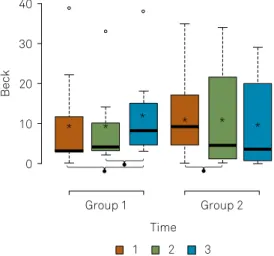
In the intra-group comparisons (Figure 3), a statistically signiicant diference was observed between the irst and the third time points (p < 0.04), and between the second and the third time points (p < 004) in group I, whereas in group II, a statistically signiicant diference was observed between the irst and the second time points (p < 0.03).
DISCUSSION
In the present study, the subjects were randomly assigned to one of two groups, one group receiving radiotherapy and chemotherapy only (group I), and the other receiving ra
-diotherapy, chemotherapy and educational intervention
(group II). In the group II, most patients were men, which is in accordance with the frequency of high-grade glioma, rela
-tively higher among men than women (3:1 proportion)6.
he educational program directed for fatigue manage
-ment in patients with high-grade glioma in group II did not show a statistically signiicant efect on fatigue or quality of life, as compared to group I.
In intra-group comparisons, the FACT-G, used to mea
-sure health-related quality of life in cancer patients, was sig
-niicantly diferent between the post-operative period and at three months after adjuvant chemotherapy, indicating a de
-crease in quality of life. his inding corroborates with that previously reported by a study aiming at evaluating the qual
-ity of life of patients with malignant brain tumor after com
-bined treatments in comparison with patients with other chronic neurological conditions, and presenting the relation
-ship between quality of life and clinical, pathological, afec -tive and cogni-tive factors11. he author showed that quality of
life is signiicantly associated with depression, state of anxi
-ety and performance status, and physical and cognitive per
-formances seem to play a major role in determining quality of life in brain tumor patients. In a recent study12 evaluating sub
-jective aspects of quality of life and their relation to the type of brain tumor and stage of disease, quality of life was found to encompass diferent subjective aspects, which vary in re
-lation to disease stage, and clinical worsening. Additionally, personal facets are independent on disease progression and treatment, suggesting the inluence of individual resources12.
Intra-group comparisons of FACT-F revealed improved emotional well-being in group I after radiotherapy (p < 0.02) as compared to previous time point. Group II showed lower social/family well-being (p < 0.04) one month after radiother
-apy (second time point 2) as compared to post-surgery ( irst time point). he emotional well-being category was signii
-cantly lower (p < 0.01) at three months after adjuvant chemo
-therapy (third time point) as compared to post-surgery (sec
-ond time point), and functional well-being was signiicantly lower (p < 0.04) at three months after adjuvant chemothera
-py as compared to post-radiothera-py.
As previously described, in the intervention group (group II), a decrease in social/family well-being, emotional well-being and functional well-being, and reduction in global quality of life was observed. Since patients received the educational in
-tervention after surgery (irst time point) and after radiothera
-py (second time point), we can suggest that the emotional and functional categories decreased as the frequency of sessions also decreased. herefore, we may consider that weekly ses
-sions would be appropriate to provide adequate support and opportunity for patients to receive energy conservation educa
-tion and to discuss diiculties in performing daily activities. According to Paulo Freire13, awareness brings out one’s
sense and responsibility of “announcers” or “whistleblowers”, and opens up the possibility to disclose the reality. Critical
consciousness of education focusing on awareness, change
Figure 3. Comparisons between-group (groups I and II) and intra-groups at three time points (post-surgery, one montha after radiotherapy, and three months after the TMZ chemotherapy) of Beck Depression Inventory scores.
Time 2
1 3
Beck
40
30
20
10
0
Group 1 *
* *
Group 2
and freedom requires proximity of professionals to the population. In comprehensive, individualized approaches, health education is delivered to a particular person, whose experiences and characteristics may increase the efective
-ness of preventive and therapeutic strategies. In this study, the informative lealet was used with the aim of providing written instructions and be used as a guideline by the pa
-tients. However, diferently from an impartial approach, our educational program also encompassed individual
-ized meetings/sessions, which showed a positive efect on patients’ well-being during radiotherapy.
Radiotherapy-related fatigue has been frequently report
-ed by patients with primary brain tumor, although some authors argue that fatigue in patients with glioblastoma may not be a complication of the therapy (radiotherapy or chemo
-therapy), since the prevalence of fatigue is high even before the therapy4. herefore, radio-chemotherapy toxicity may
only partly contribute to therapy-related fatigue.
Regarding to the BDI, which measures the symptoms of depression, no statistically signiicant diferences were ob
-served in the BDI scores between the groups. However, in intra-group comparisons, a statistically signiicant diference (p < 0.04) was observed between post-surgery ( irst time point) and three months after adjuvant chemotherapy (third time point), and between one month after radiotherapy (sec
-ond time point) and three months after chemotherapy (third
time point) (p < 0.04), indicating an aggravation of the symp
-toms in group I. On the other hand, in group II, a statistically signiicant diference (p < 0.03) was observed between post-surgery ( irst time point) and one month after radiotherapy (second time point), indicating a reduction in depression symptoms. his inding supports the importance of the oc
-cupational therapy sessions as an opportunity for teaching and listening. Listening is considered an important tool to empower the individual to adapt to and deal with his new condition, often full of limitations and changes.
Depression was associated with a decline in physical func
-tion, cognitive deicit, and quality of life among brain tumor patients14. In addition, patients with glioma are at higher risk
of phychiatric disorders during the period of diagnosis15,16.
he prevalence of depression in glioma patients is estimated to vary from 0% to 93%14.
he groups did not show any change in quality of life and fatigue in this study, for this reason, the educational pro
-gram did not present any signiicant diference. However, there was a signiicant diference in depressive symptoms during the educational program showing positive evidence for its applicability. herefore, this study provides contri
-butions to understand the relationship between fatigue and depressive symptoms. It also brings the possibility of non-pharmacological intervention for the treatment of fa
-tigue in patients with brain tumor.
References
1. Bower JE. Cancer-related fatigue-mechanisms, risk factors, and treatments. Nat Rev Clin Oncol. 2014;11(10):597-609. doi:10.1038/nrclinonc.2014.127
2. Raaf PJ, Klerk C, Timman R, Busschbach JJV, Oldenmenger WH, Rijt CCD. Systematic monitoring and treatment of physical symptoms to alleviate fatigue in patients with advanced cancer: a randomized controlled trial. J Clin Oncol. 2013;31(6):716-23. doi:10.1200/JCO.2012.44.4216
3. Horneber M, Fischer I, Dimeo F, Rüffer JU, Weis J. Cancer-related fatigue: epidemiology, pathogenesis, diagnosis, and treatment. Dtsch Arztebl Int. 2012;109(9):161-72. doi:10.3238/arztebl.2012.0161
4. Valko PO, Siddique A, Linsenmeier C, Zaugg K, Held U, Hofer S. Prevalence and predictors of fatigue in glioblastoma: a prospective study. Neuro-oncol. 2015;17(2): 274-81. doi:10.1093/neuonc/nou127
5. Armstrong TS, Gilbert MR. Practical strategies for management of fatigue and sleep disorders in people with brain tumors. Neuro-oncol. 2012;14(suppl 4):i65-72. doi:10.1093/neuonc/nos210
6. Instituto Nacional de Câncer José Alencar Gomes da Silva. Estatística do câncer: vigilância e de fatores de risco. Brasília, DF: Instituto Nacional do Câncer; 2014 [cited 2015 Jan 12] Available from: http://www.inca.gov.br/estimativa/2014/
7. Lakhan SE, Harle L. Dificult diagnosis of brainstem glioblastoma multiforme in a woman: a case report and review of the literature. J Med Case Reports. 2009;3(1):87. doi:10.1186/1752-1947-3-87
8. Stupp R, Mason WP, Bent MJ, Weller M, Fisher B, Taphoorn MJB, Belanger K et al. Radiotherapy plus concomitant and adjuvant temozolomide for glioblastoma. N Engl J Med. 2005;352(10):987-96. doi:10.1056/NEJMoa043330
9. Pachman DR, Price KA, Carey EC. Nonpharmacologic approach to fatigue in patients with cancer. Cancer J. 2014;20(5):313-8. doi:10.1097/PPO.0000000000000064
10. Barsevick AM, Whitmer K, Sweeney C, Nail LM. A pilot study examining energy conservation for cancer treatment-related fatigue. Cancer Nurs. 2002;25(5):333-41. doi:10.1097/00002820-200210000-00001
11. Giovagnoli, A. Quality of life in patients with stable disease after surgery, radiotherapy, and chemotherapy for malignant brain tumour. J Neurol Neurosurg Psychiatry. 1999;67(3):358-63. doi:10.1136/jnnp.67.3.358
12. Giovagnoli AR, Meneses RF, Silvani A, Milanesi I, Fariselli L, Salmaggi A et al. Quality of life and brain tumors: what beyond the clinical burden? J Neurol. 2014;261(5):894-904. doi:10.1007/s00415-014-7273-3
13. Freire P. Conscientização: teoria e prática da libertação; uma introdução ao pensamento de Paulo Freire. São Paulo: Moraes; 1980.
14. Rooney AG, Carson A, Grant R. Depression in cerebral glioma patients: a systematic review of observational studies. J Natl Cancer Inst. 2011;103(1):61-76. doi:10.1093/jnci/djq458
15. Dalton SO, Laursen TM, Ross L, Mortensen PB, Johansen C. Risk for hospitalization with de pression after a cancer diagnosis: a nationwide, population-based study of cancer patients in Denmark from 1973 to 2003. J Clin Oncol. 2009;27(9):1440-5. doi:10.1200/JCO.2008.20.5526