234 Radiol Bras. 2013 Jul/Ago;46(4):234–241
Step-by-step of ultrasound-guided core-needle biopsy
of the breast: review and technique
*
Passo-a-passo da core biópsia de mama guiada por ultrassonografia: revisão e técnica
Rafael Dahmer Rocha1, Renata Reis Pinto2, Diogo Paes Barreto Aquino Tavares3, Cláudia
Sofia Aires Gonçalves4
Ultrasound-guided core-needle biopsy has high sensitivity in the diagnosis of breast cancer. The present study is aimed at detailing the main steps of such procedure, including indications, advantages, limitations, follow-up and description of the technique, besides presenting a checklist including the critical steps required for an appropriate practice of the technique. In the recent years, an increasing number of patients have required breast biopsy, indicating the necessity of a proportional increase in the number of skilled professionals to carry out the procedures and histological diagnoses. A multidisciplinary approach involving the tripod clinical practice-radiology-pathology is responsible for the highest rate of accuracy of the technique and must always be adopted.
Keywords: Ultrasound-guided core-needle biopsy; Breast.
A core biópsia de mama guiada por ultrassonografia possui alta sensibilidade no diagnóstico das doenças neoplásicas mamárias. O presente estudo tem por objetivo detalhar as principais etapas deste procedimento, incluindo indicações, vantagens, limitações, seguimento e técnica, e elaborar um checklist contendo os passos indispensáveis para uma boa prática da técnica. O número de pacientes que necessitam de biópsia mamária tem crescido nos últimos anos, indicando ser necessário haver um crescimento proporcional de profissionais habilitados que possam realizar os procedimentos diagnósticos histológicos. A abordagem multidisciplinar envolvendo o triângulo clínica-radiologia-patologia é responsá-vel pelo mais alto índice de acurácia da técnica, devendo sempre ser utilizada.
Unitermos:Core biópsia guiada por ultrassonografia; Mama. Abstract
Resumo
* Study developed at Hospital Federal dos Servidores do Estado do Rio de Janeiro and at Hospital do Instituto Nacional de Câncer (INCA), Rio de Janeiro, RJ, Brazil.
1. MD, Resident in Radiology and Diagnostic Imaging, Hos-pital Federal dos Servidores do Estado do Rio de Janeiro, Rio de Janeiro, RJ, Brazil.
2. MD, Mastologist, Hospital do Instituto Nacional de Cân-cer (INCA), Rio de Janeiro, RJ, Brazil.
3. Head of Interventional Radiology Department, Hospital Federal dos Servidores do Estado do Rio de Janeiro, Rio de Ja-neiro, RJ, Brazil.
4. MD, Radiologist, Hospital Federal dos Servidores do Es-tado do Rio de Janeiro, Rio de Janeiro, RJ, Brazil.
Mailing Address: Dr. Rafael Dahmer Rocha. Avenida XV de Novembro, 70, ap. 801, Centro. Joaçaba, SC, Brazil, 89600-000. E-mail: [email protected].
Received September 2, 2012. Accepted after revision February 19, 2013.
Rocha RD, Pinto RR, Aquino D, Aires CS. Step-by-step of ultrasound-guided core-needle biopsy of the breast: review and technique. Radiol Bras. 2013 Jul/Ago;46(4):234–241.
tions, follow-up and description of the technique, besides presenting a checklist including the critical steps required for an appropriate practice of such procedure.
REVIEW
The most consistent indications for US-guided CB of breast are listed on Table 1. Patients with imaging studies revealing findings as BI-RADS® category 4
(approxi-mately 20% to 40% are malignant)(14,19,24)
or BI-RADS 5 (about 95% are malig-nant)(25,26) must undergo biopsy. Findings
classified as BI-RADS 3 present a lower risk for malignancy (< 2.0%), but such find-ings do require short-term follow-up(25,26).
In such category, the following situations are indicative for biopsy: difficulty in per-forming the short-term follow-up (geo-graphic factors, pregnancy, plastic breast surgery) or which may cause psychological constraint to the patient(14,19,24); explicit will
of the patient and/or assisting physician; Fine-needle aspiration biopsy (FNAB) was
utilized for many years to investigate the breast tissue in the attempt to avoid surgi-cal biopsy (gold standard). With the arrival of core biopsy, a better specimen quality could be obtained and it became possible to differentiate carcinomas in situ from in-vasive carcinomas.
In cases of breast lesions, core biopsy (CB) is preferably performed, utilizing an imaging method as guidance – for example: ultrasonography (US) or stereotactic biopsy –, but it is still performed, with lower sen-sitivity, only by means of palpation(11). First
described by Parker et al.(12) in the early
1990’s, US-guided CB of breast is currently one of the main diagnostic methods for neoplastic breast diseases, and for lesions that are sonographically visible, is fre-quently considered the procedure of choice(12–23).
The present study is aimed at detailing the main steps of US-guided CB of breast, including indications, advantages,
limita-INTRODUCTION
An increasing preoccupation has been demonstrated in the recent Brazilian radio-logical literature towards the importance of imaging studies in the improvement of breast diseases diagnosis(1–10).
clinical situations requiring anticipation of diagnosis, as such situations that may cause therapeutic changes (for example: trans-plants, synchronous malignancy)(14,27); and
patients with multiple risk factors for breast cancer.
The sensitivity of US-guided CB of breast was reviewed by Youk et al.(15) in
eight studies involving a total of 1,518 pa-tients, obtaining a mean rate of 96%, simi-lar to the rate obtained with surgical biopsy. Schueller et al.(28) have also found similar
sensitivity (95.8%) in 1,352 cases. Some factors increase the sensitivity of the samples and should be taken into consid-eration: five as minimum number of speci-mens(12,17,23,29) which ideally should be
in-tact, homogeneous, predominantly white, and sinks as soon as it is put in the formal-dehyde solution(15,24,29); and obtained by a
CB device with appropriate depth range (> 15 mm), so the sensitivity is directly pro-portional to the volume of specimens(12,13, 24,29,30). Some studies(13,15,20) suggest that the
real-time visualization of the needle within the lesion may help in reducing the num-ber of false-negatives.
The US-guided CB of breast is better tolerated than surgical biopsy, and can be performed quickly and at a much lower cost, as demonstrated in Table 2. Over the past 20 years, the present technique has demonstrated to be very safe, with rare se-vere complications(11,12,19,31–33). Parker et
al.(21) reported only six cases (0.2%) in the
follow-up of 3,765 CBs where the devel-opment of three voluminous hematomas and three abscesses was observed, requir-ing surgical drainage. No case of pneu-mothorax was observed in that study,
de-spite the existence of some risk, which is higher in the cases of small breasts with axillary or medial lesions(39). Fistulas may occur during pregnancy or lactation, par-ticularly in central and deep regions of the breast(19,31). Minor complications such as pain, edema, psychological trauma, small hemorrhages and vasovagal reactions are frequently observed(12,27,31). Hemorrhages are more frequent in hypertensive women and in breasts submitted to radiotherapy, whose vessels are more friable(40). When-ever possible, biopsies should be avoided in the perimenstrual period, where the breasts are more sensitive.
As regards anticoagulant drugs, in spite of acetylsalicylic acid not being a contrain-dication(19,27,30), LaTrenta recommends that its use should be avoided for seven days prior to the biopsy, as well as the interrup-tion of non-steroidal anti-inflammatory drugs for 2–5 days(31). As regards the
deci-sion of interrupting oral anticoagulant drugs, it should only be made after multidisciplinary analysis(19), by pondering
the risk for thrombotic events versus the risk for development of important he-matoma. If such an interruption is consid-ered necessary, its use may be stopped 4–7 days before the procedure, and resumed soon after the procedure(31).
The rate of repeated biopsies reaches up to 18% of cases(11,18,40,41). According to
Liberman et al.(13), nodules < 5 mm may
oc-casionally be completely removed during the biopsy procedure in 4% to 9% of cases, impairing the surgical marking. In such cases, the placement of a metal clip is sug-gested, to serve as a marker for later surgery. Memarsadeghi et al.(42) have reported a 0.4%
overall rate of false-negatives in a series of 3,380 biopsies. Among the factors which increase the false-negatives rate, the fol-lowing factors were associated: poor needle visualization, lesion mobility, deep lesions, central lesions in large breasts, dense breast with fibrosis, nodules ≤ 5 mm, and lesions obscured by blood accumulation. In other study, the false-negative rate was 1.1%, and more than 20% of the biopsied lesions mea-sured up to 10 mm(21). Fornage et al.(43)
have reported that any lesion clearly visu-alized at US can be submitted to CB.
Despite the innumerable advantages of utilizing US-guided biopsy, some lesions
Table 1 Indications for core breast biopsy according to the BI-RADS category of images (mammography, ultrasonography and magnetic resonance imaging).
BI-RADS 5
BI-RADS 4
BI-RADS 3
– Patient’s and/or assisting physician will
– Psychological factors
– Short-interval follow-up difficulties
– Patients with multiple risk factors for breast cancer
– Need for diagnostic anticipation
Table 2 Advantages and limitations of US-guided core biopsy of breast. Advantages
– Evaluation of tumor grade and hormone receptors*(19,34–37)
– Real time image
– Accessibility to all areas of the breast
– Absence of ionizing radiation
– Low incidence of complications and discomfort for the patient(12,13,17,20,21,34)
– Procedure swiftness (about 20 minutes)(12,13)
– Wide availability of the utilized equipment
– One-half to one-fourth of the cost of surgical biopsy(13,21,38)
Technical limitations
– Difficulty in visualizing the finding
– Cystic lesions
– Nodules < 5 mm
– Need for a new biopsy in selected cases
– Breast implants
Limitations related to the patient – Cooperation incapacity
– Hemorrhagic diathesis
– Use of oral anticoagulant medications
– Allergy to the anesthetic agent
are not visible at the method, and in such cases the utilization of stereotactic biopsy is preferable(14,17,31,44). Patients with suspi-cious microcalcifications or with breast im-plants may benefit from vacuum-assisted biopsy, because of the higher number of calcifications in the specimens and lower risk for implant rupture(14,20,30,34,45–47). As
regards simple cystic lesions, FNAB, be-sides being a diagnostic method may also become therapeutic as the cytological as-pirate is typically benign.
PRE-BIOPSY (PATIENT, ROOM AND MATERIAL)
Because of the low incidence of com-plications and contraindications, generally no laboratory test is required, except for those patients with a history of coagulo-pathy or under anticoagulant ion ther-apy(2,19,23,31). Routine prophylactic
antibiot-ics are not indicated, but the sterile tech-nique should be used, minimizing post-bi-opsy infections(31). Bugbee et al.(48) have
evaluated the effects of pre-biopsy oral anxiolytic medication and found a signifi-cant reduction in the anxiety levels in the women group that utilized 0.25–0.5 mg alprazolam 15 minutes before the proce-dure.
The room must be appropriate for the performance of the procedure, with adjust-able lighting and circulation area at both sides of the table, in order to facilitate the assistant’s movements and access to all regions of the breast and axilla. The trans-ducer must be of high-frequency (ideally higher than 10 MHz) linear type(15), and
must be cleaned with antiseptics or be in-volved by a cover or a sterile glove(12).
Ster-ile gel or the antiseptic itself will serve as ultrasound conductive agent.
An automated biopsy device equipped with a long needle (reaching 23 mm) is preferable over the short needle (reaching 15 mm). The recommended needle caliber for CB is 14-gauge, which has demon-strated greater sensitivity than the 16-gauge and 18-16-gauge needles, without in-creasing complications or costs(27,34,35,49– 51)
. The professional must be experienced in manipulating the CB device and also be aware on how many millimeters the needle will advance when the device is triggered,
in order to avoid transfixion of the chest wall.
Before initiating the procedure itself, some items must be checked out. The pa-tient must be duly explained on the reason for the biopsy, the technique that will be uti-lized, the risks and benefits, and on the existence of alternative techniques. A term of free and informed consent should then be signed by the patient. Previous images should be reviewed, and then an US scan should be performed to document the le-sion and establish the technique to be uti-lized, confirm whether the indication for biopsy is appropriate and evaluate limita-tions which may negatively impact the pro-cedure. The lesion documentation will be useful for follow-up and comparison pur-poses. Orthogonal measurements and local-ization of the lesion must be performed (the clock position system is recommended and the distance between the lesion and the nipple should be measured and recorded). At that point, the physician should estab-lish the best pathway to reach the lesion, and decide which hand he will use to hold the transducer. The choice must lie on the one which will provide greater comfort and effectiveness for the procedure, and may vary according to the lesion site and to the dominant hand of the professional.
The patient is usually positioned in dor-sal decubitus, with the upper limb ipsilat-eral to the lesion being rested behind her head(12,19,31). The anterior oblique position may be beneficial in patients with large breasts or extreme lateral lesion loca-tion(19,31). Lesions located in the outer quad-rant are usually better approached with the professional positioned at the side of the ipsilateral breast, while in lesions located in the inner quadrant the professional should be positioned at the side of the con-tralateral breast(31).
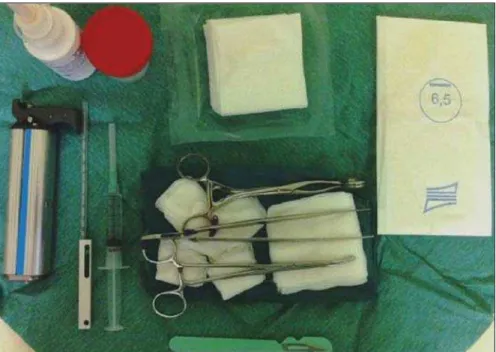
A sterile surgical drape should be placed on a portable table and the materi-als represented on Figure 1 should be po-sitioned over that drape. The physician puts on the sterile gloves and couples the biopsy needle to the CB device. He then performs a triggering test, informing the patient that the clicking sound will be heard each time a sample is obtained. In cases of very dense breasts, the physician should pay special attention to the click-ing sound, as when it sounds differently than expected, this may mean that the sample is inappropriate. Subsequently, the anesthetic agent is aspirated into a syringe with 5–10 ml of lidocaine 1% (without vasoconstrictor), or 3–5 ml of lidocaine 2% diluted in 5 ml distilled water.
Table 3 Checklistfor US-guided core biopsy of breast.
1. Review previous imaging studies and perform a well documented targeted ultrasonography scan. 2. Evaluate whether the biopsy is appropriately indicated and its limitations (Tables 1 and 2).
3. Obtain the term of free and informed consent from the patient after having explained its entire contents.
4. Define the pathway to approach the lesion, as well as which of the physician’s hands will be used for each function. 5. Carry out the antisepsis of the transducer and prepare the materials on a portable table.
6. Don the sterile gloves and couple the core biopsy needle (14G) to the device. Perform a triggering test, checking out the needle travel, as well as the triggering sound from the device.
7. Aspirate the anesthetic agent (1–2% lidocaine without vasoconstrictor). 8. Positioning the patient (usually in dorsal or anterior oblique decubitus).
9. Perform the antisepsis over a wide area around the lesion, over which a sterile fenestrated drape should be placed. The antiseptic or sterile gel will serve as an ultrasound conductive agent.
10. Sonographically identify the lesion. The palm of the hand holding the transducer and the fourth and fifth fingers exert some pressure on the breast to avoid its motion.
11. Remember the access and entry point defined on item 4. Under US guidance, inject the anesthetic agent through the entire pathway up to the lesion. 12. Make a 2-3 mm incision on the skin over needle entry point.
13. Insert the biopsy needle through the incision, attempting to follow the same pathway of the anesthetic needle towards the lesion border. At this point, the needle is to be directed to a position parallel to the nodule.
14. Tell the patient that a sample is about to be obtained, and trigger the device action.
15. Cross sectionally and longitudinally slide the transducer aiming at verifying whether the needle penetrated the nodule and that no injury occurred to the chest wall.
16. Retrieve the sample from the needle with the scalpel blade or sterile needle, placing it in the vial with formaldehyde, briefly evaluating its character-istics.
17. Repeat steps 13 to 16 until a minimum of five good samples are obtained, preferably from different areas of the lesion (center, 3, 6, 9, and 12 o’clock positions). In cases of microcalcifications, at least ten samples should be collected and submitted to radiography, identifying and separating those without calcifications from the ones with calcium.
18. Compress the lesion and incision areas for at least five minutes and apply local ice.
19. Perform asepsis and apply compressive dressings which should be left in place for 24-48 hours.
20. Instruct the patient to avoid intense physical exertion and prescribe pain-relievers and non-steroid anti-inflammatory medication, as necessary. 21. Clarify doubts and schedule return as soon as the histopathological results are available. The approach should be adopted according to Table 4.
* Note: The presence of an assistant is valuable during the procedure. Such an assistant can perform the functions described on items 5, 8, 9, 16,18 and 19. This will make the procedure swifter and the physician will be able to exert compression on the breast after triggering the CB device, thus decreasing the risk for development of hematoma.
Table 4 Radiological-pathological correlation of core biopsy of breast. Classification
Concordant benign results
Discordant benign results
Risk lesions, precursor lesions, or lesion at risk for underesti-mation
Malignant
Radiological result
BI-RADS 3 or 4
BI-RADS 5
Independent
Independent
Histological result
Benign lesions
Benign lesions
Carcinoma in situ, radial scar, atypical epithelial prolif-eration, lobular neoplasias, papilliferous lesions, fibroepi-thelial lesion (with possibility of phyllodes tumor)
Infiltrative carcinoma
Recommended approach
Six-month imaging follow-up
Surgical biopsy
Surgical biopsy
Contact assisting physician BIOPSY
The preferred biopsy technique is the “freehand” technique based on the descrip-tion by Parker et al.(12) and by other
au-thors(19,31,34,52), where the radiologist ma-nipulates the transducer with one hand and the CB device with the other. As regards technical standards, there are small regional variations. On Table 3, a checklist is sug-gested, adapted from the literature review and from the authors’ own professional experience.
Figure 2 shows the main steps at US-guided breast CB. Initially, the antisepsis of
the exposed area is performed by means of sterile gauze pad and antiseptic solution (chlorhexidine, povidone iodine or alco-hol). The lesion to be biopsied is identified with the transducer and, it is recommended that with the palm of the same hand, the fourth and fifth fingers resting on the field without exerting pressure on the breast the physician avoids the motion of the breast. By keeping the area of interest farther from the needle insertion point, it is possible to observe its entire trajectory, from the skin surface up to the lesion.
The recommended access area is the pe-ripheral curvature of the breast, positioning
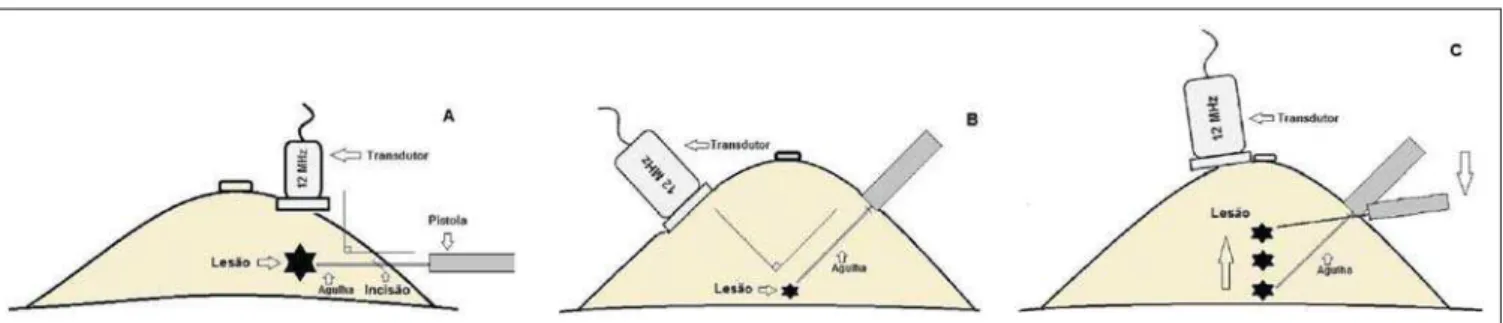
the needle at 2 to 3 cm away from the edge of the transducer, in parallel to the chest wall and perpendicularly to the transducer, allowing a better US visualization of the needle and reducing the risk for pneu-mothorax (Figure 3A). The access through the nipple-areolar complex should be avoided. In cases of very deep or centrally and superficially located lesions, the ob-lique needle access may be necessary, which may impair its visualization at US. In such cases, the transducer should be angled at approximately 90° (Figure 3B).
Figure 3. Commonly utilized approaches at US-guided core biopsy of breast. A: Needle parallel to the chest wall, perpendicular to the transducer. Better sonographic visualization of the needle and lower risk for pneumothorax. B: Needle angulated in relation to the chest wall. The transducer is guided in an attempt to maintain a perpendicular angle. Useful in very deep or superficial central lesions. C: The inferior movement of the CB device may help to move the lesion away as much as possible from the chest wall.
needle up to the lesion. In cases of mobile lesions, the infiltration can be performed in the lesions’ circumjacent areas, which will reduce its mobility. Deep lesions may ben-efit from posterior anesthetic infiltration, in an attempt to displace the nodule anteriorly. With a scalpel blade, a 2–3 mm incision is made on the numbed skin. Gauze pads are to be left in the incision proximity, in order to facilitate breast compression and clean-ing of blood. Though the incision location, the biopsy needle is advanced towards the lesion’s margin, through the same pathway utilized for anesthesia. The needle is posi-tioned parallel to the nodule, the patient is warned that the sample is about to be col-lected, and the CB device is triggered.
In cases of mobile lesions, with the same hand that holds the transducer, pres-sure can be exerted against the nodule, thus decreasing the possibility of the needle pushing the nodule backwards as the device is triggered, so the collected sample is in-appropriate. It is also possible to push the tip of needle into the nodule prior to trig-gering the CB device. Deep lesions may be better accessed with a greater needle angu-lation to reach the posterior border of the lesion. The needle may be directed upwards with the purpose of lifting the lesion and moving it away as much as possible from the chest wall (Figure 3C). An important difficulty may be observed in patients very dense breasts. In such cases, breast fibro-sis may impair the progression of the needle and repeating the trajectory after each trig-gering represents an important limitation. Thus the technique with coaxial needle should be utilized, allowing for different areas to be biopsied by just changing the angle of the trocar.
POST-BIOPSY PROCEDURES
Once the samples are obtained, the ar-eas of the incision and of the nodule are compressed for at least five minutes, and a dressing is then applied. The utilization of ice on the biopsy site may also help in he-mostasis. The patient is requested to avoid more intense physical exertion for at least two days. Pain relieving and anti-inflam-matory medications are prescribed as nec-essary, avoiding the utilization of acetyl-salicylic acid for seven days after the
cedure. The professional then issues a pro-cedure report and fills out a histopathologi-cal analysis request with a detailed report on the lesion, specifying radiological cat-egory, location, number of collected samples, presence of lymph node enlarge-ment and occurrence of possible complica-tions. Any patient’s doubts should be clari-fied, and a return should be scheduled upon availability of the histopathological results. The follow-up recommended by Youk et al.(15) and by the Instituto Nacional de
Câncer(51) is shown on Table 4. It is
ex-tremely important to be aware of the histo-logical results and to maintain a close fol-low-up on the patient, so that in the event of discordant results, particularly in those cases where the possibility of malignancy is underestimated, a correct diagnosis may be obtained as early as possible. A good physician-patient relationship as well as a good relationship with the pathologist must be emphasized. In two studies(18,22), a great
part of the false-negatives could be reevalu-ated soon enough, without changes in pa-tient progression. Liberman(52) has
re-viewed some studies and found rates of 20% to 56% of underestimated carcinomas in atypical ductal hyperplasia and of 16% to 35% in ductal carcinomas in situ. Under-estimated lesions are those whose surgical biopsy revealed ductal carcinoma in situ or invasive ductal carcinoma, while at CB the result indicated high risk lesion or carci-Once the device is triggered, the
opera-tor must sonographically confirm whether the needle is inside the nodule, by analyz-ing the needle in the two planes (cross sec-tional and longitudinal). Frequently during the biopsy, air enters through the needle and is visualized as a hyperechoic line in the triggering trajectory (Figure 4). Such arti-fact may be useful in the determination of lesion locations yet to be biopsied.
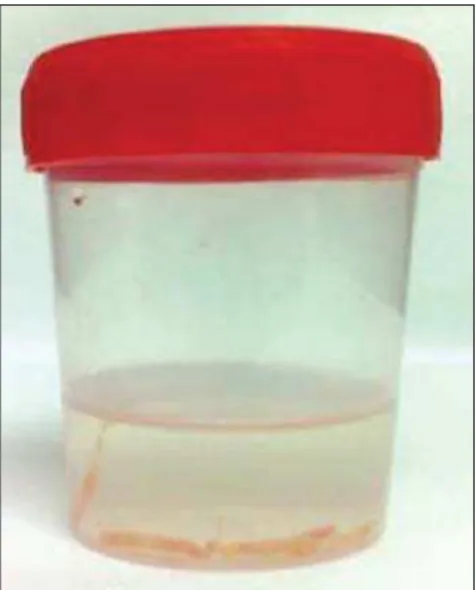
The lesion sample must be retrieved from the core needle and be briefly ana-lyzed with respect to the characteristics which classify such sample as appropriate (Figure 5). The anesthetic needle or the scalpel may be utilized to retrieve the sample, and place it in a vial containing 10% formalin. Samples should be obtained from different areas of the lesion, usually from the center and close to the borders at the 3, 6, 9 and 12 o’clock positions. Be-tween each and other consecutive sample retrieval, the physician or the assistant must compress the breast with gauze pads in or-der to reduce the risk for hematomas. In those biopsies including microcalcifi-cations, Parker et al.(12) recommend
collect-ing at least 10 samples, which should be submitted to radiography to confirm the presence or absence of calcium(50). It is
rec-ommended that samples containing calci-fications be separated from those without calcification when they are sent for histo-pathological analysis.
Figure 4. Post-triggering air artifact. A: Needle path (wide arrows) within the nodule (asterisk) during biopsy. B: After biopsy, a small amount of gas can be observed, represented by a hyperechogenic line (thin arrows). Such artifact may be useful in the determination of lesion locations yet to be biopsied.
noma, but with incomplete pathological characterization(16,40,53). Some studies have
demonstrated that the utilization of vacuum-assisted biopsy reduced the risk for underestimation in cases of atypical ductal hyperplasia and ductal carcinoma in situ by 20% and 10%, respectively(30,54).
As regards rebiopsy incidence, Youk et al.(15) have found a rate of 10% (338 pa-tients) in 3,299 biopsied lesions in eight studies, from which 17% were malignant lesions. Main reasons for rebiopsy were histology results demonstrating benign le-sions and/or high risk lele-sions requiring sur-gical intervention (3% to 5%)(13,15,18,30,32,35), followed by results in disagreement with clinico-radiological findings (2% to7.7% of the total)(15,19,40) and inappropriate samples (0.4% to 2% of the total of biopsies)(13,20,40).
CONCLUSION
The number of patients who require breast biopsy has increased over the past years, mainly because of wider access of the population to breast cancer screening allowing earlier diagnosis. Thus, a propor-tional or greater increase in the number of professionals who perform histological diagnoses is necessary in order to reduce the wait for a definitive diagnosis and in-crease the patients’ survival. Ultrasonogra-phy-guided core biopsy of breast has be-come the method of choice for all alter-ations visualized at the method, with sen-sitivity rates which are very close to those of surgical biopsy. A multidisciplinary ap-proach involving the tripod clinical prac-tice-radiology-pathology is responsible for the highest rate of accuracy of the tech-nique and must always be adopted. Finally, the radiologist also plays an important role in the follow-up of such patients, with whom a sound relationship must be main-tained in order to guarantee the patients’ return and appropriate follow-up.
REFERENCES
1. Miranda CM, Santos CJ, Maranhão CP, et al. A tomografia computadorizada multislice é ferra-menta importante para o estadiamento e segui-mento do câncer de mama? Radiol Bras. 2012;45: 105–12.
2. Calas MJ, Gutfilen B, Pereira W. CAD e mamo-grafia: por que usar esta ferramenta? Radiol Bras. 2012;45:46–52.
3. Azevedo A, Canella E, Djahjah MC, et al.
Con-duta das funcionárias de um hospital na adesão ao programa de prevenção do câncer de mama. Radiol Bras. 2012;45:215–8.
4. Alvares B, Freitas C, Jales R, et al. Mammo-graphic density in asymptomatic menopausal women: correlation with clinical and sonographic findings. Radiol Bras. 2012;45:149–54. 5. Barra FR, Barra RR, Barra Sobrinho A. Novos
métodos funcionais na avaliação de lesões mamá-rias. Radiol Bras. 2012;45:340–4.
6. Criado DA, Braojos F, Torres U, et al. Aesthetic breast augmentation with hyaluronic acid: imag-ing findimag-ings and implications for radiological assessment. Radiol Bras. 2012;45:181–3.
7. Urban L, Schaefer M, Duarte D, et al. Recomen-dações do Colégio Brasileiro de Radiologia e Diagnóstico por Imagem, da Sociedade Brasileira de Mastologia e da Federação Brasileira das As-sociações de Ginecologia e Obstetrícia para ras-treamento do câncer de mama por métodos de imagem. Radiol Bras. 2012;45:334–9. 8. Calas MJG, Alvarenga AV, Gutfilen B, et al.
Ava-liação de parâmetros morfométricos calculados a partir do contorno de lesões de mama em ultrasso-nografias na distinção das categorias do sistema BI-RADS®. Radiol Bras. 2011;44:289–96.
9. Marques E, Medeiros ML, Souza J, et al. Indica-ções de ressonância magnética das mamas em um centro de referência em oncologia. Radiol Bras. 2012;44:363–6.
10. Lykawka R, Biasi P, Guerini C, et al. Avaliação dos diferentes métodos de medida de força de compressão em três equipamentos mamográficos diferentes. Radiol Bras. 2012;44:172–6.
11. Liberman L, Ernberg LA, Heerdt A, et al. Palpable breast masses: is there a role for percutaneous imaging-guided core biopsy? AJR Am J Roent-genol. 2000;175:779–87.
12. Parker SH, Jobe WE, Dennis MA, et al. US-guided automated large-core breast biopsy. Radi-ology. 1993;187:507–11.
13. Liberman L, Feng TL, Dershaw DD, et al. US-guided core breast biopsy: use and cost-effective-ness. Radiology. 1998;208:717–23.
14. Liberman L. Centennial dissertation. Percutane-ous imaging-guided core breast biopsy: state of the art at the millennium. AJR Am J Roentgenol. 2000;174:1191–9.
15. Youk JH, Kim EK, Kim MJ, et al. Missed breast cancers at US-guided core needle biopsy: how to reduce them. Radiographics. 2007;27:79–94.
16. Youk JH, Kim EK, Kim MJ, et al. Sonographically guided 14-gauge core needle biopsy of breast masses: a review of 2,420 cases with long-term follow-up. AJR Am J Roentgenol. 2008;190:202– 7.
17. Dillon MF, Hill AD, Quinn CM, et al. The accu-racy of ultrasound, stereotactic, and clinical core biopsies in the diagnosis of breast cancer, with an analysis of false-negative cases. Ann Surg. 2005; 242:701–7.
18. Schoonjans JM, Brem RF. Fourteen-gauge ultrasonographically guided large-core needle biopsy of breast masses. J Ultrasound Med. 2001;20:967–72.
19. Harvey JA, Moran RE. US-guided core needle biopsy of the breast: technique and pitfalls. Radiographics. 1998;18:867–77.
20. Philpotts LE, Hooley RJ, Lee CH. Comparison of
automated versus vacuum-assisted biopsy meth-ods for sonographically guided core biopsy of the breast. AJR Am J Roentgenol. 2003;180:347–51. 21. Parker SH, Burbank F, Jackman RJ, et al. Percu-taneous large-core breast biopsy: a multi-institu-tional study. Radiology. 1994;193:359–64.
22. Crystal P, Koretz M, Shcharynsky S, et al. Accu-racy of sonographically guided 14-gauge core-needle biopsy: results of 715 consecutive breast biopsies with at least two-year follow-up of be-nign lesions. J Clin Ultrasound. 2005;33:47–52. 23. Liberman L, Dershaw DD, Rosen PP, et al. Ster-eotaxic 14-gauge breast biopsy: how many core biopsy specimens are needed? Radiology. 1994; 192:793–5.
24. Dershaw DD. Needles and biopsy probes. In: Dershaw DD, editor. Imaging-guided interven-tional breast techniques. New York: Springer-Verlag; 2003. p. 69–86.
25. American College of Radiology. BI-RADS® – Ultrasound, 1st ed. Breast Imaging Reporting and Data System Atlas (BI-RADS® Atlas). 4th ed. Reston: American College of Radiology; 2003. 26. American College of Radiology. BI-RADS® –
Mammography, 4th ed. Breast Imaging Report-ing and Data System Atlas (BI-RADS® Atlas). 4th ed. Reston: American College of Radiology; 2003.
27. Sweeney KJ, Kerin MJ. Preoperative diagnosis and biopsy guns. In: Drew P, Cawthorn S, Michell M, editors. Interventional ultrasound of the breast. London: Informa Healthcare; 2007. p. 63–78. 28. Schueller G, Jaromi S, Ponhold L, et al. US-guided
14-gauge core-needle breast biopsy: results of a validation study in 1352 cases. Radiology. 2008; 248:406–13.
29. Fishman JE, Milikowski C, Ramsinghani R, et al. US-guided core-needle biopsy of the breast: how many specimens are necessary? Radiology. 2003; 226:779–82.
30. Mainiero MB, Koelliker SL, Lazarus E, et al. Ul-trasound-guided large-core needle biopsy of the breast: frequency and results of repeat biopsy. J Women Imaging. 2002;4:52–7.
31. LaTrenta L. Ultrasound-guided core breast biopsy. In: Dershaw DD, editor. Imaging-guided interven-tional breast techniques. New York: Springer-Verlag; 2003. p. 119–29.
32. Sauer G, Deissler H, Strunz K, et al. Ultrasound-guided large-core needle biopsies of breast le-sions: analysis of 962 cases to determine the num-ber of samples for reliable tumour classification. Br J Cancer. 2005;92:231–5.
33. Buchberger W, Niehoff A, Obrist P, et al. Sono-graphically guided core needle biopsy of the breast: technique, accuracy and indications. Radiologe. 2002;42:25–32.
34. Non-operative Diagnosis Subgroup of the Na-tional Coordination Group for Breast Screening Pathology. Guidelines for non-operative diagnos-tic procedures and reporting in breast cancer screening. NHSBSP Publication No. 50. Sheffield: NHS Cancer Screening Programmes; 2001. 35. Wallis M, Tarvidon A, Helbich T, et al. Guidelines
from the European Society of Breast Imaging for diagnostic interventional breast procedures. Eur Radiol. 2007;17:581–8.
nonpalpable breast disease: a meta-analysis. Br J Cancer. 2000;82:1017–21.
37. Helbich TH, Matzek W, Fuchsjäger MH. Stereo-tactic and ultrasound-guided breast biopsy. Eur Radiol. 2004;14:383–93.
38. Burkhardt JH, Sunshine JH. Core-needle and sur-gical breast biopsy: comparison of three methods of assessing cost. Radiology. 1999;212:181–8.
39. Michell M. Tecnhiques of ultrasound biopsy. In: Drew P, Cawthorn S, Michell M, editors. Inter-ventional ultrasound of the breast. London: Informa Healthcare; 2007. p. 79–88.
40. Berg WA. Image-guided breast biopsy and man-agement of high-risk lesions. Radiol Clin North Am. 2004;42:935–46.
41. Gur D, Wallace LP, Klym AH, et al. Trends in re-call, biopsy, and positive biopsy rates for screen-ing mammography in an academic practice. Ra-diology. 2005;235:396–401.
42. Memarsadeghi M, Pfarl G, Riedl C, et al. Value of 14-gauge ultrasound-guided large-core needle biopsy of breast lesions: own results in compari-son with the literature. Rofo. 2003;175: 374–80. 43. Fornage BD, Sneige N, Edeiken BS. Interven-tional breast sonography. Eur J Radiol. 2002; 42:17–31.
44. Liberman L. Stereotatic core biopsy. In: Dershaw DD, editor. Imaging-guided interventional breast techniques. New York: Springer-Verlag; 2003. p. 87–118.
45. Liberman L, Drotman M, Morris EA, et al. Imag-ing-histologic discordance at percutaneous breast biopsy. Cancer. 2000;89:2538–46.
46. Brennan ME, Turner RM, Ciatto S, et al. Ductal carcinoma in situ at core-needle biopsy: meta-analysis of underestimation and predictors of in-vasive breast cancer. Radiology. 2011;260:119– 28.
47. Jackman RJ, Lamm RL. Stereotactic histologic biopsy in breasts with implants. Radiology. 2002; 222:157–64.
48. Bugbee ME, Wellisch DK, Arnott IM, et al. Breast core-needle biopsy: clinical trial of relaxation technique versus medication versus no interven-tion for anxiety reducinterven-tion. Radiology. 2005;234: 73–8.
49. Nath ME, Robinson TM, Tobon H, et al. Auto-mated large-core needle biopsy of surgically re-moved breast lesions: comparison of samples obtained with 14-, 16-, and 18-gauge needles. Radiology. 1995;197:739–42.
50. Pijnappel RM, van den Donk M, Holland R, et al.
Diagnostic accuracy for different strategies of image-guided breast intervention in cases of nonpalpable breast lesions. Br J Cancer. 2004;90: 595–600.
51. Helbich TH, Rudas M, Haitel A, et al. Evaluation of needle size for breast biopsy: comparison of 14-, 16-, and 18-gauge biopsy needles. AJR Am J Roentgenol. 1998;171:59–63.
52. Georgian-Smith D, Shiels WE 2nd. From the RSNA refresher courses. Freehand interventional sonography in the breast: basic principles and clinical applications. Radiographics. 1996;16: 149–61.
53. Liberman L, Kaplan JB, Morris EA, et al. To ex-cise or to sample the mammographic target: what is the goal of stereotactic 11-gauge vacuum-as-sisted breast biopsy? AJR Am J Roentgenol. 2002;179:679–83.
54. Ministério da Saúde. Instituto Nacional de Cân-cer. Controle do câncer de mama: documento de consenso. Rio de Janeiro: Instituto Nacional de Câncer; 2004.