Prevalence and management of anemia in pre-dialysis Malaysian
patients: A hospital-based study
MUHAMMAD SALMAN1*, AMER HAYAT KHAN2, AZREEN SYAZRIL ADNAN3, SYED AZHAR SYED SULAIMAN4, KHALID HUSSAIN5,
NAUREEN SHEHZADI6, MUHAMMAD ISLAM7, FAUZIAH JUMMAAT8
1PharmD, MSc. Doctoral Student, Discipline of Clinical Pharmacy, School of Pharmaceutical Sciences, Universiti Sains Malaysia (USM), Penang, Malaysia. Lecturer, University College of Pharmacy, University of the Punjab,
Lahore, Pakistan
2BPharm, MPhil, PhD. Senior Lecturer, Discipline of Clinical Pharmacy, School of Pharmaceutical Sciences, USM, Penang, Malaysia
3MD, MMed, FASN. Associate Professor, Chronic Kidney Disease Resource Centre, School of Medical Sciences, USM, Health Campus, Kota Bharu, Kelantan, Malaysia 4BPharm, PharmD. Full Professor, Discipline of Clinical Pharmacy, School of Pharmaceutical Sciences, USM, Penang, Malaysia
5BPharm, MPhil, PhD. Full Professor, University College of Pharmacy, University of the Punjab, Lahore, Pakistan 6PharmD, MPhil. Doctoral Student, University College of Pharmacy, University of the Punjab, Lahore, Pakistan 7BPharm, MPhil, PhD. Lecturer, University College of Pharmacy, University of the Punjab, Lahore, Pakistan
8MD, MMed. Lecturer, Department of Gynecology and Obstetrics, School of Medical Sciences, USM, Health Campus, Kota Bharu, Kelantan, Malaysia
S
UMMARYStudy conducted at the Hospital
Universiti Sains Malaysia, Kota Bharu, Kelantan, Malaysia
Article received: 1/17/2016
Accepted for publication: 1/18/2016
*Correspondence:
Address: School of Pharmaceutical
Sciences, Universiti Sains Malaysia, 11800 Minden, Pulau Pinang, Malaysia
http://dx.doi.org/10.1590/1806-9282.62.08.742
Objective: Anemia, a common complication of chronic kidney diseases (CKD), is involved in signiicant cardiovascular morbidity. Therefore, the objective of our study was to investigate the prevalence and severity of anemia in pre-dialysis patients, as well as to determine the predictors of anti-anemic therapy.
Method: A retrospective, observational study was conducted on adult pre-dial-ysis patients receiving treatment at the Hospital Universiti Sains Malaysia from January 2009 to December 2013.
Results: A total of 615 eligible cases were included. The mean age of patients was 64.1±12.0 years. The prevalence of anemia was 75.8%, and the severity of anemia was mild in 47.7% of the patients, moderate in 32.2%, and severe in 20%. Based on morphological classiication of anemia, 76.9% of our patients had normochromic-normocytic anemia whereas 21.8 and 1.3% had hypochromic--microcytic anemia and macrocytic anemia, respectively. Oral iron supplements were prescribed to 38.0% of the patients and none of the patients was given erythropoietin stabilizing agents (ESA) or intravenous iron preparations. In logistic regression, signiicant predictors of anti-anemic preparation use were decreased hemoglobin and hematocrit, and advanced stages of CKD.
Conclusion: The results of the present study suggest that the prevalence of anemia in pre-dialysis patients is higher than currently accepted and it is found to be correlated with renal function; prevalence increases with declined renal function. An earlier identiication as well as appropriate management of anemia will not only have a positive impact on quality of life but also reduce hospitaliza-tions of CKD patients due to cardiovascular events.
Keywords: anemia, antianemic therapy, chronic kidney disease, physician inertia.
I
NTRODUCTIONChronic kidney disease (CKD) is a major public health problem across the world and end-stage renal disease (ESRD) is conventionally considered the most serious outcome of CKD.1 Other outcomes include complications
of declined renal function, e.g. high risk of cardiovascular diseases (CVD), acute renal injury, cognitive impairment, infections, and impaired physical function.2-6
Anemia is a very common complication of CKD and is the result of interference of erythropoietin production. However, iron and vitamin deiciencies, blood loss, reduced erythrocyte life span, chronic inlammation, and uremic milieu are also the contributing factors for anemia in CKD patients.7 Published data suggest that anemia is an
associ-ated with a signiicantly higher stroke risk.9 CVD is the
foremost cause of mortality in the CKD population, ac-counting for nearly half of the overall mortality.10 Even
mild renal insuficiency is linked to a higher risk of cardio-vascular events. Cardiocardio-vascular mortality in CKD popula-tion is 10 to 20 times greater than in normotensive popu-lations.11 Untreated anemia contributes to the increased
CVD burden in CKD populations.7
Timely treatment of anemia with an emphasis on raising hematocrit to at least 36% can improve patient’s quality of life,12 decrease the need of blood transfusions,13,14
improve cognitive function15 and muscle strength,16 and
decrease hospitalizations and mortality.17,18 This study
aimed at estimating the prevalence and severity of anemia in adult pre-dialysis patients. The secondary objective was to determine the predictors of anti-anemic therapy.
M
ETHODThis retrospective, observational study was conducted at Hospital Universiti Sains Malaysia (HUSM), Kota Bharu, Kelantan, Malaysia. All adult (≥ 18 years of age) pre-dialysis patients receiving treatment at CKD Resource Centre, HUSM, from January 2009 to December 2013 were included in the study. Patients with acute renal impairment, severe hemorrhage, age < 18 years, and di-alysis patients were excluded. Data regarding demograph-ics, laboratory investigations and medications for the treatment of anemia were gathered using a data collection form. Permission to conduct this study was obtained from Human Research Ethics Committee, Universiti Sains Malaysia, prior to data collection.
Anemia was deined as per Kidney Disease: Improving Global Outcomes (KDIGO) guidelines [hemoglobin (Hb) < 13.0 g/dL in males and < 12 g/dL in females] or patient utilizing anti-anemic preparations at any Hb level.19 Mild
anemia was deined as Hb > 11 g/dL, whereas moderate and severe anemia were deined as Hb 9-11 g/dL and < 9 g/dL, respectively.20 Glomerular iltration rate was
calcu-lated using the Chronic Kidney Disease-Epidemiology Collaboration (CKD-EPI) Equation21 and patients were
classiied into the stages of CKD as per KDIGO guidelines.22
Continuous variables were presented as mean ± stan-dard deviation, whereas categorical variables were pre-sented as number and percentage. Comparison of con-tinuous variables was made by t-test and one-way ANOVA, whereas categorical variables were analyzed using chi-square test. Binary logistic regression analysis was performed with use of anti-anemic preparations as a dependent variable, controlling covariates. Covariates used for the regression model to predict use of anti-anemic preparations were age,
gender, diabetes, cardiovascular disease, Hb, serum albumin, hematocrit (HCT), and CKD stage. Data analysis was car-ried out using SPSS version 20.0 for Windows. A p-value <0.05 was considered as statistically signiicant.
R
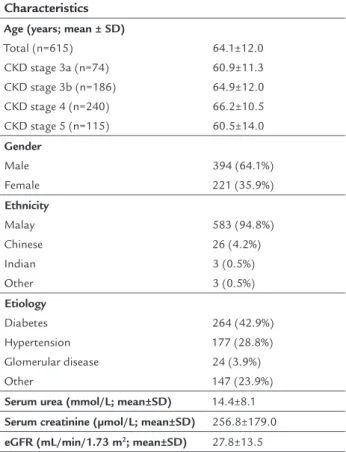
ESULTSA total of 615 cases were included in the study. Patient’s demographic data are shown in Table 1. The mean age was 64.1±12.0 years, with a preponderance of male subjects and Malay ethnic group. The most common etiology of CKD was diabetes followed by hypertension.
TABLE 1 Demographic data of the study population.
Characteristics
Age (years; mean ± SD)
Total (n=615) CKD stage 3a (n=74) CKD stage 3b (n=186) CKD stage 4 (n=240) CKD stage 5 (n=115)
64.1±12.0 60.9±11.3 64.9±12.0 66.2±10.5 60.5±14.0
Gender
Male Female
394 (64.1%) 221 (35.9%)
Ethnicity
Malay Chinese Indian Other
583 (94.8%) 26 (4.2%) 3 (0.5%) 3 (0.5%)
Etiology
Diabetes Hypertension Glomerular disease Other
264 (42.9%) 177 (28.8%) 24 (3.9%) 147 (23.9%)
Serum urea (mmol/L; mean±SD) 14.4±8.1
Serum creatinine (µmol/L; mean±SD) 256.8±179.0
eGFR (mL/min/1.73 m2; mean±SD) 27.8±13.5
CKD: chronic kidney disease; SD: standard deviation; eGFR: estimated glomerular filtra-tion rate.
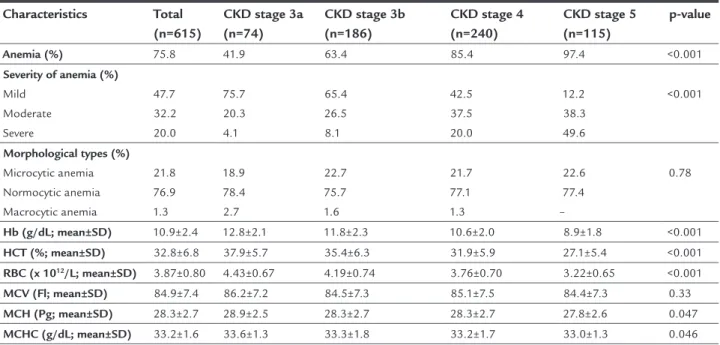
TABLE 2 Anemia and its parameters with different stages of chronic kidney disease.
Characteristics Total
(n=615)
CKD stage 3a (n=74)
CKD stage 3b (n=186)
CKD stage 4 (n=240)
CKD stage 5 (n=115)
p-value
Anemia (%) 75.8 41.9 63.4 85.4 97.4 <0.001
Severity of anemia (%)
Mild Moderate Severe
47.7 32.2 20.0
75.7 20.3 4.1
65.4 26.5 8.1
42.5 37.5 20.0
12.2 38.3 49.6
<0.001
Morphological types (%)
Microcytic anemia Normocytic anemia Macrocytic anemia
21.8 76.9 1.3
18.9 78.4 2.7
22.7 75.7 1.6
21.7 77.1 1.3
22.6 77.4 –
0.78
Hb (g/dL; mean±SD) 10.9±2.4 12.8±2.1 11.8±2.3 10.6±2.0 8.9±1.8 <0.001
HCT (%; mean±SD) 32.8±6.8 37.9±5.7 35.4±6.3 31.9±5.9 27.1±5.4 <0.001
RBC (x 1012/L; mean±SD) 3.87±0.80 4.43±0.67 4.19±0.74 3.76±0.70 3.22±0.65 <0.001
MCV (Fl; mean±SD) 84.9±7.4 86.2±7.2 84.5±7.3 85.1±7.5 84.4±7.3 0.33
MCH (Pg; mean±SD) 28.3±2.7 28.9±2.5 28.3±2.7 28.3±2.7 27.8±2.6 0.047
MCHC (g/dL; mean±SD) 33.2±1.6 33.6±1.3 33.3±1.8 33.2±1.7 33.0±1.3 0.046
CKD: chronic kidney disease; Hb: hemoglobin; HCT: hematocrit; RBC: red blood cells; MCV: mean corpuscular volume; MCH: mean corpuscular hemoglobin; MCHC: mean corpuscular hemoglo-bin concentration; SD: standard deviation.
The prevalence of mild, moderate, and severe anemia by gender is presented in Table 3. There were signiicantly greater anemic female CKD patients as compared to male patients (p=0.001). Moreover, prevalence of mild anemia was signiicantly greater in male than in female patients. But the prevalence of female CKD patients suffering from moderate and severe anemia was signiicantly higher as compared to male subjects. There was a signiicantly lower level of Hb, HCT and erythrocytes in females as compared to male patients.
TABLE 3 Gender-based comparison of anemia parameters.
Parameters Male
(n=394 )
Female (n=221)
p-value
Anemia (%) 71.6 83.3 0.001
Severity of anemia (%)
Mild Moderate Severe
53.9 31.0 15.0
36.7 34.4 29.0
<0.001
HCT (%; mean±SD) 34.0±6.8 30.7±6.3 <0.001
RBC (x 1012/L; mean±SD) 4.01±0.78 3.63±0.79 <0.001
MCV (Fl; mean±SD) 85.0±7.0 84.8±8.0 0.053
MCH (Pg; mean±SD) 28.4±2.6 28.2±2.8 0.28
MCHC (g/dL; mean±SD) 33.3±1.6 33.2±1.7 0.95
Hb: hemoglobin; HCT: hematocrit; RBC: red blood cells; MCV: mean corpuscular volume; MCH: mean corpuscular hemoglobin; MCHC: mean corpuscular hemoglobin concentration; SD: standard deviation.
Anti-anemic preparations were prescribed for only 38.0% of the patients. Underutilization of erythropoietin stabiliz-ing agents was apparent as none of the patients received these agents for the management of anemia. The predictors of oral anti-anemic therapy use are shown in Table 4. The logistic regression model was statistically signiicant, χ2
(10) = 196.086, p<0.001. The model explained 37.1% (Nagelkerke R2) of the variance in use of anti-anemic
prep-arations and correctly classiied 75.6% of cases. Result of Hosmer and Lemeshow test for goodness-of-it indicated that our model predicts values not signiicantly different than what we observed, χ2 (8) = 7.320, p=0.50. Patients with
Hb 9-11 g/dL were 2.14 times more likely to be prescribed anti-anemic preparations, holding all other independent variables constant. Moreover, patients with Hb < 9 g/dL were 2.90 times more likely to be given anti-anemic thera-py. Decreased HCT level was associated with 2.65 times odds of anti-anemic therapy use. Moreover, the deteriorat-ing kidney function (increased severity of CKD) was also a positive predictor of oral anti-anemic preparations use.
D
ISCUSSIONThe mean age of the patients in this study was similar to that reported in a previous study.23 There was a
predomi-nance of male subjects, which was similar to the results of previous reports.20,23 The study population included
mostly Malays, since our setting was the northeastern peninsular Malaysia, more speciically the States of Kel-antan, Terengganu and Pahang. There is a wide variation in the prevalence of anemia and its severity in CKD patients. In the present study, the prevalence of anemia was 75.8%. By contrast, Martinez-Castellao et al. reported a 51.3% prevalence of anemia in their Spanish cohort of CKD stage 3 and 4 patients.20 Likewise, a study conducted by Poudel
et al.24 reported that the prevalence of anemia was 47.85%
in Nepali CKD patients. In both of these studies, the ind-ings were lower than our results because most of our CKD cohort had advanced stages of CKD. We found that prev-alence of anemia increased with progressively deteriorating renal function. Regarding the severity of anemia, major-ity of the patients in our study had mild anemia followed by moderate anemia. Conversely, most of the patients in a previous study had moderate anemia followed by mild anemia.25 We also observed that the percentage of CKD
stage 5 patients with mild anemia was signiicantly lower than in the early stages, whereas the percentage of patients with CKD stage 5 having moderate and severe anemia were signiicantly higher as compared to other CKD stages. These indings relect that severity of anemia increases with declining renal function, which can be attributable to various factors associated with the development of anemia in CKD, such as erythropoietin insuficiency, iron and vitamin deiciency, malnutrition, inlammation, plate-let dysfunction, reduced red blood cell survival, and he-molysis.7 Similar to the indings of a previous study,24 we
also found that mean level of Hb, red blood cells, mean corpuscular hemoglobin and mean corpuscular hemoglo-bin concentration were signiicantly decreased by deterio-rating renal function. This considerable decrease could be another cause of a higher prevalence of anemia by dete-riorating kidney function. Levels of Hb, HCT, and red blood cells were signiicantly lower in female CKD patients than in male patients. Findings from a previous study conducted on ESRD patients also revealed that Hb-level was signiicantly lower in females as compared to male patients.26 Most of the patients in the current study had
TABLE 4 Predictors of use of oral anti-anemic preparations.
Variables Univariate Multivariate
OR (95CI) p-value OR (95CI) p-value
Age 0.99 (0.98-1.00) 0.17
Gender
Male Female
1.00 (Reference) 1.65 (1.18-2.31)
– 0.004
Diabetes 0.97 (0.68-1.37) 0.85
CVD 0.636 (0.45-0.90) 0.010
Hb (g/dl)
>11 9-11 <9
1.00 (Reference) 4.61 (3.04-7.00) 15.15 (9.09-25.26)
– <0.001 <0.001
1.00 (Reference) 2.14 (1.28-3.61) 2.90 (1.25-6.73)
– 0.013 0.004
Albumin (g/L)
>44 38-44 ≤37
1.00 (Reference) 0.86 (0.43-1.70) 2.14 (1.09-4.19)
– 0.66 0.027
Hematocrit (%)
>30 <30
1.00 (Reference) 7.93 (5.44-11.56)
– <0.001
1.00 (Reference) 2.65 (1.43-4.92)
– 0.002
CKD severity
Stage 3a Stage 3b Stage 4 Stage 5
1.00 (Reference) 1.67 (0.76-3.68) 6.11 (2.91-12.83) 16.51 (7.40-36.82)
– 0.20 <0.001 <0.001
1.00 (Reference) 1.36 (0.60-1.37) 4.08 (1.86-8.98) 6.07 (2.54-14.52)
– 0.47 <0.001 <0.001
normochromic-normocytic anemia followed by hypochro-mic-microcytic anemia, which was comparable to the indings of an earlier study.25
We observed a mismatch between the number of pa-tients with anemia and the number of papa-tients treated for anemia. Nearly half of the patients with anemia (37.8%) were not being treated with an anti-anemic agent accord-ing to their medical charts. Probable explanations for this inding are clinical inertia or a higher frequency of patients with mild anemia using vitamins (vitamin B complex). Nonetheless, the use of oral iron therapy in this study was greater than previously reported.23 Ferrous fumarate
(325 mg once daily) and folic acid (5 mg once daily) were the predominantly prescribed oral iron supplement combination for the treatment of anemia in our cohort. Underutilization of erythropoietin stabilizing agents in the current study might also be attributable to physician inertia or its prohibitive cost. Our study proposes that there is room for substantial improvement in terms of anemia control. Bailie et al.23 reported that the positive
predictors of iron use in pre-dialysis patients were Cau-casians [odds ratio (OR) = 2.6] and diabetics (OR = 2.1). Contrary to these indings, we found that the signiicant predictors of anti-anemic therapy prescribed were de-creased HCT and Hb level, and inde-creased severity of CKD. This study was carried out in a single Malaysian ter-tiary care hospital and the vast majority of the patients were Bumiputera (Malay ethnicity) from the northeastern peninsular region. Therefore, the indings may not be representative of the multiethnic Malaysian population. This study indicates the need to conduct a brief survey among physicians, enquiring reasons for prescribing or not prescribing erythropoietin stabilizing agents. Never-theless, this study offers valuable information regarding the prevalence, severity and treatment of anemia in Ma-laysian pre-dialysis patients.
C
ONCLUSIONPrevalence of anemia is high among pre-dialysis Malaysian patients at this tertiary care hospital, and is correlated with declining renal function. Earlier identiication as well as proper management of anemia may not only have a positive impact on the patient’s quality of life but also reduce hospitalization of CKD patients due to CVD.
A
CKNOWLEDGMENTSAuthors are very grateful to Ms. Nurul Jannah Ambak (Unit of Biostatistics and Research Methodology, School of Medical Sciences, Universiti Sains Malaysia) for assist-ing in the statistical analysis. Moreover, authors are also
thankful for the assistance of the staff of the CKD Re-source Centre, Kota Bharu, Kelantan, Malaysia, espe-cially Ms. Cheiok Chia Lee and Mr. Nik Zamli.
R
ESUMOAnemia em pacientes pré-diálise: prevalência, gravida-de, manejo
Objetivo: anemia é uma complicação comum de doenças renais crônicas (DRC) e está signiicativamente envolvida na morbidade cardiovascular. O objetivo de nosso estudo foi investigar a prevalência e a gravidade da anemia em pacientes adultos pré-diálise, bem como determinar fa-tores predifa-tores da terapia antianêmica.
Método: estudo retrospectivo observacional foi realiza-do em pacientes pré-diálise adultos que recebiam trata-mento no Hospital Universiti Sains Malaysia de janeiro de 2009 a dezembro de 2013.
Resultados: ao todo, 615 casos elegíveis foram incluídos. A idade média dos pacientes foi de 64,1±12,0 anos. A pre-valência de anemia foi de 75,8%, e a gravidade da anemia foi considerada leve em 47,7%, moderada em 32,2% e grave em 20% dos pacientes. Com base nas características morfológicas da anemia, os pacientes foram classiicados em anemia normocrômica normocítica (76,9%), anemia hipocrômica microcítica (21,8%) e anemia macrocítica (1,3%). Suplementos de ferro oral foram prescritos para 38% dos pacientes e a nenhum dos pacientes foram dados eritropoietina, agentes estabilizadores (ESA) e preparações de ferro por via intravenosa. Na regressão logística, os preditores signiicativos de utilização da preparação an-tianêmica foram diminuição da hemoglobina e do hema-tócrito e estágios avançados da DRC.
Conclusão: os resultados do presente estudo sugerem que a prevalência de anemia em pacientes pré-diálise é maior do que o atualmente aceito e está associado com a função renal; a prevalência aumenta com a diminuição da função renal. A identiicação precoce e o manejo adequado da anemia não só terão um impacto positivo na qualidade de vida, mas também reduzirão internações de pacientes com DRC decorrentes de eventos cardiovasculares.
Palavras-chave: anemia, terapia antianêmica, doença renal crônica, inércia do médico.
R
EFERENCES1. Levey AS, Coresh J. Chronic kidney disease. Lancet. 2012; 379(9811):165-80. 2. Hailpern SM, Melamed ML, Cohen HW, Hostetter TH. Moderate chronic
National Health and Nutrition Examination Survey (NHANES III). J Am Soc Nephrol. 2007; 18(7):2205-13.
3. Hsu CY, Ordoñez JD, Chertow GM, Fan D, McCulloch CE, Go AS. The risk of acute renal failure in patients with chronic kidney disease. Kidney Int. 2008; 74(1):101-7.
4. James MT, Quan H, Tonelli M, Manns BJ, Faris P, Laupland KB, et al. CKD and risk of hospitalization and death with pneumonia. Am J Kidney Dis. 2009; 54(1):24-32.
5. James MT, Hemmelgarn BR, Wiebe N, Pannu N, Manns BJ, Klarenbach SW, et al. Glomerular filtration rate, proteinuria, and the incidence and consequences of acute kidney injury: a cohort study. Lancet. 2010; 376(9758):2096-103.
6. Wilhelm-Leen ER, Hall YN, Tamura MK, Chertow GM. Frailty and chronic kidney disease: the third national health and nutrition evaluation survey. Am J Med. 2009; 122(7):664-71.
7. Nurko S. Anemia in chronic kidney disease: causes, diagnosis, treatment. Clev Clin J Med. 2006; 73(3):289-97.
8. Sarnak MJ, Tighiouart H, Manjunath G, MacLeod B, Grifith J, Salem D, et al. Anemia as a risk factor for cardiovascular disease in The Atherosclerosis Risk in Communities (ARIC) study. J Am Coll Cardiol. 2002; 40(1):27-33. 9. Abramson JL, Jurkovitz CT, Vaccarino V, Weintraub WS, McClellan W. Chronic
kidney disease, anemia, and incident stroke in a middle-aged, community-based population: the ARIC Study. Kidney Int. 2003; 64(2):610-5. 10. Haynes RJ, Winearls CG. Chronic kidney disease. Surgery (Oxford). 2010;
28(11):525-9.
11. Foley RN, Parfrey PS, Sarnak MJ. Epidemiology of cardiovascular disease in chronic renal disease. J Am Soc Nephrol. 1998; 9(12 Suppl):S16-23. 12. Moreno F, Sanz-Guajardo D, López-Gómez JM, Jofre R, Valderrábano F.
Increasing the hematocrit has a beneicial effect on quality of life and is safe in selected hemodialysis patients. Spanish Cooperative Renal Patients Quality of Life Study Group of the Spanish Society of Nephrology. J Am Soc Nephrol. 2000; 11(2):335-42.
13. Eschbach JW, Adamson JW. Iron overload in renal failure patients: changes since the introduction of erythropoietin therapy. Kidney Int Suppl. 1999; 69:S35-43.
14. Eschbach JW, Abdulhadi MH, Browne JK, Delano BG, Downing MR, Egrie JC, et al. Recombinant human erythropoietin in anemic patients with
end-stage renal disease. Results of a phase III multicenter clinical trial. Ann Intern Med. 1989; 111(12):992-1000.
15. Marsh JT, Brown WS, Wolcott D, Carr CR, Harper R, Schweitzer SV, et al. rHuEPO treatment improves brain and cognitive function of anemic dialysis patients. Kidney Int. 1991; 39(1):155-63.
16. Robertson HT, Haley NR, Guthrie M, Cardenas D, Eschbach JW, Adamson JW. Recombinant erythropoietin improves exercise capacity in anemic hemodialysis patients. Am J Kidney Dis. 1990; 15(4):325-32.
17. Ma JZ, Ebben J, Xia H, Collins AJ. Hematocrit level and associated mortality in hemodialysis patients. J Am Soc Nephrol. 1999; 10(3):610-9.
18. Xia H, Ebben J, Ma JZ, Collins AJ. Hematocrit levels and hospitalization risks in hemodialysis patients. J Am Soc Nephrol. 1999; 10(6):1309-16. 19. Kidney Disease: Improving Global Outcomes (KDIGO) Anemia Work Group.
KDIGO Clinical Practice Guideline for Anemia in Chronic Kidney Disease. Kidney Int Supplements. 2012; 2(4):279-335.
20. Martínez-Castelao A, Górriz JL, Portolés JM, De Alvaro F, Cases A, Luño J, et al. Baseline characteristics of patients with chronic kidney disease stage 3 and stage 4 in Spain: the MERENA observational cohort study. BMC Nephrol. 2011; 12:53.
21. Levey AS, Stevens LA, Schmid CH, Zhang YL, Castro 3rd AF, Feldman HI, et al.; CKD-EPI (Chronic Kidney Disease Epidemiology Collaboration). A new equation to estimate glomerular iltration rate. Ann Intern Med. 2009; 150(9):604-12. 22. Kidney Disease: Improving Global Outcomes (KDIGO) CKD Work Group.
KDIGO 2012 Clinical Practice Guideline for the Evaluation and Management of Chronic Kidney Disease. Kidney Int Supplements. 2013; 3(1):1-150. 23. Bailie GR, Eisele G, Liu L, Roys E, Kiser M, Finkelstein F, et al. Patterns of
medication use in the RRI-CKD study: focus on medications with cardiovascular effects. Nephrol Dial Transplant. 2005; 20(6):1110-5. 24. Poudel B, Yadav BK, Jha B, Raut KB, Pandeya DR. Prevalence and association
of anemia with CKD: a hospital based cross-sectional study from Nepal. Biomedical Res. 2013; 24(1):99-103.
25. Afshar R, Sanavi S, Salimi J, Ahmadzadeh M. Hematological proile of chronic kidney disease (CKD) patients in Iran, in pre-dialysis stages and after initiation of hemodialysis. Saudi J Kidney Dis Transplant. 2010; 21(2):368-71. 26. Al-Ageel NA, Al-Aqeel SA, Abanmy NO, Alwakeel JS, Sabry A, Alsaran KA.