Article
Printed in Brazil - ©2016 Sociedade Brasileira de Química0103 - 5053 $6.00+0.00*e-mail: [email protected]
Self-Immobilization of Poly(methyltetradecylsiloxane) onto Metalized Silica
Particles as Stationary Phases for HPLC
Giselle O. Carvalho,a Carol H. Collinsb and Anizio M. Faria*,a
aCurso de Química, Faculdade de Ciências Integradas do Pontal, Universidade Federal de
Uberlândia, 38304-402 Ituiutaba-MG, Brazil
bInstituto de Química, Universidade Estadual de Campinas, Caixa Postal 6154,
13084-971 Campinas-SP, Brazil
This work presents a study of the sorption of a pre-synthesized polysiloxane, poly(methyltetradecylsiloxane) - PMTDS, onto zirconized and titanized-silica particles that results in efficient stationary phases for reversed phase liquid chromatography. The sorbed materials, after 6 days at room temperature without any chemical or physical agent, denominated as self-immobilized stationary phase, present appropriate polymeric layer thicknesses that cover the metalized silica surfaces. The self-immobilization of polymer onto titanized silica particles produces more homogeneous polymeric coatings and stationary phases without silanophilic activity. Zirconized silica-based phases were more chemically resistant, despite their strong retention of basic solutes. In general, the chromatographic performance and chemical stability of metalized silica-based self-immobilized PMTDS phases were similar to conventional chemically bonded stationary phases.
Keywords: HPLC, metalized-silica supports, poly(methyltetradecylsiloxane), self-immobilization, stationary phases
Introduction
The polymeric coating of inorganic oxide particles has been a strategy for preparation of reversed stationary phases for high-performance liquid chromatography with low cost, good selectivity and high hydrolytic stability.1-4
The preparation of phases may occur by cross-linking of a polymer initiated by a chemical agent5,6 or by
immobilization of pre-synthesized organic polymer onto chromatographic support particles.7-9 This latter method is
less expensive as does not require the use of specific high-cost reagents. It is also simpler and more reproducible as it requires no strict control of the preparation conditions.10
Polymer immobilization on the support surface is typically performed by a chemical process11-13 or by a physical
process such as thermal treatment,7,14,15 gamma ionizing
radiation,16-18 and microwave radiation.8,19 The mechanisms
of these treatments on the polymer immobilization process is not yet well understood, although the resulting material typically has a thin polymer layer chemically bonded to some of the active sites of the chromatographic
support, which results in good separations and high stability.20
A n o t h e r p o s s i b i l i t y f o r p r e p a r a t i o n o f t h e polymer-coated stationary phases with pre-synthesized polymers has been by the self-immobilization process.21-23
In this method, the polymer is deposited onto silica particles at room temperature without the use of any conventional immobilization procedure. The polymer self-immobilization is capable of producing stationary phases with chromatographic performance similar to the immobilized phases.21 The factors that affect both polymer
incorporation onto silica particles and column efficiency in the self-immobilization procedure are the contact time between polymer and chromatographic support and also the characteristics of the support surface.22
Silica particles have a surface suitable for the self-immobilization of pre-synthesized polymers due to the presence of highly reactive silanol groups that act as “anchor points” for the polymeric layer, providing resistance to removal even with the continuous passage of eluents.24,25 However, silica-based phases have a
oxide layers that add more stability to the silica particles while preserving their morphologies.26-29 Silica supports
coated with zirconia or titania layers have been the most used of these modified chromatographic supports for the preparation of immobilized phases or chemically bonded phases, improving the applicability of reversed-phase high-performance liquid chromatography (RP-HPLC) for mobile phase conditions above pH 9.30-32
This work aimed to evaluate the capacity of producing stationary phases with better support surface coatings and the applicability of the resulting zirconized and titanized silica surfaces modified by the self-immobilization of poly(methyltetradecylsiloxane), PMTDS. PMTDS is a polysiloxane with 14 carbon atoms in its side chain, a chain length considered ideal for chromatographic separations.33,34
The physicochemical and chromatographic properties of self-immobilized PMTDS phases were characterized to evaluate their performance in the separation of some standard test mixtures.
Experimental
Chemicals
Mobile phases were prepared using HPLC-grade methanol from Tedia (Rio de Janeiro, Brazil) and Milli-Q water, Millipore (Bedford, MA, USA). The mobile phases were filtered using 0.22 µm nylon membrane filters from Millipore. Analytical reagent-grade chloroform, toluene and hexane, all from Tedia (Rio de Janeiro, Brazil), were used without filtration. All the compounds used for the chromatographic testing were also analytical reagent-grade purchased from Aldrich (Milwaukee, WI, USA) and not further purified. Five micrometer Kromasil silica from Akzo Nobel (Bohus, Sweden), having a mean pore size of 11.1 nm and a 309 m2 g-1 specific surface area,
TiIV tetrabutoxide and ZrIV tetrabutoxide from Aldrich
were used to prepare the metallized-silica supports. Poly(methyltetradecylsiloxane) (PMTDS), average molar mass (M) 9500, was purchased from Petrarch/Hüls America (Piscataway, NJ, USA). The sodium bicarbonate and sodium hydroxide used to prepare alkaline mobile phases were analytical-reagent grade from Fisher (Fair Lawn, NJ, USA).
Preparation of metalized-silica supports (Si−Zr and Si−Ti)
Zirconized silica and titanized silica was prepared using the previously described optimized procedures.29,35 Briefly,
chromatographic silica was added to a solution containing ZrIV or TiIV tetrabutoxide dissolved in 20 mL of anhydrous
toluene. These solutions were placed in a thermostated bath
for 5 h 30 min and for 3 h 30 min at 40 ºC, respectively. After that, the solutions were centrifuged for 15 min, the supernatants were discarded and the resulting solids were washed with anhydrous toluene and again centrifuged. This solvent washing step was repeated five times. The materials were hydrolyzed with 15.0 mL of 0.001 mol L-1 aqueous
HNO3 and centrifuged for 15 min. The solids were washed
with 15.0 mL of deionized water, centrifuged for 10 min, and then, they were dried in an oven at 120 °C for 12 h. This procedure is repeated twice. The resulting Si−Zr particles had 20% zirconium and the Si–Ti particles had about 8% titanium on their surfaces.
Study of the sorption of PMTDS onto metalized silica supports
The zirconized and titanized silica were dried in air at 140 °C for 12 h and then individually added to 10% (m/v) solutions of PMTDS in hexane at a specific mass (–m) of 0.9 gPMTDS / gSi–Zr or 0.8 gPMTDS / gSi–Ti. The mixtures were
slowly stirred for 3 h at room temperature. Subsequently, the hexane was allowed to evaporate, without stirring, at room temperature.
Each 15 days a small portion of the sorbed material was collected and was placed inside a stainless steel tube (150 mm × 10 mm i.d.). This tube was connected to a pump (Waters 510, Milford, MA, USA) for extraction of non-sorbed PMTDS by passing hexane at 0.5 mL min-1
for 4 h at 50 °C. After this extraction step, the material was dried with flowing N2. Columns (60 mm × 3.9 mm)
made from type 316 stainless steel tubing with polished internal surfaces were slurry packed using 5% slurries (m/v) of the stationary phases in chloroform. A constant packing pressure of 38 MPa (for zirconized silica-based phases) or 50 MPa (for titanized silica-based phases) from a Haskel packing pump (Burbank, CA, USA) was used with methanol as propulsion solvent. Columns were conditioned for 1 h with mobile phase at 0.3 mL min-1 prior
to the chromatographic evaluations.
Chromatographic evaluation
amounts of each solvent. All solvents were filtered and degassed before use. The mobile phase was methanol:water (70:30, v/v) at 0.3 mL min-1 for all stationary phases. Two
test mixtures were used in this study: (i) uracil, benzonitrile, benzene, toluene and naphthalene; and (ii) uracil, phenol,
N,N-dimethylaniline, naphthalene and acenaphthene. The column dead time (tM) was determined using uracil as an
unretained compound.
Elemental analysis
Approximately 10 mg of each extracted stationary phase sample were subjected to elemental analysis on a Model CHN-2400 Perkin-Elmer Analyzer (Shelton, CT, USA). From these data, the mass of PMTDS per gram of metalized-silica (specific mass of PMTDS) was calculated using the formula: –mPMTDS = %C/(70 – %C), since 70% of
the PMTDS refers to carbon.
Adsorption measurements
The specific surface areas of the self-immobilized Si−Zr(PMTDS) and Si−Ti(PMTDS) stationary phases were determined by nitrogen adsorption in the dry state. The nitrogen adsorption measurements were made using a Model 2300 Micromeritics Flow Sorb II instrument (Norcross, GA, USA). The samples (ca. 100 mg) were outgased in vacuum at 120 °C for at least 12 h. The specific surface area (SBET) values were calculated by applying the
BET (Brunauer, Emmet and Teller) model.36
Fourier transform infrared (FTIR)
The surface properties of PMTDS self-immobilized onto zirconized-silica and titanized-silica stationary phases were evaluated by infrared spectroscopy with a 4100 series FT/IR Jasco spectrometer (Tokyo, Japan). Infrared (IR) spectra were measured as KBr pellets (sample/KBr = 1/100) in the spectral range of 4000-400 cm-1 using 32 scans with
a resolution of 4 cm-1.
29Si nuclear magnetic resonance spectroscopy
The solid state 29Si NMR spectroscopy using a Bruker
ASX 300 NMR spectrometer (Rheinstetten, Germany) with cross polarization and magic angle spinning (CP/MAS) was used to characterize the self-immobilized Si−Zr(PMTDS) and Si−Ti(PMTDS) stationary phases. The contact time and pulse interval time were 5 ms and 1.5 s, respectively. A frequency of 59.6 MHz was used. Representative samples of 200-300 mg of self-immobilized phases were spun at
4 kHz using 7 mm double ZrO rotors. Typically, 1.5 k free induction decays (FIDs) with an acquisition time of 35 ms were accumulated in 1 kb data points, zero-filling to 8 kb prior to Fourier transformation. The line broadening used was 30 Hz and the spectral width for all spectra was about 25 kHz.
Stability testing
Stationary phases based on PMTDS self-immobilized onto zirconized silica and onto titanized silica supports were submitted to stability testing with a pH 10 mobile phase. The stability was compared to that of a phase having PMTDS thermally immobilized onto similar chromatographic supports. For this test, the alkaline mobile phase consisted of methanol:50 mmol L-1 carbonate buffer
(70:30, v/v), with the pH adjusted to 10 using a calibrated pH meter before addition of methanol. The flow rates through the columns were 1.0 mL min-1 at 50 °C. The
column was periodically tested for the separation of a mixture consisting of uracil, phenol, N,N-dimethylaniline, naphthalene and acenaphthene. The conditions used in the stability test accelerate column deterioration and it is possible to obtain faster evaluations using considerably less mobile phase and instrument time.37
Results and Discussion
The PMTDS sorption onto titanized silica and zirconized silica particles was carried out for 100 days, with portions of the sorbed material periodically withdrawn for chromatographic evaluation from the sixth day (complete evaporation of hexane) and thereafter every 15 days. Columns packed with these self-immobilized phases were used to separate standard test mixtures. The chromatographic separations of a test mixture promoted by some of these self-immobilized Si−Ti(PMTDS) and Si−Zr(PMTDS) phases are shown in Figure 1.
The materials produced from the self-immobilization of PMTDS onto titanized silica or zirconized silica particles show potential for use as RP-HPLC stationary phases even with a reduced sorption time. In general, improvement of chromatographic separation by self-immobilized phase on the supports is observed with increased sorption time. However, the surface sites of zirconized silica showed more activity than did those on the titanized silica, since from the 6th sorption day the Si−Zr(PMTDS) sorbent promoted
associated with higher reactivity of zirconium compared to titanium.38 The chromatographic parameters obtained for
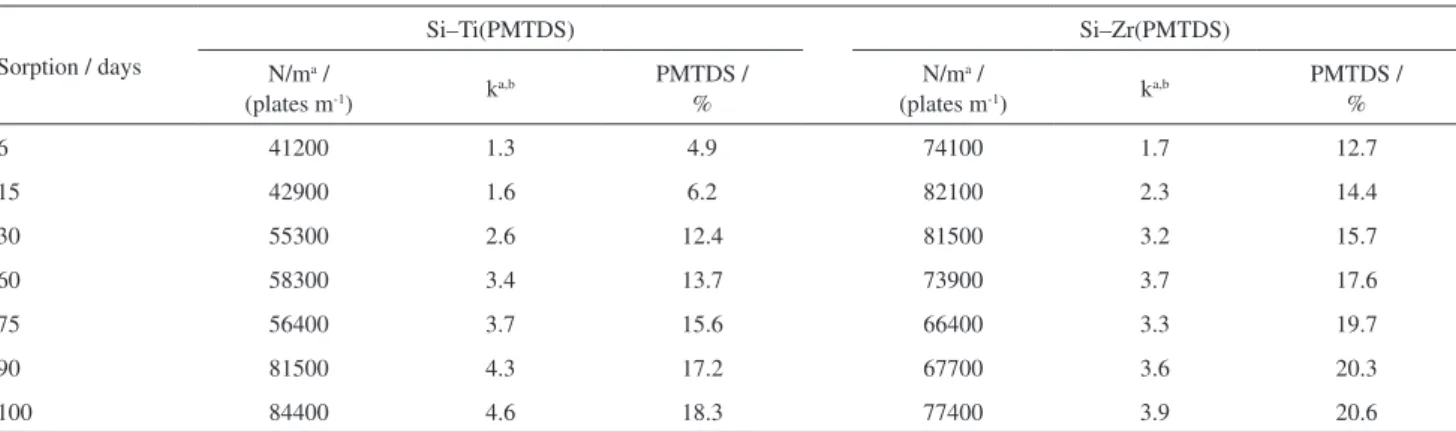
all self-immobilized Si−Ti(PMTDS) and Si−Zr(PMTDS) phases are shown in Table 1.
According to Table 1, the amount of self-immobilized polymer on the supports increased with the increase in sorption time. The amount of self-immobilized PMTDS on zirconized silica in the initial step of the study was similar to that obtained after 30 days of sorption on the titanized silica, which confirms the higher activity of the zirconized silica surface. This greater amount of polymer sorbed on the support surface resulted in a higher retention of compounds during the study. This greater retention of the compounds occurs linearly with increasing sorption time of PMTDS on the supports. It is also observed that the retention times of compounds at the end of study is somewhat greater on the
Si−Ti(PMTDS) phase than on the Si−Zr(PMTDS) phase (Table 1). This variation can be associated to the deposition of polymer on the inorganic support surface, which occurs in the form of “drops” that rearrange in thin layers by the use of a conventional immobilization procedure.4 Perhaps,
the slightly slower sorption of polymer on the titanized silica causes the polymer to distribute more uniformly on the support surface, leading to a linear increasing of number of plates with increasing the sorption time.
The deposition of PMTDS occurs principally in the pores of zirconized and titanized silica supports. As seen in Table 2 the specific surface areas of self-immobilized Si−Zr(PMTDS) and Si−Ti(PMTDS) phases showed similar values, about 170 m2 g-1. However, the reduction of specific
surface area with the deposition of PMTDS on titanized silica support was slightly lower than on zirconized silica, 43 vs. 48% respectively, probably due to a better accommodation of PMTDS on titanized silica surface and also because the greater amount of polymer deposited on zirconized silica.
The separation of basic compounds is a problem for most chemically-bonded and polymer-immobilized phases, due to incomplete covering of the polar support surface, which then interacts with basic analytes. Self-immobilized phases were chromatographically evaluated by the separation of a test mixture containing a basic solute, N,N-dimethylaniline. The chromatograms obtained for the phase self-immobilized for 100 days are presented in Figure 2.
The retention of the basic compound N,N-dimethylaniline on the self-immobilized phases occurs proportionately to the amount of PMTDS immobilized during the 100 days, with that of the basic compound on the Si−Ti(PMTDS) phase being somewhat lower, by about 1 min, than observed with the Si−Zr(PMTDS) phase, which has about 2% more PMTDS. However, the asymmetry for the
N,N-dimethylaniline peak on the zirconized silica-based
0 3 6 9 12 0 3 6 9 12
0 3 6 9 12 0 3 6 9 12
0 3 6 9 12 0 3 6 9 12
Si-Ti(PMTDS) 6 days
5
4 3 1,2
Si-Zr(PMTDS) 6 days
5 4 3 2
1
Si-Ti(PMTDS) 60 days
5
4 3 2
1 Si-Zr(PMTDS)60 days
5
4 3 2
1
Si-Ti(PMTDS) 100 days
time / min 5
4 3 2
1
Si-Zr(PMTDS) 100 days
5
4 3 2
1
Figure 1. Chromatographic separations by self-immobilized
Si−Ti(PMTDS) and Si−Zr(PMTDS) phases of a test mixture composed by (1) uracil; (2) benzonitrile; (3) benzene, (4) toluene; and (5) naphthalene. Chromatographic conditions: mobile phase MeOH:water (70:30, v/v); flow rate of 0.4 mL min-1; temperature of 25 °C; and UV detection at 254 nm.
Table 1. Chromatographic parameters of the self-immobilized Si–Ti(PMTDS) and Si–Zr(PMTDS) phases after 100 days of sorption
Sorption / days
Si–Ti(PMTDS) Si–Zr(PMTDS)
N/ma /
(plates m-1) ka,b
PMTDS / %
N/ma /
(plates m-1) ka,b
PMTDS / %
6 41200 1.3 4.9 74100 1.7 12.7
15 42900 1.6 6.2 82100 2.3 14.4
30 55300 2.6 12.4 81500 3.2 15.7
60 58300 3.4 13.7 73900 3.7 17.6
75 56400 3.7 15.6 66400 3.3 19.7
90 81500 4.3 17.2 67700 3.6 20.3
100 84400 4.6 18.3 77400 3.9 20.6
aCalculated for the naphthalene peak; bt
material indicates that the coating of support surface by the PMTDS may not have been as efficient as on the titanized silica surface. Associated with this fact, the residual active groups from the Si−Zr(PMTDS) surface are influenced by the presence of zirconium, which is more reactive than titanium, intensifying the interaction of these acidic sites with basic solutes.
The infrared measurements showed that the self-immobilized phase for 100 days over the titanized silica support was better protected by the PMTDS layer. Figure 3 shows the infrared spectra of the self-immobilized Si−Ti(PMTDS) and Si−Zr(PMTDS) phases.
According to FTIR spectra it can be observed that the small signal at 970 cm-1, attributed to the OH
vibration from residual silanols, was present only in the Si−Zr(PMTDS) phase, indicating an incomplete coating by the PMTDS layer on this phase. Furthermore, the presence of a more intense band at 3450 cm-1 due to the
vibrations of H2O molecules indicates a more polar surface
of the Si−Zr(PMTDS) phase, i.e. a non-uniform coating of polymeric layer.
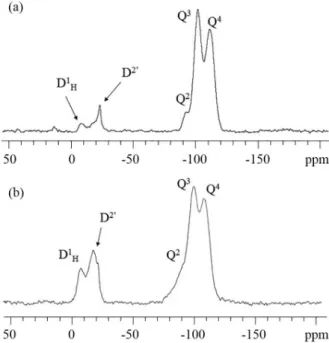
In 29Si NMR spectra (Figure 4) it was observed the
presence of silicon species related to the self-immobilized
PMTDS on the supports at –10 ppm and –20 ppm of chemical shift. The lowest intensity of these signals in the Si−Ti(PMTDS) phase may be related to the formation of a thin and homogeneous layer of PMTDS on support, whereas in the Si−Zr(PMTDS) phase the immobilization of denser droplets of PMTDS on support surface resulted in highest signal intensities, although part of the Si−Zr surface remained exposed as observed in the FTIR spectrum. The wider signals between –90 and –110 ppm in the Si−Zr(PMTDS) spectrum (Figure 4b) indicating the presence of a larger amount of silicon species from the
Table 2. Morphological properties of the self-immobilized materials after 100 days of PMTDS sorption
Material Specific surface area / (m2 g-1) Pore volume / (cm3 g-1) Pore size / nm
SiO2 309 ± 4 0.89 ± 0.02 11.7 ± 0.2
Si–Zr 336 ± 7 0.68 ± 0.01 8.0 ± 0.5
Si–Zr(PMTDS) 177 ± 8 0.37 ± 0.01 6.2 ± 0.2
Si–Ti 292 ± 3 0.73 ± 0.05 9.5 ± 0.7
Si–Ti(PMTDS) 167 ± 5 0.41 ± 0.02 8.0 ± 0.2
0 5 10 15 20
0 5 10 15 20
(b)
5 4
3 2
time / min
1
(a)
5 4
3
2
1
Figure 2. Separation of a test mixture composed of (1) uracil; (2) phenol;
(3) N,N-dimethylaniline; (4) toluene; and (5) acenaphthene obtained on (a) Si−Ti(PMTDS) and (b) Si−Zr(PMTDS) phases self-immobilized for 100 days. Chromatographic conditions: mobile phase MeOH:water (70:30, v/v); flow rate of 0.4 mL min-1; temperature of 25 °C; and UV detection at 254 nm.
4000 3200 2400 1600 800 (a)
3
4
5
0
4
7
0
8
0
0
1
0
9
5
2
8
6
0
2
9
3
0
T
ra
n
sm
it
ta
n
c
e
/
%
Wavenumber / cm-1
4000 3200 2400 1600 800 (b)
3
4
5
0
9
7
0
4
7
0
8
0
0
1
1
0
0
2
8
5
0
T
ra
n
sm
it
ta
n
c
e
/
%
Wavenumber / cm-1
2
9
3
0
Figure 3. FTIR spectra of the self-immobilized (a) Si−Ti(PMTDS) and
support surface on this phase. The structures of the silicon species present on the self-immobilized phases are shown in Figure 5.
The hydrolytic stability of self-immobilized phases was assessed by continuous passage of alkaline mobile phase buffered at pH 10 to verify the resistance of polymeric layer on the support surface under fast degradation conditions. The passage of alkaline mobile phase was periodically interrupted and the material subjected to the separation of a test mixture to monitor the chromatographic performance of the self- immobilized Si−Ti(PMTDS) and Si−Zr(PMTDS)
phases obtained after 100 days. The variation of the retention factor for a solute on the self-immobilized phase is shown in Figure 6.
The self-immobilized phases showed significant stability for the retention parameters of compounds with continuous mobile phase elution, presenting a small loss of retention after 2000 column volumes. This result indicates that, after 100 days of sorption at room temperature without addition of any physical or chemical agent in the self-immobilization process, the PMTDS layer is strongly retained on the metalized silica surfaces. The Si−Ti(PMTDS) phase showed less variation for the retention factor of acenaphthene than the Si−Zr(PMTDS) phase. The better accommodation of the PMTDS layer on the titanized silica surface produces a more uniform coating along the support surface which provides improved mass distribution of solute throughout the stationary phase. However, the higher chemical stability of the zirconized silica support offers slightly better stability to the stationary phase in terms of plate numbers, under fast degradation conditions. Figure 7 shows the resistance of the Si−Ti(PMTDS) and Si−Zr(PMTDS) phases self-immobilized for 100 days, compared to a thermally immobilized Si(PMTDS) phase, monitoring the column efficiency for the acenaphthene peak, with continuous alkaline mobile phase elution.
Despite the greater variation in retention values, the Si−Zr(PMTDS) phase has greater chemical resistance, about 80%, after the passage of alkaline mobile phase if compared to the Si−Ti(PMTDS) phase, as can be seen in
Figure 4. 29Si NMR spectra of the self-immobilized (a) Si−Ti(PMTDS)
and (b) Si−Zr(PMTDS) phases for 100 days of PMTDS sorption.
Si R
CH3
O
O
Si O
O O Si C
H3
R
O
Si
O O
n
OH
O Si C
H3
R
O
Si
O O
O OH
Si
O O
OH O H
Si O
O
O O
Si O
O
D1H
D2'
Q3 Q2
Q4
Figure 5. Silicon species present on the self-immobilized stationary
phases.
0 500 1000 1500 2000 2500
0 2 4 6 8 10
R
et
en
ti
o
n
fa
ct
o
r
(k
)
Column volume
Si–Zr(PMTDS) Si–Ti(PMTDS)
Figure 6. Variation of retention factor for the acenaphthene on the
Figure 7. This fact is associated with the higher stability of the silica-zirconia support, resulting in stationary phases with longer lifetimes than similar stationary phases with titanium.3 Even without any immobilization step, the
self-immobilized phases on the metalized silica surfaces exhibited chemical stability up to four times greater than the similar stationary phase thermally immobilized on a bare silica support. Thus, it can be concluded that the process of the PMTDS self-immobilization on metalized silica supports resulted in stationary phases with excellent chemical stability.
Conclusions
The self-immobilization of pre-synthesized organic polymers on the metalized silica surfaces results in reversed stationary phases with good separation performance and excellent resistance to elutions using basic mobile phases, comparable to commercial chemically bonded phases. The surface of the zirconized silica presented more activity than the titanized silica supports, leading to an immobilization of somewhat more polymer. However, the slower self-immobilization of PMTDS on the titanized silica produces a more homogeneous polymeric coating, resulting in reversed phases with low silanophilic activity and high column efficiency. The chemical stability of the zirconized silica materials is greater than the titanized silica ones, due to the higher chemical resistance of zirconium in drastic pH conditions if compared to titanium, offsetting the larger exposure of the support to the contact with mobile phase eluents from its irregular polymeric coating.
Acknowledgments
The authors acknowledge financial support and fellowships from the Fundação de Amparo à Pesquisa do Estado de São Paulo (FAPESP) and the Conselho Nacional de Desenvolvimento Científico e Tecnológico (CNPq).
References
1. Petro, M.; Berek, D.; Chromatographia1993, 37, 549. 2. Jardim, I. C. S. F.; Collins, K. E.; Collins, C. H.; Microchem.
J.2004, 77, 191.
3. Faria, A. M.; Jardim, I. C. S. F.; Collins, K. E.; Collins, C. H.; J. Sep. Sci.2006, 29, 782.
4. Faria, A. M.; Jardim, I. C. S. F.; Collins, C. H.; J. Braz. Chem. Soc.2009, 20, 1385.
5. Figge, H.; Deege, A.; Köhler, J.; Schumburg, G.; J. Chromatogr. A1986, 351, 393.
6. Kolla, P.; Köhler, J.; Schomburg, G.; Chromatographia1987, 23, 465.
7. Silva, C. G. A.; Collins, C. H.; J. Chromatogr. A2012, 1232, 248.
8. Begnini, F. R.; Jardim, I. C. S. F.; J. Chromatogr. A2013, 1297, 113.
9. Dib, S. R.; Faria, A. M.; Chromatographia2014, 77, 533. 10. Faria, A. M.; Collins, K. E.; Collins, C. H.; J. Chromatogr. A
2006, 1122, 114.
11. Qin, Q.; Zhang, S.; Zhang, W. G.; Zhang, Z. B.; Xiong, Y. J.; Guo, Z. Y.; Fan, J.; Run-Zheng, S.; Finlow, D.; Yin, Y.; J. Sep. Sci.2010, 33, 2582.
12. Zhang, T.; Franco, P.; Nguyen, D.; Hamasaki, R.; Miyamoto, S.; Ohnishi, A.; Murakami, T.; J. Chromatogr. A2012, 1269, 178. 13. Ciogli, A.; Bicker, W.; Lindner, W.; Chirality2010, 22, 463. 14. Bottoli, C. B. G.; Chaudhry, Z. F.; Fonseca, D. A.; Collins, K.
E.; Collins, C. H.; J. Chromatogr. A2002, 948, 121. 15. Maldaner, L.; Jardim, I. C. S. F.; J. Sep. Sci.2010, 33, 174. 16. Lopes, N. P.; Collins, K. E.; Jardim, I. C. S. F.; J. Chromatogr.
A2003, 987, 77.
17. Tonhi, E.; Collins, K. E.; Collins, C. H.; J. Chromatogr. A2005, 1075, 87.
18. Faria, A. M.; Collins, K. E.; Collins, C. H.; J. Chromatogr. A 2007, 1156, 51.
19. Morais, L. S. R.; Jardim, I. C. S. F.; J. Chromatogr. A2005, 1073, 127.
20. Bachmann, S.; Melo, L. F. C.; Silva, R. B.; Anazawa, T. A.; Jardim, I. C. S. F.; Collins, K. E.; Collins, C. H.; Albert, K.; Chem. Mater.2001, 13, 1874.
21. Bottoli, C. B. G.; Collins, K. E.; Collins, C. H.; J. Chromatogr. A2003, 987, 87.
22. Bottoli, C. B. G.; Vigna, C. R. M.; Fischer, G.; Albert, K.; Collins, K. E.; Collins, C. H.; J. Chromatogr. A2004, 1030, 217.
0 300 600 900 1200 1500
Si–Zr(PMTDS) Si–Ti(PMTDS)
Column volume
Si(PMTDS)
S
ta
ti
o
n
ar
y
p
h
as
es
Figure 7. Chemical resistance of thermally immobilized Si(PMTDS) and
23. Collins, K. E.; Bottoli, C. B. G.; Vigna, C. R. M.; Bachmann, S.; Albert, K.; Collins, C. H.; J. Chromatogr. A2004, 1029, 43. 24. Pesek, J. J.; Matyska, M. T.; J. Sep. Sci.2005, 28, 1845. 25. Engelhardt, H.; Blay, Ch.; Saar, J.; Chromatographia2005, 62,
s19.
26. Nawrocki, J.; Dunlap, C.; McCormick, A.; Carr, P. W.; J. Chromatogr. A2004, 1028, 1.
27. Nawrocki, J.; Dunlap, C.; Li, J.; Zhao, J.; McNeff, C. V.; McCormick, A.; Carr, P. W.; J. Chromatogr. A2004, 1028, 31. 28. Dun, H.; Zhang, W.; Wei, Y.; Xiuqing, S.; Li, Y.; Chen, L.; Anal.
Chem.2004, 76, 5016.
29. Faria, A. M.; Magalhães, D. R.; Collins, K. E.; Collins, C. H.; Anal. Chim. Acta2005, 550, 137.
30. Ge, J.; Shi, X.; Li, Y.; Chen, L.; Chromatographia2006, 63, 25.
31. Ge, J.; Zhao, L.; Chen, L.; Shi, Y.; J. Chromatogr. Sci.2010, 48, 29.
32. Ge, J.; Li, Y.; Chen, L.; J. Liq. Chromatogr. Relat. Technol. 2006, 29, 2329.
33. Szabó, K.; Ha, N. L.; Schneider, P.; Zeltner, P.; Kováts, E. sz.; Helv. Chim. Acta1984, 67, 2128.
34. Kirkland, J. J.; J. Chromatogr. A2004, 1060, 9.
35. Faria, A. M.; Magalhães, D. R.; Collins, C. H.; Materia2004, 9, 344.
36. Brunauer, S.; Emmett, P. H.; Teller, E.; J. Am. Chem. Soc.1938, 60, 309.
37. Fonseca, D. A.; Gutierrez, H. R.; Collins, K. E.; Collins, C. H.; J. Chromatogr. A2004, 1030, 149.
38. Basso, N. R. S.; Grecco, P. P.; Carone, C. L. P.; Livotto, P. R.; Simplício, L. M. T.; Rocha, Z. N.; Galland, G. B.; Santos, J. H. Z.; J. Mol. Catal. A: Chem.2007, 267, 129.
Submitted: November 10, 2015 Published online: January 29, 2016