Article
Printed in Brazil - ©2016 Sociedade Brasileira de Química0103 - 5053 $6.00+0.00*e-mail: [email protected]
Synthesis, Characterization and
in vitro
Antioxidant Activity of New Chiral
N
-boc
Organotellurium Compounds, (CH
3)
3OC(O)NHCH(R)C(O)NHCH
2-CH
2Te-C
6H
4-4-OCH
3, Containing Carbamate and Peptide Groups
Rajegowda H. Revanna,Raghavendra K. Panchangam,* Udaya Bhanu and Suresh Doddavenkatanna
Department of Chemistry, UCS,Tumkur University, 572 103, Tumkur, Karnataka, India
Synthesis, characterization and antioxidant activity of a new series of chiral N-boc oraganotellurium compounds, (CH3)3OC(O)NHCH(R)C(O)NHCH2CH2Te-C6H4-4-OCH3,
containing carbamate and peptide groups have been reported in this paper. These chiral peptides were synthesized in good to excellent yields, via acid-amine coupling reaction of N-boc L-amino acids with 2-(4-methoxyphenyltelluro) ethylamine in presence of dicyclohexyl carbodimide (DCC) at room temperature. The elemental analyses, Fourier transform infrared (FTIR), 1H and 13C {1H} nuclear magnetic resonance (NMR) spectra and mass spectra were characteristic. Specific
optical rotation (SOR) was also determined. In vitro antioxidant activity of these multi-functional compounds in methanol has been evaluated against 2,2-diphenyl-1-picrylhydrazyl (DPPH) radicals with 2,6-di-tert-butyl-4-methylphenol (BHT) as a standard reference compound. The IC50
(inhibitory concentration 50) values of these chiral peptides revealed significant inhibition against DPPH radicals and found to be effective antioxidants.
Keywords: organochalcogen, aminoacid derivative, antioxidant
Introduction
An antioxidant is “any substance that delays or prevents oxidation of an oxidisable species”.1,2 Oxidative stress,
induced by reactive oxygen species (ROS) produced in the body, is one of the main factors of current slow killer diseases, that population suffering from, like cancer, diabetes, cardiovascular, neurological (Alzheimer’s and Parkinson’s), inflammatory viral diseases and digestive disorders.3-6
Since the discovery of “Ebselen”, a natural antioxidant, a number of organochalcogen (S, Se, Te) compounds have been designed, synthesized and investigated as free radical scavengers or antioxidants to mimic the natural ones.7-30 The divalent organochalcogen compounds have
the potential to act as catalytic antioxidants because they readily react with many types of oxidants such as peroxides, peroxynitrites, singlet oxygen and ozone resulting tetravalent organochalcogens (that is chalcogenides to chalcogenoxides and chalcogenols to dichalcogenides) which in turn reduced by many mild reducing agents. The antioxidant activity of organochalcogen compounds is also related to their redox potentials and rates of oxidation in solutions.31-35 Even though
a large number of antioxidants are available, they have many disadvantages such as they are costly and many of them cause various side effects due to the toxic byproducts.36-40,22
Organotellurium compounds have shown many advantages as free radical scavengers or antioxidants. They act as both peroxide decomposers and chain-breaking, donating antioxidants even under biologically relevant conditions. They have also demonstrated higher radical scavenging efficiency than the corresponding S and Se compounds.41,42
Organotellurium compounds have been much less explored in biology unlike the compounds of its lower congeners (S and Se), even though tellurium exhibit various similar properties of sulfur and selenium43-46 which may be
due to the fact that tellurium was considered non-essential biological trace element, commercial non-availability of a wide variety of organotellurium compounds as starting materials and some misconception that they are air sensitive, foul smelling and even toxic. A few reasons among enhanced interest currently in the biological chemistry of organotellurium compounds are the availability of modern analytical techniques (125Te Fourier transform
emission spectrometry,ICP-AES) to study and understand the solution behavior of Te containing systems, such an option does not exist for sulfur compounds, the secondary interactions (Te…X where X = O, Cl, Br, I orM) arises from the hypervalent nature of Te, thus increases the stability of organotellurium compounds and higher redox activity of the tellurium.
Numerous organochalcogen compounds containing amine, peptide/amide and carbamate groups enhances the rates of their redox reactions16,22,23,47 and the effect
of these groups on the activity of organotellurium compounds was expected to be more pronounced than that of corresponding organoselenium compounds.47,23 The
biological activity of chiral organochalcogen compounds may be specific. Recently reported that the organoselenium and tellurium compounds which contain the secondary interactions between chalcogen atom and other heteroatoms [TeX, X = N, O, S, Cl, Br, I] through internal chelation play an important role in the catalytic antioxidant activity.48-50
There are numerous synthetic and natural chiral organoselenium compounds20-26,43-46 but there has not been
studied antioxidant properties of chiral organotellurium compounds containing peptide and carbamate functionalities.
In view of the above advantages and to expand the applications of chiral organotellurium compounds in biological activities51 particularly as antioxidants, we have
reported in this paper the synthesis, spectral and analytical characterization data of chiral N-boc organotellurium compounds containing amide and carbamate groups. These chiral multi-functionalized compounds (4a-4g) synthesized from N-boc L-amino acids and 2-(4-methoxyphenyltelluro) ethylamine via condensation in presence of dicyclohexyl carbodimide (DCC). The in vitro antioxidant activity of these compounds against 2,2-diphenyl-1-picrylhydrazyl (DPPH) radicals has been studied. All the compounds showed significant antioxidant activity when compared to 2,6-di-tert-butyl-4-methylphenol (BHT).
Results and Discussion
Synthesis and character ization of chiral N-boc organotellurated peptides (4a-4g)
A new series of chiral N-boc organotellurated compounds (4a-4g, Figure 1) were synthesized by condensation of N-boc L-amino acids and 2-(4-methoxyphenyltelluro) ethylamine in presence of DCC as a dehydrating agent according to the reactions given in the Scheme 1. The reactions were carried out in dry dichloromethane. The products were purified by flash column chromatography. The compounds, 4a-4g, were obtained with good to
excellent yields of about 80-95%.
FTIR spectra of chiral N-boc organotellurated peptides (4a-4g)
Fourier transform infrared (FTIR) spectra were recorded in the range of 400-4000 cm-1.In the IR spectra
of compounds, 4a-4g, characteristic bands were obtained for NH, C−H, C=C, C=O, C−O, C−S and C−Te functional groups. The –NH− stretching bands were observed at around at 3300-3450 cm-1 and the C=O stretching vibrational bands
were obtained at 1630-1660 cm-1. The C−S stretching band
in 4d and 4e were appeared at 733 cm-1. The C−Te aryl
stretching vibrational band was appeared in the region of 510 ± 5 cm-1.52-55
1H NMR spectra of chiral N-boc organotellurated peptides
(4a-4g)
The 1H NMR spectra of the compounds 4a-4g were
found characteristic. The CH2Te and CH2N signals were
observed at d, 2.734-2.814 and 3.290-3.375 ppm and appeared as triplets and multiplets respectively. These signals were found deshielded about 0.4 to 0.5 ppm when compared to 2-(4-methoxyphenyltelluro) ethylamine.55
There are two types of NH groups such as the carbamate (Boc-NH–) and amide (>CO–NH–). The carbamate NH proton gave a doublet in the range of d, 6.5 to 6.9 ppm while the amide NH gave a triplet between 7.95 to 8.25 ppm due to coupling with CH and CH2 protons respectively. In all the compounds a singlet was observed at around 1.35 ppm for all the 9 protons of t-Bu group. In 4a the methyl group showed a doublet at 1.118-1.136 ppm. In 4b the benzylic CH2 protons were split into two doublets of a doublet at 2.672-2.705 and 2.891-2.924 ppm due to their diastereotopic nature. In 4c the CH, CH2 and CH3 protons all gave multiplets between 0.77 to 1.25 ppm. The protons of –CH2–CH2–S–CH3 group in 4d were appeared as a
multiplet, triplet and a singlet at 1.698-1.771, 2.384-2.423 and 2.013 ppm respectively. In 4e, the -CH2SCH2Ph,
protons were observed as two multiplets. In 4f the phenolic OH was obtained as a singlet at 9.12 ppm. The aromatic protons present at meta and ortho to Te were observed at 6.804-6.9 and 7.606-7.663 ppm respectively in all the compounds which were in agreement with that reported for 2-(4-methoxyphenyltelluro) ethylamine.55 The peaks
for other aromatic protons were characteristic.
13C NMR spectra of chiral N-boc organotellurated peptides
(4a-4g)
Figure 1.Structure of chiral N-boc organotellurated peptides(4a-4g).
R
NH OH
O
BOC
N OH O
CH3
C
H3 CH3 ClCH
2CH2NH2HCl
Antioxidant activity againt DPPH radicals Ar2Te2
N H2
Te
O
CH3
3a: R=CH3
3g:
3b: R=CH2C6H5
3c: R=CH(CH3)CH2CH3
3d: R=CH2CH2SCH3
3e: R=CH2SCH2C6H5
3f: R=CH2C6H4-4-OH
3a f
-4a 4f
-R
NH NH
O
Te O
O
CH3 C
H3
CH3
O CH3
4f: R=CH2C6H4-4-OH
4e: R=CH2SCH2C6H5
4d: R=CH2CH2SCH3
4c: R=CH(CH3)CH2CH3
4b: R=CH2C6H5
4a: R=CH3
N
NH O
Te
O
O O
CH3 C
H3
CH3 C H3
4g
+
a
b
c 2-(4-Methoxyphenyltelluro)
ethylamine
d
d
Scheme 1.Synthesis of chiral N-boc organotellurated peptides(4a-4g): (a) EtOH, NaBH4/aq. NaOH, CH2Cl2; (b) 3a-3f, DCC, THF; (c) 3g, DCC, THF;
(d) antioxidant activity against DPPH radicals. R
NH OH
O
BOC
N OH
O
CH3
C
H3 CH3
ClCH
2CH2NH2HCl
Antioxidant activity againt DPPH radicals
Ar2Te2
N H2
Te
O
CH3
3a: R=CH3
3g:
3b: R=CH2C6H5
3c: R=CH(CH3)CH2CH3
3d: R=CH2CH2SCH3
3e: R=CH2SCH2C6H5
3f: R=CH2C6H4-4-OH 3a f
-4a 4f -R
NH NH
O
Te O
O
CH3 C
H3
CH3
O CH3
4f: R=CH2C6H4-4-OH
4e: R=CH2SCH2C6H5
4d: R=CH2CH2SCH3
4c: R=CH(CH3)CH2CH3
4b: R=CH2C6H5
4a: R=CH3
N
NH O
Te
O
O O
CH3 C
H3
CH3 C H3
4g
+
a
b
c 2-(4-Methoxyphenyltelluro)
ethylamine
d
4a-4g, the CH2Te and CH2N carbon signals were appeared
between d, 22-25 ppm and 40-41 ppm, respectively.56
The methyl carbons of tBu group in 4d and 4f are
slightly deshielded and appeared at 28.63 and 29.87 ppm, respectively, whereas in others these carbon were appeared at 28.07-28.16 ppm. The quaternary carbon peaks of tBu
group were produced at d ca. 78 ppm. The carbons atoms present at position meta and ortho to Te were appeared at around 115.5 and 140.0 ppm, respectively. The carbamate [(CH3)3CO(CO)NH−] and amide [−NH(CO)CH<] carbons
are highly deshielded and appeared in the range of 155.0-155.5 and 170-171 ppm, respectively, in all 4a-4g. The methyl carbon was observed at 18.29 ppm in 4a. In 4b and 4f the benzylic methylene carbon signal was appeared at ca. 37 ppm. In 4d the carbons of CH3SCH2CH2− chain
were obtained at 15.09, 32.21 and 30.24 ppm, respectively. The signals for CH2SCH2− carbons were observed at 35.10
and 47.44 ppm, respectively, in 4e. The carbon atoms meta and ortho to Te were observed between 115.2-115.7 and 139.0-140.5 ppm, respectively in 4a-4g.56 The other
aromatic signals are characteristic for their respective carbons.
Mass spectra of 4a, 4b and 4g
Mass spectra of compounds 4a, 4b and 4g were recorded using atmospheric-pressure chemical ionization (APCI) in the positive mode. The [M + 1] ion peak were obtained at m/z 450.9, 527 and 476.9 with 20, 30 and 10% abundance. In all, the peaks were also obtained with [M + 1 + H2O] at
467.9, 545 and 494.9 with 100% abundance.
Radical scavenging activity of chiral N-boc organotellurated peptides (4a-4g)
In order to understand the influence of tellurium atom along with carbamate and amide groups by varying the substituent at chiral carbon in the biological activity, such as the antioxidant activity of compounds 4a-4g in comparison with BHT, a common antioxidant that finds application in the food industry,57,58 was determined by DPPH assay
in vitro as given in Table 1.
DPPH is characterized as a stable free radical by virtue of the delocalization of the single electron over the molecule as a whole, so that the molecules do not dimerise, as would be the case with most other free radicals. The delocalization also gives rise to the deep violet color, characterized by an absorption band in ethanol solution centered at about 520 nm.
When a solution of DPPH is mixed with that of a substance that can donate an electron or hydrogen atom, then this gives rise to the reduced form with the loss of
this violet color.52-55 This latter will then undergo further
reactions which control the overall stoichiometry, that is, the number of molecules of DPPH reduced (decolorized) by one molecule of the reductant. The reaction is therefore intended to provide the link with the reactions taking place in an oxidizing system, such as the autoxidation of a lipid or other unsaturated substance; the DPPH molecule is thus intended to represent the free radicals formed in the system whose activity to be suppressed by the substance.
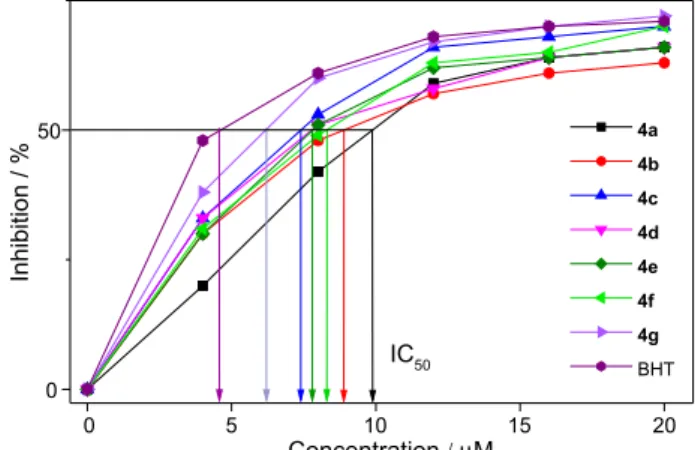
Antioxidant potential of chiral N-boc organotellurated amides were assessed through DPPH radicals with varying concentration as given in the Table 1 and also shown in Figure 2which demonstrated that these multi-functionalized compounds (4a-4g) are effective antioxidants than BHT towards DPPH radicals due to the presence of Te and which is also influenced by carbamate and amide groups.
The IC50 (inhibitory concentration 50) values (sample
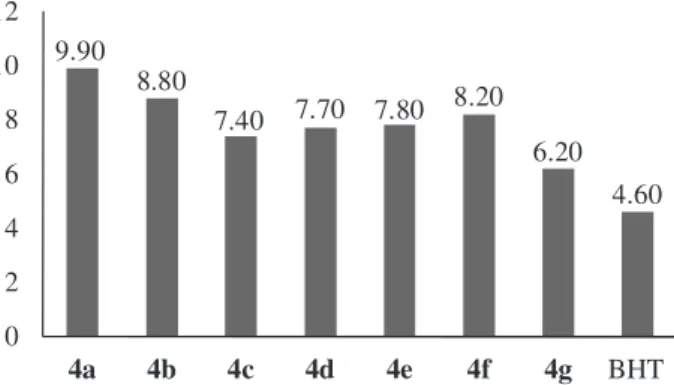
concentration required to inhibit 50% of the radicals) of 4a-4g are in the range of 6.00 to 10.00 µM mL-1 as
given in the Table 2 and also represented graphically in Figure 3. These values suggested that the chiral N-boc organotellurated compounds containing carbamate and amide functionalities showed good antioxidant activities.
Table 1. Antioxidant capacities of chiral N-boc organotellurated peptides (4a-4g)
Concentration / µM
Inhibition / %
4a 4b 4c 4d 4e 4f BHT
0 0 0 0 0 0 0 0
4 20 30 33 33 30 31 38
8 42 48 53 51 51 49 60
12 59 57 66 58 62 63 67
16 64 61 68 64 64 65 70
0 5 10 15 20
0 50
Concentration/ µM
Inhibition / %
4a
4b
4c
4d
4e
4f
4g
BHT
IC50
Figure 2.Graphical representation of antioxidant activity of 4a-4g against DPPH radicals.
0 5 10 15 20
0 50
Concentration/ µM
Inhibition / %
4a
4b
4c
4d
4e
4f
4g
Conclusions
In summary, we presented the synthesis of new chiral N-boc oraganotellurium compounds (4a-4g) containing carbamate and peptide groups from N-boc L-amino acids and 2-(4-methoxyphenyltelluro) ethylamine in presence of DCC. All these compounds were characterized by elemental analysis, FTIR, 1H, and 13C {1H} NMR spectroscopy and mass spectrometry.
Specific optical rotations were determined for 4a-4g. In vitro antioxidant activity of 4a-4g in methanol has been investigated against DPPH radicals with BHT as a standard reference compound. The IC50 values of the
chiral N-boc organotellurrated peptides (4a-4g) were found in the range of 6 to 10 µM concentration. These results revealed that the new chiral N-boc organotellurated peptides (4a-4g) proved to possess significantly high antioxidant activity against DPPH radicals and among which compound 4g, L-proline based peptide showed highest antioxidant activity.
Experimental
Analytical techniques
1H and 13C {1H} NMR spectra were recorded on a Bruker
DPX-400 Hz or AVANCE II Bruker 400 Hz spectrometer at
399.65 and 100.64 Hz, respectively. Spectra were recorded in dimethyl sulfoxide, DMSO-d6, solutions. Chemical shifts were reported in parts per million (ppm) with tetramethylsilane (TMS) as a reference standard. Specific optical rotations (SOR) were measured using Rudolph Autopol-I automatic Polarimeter in a cell of 100 mm path length. Melting points were recorded in open capillary tubes and are reported uncorrected. FTIR spectra were recorded on a JASCO FTIR-4100 instrument in the range of 400 to 7000 cm-1. Column chromatography was performed using
Merck silica gel (230-400 mesh). Thin layer chromatography (TLC) was performed using Merck 60 F254 silica gel on pre-coated aluminum sheets. Compounds were visualized on TLC with UV-light, potassium permanganate stain, iodine vapor or with ninhydrin.
Materials
Solvents such as tetrahydrofuran (THF) and benzene were dried using sodium metal and benzophenone. N-boc L-aminoacids, sodium borohydride, elemental tellurium, anisole, 2-chloroethylamine hydrochloride, DCC, DPPH and BHT were purchased from Sigma Aldrich Ind. Ltd., and they were used as received. The following precursor compounds were prepared according to literature procedures: 1,2-bis(4-methoxyphenyl) ditellane,59
2-(4-methoxyphenyltelluro) ethylamine.52-55
General procedure for the synthesis of chiral N-boc L-organotellurated amides (4a-4f)
The stirred solution of N-boc L-amino acids, (10 mmol) in dry CH2Cl2 (50 mL) was cooled to 0 °C and then was
added DCC (2.063 g, 10 mmol). The reaction mixture was slowly brought to room temperature and continued the stirring for about 2-3 h. A solution of 2-((4-methoxyphenyl) tellanyl) ethylamine dissolved in 15-20 mL of CH2Cl2 was
added dropwise. The whole reaction mass was further stirred at room temperature. The progress of the reaction was checked by TLC. After completion of the reaction, the resulting mixture was diluted with CH2Cl2 and the organic
layer was washed thrice with brine (3 × 50 mL). The combined organic layers were dried over anhydrous Na2SO4
and then filtered. The solvent was removed under reduced pressure. The crude product obtained above was subjected to column chromatography hence gave compounds 4a-4f.
(S)-ter t-Butyl(1-((2-((4-methoxyphenyl)tellanyl)ethyl) amino)-1-oxopropan-2-yl) carbamate (4a)
Light brown viscous liquid;yield 85%; [α]D28.5 –20.0
(c 1.0, CHCl3); IR (KBr) ν / cm-1 3338, 3306, 2976, 2926, Table 2.IC50 values of 4a-4g
Compound IC50 / µM
4a 9.9
4b 8.8
4c 7.4
4d 7.7
4e 7.8
4f 8.2
4g 6.2
IC50: inhibitory concentration 50.
2849, 1686, 1644, 1524, 1488, 1449, 1365, 1320, 1280, 1240, 1162, 1065, 1024, 810, 638, 585, 511, 463, 446, 419; 1H NMR(399.65 Hz, DMSO-d
6) d1.118-1.136 (d,
3H, J 7.2 Hz,H12), 1.357 (s, 9H, tBu), 2.779-2.814 (t,
2H, J 7.59 Hz,H5), 3.290-3.375 (m, 2H, H4), 3.73 (s, 3H, OCH3), 3.843-3.879 (m, 1H, H2), 6.804-6.833 (m, 3H,
H8, H10, NH), 7.612-7.663 (d, 2H, J 8.4 Hz, H7, H11), 7.964-7.993 (t, H, J 5.99Hz,NH); 13C NMR (100.64 Hz,
DMSO-d6) d18.29 (CH3), 24.43 (C5), 28.17 (tBu), 40.72
(C2), 40.72 (C4), 55.23 (OCH3), 77.93 (tBuCO), 100.18
(C6), 115.57 (C8, C10), 139.90 (C7, C11), 154.94 (C1), 159.27 (C9), 172.34 (C3); MS (+ pESI) m/z, calcd. for C17H26N2O4Te [M+]: 450; found (% abundance): 150 (90),
288 (30), 330 (70), 450.9 (20), 467.9 (100).
(S)-ter t-Butyl(1-((2-((4-methoxyphenyl)tellanyl)ethyl) amino)-1-oxo-3-phenylpropan-2-yl) carbamate (4b)
Colourless solid;yield 90%; [α]D29.0 –9.5 (c 1.0, CHCl3);
mp 108-110 °C; elemental anal. calcd. for C23H30N2O4Te
(found): C 52.51 (52.98), H 5.75 (5.75), N 5.32 (5.41); IR (KBr) ν / cm-1 3392, 3061, 2968, 2935, 1688, 1656, 1585,
1525, 1487, 1455, 1389, 1365, 1302, 1285, 1243, 1175, 1159, 1066, 1029, 1005, 948, 846, 817, 788, 754, 701, 659, 635, 589, 511; 1H NMR (399.65 Hz, DMSO-d
6) d1.279 (s, 9H,
tBu), 2.672-2.705 (dd, 1H, J 13.18 Hz,H12), 2.739-2.777 (t,
2H, J 7.59 Hz,H5), 2.891-2.924 (dd, 1H, J 13.18 Hz,H12), 3.288-3.396 (m, 2H, H4), 3.726 (s, 3H, OCH3), 4.058-4.068
(m, 1H, H2), 6.809-6.831 (d, 2H, J 8.4 Hz, H8, H10), 6.849-6.870 (d, 1H, J 8.39 Hz,NH), 7.162-7.240 (m, 5H, H14 to H18), 7.614-7.636 (d, 2H, J 8.7 Hz, H7, H11), 8.117 (bt, H, NH); 13C NMR (100 Hz, CDCl
3) d25.05 (C5), 28.07 (tBu),
37.61 (C12), 40.79 (C4), 55.69 (C2), 54.95 (OCH3), 77.87
(tBuCO), 100.21 (C6), 115.29 (C8, C10), 126.06 (C16),
127.91 (C14, C18), 129.10 (C15,17), 138.08 (C13), 139.80 (C7, C11), 155.07 (C1), 159.23 (C9), 171.17 (C3); MS (+ pESI) m/z, calcd. for C23H30N2O4Te [M+]: 526.1; found
(% abundance): 365 (40), 404 (70), 527 (30), 545 (100).
(S)-tert-Butyl((2S,3S)-1-((2-((4-methoxyphenyl)tellanyl) ethyl)amino)-3-methyl-1-oxopentan-2-yl) carbamate (4c)
Colourless solid; yield 95%; [α]
D27.5 −13.5 (c 1.0,
CHCl3); mp. 61-62 °C; elemental anal. for C20H32N2O4Te:
calcd. (found): C 48.82 (48.90), H 6.55 (6.55), N 5.69 (5.75); IR (KBr) ν / cm-1 3314, 3061, 3085, 2962, 2930,
2876, 2853, 1679, 1644, 1518, 1486, 1281, 1243, 1164, 1019, 640, 586, 512, 447, 420; 1H NMR (400.23 Hz,
DMSO-d6)d0.769-0.807 (m, 6H, H14, H15), 1.011-1.065
(m, 2H, H13), 1.197-1.247 (m, 1H, H12), 1.357 (s, 9H, tBu),
2.779-2.817 (t, 2H, J 7.99 Hz,H5), 3.328-3.413 (m, 2H, H4), 3.692-3.794 (m, 1H, H2), 3.731 (s, 3H, OCH3),
6.591-6.613 (d, 1H, J 8.79 Hz, NH), 6.799-6.835 (d, 2H, J 8.4 Hz,
H8, H10), 7.606-7.642 (d, 2H, J 8.7 Hz, H7, H11), 8.068 (bt, 1H, NH); 13C NMR (100.64 Hz, DMSO-d
6) d10.97
(C10), 15.47 (C18), 24.38 (C13), 25.30 (C5), 28.16 (tBu),
40.15 (C2), 40.77 (C4), 54.99 (OCH3), 77.90 (tBuCO),
100.23 (C6), 115.33 (C8, C10), 139.91 (C7, C11), 155.26 (C1), 159.28 (C9), 171.09 (C3).
(S)-ter t-Butyl(1-((2-((4-methoxyphenyl)tellanyl)ethyl) amino)-4-(methylthio)-1 oxobutan-2-yl)carbamate (4d)
Light brown viscous liquid;yield 80%; [α]D28.0 −2.0 (c
1.0, CHCl3); IR (KBr) ν / cm-1 3320, 3061, 2974, 2929, 1696,
1586, 1520, 1489, 1439, 1391, 1366, 1283, 1245, 1174, 1046, 1025, 963, 861, 822, 788, 758, 695, 635, 587, 515, 485; 1H NMR (399.65 Hz, DMSO-d
6) d1.361 (s, 9H,
tBu),
1.698-1.771 (m, 2H, H12), 2.013 (s, 3H, H14), 2.384-2.423 (t, 2H, J 7.19 Hz,H13), 2.791-2.825 (t, 2H, J 6.39 Hz,H5), 3.295-3.409 (m, 2H, H4), 3.730 (s, 3H, OCH3), 3.887-3.939
(m, 1H, H2), 6.896-6.916 (d, 1H, J 7.99 Hz,NH), 6.804-6.826 (d, 2H, J 8.4 Hz, H8, H10), 7.611-7.633 (d, 2H, J 8.7 Hz, H7, H11), 8.022-8.049 (t, H, J 5.59 Hz, NH); 13C NMR
(100.64 Hz, DMSO-d6) d15.09 (C12), 28.63 (tBu), 30.24
(C14), 32.21 (C13), 33.79 (C5), 41.17 (C4), 47.96 (C2),55.46 (OCH3), 78.50 (tBuCO), 100.66 (C6), 115.79 (C8, C10),
140.36 (C7, C11), 155.76 (C1), 159.74 (C9), 171.81 (C3).
(S)-ter t-Butyl(3-(benzylthio)-1-((2-((4-methoxyphenyl) tellanyl)ethyl)amino)-1-oxopropan-2-yl) carbamate (4e)
Bright yellow solid;yield 95%; [α]D27.0 –6.5 (c 1.0, CHCl3);
mp 89-90 °C; elemental anal. for C24H32N2O4STe calcd.
(found): C 50.38 (50.38), H 5.64 (5.65), N 4.90 (4.95); IR (KBr)
ν / cm-1 3357, 3323, 3058, 3023, 2925, 2850, 1685, 1654,
1514, 1487, 1456, 1365, 1282, 1244, 1227, 1156, 1018, 697, 608, 563, 507, 464, 436; 1H NMR (399.65 Hz, DMSO-d
6) d1.394 (s, 9H, tBu), 2.672-2.720 (dd, 1H, J 5.59 Hz,C12),
2.803-2.839 (t, 2H, J 6.79 Hz,H5), 3.354-3.442 (m, 1H, C13), 3.701-3.735 (m, 2H, H4), 3.740 (s, 3H, OCH3),
4.075-4.131 (m, 1H, H2), 6.815-6.837 (d, J 8.4 Hz, 2H, H8, H10), 6.899-6.920 (d, 1H, J 8.39 Hz,NH), 7.221-7.308 (m, 5H, H15 to H19), 7.624-7.646 (d, J 8.7 Hz, 2H, H7, H11), 8.210-8.237 (t, H, J 5.19 Hz,NH); 13C NMR (100.64 Hz, DMSO-d
6) d24.39 (C5), 28.12 (tBu), 35.10 (C12), 40.86 (C4), 47.44
(C13), 53.70 (C2), 54.95 (OCH3), 78.16 (tBuCO), 100.20
(C6), 115.28 (C8, C10), 126.73 (C17), 128.25 (C15, C19), 128.83 (C16, C18), 138.32 (C14), 139.86 (C7, C11), 155.14 (C1), 159.24 (C9), 170.14 (C3).
(S)-tert-Butyl(3-(4-hydroxyphenyl)-1-((2-((4-methoxyphenyl) tellanyl)ethyl)amino)-1-oxopropan-2-yl) carbamate(4f)
Light brown solid;yield 80%; [α]
D26.0 –5.7 (c 1.0, CHCl3);
mp 96-97 °C; elemental anal. for C23H30N2O5Te calcd. (found):
ν / cm-1 3319, 2927, 2850, 1646, 1513, 1487, 1438, 1364,
1242, 1158, 1023, 820, 641, 587, 515, 463, 413; 1H NMR
(400.33 Hz, DMSO-d6) d1.30 (s, 9H, tBu), 2.570-2.627 (m,
1H, H12), 2.764-2.807 (t, 2H, J 7.60 Hz,H5), 2.844-2.924 (dd, 1H, J 14.80 Hz,H12), 3.334-3.405 (m, 1H, H4), 3.486 (bs, 1H, H4), 3.731 (s, 3H, OCH3), 3.913-3.973 (m, 1H, H2),
6.809-6.829 (d, J 8.4 Hz, 2H, H7, H10), 6.696-6.717 (d, 1H, J 8.40 Hz,NH), 6.614-6.633 (d, 2H, J 8.7 Hz, H14, H18), 6.976-6.995 (d, 2H, J 8.4 Hz, H15, H17), 7.612-7.633 (d, 2H, J 8.7 Hz, H7, H11), 8.034 (bt, H, NH),9.123 (bs, 1H, OH); 13C NMR (100.64 Hz, DMSO-d
6) d25.88 (C5), 29.87
(tBu), 37.40 (C12), 41.28 (C4),47.96 (C2),55.46 (OCH 3),
78.35 (tBuCO), 100.72 (C6), 115.24 (C7, C10), 115.80 (C15,
C17), 128.54 (C13), 130.49 (C14, C18), 140.30 (C7, C11), 155.56 (C16), 156.53 (C1), 159.73 (C9), 171.83 (C3).
(S)-ter t-Butyl2-((2-((4-methoxyphenyl)tellanyl)ethyl) carbamoyl)pyrolidine-1-carboxylate (4g)
Colourless solid;yield 90%; [α]
D28.5 −36.7 (c 1.0, CHCl3);
mp 105-106 °C; elemental anal. for C19H28N2O4Te, calcd.
(found): C 47.94 (47.54), H 5.93 (5.65), N 5.88 (6.01); IR (KBr) ν / cm-1 3077, 3305, 2998, 2974, 2934, 2870, 2835,
1677, 1658, 1584, 1544, 1486, 1455, 1415, 1368, 1343, 1280, 1244, 1160, 1122, 1060, 1027, 918, 890, 832, 812, 777, 753, 673, 586, 539, 513; 1H NMR (400.23 Hz, DMSO-d
6) d1.306
(s, 9H, tBu), 1.609-1.652 (dd, 1H, J 4.00 Hz,H13),
1.730-1.748 (m, 4H, H12-H14), 2.048-2.069 (dd, 1H, J 5.79 Hz, H2), 2.790-2.830 (t, 2H, H5), 3.215-3.275 (m, 2H, H4), 3.729 (s, 3H, OCH3), 3.907-3.949 (dd, 1H, J 6.79 Hz, H2),
6.809-6.829 (d, 2H, J 8.4 Hz, H8, H10), 7.609-7.631 (d, 2H, J 8.7 Hz, H7, H11), 8.047-8.061 (t, H, J 5.59 Hz, NH);
13C NMR (100.64 Hz, DMSO-d
6) d23.13 (C13), 25.30 (C5),
28.13 (tBu), 30.97 (C12), 40.82 (C2), 46.62 (C4), 47.48
(C14), 55.25 (OCH3), 78.37 (tBuCO), 100. 27 (C6), 115.32
(C8, C10), 139.81 (C7, C11), 153.61 (C1), 159.28 (C9), 172.18 (C3); MS (+ pESI) m/z, calcd. for C19H28N2O4Te [M+]:
476.04, found (% abundance): 315 (50), 354 (70), 377 (25), 476.9 (15), 494.9 (100).
Antioxidant activity DPPH radical scavenging evaluation of compounds (4a-4g)
Antioxidant activity was evaluated for the series of newly synthesized chiral N-boc organotellurated peptides, 4a-4g, in vitro using DPPH assay following the modified method of Brand-Williams.60 DPPH is a stable free radical
with purple color which is generally used for determination of electron donating capacity of an antioxidant compound in vitro.61 In the presence of an antioxidant, the DPPH
radical decays and the change in absorbance at 520 nm was measured by spectrophotometry. Hence the scavenging
activity of compounds was determined. The solutions of concentrations of 4, 8, 16 and 20 µM of compounds, 4a-4g, in 50% methanol were prepared. To this 140 µL of 1 mM DPPH were added and then incubated at 37 °C for 30 min. The absorbance’s for these solutions were measured at 520 nm against 50% methanol as blank by UV-Vis, spectrophotometer. A control reaction was also carried out without addition of the test sample. The actual absorbance was taken as the difference in the absorbance of the control and the test samples and hence IC50 (inhibitory
concentration 50) values were determined.
Supplementary Information
Supplementary data (NMR, MS and FTIR spectra) are available free of charge at http://jbcs.sbq.org.br as PDF file.
Acknowledgments
Raghavendra K. Panchangam thanks Department of Science and Technology-SERB, New Delhi, India for financial support in the form of major research project No. DST/SR/S1/IC-76/2010(G).
References
1. Engman, L.; Persson, J.; Vessman, K.; Ekstrom, M.; Berglund, M.; Anderson, C. M.; Free Radical Biol. Med. 1995, 19, 441. 2. Halliwell, B.; Gutteridge, J. M. C.; Free Radicals in Biology
and Medicine, 2nd ed.; Clarendon Press: Oxford, UK, 1989. 3. Andersen, J. K.; Nat. Rev. Neurosci. 2004, 5, S18.
4. Seet, R. C. S.; Lee, C.-Y. J.; Lima, E. C. H.; Tan, J. J. H.; Quek, A. M. L.; Chong, W. L.; Looi, W. F.; Huang, S. H.; Wang, H.; Chand, Y. H.; Halliwell, B.; Free Radical. Biol. Med. 2010, 48, 560. 5. Shohat, M.; Mimouni, D.; Ben-Amitai, D.; Sredni, B.;
Sredni, D.; Shohat, B.; Clin. Exp. Dermatol. 2005, 30, 432. 6. Halliwell, B.; Free Radicals and Other Reactive Species in
Disease; John Wiley & Sons: Chichester, 2015.
7. Spallholz, J. E.; Boylan, L. M. In Peroxidases in Chemistry and Biology, Vol. I; Everse, J.; Everse, K. E.; Grisham, M. B., eds.; CRC Press: Boca Raton, 1991.
8. Halliwel, B.; Gutteridge, J. M. C. In Free Radicals in Biology and Medicine, 4th ed.; Oxford University Press: Oxford, 2007. 9. Gerzson, M. F. B.; Victoria, F. N.; Radatz, C. S.; Gomes,
M. G.; Boeira, S. P.; Jacob, R. G.; Alves, D.; Jesse, C. R.; Savegnago, L.; Pharmacol., Biochem. Behav. 2012, 102, 21. 10. Savegnago, L.; Vieira, A. I.; Seus, N.; Goldani, B. S.; Castro,
M. R.; Lenardão, E. J.; Alves, D.; Tetrahedron Lett. 2013, 54, 40. 11. Engman, L.; Laws, M. J.; Malmstrom, J.; Schiesser, C. H.;
Zugaro, L. M.; J. Org. Chem. 1999, 64, 6764.
Functional Groups; Rappoport, Z., ed.; Wiley: Chichester, 2011. 13. Manjare, S. T.; Kim, Y.; Churchill, D. G.; Acc. Chem. Res. 2014,
47, 2985.
14. Nobre, P. C.; Borges, E. L.; Silva, C. M.; Casaril, A. M.; Martinez, D. M.; Lenardão, E. J.; Alves, D.; Savegnago, L.; Perin, G.; Bioorg. Med. Chem. 2014, 22, 6242.
15. Sies, H.; Arteel, G. E.; Free Radical. Biol. Med. 2000, 28, 1451. 16. Nogueira, C. W.; Rocha, J. B. T.; J. Braz. Chem. Soc. 2010, 21,
2055.
17. Engman, L.; Stern, D.; Frisell, H.; Vessman, K.; Berglund, M.; Ek, B.; Andersson, C. M.; Bioorg. Med. Chem. 1995, 3, 1255. 18. Vessman, K.; Ekstram, M.; Berglund, M.; Andersson, C. M.;
Engman, L.; J. Org. Chem. 1995, 60, 4461.
19. Mugesh, G.; Panda, A.; Kumar, S.; Apte, S. D.; Singh, H. B.; Butcher, R. J.; Organometallics 2002, 21, 884.
20. Mugesh, G.; Mont, W.-W.; Sies, H.; Chem. Rev. 2001, 101, 2125.
21. Zimmerman, M. T.; Bayse, C. A.; Ramoutar, R. R.; Brumaghim, J. L.; J. Inorg. Biochem. 2015, 145, 30.
22. Nogueira, C. W.; Zeni, G.; Rocha, J. B. T.; Chem. Rev. 2004, 104, 6255.
23. Alberto, E. E.; Nascimento, V.; Braga, A. L.; J. Braz. Chem. Soc. 2010, 21, 2032.
24. Rocha, J. B. T.; Saraiva, R. A.; Garcia, S. C.; Gravina, F. S.; Nogueira, C. W.; Toxicol. Res. 2012, 1, 85.
25. Jacobs, J. L.; The Year in Immunology; 1989, 4, 276.
26. Victoria, F. N.; Radatz, C. S.; Sachini, M.; Jacob, R. G.; Alves, D.; Savegnago, L.; Perin, G.; Motta, A. S.; Silva, W. P.; Lenardão, E.; Food Control 2012, 23, 95.
27. Kanski, J.; Drake, J.; Aksenova, M.; Engman, L.; Butterfield, D. A.; Brain Res. 2001, 911, 12.
28. Engman, L.; Stem, D.; Cotgreave, I. A.; Andersson, C. M.; J. Am. Chem. Soc. 1992, 114, 9737.
29. Engman, L.; Stem, D.; Pelcman, M.; Andersson, C. M.; J. Org. Chem. 1994,59, 1973.
30. Andersson, C. M.; Brattsand, R.; Hallberg, A.; Engman, L.; Persson, J.; Moldeus, I. P.; Cotgreave, A.; Free Radical Res. 1994,20, 401.
31. Morya, V. K.; Shin, J. D.; Eun-ki, K.; Appl. Biochem. Biotechnol. 2014, 172, 3390.
32. Ba, L. A.; Döring, M.; Jamier, V.; Jacob, C.; Org. Biomol. Chem. 2010, 8, 4203.
33. Giles, G. I.; Tasker, K. M.; Johnson, R. J. K.; Jacob, C.; Peers, C.; Green, K. N.; Chem. Commun. 2001, 2490. 34. Młochowski, J.; Lisiak, R.; Halina, W. M. In: PATAI’S Chemistry
of Functional Groups, The Chemistry of Organic Selenium and
Tellurium Compounds; Rappoport, Z., ed.; John Wiley & Sons: Chichester, 2012.
35. Cotgreave, L. A.; Moldus, P.; Engman, L.; Hallberg, A.; Biochem. Pharmacol. 1991, 42, 1481.
36. Sies, H.; Exp. Physiol. 1997, 82, 291.
37. Sies, H.; Jones, D. In Encyclopedia of Stress, Vol. 3, 2nd ed.; Fink, G., ed.; Elsevier: Amsterdam, 2007, pp 45-48.
38. Halliwel, B.; Plant Physiol. 2006, 141, 312.
39. Poorna, C. A.; Resmi, M. S.; Soniya, E. V.; Int. J. Agr. Chem. 2012, 1, 1.
40. Donato, F.; Gomes, M. G.; Goes, A. T. R.; Seus, N.; Alves, D.; Jesse, C. R.; Savegnago, L.; Life Sci. 2013, 93, 393.
41. Rooseboom, M.; Vermeulen, N. P. E.; Durgut, F.; Commandeur, J. N. M.; Chem. Res. Toxicol. 2002, 15, 1610.
42. Andersson, C. M.; Hallberg, A.; Brattsand, R.; Cotgreave, I. A.; Engman, L.; Persson, J.; Bioorg. Med. Chem. Lett. 1993, 3, 2553.
43. Romano, B.; Plano, D.; Encío, I.; Palop, J. A.; Sanmartín, C.; Bioorg. Med. Chem. 2015, 23, 1716.
44. Nogueira, C. W.; Rocha, J. B. T.; Arch. Toxicol. 2011, 85, 1313. 45. Romano, B.; Font, M.; Encío, I.; Palop, J. A.; Sanmartín, C.;
Eur. J. Med. Chem. 2014, 83, 674.
46. Sanmartína, C.; Garmendia, I.; Romano, B.; Díaz, M.; Palop, J. A.; Goicoecheac, N.; Sci. Hortic. 2014, 180, 40.
47. Bhabak, K. P.; Mugesh, G.; Chem. Eur. J. 2008, 14, 8640. 48. Sudha, N.; Singh, H. B.; Coord. Chem. Rev. 1994, 135-136,
469.
49. Mugesh, G.; Singh, H. B.; Acc. Chem. Res. 2002, 35, 226. 50. Mukherjee, A. J.; Zade, S. S.; Singh, H. B.; Sunoj, R. B.; Chem.
Rev. 2010, 110, 4357.
51. Asakura, T.; Shibutani, Y.; Reilly, M. P.; de Meio, R. H.; Blood 1984, 64, 305.
52. Nakamoto, K.; Infrared and Raman Spectra of Inorganic and Coordination Compound, 3rd ed.; John Wiley & Sons: Hoboken, New Jersey, 1978.
53. Kumar, P. R.; Upreti, S.; Singh, A. K.; Inorg. Chim. Acta 2008, 361, 1426.
54. Vargas, F.; Sehnem, J. A.; Galetto, F. Z.; Braga, A. L.; Tetrahedron 2008, 64, 392.
55. Kumar, P. R.; Singh, A. K.; Butcher, R. J.; Sharma, P.; Toscano, R. A.; Eur. J. Inorg. Chem. 2004, 1107.
56. Singh, A. K.; Srivastava, V.; Phosphorus, Sulfur Silicon Relat. Elem. 1990, 47, 471.
57. Suresh, D.; Udayabhanu, Nethravathi, P. C.; Lingaraju, K.; Rajanaika, H.; Sharma, S. C.; Nagabhushana, H.; Spectrochim. Acta, Part A 2015, 136, 1467.
58. Karamac, M.; Amarowicz, R.; Grasas Aceites 1997, 48, 83. 59. Irgolic, K. J.; Zingaro, R. A.; Reactions of Organotellurium
Compounds in Organometallic Synthesis, Vol. 2; Becker, E.; Tsutsui, M., eds.; John Wiley & Sons: New York, NY, USA, 1971. 60. Brand-Williams, W.; Food Sci. Technol. Int. 1995, 28, 25. 61. You, Y.; Ahsan, K.; Detty, M. R.; J. Am. Chem. Soc. 2003, 125,
4918.
Submitted: November 11, 2015