SIMULATION AS A DECISION SUPPORT TOOL IN MAINTENANCE FLOAT
SYSTEMS
Francisco Peito Guilherme Pereira Armando Leitão Luis Dias
Polytechnic Institute of Bragança Higher School of Technology and
Management
University of Minho School of Engineering
Polytechnic Institute of Bragança Higher School of Technology
and Management
University of Minho School of Engineering Industrial Management Dpt Production and Systems Dpt Industrial Management Dpt Production and Systems Dpt Campus de Santa Apolónia Campus de Gualtar Campus de Santa Apolónia Campus de Gualtar
5301-857 Bragança Portugal [email protected]
4710 057 Braga Portugal [email protected]
5301-857 Bragança Portugal [email protected]
4710 057 Braga Portugal [email protected]
KEYWORDS
Simulation, Discrete Event Simulation, Maintenance, Preventive Maintenance, Queueing Theory, Float Systems.
ABSTRACT
This paper is concerned with the use of simulation as a decision support tool in maintenance systems, specifically in MFS(Maintenance Float Systems). For this purpose and due to its high complexity, in this paper the authors explore and present a possible way to construct a MFS model using Arena® simulation language, where some of the most common performance measures are identified, calculated and analysed.
INTRODUCTION
Since the industrial revolution, the world has seen an accelerated growth of the complexity of enterprises and organizations. This considerable increase of the complexity and specialisation, either in production, or management, has raised several problems, namely those associated with the complexity in the distribution and the optimum use of resources (generally restricted), in order to improve the effectiveness within the organization. The need to resolve more efficiently these and other problems led to the appearance of operational research (O.R.) as a science during the second World War. There are two types of models in O.R. : optimization and simulation. The
optimization models are more suitable when all the variables within the system are deterministic and structured towards the choice of a single alternative, which will be considered optimal according to a predetermined criterion. The other type, the simulation models, would be more adequate in systems which have stochastics variables. These models, in turn, allow the analysis of various scenarios in the process of decision. Each scenario can be seen as a specific configuration of the analysed system. Thus, simulation does not produce an optimum and unique solution, but instead, a response from the system to a change of its configuration (Mamede 1984; Ingalls 2001; Shannon 1998). If the model is not a valid representation of the system in study, the results of the simulation bring few useful information about the real system (Rodrigues and Carvalho 1984; Rubinstein and Melamed 1998).
According to (Pegden et al. 1990), the simulation can be understood as the process of construction of a
representative model of a real system, as well as experiments with this model with the goal of better understanding their behavior and assess the impact of alternative strategies of operation. Thus, simulation may also be considered as a decision support tool that allows to project and to analyze the performance of complex systems and processes as they are in many real systems. These real systems, such as factories, hospitals, transport fleets, etc., by their complexity and requirements imposed by the increase of the competitiveness or maintenance of a high level of operational availability, involve a large number of variables whose management is complex and has a high impact on its performance. However, with the use of simulation we acquired a capacity to forecast and achieve quickly the importance of taking some decisions about the system under analysis.
Mainly due to the non-existance of a specific simulator for the maintenance field, we had a great difficulty in choosing an appropriate simulation tool. However, (Dias et al. 2005) had a definite contribution as far as the simulation tool decision is concerned.
In fact, the choice of Arena® as a simulation language was based on the fact that its hierarchical structure offers different levels of flexibility, thus allowing the construction of extremely complex models, allied to a strong visual component.
proposed model already involves a certain amount of complexity it may become even more complex by adding new variables and factors such as: a) time spent on spare equipment transportation, b) time spent on spare equipment installation; c) the introduction of more or different ways of estimating efficient measures; d) allowing the system to work discontinuously; e) speed or efficiency of the repair and revision actions; f) taking into account restrictions on workers timetable to perform the repair and revision actions; g) taking into account the workers scheduling to perform the repair and revision actions; h) taking into account the possibility of spare equipment failure; etc. Anyway these mentioned approaches would aim at ending up with MFS models very close to real system configurations. In fact, the literature review showed that most of the works published, involving either analytical or simulation models, concentrate on a single maintenance crew, or on a single machine on the workstation or even considering an unlimited maintenance capacity – thus overcoming the real system complexity and therefore not quite responding to the real problem as it exists. This way, the authors believe this paper will make an important contribution to this issue.
We must refer that the proposed tool is intended exclusively to give a response to a type-standard configuration of Maintenance Float Systems. This way, the resulting MFS model aims to fill a gap in terms of computer solutions currently existing for this specific type of maintenance systems.
MAINTENANCE FLOAT SYSTEM DESCRIPTION
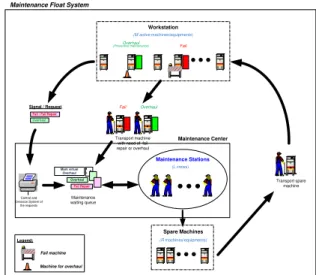
A typical Maintenance Float System is composed of a workstation, a maintenance center with a set of maintenance crews to perform overhauls and repair actions and a set of spare machines (Fig.1). The workstation consists of a set of identical machines and the repair center of a limited number of maintenance crews and a limited number of spare machines. However, the model we have adopted, being a typical MFS, presents certain specificities both as far as the philosophy of the maintenance waiting queues are concerned, and related to the management of the maintenance crews.
Fig. 1 –Typical Maintenance Float System
This model follows the one proposed and developed by (Lopes 2005; Lopes et al. 2006; Lopes et al. 2007), considering M active machines, R independent and identical spare machines and L maintenance crews The active machines considered operate continuously.
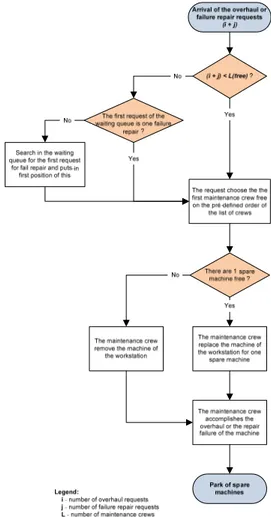
Machines that fail are taken from the workstation and sent to the maintenance park waiting queue, where they will be assisted according to arrival time (Fig.2). Machines that reach their optimal overhaul time are kept in service until the end of a period T without failures. However they will be also kept on a virtual queue to overhaul. If the number of failed machines plus the number of machines requiring overhaul is lower than the number of maintenance crews available, machines are replaced and repaired according to FIFO (First In First Out) rule. Otherwise if it exceeds the number of maintenance crews, the machines will either be replaced (while there are spare machines available) or will be sent to the maintenance queue. The machines that complete a duration period T or time between overhauls in operation without failures are maintained active in the workstation, where they wait to be assisted, and they are replaced when they are retired of the workstation to be submitted to a preventive intervention. Its replacement is assured by the machine that leaves the maintenance center in the immediately previous instant. If an active machine happens to fail it awaits for the accomplishment of an overhaul, then it will be immediately replaced, if a spare machine is available or as soon it is available. (Fig.2)
Fig. 2 - Procedure for the management of requests for
overhaul or failure repair by the maintenance crews
When the failure rate is increasing, the models for calculating the optimal number of spare machines have little interest. In these cases, one must be concerned with the causes rather than on the consequences - the optimal number of standby units, the optimal number of maintenance crews and the optimal time interval between overhauls should be discussed.
When the failure rate is decreasing, and until the system reaches the steady state, it would be premature to plan maintenance - this mainly occurs in the early life of the machines.
Time between failures are assumed as independent and identically distributed following an Exponential
Distribution for all machines (failures occur under a
Homogeneous Poisson Process). However, during a simulation run, this value could be adjusted based on time between overhauls. Obviously a smaller time between overhauls implies greater time between failures.
As far as time to overhaul and time to repair are concerned, we have assumed the Erlang-2 distribution, eventhough considering overhaul time significantly lower than the repair time.
For this MFS, the following parameters and variables are identified:
Parameters
1. Number of active machines (M);
2. Number of maintenance crews (L); 3. Number of spare machines (R); Variables
4. Machine- Overhauls rate (λrev)*;
5. Machine-Initial Failures rate (λf)*;
6. Crews-Repair rate (µrep)*;
7. Crews-Overhaul rate (µrev)*;
8. Failure cost (Cf);
9. Repair cost (Crep);
10. Overhaul cost (Crev);
11. Replacement cost (Cs);
12. Cost due to loss production (Clp);
13. Holding cost per time unit (h); 14. Labour cost per time unit (k);
15. Time to convey and install spare machine
(TConvInst).
(*) This variable can be adjusted during the simulation run.
SIMULATION MODEL
The Arena® simulation language environment was used in the development of the simulation model for this MFS (Kelton 2004; Pidd 1989; Dias 2006 and Pidd 1993).
The steps for the development of the simulation model are presented in the following figure (Fig.3).
Fig. 3 -Steps for simulation model development
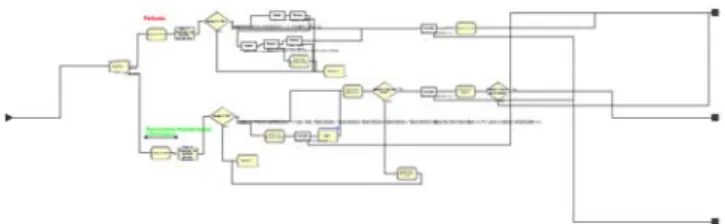
The logical model configuration choice (Fig.4) for the MFS intends to provide a clear global visualization of the undergoing operations and a great flexibility as far as the definition of its basic structure (M, L and R) is concerned.
Fig. 4 - Arena® Logic Model
Figure 4 explicits the global logical simulation model, underlining its different components developed:
1. Active machines (workstation); 2. Statistics 1 (Recording Machines Tup);
3. Maintenance queue;
4. Machines’ transportation (by the maintenance crews);
5. Spare machine request;
6. Maintenance center (set of maintenance Stations);
7. Release machines to the set of spare machines; 8. Statistics 2 (Recording Machines Tup and Tdown);
9. Spare machines (in the start of the system).
The components 1 and 9 include a generation and control system for repair and overhaul requests for each machine (Fig.5).
Workstation (M active machines/equipments)
Control and Emission System of
the requests
Fail Overhaul
Maintenance waiting queue
Spare Machines (R machines/equipments)
Maintenance Stations
(L crews)
Fail machine Machine for overhaul
Legend:
Transport spare machine
(Preventive maintenance)
Fail Overhaul
Fail Repair
Overhaul Mark virtual
Overhaul Signal / Request
Fail / Fail Repair
Overhaul
Maintenance Float System
Maintenance Center Transport machine
Fig. 5 - Generation and control system for repair and overhaul requests
This repair and overhaul generation and control system is implemented for each machine in order to assure total independence of each occurrence of each request.
As far as the overhaul requests are concerned, they were defined according to the following situations:
1) Based on the total number of requests in the waiting queue (repairs and overhauls), there exists, at least, a maintenance crew and a spare machine available;
2) Or, based on the total number of requests in the waiting queue (repairs and overhauls), there is no maintenance crew or spare machine available. In the first situation, the action for overhaul is made immediately and the machine is removed and replaced by the maintenance crew. In the second situation, it is only made a virtual request that is performed only after confirmation. In this case, the machine remains in operation and confirmation will only occur when the system identifies a maintenance crew and a spare machine available.
For all the machines in the system, the repair request has priority over the overhaul request. In this respect it should be emphasized the specific situation where a machine fails, while active but already waiting for an overhaul. In this case the overhaul request is removed and replaced by a repair request. Furthermore, the time between failures will be adjusted according to the overhaul rate.
The waiting queue rule in the maintenance queue is defined in component 3, together with the "control mechanism" which only allows a request to proceed if there is a free maintenance crew (Fig.6).
FIFO (First In First Out) is the rule for the maintenance queue management, except for the case when the total number of maintenance requests (overhauls plus repair actions) exceeds the number of maintenance crews – in this case, machines requiring repair action heve priority over machines requiring overhauls.
Fig. 6 - Maintenance waiting queue
Component 4 is responsible for requesting transportation action for a spare machine while seizing the respective maintenance crew
Component 5 (Fig.7) represents the request of a spare machine, performed by a maintenance crew. If a spare machine is available, the maintenance crew takes and installs the machine, replacing the one requiring maintenance crew action.
Fig. 7 - Request and activation of spare machines
Component 6 distinguishes overhaul actions and repair actions (Fig.8). This will permit to clearly understand whether a maintenance crew is performing one action or the other. This component is also important as to produce true performance measures related to both maintenance operations.
Fig. 8 – Identification and statistics of the states of the
maintenance crew
Component 7 is then responsible for releasing machines under maintenance crew actions, whenever they finish their work, either repairing or performing overhauls. Finally, components 2 and 8 are recording fundamental statistical data to calculate adequate efficiency measures. In fact component 2 is storing operation times for each machine (Time-up), while component 8 is storing down times for each machine, thus estimating and updating performance measures.
Fig. 9 – Record statistics
Fig. 10 – Data intoduction area sample screenshot
Fig. 11 - Variables and graphics control
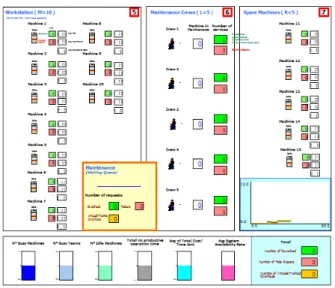
Fig. 12 – Animation area sample screenshot
DISCUSSION
The developed simulation application for a Maintenance Float System allows the estimation of the following global efficiency measures:
a) Average system availability (AvgSAv);
b) Total maintenance cost per time unit (AvgTCu);
However, some other performance measures are also analysed, such as:
c) Average number of missing machines at the workstation (AvgMeq),
d) Average number of machines in the maintenance waiting queue (AvgLq);
e) Average waiting time in the maintenance waiting queue (Avg Wt);
f) Average operating cycle time (AvgD);
g) Probability of existing 1 or more idle Machines
(Probim);
h) Probability of the system being fully active
(Probs);
And, finally, the simulation model also computes some individual efficiency measures per machine or maintenance crew, i.e.,
i) Utilization rate per machine;
j) Utilization rate per maintenance crew;
k) Number of overhauls and repair actions performed per maintenance crew;
l) Average availability per machine.
The MFS decision support system developed model has three major characteristics:
Setting Parameters
This means that the user can interact with the simulation system through the initial introduction of various parameters such as repair rate, overhaul rate, repair cost and others. The user can, this way, evaluate the system possibilities under different operating conditions.
Flexibility
This means that the user can interact with the running simulation system through the modification of various parameters values. The user can, this way, evaluate the system behaviour under different maintenance strategies.
Interactivity
This means that the computer screen continuously display the system status as where as its time evolution allowing a better communication between the model and the user. Indeed, the strong visual aspect offered by the developed model clarifies the actual process inside the system. This allows a better understanding of the different interactions in the model and of the simulation results.
FUTURE DEVELOPMENTS
development of an advanced simulation model, incorporating flexibility. This target would be reached by developing and incorporating new modules in our simulation tool, following past experiences found on literature (Luís S Dias, 2005, 2006 and Vilk, P., 2009, 2010) where the automatic generation of simulation programs enables desired model flexibility, i.e., making the model generating specific simulation programs for specific Maintenance Float Systems. These mentioned future developments also intend to potentiate the known capability of simulation to efficiently communicate with managers and decision makers, even if they are not simulation experts.
REFERENCES
Alam, Fasihul M.; McNaught, Ken R. and Ringrose, Trevor J. (2003), “Developing Simulation Metamodels for a Maintenance Float System”, AMORG, Engineering Systems Department, Cranfield University, RMCS Shrivenham, Swindon SN6 8LA, UK
Chen, M. C. and Tseng, H. Y. (2003), "An approach to design of maintenance float systems," Integrated Manufacturing Systems, vol. 14, pp. 458-467.
Dias, Luis M. S; Rodrigues, A. J. M. Guimarães; Pereira, Guilherme A. B. (2005), An Activity Oriented Visual Modelling Language with Automatic Translation to Different Paradigms, Proceedings of the 19th European Conference On Modelling And Simulation (ECMS 2005), Riga, Letónia. Ed. Yury Mercuryev et al. Junho de 2005. pp. 452-461
Dias, Luis S; Pereira, Guilherme A. B. and Rodrigues, A. J. M. Guimarães (2006), “A Shortlist of the Most ‘Popular’ Discrete Simulation Tools”, ASIM 2006 - 19th Symposium on Simulation Technique. SCS Publishing House. Ed. M. Becker and H. Szczerbicka. Hanover, Alemanha. pp. 159-163.
Dias, Luis S.; Pereira, Guilherme A. B. and Rodrigues, A. J. M. Guimarães (2006), “Activity based modeling with automatic prototype generation of process based arena models”, EMSS 2006 - 2nd European Modeling and Simulation Symposium. Barcelona, Espanha. pp. 287-296 Gupta, V. and Rao, T. (1996), "On the M/G/1 machine interference model with spares," European Journal of Operational Research, vol. 89, pp. 164-171.
Gupta, S. M. (1997), "Machine interference problem with warm spares, server vacations and exhaustive service," Performance Evaluation, vol. 29, pp. 195-211.
Ingalls, Ricki G. (2001), "Introduction to Simulation", in Proceedings of 2001 Winter Simulation Conference, B.A. Peters, J.S. Smith, D.J. Medeiros, and M. W. Rohrer, eds. Kelton, W. David; Sadowski, Randall P. and Strurrok, David T. (2004), "Simulation With Arena", (3rd edition), McGraw-Hill, (1998-2004).
Kuei, C. H. and Madu, C. N. (1994), "Polynomial metamodelling and Taguchi designs in simulation with
application to the maintenance float system," European Journal of Operational, Reseach, vol. 72, pp. 364-375. Lopes, Isabel S. (2007), "Técnicas Quantitativas no Apoio à Decisão em Sistemas de Manutenção", Tese de Doutoramento, Universidade do Minho.
Lopes, Isabel S.; Leitão, Armando L. F. and Pereira, Guilherme A. B. (2005), "Modelo de Custos de Manutenção para um Sistema com M Unidades Idênticas", in C. G.Soares, A. P. Teixeira e P. Antão (eds), Análise e Gestão de Riscos, Segurança e Fiabilidade 2: p 603-620, Lisboa: Edições Salamandra (ISBN 972-689-230-9). Lopes, Isabel S.; Leitão, Armando L. F. and Pereira, Guilherme A. B. (2006), "A Maintenance Float System with Periodic Overhauls", in Guedes Soares & Zio (eds), Safety and Reliability for Managing Risk 1: p 613-618, London: Taylor & Francis Group (ISBN 0-415-41620-5). Madu, C. N. and Kuei, C. H. (1992a), "Group screening and Taguchi design in the optimization of multi-echelon maintenance float simulation metamodels," Computers and Operations Research vol. 19, pp. 95-105.
Madu, C. N. and Kuei, C. H. (1992b), "Simulation metamodels of system availability and optimum spare and repair units," IIE Transactions, vol. 24, pp. 99-104.
Madu, C. N. and Lyeu, P. (1994), "On the use of simulation metamodeling in solving system availability problems," Microelectronics Reliability, vol. 34, pp. 1147-1160.
Madu, I. E. (1999), "Robust regression metamodel for a maintenance float policy," International Journal of Quality & Reliability Management, vol. 16, pp. 433-456.
Mamede, Nuno (1984), "Simulação Digital de Processos", Tese de Mestrado em Engenharia Electrotécnica e de Computadores (Telecomunicações e Computadores), Instituto Superior Técnico.
Pegden, C.D.; Shannon, R. E.and Sadowski, R. P. (1990) "Introduction to Simulation Using SIMAN, McGraw-Hill", New York, USA. v. 2. 1990.
Pidd, Michael (1989), "Computer Modelling for Discrete Simulation", (Editor), Wiley.
Pidd, Michael (1993), "Computer Simulation in Management Science", Third Edition, Wiley.
Rodrigues, Guimarães and Carvalho, Valério (1984), "CAPS - ECSL, Experiência de modelagem e simulação aplicada a um sistema de elevadores", Relatório Técnico, Universidade do Minho.
Rubinstein, Reuven Y. and Melamed, Benjamin (1998), "Modern Simulation and Modeling", Wiley Series in Probability and Statistics, Applied Probability and Statistics Section, A Wiley-Interscience Publication, John Wiley & Sons, INC., ISBN 0- 471-17077-1.
Shankar, G. and Sahani, V. (2003), "Reliability analysis of a maintenance network with repair and preventive maintenance," International Journal of Quality & Reliability Management, vol. 20, pp. 268-280.
Vik, P.; Pereira, G. and Dias, L. (2009), “Software Tools Integration for the Design of Manufacturing Systems”, Proceedings of the Industrial Simulation Conference, Loughborough, eds. Diganta Bhusan Das, Vahid Nassehi and Lipika Deka, pp 127-131
Vik, P.; Dias, L. and Pereira, G. (2010), “Automatic Generation of Computer Models Through the Integration of Production Systems Design Software Tools”. ASMDO2010 - Third International Conference on Multidisciplinary Design Optimization and Applications. Paris (France)
Vik, P.; Dias, L.; Pereira, G. and Oliveira, J. (2010), “Improving Production and Internal Logistics Systems – An Integrated Approach Using CAD and Simulation”. ILS2010 - 3rd International Conference on Information Systems, Logistics and Supply Chain - Creating value through green supply chains. Casablanca (Morocco), April 14-16.
Zeng, A. Z. and Zhang, T. (1997), "A queuing model for designing an optimal three-dimensional maintenance float system", Computers & Operations Research, vol. 24, pp. 85-95.
AUTHOR BIOGRAPHY
FRANCISCO PEITO was born in
1966 in Macedo de Cavaleiros, Portugal. He graduated in Mechanical Engineering-Management of Production in Polytechnic Institute of Porto. He holds an MSc degree Industrial Maintenance in University of Porto. His main research interests are Simulation and Maintenance.
GUILHERME A B PEREIRA was
born in 1961 in Porto, Portugal. He graduated in Industrial Engineering and Management at the University of Minho, Portugal. He holds an MSc degree in Operational Research and a PhD degree in Manufacturing and Mechanical Engineering from the University of Birmingham, UK. His main research interests are Operational Research and Simulation.
ARMANDO LEITÃO was born in
1958 in Porto, Portugal. He graduated in Mechanical Engineering at University of Porto, Portugal. He holds an MSc degree in Production Engineering and a PhD degree in Production Engineering from the University of Birmingham, UK. His
main research interests are Reliability and Quality Maintenance.
LUÍS M S DIAS was born in 1970 in